Mayday!
p. 63 · Read in the full issue
Come In
Mayday!
By Glen Wright
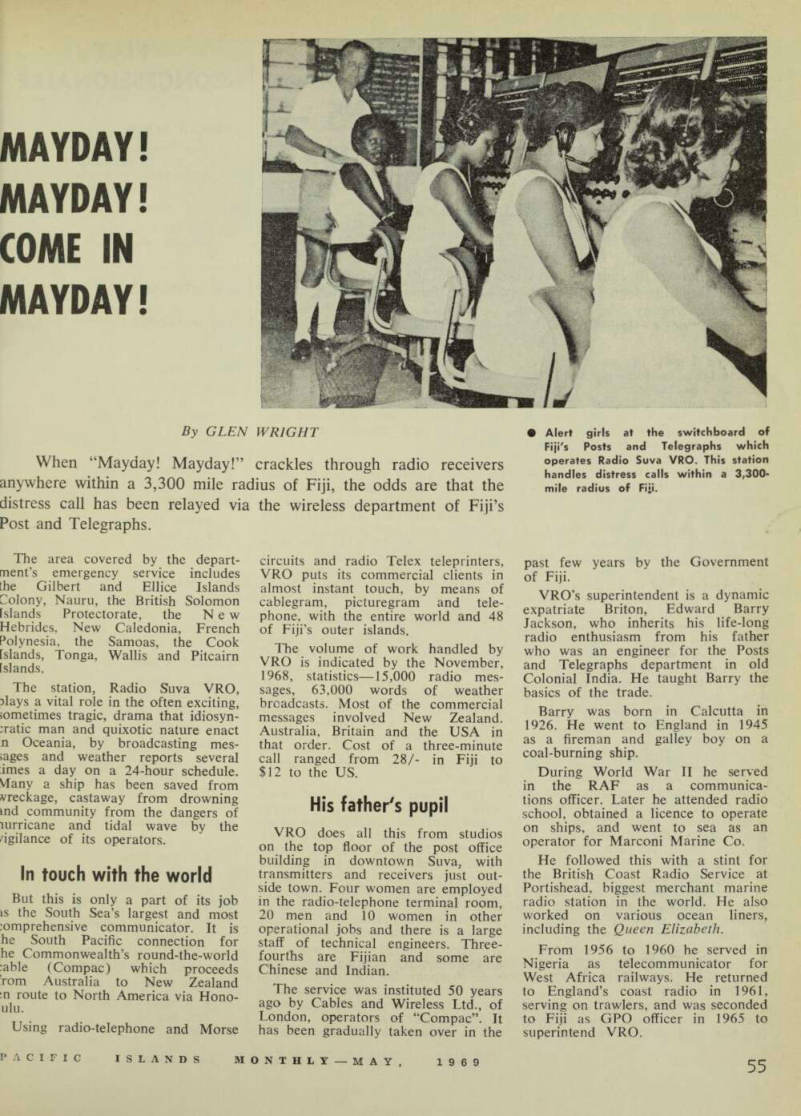
When “Mayday! Mayday!” crackles through radio receivers anywhere within a 3,300 mile radius of Fiji, the odds are that the distress call has been relayed via the wireless department of Fiji’s Post and Telegraphs.
The area covered by the depart ment’s emergency service includes the Gilbert and Ellice Islands Colony, Nauru, the British Solomon islands Protectorate, the New Hebrides, New Caledonia, French Polynesia, the Samoas, the Cook Islands, Tonga, Wallis and Pitcairn islands.
The station, Radio Suva VRO, slays a vital role in the often exciting, sometimes tragic, drama that idiosyn cratic man and quixotic nature enact n Oceania, by broadcasting mes sages and weather reports several imes a day on a 24-hour schedule.
Vlany a ship has been saved from vreckage, castaway from drowning md community from the dangers of mrricane and tidal wave by the dgilance of its operators.
In touch with the world
But this is only a part of its job is the South Sea’s largest and most comprehensive communicator. It is he South Pacific connection for he Commonwealth’s round-the-world cable (Compac) which proceeds Torn Australia to New Zealand ;n route to North America via Hono ulu.
Using radio-telephone and Morse
circuits and radio Telex teleprinters, VRO puts its commercial clients in almost instant touch, by means of cablegram, picturegram and tele phone, with the entire world and 48 of Fiji’s outer islands.
The volume of work handled by VRO is indicated by the November, 1968, statistics—ls,ooo radio mes sages, 63,000 words of weather broadcasts. Most of the commercial messages involved New Zealand.
Australia, Britain and the USA in that order. Cost of a three-minute call ranged from 28/- in Fiji to Sl2 to the US.
His father's pupil
VRO does all this from studios on the top floor of the post office building in downtown Suva, with transmitters and receivers just out side town. Four women are employed in the radio-telephone terminal room, 20 men and 10 women in other operational jobs and there is a large staff of technical engineers. Three fourths are Fijian and some are Chinese and Indian.
The service was instituted 50 years ago by Cables and Wireless Ltd., of London, operators of “Compac”. It has been gradually taken over in the
past few years by the Government of Fiji.
VRO’s superintendent is a dynamic expatriate Briton, Edward Barry Jackson, who inherits his life-long radio enthusiasm from his father who was an engineer for the Posts and Telegraphs department in old Colonial India. He taught Barry the basics of the trade.
Barry was born in Calcutta in 1926. He went to England in 1945 as a fireman and galley boy on a coal-burning ship.
During World War II he served in the RAF as a communica tions officer. Later he attended radio school, obtained a licence to operate on ships, and went to sea as an operator for Marconi Marine Co.
He followed this with a stint for the British Coast Radio Service at Portishead, biggest merchant marine radio station in the world. He also worked on various ocean liners, including the Queen Elizabeth.
From 1956 to 1960 he served in Nigeria as telecommunicator for West Africa railways. He returned to England’s coast radio in 1961, serving on trawlers, and was seconded to Fiji as GPO officer in 1965 to superintend VRO.
Alert girls at the switchboard of Fiji's Posts and Telegraphs which operates Radio Suva VRO. This station handles distress calls within a 3,300mile radius of Fiji.