really necessary?
p. 35 · Read in the full issue
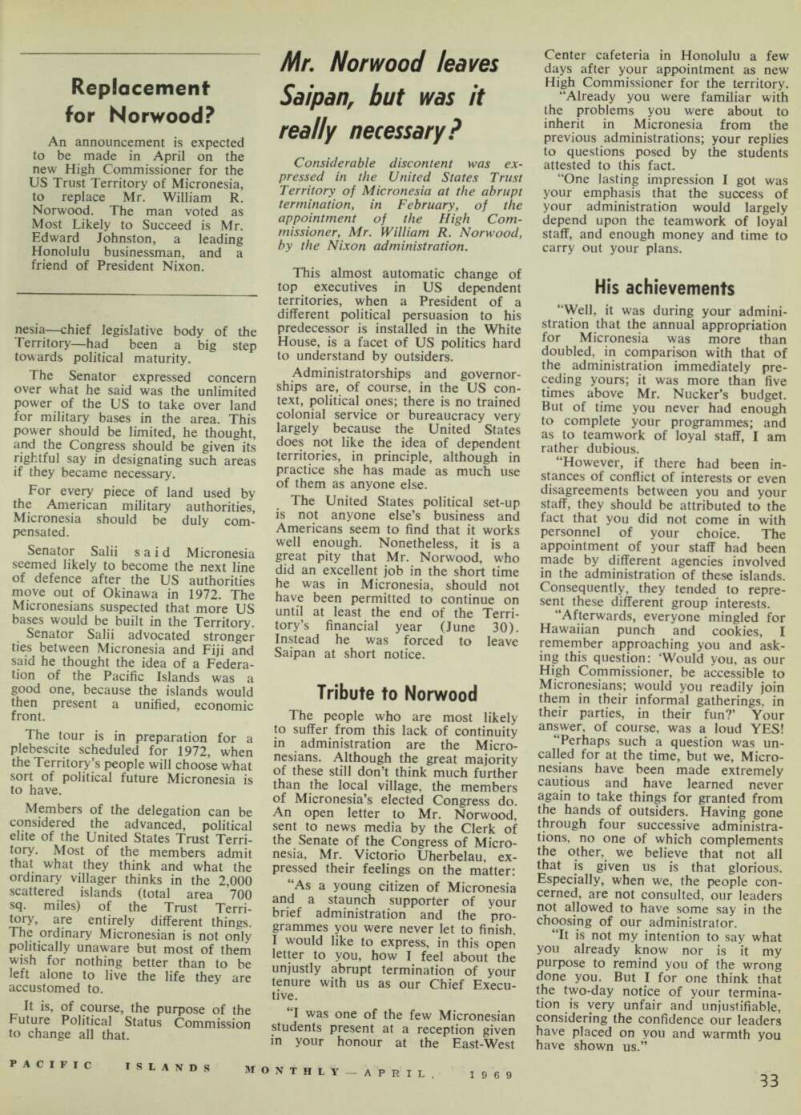
Mr. Norwood leaves Saipan, but was it really necessary?
Considerable discontent was ex pressed in the United States Trust Territory of Micronesia at the abrupt termination, in February, of the appointment of the High Com missioner, Mr. William R. Norwood, by the Nixon administration.
This almost automatic change of top executives in US dependent territories, when a President of a different political persuasion to his predecessor is installed in the White House, is a facet of US politics hard to understand by outsiders.
Administratorships and governor ships are, of course, in the US con text, political ones; there is no trained colonial service or bureaucracy very largely because the United States does not like the idea of dependent territories, in principle, although in practice she has made as much use of them as anyone else.
The United States political set-up is not anyone else’s business and Americans seem to find that it works well enough. Nonetheless, it is a great pity that Mr. Norwood, who did an excellent job in the short time he was in Micronesia, should not have been permitted to continue on until at least the end of the Terri tory’s financial year (June 30).
Instead he was forced to leave Saipan at short notice.
Tribute to Norwood
The people who are most likely to suffer from this lack of continuity in administration are the Micro nesians. Although the great majority of these still don’t think much further than the local village, the members of Micronesia’s elected Congress do.
An open letter to Mr. Norwood, sent to news media by the Clerk of the Senate of the Congress of Micro nesia, Mr. Victorio Uherbelau, ex pressed their feelings on the matter: “As a young citizen of Micronesia and a staunch supporter of your brief administration and the pro grammes you were never let to finish, I would like to express, in this open letter to you, how I feel about the unjustly abrupt termination of your tenure with us as our Chief Execu tive.
“I was one of the few Micronesian students present at a reception given in your honour at the East-West
Center cafeteria in Honolulu a few days after your appointment as new High Commissioner for the territory.
“Already you were familiar with the problems you were about to inherit in Micronesia from the previous administrations; your replies to questions posed by the students attested to this fact.
“One lasting impression I got was your emphasis that the success of your administration would largely depend upon the teamwork of loyal staff, and enough money and time to carry out your plans.
His achievements
“Well, it was during your admini stration that the annual appropriation for Micronesia was more than doubled, in comparison with that of the administration immediately pre ceding yours; it was more than five times above Mr. Nucker’s budget.
But of time you never had enough to complete your programmes; and as to teamwork of loyal staff, I am rather dubious.
“However, if there had been in stances of conflict of interests or even disagreements between you and your staff, they should be attributed to the fact that you did not come in with personnel of your choice. The appointment of your staff had been made by different agencies involved in the administration of these islands.
Consequently, they tended to repre sent these different group interests.
“Afterwards, everyone mingled for Hawaiian punch and cookies, I remember approaching you and ask ing this question: ‘Would you, as our High Commissioner, be accessible to Micronesians; would you readily join them in their informal gatherings, in their parties, in their fun?’ Your answer, of course, was a loud YES!
“Perhaps such a question was un called for at the time, but we, Micro nesians have been made extremely cautious and have learned never again to take things for granted from the hands of outsiders. Having gone through four successive administra tions, no one of which complements the other, we believe that not all that is given us is that glorious.
Especially, when we, the people con cerned, are not consulted, our leaders not allowed to have some say in the choosing of our administrator.
“It is not my intention to say what you already know nor is it my purpose to remind you of the wrong done you. But I for one think that the two-day notice of your termina tion is very unfair and unjustifiable, considering the confidence our leaders have placed on you and warmth you have shown us.”