But U.S. Ties
pp. 34-35 · Read in the full issue
Important To
Micronesia
During their two days in Fiji in March members of the touring Congress of Micronesia delegation had a few harsh words to say about what they called the US neglect of the Trust Territory.
Nonetheless, the delegation’s leader predicted that, in any future political arrangement, economic ties and a treaty of friendship with the United States would be an important in~ gredient.
The delegation’s leader is Senator Lazarus E. Salii.
“The United Nations Agreement with the US is that the US will develop the area economically, politically, socially and educationally until it is ready for self-government and independence,” said the Senator.
After 24 years under Trusteeship the area was not anywhere near be ing economically sufficient, he said.
He believed that $l3O million would be needed shortly to provide the basis for real economic development in the area.
In the field of education, however, he thought America had a good record in the Territory. Moreover, the creation of the Congress of Micro
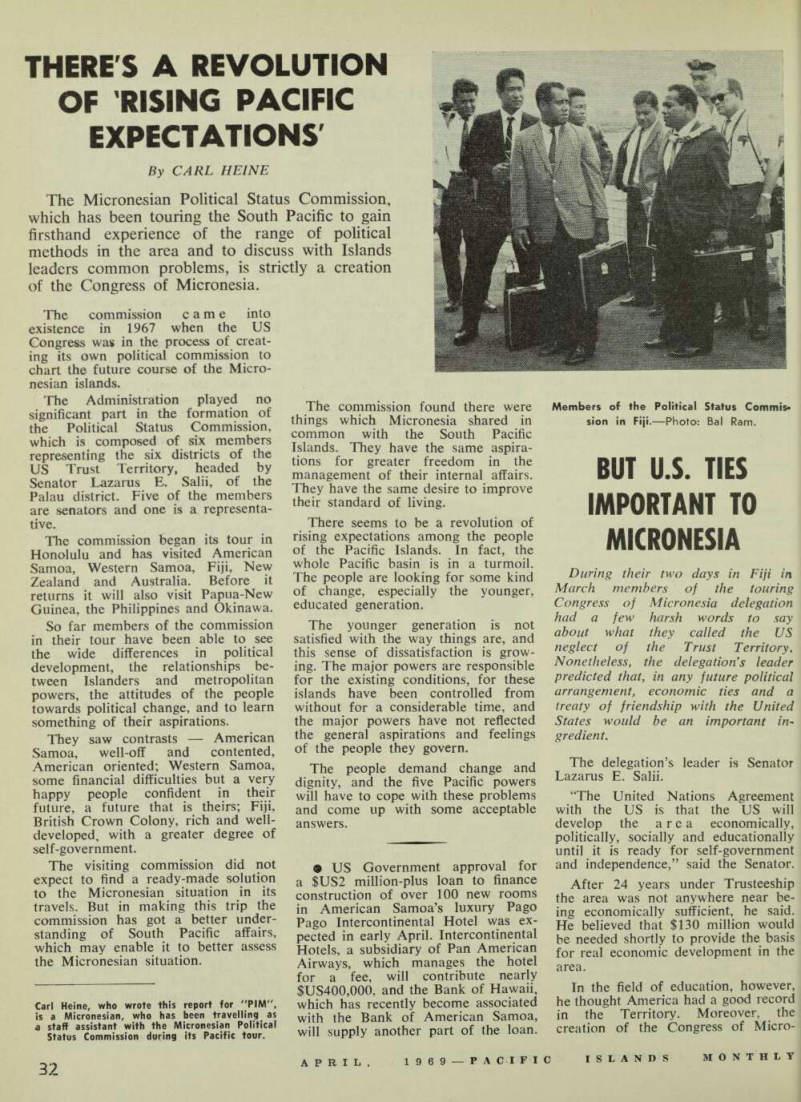
Members of the Political Status Commis sion in Fiji. —Photo: Bal Ram.
nesia—chief legislative body of the Territory—had been a big step towards political maturity.
The Senator expressed concern over what he said was the unlimited power of the US to take over land for military bases in the area. This power should be limited, he thought, and the Congress should be given its rightful say in designating such areas if they became necessary.
For every piece of land used by the American military authorities, Micronesia should be duly com pensated.
Senator Salii said Micronesia seemed likely to become the next line of defence after the US authorities move out of Okinawa in 1972. The Micronesians suspected that more US bases would be built in the Territory.
Senator Salii advocated stronger ties between Micronesia and Fiji and said he thought the idea of a Federa tion of the Pacific Islands was a good one, because the islands would then present a unified, economic front.
The tour is in preparation for a plebescite scheduled for 1972, when the Territory’s people will choose what sort of political future Micronesia is to have.
Members of the delegation can be considered the advanced, political elite of the United States Trust Terri tory. Most of the members admit that what they think and what the ordinary villager thinks in the 2,000 scattered islands (total area 700 sq. miles) of the Trust Terri tory, are entirely different things.
The ordinary Micronesian is not only politically unaware but most of them wish for nothing better than to be left alone to live the life they are accustomed to.
It is, of course, the purpose of the Future Political Status Commission to change all that.