Tropicalities
pp. 36-38 · Read in the full issue
The churches in Papua-New Guinea found themselves on the receiving end of some hard-hitting words from an important visiting minister in March.
The Rev. Victor Hayward, who is associate general secretary of the World Council of Churches arrived in an atmosphere of mild interest, and departed five days later in a blaze of bold headlines.
He went for talks with officials of the Melanesian Council of Churches and other church leaders, his job being, he said, “to foster good rela tions between the WCC and other councils around the world.”
His broadside about church pater nalism and failure in mutual co operation came as a considerable shock to many people.
But it is a measure of the respect Mr. Hayward commanded and pos sibly also of the fair mindedness of territory churchmen that in fact little anger or resentment seems to have been caused.
Mr. Hayward began with a dire warning: unless the churches worked faster to prepare New Guineans for independence, the territory could be come “another Congo”.
Too paternal
At present the churches were “too paternal and protective in their atti tudes to the people”. Not that he is always against paternalism arid pro tectivism —indeed, these are “normal and proper in the early days of mis sion work.” But these “should already have given way to greater mutual recognition and greater political awareness, if the peoples of this great and exciting island are not to go through the agonies of a country like the Congo”.
Mr. Hayward admitted to being im pressed by what he had seen of the work done by the churches for the people of Papua-New Guinea. “But unfortunately I am convinced from the experience of the church in other parts of the world, particularly throughout Africa, that the period in which work can be continued at the present pace and in the present way will be far shorter than most people would like to imagine.”
The unkindest cut of all, however, was reserved for the ecumenical
Broadside Over
Church Role
movement on which territory church men tend to pride themselves—not without reason, either, for mostly they get on well together.
Not well enough, though, in the opinion of Mr. Hayward. “In spite of all their good works,” he said, “the churches here will prove woefully in adequate unless they think, train and serve together in ways which seem far removed from present realities.”
He reckoned that Papua-New Guinea “really needs the ecumenical movement.” He added: “Its present Christian council, the Melanesian Council of Churches, has to operate on a seventh of one man’s time and a minimal budget. In other words, the churches are not yet in business to gether, with the exception of the new United Church.
“Some of them cannot even pray together. And none of them, except possibly the Roman Catholic Church, seems to be looking ahead to the 21st century, now only 30 years away.”
Mr. Hayward was generally ac cepted in New Guinea as a shrewd and penetrating thinker, with long ex perience in the missionary situation —he served in China for 17 years and was general overseas secretary of the Baptist Church in London at the time of the Congo trouble.
In the Australian Parliament on March 4, Dr. M. G. Mackay (Liberal, NSW) drew attention to Mr. Hayward’s New Guinea visit during a debate on defence. He said that Mr. Hayward in New Guinea had been “trying to stir up greater nationalist activities among the churches, castigating his brethren for going too slowly in the direction of independence, and suggesting another Congo if they did not move faster.
The World Council of Churches is increasingly in the grip of those who believe that the overthrow of free enterprise society by revolutionary means is the Christian duty”.
Bulldozed a way
through history
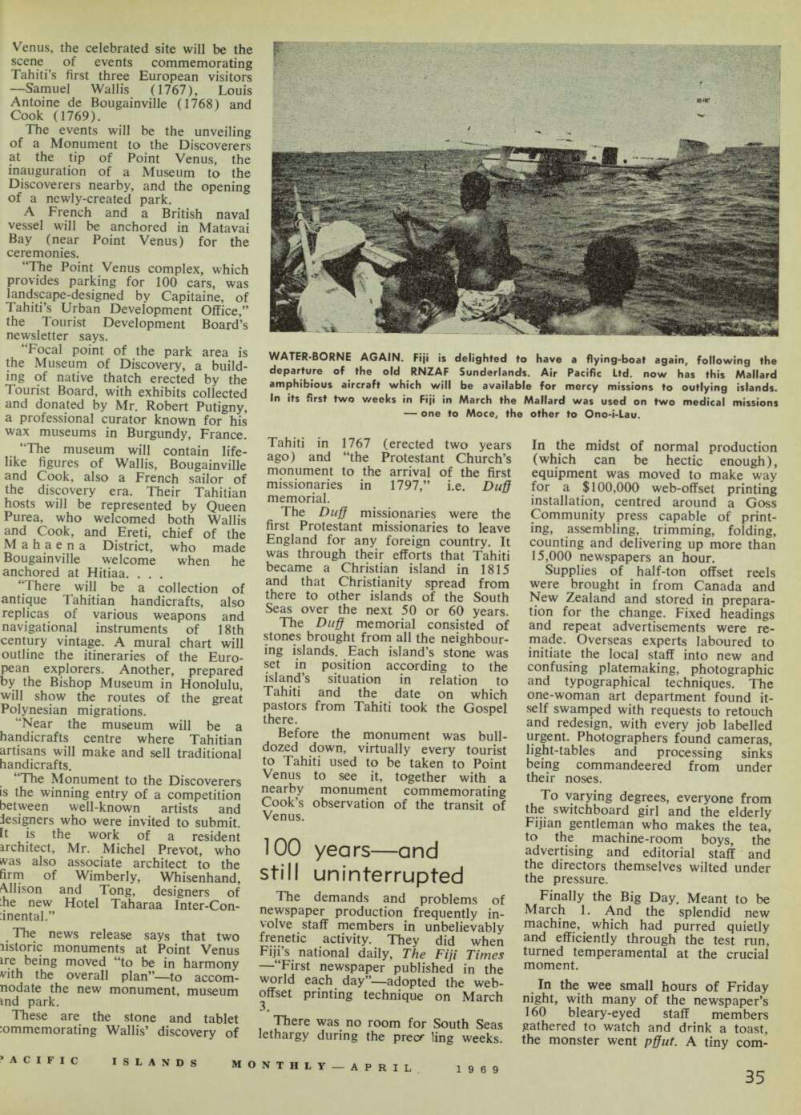
One of the South Pacific’s best-known and most frequently visited monuments, the Duff memorial at Point Venus, Tahiti, was destroyed by a bulldozer in late February. The memorial was erected in 1956 to commemorate the arrival in Tahiti in 1797 of the first protestant missionaries in the 267-ton ship Duff.
Tahiti’s Protestant community was staggered and intensely indignant on hearing news of the monument’s destruction, but could not immed iately determine how the incident had occurred.
It was said on the one hand that only vandals could have been respon sible. On the other, it was suggested that a buldozer driver, working for the Tahiti Tourist Development Board on the beautification of the Point Venus area, had misunderstood his instructions.
It appears, however, that the Tourist Development Board had, in fact, intended to knock the monu ment down and re-erect it else where. But it had not told the owners of the monument, the Eglise Evangelique de Polynesie Francaise.
A news release issued by the Tourist Development Board recently says that on April 12 this year, exactly 200 years after Captain James Cook landed at Point Venus to observe the transit of the planet
The "Duff" memorial.
Venus, the celebrated site will be the scene of events commemorating Tahiti’s first three European visitors —Samuel Wallis (1767), Louis Antoine de Bougainville (1768) and Cook (1769).
The events will be the unveiling of a Monument to the Discoverers at the tip of Point Venus, the inauguration of a Museum to the Discoverers nearby, and the opening of a newly-created park.
A French and a British naval vessel will be anchored in Matavai Bay (near Point Venus) for the ceremonies.
“The Point Venus complex, which provides parking for 100 cars, was landscape-designed by Capitaine, of Tahiti’s Urban Development Office,” the Tourist Development Board’s newsletter says.
“Focal point of the park area is the Museum of Discovery, a build ing of native thatch erected by the Tourist Board, with exhibits collected and donated by Mr. Robert Putigny, a professional curator known for his wax museums in Burgundy, France.
“The museum will contain life like figures of Wallis, Bougainville and Cook, also a French sailor of the discovery era. Their Tahitian hosts will be represented by Queen Purea, who welcomed both Wallis and Cook, and Ereti, chief of the Maha e n a District, who made Bougainville welcome when he anchored at Hitiaa. . . .
“There will be a collection of antique Tahitian handicrafts, also replicas of various weapons and navigational instruments of 18th century vintage. A mural chart will outline the itineraries of the Euro pean explorers. Another, prepared by the Bishop Museum in Honolulu, will show the routes of the great Polynesian migrations.
“Near the museum will be a handicrafts centre where Tahitian artisans will make and sell traditional handicrafts.
“The Monument to the Discoverers is the winning entry of a competition between well-known artists and lesigners who were invited to submit, ft is the work of a resident architect, Mr. Michel Prevot, who was also associate architect to the firm of Wimberly, Whisenhand, Allison and Tong, designers of ; he new Hotel Taharaa Inter-Con inental.”
The news release says that two listoric monuments at Point Venus ire being moved “to be in harmony vith the overall plan”—to accom nodate the new monument, museum md park.
These are the stone and tablet :ommemorating Wallis’ discovery of
Tahiti in 1767 (erected two years ago) and “the Protestant Church’s monument to the arrival of the first missionaries in 1797,” i.e. Duff memorial.
The Duff missionaries were the first Protestant missionaries to leave England for any foreign country. It was through their efforts that Tahiti became a Christian island in 1815 and that Christianity spread from there to other islands of the South Seas over the next 50 or 60 years.
The Duff memorial consisted of stones brought from all the neighbour ing islands. Each island’s stone was set in position according to the island’s situation in relation to Tahiti and the date on which pastors from Tahiti took the Gospel there.
Before the monument was bull dozed down, virtually every tourist to Tahiti used to be taken to Point Venus to see it, together with a nearby monument commemorating Cook’s observation of the transit of Venus.
100 years—and
still uninterrupted
The demands and problems of newspaper production frequently in volve staff members in unbelievably frenetic activity. They did when Fiji’s national daily, The Fiji Times —“First newspaper published in the world each day”—adopted the web offset printing technique on March There was no room for South Seas lethargy during the precf ling weeks.
In the midst of normal production (which can be hectic enough), equipment was moved to make way for a $lOO,OOO web-offset printing installation, centred around a Goss Community press capable of print ing, assembling, trimming, folding, counting and delivering up more than 15,000 newspapers an hour.
Supplies of half-ton offset reels were brought in from Canada and New Zealand and stored in prepara tion for the change. Fixed headings and repeat advertisements were re made. Overseas experts laboured to initiate the local staff into new and confusing platemaking, photographic and typographical techniques. The one-woman art department found it self swamped with requests to retouch and redesign, with every job labelled urgent. Photographers found cameras, light-tables and processing sinks being commandeered from under their noses.
To varying degrees, everyone from the switchboard girl and the elderly Fijian gentleman who makes the tea, to the machine-room boys, the advertising and editorial staff and the directors themselves wilted under the pressure.
Finally the Big Day. Meant to be March 1. And the splendid new machine, which had purred quietly and efficiently through the test run, turned temperamental at the crucial moment.
In the wee small hours of Friday night, with many of the newspaper’s 160 bleary-eyed staff members gathered to watch and drink a toast, the monster went pffut. A tiny com
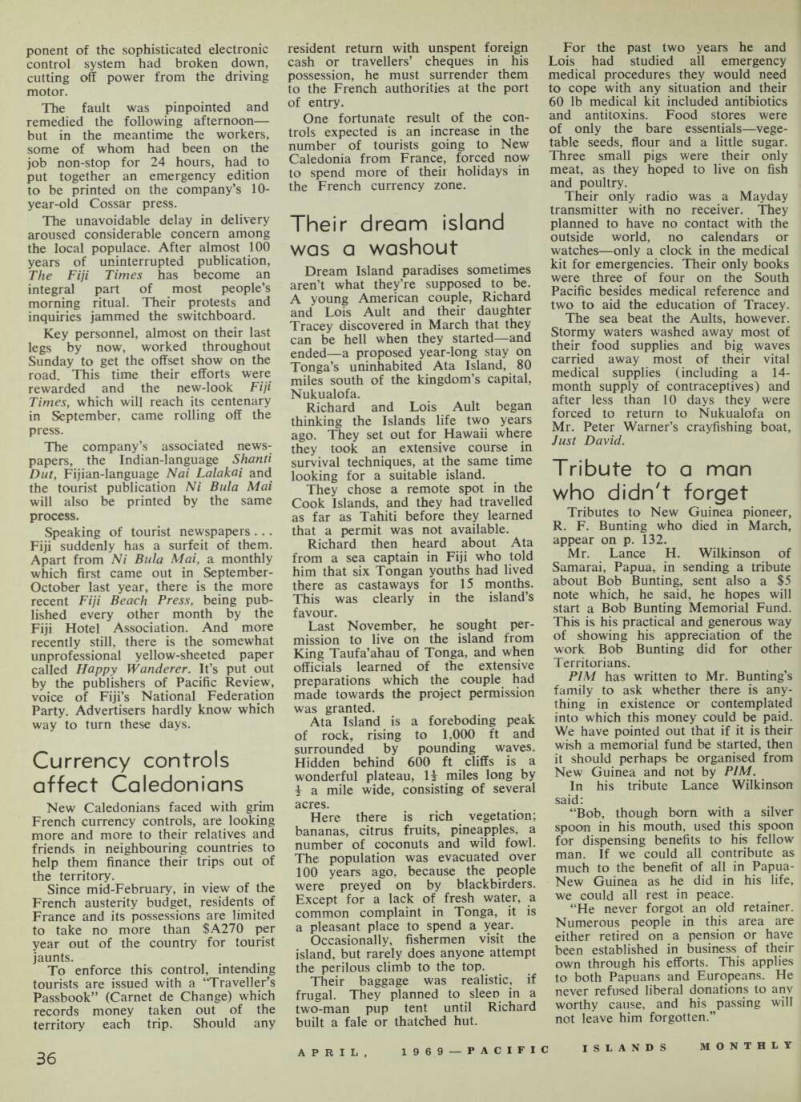
WATER-BORNE AGAIN. Fiji is delighted to have a flying-boat again, following the departure of the old RNZAF Sunderlands. Air Pacific Ltd. now has this Mallard amphibious aircraft which will be available for mercy missions to outlying islands.
In its first two weeks in Fiji in March the Mallard was used on two medical missions -one to Moce, the other to Ono-i-Lau.
ponent of the sophisticated electronic control system had broken down, cutting off power from the driving motor.
The fault was pinpointed and remedied the following afternoon — but in the meantime the workers, some of whom had been on the job non-stop for 24 hours, had to put together an emergency edition to be printed on the company’s 10year-old Cossar press.
The unavoidable delay in delivery aroused considerable concern among the local populace. After almost 100 years of uninterrupted publication, The Fiji Times has become an integral part of most people’s morning ritual. Their protests and inquiries jammed the switchboard.
Key personnel, almost on their last legs by now, worked throughout Sunday to get the offset show on the road. This time their efforts were rewarded and the new-look Fiji Times, which will reach its centenary in September, came rolling off the press.
The company’s associated news papers, the Indian-language Shanti Dut, Fijian-language Nai Lalakai and the tourist publication Ni Bula Mai will also be printed by the same process.
Speaking of tourist newspapers . ..
Fiji suddenly has a surfeit of them.
Apart from Ni Bula Mai, a monthly which first came out in September- October last year, there is the more recent Fiji Beach Press, being pub lished every other month by the Fiji Hotel Association. And more recently still, there is the somewhat unprofessional yellow-sheeted paper called Happy Wanderer. It’s put out by the publishers of Pacific Review, voice of Fiji’s National Federation Party. Advertisers hardly know which way to turn these days.
Currency controls
affect Caledonians
New Caledonians faced with grim French currency controls, are looking more and more to their relatives and friends in neighbouring countries to help them finance their trips out of the territory.
Since mid-February, in view of the French austerity budget, residents of France and its possessions are limited to take no more than SA27O per year out of the country for tourist jaunts.
To enforce this control, intending tourists are issued with a “Traveller’s Passbook” (Carnet de Change) which records money taken out of the territory each trip. Should any
resident return with unspent foreign cash or travellers’ cheques in his possession, he must surrender them to the French authorities at the port of entry.
One fortunate result of the con trols expected is an increase in the number of tourists going to New Caledonia from France, forced now to spend more of their holidays in the French currency zone.
Their dream island
was a washout Dream Island paradises sometimes aren’t what they’re supposed to be.
A young American couple, Richard and Lois Ault and their daughter Tracey discovered in March that they can be hell when they started—and ended —a proposed year-long stay on Tonga’s uninhabited Ata Island, 80 miles south of the kingdom’s capital, Nukualofa.
Richard and Lois Ault began thinking the Islands life two years ago. They set out for Hawaii where they took an extensive course in survival techniques, at the same time looking for a suitable island.
They chose a remote spot in the Cook Islands, and they had travelled as far as Tahiti before they learned that a permit was not available.
Richard then heard about Ata from a sea captain in Fiji who told him that six Tongan youths had lived there as castaways for 15 months.
This was clearly in the island’s favour.
Last November, he sought per mission to live on the island from King Taufa’ahau of Tonga, and when officials learned of the extensive preparations which the couple had made towards the project permission was granted.
Ata Island is a foreboding peak of rock, rising to 1,000 ft and surrounded by pounding waves.
Hidden behind 600 ft cliffs is a wonderful plateau, li miles long by i a mile wide, consisting of several acres.
Here there is rich vegetation; bananas, citrus fruits, pineapples, a number of coconuts and wild fowl.
The population was evacuated over 100 years ago, because the people were preyed on by blackbirders.
Except for a lack of fresh water, a common complaint in Tonga, it is a pleasant place to spend a year.
Occasionally, fishermen visit the island, but rarely does anyone attempt the perilous climb to the top.
Their baggage was realistic, if frugal. They planned to sleeo in a two-man pup tent until Richard built a fale or thatched hut.
For the past two years he and Lois had studied all emergency medical procedures they would need to cope with any situation and their 60 lb medical kit included antibiotics and antitoxins. Food stores were of only the bare essentials—vege table seeds, flour and a little sugar.
Three small pigs were their only meat, as they hoped to live on fish and poultry.
Their only radio was a Mayday transmitter with no receiver. They planned to have no contact with the outside world, no calendars or watches—only a clock in the medical kit for emergencies. Their only books were three of four on the South Pacific besides medical reference and two to aid the education of Tracey.
The sea beat the Aults, however.
Stormy waters washed away most of their food supplies and big waves carried away most of their vital medical supplies (including a 14month supply of contraceptives) and after less than 10 days they were forced to return to Nukualofa on Mr. Peter Warner’s crayfishing boat, Just David.
Tribute to a man
who didn't forget
Tributes to New Guinea pioneer, R. F. Bunting who died in March, appear on p. 132.
Mr. Lance H. Wilkinson of Samarai, Papua, in sending a tribute about Bob Bunting, sent also a $5 note which, he said, he hopes will start a Bob Bunting Memorial Fund.
This is his practical and generous way of showing his appreciation of the work Bob Bunting did for other Territorians.
PIM has written to Mr. Bunting’s family to ask whether there is any thing in existence or contemplated into which this money could be paid.
We have pointed out that if it is their wish a memorial fund be started, then it should perhaps be organised from New Guinea and not by PIM.
In his tribute Lance Wilkinson said: “Bob, though bom with a silver spoon in his mouth, used this spoon for dispensing benefits to his fellow man. If we could all contribute as much to the benefit of all in Papua- New Guinea as he did in his life, we could all rest in peace.
“He never forgot an old retainer.
Numerous people in this area are either retired on a pension or have been established in business of their own through his efforts. This applies to both Papuans and Europeans. He never refused liberal donations to any worthy cause, and his passing will not leave him forgotten.”