not enough tradition,
pp. 65-66 · Read in the full issue
Too much showbiz, not enough tradition, in Cook Islands
Says BETH DEAN, writing especially for PIM.
The old men on Rarotonga, Cook Islands, say that at the beginning of time Rarotonga, which was the “number two Hawaiki” (Hawaiki is the legendary home of the Polynesians), lay close to Raiatea, the “number one Hawaiki”.
Today Rarotonga is more than 700 miles to the south-west of Rarotonga. Naturally enough a legend surrounds this geographical upset.
In the beginning of time, so the legend goes, the Polynesian people did not know how to dance. How ever, the people were happy and they sang.
Then the people on Rarotonga made a drum from a split hollow log. The rhythm of the drum, as it accompanied the Cook Islanders’ singing, was infectious and the people began to sway and move their bodies in dance. So pleased were the three mighty gods of Polynesia (Tangaroa, Atua ’Oro and Tutavake) to see all this that they suggested that Raro tonga and Raiatea (where dancing had been discovered, though without the help of a drum) should have a dancing competition.
The gods acted as judges. Raro tonga won the competition and the people of Raiatea were very upset.
Although the Rarotongans were
pleased to have won, they were sorry to see the Raiateans so uphappy. They felt that possibly their drum had given them an advantage. th made another d a ß nd , h sen( it with a de l e gation to R a i a t e a 5 * Rut the people of Raiatea met the Rarotongans with angry words, and they attacked and killed them. This made the three gods very angry and they moved Rarotonga down south” (Rarotonga means ‘‘down south”), . ther , e > “ everybody knows, it remains to tms day.
This is just one of the legends of
the colourful Cooks. There are dozens more, many of which are enacted in dance form. For instance the legend of Ru, the man who made a long and perilous journey by canoe to find Aitutaki, is known and acted out by every child dancer on Aitutaki.
Other legends tell of the long voy ages of Polynesian leaders such as Toi, who built the famous road that goes right round Rarotonga, and Te-Marau, who came from Tahiti and Raiatea to settle in Rarotonga.
Movements of the Islands
Then there was Tangiia, who, after many daring exploits, made himself Ariki of Tahiti and then took his people and settled on the eastern side of Rarotonga, which is still called Ngatangiia.
In their traditional dances the Polynesians depict the movements and sounds of the Islands the flow of the tides, the roar of the dis tant surf breaking on the reefs, the wind sighing in the trees and the gracious sway of the tall palms Yet among the different groups scattered about the vast triangle of
Cook Islands dancers perform at last year's Constitution Day cele brations.
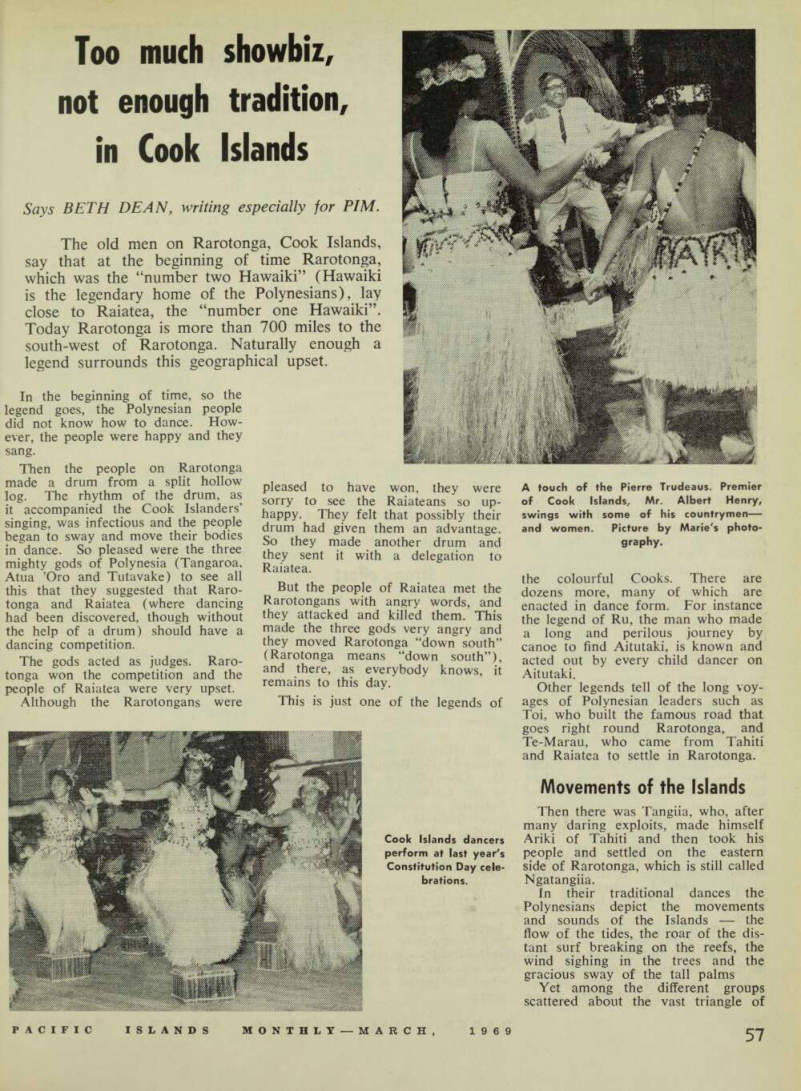
A touch of the Pierre Trudeaus. Premier of Cook Islands, Mr. Albert Henry, swings with some of his countrymen— and women. Picture by Marie's photo
graphy.
Polynesia there are quite different dance styles.
Hawaii emphasises story telling, with eloquent hand movements. In New Zealand there is the skilful tracery of the whirling poi balls, the Haka posture dances, the rather stylised action songs and the stamp ing and leaping war dances. Tahiti goes in for acrobatic hips and has recently begun to set up competitive performances that seem intent on rivalling those of nightclubs.
In the Cooks there are still old dance styles such as those of Mangaia, Atiu and Manihiki all of them links with a long history. And this is how Islands dancing should be.
But there are young dancers in the Cooks who do not discrimin ate between showbusiness and art.
These dancers should be guided by art based on indigenous ideas rather than be influenced by outside cul tures or by a yen for an easy beat on the guitar.
Cook Islands dramas and dances have become more and more stylised until now they are mere symbols of a once great art memorials to the dance dramas of the Areoi people, those professional choreo graphers-cum-entertainers of yore who, like Europe’s troubadors, moved from village to village, from island to island, entertaining the people and being fed, housed and feted.
In the process of stylisation there has crept in the army drill type of movement that has become the hall mark of the Aitutaki dance troupes.
There could be a deep process of renewal if the excellent dance
ABOUT THE AUTHOR: Beth Dean is dance critic of the "Sydney Morning Herald". She has written three books on dancing — "Dust for the Dancers" (Australian Aboriginal), "Softly Wild Drums" (New Guinea), and "The Many Worlds of Dance". She has also written a novel, "Naked We Are Born". She choreographed "Cor roboree" for the Queen's first visit to Australia in 1954. In 1968 she represented Australia at the Cultural Olympics in Mexico City, and she won a Gold Medal — Australia's first for culture — for producing an aboriginal ballet, "Kukaitcha". On her way back from Mexico she spent six weeks on Rarotonga with her husband, during which time she re searched material for this article.
Beth Dean and her husband are to return to the Cooks in June this year to instigate a programme of research into traditional Cook Island dancing.
technicians of Aitutaki were to in ject their past into the experiences of today. As dancers they must re turn to the ideas and dramas of the Islands that show them as a distinct people.
Today, alas, vast numbers of fast drum dances are replacing the beauty and lyricism even of the recent past.
During our first visit to the Cooks in 1962 my husband filmed and re corded the beautiful Una Koe, the lovely Taku Manu E, and the song of the giant, Ona Kura. But these three had been discarded by the time we returned to the Cooks in 1968.
This time there was a sign of show business about the dancing and singing.
It would be a real pity if the beauty and the loveliness of the Cook Islands dances were to be lost forever; if they were to continue along the showbusiness path.
Though no one can suggest that all new dance forms should be dis carded, it must be said that the show business trend is dangerous.
Nightclub numbers are infiltrat ing Rarotonga, and nudity, Euro pean instruments and European styles of dance are used. Kerosene tins are banged with such abandon that they drown the mellow tones of the classic patu drums. The wood for these old drums was lovingly chosen, then carved and shaped. How horrible to see these drums being replaced with garbage tins!
Strong effort
A strong effort must be made to collect from the older people of the Cooks the stories of the legendary leaders, those great chiefs who sailed the vast Pacific to populate the Cooks. An attempt must be made now to preserve the ancient music and style of dance of the Cooks.
These must be taught to future gen erations so that they will have pride in their own culture.
In 1968 my husband and I had talks with the Premier of the Cooks, Mr. Albert Henry, about our going to the Cooks Islands this year to instigate a programme of research into traditional Cook Isla n d s’ dancing. Mr. Henry strongly sup ports any programme that will pre serve the great heritage of his people.
After a thorough and lengthy research it will be possible to pre pare a company of Cook Islands’ dancers, singers and musicians to grve completely authentic but professional performances for the visitors who will flock to the Cooks when the jetport is opened at Raro tonga.