tall, genial and keen-eyed
pp. 69-73 · Read in the full issue
Bob Hunter, island specialist, is tall, genial and keen-eyed
From SUE WENDT, in Suva Fiji is full of whirlwind Americans these days. Not the least zealous of them is youthful Bob Hunter, of Seattle, whose recent $340,000 purchase of Wakaya Island was something of a coup in the intriguing business of buying and selling islands.
It was a pretty impressive purchase price, considering that 11 years ago the Fijian Affairs Board paid only $90,000 for the island. It was bought then from Mr. and Mrs. R. V. O.
Bentley and has been administered since as a copra estate, with Ratu Sir Kamisese Mara, the Chief Min ister, and Ratu Edward Cakobau as trustees, for “the broad benefit and advancement of the Fijian people.”
Wait another 11 years though, says Bob Hunter—tall, genial, with keen blue eyes—and the value of Wakaya will soar by as much again if Fiji continues to capture the in terest of clients he likes to term “affluent” rather than wealthy (“I don’t like the term ‘wealthy Ameri cans’ ”).
Soon after his first visit to Fiji three years ago, the energetically
acquisitive Mr. Hunter bought two Vanua Levu copra plantations.
In January, on behalf of a new Fiji corporation called Wailolo Ltd. —consisting of himself, another American and a Canadian —he bought a 1,200-acre tract on Koro Island from the founder of Air Pacific Ltd., Mr. Pat Macassey, and another Fiji identity, Mr, Jock Baker.
Now, having acquired Wakaya for an unnamed company to be incor porated in Fiji, with himself as one of the principals, Bob Hunter will spend most of his time in the Islands —that is, when he’s not jet-setting about in his role of real estate broker extraordinaire.
Over coffee at the Suva Travel lodge, where he’s taken a permanent suite, he worked out that he’d
travelled some 150,000 miles in 1968—“ nine trips to Fiji alone!”
He estimates that in a year he handles anywhere between $3 million and $5 million worth of property transactions, always islands and water front tracts, with much of his recent business having been done in Aus tralia and New Zealand.
"Quite affluent" clients
He has, he says, about 500 “quite affluent” clients, many of whom allow him to buy property on their behalf without ever having seen it themselves.
“On the whole it’s a conservative, staid, at the same time adventurous clientele—mostly Americans and Canadians looking for property in vestment with a touch of romance,” he said.
His plans for historically-significant Wakaya—it was the scene of the capture of the famous sea raider, Count Graf von Luckner, in Sep tember, 1917, and it is also recorded in Captain Bligh’s log book—are indefinite. It may become a holiday resort-residential complex, he said— “not super exclusive, but somewhat exclusive.”
The Koro Island tract will be divided into 10-acre sites so that
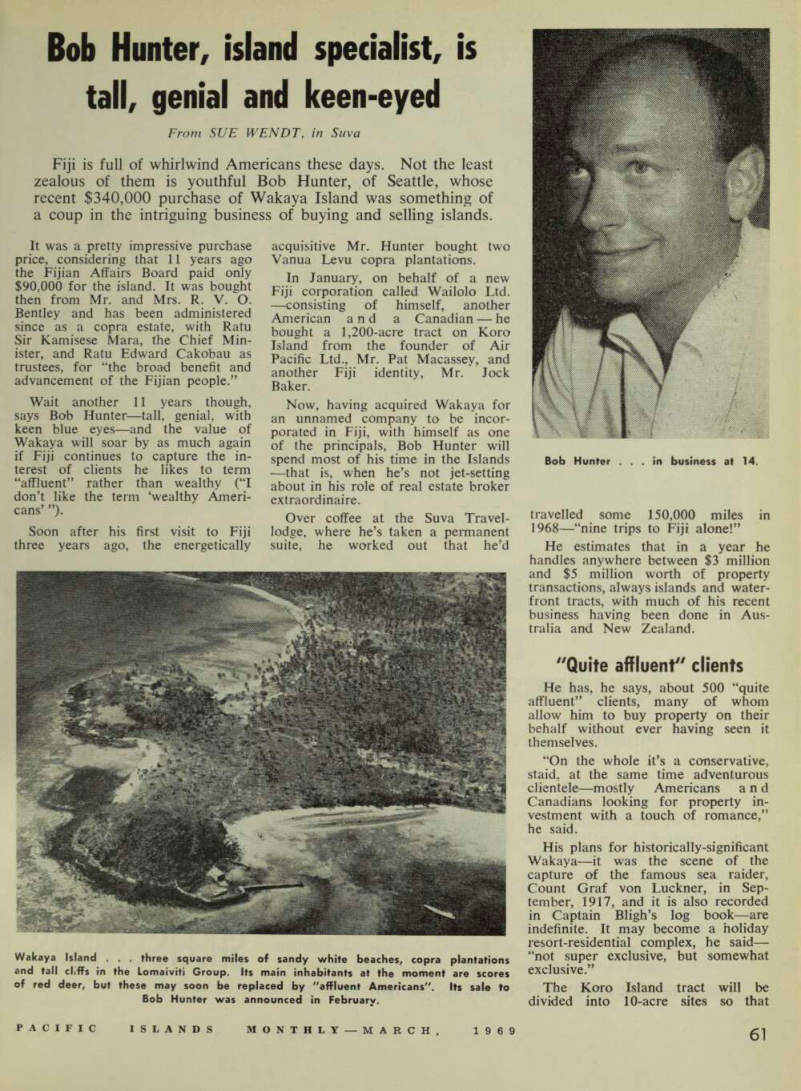
Wakaya Island . . . three square miles of sandy white beaches, copra plantations and tall cl.ffs in the Lomaiviti Group. Its main inhabitants at the moment are scores of red deer, but these may soon be replaced by "affluent Americans". Its sale to Bob Hunter was announced in February.
Bob Hunter ... in business at 14.
Other Fiji projects
“people can buy their own South Pacific coconut plantations and live on fresh seafood and vegetables.”
Bob Hunter’s first commercial venture was at the age of 14, when he and a cousin cottoned onto the idea of cutting and selling Christmas trees. They used their first $3OO of profit as down-payment on some land near Seattle and by the time he was 20, they owned 1,000 acres between them. They were also ship ping close to a quarter of a million Christmas trees from Seattle into California each year.
After managing an oyster farm, then a dairy property, he attended the Seattle Pacific College, majoring in political science and business ad ministration.
“I thought of law at one stage, but I’ve always been so land consci ous that it seemed natural after college to go into real estate,” he said. His company, Robert H.
Hunter Estates, has an office in Seattle and another in Duncan, British Colombia.
Not half-hearted
His aim is to establish a Fiji based real estate brokerage, operat ing throughout the entire South Pacific “I’m interested in terri tories like the Gilberts and the Marshalls”—but he’s enthusiastic, too, about several other Fiji projects. They include setting up a plantation man agement operation, to be conducted on a scientific basis. As a start, he’s bought two tractors.
His first Fiji acquisitions—the copra plantations on Vanua Levu— were made, explains Bob Hunter, be cause he wanted to “become in volved” in the area before setting up as a property broker. No one could accuse him of being half hearted about his involvement.
Meanwhile, Liberal Party leader Dr. L. Verrier has questioned the legality of allowing Wakaya Island to be sold out of Fijian hands.
Broaching the matter in the Legis lative Council, Dr. Verrier said that relatives of the Tui Wakaya were distressed about the sale and claimed they had received assurances that arrangements would be made for them to return to Wakaya, which their people had been forced to leave some 120 years ago. He asked the government to reconsider the sale.
In reply, the Chief Minister, Sir
Queen petitioned
Ratu Kamisese Mara, said the gov ernment had nothing to do with the sale. He said he could not remember giving a statement on behalf of the Fijian Affairs Board that the island would not be sold.
Undaunted, Dr. Verrier then sent a lengthy cable to the Queen asking her to intervene: It read: “On behalf of the Fijian people of Wakaya Island, I humbly and re spectfully implore Her Majesty’s in tervention in monstrous purported sale of island freehold to foreign interests in spite of Fijian Affairs Board’s written undertaking not to sell.
“Unadvertised negotiations would dispose of recently regained freehold at one-tenth of its value. King of Wakaya and his people humbly look to the Throne for redress.”
Commenting on Dr. Verrier’s claims, a spokesman for the Fijian Affairs Board said that no such title as the Tui Wakaya exists or ever has existed.
No right
“The people who claim to be descended from the survivors of the Wakaya war in 1852 have no more right to the island than any other Fijians who claim to be descended from the original owners of land that is now freehold,” he said.
The spokesman said the first record of a sale of Wakaya, con tained in a letter written by David Whippy and printed in the Wilkes’ expedition records, showed that the island was sold by Tui Levuka in 1840 to Captain Houghton of the Currency Lass.
Twelve years later Tui Levuka drove the Wakaya people from the island. Many died by leaping over the cliff and the survivors settled in Koro.
In November, 1857, after the island had been unoccupied for five years, Tui Levuka sold it to Isaac Brower and Robert Swanston.
Cakobau objected to the sale, saying the island belonged to him, and the missionary Fordham wrote a letter on his behalf to the American Consul, threatening to oppose the sale when the next British warship visited the group. There is no other record of his objection.
The spokesman said the Lands Claims Commission investigated the sale and had no hesitation in declar ing it to be a lawful sale. They recommended the issue of a grant and the papers are in claim 393.