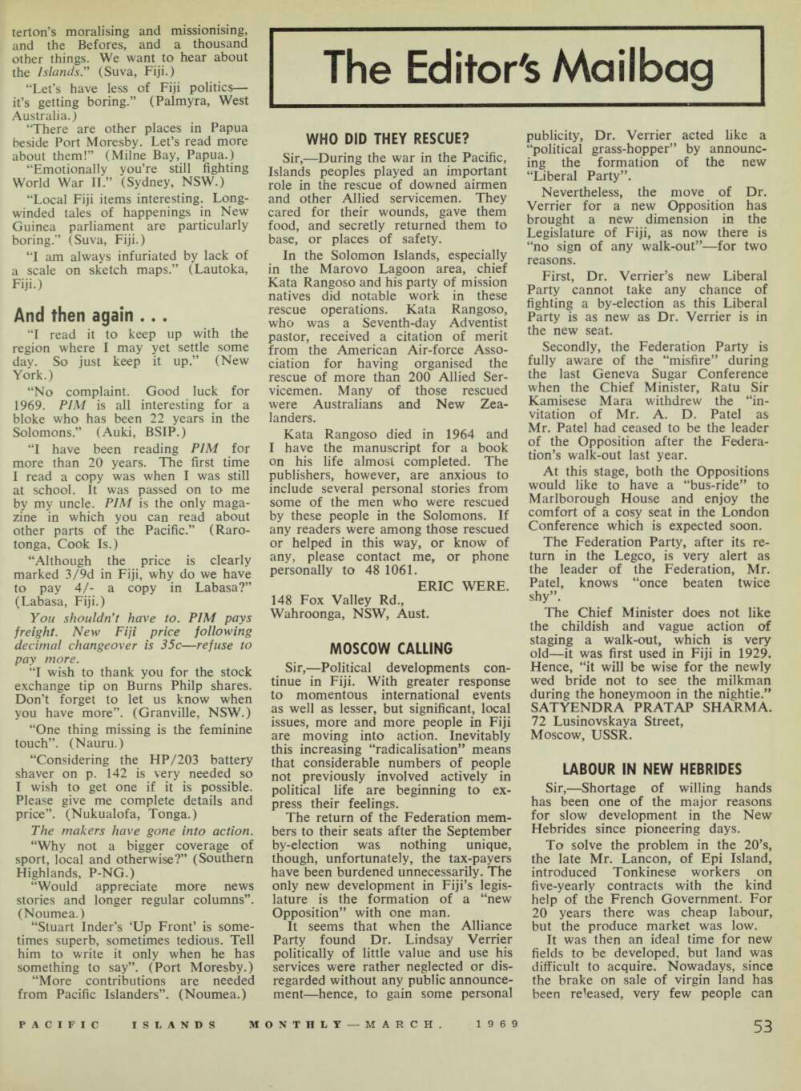
The Editor's Mailbag
pp. 59-61 · Read in the full issue
Who Did They Rescue?
Sir, —During the war in the Pacific, Islands peoples played an important role in the rescue of downed airmen and other Allied servicemen. They cared for their wounds, gave them food, and secretly returned them to base, or places of safety.
In the Solomon Islands, especially in the Marovo Lagoon area, chief Kata Rangoso and his party of mission natives did notable work in these rescue operations. Kata Rangoso, who was a Seventh-day Adventist pastor, received a citation of merit from the American Air-force Asso ciation for having organised the rescue of more than 200 Allied Ser vicemen. Many of those rescued were Australians and New Zea landers.
Kata Rangoso died in 1964 and I have the manuscript for a book on his life almost completed. The publishers, however, are anxious to include several personal stories from some of the men who were rescued by these people in the Solomons. If any readers were among those rescued or helped in this way, or know of any, please contact me, or phone personally to 48 1061.
Eric Were.
148 Fox Valley Rd., Wahroonga, NSW, Aust.
Moscow Calling
Sir, —Political developments con tinue in Fiji. With greater response to momentous international events as well as lesser, but significant, local issues, more and more people in Fiji are moving into action. Inevitably this increasing “radicalisation” means that considerable numbers of people not previously involved actively in political life are beginning to ex press their feelings.
The return of the Federation mem bers to their seats after the September by-election was nothing unique, though, unfortunately, the tax-payers have been burdened unnecessarily. The only new development in Fiji’s legis lature is the formation of a “new Opposition” with one man.
It seems that when the Alliance Party found Dr. Lindsay Verrier politically of little value and use his services were rather neglected or dis regarded without any public announce ment—hence, to gain some personal
publicity. Dr. Verrier acted like a “political grass-hopper” by announc ing the formation of the new “Liberal Party”.
Nevertheless, the move of Dr, Verrier for a new Opposition has brought a new dimension in the Legislature of Fiji, as now there is “no sign of any walk-out”—for two reasons.
First, Dr. Verrier’s new Liberal Party cannot take any chance of fighting a by-election as this Liberal Party is as new as Dr. Verrier is in the new seat.
Secondly, the Federation Party is fully aware of the “misfire” during the last Geneva Sugar Conference when the Chief Minister, Ratu Sir Kamisese Mara withdrew the “in vitation of Mr. A. D. Patel as Mr. Patel had ceased to be the leader of the Opposition after the Federa tion’s walk-out last year.
At this stage, both the Oppositions would like to have a “bus-ride” to Marlborough House and enjoy the comfort of a cosy seat in the London Conference which is expected soon.
The Federation Party, after its re turn in the Legco, is very alert as the leader of the Federation, Mr.
Patel, knows “once beaten twice shy”.
The Chief Minister does not like the childish and vague action of staging a walk-out, which is very old—it was first used in Fiji in 1929.
Hence, “it will be wise for the newly wed bride not to see the milkman during the honeymoon in the nightie.”
Satyendra Pratap Sharma.
72 Lusinovskaya Street, Moscow, USSR.
Labour In New Hebrides
Sir, —Shortage of willing hands has been one of the major reasons for slow development in the New Hebrides since pioneering days.
To solve the problem in the 20’s, the late Mr. Lancon, of Epi Island, introduced Tonkinese workers on five-yearly contracts with the kind help of the French Government. For 20 years there was cheap labour, but the produce market was low.
It was then an ideal time for new fields to be developed, but land was difficult to acquire. Nowadays, since the brake on sale of virgin land has been released, very few people can
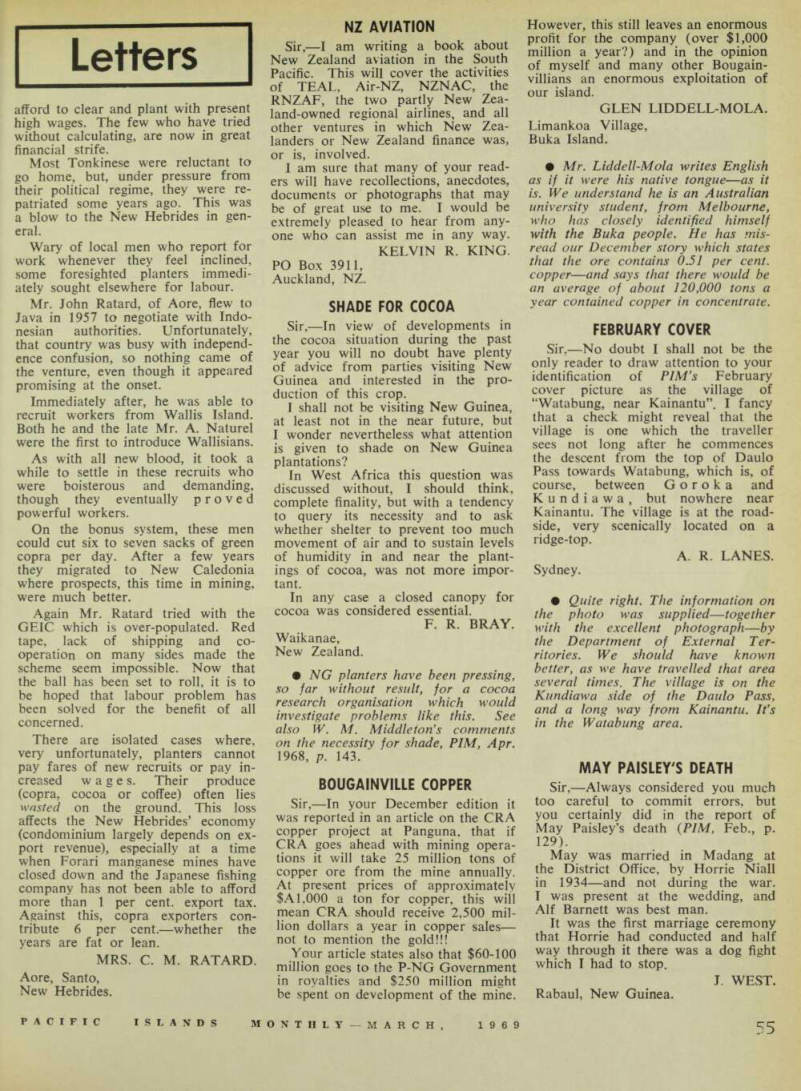
Letters
afford to clear and plant with present high wages. The few who have tried without calculating, are now in great financial strife.
Most Tonkinese were reluctant to go home, but, under pressure from their political regime, they were re patriated some years ago. This was a blow to the New Hebrides in gen eral.
Wary of local men who report for work whenever they feel inclined, some foresighted planters immedi ately sought elsewhere for labour.
Mr. John Ratard, of Aore, flew to Java in 1957 to negotiate with Indo nesian authorities. Unfortunately, that country was busy with independ ence confusion, so nothing came of the venture, even though it appeared promising at the onset.
Immediately after, he was able to recruit workers from Wallis Island.
Both he and the late Mr. A. Naturel were the first to introduce Wallisians.
As with all new blood, it took a while to settle in these recruits who were boisterous and demanding, though they eventually proved powerful workers.
On the bonus system, these men could cut six to seven sacks of green copra per day. After a few years they migrated to New Caledonia where prospects, this time in mining, were much better.
Again Mr. Ratard tried with the GEIC which is over-populated. Red tape, lack of shipping and co operation on many sides made the scheme seem impossible. Now that the ball has been set to roll, it is to be hoped that labour problem has been solved for the benefit of all concerned.
There are isolated cases where, very unfortunately, planters cannot pay fares of new recruits or pay in creased wages. Their produce (copra, cocoa or coffee) often lies wasted on the ground. This loss affects the New Hebrides’ economy (condominium largely depends on ex port revenue), especially at a time when Forari manganese mines have closed down and the Japanese fishing company has not been able to afford more than 1 per cent, export tax.
Against this, copra exporters con tribute 6 per cent. —whether the years are fat or lean.
Mrs. C. M. Ratard.
Aore, Santo, New Hebrides.
Nz Aviation
Sir, —I am writing a book about New Zealand aviation in the South Pacific. This will cover the activities of TEAL, Air-NZ, NZNAC, the RNZAF, the two partly New Zea land-owned regional airlines, and all other ventures in which New Zea landers or New Zealand finance was, or is, involved.
I am sure that many of your read ers will have recollections, anecdotes, documents or photographs that may be of great use to me. I would be extremely pleased to hear from any one who can assist me in any way.
Kelvin R. King.
PO Box 3911, Auckland, NZ.
Shade For Cocoa
Sir, —In view of developments in the cocoa situation during the past year you will no doubt have plenty of advice from parties visiting New Guinea and interested in the pro duction of this crop.
I shall not be visiting New Guinea, at least not in the near future, but I wonder nevertheless what attention is given to shade on New Guinea plantations?
In West Africa this question was discussed without, I should think, complete finality, but with a tendency to query its necessity and to ask whether shelter to prevent too much movement of air and to sustain levels of humidity in and near the plant ings of cocoa, was not more impor tant.
In any case a closed canopy for cocoa was considered essential.
F. R. Bray.
Waikanae, New Zealand. • NG planters have been pressing, so far without result, for a cocoa research organisation which would investigate problems like this. See also W. M. Middleton’s comments on the necessity for shade, PIM, Apr. 1968, p. 143.
Bougainville Copper
Sir, —In your December edition it was reported in an article on the CRA copper project at Panguna, that if CRA goes ahead with mining opera tions it will take 25 million tons of copper ore from the mine annually.
At present prices of approximately $A 1,000 a ton for copper, this will mean CRA should receive 2,500 mil lion dollars a year in copper sales— not to mention the gold!!!
Your article states also that $6O-100 million goes to the P-NG Government in royalties and $250 million might be spent on development of the mine.
However, this still leaves an enormous profit for the company (over $l,OOO million a year?) and in the opinion of myself and many other Bougain villians an enormous exploitation of our island.
Glen Liddell-Mola.
Limankoa Village, Buka Island. • Mr. Liddell-Mola writes English as if it were his native tongue—as it is. We understand he is an Australian university student, from Melbourne, who has closely identified himself with the Buka people. He has mis read our December story which states that the ore contains 0.51 per cent, copper—and says that there would be an average of about 120,000 tons a year contained copper in concentrate.
February Cover
Sir, —No doubt I shall not be the only reader to draw attention to your identification of PlM’s February cover picture as the village of “Watabung, near Kainantu”. I fancy that a check might reveal that the village is one which the traveller sees not long after he commences the descent from the top of Daulo Pass towards Watabung, which is, of course, between Goroka and Kundiawa, but nowhere near Kainantu. The village is at the road side, very scenically located on a ridge-top.
A. R. Lanes.
Sydney. • Quite right. The information on the photo was supplied—together with the excellent photograph—by the Department of External Ter ritories. We should have known better, as we have travelled that area several times. The village is on the Kundiawa side of the Daulo Pass, and a long way from Kainantu. It’s in the Watabung area.
May Paisley's Death
Sir, —Always considered you much too careful to commit errors, but you certainly did in the report of May Paisley’s death ( PIM, Feb., p. 129).
May was married in Madang at the District Office, by Horrie Niall in 1934—and not during the war.
I was present at the wedding, and Alf Barnett was best man.
It was the first marriage ceremony that Horrie had conducted and half way through it there was a dog fight which I had to stop.
J. West.
Rabaul, New Guinea.