Yesterday
p. 99 · Read in the full issue
Strange things happen in the “silly season” and the “silly season” of 20 years ago was no exception in the Islands. PIM , of February, 1949, reported that Spain had laid claim to three central Pacific coaling stations—Yap, Koror and Saipan—all of which were held by the US under trusteeship conditions. The claim, made in the General Franco-founded magazine, Africa, was based on discoveries by Spanish navigators in the 16th century and on the protocol of a treaty concluded between Germany and Spain at Rome in 1885 and at Madrid in 1889.
Spain’s claims, of course, came to nothing. Yap, Koror and Saipan are still in the US Trust Territory.
Other news in PIM 20 years ago included: Trouble was reported in NG’s Upper Markham Valley. Assistant DO, Morobe, Mr. G. O’Donnell, was on his way from Lae to investigate reports that New Guineans armed with Japanese rifles had killed several villagers.
Sir Howard Ellis, who lived in Fiji for nearly 30 years (he was ap pointed one of the two unofficial members of the colony’s fledgling Executive Council in 1941) died in Auckland on January 19, 1949. His widow, Lady Ellis, was a member of the old Fiji Joske family whose trading business was taken over many years ago by W. R. Carpenter.
PIM criticised the new US name for Micronesia—The US Trust Ter ritory of the Pacific Islands—as “un fortunate and confusing”. PlM’s suggestion: “The Trust Territory of Micronesia”.
Bounty relics were in the news.
Lieutenant William Bligh’s soup tureen had turned up in Suva in the hands of Mr. R. M. D. Towner, the bible of the HMS Bounty was to be returned to Pitcairn and the Bounty's barometer was still being tapped and read every morning—by Ray Nobbs, of Norfolk Island.
A PIM advertisement for a gov erness to teach two children on a coconut plantation on Papua’s isolated Fly River. Salary: “two pounds a week”.
Rabaui remembered January 23, 1942 (anniversary of the fall of the New Britain town to the Japanese) with two ceremonies one near
Vulcan Island, where the invaders landed, and the other at the Colyer Watson wharf, where the ill-fated Montevideo Maru sailed for Japan with hundreds of civilian internees and AIF soldiers captured in the Rabaui area. (The Montevideo Maru was lost, with all on board, on the way to Japan).
The Union Manufacturing and Export Company of Wellington, NZ, started a shipping run to NG in January when the company sent the 5,000-ton motor vessel Wairata to Lae.
NZ’s new High Commissioner for Western Samoa, Mr. G. R. Powles, his wife and their children, had all arrived in Apia to take up residence, at, of course, Vailima—Robert Louis Stevenson’s old home.
Australia’s Air Force Association had proposed to erect a bronze symbolic statue 30 ft high in Suva to commemorate the landing in Fiji by Sir Charles Kingsford Smith on the first trans-Pacific crossing by air.
The proposal came to nothing but 10 years later a monument to mark the landing was erected at the corner of Albert Park Drive and Victoria Parade.
The London Missionary Society’s proud cruiser, John Williams VI, made her first appearance in the South Pacific when she berthed at her base, Suva, on January 15. She had been named by Princess Margaret in a ceremony in London on August 5, 1948.
Islands cocoa prices took a beating.
NG prices came down from over £2OO a ton to £l6l, New Hebrides prices came down from an even higher amount to £165 a ton and Samoan cocoa, which fetched £230 a ton in 1948, was near the £2OO a ton mark. Sydney buyers couldn’t give a good reason for the falls; they said there was still a world shortage of the beans.
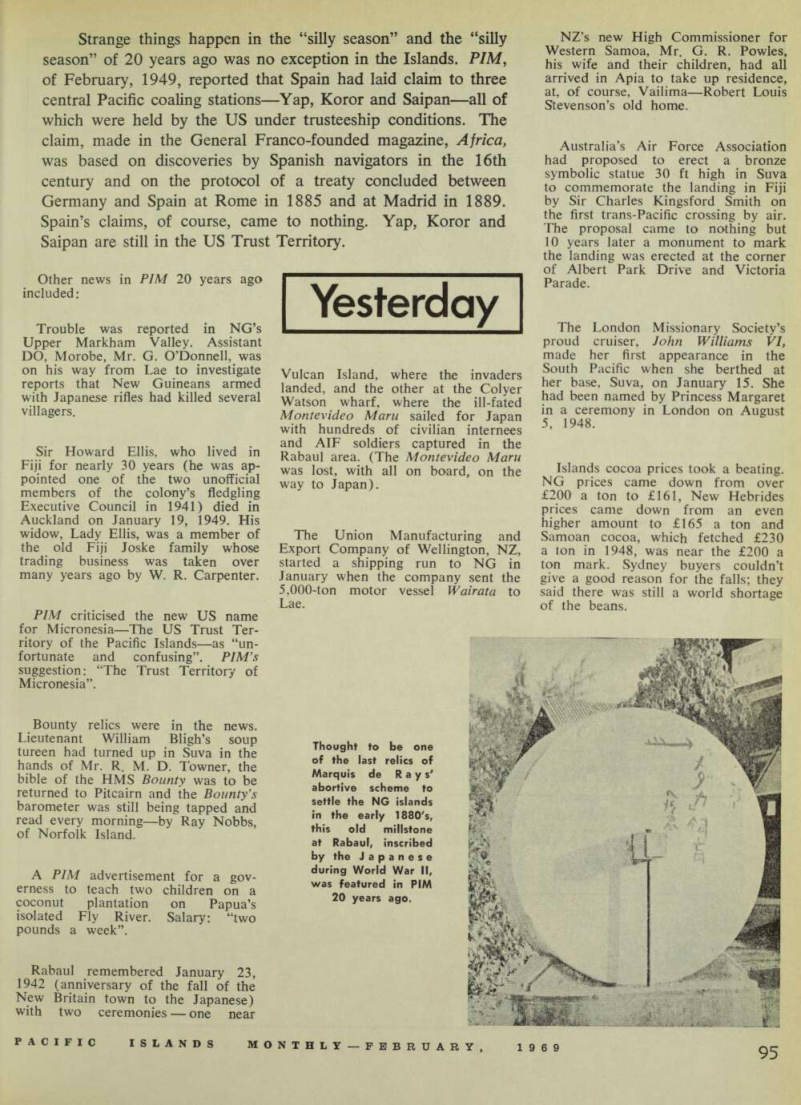
Thought to be one of the last relics of Marquis de Rays' abortive scheme to settle the NG islands in the early 1880's, this old millstone at Rabaui, inscribed by the Japanese during World War II, was featured in PIM 20 years ago.