Book Reviews
pp. 101-103 · Read in the full issue
Hubert Murray Of Papua:
The Best Analysis Yet
It is an example of the irony of modem socio-political development that another book on Sir Hubert Murray should be published just when Australia’s stumbling planners are wondering what on earth they really are going to do with Papua-New Guinea.
It is further irony that I should be asked by the editor of PIM to review this book.
In the decade before Sir Hubert died in Samarai “with his boots on”, in February, 1940, I saw the Lieut.- Govemor on many occasions, and listened for hours to his biting com ments on Australian politicians, on world trends in “colonialism”, and on the efforts being made by “those fellows next door”—a succession of bespangled military officers from World War I who probably had never seen a Melanesian village until they became “Administrators” of New Guinea—to introduce an effective Administration into the widely scat tered, wholly disunited “Mandated Territory”.
"A nightmare"
I can imagine Sir Hubert in these days, sitting on the edge of a pink cloud somewhere above the Owen Stanley Range, grimly examining the dual territory after Australia’s politi cians and planners have spent 25 years, and hundreds of millions of Australian dollars, on “development and modernisation”; and their appar ently serious claim that they now have a united nation ready for self government and independence. His comments would be worth hearing.
If you would like to know the nature of those comments, read Hubert Murray, by Dr. Francis T. West, of the Australian National University. It is a good book the best analysis I have seen of the Murray regime, and of the man who created the legend of Murray’s Papua.
There must have been a dozen books about the Hubert Murray regime published since World War IT and the Japanese invasion threw
the Australian territory of Papua and the ex-German colony of New Guinea into a political melting-pot, to emerge as this ragged and non descript “Trust Territory of New Guinea”. Actually, it is half of the world’s biggest island, plus the very large islands of New Britain, New Ireland, Bouganville, and a score of little ones, containing over two mil lion mostly primitive people, speak ing about 700 separate languages— an Administrator’s nightmare.
Seeking guidance concerning the trust territory, conscientious Admin istration officials must have gone back again and again to the records of the Murray rule in Papua, and must often have been baffled.
Most of those books were good only in parts: none I think pre sented a completely true picture.
That is not surprising.
Murray himself, especially to wards the end of his 36 years in Papua, often was baffled and con fused, and especially after a wrestle with one or other of the various types of Territories Minister thrown into office in Canberra by the vagar ies of Australian politics.
What was his policy?
Francis West never knew Mur ray. West is an English scholar who came to Australia in the early ’Fifties, and has established himself as an ardent and painstaking re searcher. This record of the life and work of Hubert Murray is as com plete, well-balanced and accurate as a first-grade historian could make it, and it will, I think, become the standard reference work on Papua, up to the time when Papua was thrown to the eager wolves of the United Nations which time is
nearly coincidental with the death of Murray in 1940.
What was Murray’s “native pol icy”? That is what all these plan ners ask, sooner or later. With Dr.
West’s new book for reference, together with my own memories of many talks with the old man, I think I can answer that one.
Pacification
In the beginning, Murray simply sought pacification of the tribes, so that European control could be introduced. He went out personally among the primitive people, and later he always had some of his devoted young men far out on patrol, striving ceaselessly to persuade these folk to abandon their ages-old cus tom of an-eye-for-an-eye, and accept rule by law and justice, represented by “resident magistrates” in the main centres, and by selected native con stables in the villages.
Papua was desperately poor; Aus tralia’s grant was rarely over £30,000 p.a. Gold and copper mining had flared up, occasionally, but otherwise there was little produce to sell over seas, to provide an economy that could be taxed. So, naturally, Mur ray did everything within his power to promote development of primary industry by Europeans.
European enterprise, of course, sought two things, land and labour.
From the beginning, Murray instinc tively protected the rights of the indigenes in both respects; but his policy definitely was one of encour
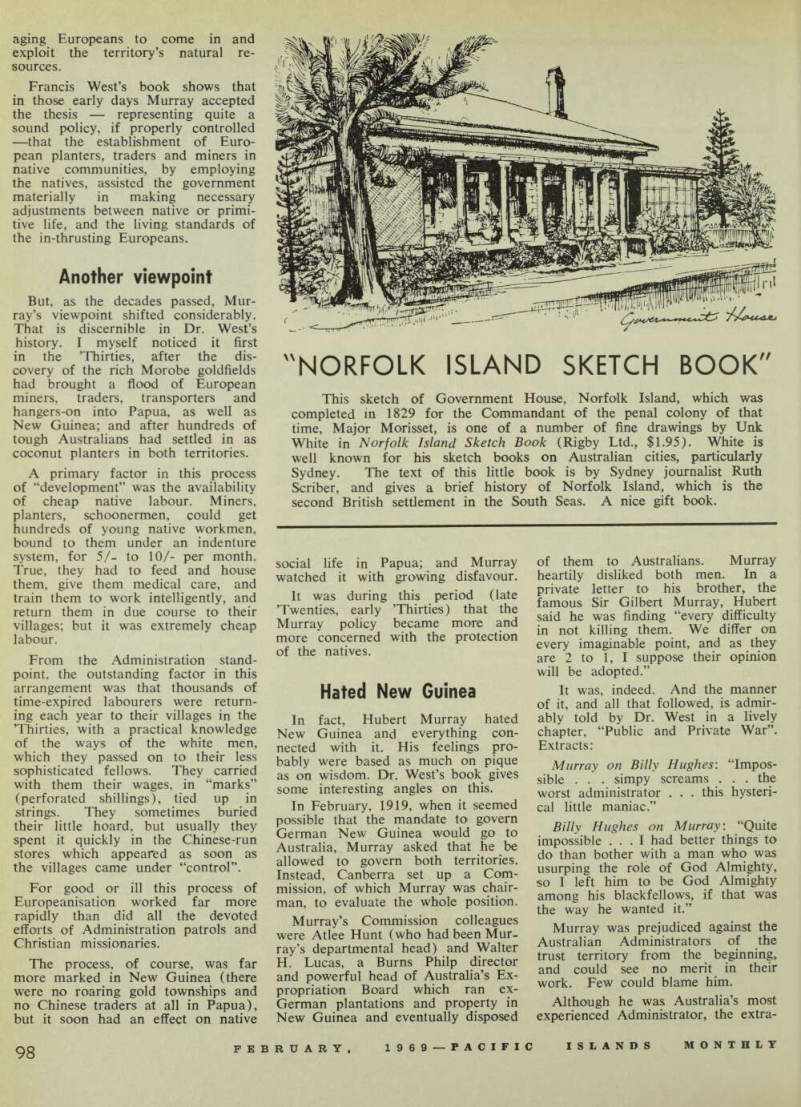
Sir Hubert Murray about 1925.
aging Europeans to come in and exploit the territory’s natural re sources.
Francis West’s book shows that in those early days Murray accepted the thesis representing quite a sound policy, if properly controlled —that the establishment of Euro pean planters, traders and miners in native communities, by employing the natives, assisted the government materially in making necessary adjustments between native or primi tive life, and the living standards of the in-thrusting Europeans.
Another viewpoint
But, as the decades passed, Mur ray’s viewpoint shifted considerably.
That is discernible in Dr. West’s history. I myself noticed it first in the ’Thirties, after the dis covery of the rich Morobe goldfields had brought a flood of European miners, traders, transporters and hangers-on into Papua, as well as New Guinea; and after hundreds of tough Australians had settled in as coconut planters in both territories.
A primary factor in this process of “development” was the availability of cheap native labour. Miners, planters, schoonermen, could get hundreds of young native workmen, bound to them under an indenture system, for 5/- to 10/- per month.
True, they had to feed and house them, give them medical care, and train them to work intelligently, and return them in due course to their villages; but it was extremely cheap labour.
From the Administration stand point, the outstanding factor in this arrangement was that thousands of time-expired labourers were return ing each year to their villages in the Thirties, with a practical knowledge of the ways of the white men, which they passed on to their less sophisticated fellows. They carried with them their wages, in “marks” (perforated shillings), tied up in strings. They sometimes buried their little hoard, but usually they spent it quickly in the Chinese-run stores which appeared as soon as the villages came under “control”.
For good or ill this process of Europeanisation worked far more rapidly than did all the devoted efforts of Administration patrols and Christian missionaries.
The process, of course, was far more marked in New Guinea (there were no roaring gold townships and no Chinese traders at all in Papua), but it soon had an effect on native
social life in Papua; and Murray watched it with growing disfavour.
It was during this period (late Twenties, early ’Thirties) that the Murray policy became more and more concerned with the protection of the natives.
Hated New Guinea
In fact, Hubert Murray hated New Guinea and everything con nected with it. His feelings pro bably were based as much on pique as on wisdom. Dr. West’s book gives some interesting angles on this.
In February, 1919, when it seemed possible that the mandate to govern German New Guinea would go to Australia, Murray asked that he be allowed to govern both territories.
Instead, Canberra set up a Com mission, of which Murray was chair man, to evaluate the whole position.
Murray’s Commission colleagues were Atlee Hunt (who had been Mur ray’s departmental head) and Walter H. Lucas, a Burns Philp director and powerful head of Australia’s Ex propriation Board which ran ex- German plantations and property in New Guinea and eventually disposed
of them to Australians. Murray heartily disliked both men. In a private letter to his brother, the famous Sir Gilbert Murray, Hubert said he was finding “every difficulty in not killing them. We differ on every imaginable point, and as they are 2 to 1, I suppose their opinion will be adopted.”
It was, indeed. And the manner of it, and all that followed, is admir ably told by Dr, West in a lively chapter, “Public and Private War”.
Extracts: Murray on Billy Hughes : “Impos sible . . . simpy screams . . . the worst administrator . . . this hysteri cal little maniac.”
Billy Hughes on Murray : “Quite impossible ... I had better things to do than bother with a man who was usurping the role of God Almighty, so I left him to be God Almighty among his blackfellows, if that was the way he wanted it.”
Murray was prejudiced against the Australian Administrators of the trust territory from the beginning, and could see no merit in their work. Few could blame him.
Although he was Australia’s most experienced Administrator, the extra
ordinarily stupid clique which ruled the Department of Territories in Canberra from 1921 to 1942 gave him no part in the trust territory administration.
I was one who wrote frequently about that bureaucratic pheno menon: although the department ruled continguous and almost exact ly similar tropical countries, Papua and New Guinea were kept in strict ly watertight compartments — no interchange of officers, no com munication between them except through Canberra, not even an ex change of ideas and experiences.
"Honour and dispair"
Murray was acutely sensitive to all this. Little wonder that West’s heading for the last chapter of his book, in which he describes Murray’s last unhappy decade in Papua, is “Honour and Despair”!
Many of we old-timers thought that Hubert Murray, a great Aus tralian and a brilliant member of a distinguished family, died of a broken heart. That belief seems to be proven by the new material in this book about Murray’s relations with Canberra, and the details of his lonely personal life.
I wish that West had inquired more about Murray’s attitude to wards education of the natives.
"Blind spot"
As a journalist and editor, from 1930 to 1965, I observed the Aus tralian Administration in P-NG. Its greatest weakness, and the root cause of much of Australia’s embar rassment there today, was its total failure to introduce, in the beginning, an education system which might have opened the door to rapid social development and early nationhood.
As it is, the lack of an adequate education system still is the blind spot in Australia’s administration there.
Australia has recently spent huge sums on the establishment there of a university. P-NG does not need graduates so much as it needs effec tive village schools, and secondary and technical schools—and it needs these urgently. It is my estimate that more than 60 per cent, of the people whom Australia’s planners are try ing to thrust into independent nation hood still are completely illiterate.—
R. W. Robson.
(HUBERT MURRAY. Published by Oxford University Press, Melbourne. $7.50.)