The Royal Blood Of
p. 97 · Read in the full issue
Denmark In P-Ng?
By R. W. Robson
Because a book, Queen Emma, which I wrote a few years ago, came by chance into the hands of Mr. Arthur Vaag, of Mando 6760, Ribe, Denmark, there has come to light some Danish-German history of particular interest to the many descendants of Richard and Phoebe Parkinson, pioneer trader and planter in former German New Guinea.
Phoebe Coe, a sister of “Queen Emma” Forsayth (formerly Coe), married Richard H. R. Parkinson in Western Samoa about 1879, and they joined Emma in New Britain in 1882. Parkinson was a scholar and a brilliant botanist. (He will remain in New Guinea history because he was the first man to plant coconuts on a commercial scale in that great archipelago).
Hitherto, Parkinson has been described merely as the son of an Englishman who took German nationality after he became the coach man of a German noble. Now, we have a much more interesting story.
Mr. Vaag read my various references to Parkinson in Queen Emma and he has kindly written to give me the Parkinson history. He says it was told to him by his wife, who is a native of Augustenberg, in Schleswig, now a part of Denmark.
Mrs. Vaag, as a girl, knew Mrs..
Parkinson, the mother of Richard Parkinson. She was a very old lady when she died, about 1905.
Mrs. Vaag says that it was generally believed that Mrs. Parkin son, as a very young woman, was a member of the staff of the Duke of Augustenberg, a nephew of the
Danish Queen, and that she had a love affair with him. When she became pregnant, the Duke protected her.
The young woman was hurriedly married to an Englishman, Parkinson, who was the master of the Duke’s famous stud farm. The newly married couple then left Augustenberg, for either Germany or England; and Mrs.
Vaag’s grandfather followed Parkin son as manager of the Duke’s stud farm—that is how she learned of the incidents now recounted.
“That marriage was about 1844” writes Mr. Vaag. “The Duke took care of the child. In 1848 the Duke made insurrection against his near relative, the King of Denmark. The war lasted until 1850; the Duke fled to Altona and later to Silesia; and so he lost eyerything —if he had not rebelled against the King he would himself have become King of Denmark.”
This summary of the rebellion is borne out by the Chambers’ Encyclo paedia.
It says that Count Reventlow and Prince Frederick of Augustenberg rose against the King of Denmark in 1848; that Austria intervened and established peace; that Frederick made certain claims affecting the
throne when the Danish King died in 1863; that Austria and Prussia came into the picture and chased Frederick away; and that Schleswig and Holstein thence forward were a province of Prussia until after World War I.
Mr. Vaag’s story is further sup ported by the facts that Richard Parkinson was very well educated, and was fluent in English as well as German. Letters written by Parkin son to NSW Governor le Hunte, and now in the Mitchell Library, in Sydney, show a mastery of col loquial English.
Parkinson was over 30, and a qualified surveyor, when he was sent out from Hamburg to the Goddeffroy firm in Western Samoa, where the Germans had founded their first Pacific colony. It was in Apia that he met and about 1879, married Phoebe Coe, then in her teens.
Great fortune
In New Britain, between 1882 and 1907, Parkinson was closely as sociated with “Queen Emma”, and the coconut plantations he established for her behind Ralum, near Kokopo, contributed much to her great fortune.
Mr. and Mrs. Parkinson had 12 children, and their descendants are numerous and are scattered widely over New Guinea and Australia.
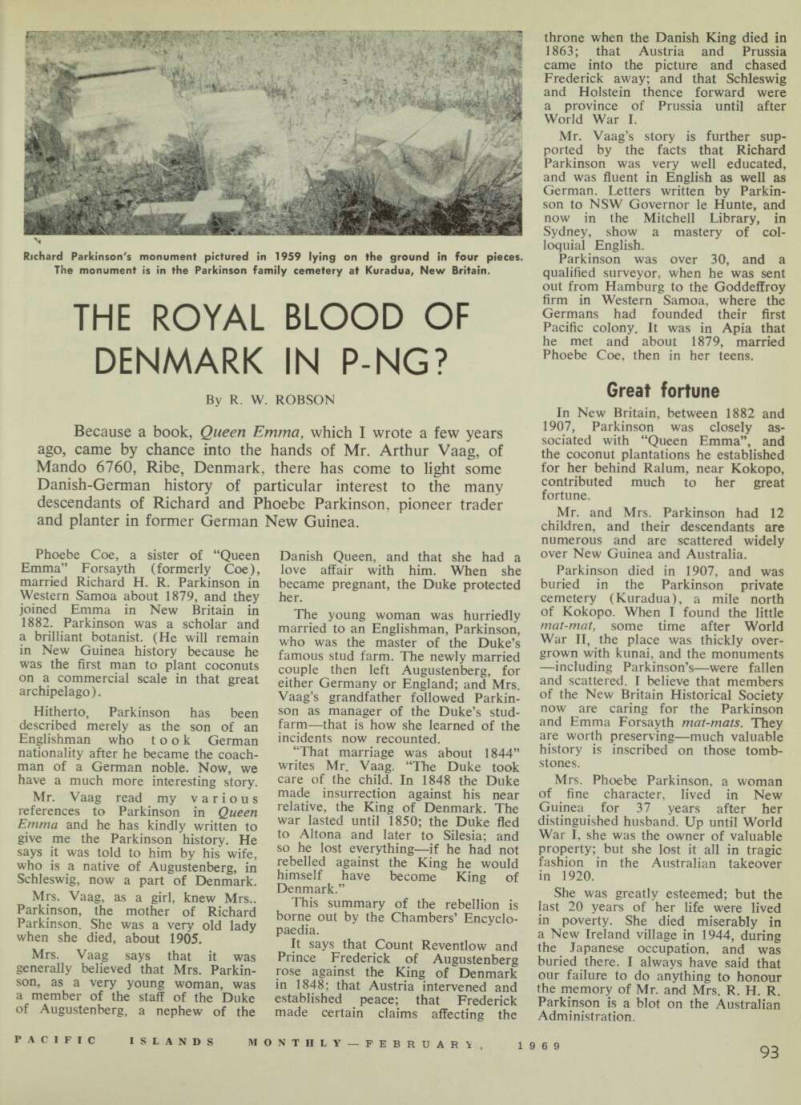
Parkinson died in 1907, and was buried in the Parkinson private cemetery (Kuradua), a mile north of Kokopo. When I found the little mat-mat, some time after World War 11, the place was thickly over grown with kunai, and the monuments —including Parkinson’s—were fallen and scattered. I believe that members of the New Britain Historical Society now are caring for the Parkinson and Emma Forsayth mat-mats. They are worth preserving—much valuable history is inscribed on those tomb stones.
Mrs. Phoebe Parkinson, a woman of fine character, lived in New Guinea for 37 years after her distinguished husband. Up until World War I, she was the owner of valuable property; but she lost it all in tragic fashion in the Australian takeover in 1920.
She was greatly esteemed; but the last 20 years of her life were lived in poverty. She died miserably in a New Ireland village in 1944, during the Japanese occupation, and was buried there. I always have said that our failure to do anything to honour the memory of Mr. and Mrs. R. H. R.
Parkinson is a blot on the Australian Administration.
Richard Parkinson's monument pictured in 1959 lying on the ground in four pieces.
The monument is in the Parkinson family cemetery at Kuradua, New Britain.