the good
p. 95 · Read in the full issue
A mule took command of the good ship "Musa"
LANCE H. WILKINSON, in Samarai, remembers.
What with Land-Rovers, aeroplanes and helicopters, gold prospectors are faced with few transport difficulties there days.
In fact, much of the “trudgery” of gold prospecting has been done away with. But things were very different in the old days —in the days for instance, when Gold Mines of Papua took over Mount Sisa on Misima.
Mount Sisa is some seven miles from the coast of Misima and all supplies in the early days of the mine’s operation had to be taken in by native carrier. A road existed as far as Umuna but from there on there was only a goat track.
Now goat tracks are all very well if you have the goats to do the tracking, but when Gold Mines of Papua came to Misima there were no goats available.
So the people in charge of opera tions decided that the mules would be a good substitute for goats, and the people who ran the Doini planta tion near Samarai agreed to sell Gold Mines two mules. So far so good, but then a problem arose.
How to get the mules from Samarai to Misima—after all it’s some dis tance by sea.
After some persuasive negotiating by anxious Gold Mines’ representa tives, Steamships Trading Company agreed to transport the mules from Samarai to Misima on the MV Nusa.
Mutiny!
I happened to be doing that trip on the Nusa with a mate, Gerry Polini. When we anchored at Doini, the Nusa’s master, Captain Anderson, asked Gerry and me whether we knew anything about mules. Neither of us did but we knew horses, so we agreed to assist in loading the two
mules. We didn’t know what we were letting ourselves in for!
Every time we approached one of the mules, it turned its kicking end towards us—and in the end we found ourselves flying through the air!
Finally the native muleteer arrived.
He smacked the mules on their rumps, put halters on them and they went peacefully to the waiting ship.
The first mule was slung aboard without any difficulty, but the second one was dropped from the sling to the deck from a height of six feet.
It promptly decided to get its revenge on the deck and proceeded to kick it —and everything in sight— to pieces.
Crew fled
Quick as a flash, Captain Anderson made for the safety of the bridge; the engineer Bill Johnson, beat all records in his haste to get to the engine room; and the crew made for the whale boat—or went over the side.
The mule was master of the ship.
It had been a bloodless mutiny.
The underground manager of Gold Mines of Papua, Ted Gallon, was at Misima wharf to meet the cargo of mules. Having not visited the bright lights of Misima for six dry months, he had consumed quite a lot of Burns Philp “toothpaste” at 1/9 a bottle. (In those days, it was against the law to buy beer by the single
bottle so bottles were marked in stores’ accounts as toothpaste. It’s surprising how much toothpaste BP’s sold.) The mules were saddled with two bags of rice each. Ted inspected them, pronounced them fit and re turned to the “toothpaste”. Half an hour later he inspected them again.
This time one of the creatures moved its head slightly as Ted walked past.
The movement threw Ted off his balance and he crashed to the ground.
Not very happy
Ted wasn’t very happy about this.
He declared the beast to be flighty and ordered another bag of rice to be put on its back. Then both mules began to annoy Ted, and he ordered more and more bags to be loaded on their backs.
As the sun went down, Ted and his mules set off for Mount Sisa.
The next morning on the coast road I saw Ted’s mules, minus Ted.
One had no pack saddle and the other had a pack saddle dangling from its belly. Naturally I was a little worried about Ted, knowing the pitfalls of the mountain road.
However all was well. On going through Bwagaoia village I met a rather forlorn Ted who asked me if I had seen anything of his mules.
I told him that I had.
Ted never spoke to the mules again, though the two animals did some sturdy work for Gold Mines of Papua for several years.
And Ted never visited the coast again. These days Ted is a strict abstainer and the idol of his grand children. But I doubt very much whether he has ever told them the story of those mules. It might be an animal story, but it’s not for kids.
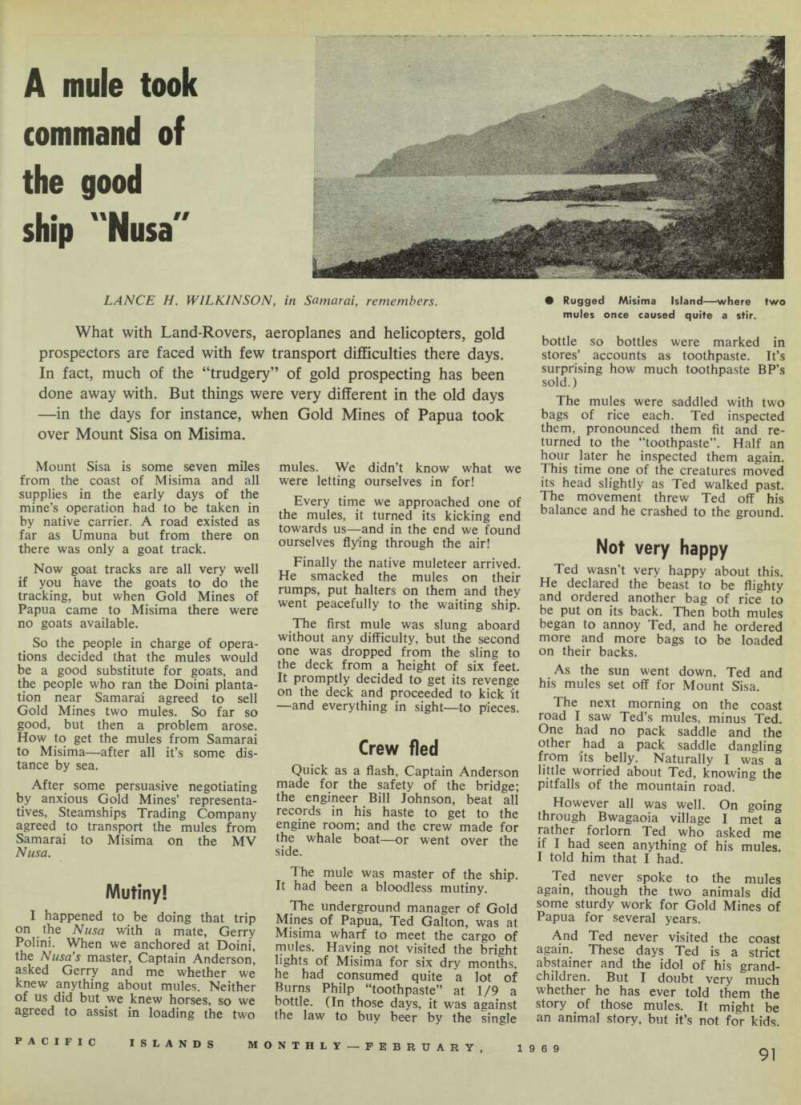
• Rugged Misima Island—where two mules once caused quite a stir.