Investors
pp. 65-67 · Read in the full issue
Give Boost
To Islands
Stamps
By HARRY H. JACKMAN, a Port Moresby collector.
Not only collectors, but now investors, are collecting stamps from the South Pacific, and there is evidence that the Pacific stamp business will continue to boom.
This is a good thing for territories in need of money, and it can be a good thing for both collectors and investors. But there are pitfalls for all three.
Collectors fall into four main categories. They collect: (a) all Pacific territories and countries; (b) British Commonwealth in the Pacific; (c) French Community in the Pacific; and (d) Thematics.
Although Tonga, Western Samoa and Nauru are independent, their stamps are usually included in British Commonwealth collections. Many Australian collectors confine their collecting to issues of Australian territories. Thematic collectors are interested in issues dealing with a special subject, such as butterflies, birds, ships, famous paintings, Red Cross and Olympics,
Fair . . . and foul
Postal authorities in the Pacific are well aware of trends among collectors and investors, and they use every means, usually fair but sometimes foul, to gain revenue from stamp sales. The days have gone when stamps were only issued to facilitate payment for postal services. Not only commemorative issues but even definitives are now frequently issued to obtain cash from collectors and investors.
During the years 1960 to 1967, a collector would have had to spend more than $205 to buy one copy of every stamp issued, as the follow ing table shows:—
The cheapest way of buying stamps is from post offices and philatelic bureaux in the country of issue, or from philatelic agents elsewhere, appointed by the issuing
authority. Many dealers in metro politan countries and the Pacific operate “new issue services”, usually on a deposit made by the customer.
Major dealers who advertise in well known philatelic journals, such as The Australian Stamp Monthly, Lynn's Weekly (USA). L’Echo de la Timbrologie (France) and Stamp News (England), give reliable service, but this is not always the case with smaller dealers. The following table shows official points where stamps may be bought. Some will service first-day covers, special postmarks, cancel to order, etc., but others will merely sell new issues, enclosing them or affixing them to envelopes.
NOTE: London buying is for dealers only, at the Crown Agents.
Most collectors are hobbyists but some of them also speculate, and so do a growing number of investors.
A quick glance at a few items selected for the exceptional monetary appreciation shows what investment
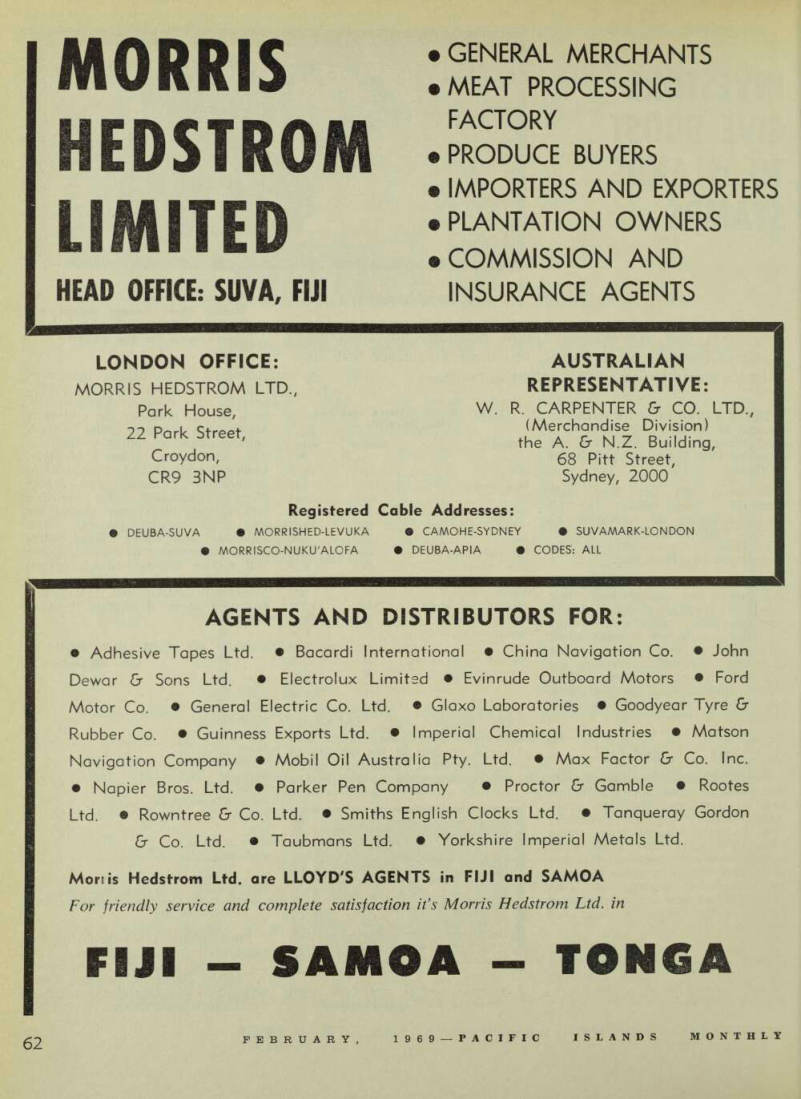
A recently-issued 5 cent P-NG stamp showing the Conus Marmoreus.
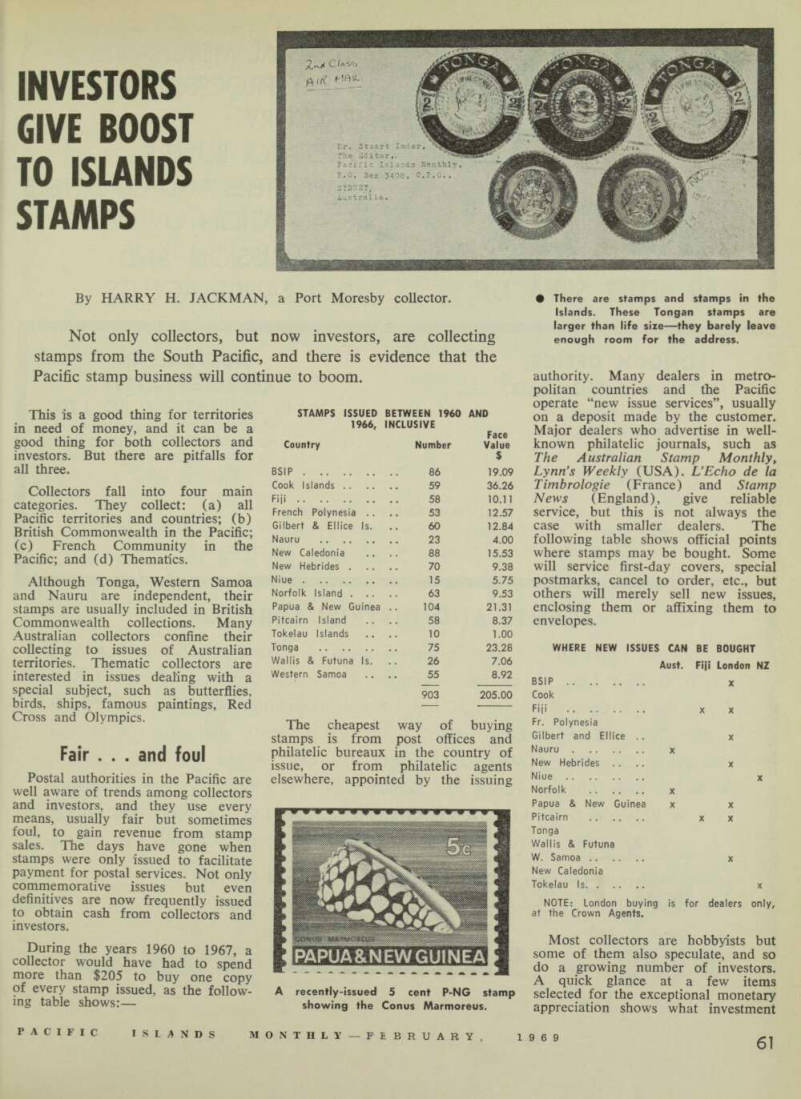
• There are stamps and stamps in the Islands. These Tongan stamps are larger than life size—they barely leave enough room for the address.
l;krfokdf;lkSTAMPS ISSUED
Between 1960
And
1966,
Inclusive
Face Country Number Value $
Bsip
86 19.09 Cook Islands .. 59 36.26 Fiji 58 10.11 French Polynesia .. 53 12.57 Gilbert & Ellice Is. 60 12.84 Nauru 23 4.00 New Caledonia 88 15.53 New Hebrides . 70 9.38 Niue 15 5.75 Norfolk Island . .. 63 9.53 Papua & New Guinea 104 21.31 Pitcairn Island 58 8.37 Tokelau Islands 10 1.00 Tonga 75 23.28 Wallis & Futuna Is. 26 7.06 Western Samoa * * 55 903 8.92 205.00
Where New Issues
Can
BE
Bought
Aust.
Fiji London NZ
Bsip
X Cook Fiji X X Fr. Polynesia Gilbert and Ellice ..
X Nauru X New Hebrides X Niue X Norfolk X Papua & New Guinea X X Pitcairn X X Tonga Wallis & Futuna W. Samoa X New Caledonia Tokelau Is X
in stamps can sometimes, though certainly not frequently, produce:
All these stamps were regular issues sold at post offices.
The bobby-dazzler of them all dur ing the past decade was the 1960 Papua & New Guinea 6d postage due stamp, first overprint, whose catalogue value is now $237, but it was issued in error—possibly no more than 25 sheets of 36 stamps each were issued.
Then, too, there have been some errors in overprints, perforations, etc., giving the lucky collector or perhaps just someone buying a stamp to stick on an envelope, a far better return than any mining share specu lation.
Examples of genuine bonanza stamps are the 1939 BSIP 2id definitive stamp imperforated between two stamps, now catalogued at $B6O, and the 1960 Papua & New Guinea 6d postage due stamp, double over print, now catalogued at $526.
Doubtful parentage
Others, but of doubtful parentage, are the 1960 Papua & New Guinea 3d postage due, double overprint ($215), the 1962 Tonga officials, set of six with face value of £l/16/7 ($592) and the 1966 Cook Islands lOd Churchill commemorative, double overprint ($430).
I would not fork out my bawbees for them but there are some collectors and investors who would.
Lest the parents of those stamps take umbrage, let me say that the Papua & New Guinea stamp was not obtainable through normal purchase at a post office; the Tongan set could not be bought at post offices either; and the 1966 postal situation in the Cook Islands has been men tioned on occasions in PIM.
Collectors of Pacific stamps often find it difficult to obtain their wants through exchange with other collec tors, because genuine postal use, especially in the smaller islands, does not result in enough stamps to satisfy demand by collectors.
Philatelic sales will, therefore, continue to be a worthwhile money spinner for governments in our part of the world, provided that issuing authorities do not kill the goose that lays the golden egg (read: buys stamps for non-postal use).
The postal authorities of several
Pacific countries give very good service to collectors—and the New Hebrides deserves special praise.
Some postal authorities, however, need to adopt more ethical practices, and/or could do with a management consultant.
Several have become too greedy for revenue from philatelic sales and are issuing far too many and often also too expensive stamps. -r , , y . , , Qirp^?v a inft nd c^r?°° k „ Is ands bav ® r , lc ! st . some collector support and the issuing policies of several New r“ e L n °l ably Pap f ua * The ° ne f
zrussgfsjs .sirs, g
decline in value.
A change m policy by the local postal authority from moderatelypriced and infrequent issues, to a spate of expensive ones, can quickly change the market value of previous issues and leave investors high and dry. (I hope the right person on Nauru is reading this).
Secondly, catalogue values are not necessarily a useful indication of actual cash value to the investor.
Take the 1963 Papua & New Guinea £1 definitive stamp. Its present catalogue value is $12.90, but Australian dealers sell it for $4.50 and an investor would be lucky to receive more than $2.75 from a dealer.
T Investment in stamps, like investment in shares, requires sound knowledge of the commodity, its past performance and present supply/ demand situation, and an informed
guess about its future. It is definitely not a mug’s game.
Judging by their past record, Gilbert & Ellice Islands and BSIP stamps are a good bet, with the latter being in great demand by Australian as well as British collectors, Indeed, the increasing popularity °f Pacific stamps, especially those of several English-speaking countries, among American collectors, makes issues controlled by metropolitan countries a safe, though not spectacu lar investment opportunity.
The best prospect of all seems to be Norfolk Island. An Australian
lss
collectors alone assures a bright future for Norfolk Island stamps even though their past rate of monetary appreciation, unequalled by any other country in the Pacific, is unlikely to be kept up.
I personally collect the stamps of French colonies and territories in the Pacific because they are among the best desi gned and produced and there bas as ye . l b . een n ° funny business by lssum g authorities. Then, l ?°' th f y are very expensive as demai ? d b V collectors in Europe, America and elsewhere is less than that . for British Commonwealth and ass °c iated issues.
Even s °’ th ? T very early lssues are expensive. Has anyone seen the 25 centimes stamp of the 1893 Tahiti issue? It’s catalogued at s4,ooo—the most expensive stamp ever issued in the Pacific. Vive la France!
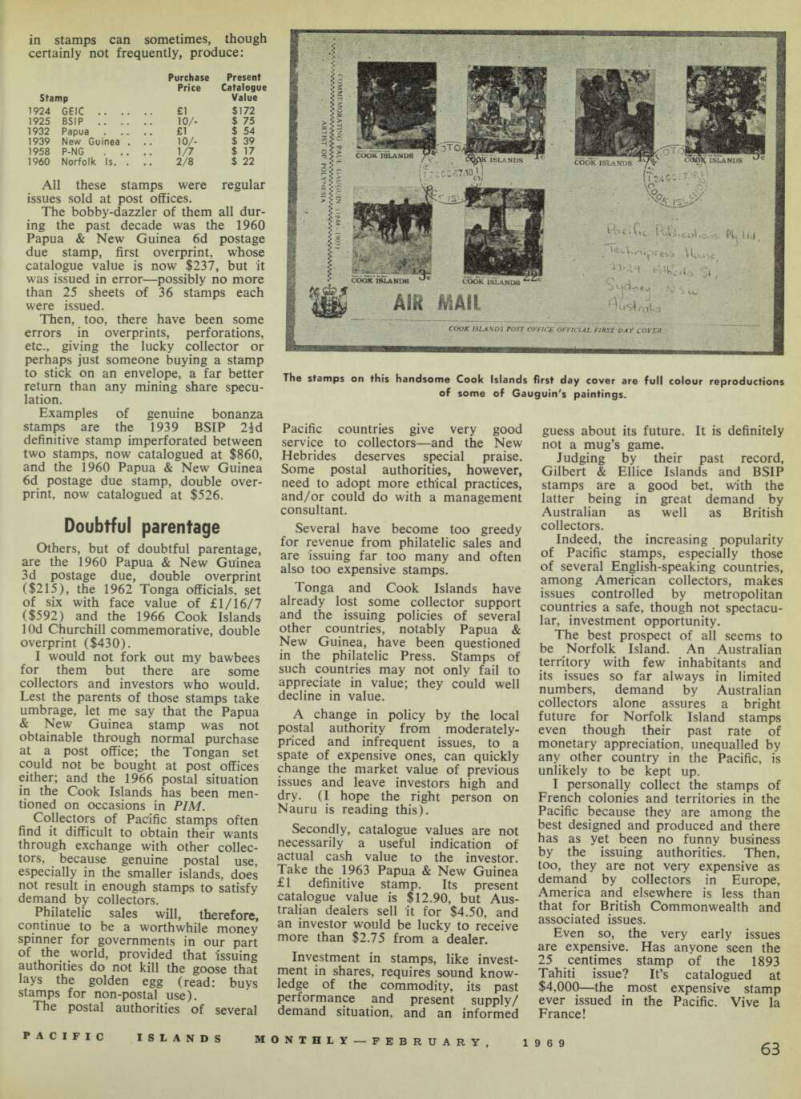
The stamps on this handsome Cook Islands first day cover are full colour reproductions of some of Gauguin's paintings.
Purchase Present Price Catalogue Stamp Value
1924 Geic .. ..
£1 $172
1925 Bsip .. ..
10/- $ 75 1932 Papua £1 $ 54 1939 New Guinea . 10/- $ 39
1958 P-Ng . ..
1/7 $ 17 1960 Norfolk Is. . 2/8 $ 22