Spirited Meeting Of Bsip
p. 68 · Read in the full issue
Legislative Council
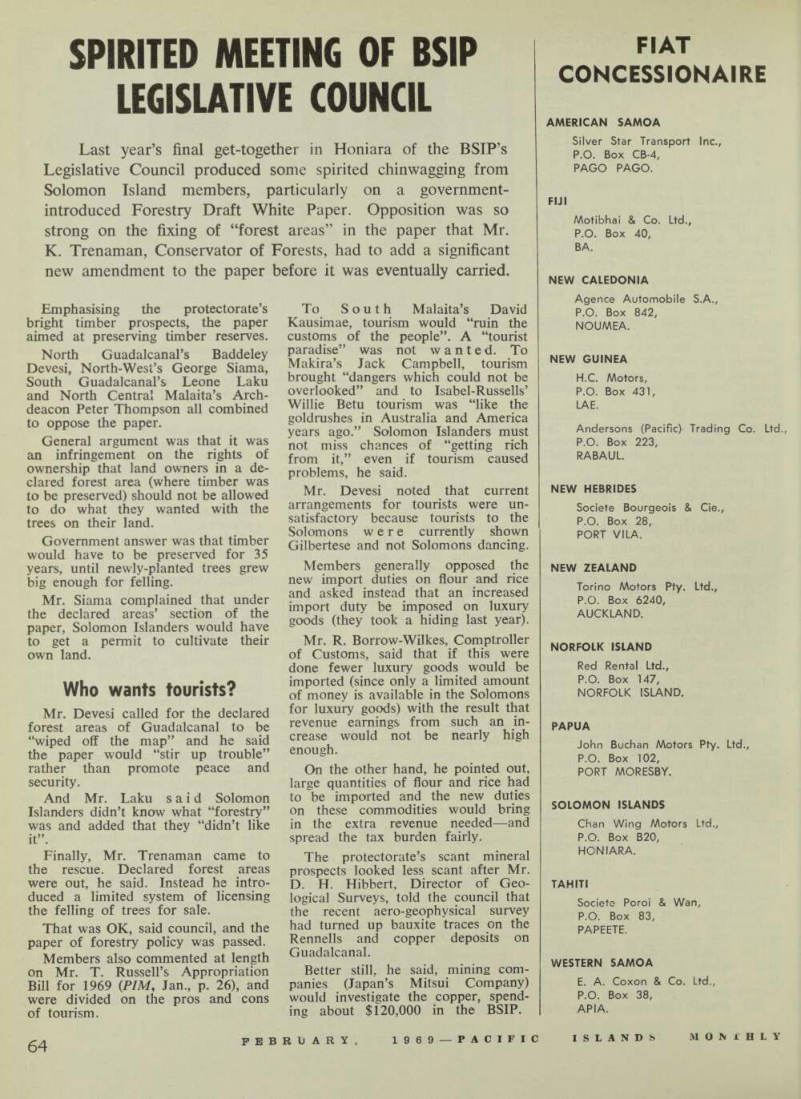
Last year’s final get-together in Honiara of the BSIP’s Legislative Council produced some spirited chinwagging from Solomon Island members, particularly on a government introduced Forestry Draft White Paper. Opposition was so strong on the fixing of “forest areas” in the paper that Mr.
K. Trenaman, Conservator of Forests, had to add a significant new amendment to the paper before it was eventually carried.
Emphasising the protectorate’s bright timber prospects, the paper aimed at preserving timber reserves.
North Guadalcanal’s Baddeley Devesi, North-West’s George Siama, South Guadalcanal’s Leone Laku and North Central Malaita’s Arch deacon Peter Thompson all combined to oppose the paper.
General argument was that it was an infringement on the rights of ownership that land owners in a de clared forest area (where timber was to be preserved) should not be allowed to do what they wanted with the trees on their land.
Government answer was that timber would have to be preserved for 35 years, until newly-planted trees grew big enough for felling.
Mr. Siama complained that under the declared areas’ section of the paper, Solomon Islanders would have to get a permit to cultivate their own land.
Who wants tourists?
Mr. Devesi called for the declared forest areas of Guadalcanal to be “wiped off the map” and he said the paper would “stir up trouble” rather than promote peace and security.
And Mr. Laku said Solomon Islanders didn’t know what “forestry” was and added that they “didn’t like it”.
Finally, Mr. Trenaman came to the rescue. Declared forest areas were out, he said. Instead he intro duced a limited system of licensing the felling of trees for sale.
That was OK, said council, and the paper of forestry policy was passed.
Members also commented at length on Mr. T. Russell’s Appropriation Bill for 1969 (P/M, Jan., p. 26), and were divided on the pros and cons of tourism.
To South Malaita’s David Kausimae, tourism would “ruin the customs of the people”. A “tourist paradise” was not wanted. To Makira’s Jack Campbell, tourism brought “dangers which could not be overlooked” and to Isabel-Russells’
Willie Betu tourism was “like the goldrushes in Australia and America years ago.” Solomon Islanders must not miss chances of “getting rich from it,” even if tourism caused problems, he said.
Mr. Devesi noted that current arrangements for tourists were un satisfactory because tourists to the Solomons were currently shown Gilbertese and not Solomons dancing.
Members generally opposed the new import duties on flour and rice and asked instead that an increased import duty be imposed on luxury goods (they took a hiding last year).
Mr. R. Borrow-Wilkes, Comptroller of Customs, said that if this were done fewer luxury goods would be imported (since only a limited amount of money is available in the Solomons for luxury goods) with the result that revenue earnings from such an in crease would not be nearly high enough.
On the other hand, he pointed out, large quantities of flour and rice had to be imported and the new duties on these commodities would bring in the extra revenue needed—and spread the tax burden fairly.
The protectorate’s scant mineral prospects looked less scant after Mr.
D. H. Hibbert, Director of Geo logical Surveys, told the council that the recent aero-geophysical survey had turned up bauxite traces on the Rennells and copper deposits on Guadalcanal.
Better still, he said, mining com panies (Japan’s Mitsui Company) would investigate the copper, spend ing about $120,000 in the BSIP.