Blueprint For
pp. 60-61 · Read in the full issue
Solomons
Tourism
Are the British Solomon Islands about to embark upon a comprehensive, Government
planned tourist promotion pro
gramme—or will tourism, like Topsy, grow of its own accord in that still fairly exclusive comer of the Pacific?
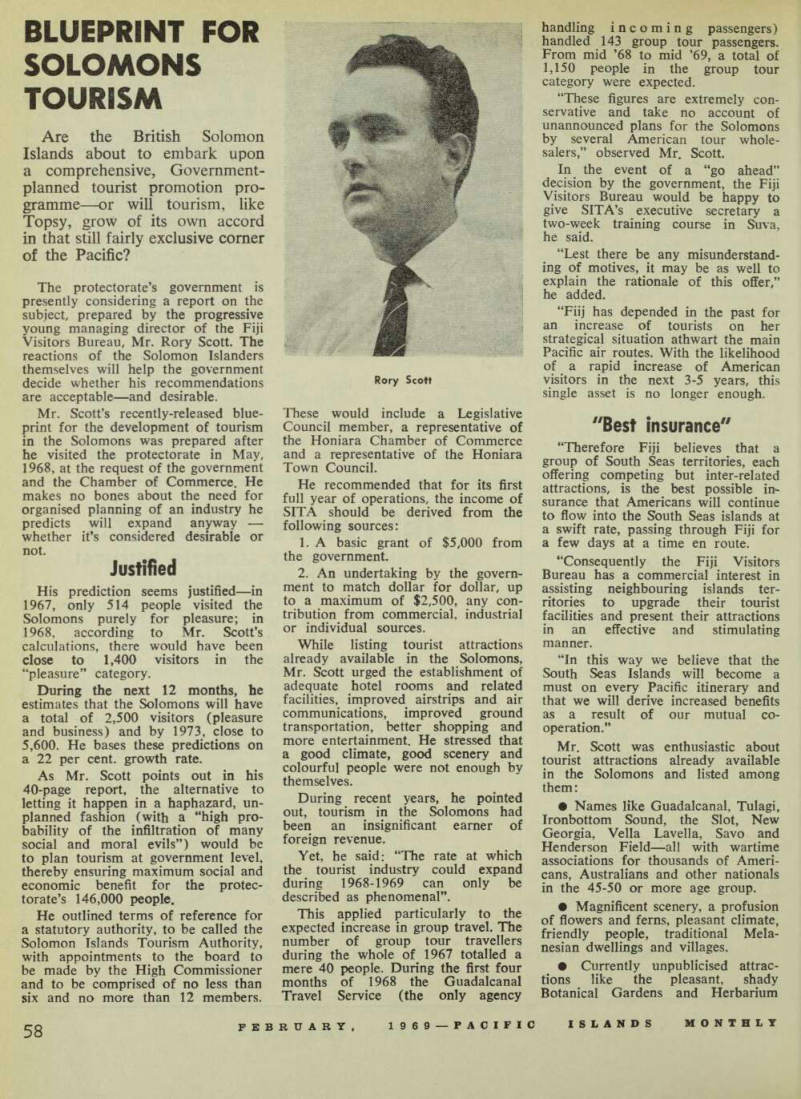
The protectorate’s government is presently considering a report on the subject, prepared by the progressive young managing director of the Fiji Visitors Bureau, Mr. Rory Scott. The reactions of the Solomon Islanders themselves will help the government decide whether his recommendations are acceptable—and desirable.
Mr. Scott’s recently-released blue print for the development of tourism in the Solomons was prepared after he visited the protectorate in May, 1968, at the request of the government and the Chamber of Commerce. He makes no bones about the need for organised planning of an industry he predicts will expand anyway whether it’s considered desirable or not.
Justified
His prediction seems justified—in 1967, only 514 people visited the Solomons purely for pleasure; in 1968, according to Mr. Scott’s calculations, there would have been close to 1,400 visitors in the “pleasure” category.
During the next 12 months, he estimates that the Solomons will have a total of 2,500 visitors (pleasure and business) and by 1973, close to 5,600. He bases these predictions on a 22 per cent, growth rate.
As Mr. Scott points out in his 40-page report, the alternative to letting it happen in a haphazard, un planned fashion (with a “high pro bability of the infiltration of many social and moral evils”) would be to plan tourism at government level, thereby ensuring maximum social and economic benefit for the protec torate’s 146,000 people.
He outlined terms of reference for a statutory authority, to be called the Solomon Islands Tourism Authority, with appointments to the board to be made by the High Commissioner and to be comprised of no less than six and no more than 12 members.
These would include a Legislative Council member, a representative of the Honiara Chamber of Commerce and a representative of the Honiara Town Council.
He recommended that for its first full year of operations, the income of SITA should be derived from the following sources: 1. A basic grant of $5,000 from the government. 2. An undertaking by the govern ment to match dollar for dollar, up to a maximum of $2,500, any con tribution from commercial, industrial or individual sources.
While listing tourist attractions already available in the Solomons, Mr. Scott urged the establishment of adequate hotel rooms and related facilities, improved airstrips and air communications, improved ground transportation, better shopping and more entertainment. He stressed that a good climate, good scenery and colourful people were not enough by themselves.
During recent years, he pointed out, tourism in the Solomons had been an insignificant earner of foreign revenue.
Yet, he said: “The rate at which the tourist industry could expand during 1968-1969 can only be described as phenomenal”.
This applied particularly to the expected increase in group travel. The number of group tour travellers during the whole of 1967 totalled a mere 40 people. During the first four months of 1968 the Guadalcanal Travel Service (the only agency
handling incoming passengers) handled 143 group tour passengers.
From mid ’6B to mid ’69, a total of 1,150 people in the group tour category were expected.
“These figures are extremely con servative and take no account of unannounced plans for the Solomons by several American tour whole salers,” observed Mr. Scott.
In the event of a “go ahead” decision by the government, the Fiji Visitors Bureau would be happy to give SITA’s executive secretary a two-week training course in Suva, he said.
“Lest there be any misunderstand ing of motives, it may be as well to explain the rationale of this offer,” he added.
“Fiij has depended in the past for an increase of tourists on her strategical situation athwart the main Pacific air routes. With the likelihood of a rapid increase of American visitors in the next 3-5 years, this single asset is no longer enough.
"Best insurance"
“Therefore Fiji believes that a group of South Seas territories, each offering competing but inter-related attractions, is the best possible in surance that Americans will continue to flow into the South Seas islands at a swift rate, passing through Fiji for a few days at a time en route.
“Consequently the Fiji Visitors Bureau has a commercial interest in assisting neighbouring islands ter ritories to upgrade their tourist facilities and present their attractions in an effective and stimulating manner.
“In this way we believe that the South Seas Islands will become a must on every Pacific itinerary and that we will derive increased benefits as a result of our mutual co operation.”
Mr. Scott was enthusiastic about tourist attractions already available in the Solomons and listed among them: • Names like Guadalcanal, Tulagi, Ironbottom Sound, the Slot, New Georgia, Vella Lavella, Savo and Henderson Field—all with wartime associations for thousands of Ameri cans, Australians and other nationals in the 45-50 or more age group. • Magnificent scenery, a profusion of flowers and ferns, pleasant climate, friendly people, traditional Mela nesian dwellings and villages. • Currently unpublicised attrac tions like the pleasant, shady Botanical Gardens and Herbarium
Rory Scott
(difficult to reach at present because of the lack of any form of public transport). • Areas with historical associa tions, not necessarily associated with World War 11. These include Point Cruz, where the Spanish navigator Alvaro de Mendana landed during 1568. • The nine-mile drive from Henderson Field to Honiara, which Rory Scott described as among the most attractive airport-to-town-centre journeys in the world. • The absence of tipping, the absence of any airport departure tax, hotel room tax or any other direct levy on the visitors; the absence of mosquitoes in Honiara; good, inter national-standard accommodation at the Mendana Hotel.
The fact that two airlines flying from different directions terminated their services at Honiara placed the Solomons in a fortunate position with regard to attracting a larger share of the world travel market. However, said Mr. Scott, it was expected that by the end of 1968 both airlines— Fiji Airways and Trans-Australia Airlines—would have increased their frequencies and be providing a lift input capacity “substantially and even alarmingly” in excess of the Solomons’ hotel room capacity.
Speedy remedial measures were already overdue.
Mr. Scott’s message to the protec torate then, is that it won’t be able to avoid dipping its toes into the tourist tide for much longer. Desired or not, the tourist, with camera and tourist dollar, will come. Mr. Scott’s recommendations should have a lot to do with the kind of reception he gets.
THE number of tourists visiting New Caledonia increased 14 per cent, last year, and 141 per cent, over 1966. Of the 17,199 tourists in 1968, almost half were Australians (8,236) followed by New Zealanders (4,030), Americans (2,802) and French (1,052). These visitors stayed an average of eight days in the territory.
In addition, cruise ships brought an estimated 22,758 visitors to the island, with a record influx over 5,000 for the festive month of December.