By sea from Apia to Pago
pp. 57-59 · Read in the full issue
in a trip to remember
By GLEN WRIGHT, in Apia
“You are going to Pago Pago by boat? At night? Are you out of your mind? Don’t you know that you can go by plane?”
Yes, I knew quite well that I could go by plane. But I wanted to make an inter-island trip on a trading schooner. It would be the pay-off for all those years of reading the adventure magazines. Ah! Those stirring tales of swash buckle and ievil-may-care in the South Seas!
So, while my papalagi (white) friends, shook their heads, I left them I T h rnnMn’t an^ h mv et l- for f the d 0( ] k ' #° r pe°p le - S a? ° an t ° f all , ages crowded around her. I wormed my jay through them Alas! The MS aS litH°p S ™Lfv™ ner ’ti, bUt a stubby little motorship with a 3 .n m th ShiP ft V Plle af oil drums on the after deck.
Wrangling, shouting
c .. . *~ , Sweating, half-naked young men vere loading her hold with burlap sacks of taro. Several truckloads vere stowed into her innards. Die .rowd interfered with them, they »mplamed, and white-helmeted 30 ice moved the onlookers back of Z IVT* 5 away on the inghtly lighted dock We were an assorted lot of adults, eenagers and babies. The oldsters
stood guard over piles of luggage: cardboard boxes, rolls of woven reed mats, fibre baskets and banana leaf hampers.
The teenagers coagulated into groups, wrangling, shouting, striking each other in what passes for play among Samoan youth, or singing to the strum of ukuleles and guitars, At last the skipper) purser and immigration officer arrived. Names on the passenger list were called out and passports and tickets (SUSS.OO) were proC essed and we were per mitted to board. P ™ gangplank? Silly question number 10109. We stepped directly from dock edge to deck—when the motion of the boat sufficiently closed The last bag of taro was squeezed into the hold, the hatch cover was battened down and its 100 square feet of surface was immediately covered with reed mats to become the communal open air stateroom for some two dozen passengers. As the Rendy pulled away from the dock children were fed and bedded down Adults sat cross-legged, literally cheek by jowel, and talked. And talked And talked A hard-bitten ship’s officer
sat on the rail and nipped at a bottle of whisky. I asked him where my berth was. He led me forward; the after portion of the wheelhouse was a small cabin containing four wooden bunks, unfurnished except for thin mats.
Pointing to the upper berth on the port side, he said “one dollar, please”. I glared at him. He then smiled, wished me good night and went back to the rail. After all, he had tried.
It was a dark night. There was no moon. But the sea around us sparkled with phosphorescence, the cloudless sky was strewn with gleaming con stellations and the milky way ap peared as a giant brush stroke of luminous white paint. The breeze was balmy and heavy with the scent of flowers around the necks and in the hair of the deck passengers. The flying spray was saltily refreshing on my face. The rise and fall of the prow was an exhilarating challenge to my sense of balance.
Turbulent waters
Then the Rendy left the quiet Apia harbour, went through the channel in the reef and headed into turbulent waters kicked up by a strong head wind. This wind and matching ocean current always prevails northwest by southeast across the 80 miles of Pacific from the islands of American Samoa to those of Western Samoa.
Navigators from days of old have called sailing against or with this wind and tide going “uphill** or “downhill”.
The 25 milligrams of Avomine I had taken prescribed an hour before sailing were proof against motion, but not the smelly fumes that wafted from the engine room.
I climbed fully clothed into my hard bunk, made a pillow of my brief case, and tried to sleep. I finally succeeded, only to be wakened at midnight by some oaf asking if I had a match.
After that I got little sleep. The passengers fed the fish with regularity.
First the youngsters, then the teen agers, and finally the oldsters; they
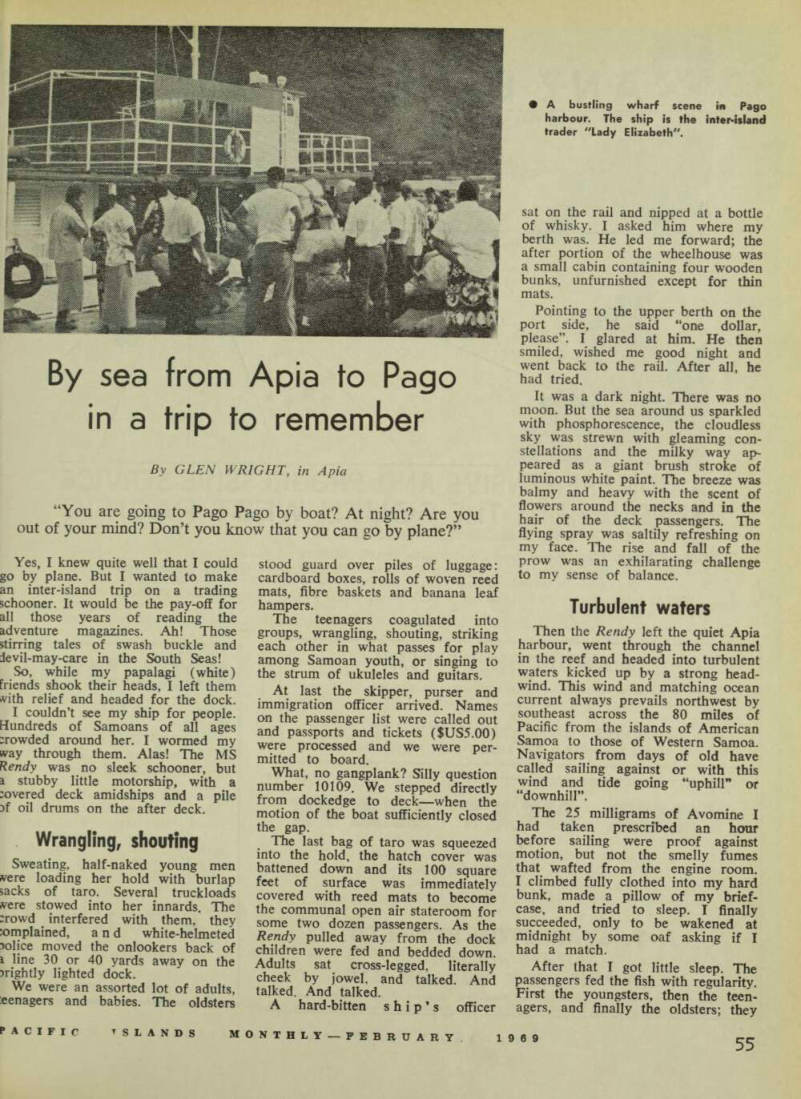
• A bustling wharf scene in Pago harbour. The ship is the inter-island trader "Lady Elizabeth".
They were dressed every which way
would cough, gag, and gurgle and they seldom reached the rail by the third stage. The noise of the retching and the stink of the vomit were unnerving.
As fate would have it, I slept soundly, beginning at dawn, when I should have been up to take photos of the entrance of Pago Pago harbour, justly famous for its beauty. I had especially wanted a colour shot of the Intercontinental Hotel. I wakened to see it slipping by past the port hole, bounded out onto deck in an instant, but by the time I could focus my camera the picture was no longer possible.
Thoroughly irked. I consigned the whole photograph bit to the nether most reaches of hell and went to the wheelhouse to chat with the skipper.
He is a half-caste Samoan and his English is good.
The Ready is 74 ft long and 17 ft at her widest. She was built in 1962 near Apia of native hardwoods. She is powered by three diesel engines turning three propellers. Her maximum speed is 10 knots. But we were overloaded that trip and were 12 hours on the 80 mile “up hill” journey.
No bulkheads
All the Rendy’s area from stem to stern below deck is cargo space; there are no bulkheads so freight is piled right against the hull.
In addition to the cabin I oc cupied there is another, also of four bunks, just abaft of midship. It was unoccupied, and for good reason: it is continually saturated with the oily stench from the engine-room below.
Nowhere on that boat could I find any drinking water or a basin. But there is a toilet, a little wooden shanty of a privy at the edge of the stern, its one-hole bench hung out over the sea.
The morning sun brightly limned the harbour and everything about it.
Rainmaker Mountain (Pioa) was a green tower to our right. Conical thatch roofed fales dotted the slope to the left. The gleaming white, yacht like cruise liner Mariposa was docked just before us. Our little Ready was not much bigger than two of her lifeboats.
Again the pier was a turmoil of laughing, shouting, singing Samoans
and a sprinkling of grinning whites.
They were dressed every which way: the men wore shorts, trousers, the wrap-around skirt called the lava lava with or without shirts, or formal business suits. The girls were delights to the eye in blouses and miniskirts or minidresses, chic frocks or pedal pushers; the women almost univer sally were shapeless and drab in sloppy mother hubbards or blouses and ankle-length black skirts.
The misguided misanthrope who talked the women of the South Seas out of their perfectly appropriate topless grass skirts, and into the un comfortable and ugly hanks of yardage modelled after prudish Vic torian nightgowns should have gone down in a storm at sea on his first voyage.
Where was I? On the Pago Pago pier, waiting for the immigration officers, resplendent in visored police caps with “U.S.A.” emblazened, white shirts, sharply pressed blue trousers and shiny black shoes, to
let us go ashore. A toothless old Samoan, whose flapping lava lava showed that he was tattooed in the traditional fashion from knees to waist, capered zanily about yelling “talofa!” (welcome) and mimicking the announcements of the officers.
Then I was in the village of Pago Pago. Overhead the cable car swung midway between Governor’s Hill and Mt. Alava. But down where I stood all was the squalid ugliness of wooden shanties and store buildings that look like a Hollywood studio replica of a down-at-the-heels western town for a shoot-em-up movie; harsh, black macadam streets; drab, grey concrete sidewalks; beer-can littered beach and smelly automobiles.
I went into a store. It was filled with tourists from the Mariposa.
One of them, a fat man smoking a long, odorous cigar, was looking at a pile of bright sport shirts. “How much are they?” he asked. “They are our best, sir,” replied the pretty Samoan girl clerk, “And only $9.98”.
The tourist’s voice dripped with contempt: “Too cheap. Don’t you have any good ones—you know, the kind that cost $3O or $40?”