Magazine Section
pp. 85-89 · Read in the full issue
WHERE HOUSEGIRLS READ THE "TIMES LIT SUP"
And You Play Golf On Sawdust
By J. Edward Brown
We went to the local Film Society show the other night, and when we came home our housegirl, acting as a baby-sitter, had dozed off to sleep on the floor with the Times Literary Supplement open beside her.
A few short years ago, no house girl would have been able to read the Times Literary Supplement, nor would any housegirl even have thought of reading it. And perhaps this one didn’t understand the Sup plement, but it shows the sweeping changes in Niuean education and ideas.
But housegirls are now almost a dying race on Niue. The age of the “cheap” (how cheap has always been debatable) servant is over. Wages are higher than they have ever been, but girls dont want to be housegirls anymore.
And perhaps because of this, the new houses being built by the Administration on Niue don’t have housegirl quarters—a radical depar ture from previous housing.
However, the new houses are easier run than the old ones. They are smaller, they have solar water heaters and bottled gas stoves. The elimination of the wood stove, which was general in Administration houses, is a move to be approved, because the wood stove almost requires a housegirl of its own to attend it, as well as a garden boy to keep enough wood chopped to feed its hungry fire-box.
Lucky to find one
Everybody used to have two house girls, and I remember a few years ago a worried woman wondering what she was going to do because, tem porarily, she had only one housegirl instead of her usual two. Now she’d be lucky to find one wanting a job.
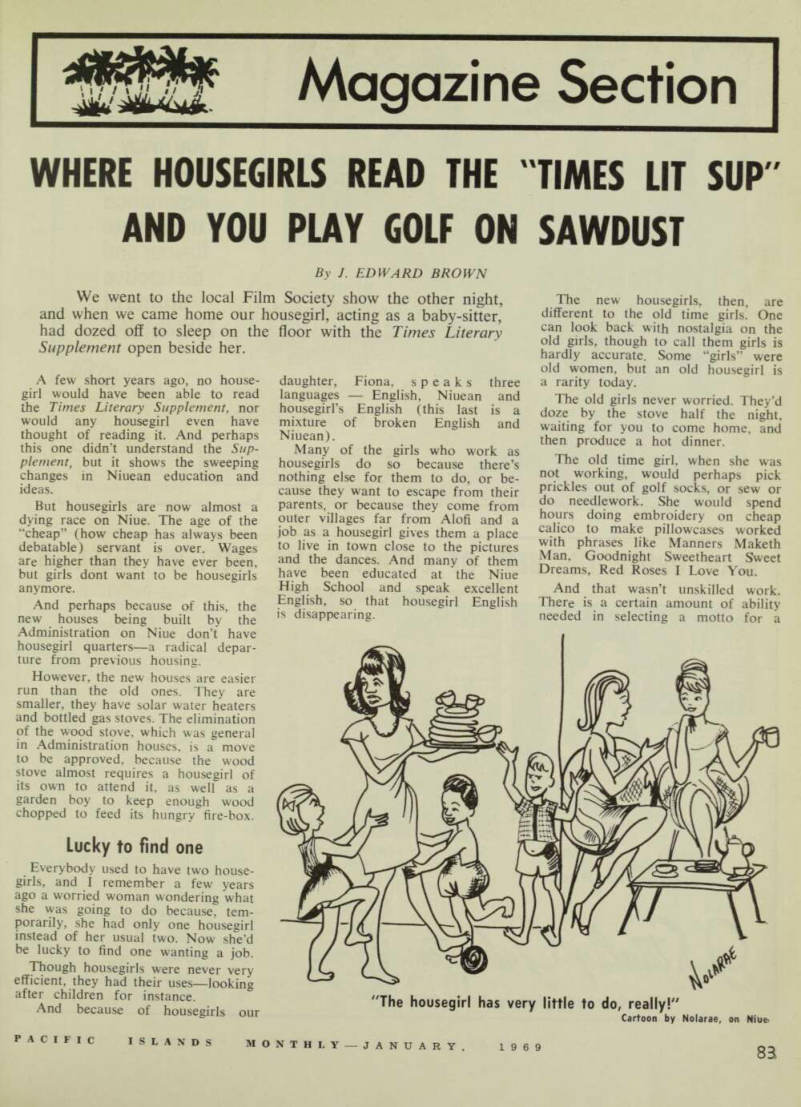
TTiough housegirls were never very efficient, they had their uses—looking after children for instance.
And because of housegirls our
daughter, Fiona, speaks three languages English, Niuean and housegirl’s English (this last is a mixture of broken English and Niuean).
Many of the girls who work as housegirls do so because there’s nothing else for them to do, or be cause they want to escape from their parents, or because they come from outer villages far from Alofi and a job as a housegirl gives them a place to live in town close to the pictures and the dances. And many of them have been educated at the Niue High School and speak excellent English, so that housegirl English is disappearing.
The new housegirls, then, are different to the old time girls. One can look back with nostalgia on the old girls, though to call them girls is hardly accurate. Some “girls” were old women, but an old housegirl is a rarity today.
The old girls never worried. They’d doze by the stove half the night, waiting for you to come home, and then produce a hot dinner.
The old time girl, when she was not working, would perhaps pick prickles out of golf socks, or sew or do needlework. She would spend hours doing embroidery on cheap calico to make pillowcases worked with phrases like Manners Maketh Man, Goodnight Sweetheart Sweet Dreams, Red Roses I Love You.
And that wasn’t unskilled work.
There is a certain amount of ability needed in selecting a motto for a
"The housegirl has very little to do, really!"
Cartoon by Nolarae, on Niue
They thought us mad!
pillowcase. It has to be pithy, mean something, perferably something about love—and fit on a pillowcase.
In addition, the embroidered pillow case shouldn’t be lumpy when you lay your head on it.
All housegirls made those pillow cases, and our children have them on their beds, even though have resisted them. Some households on wash days have embroidered pillow cases waving like signal flags in the breeze—a touching hoist of love messages.
SATURDAY afternoons on Niue are golf afternoons for the ex patriate Europeans. Only a few years ago, when the European community was smaller—so small that it was possible to have a party and invite every European on the island—if you didn’t play golf you were considered almost odd.
In those days, no social function would be scheduled on Saturday afternoon if Europeans were to be invited, because everybody knew the Europeans played golf then.
And they probably then thought— and probably still think—that any body who walks around in the hot tropical sun with a heavy bag of golf clubs, just for pleasure, is mad.
The golf course is on the Fonua kula Prison Farm. Lost balls are retrieved by prisoners who place them on the stone fence by the chief warder’s house for sale back to their owners at 5 cents each. On Niue all players initial their balls with finger nail polish.
The golf course is a par 64, and, by other standards, some of the holes are a little short, but there are hidden hazards.
For instance you do a beautiful drive, high and long, the ball falls gently towards the ground—l pur posely refrain from using the word earth—and it lands on an outcrop of coral and zooms skyward again with increased impetus but at an acute angle and curves over the wall, out of bounds, which of course means a penalty and having to play another ball.
Expensive soft cover, balls don’t last very long; one good hit which happens to land the ball on an out crop of coral and the ball is gashed and unplayable. So cheap balls are the most popular.
Much of the Niue’s golf course is made up from rotted down saw dust and wood shavings, which only
just cover the coral underneath, and golfers are always allowed a “foot place” when hitting off the fairways, which means you can shift the ball a foot in any direction except nearer the hole.
So before people play a shot there is much tapping of the ground to make sure that there is no coral concealed beneath the ball—actions which might horrify purists, but many broken golf clubs testify to the fact that the Niue coral is very hard.
The bunkers are pure sawdust because sand is a very rare com modity on Niue, and also the sand available sets like concrete in bunkers.
Natural golfers
But middle-aged desk men, many of whom didn’t play golf before they arrived in Niue, are no match for the Niueans who play. The Niueans appear to be natural golfers, with beautiful easy swings which send the ball for hundreds of yards. If they started young enough, and were coached, they’d be championship players.
I’ve theorised that their beautiful swings, which in vain I’ve tried to emulate, might be the result of the Niuean’s constant use of the kini, which is a curious implement for cut ting grass. It consists of a long wooden handle on which a piece of steel, often a piece of a strap off a bale of copra sacks, is tied firmly.
The piece of steel is sharpened on
both sides and is bent so that it is parallel with the ground. In use, the grass cutter stands upright and swings the kini backwards and for wards in a rhythmic golf stroke movement that lops the tops off the grass and weeds.
I’ve got a couple of kirns, the blades made from copra sack strap, and they’re ideal for a few idle minutes of effortless grass cutting, though the use of a kini hasn’t im proved my golf at all.
But I’ve often thought there’d be a good market anywhere for kinis, if they were factory made, because they are unlike any gardening tool I’ve seen anywhere else.
I could probably play better golf if I used a kini instead of a club. a brief period on Niue I used to go to work in a truck. Litaio would call for me in a lumbering old yellow Bedford.
I think it was the oldest truck on Niue. It had a warrant of fitness— I’d seen it—but confidence in it; was not engendered when I saw Litaio one day calmly bolting down the steering box at the end of the steering wheel shaft. It had come adrift from the chassis and was floating free.
“Don’t you think you should let the mechanics at the Public Works have a look at it?” I asked.
“Oh no, this is always happening,” he said casually.
I never enjoyed the ride to work
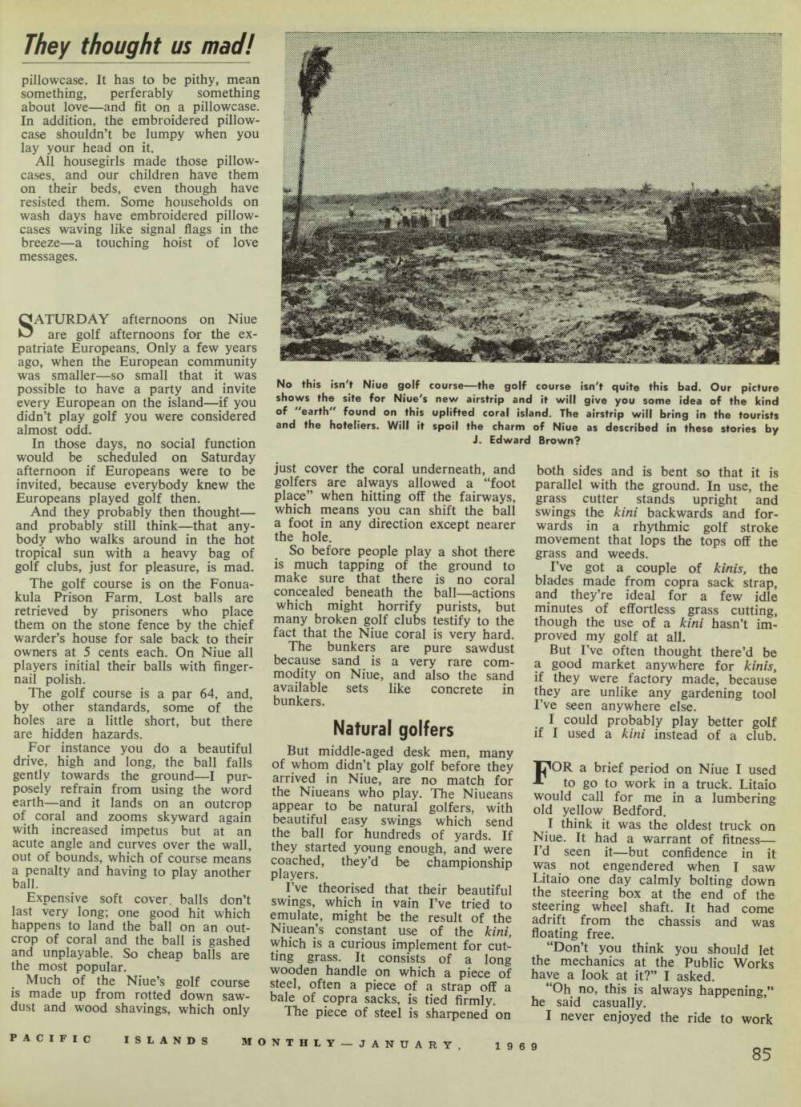
No this isn't Niue golf course—the golf course isn't quite this bad. Our picture shows the site for Niue's new airstrip and it will give you some idea of the kind of "earth" found on this uplifted coral island. The airstrip will bring in the tourists and the hoteliers. Will it spoil the charm of Niue as described in these stories by J. Edward Brown?
through the hordes of school childer 611 . going to Tufukia village school.
Litaio weaved in and out, acceleratmg to reach a top speed (all of 20 mph though it seemed a lot more in the unlined cab of the truck).
The seat was wooden and hard, and though it had once been padded, the cover had long since been torn, and the green foam rubber had escaped m sticky strips which stuck to the passengers clothes like some tr °? l( T p , • And as Litaio sometimes parked the vehicle at home, out in the open, h was sometimes covered in dew, and the only section of the windscreen which could be seen through
the drived “was leaned b°v
the erratic motion'of The etctrically-
in front of the olass nl h rtLfl th n B r’“ f ? it, so mat 1, m the passenger seat, couldn’t see where we were going.
At times, in moments of horror (at some sudden lurch, for instance), I would poke my head out the side window to check that we hadn’t run
over somebody.
Id always thought that Litaio seemed to drive rather fast, but it was hard to judge because the noise from the engine and the rattle of the body tended to cloud judgment.
The speedometer certainly never indicated that we were speeding.
But one day, when Umu, Litaio’s assistant, was coming back from Makefu village after a morning of cutting trees away from the telephone line, he was stopped by the Chief of Police who told him that he was doing 50 mph when the speed limit was 35 mph. Umu protested that he was only doing 35 mph, because that’s what his speedometer said.
The tmck was decked at the Publi c Works Department, and found
Stsdfisd E-Vjtss
on the speedometer equalled 25 m ph for driving through villages. r 6 6 B . 1 told Litaio not to call for me “ the mornings in future, though the condition of the truck wasn’t the reason for this.
One reason was that he always called two or three minute before
I could finish my breakfast in corn fort so that I had to bolt it when the truck roared up to the house, And that was too much like having to hurry to catch the train or bus in some civilised city. And that sort of pressure shouldn’t exist on Niue, But the main reason was that I like to ride my bicycle to work in the mornings.
The early mornings are the best part of the day on Niue. The air is cool and clean, wood smoke curls from early morning cooking fires the Pacific beats lazily on the coral reef below the road, and just off the reef you can see a motionless canoe with a fisherman. that was lost in the bone- Bedford ear - shattenn " ride in the The only disadvantage is that the bicycle had to be ridden home again for lunch at midday. And I usually went back to work in ofWn in my C ar because it’s hot then If orily Y there had been some wav T C Q UId get the bicvcle back h^e without riding it!
As you can see, even on Niue life has its complications.
Lord Howe's Other Forced Landing
PIM's story some months ago about the forced landing of a Fletcher light aircraft on Lord Howe Island brought to light an interesting picture of the only other recorded successful forced landing on Lord Howe —by a Belgian monoplane 18 years ago. It was turned up by Mr. J. McBean, former superintendent of the island, now living in Sydney, and it shows locals surrounding the monoplane on Lord Howe's lagoon beach with Rabbit Island in the background. Our other picture shows the Fletcher making a forced landing in March last year. Lord Howe, of course, has no airstrip—the island is regularly serviced by flying-boats out of Sydney.