Prosperous New Caledonia is happy to he
pp. 75-76 · Read in the full issue
French (but it has some gripes)
From KATHLEEN HANCOCK, in Noumea Rumours kept cropping up all during 1968 about unrest in New Caledonia. The landing of 300 paratroopers in Noumea was publicised in Australia as a move to quell incipient “rebellion”.
Visits of French warships have been termed a “show of force”. A demonstration in a West Coast hamlet against government tardiness in installing a water system was blown up into a call for “independence”.
It’s all a little silly. France has been a naval power in the Pacific these hundred years and more. What is so surprising in a visit to Noumea of French warships on their way to Tahiti’s big naval base? As for para troopers—or any other troops that might be landed in New Caledonia— there aren’t many other French colonies these days where young Frenchmen can put in their 18 months of compulsory military service. Tahiti, Martinique, New Caledonia—you’ve just about named the lot.
"Take it as it conies"
On New Caledonia’s West Coast the Poya district had been petition ing for a water supply for 20 years.
But in this mineral-rich country, any thing not directly to do with mining tends to be overlooked—indefinitely.
However, the necessary funds were requisitioned by government two years ago. Time passed, still the good citizens of Poya had no water supply. So the local gentry staged a demonstration. It was hardly the harbinger of bloody revolution!
The man in the street in Noumea —European, Melanesian, Tahitian, Martiniquais, Vietnamese, Soamli, Arab—responds to rumours of this sort with little more than a shrug of the shoulders. He certainly has
his gripes about local affairs. But from the political left to the political right—and the distance in New Cale donia isn’t very great—all parties want to remain within the French Union.
Among the discontent to be found in New Caledonia is dissatisfaction with the French Government’s failure to encourage exploitation of low grade nickel deposits. But the permission recently granted foreign concerns to enter this field has done a lot to allay this. Up-country farmers and planters erupt periodic ally over government’s failure to improve roads and install essential services (such as that water incident), and they have a genuine grievance in this wealthy country.
There is grumbling about the
neglect of agriculture. But both the country’s great mineral resources and the Melanesian system of com munal land tenure work against any encouragement the government might give to agricultural development.
You have to look very hard indeed in New Caledonia to find a farmer who relies solely on farming for a living or does anything to improve his property or his stock. His at tention is always diverted from farm ing to mining, where the return averages about 30 per cent, on the investment. And all you need is a bulldozer and a few trucks.
"Sensible fellows"
It’s not hard to see how the hard graft of agriculture might come off second best in a situation like this, which is compounded by the difficulty of getting casual labour away from mining or the sweet life of communal living.
Time was when the gendarmerie, those hard-eyed cops-cum-soldiers who are sent from France to keep
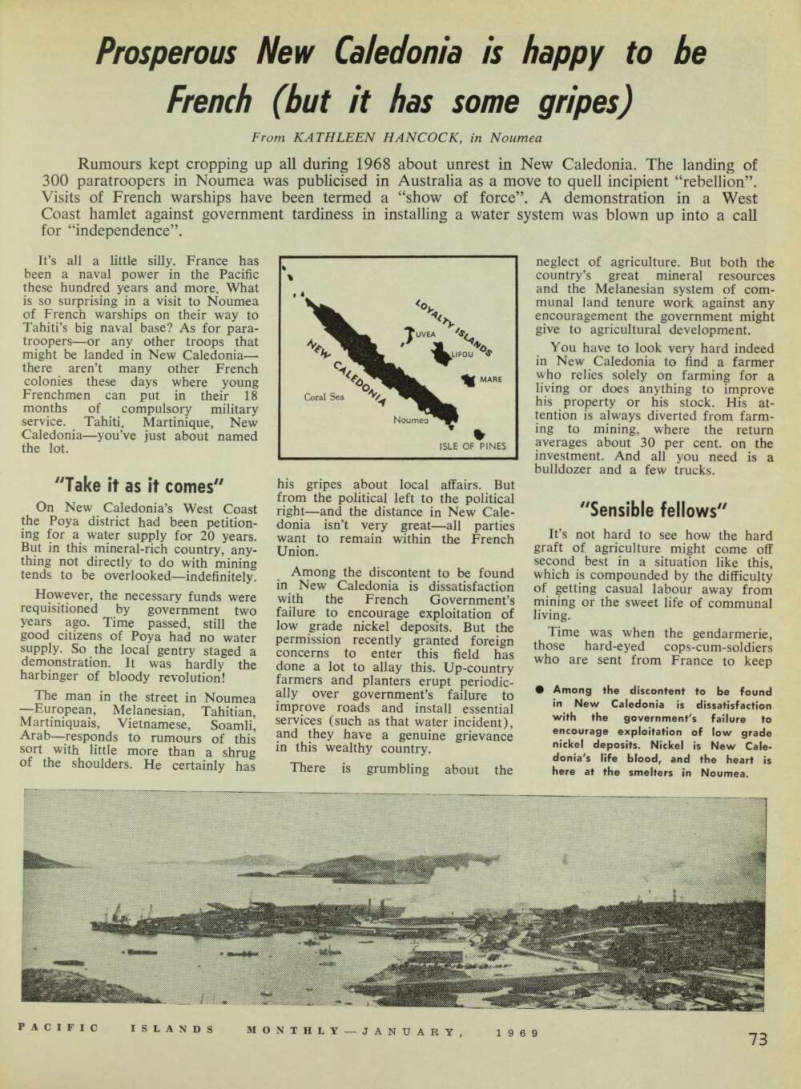
• Among the discontent to be found in New Caledonia is dissatisfaction with the government's failure to encourage exploitation of low grade nickel deposits. Nickel is New Cale donia's life blood, and the heart is here at the smelters in Noumea.
order in the New Caledonian countryside, were detested by all right-thinking “colons”. But your New Caledonian is a sensible fellow, really. It didn't take him long to realise that in a country where everyone is somebody’s cousin, or uncle, or brother-in-law, a non-in volved peace-keeping body is an es sential part of law and order. And even the working-class Union Cale donienne party has a kind word to say for the gendarmerie these days.
Social security
There’s no income tax on this carefree island—the fruits of your labour are for the most part all yours. There are, of course, indirect taxes and heavy duties on imported goods, but social security is largely provided for by a pay-roll tax paid by employers. So it’s not surprising that the lone socialist Assemblyman, Mr. Alain Bernut, finds that his call for this hardly revolutionary form of taxation falls on deaf ears.
Even the rank and file of the European-Melanesian Union Cale donienne cannot get excited over this idea. They probably have a weather eye on some day not too far in the future when they, too, might have to fork out income tax themselves.
New Caledonians have quite a comprehensive system of social security and their family allowance is a fine, fat sum. Parents receive 5A5.25 per child—that is, all parents who are neither employers nor self employed. Neither of the two latter classes is eligible for any other kind of social security either, so it’s easy to see why the New Caledonian wage-earner can’t get particularly wrought up over Mr. Bernut’s cry for social justice. He’s got a goodly portion of it already. In fact, any
revolution likely to erupt in this comfortable country would seem to have more chance of originating within the capitalist classes than among the wage-earning section of the community.
All New Caledonians, of whatever race, in whatever income bracket, have got it good these days—with high wages, no income tax, social security, workers’ housing schemes, and the magnificent sports facilities that the South Pacific Games brought to Noumea.
Tourism is booming—nickel prices are good. But in spite of all this material prosperity, these French colonials would like to get their hands on more of the rich profits being harvested from their mountains by the big nickel companies.
However, they’re in a difficult spot. As French citizens, with universal franchise and the right to elect their own representative to the French parliament, they don’t really have a leg to stand on. Through their elected representatives in Paris, they already have as much say in con trolling their own affairs as any citizen of metropolitain France has in controlling his.
New Caledonians of all parties turn their faces against closer ties with France—they don’t want any more “departmentalisation”. But they don’t want independence either. They are happy for the most part with the judiciary, the gendarmerie and the strong defence force that pro tects their small but rich island.
But they’d like to have more con trol over local affairs and more say in matters like the nature and extent of secondary education in the ter ritory. They want to be protected by the mother country but they want to do their own taxing and spending.
They want to have their cake and eat it. In a word—they’re human.
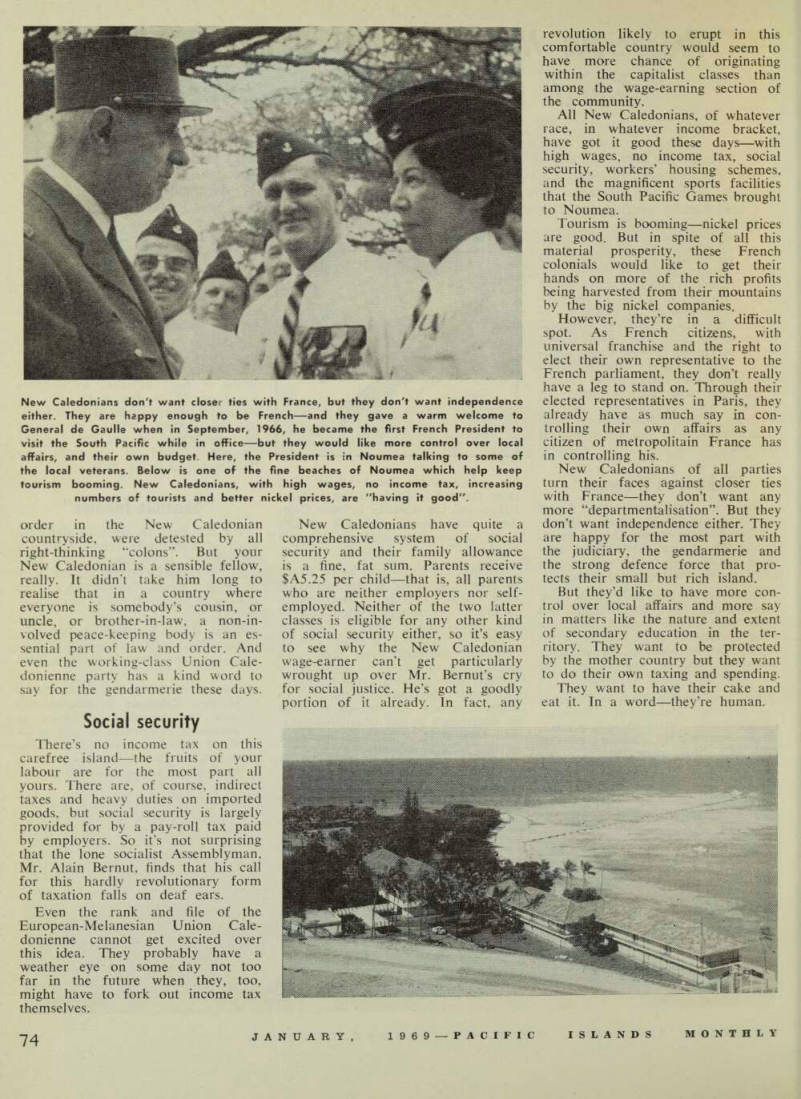
New Caledonians don't want closer ties with France, but they don't want independence either. They are happy enough to be French—and they gave a warm welcome to General de Gaulle when in September, 1966, he became the first French President to visit the South Pacific while in office—but they would like more control over local affairs, and their own budget. Here, the President is in Noumea talking to some of the local veterans. Below is one of the fine beaches of Noumea which help keep tourism booming. New Caledonians, with high wages, no income tax, increasing numbers of tourists and better nickel prices, are "having it good".