Of Norfolk
pp. 90-91 · Read in the full issue
Solved And
Unsolved
Mysteries
Of Norfolk
Island
By Merval Hoare
Norfolk Island, which is as rich in history as any other island in the South Pacific, has its share of minor mysteries. Recently one mystery was solved and another partially solved, but there are plenty of others left. A newly-formed body is the Norfolk Island Historical Society, whose members plan to investigate some of these mysteries.
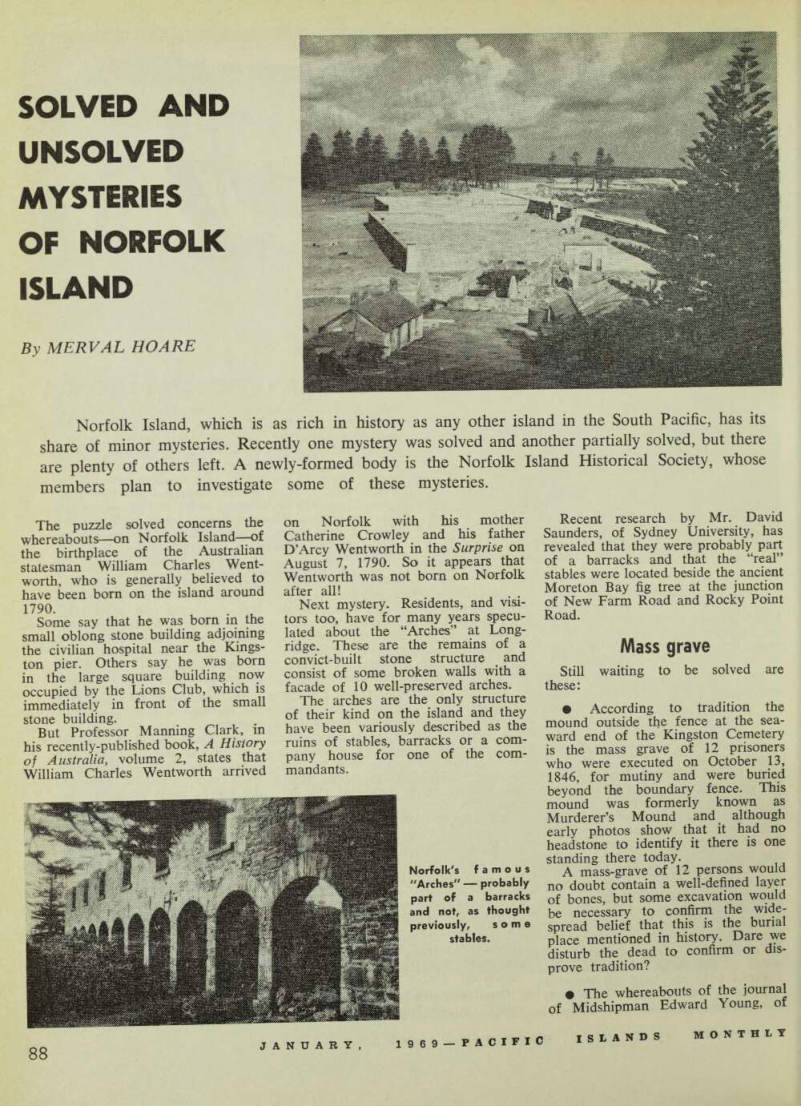
The puzzle solved concerns the whereabouts —on Norfolk Island—of the birthplace of the Australian statesman William Charles Went worth, who is generally believed to have been born on the island around 1790. . L Some say that he was born m the small oblong stone building adjoining the civilian hospital near the Kings ton pier. Others say he was born in the large square building now occupied by the Lions Club, which is immediately in front of the small stone building.
But Professor Manning Clark, in his recently-published book, A History of Australia, volume 2, states that William Charles Wentworth arrived
on Norfolk with his mother Catherine Crowley and his father D’Arcy Wentworth in the Surprise on August 7, 1790. So it appears that Wentworth was not born on Norfolk after all! . .
Next mystery. Residents, and visi tors too, have for many years specu lated about the “Arches” at Long ridge. These are the remains of a convict-built stone structure and consist of some broken walls with a facade of 10 well-preserved arches.
The arches are the only structure of their kind on the island and they have been variously described as the ruins of stables, barracks or a com pany house for one of the com mandants.
Recent research by Mr. David Saunders, of Sydney University, has revealed that they were probably part of a barracks and that the “real” stables were located beside the ancient Moreton Bay fig tree at the junction of New Farm Road and Rocky Point Road.
Mass grave
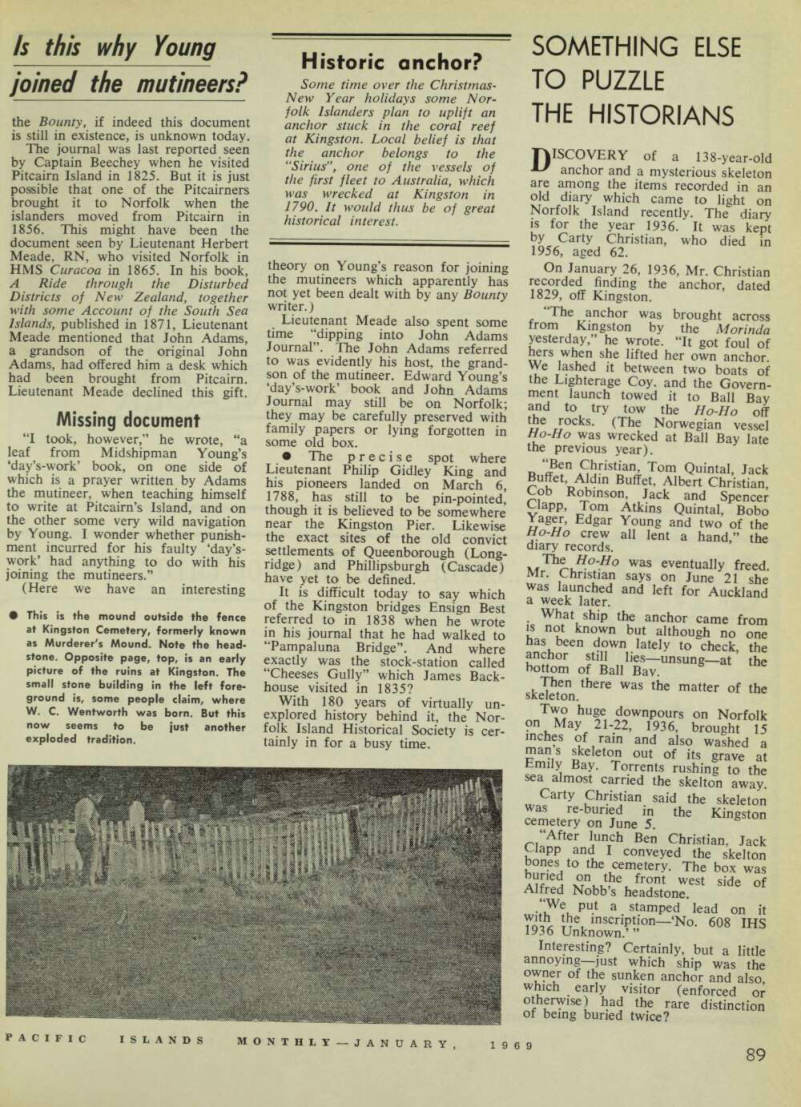
Still waiting to be solved are these: • According to tradition the mound outside the fence at the sea ward end of the Kingston Cemetery is the mass grave of 12 prisoners who were executed on October 13, 1846, for mutiny and were buried beyond the boundary fence. This mound was formerly known as Murderer’s Mound and although early photos show that it had no headstone to identify it there is one standing there today.
A mass-grave of 12 persons would no doubt contain a well-defined layer of bones, but some excavation would be necessary to confirm the wide spread belief that this is the burial place mentioned in history. Dare we disturb the dead to confirm or dis prove tradition? • The whereabouts of the journal of Midshipman Edward Young, of
Norfolk's famous "Arches"-probably part of a barracks and not, as thought previously, some stables.
Is this why Young joined the mutineers?
the Bounty, if indeed this document is still in existence, is unknown today.
The journal was last reported seen by Captain Beechey when he visited Pitcairn Island in 1825. But it is just possible that one of the Pitcairners brought it to Norfolk when the islanders moved from Pitcairn in 1856. This might have been the document seen by Lieutenant Herbert Meade, RN, who visited Norfolk in HMS Curacoa in 1865. In his book, A Ride through the Disturbed Districts of New Zealand, together with some Account of the South Sea Islands, published in 1871, Lieutenant Meade mentioned that John Adams, a grandson of the original John Adams, had offered him a desk which had been brought from Pitcairn.
Lieutenant Meade declined this gift.
Missing document
“I took, however,” he wrote, “a leaf from Midshipman Young’s ‘day’s-work’ book, on one side of which is a prayer written by Adams the mutineer, when teaching himself to write at Pitcairn’s Island, and on the other some very wild navigation by Young. I wonder whether punish ment incurred for his faulty ‘day’s work’ had anything to do with his joining the mutineers.” (Here we have an interesting
theory on Young’s reason for joining the mutineers which apparently has not yet been dealt with by any Bounty writer.) Lieutenant Meade also spent some time “dipping into John Adams Journal”. The John Adams referred to was evidently his host, the grand son of the mutineer. Edward Young’s ‘day’s-work’ book and John Adams Journal may still be on Norfolk; they may be carefully preserved with family papers or lying forgotten in some old box. • The precise spot where Lieutenant Philip Gidley King and his pioneers landed on March 6, 1788, has still to be pin-pointed, though it is believed to be somewhere near the Kingston Pier. Likewise the exact sites of the old convict settlements of Queenborough (Long ridge) and Phillipsburgh (Cascade) have yet to be defined.
It is difficult today to say which of the Kingston bridges Ensign Best referred to in 1838 when he wrote in his journal that he had walked to “Pampaluna Bridge”. And where exactly was the stock-station called “Cheeses Gully” which James Back house visited in 1835?
With 180 years of virtually un explored history behind it, the Nor folk Island Historical Society is cer tainly in for a busy time.
• This is the mound outside the fence at Kingston Cemetery, formerly known as Murderer's Mound. Note the head stone. Opposite page, top, is an early picture of the ruins at Kingston. The small stone building in the left fore ground is, some people claim, where W. C. Wentworth was born. But this now seems to be just another exploded tradition.