The Editor's Mailbag
pp. 58-59 · Read in the full issue
Aircraft Restoration
Sir, —After reading letters to PIM over the past few issues dealing with the recovery and restoration of war time aircraft in Papua-New Guinea, as well as the north British Solomons, I feel I should clarify some of the misconceptions about aircraft finding their way to Port Moresby, apparently to the annoyance of persons in other parts of this territory.
As chairman of the Air Museum of Papua and New Guinea, I want to point out—from bitter experience —that the lifetime of discovered air craft is directly in proportion to the number of persons who gain access to them, to strip them for souvenirs or because of pure vandalism. Our air museum, though based in Port Moresby, is devoted to the recovery and full restoration of as many of these valuable relics as possible, no matter where they may be.
Two years ago we obtained salvage rights to the Kavieng Zero mentioned by Mr. Victor Chapman {PIM, Dec., p. 11) and considered that its con dition at Kavieng was such that with in a short time the aircraft would be little more than scrap. However, in Melbourne, a young man with an almost superhuman ability to restore aircraft, had offered to exchange a rare CAC “Wirraway” (A2O-13) for this machine. Now, whereas we have a number of Zeros left, a valuable wartime relic has been obtained for the territory (NOT Port Moresby, Mr. Chapman) and will take its place alongside other historic aircraft, such as the P47D Thunderbolt and the Lockheed Lighting. By 1970 the air museum will have a Ford Trimotor, a P 39 Airacobra, a Zero, a Tiger Moth, as well as civilian aircraft such as the DH Dragon, and a replica of the Curtis “Seagull”—the first aircraft to fly in the territory.
The Canadian, Mr. Robert Diemert, whom we have materially assisted in the recovery of a “Val” divebomber and three Zeros, obtained these machines because he has proved him self capable of turning a pile of wreckage into a flying relic. If he had been only interested in the planes for monetary gain, he would not have received our co-operation.
The Air Museum of Papua and New Guinea has at no time received one cent from the Administration to help in recovery, restoration and ex hibition costs. We are not a profit
making organisation and have borne every cost for our past work, and will probably continue to pay for all our future efforts.
The reason the group operates in Port Moresby is primarily because the people capable of such an im mense undertaking live in Port Moresby. If we lived elsewhere we would do the same thing there. We have tried to avoid friction with other centres as much as possible by first determining if any other organ isation could attempt a similar scheme in its own locality. Where it is obvious that no restoration can be under taken on the spot, every effort is made to bring the planes to Moresby, where we can guarantee them a home.
This sometimes means we exchange duplicate aircraft for unprocurable relics elsewhere.
We are NOT a “bureaucracy”, as was suggested by my namesake in his letter, but a collection of dedicated individuals who are determined to keep those aircraft in the territory, and find a “happy home” for those we cannot restore and display.
We have land, we own our own building and equipment, we have rapidly acquired skills and a tremend ous fund of knowledge of restora tion, and we have worked hard over two years with no thanks or personal reward. If anyone wants to know just how hard we’ve worked they may like to send for our newsletter, which devotes a lot of space to re covery and restoration projects. We pay for the postage and printing costs!
I feel that it is much easier to complain about the motivations of others in this world than it is to roll up the sleeves and get stuck into the job of remedying the complaint.
Our little air museum in Port Moresbv could be duplicated else where in Papua and New Guinea, if only the talkers could get off their posteriors, race into the hills, islands and swamps, and start working. Then we may sympathise with their com plaints.
Until then we will continue to work, quietly preserving our aviation heritage.
Bill Chapman.
Chairman, Air Museum of Papua and New Guinea.
Box 844, Port Moresby.
Kavieng's Zero
Sir, —I refer to your photograph of a Japanese Zero aircraft at Kavieng {PIM, Oct., p. 36) and to a letter {PIM, Dec., p. 11) from Mr, Victor Chapman. Mr. Chap man and other readers may be interested in the following informa tion regarding this or another Zero aeroplane from Kavieng.
In June, 1968, 1 was a passenger aboard Bank Lines MV Crestbank.
We arrived at Kavieng to load copra on June 11, and while loading pro ceeded, members of the crew and myself had a good look around the area.
One thing that attracted our attention was a damaged, but still in reasonably good condition, Zero aeroplane stored behind some sheds belonging to the CWD.
On June 18 this very same plane arrived wharfside and was loaded onto No. 3 hatch of the Crestbank.
Unfortunately I left the ship on the afternoon of the 18th but I be lieve the plane was destined for Melbourne for restoration.
The above information conflicts somewhat with Mr. Chapman’s account of the movements of this plane from Kavieng, but some other reader may be able to clarify the subsequent movements of this plane after off-loading from the Crestbank.
John O’Brien.
Pennant Hills,
Nsw.
Deportation Of Kanakas
Sir, —Readers of PIM may have read an “eyewitness” account in the Sydney Morning Herald, November 2, of the deportation of “shackled”
Kanakas from Cairns in 1907, and also the subsequent letters in the Herald denying the accuracy of this account. As another eyewitness, 1 would like to add my voice to those who have denied that the Kanakas left Australia in shackles.
As a supercargo with Burns Philp from 1902 to 1915 I accompanied many a shipload of Kanakas from Queensland, and I can fairly say that I never saw a happier lot of people.
On one trip on the Titus we had on board a full Salvation Army band.
We landed them at Mai, in the New Hebrides.
The writer of the Herald article mentioned hearing a siren blow as the steamer with the Kanakas on board went down the bay and headed for open sea, yet none of the BP vessels (which handled the repatria tion of Kanakas) had sirens.
The writer also goes on to state
that as the Kanakas boarded the vessels in irons one bystander referred to them as “black bastards”.
The only bastard I ever saw in irons was not black but white. He was a pirate named Joseph Mortelmans who murdered the captain and the mate of the schooner Nuevo Tigre in 1907 (PIM, August, p. 81).
I have made investigations to back up my sure recollection that the Kanakas deported from Queensland were not in irons. I recently wrote to Mr. David Burns, chairman of Burns Philp and Company Ltd., to see if he could provide me with further information on this matter from his Cairns branch. Mr. Burns wrote to the manager of his Cairns office, Mr. Taylor, who sent him a report which bears out what I have said.
Mr. Taylor’s report is based on an examination of Cairns newspaper files for early 1907. He writes: “No less than four articles appeared during the period January 21 and mid-February, 1907, specifically re ferring to the deportation of Kanaka labour and referring in particular to the party of 256 which travelled by Malaita, leaving Cairns on January 25.
“None of the articles gives any indication that the movements of the Kanakas was in any way restricted.
In fact it is to be construed from one of the articles . , . that they were permitted to walk about at will awaiting deportation.”
The article to which Mr. Taylor refers (from the Morning Post, now the Cairns Post, of January 25, 1907) described the attempted as sault on a nursing sister, and con cluded with the following: “There are a large number of Kanakas camping in the vicinity of Parramatta and the Soap Works awaiting deportation and while they are there a special patrol should be in the vicinity at night”.
Thus the Morning Post implied that the Kanakas were so free to walk about that one of them could have been responsible for the as sault. The newspaper could hardly have made such an implication had the Kanakas been in irons!
Incidentally, the Morning Post of February 1, 1907 reported: “No apprehension is felt by the officers of the Department of External Affairs (says Tuesday’s Argus) that the deportation of Kanakas from Queensland will be attended by bloodshed when the returned “boys” meet the stay-at home natives of the Pacific Islands.
It is pointed out that on some islands
there is always more or less fighting but the Kanakas who are being deported will adopt the usual means well known to them of testing the probable nature of their reception before they land at any of the islands.
In some cases it is true that there are long-standing scores to be adjusted against the men who are being returned and that the in habitants of the islands who have long memories on these matters will take steps to avenge old wrongs. As to these and other possibilities the officials say that the natives have so far lodged no complaints and they have not in the past shown any dis position to accept their grievances ‘lying down’,”
Neville Chatfield.
Killara, Sydney. • Many thanks to Mr. Chatfield, who in earlier days wrote for PIM under the name of “Supercargo”.
He is now 84.
Ngvr Names
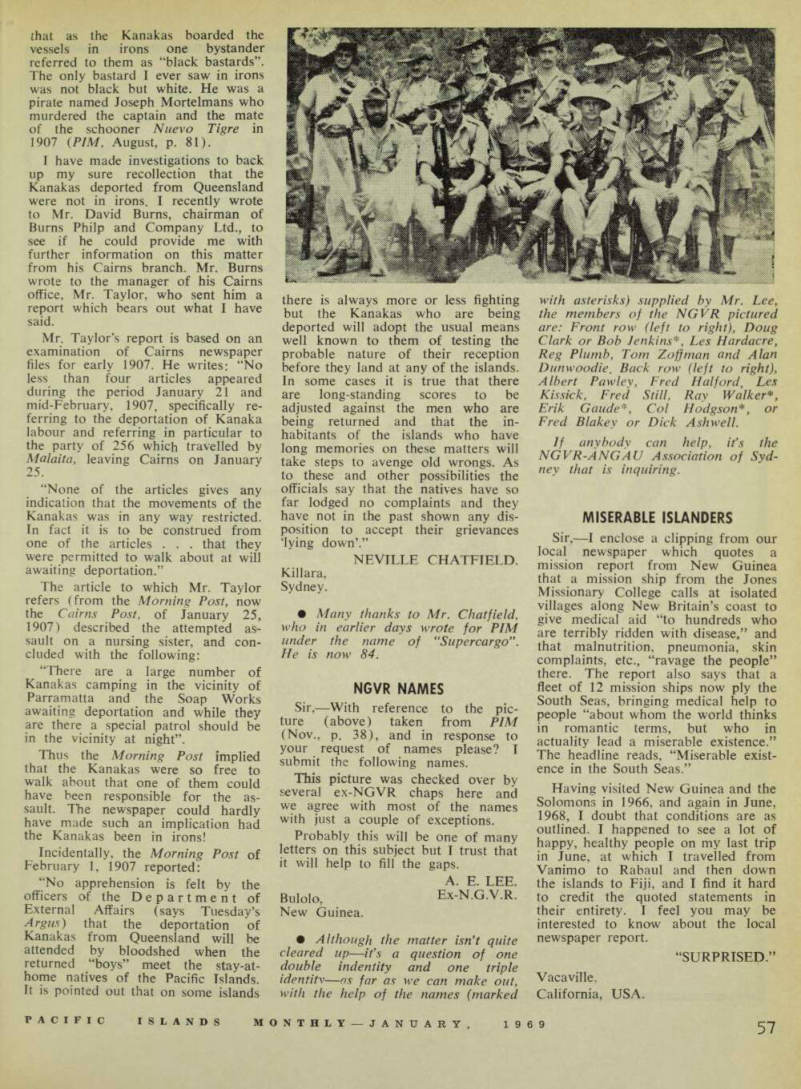
Sir, —With reference to the pic ture (above) taken from PIM (Nov., p. 38), and in response to your request of names please? I submit the following names.
This picture was checked over by several ex-NGVR chaps here and we agree with most of the names with just a couple of exceptions.
Probably this will be one of many letters on this subject but I trust that it will help to fill the gaps.
A. E. Lee.
Ex-N.G.V.R.
Bulolo,
New Guinea. • Although the matter isn’t quite cleared up — it’s a question of one double indentity and one triple identity—ns far as we can make out, with the help of the names (marked
with asterisks) supplied by Mr. Lee, the members of the NGVR pictured are: Front row (left to right), Doug Clark or Bob Jenkins*, Les Hardacre, Reg Plumb, Tom Zoffman and Alan Dunwoodie. Back row (left to right), Albert Pawley, Fred Halford, Les Kissick, Fred Still, Ray Walker*, Erik Gaude *, Col Hodgson*, or Fred Blakey or Dick Ashwell.
If anybody can help, it’s the NGVR-ANGAU Association of Syd ney that is inquiring.
Miserable Islanders
Sir, —I enclose a clipping from our local newspaper which quotes a mission report from New Guinea that a mission ship from the Jones Missionary College calls at isolated villages along New Britain’s coast to give medical aid “to hundreds who are terribly ridden with disease,” and that malnutrition, pneumonia, skin complaints, etc., “ravage the people” there. The report also says that a fleet of 12 mission ships now ply the South Seas, bringing medical help to people “about whom the world thinks in romantic terms, but who in actuality lead a miserable existence.”
The headline reads, “Miserable exist ence in the South Seas.”
Having visited New Guinea and the Solomons in 1966, and again in June, 1968, I doubt that conditions are as outlined. I happened to see a lot of happy, healthy people on my last trip in June, at which I travelled from Vanimo to Rabaul and then down the islands to Fiji, and I find it hard to credit the quoted statements in their entirety. I feel you may be interested to know about the local newspaper report.
“Surprised.”
Vacaville, California, USA.