To the Point
pp. 54-57 · Read in the full issue

Has The Concept Of Attracting Overseas
SKILLS TO P-NG GOT OUT OF HAND?
Niugini as a national name did not win acceptance by the P-NG House of Assembly at its November meeting. There was a variety of reasons for this, and its non-adoption should not be in terpreted as a rejection. Anyway, until someone comes up with a better idea or until a new national name wins official acceptance, I propose for the purpose of this column to use “Niugini” as a convenient shorthand for “Papua and New Guinea” and “Niuginian” for Papuan and/or New Guinean.
During the last few years I have been roped in with increasing fre quency to speak at a variety of functions school prize givings, annual meetings and so on. I have even figured as an after-dinner speaker. People seem to have decided that I can be relied on to be reasonably brief and not too dull.
The occasions which have taken me furthest off my “beat”, but which I have nevertheless found to be among the most interesting and stimulating, have been those on which I have been invited to talk to groups of people involved in the training of Niuginians for advance ment in the fields of commerce, in dustry and public utilities.
My assignment has been to talk about the cultural backgrounds from which the trainees come, and the implications of those backgrounds for training programmes. Not only have I enjoyed these assignments, but I have been most impressed with the keenness of the people engaged in this kind of work.
This represents a major revolution in thinking. For decades private
To the Point with Percy Chatterton
enterprise in Papua, and the Admini stration too for that matter, was bogged down in what might be called the “tea-boy” era. The function of the Papuan in an office was to go round to the Post Office to collect the mail, and then to make cups of tea or coffee and carry them round to the Europeans at their desks. (In earlier days it was always tea; with the advent of “instant” coffee, habits have changed).
At other times he might be called on to bring a needed file from the filing cabinet to the desk at which
it was needed and later to return it to its place. That, and the running of sundry messages, was about as far as he went.
If he worked in a retail store his principal task was to reach for items from shelves and hand them to the European salesman or saleswoman, to tie up parcels, and perhaps to carry them out to the customer’s car.
In the bulk store he man-handled the bulkier and heavier items. In the workshop he handed the right, or perhaps more often the wrong, tool to the European mechanic.
Nothing wrong in all this. Many English and Australian school-leavers have started their careers in such jobs. But these Papuan lads were liable to find themselves doing them for the rest of their working lives with little chance of advancement.
Menial tasks
It is fair to say that this situation was in part due to the very rudi mentary education which most Papuans received in those days. But in part it was due to a mental attitude which regarded it as unfitting that Papuans should be allotted any but menial tasks. As a result even the small advances towards know how and responsibility which they might have made were not made.
In the last few paragraphs I have written “Papuan” because my own experience has been of Papua. But from my contact with ex-New
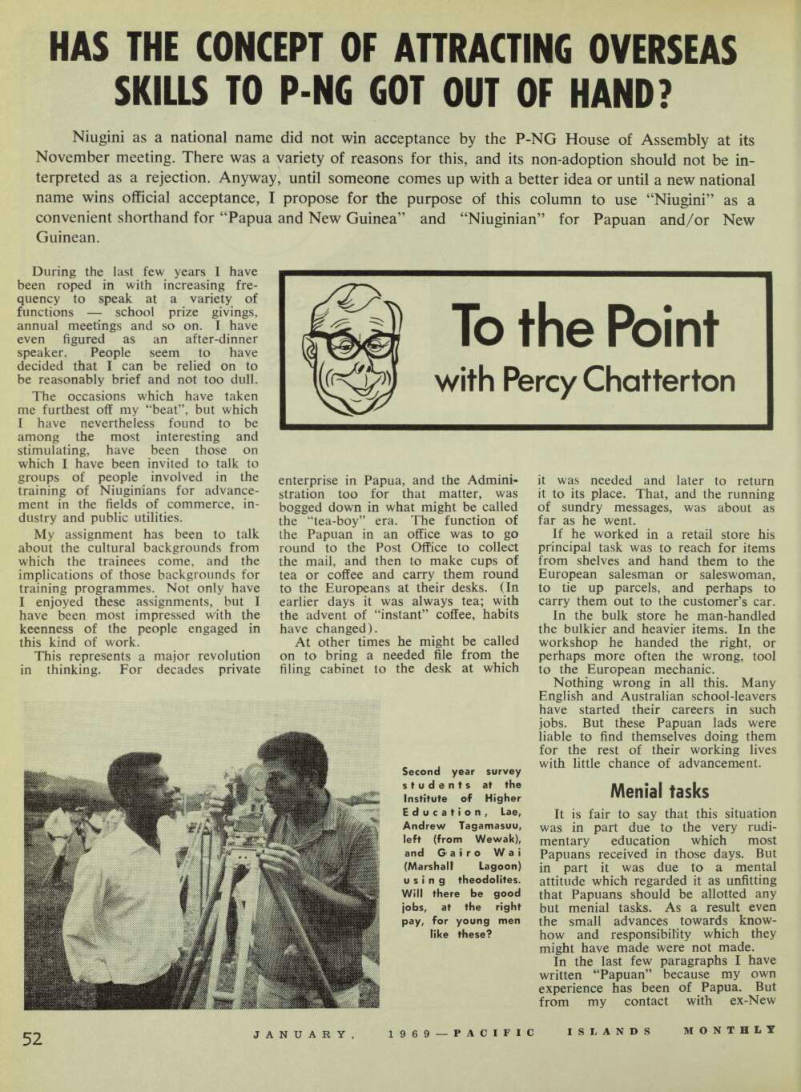
Second year survey students at the Institute of Higher Education, Lae, Andrew Tagamasuu, left (from Wewak), and Cairo Wai (Marshall Lagoon) using theodolites.
Will there be good jobs, at the right pay, for young men like these?
Guinea types during the war years I should think that what I have written would be at least as applic able to New Guinea as it was to Papua. 1 still remember, almost with incredulity, the tight-lipped gentle man who would not allow Papuans to speak to him in English. It was impertinent, he said. If they couldn’t talk pidgin they must speak to him through an interpreter.
"Impressive"
How things have changed! Even if localisation of the Public Service has not gone ahead as quickly as some would have liked, the figure of 600 Niuginians in the second division, given at a recent graduation ceremony at the Administrative College, is quite impressive. The figure of 13,000 Niuginians in the third division, given on the same occasion, is perhaps a bit misleading.
Nearly half of these are former administration servants who had already been working for the govern ment for years and who, when they were transferred to the Public Service, just went on doing the same jobs under a new umbrella.
In private enterprise there is an alertness, at least as great as that in the public sector, to the need for providing training which will enable Niuginians to advance themselves to positions of expertise and respon sibility.
Recently I expressed the view that firms which are doing this sort of thing should get more than just a pat on the back. They should re ceive a recognition of current effort, and an encouragement to further effort in the form of a tax rebate based on the percentage of their total payroll paid to indigenous staff. The bigger the percentage, the more generous the rebate should be.
As far as I know, no one has taken the slightest notice of this suggestion, which I still think to be a good one.
Putting ideas across
Perhaps this is partly my own fault, because at the same time that I made it I also put forward another suggestion which had better news value. I pointed out that while there were many areas of economic development in which overseas know how and capital were essential, there were already a few areas (and would presently be more) in which Niuginians could go it alone, and in those areas it might be desirable to give them some measure of protec tion from unfair competition by
expatriate enterpreneurs.
To this idea I incautiously applied the tag “Black New Guinea Policy”, which of course hit the headlines and brought down all sorts of recriminations on my head. I was accused of being a stirrer-up of racial hatred and goodness knows W t '• It is difficult to see why the phrase “Black New Guinea Policy” should be more provocative of racial hatred than the phrase “White Australia Policy”.
It is also difficult to see in what essential way my proposal, which suggested as a modest beginning giving indigenes preference over expatriates in obtaining licences to operate village trade stores, differs from the established policy of giving preference to indigenous applicants for positions in the Public Service if their qualifications are as good as those of expatriate applicants. Yet, so far as I am aware, no one has accused Public Service Commissioner Somers of being a stirrer-up of racial hatred.
My only regret at having made this suggestion is that it distracted attention from the less news-worthy but perhaps more considerationworthy one of granting tax concessions to companies which are
pulling their weight by involving indigenes in their operations at all levels.
But let us look a little more closely at this matter of racial “hatred”. I know very few Papuans (I can’t speak for New Guineans though I hope that what I am saying is true for them too) who hate white men for being white. ni i r Problems 0T race J know rather more Europeans uate, or at any rate despise, br .9, wn me n for being brown—but not ar^e num bers of them, TboBe ™ ho do 80 are mainly men ° f low . level skills who realise that they Wlll be amon g the first to be come redundant as Niuginians take over . . Jobs - The l ess . the real superiority, the more strident the efforts to assert it.
Basically the problem of race relations is one of economics, not of skin colour. The real tension is not between white and brown but be tween have and have-not. Unfor tunately the present situation in Niugini is that nearly all the have’s have white skins and nearly all the have-not’s have brown ones, Nearly all, not quite. A few of
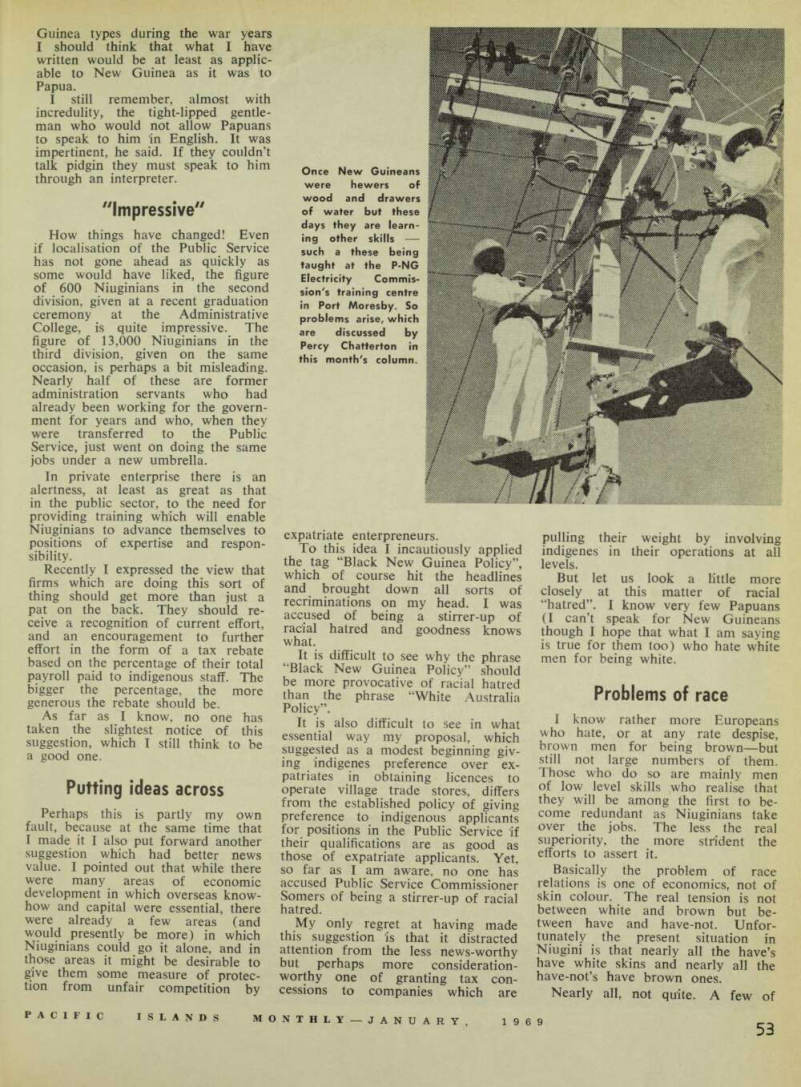
Once New Guineans were hewers of wood and drawers of water but these days they are learn ing other skills such a these being taught at the P-NG Electricity Commis sion's training centre in Port Moresby. So problems arise, which are discussed by Percy Chatterton in this month's column.
Basically, race relations are economic
the best paid Papuans are better paid than the lowest paid Europeans, and I am told that there are some quite wealthy New Guinean agri culturists. But not many. The resultant differences in living stan dards form an ever-present irritant.
As I see it, the way to avoid these tensions hardening into real racial “hatred” is not to waffle about our being all brothers under the skin or about a partnership of white and brown in developing the territory, but to increase as rapidly as possible the area of overlap in which whites and browns are receiving roughly the same sort of remuneration and en joying roughly the same standard of living.
This can be tackled from both ends: first, by increasing the number of Niuginians who are worth, and receive, higher pay levels; second by increasing the number of Euro peans willing to accept lower pay levels, in other words—volunteers.
I am not starry-eyed about volunteers. I recognise their limita tions. But most, if not all, of those limitations are shared by short-term overseas employees at any pay level.
And I feel quite sure that the value, during the next few critical years, of having substantial numbers of Europeans in the “overlap” group could be very great indeed.
I wonder whether the time has not come to take a hard look at some of the demands made by some ex patriates as the price of their par ticipation in the development of the territory.
Since the period of post-war reconstruction and development be gan, we have constantly been told
that to attract from overseas the skills we need to develop the terri tory we must offer inducements in the form of generous salaries and liberal working conditions. At the start this seemed fair enough, and was accepted by most Niuginians as a price which must be paid for the development of their country.
Has the concept got out of hand?
Has it become a racket, even a species of blackmail?
Demands for more pay and more perks come in a steady stream; and with them what sound rather like threats. “If you don’t give us what we’re asking for we’ll pack up and go”. “You must make it worth our while to stay”. “We can do as well for ourselves, if not better, in Aus tralia”.
I wonder how true that last one is. It probably is true of those with the top level skills. But is it true of those a bit further down the scale of skills? If so, why are some of them so touchy about the possibility of having their present jobs taken over by Niuginians? Why are they clamouring for a golden handshake as the price of their departure? (I am not against a golden hand shake for those who have served the territory faithfully and well. I am merely concerned with pointing out
the discrepancy between two lines of argument.) At the same time that these claims are being made and acceded to, Niuginians are being told that their pay and perks must be kept at a level which, blessed phrase, “the economy of the country can afford”.
Patient people
Niuginians are among the most patient and tolerant of people. I never cease to be glad that I have spent my life among them. But don’t let us strain their patience and their tolerance too far. Above all, let us be sure that the arguments we use, especially the arguments we use to maintain a favourable situa tion for ourselves, are arguments which will stand up to critical examination.
No, I am not trying to stir up racial hatred.
I am simply pointing out that economic tensions could develop into racial hatred, and suggesting how this may be averted. Perhaps my suggestions are not very good ones.
Perhaps someone else can come up with better ones.
If so, let us hear them. But don’t let us just adjust our blinkers and hope for the best.
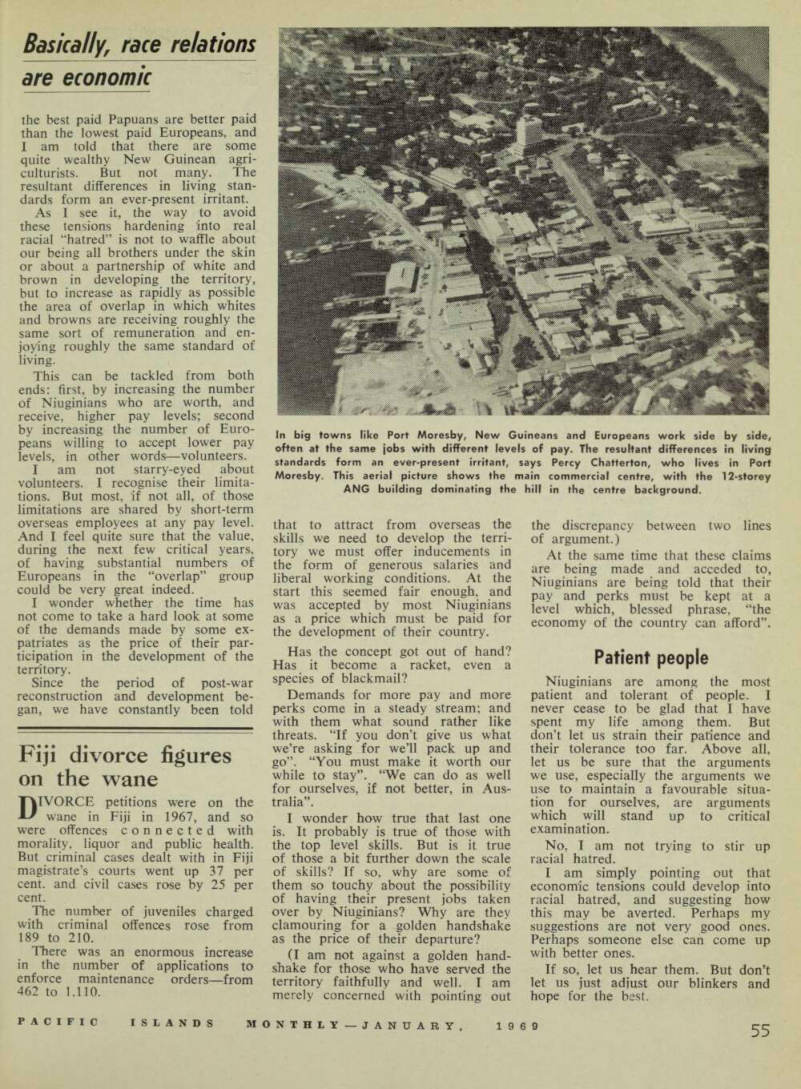
In big towns like Port Moresby, New Guineans and Europeans work side by side, often at the same jobs with different levels of pay. The resultant differences in living standards form an ever-present irritant, says Percy Chatterton, who lives in Port Moresby. This aerial picture shows the main commercial centre, with the 12-storey ANG building dominating the hill in the centre background.