New Tempo
pp. 61-63 · Read in the full issue

Fiji Dances
To A Frantic
From a Suva correspondent With leggy enthusiasm, a youthful chorus line high-steps to the strains of that old Maurice Chevalier favourite “Thank Heavens for Little Girls” ... In the glare of the spotlight, a Fijian boy—not long from the village—belts out num bers with all the verve of a young Ray Charles ... An Indian girl, self-assured and exotic, exer cises allure with a graceful Eastern folk-dance, then switches to grass skirt and lei for a hip swinging tamure . . .
The entertainment scene in Fiji these days offers amazing, and some times amusing, diversity. There are groups of Tongans and Gilbertese to present songs and dances from every part of the South Pacific; frenetic bands with names like The Insex, Maroc 5, Blue Beats, The Ducks, The Falcons to sate the ear-splitting demands of the young; delicate skinned Chinese girls to softly step out the Dance of the Lotus; muscular young men in mini-sarongs to per form, with an air of high drama, the heart-stopping Samoan knife and fire dances.
There are pretty girls, dozens of them, to do the “dance of love”— whether Tahitian, Hawaiian or Samoan —at the drop of a Fijian sulu sulu.
An incongruous crew
In addition, during the past few months, there have been a number of overseas acts. They include— somewhat incongruously —an Aus tralian singer adept at Johnny Ray tear-jerkers and an assortment of Country and Western numbers; a father-and-son’s acrobatic act; a “fabulous . . . fantastic . . . fascinat ing” hypnotist, reputedly of inter national fame and, of all people, Irish tenor Patrick O’Hagan.
In December, there was Negro soul and blues singer Junior Wells, a slight 33-year-old who belts out numbers like a man possessed. Songs like “Shout It Out! I’m Black and
I’m Proud”, had his audience clapping and stamping in frenzied rapport.
The Chicago singer and his band were presented in Fiji by the American Consulate, in co-operation with the Fiji Arts Council.
The boom in entertainment is a by-product of Fiji’s tourist and hotel
development. Dozens of new young singers, dancers and musicians have emerged, hopeful of cashing in on the demand for fresh faces. Most are unschooled but many of them show promise.
Fijian mekes and a handful of bands playing a mixture of Islands music and Western-style “pop” gleaned from borrowed recordings are no longer both backbone and body of Fiji show-biz.
Seemingly overnight, the number of places offering comprehensive entertainment has trebled. With new outlets, the number of aspiring young stars has trebled, too. It’s not exactly an industry yet—and it certainly has its growing pains—but entertainment in Fiji is going places.
Local entrepreneurs have their problems though. Visitors must be offered a show they’ll consider reason ably “indigenous”—but it mustn’t seem makeshift. American tourists in particular demand rather more than Fiji has been capable of offering
But there are some traditionalists, like little Angline Kamali, who at seven is an expert at the Tamure and hula.
Photo: Stinsons.
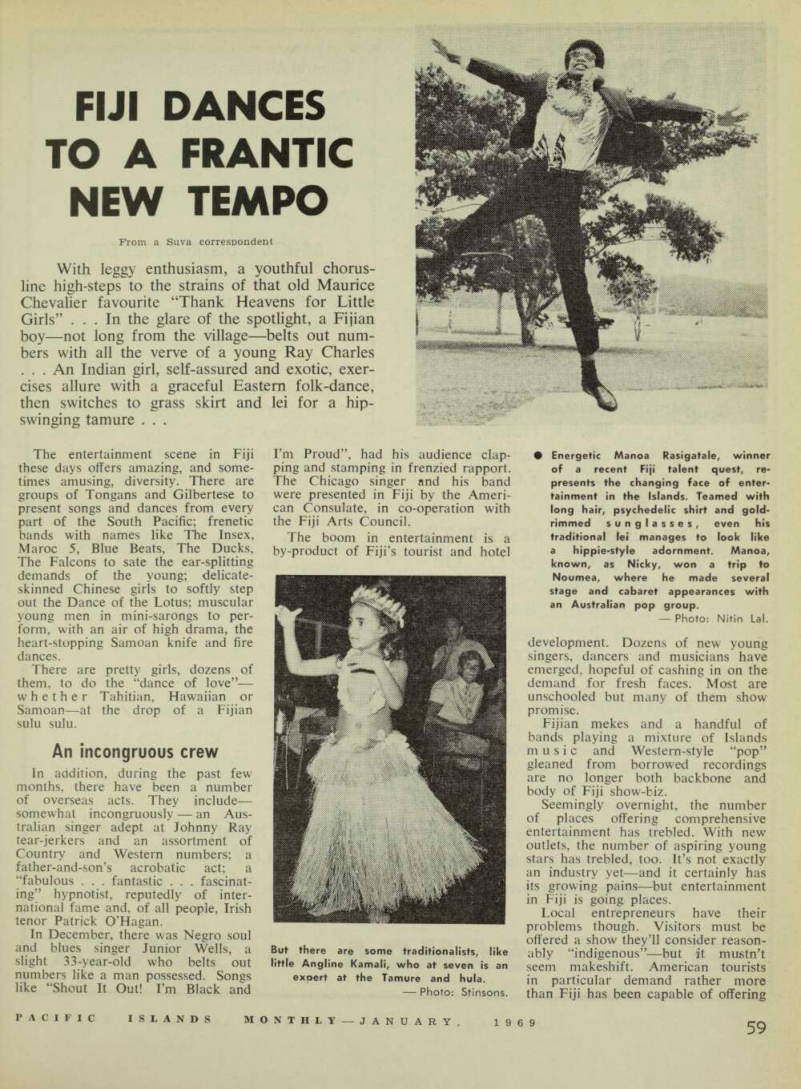
• Energetic Manoa Rasigatale, winner of a recent Fiji talent quest, re presents the changing face of enter tainment in the Islands. Teamed with long hair, psychedelic shirt and gold rimmed sunglasses, even his traditional lei manages to look like a hippie-style adornment. Manoa, known, as Nicky, won a trip to Noumea, where he made several stage and cabaret appearances with an Australian pop group.
Photo: Nitin Lal.
in the past. A Fijian meke is a spectacular sight and well worth seeing—but in a nightclub atmosphere, visitors demand sophistication, even if it’s a bit on the homespun side.
Lack of discipline, and what might be considered “artistic inspiration”, is another problem. Since Fiji’s musicians have been used to relying on natural talent—they play by ear and their singing, unschooled though it is, can be pure delight—there’s a certain apathy regarding hard work and competition.
Having always considered musicmaking a matter of mutual enjoyment, between audience and artist, it’s an entirely new concept now to regard it as a competitive, demanding field which can yield big money.
And the need for rehearsal and new technique is a strange—and not entirely welcome—innovation. liict nnt Pthiral JUSI llui eiintdi It’s difficult, too, for nightclub operators to impress on local artists that if they’re paid to appear in one spot, it’s not ethical to pop into a rival haunt and perform for free— just because they enjoy it.
One or two attempts have been made to stabilise the situation by starting up performers’ associations, but they met with only half-hearted interest. Why pay an agent’s percentage—even a small one—asked local entertainers, when jobs are on the increase? If one is dropped from a show without warning or promised payment, so what? There’s always another day and another job.
Some day soon, these talented
locals will realise that £6 a week can become £6O. But they need organisation in the ranks and the realisation that Fiji’s entertainers— with self-discipline, perseverence and know-how—can make an infinitely better impression on visitors than a second-rate act from overseas. They need unity and identity,
N&W local disc
Speaking of the Fiji musical world, Dr. Rusiate Nayacakalau, a pro minent Fijian who has been lectur ing in Anthropology at the University of Sydney since 1965, goes back to Fiji in January—at the same time that he releases a long playing record of traditional Fijian music. For re laxation Rusiate plays the steel guitar and he has privately produced this record of 14 songs composed by Eremasi Tamanisau, and played by the Way Siliva There are among other things love songs, fare wells, a meke, a song written for the South Pacific Games—all-in-all a fascinating mixture of Fijian music, The record sells for £2/5/- in Fiji, and in Sydney buyers should inquire through the Fiji Visitors Bureau office. Dr. Nayacakalau is to become manager of the Native Lands Trust Board; but he won’t give away his guitar, • In 10 years to the end of 1967 the number of vehicles registered in Fiji more than doubled—from 7,100 to 14,700. And for most of 1968 new vehicles were being registered at an average rate of 150 a month.
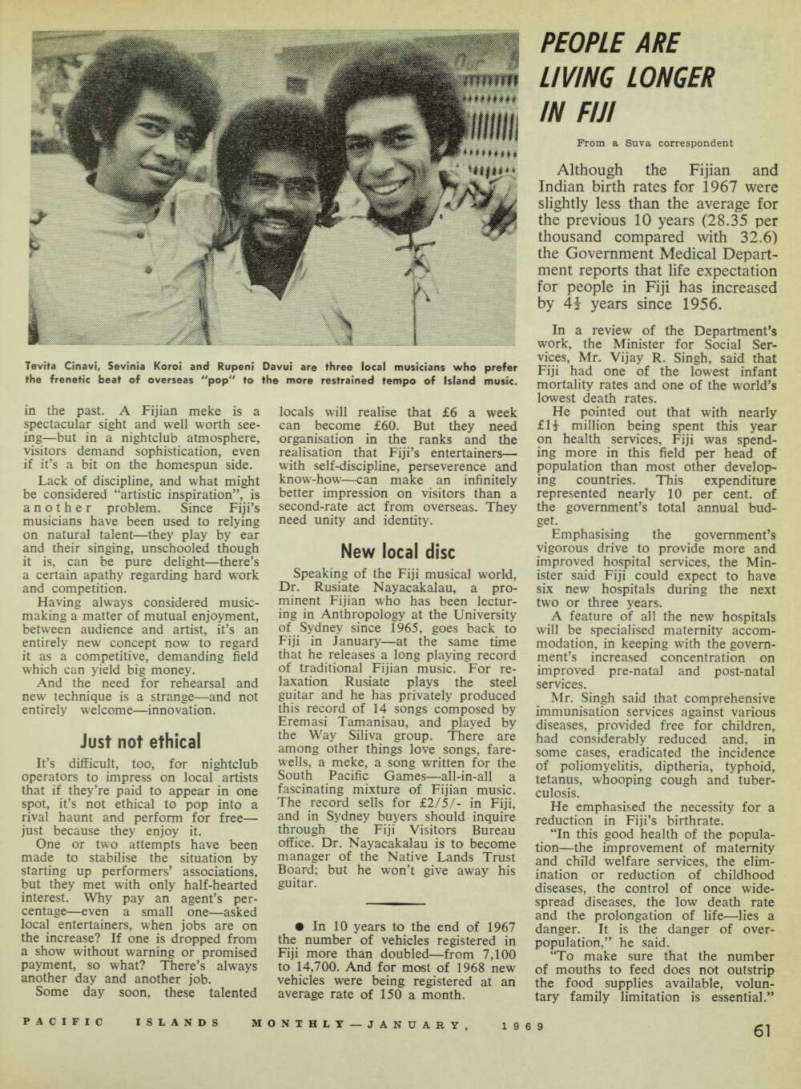
Tevita Cinavi, Sevinia Koroi and Rupeni Davui are three local musicians who prefer the frenetic beat of overseas "pop" to the more restrained tempo of Island music.