Nauru's new
p. 29 · Read in the full issue
status means a lot to Pacific
By J. W. DAVIDSON , in Canberra
It was announced in London at the end of November that the Republic of Nauru had been admitted to “associate membership” of the Commonwealth of Nations.
This decision solves a problem that has worried a number of people in the Pacific area for some years. The consequences are of immediate im portance to Nauru. They may prove important, too, to other small countries in the Pacific and elsewhere.
Broadly, Nauru will receive all the benefits enjoyed by full members of the Commonwealth, such as Australia and New Zealand, except member ship of the Prime Ministers’ Con ference.
The Government of Nauru will receive the full range of confidential documents produced by the Common wealth Secretariat in London, Nauru will have the right to send representa tives to the technical and functional meetings held by the members of the Commonwealth each year. These deal with subjects such as finance, educa tion and health.
Realistic
Nauru Will also qualify for membership of bodies such as the Commonwealth Parliamentary As sociation, where eligibility depends on a country’s link with the Com monwealth.
The Prime Ministers’ Conference mainly concerns itself with major issues of world politics. Small countries like Nauru are realistic enough to recognise that their views on these issues would carry little weight. Exclusion from the con ference is thus both sensible and unobjectionable.
Previously, when a country as sociated with the Commonwealth was
approaching independence, it faced a dilemma. It could retain its associa tion in one of two ways, jf j{ decided that the Queen should be i ts Head of State, this decision preserved the link. If it decided to have a president (or king) of its own, it could seek membership of the Prime Ministers’ Conference. If it took neither of these courses, it eventually ceased to be a Common wealth country, This problem was discussed in Western Samoa in 1960. Since the Samoans intended to have their own Head of State the question was: shou ld Western Samoa ask for membership of the Prime Ministers’
Conference 7 A ,• , , e earlier, some Common w,®as? members had opposed an ap plication by Cyprus on the ground that admission of so small a country would set a precedent and eventually make the conference so big that it would lose its special value * The Samoans decided not to risk a rebuff. The Commonwealth has since treated Western Samoa as a country that is still considering its position. It is treated “as if” it were a member and receives a number of benefits.
I have, myself, always regarded the Western Samoan position as un satisfactory, and when I was in London in 1967 with Nauru’s Head Chief (now President) Hammer Deßoburt, I had talks with Mr.
Arnold Smith, the secretary-general of the Commonwealth Secretariat, and his officers.
We worked out together the solution that has now been adopted; and, after independence the Republic of Nauru submitted an application in these terms.
This solution was possible in 1968 because of the existence of the Commonwealth Secretariat. It was not possible before the secretariat had been formed.
Western Samoa would have been content with the form of membership now granted to Nauru. But she would have had to raise the proposal of “associate member” through an exist ing Commonwealth member. And some were opposed to the idea.
In British Government circles, in particular, the old form of Com monwealth structure has been used as a means of persuading small ter ritories, such as those in the Carib bean, to settle for something short of full independence. By accepting this limitation they have been able to retain a Commonwealth association through their connections with Britain.
Now that a precedent has been established in respect of Nauru, I hope that other small countries will follow it. Associate membership of the Commonwealth would well serve the interests of Tonga and Western Samoa.
It would serve those of other small countries as they approach independence—both in the Pacific and in other parts of the world.
• Prof. Davidson to advise Miconesia.
See p. 32.
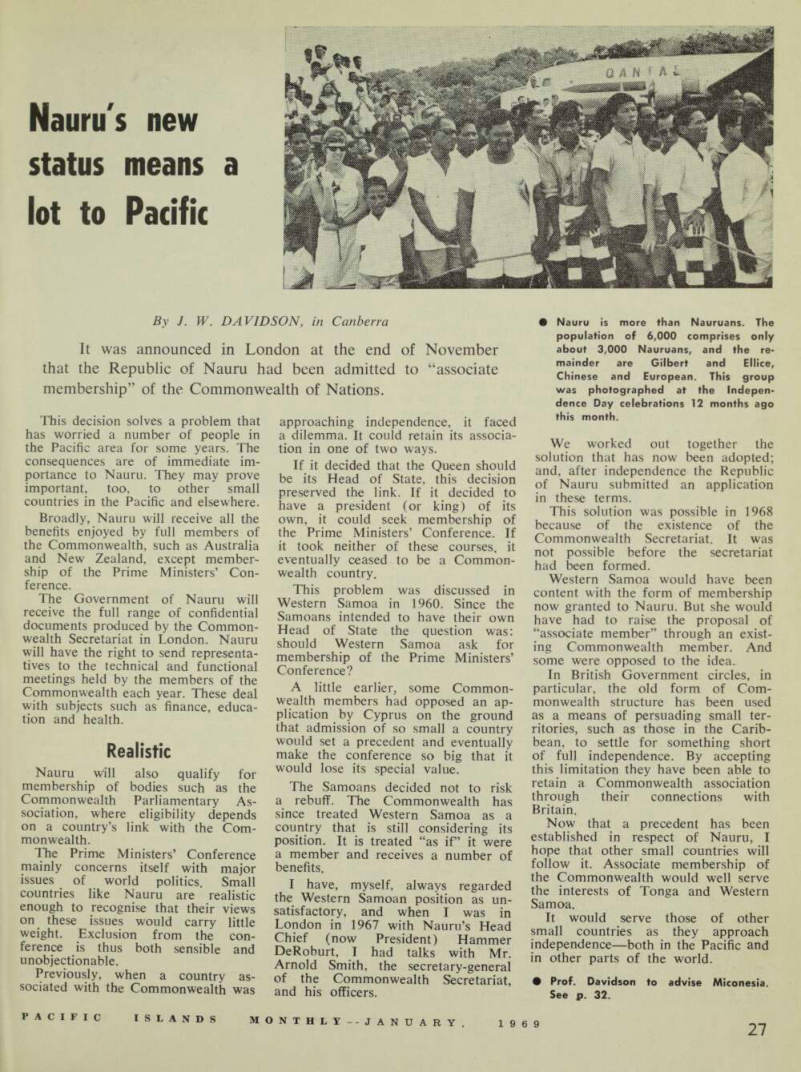
• Nauru is more than Nauruans. The population of 6,000 comprises only about 3,000 Nauruans, and the re mainder are Gilbert and Ellice, Chinese and European. This group was photographed at the Indepen dence Day celebrations 12 months ago this month.