grim fate?
pp. 30-32 · Read in the full issue
What are the lessons from the "Waka Toru's" grim fate?
By Ken Mcgregor
“Comfort! Waka Tom has all the com forts of home. It has a full-size gas stove, gas refrigerator and hot water for the shower . .
So said a Sydney newspaper in July last year, a couple of weeks before the $12,000 home-made, 46 ft trimaran sailed out of Sydney on an indefinite leisurely cruise to most of the choice yachting stopovers throughout the world. Aboard were an ex cited English family of five and three attrac tive young Sydney girls.
Waka Torn left on a burst of publicity in Australian and New Zealand newspapers because its owner and builder, Mr. William Shute, 48, an economist, had advertised widely beforehand for “four non-smoking girls” to accompany himself, his wife, Mary, 45, and his children, Joanne, 16, Rosamund, 12, and Richard, seven, on the cruise.
Eager novices and experienced sailors from Australia and even NZ applied, and Mr. Shute had the happy job of picking his crew-women from over 40 girls. The “lucky ones” were Misses Valerie Quirk, 32, Diane McNeill, 22, and Mrs. Sally Scales, 28. All were non-smokers, non-drinkers and knew nothing about sailing. All entered contracts to pay him $l,OOO for their passage to the West Indies.
What went wrong?
Waka Torn left Sydney on August 18. First call on the world tour was to be Lord Howe Island, and then Noumea, Fiji and New Zealand.
Waka Torn didn’t even make its first landfall. No one will probably ever know exactly what went wrong, but it seems likely that somewhere }lf Lord Howe in late August Waka Font was caught in a bad storm.
A fruitless air and sea search was made in September. General alerts were given to regional shipping and port authorities on the Australian
east coast and island ports in the South-West Pacific.
Relatives and friends for the next three months had no definite evidence whether the trimaran had foundered, drifted or, hopefully, been washed on some lonely shore. A big trimaran and eight people, including an entire family, had disappeared.
Until late November, when the GEIC’s 800-ton trader Moanaraoi located the Waka Torn 320 miles north-north-east of Lord Howe (PIM, Dec., p. 30).
Moanaraoi’s master. Captain Peter King, tells of the discovery: “Second officer Paueli Sione sighted the capsized wreck at 2.48 p.m. on November 19 one mile away on the port beam,” Captain King said. “Moanaraoi was brought around and manoeuvred into a position upwind of the wreck, and the crash boat was sent away under Mr. Joe Kum Kee, third officer, to pass a warping line across the wreck.
“The wreck answered the descrip tion of the missing trimaran Waka Torn and once she had been warped alongside, her stern was lifted clear of the water and the name read on her stem.
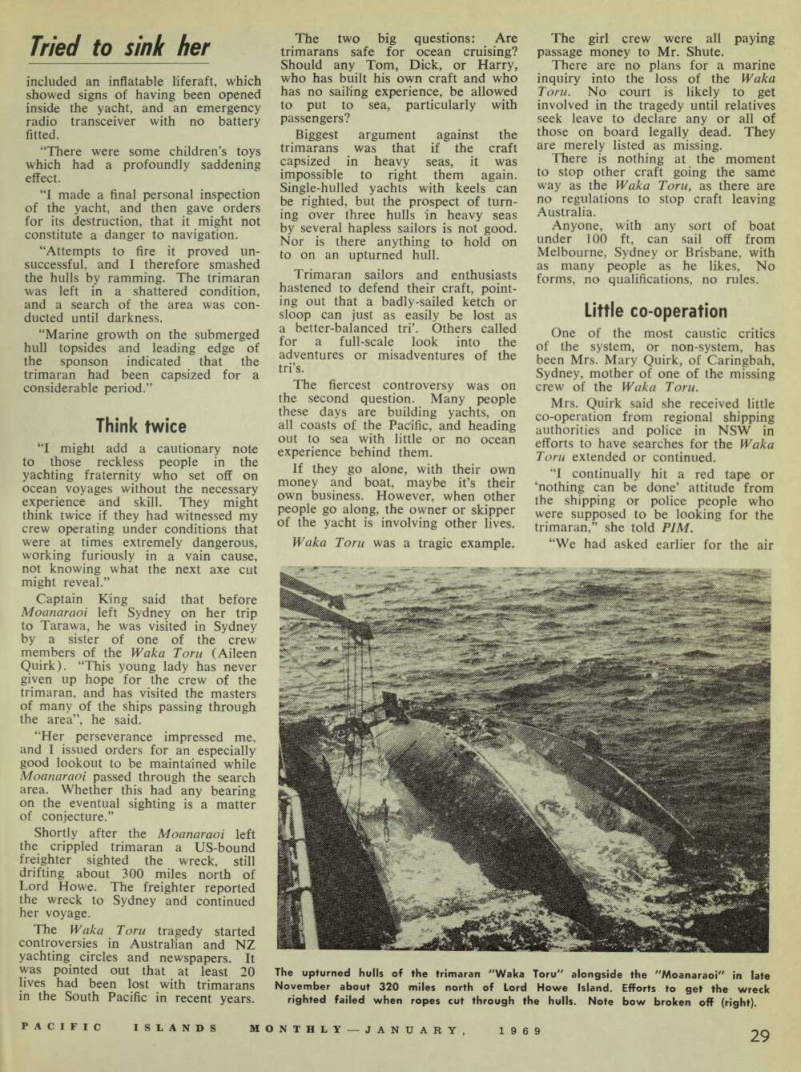
“A rope was found wrapped around her propeller, possibly washed there, and her starboard bow was broken off as far back as the leading
edge of the sponson. This was the only apparent underwater damage.
“Sails and masts could be seen drifting about under the wreck. It was not possible to carry out an underwater search on account of sharks cruising around close by.
No life
“Attempts were made to right the craft, but these were all frustrated by the rope slings cutting through the hulls like a knife through cheese.
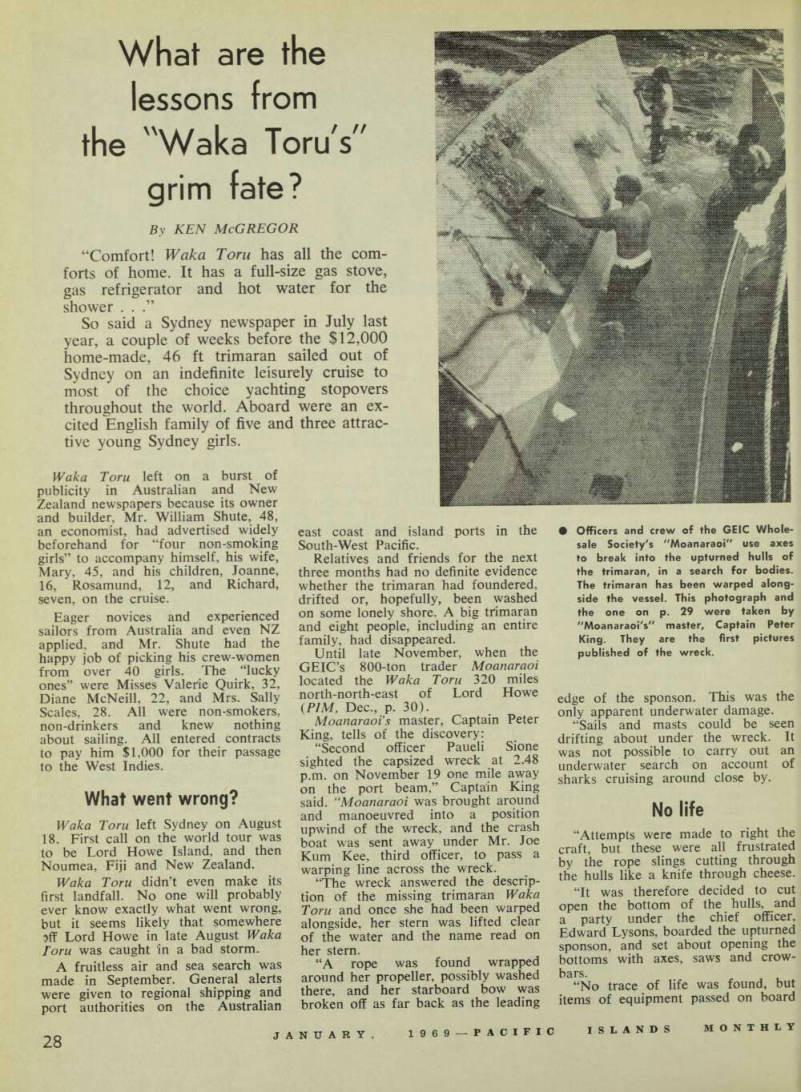
“It was therefore decided to cut open the bottom of the hulls, and a party under the chief officer, Edward Lysons, boarded the upturned sponson, and set about opening the bottoms with axes, saws and crow bars. „ ’
“No trace of life was found, but items of equipment passed on board
• Officers and crew of the GEIC Whole sale Society's "Moanaraoi" use axes to break into the upturned hulls of the trimaran, in a search for bodies.
The trimaran has been warped along side the vessel. This photograph and the one on p. 29 were taken by "Moanaraoi's" master, Captain Peter King. They are the first pictures published of the wreck.
Tried to sink her
included an inflatable liferaft, which showed signs of having been opened inside the yacht, and an emergency radio transceiver with no battery fitted.
“There were some children’s toys which had a profoundly saddening effect.
“I made a final personal inspection of the yacht, and then gave orders for its destruction, that it might not constitute a danger to navigation.
“Attempts to fire it proved un successful, and I therefore smashed the hulls by ramming. The trimaran was left in a shattered condition, and a search of the area was con ducted until darkness.
“Marine growth on the submerged hull topsides and leading edge of the sponson indicated that the trimaran had been capsized for a considerable period.”
Think twice
“I might add a cautionary note to those reckless people in the yachting fraternity who set off on ocean voyages without the necessary experience and skill. They might think twice if they had witnessed my crew operating under conditions that were at times extremely dangerous, working furiously in a vain cause, not knowing what the next axe cut might reveal.”
Captain King said that before Moanaraoi left Sydney on her trip to Tarawa, he was visited in Sydney by a sister of one of the crew members of the Waka Toru (Aileen Quirk). “This young lady has never given up hope for the crew of the trimaran, and has visited the masters of many of the ships passing through the area”, he said.
“Her perseverance impressed me, and I issued orders for an especially good lookout to be maintained while Moanaraoi passed through the search area. Whether this had any bearing on the eventual sighting is a matter of conjecture.”
Shortly after the Moanaraoi left the crippled trimaran a US-bound freighter sighted the wreck, still drifting about 300 miles north of Lord Howe. The freighter reported the wreck to Sydney and continued her voyage.
The Waka Toru tragedy started controversies in Australian and NZ yachting circles and newspapers. It was pointed out that at least 20 lives had been lost with trimarans in the South Pacific in recent years.
The two big questions: Are trimarans safe for ocean cruising?
Should any Tom, Dick, or Harry, who has built his own craft and who has no sailing experience, be allowed to put to sea, particularly with passengers?
Biggest argument against the trimarans was that if the craft capsized in heavy seas, it was impossible to right them again.
Single-hulled yachts with keels can be righted, but the prospect of turn ing over three hulls in heavy seas by several hapless sailors is not good.
Nor is there anything to hold on to on an upturned hull.
Trimaran sailors and enthusiasts hastened to defend their craft, point ing out that a badly-sailed ketch or sloop can just as easily be lost as a better-balanced tri’. Others called for a full-scale look into the adventures or misadventures of the tri’s.
The fiercest controversy was on the second question. Many people these days are building yachts, on all coasts of the Pacific, and heading out to sea with little or no ocean experience behind them.
If they go alone, with their own money and boat, maybe it’s their own business. However, when other people go along, the owner or skipper of the yacht is involving other lives.
Waka Toru was a tragic example.
The girl crew were all paying passage money to Mr. Shute.
There are no plans for a marine inquiry into the loss of the Waka Toru. No court is likely to get involved in the tragedy until relatives seek leave to declare any or all of those on board legally dead. They are merely listed as missing.
There is nothing at the moment to stop other craft going the same way as the Waka Toru, as there are no regulations to stop craft leaving Australia.
Anyone, with any sort of boat under 100 ft, can sail off from Melbourne, Sydney or Brisbane, with as many people as he likes. No forms, no qualifications, no rules.
Little co-operation
One of the most caustic critics of the system, or non-system, has been Mrs. Mary Quirk, of Caringbah, Sydney, mother of one of the missing crew of the Waka Toru.
Mrs. Quirk said she received little co-operation from regional shipping authorities and police in NSW in efforts to have searches for the Waka Toru extended or continued.
“I continually hit a red tape or ‘nothing can be done’ attitude from the shipping or police people who were supposed to be looking for the trimaran,” she told PIM.
“We had asked earlier for the air
The upturned hulls of the trimaran "Waka Toru" alongside the "Moanaraoi" in late November about 320 miles north of Lord Howe Island. Efforts to get the wreck righted failed when ropes cut through the hulls. Note bow broken off (right).
Mo ve to introduce safety regulations
search to be more to the north of Lord Howe, and this is where the trimaran was found. If planes had found it earlier perhaps some traces of the people might have been there or we might have been able to see what really happened. Even now, I don’t know exactly what was in the overturned trimaran when found, but I suspect that clothes and another inflatable raft were missing. Perhaps they all got off, and drifted some where, but if the officials have any facts which might solve this matter they haven’t told me.
“Shortly before Captain King found the trimaran a New Hebrides boat reported a yacht sailing strongly northwards towards the New Heb rides.
Still hoping
“It’s still a mystery to me and I still keep the hope that they did survive and were washed up on some lonely coast,”
Mrs. Quirk is one of a number of Sydney people who are asking their members of parliament to support a bill to introduce regulations that would-be cruising yachties must comply with before they put to sea from Australia, and regulations affect ing the seaworthiness of their craft for ocean voyaging.
They hope the bill will be passed this year and in a large way prevent other Waka Torus. Something, obviously, needs to be done.