challenging note of reality"
pp. 28-136 · Read in the full issue
BSIP's 1969 budget: "A new and challenging note of reality"
From a Honiara correspondent The infant BSIP rice industry—which will be able to supply the whole of the Solomons with rice this year—has been pro tected by a duty on imported rice which makes the local pro duct significantly cheaper than the overseas product. This was announced by Mr. T. Russell, Financial Secretary of the BSIP, when he brought down his budget for 1969, a budget which, he said, introduced a “new and challenging note of reality into public spending in the BSIP”.
The budget provides for the ap propriation of $9,038,854 which is an increase of $836,440 over the amount appropriated in 1968, but only $336,764 more than the 1968 expenditure after the restoration of money cut on account of devaluation.
True recurrent expenditure ignoring contributions to capital ac count, will absorb $5,786,914.
Capital expenditure will be $3,161,940.
Grant-in-aid to the recurrent budget is included at $2,331,584 compared with the revised grant-in aid of $2,181,574 for 1968.
Mr. Russell said that the BSIP would meet 60.3 per cent, of recur rent expenditure from local revenue and the British Government would meet 58.9 per cent, of the total ex penditure.
Tax increases
The budget includes a 25 per cent, company tax increase. However the present restrictions on dividends of resident shareholders will be abolished. This will mean that any differences between the levy of personal tax and company tax on locally distributed dividends will be refunded.
Mr. Russell also announced that there would be a maximum personal tax of 35 cents in the $ for people with incomes above $B,lOO, but that no one would be obliged to pay more than 25 per cent, gross income in tax.
Of these tax moves, Mr. Russell said: “I believe that the new tax structure, despite criticisms, strike a balance between the harsh realities of the country’s expenditure needs, the ability of the individual tax payer to pay a reasonable impost, and the need to preserve a climate
which is still favourable to invest ment”.
Mr. Russell said that there was to be no increase in the import duties on liquor and tobacco, but there was to be an increase on the import duties on flour and rice—l cent a lb on flour and 2 cents a lb on rice.
This would bring in approximately $50,000.
The duty on rice will mean that 56 lb bags of local rice will sell for $2 less than 56 lb bags of imported rice.
Speaking of the budget generally, Mr. Russell said: “Budgeting in a grant-aided territory is not simply a process of including what expenditure is desirable, totting up the revenue available and asking Great Britain to make up the balance: “We must plan, and indeed may be required, to restrict increases in expenditure to increases in local revenue if the country is ever to stand upon its own feet financially.
“We have to restrict recurrent ex penditure this year but have been given development funds in generous measure for capital development.”
Notable achievements
Looking back over 1968, Mr.
Russell said that the most notable achievements had been the dogged, hard-won development of the timber industry; the establishment of a ship ping link with New Zealand; the overcoming of any remaining dif ficulties in growing, harvesting, dry ing and milling rice to meet the national level of consumption; and several smaller-scale ventures —such as the bus service in Honiara and the expansion of motel-type accom modation.
One of the government’s major projects for the year had been the
remaking of Henderson airfield. This field should be open for service by the end of June and be completed to DC6 standard by August.
During the year an economic mis sion of the World Bank had visited the protectorate to decide whether it should lend money to the BSIP and if so for which sectors of the economy.
Mr. Russell said he was still waiting to hear what the World Bank had decided. If the bank did decide to lend money, the BSIP would like to spend it on the Lunga River hydro electric project which was the subject of a detailed feasibi lity study by William Halcrow in 1964.
On the agricultural front, Mr.
Russell said that he expected copra production to be 20,500 tons in 1968 compared with 23,517 tons in 1967.
The drop was in part caused by the 1966-1967 cyclones. The BSIP’s copra-production target for 1969 was 26,000 tons.
Cocoa production for 1968 was expected to reach 110 tons, but the number of cocoa farmers in the BSIP had fallen from 1,344 in 1967 to 1,260 in 1968. It was clear, said Mr. Russell, that cocoa pro duction would not reach significant levels until the research station at Dela isolates strains of cocoa more suited to conditions in the Solomons than those at present being used.
During 1968, 4,500 acres of rice were sown and 6,700 tons of paddi harvested. Soyabean had been abandoned for the present.
The cattle population of the Solomons was estimated at 10,000 and beasts were being slaughtered regularly.
Despite marketing difficulties, timber production in November was
(Continued on p. 134)
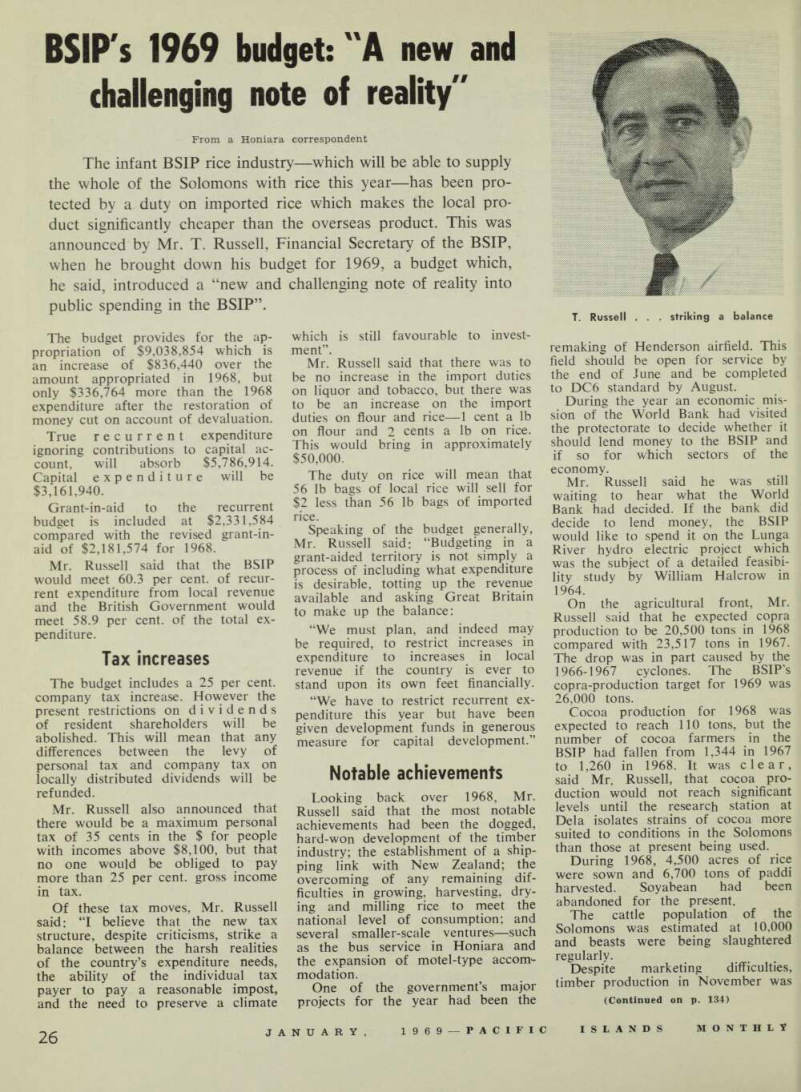
T. Russell . . . striking a balance
Funds available for tourist authority
ahead of target by \ million cu. ft and it was expected to reach 41 mil lion cu. ft by the end of the year.
The target for 1969 was 6 million cu. ft.
Outlining the BSIPs pattern of trade, Mr. Russell said that Britain’s share of exports increased from 42.8 per cent, in 1967 to 47.4 per cent, in 1968, while Japan’s dropped from 40 per cent, in 1967 to 30.2 per cent, in 1968. Australia’s share of BSIP exports increased marginally from 15.1 per cent, to 17.5 per cent.
Australia (42.4 per cent.), Britain (21.4 per cent.) and the US (10.6 per cent.) remained the chief countries from which the BSIP im ported, said Mr. Russell.
Less than expected
In 1966, said Mr. Russell, there was an overprinted definitive issue revenue from stamps amounting to $293,400, and it had been hoped to realise $420,000 from stamps this year. Crown Agents’ sales however, had been less than expected and this target could not be achieved.
Like every other island group in the South Seas, the BSIP has its eye on the tourist trade. It was estimated that by the end of 1968 some 1,850 tourists would have visited the BSIP—a huge improve ment on the figure of 813 in 1967.
Mr. Russell reported that the Fiji Visitors Bureau had advised the BSIP to set up a tourist authority so that the industry could be developed along the right lines. Funds had been made available in the 1969 estimates for setting up such an authority, he said. • Work is almost completed on the BSIP’s first comprehensive, pre fabricated housing estate, which will have houses and amenities for 78 families. The estate is at Tuvaruhu, Honiara, about a mile upstream from the Mataniko Bridge, and near the water pumping station.
Intended for local government employees, the estate will include a shopping site with car park, a recreation ground, a community hall, a church and a four-classroom primary school with playing field.
The 78 homes will comprise an equal number of two-bedroom and four-bedroom houses, built of timber and asbestos on a concrete base.