"Dramatic resurgence" tipped
p. 27 · Read in the full issue
for W. Samoa's 1969 exports
From an Apia correspondent
Despite last February’s near-crippling hurricane, Western
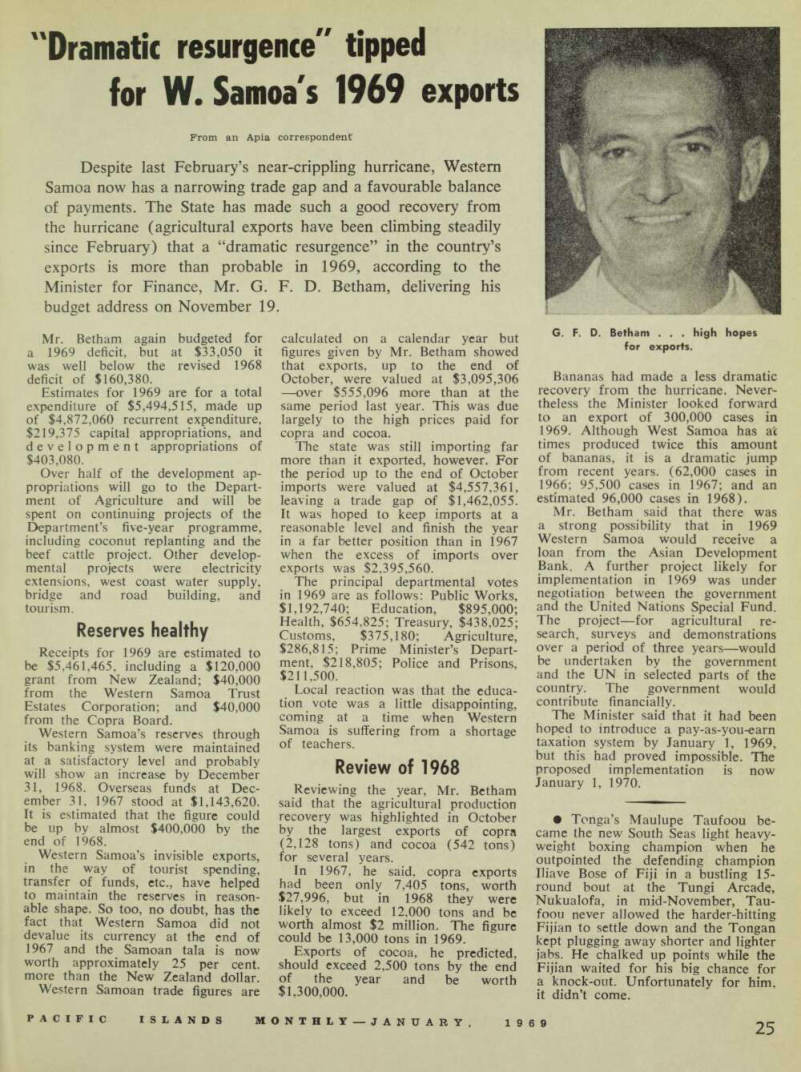
Samoa now has a narrowing trade gap and a favourable balance of payments. The State has made such a good recovery from the hurricane (agricultural exports have been climbing steadily since February) that a “dramatic resurgence” in the country’s exports is more than probable in 1969, according to the Minister for Finance, Mr. G. F. D. Betham, delivering his budget address on November 19.
Mr. Betham again budgeted for a 1969 deficit, but at $33,050 it was well below the revised 1968 deficit of $160,380.
Estimates for 1969 are for a total expenditure of $5,494,515, made up of $4,872,060 recurrent expenditure, $219,375 capital appropriations, and development appropriations of $403,080.
Over half of the development ap propriations will go to the Depart ment of Agriculture and will be spent on continuing projects of the Department’s five-year programme, including coconut replanting and the beef cattle project. Other develop mental projects were electricity extensions, west coast water supply, bridge and road building, and tourism.
Reserves healthy
Receipts for 1969 are estimated to be $5,461,465, including a $120,000 grant from New Zealand; $40,000 from the Western Samoa Trust Estates Corporation; and $40,000 from the Copra Board.
Western Samoa’s reserves through its banking system were maintained at a satisfactory level and probably will show an increase by December 31, 1968. Overseas funds at Dec ember 31, 1967 stood at $1,143,620.
It is estimated that the figure could be up by almost $400,000 by the end of 1968.
Western Samoa’s invisible exports, in the way of tourist spending, transfer of funds, etc., have helped to maintain the reserves in reason able shape. So too, no doubt, has the fact that Western Samoa did not devalue its currency at the end of 1967 and the Samoan tala is now worth approximately 25 per cent, more than the New Zealand dollar.
Western Samoan trade figures are
calculated on a calendar year but figures given by Mr. Betham showed that exports, up to the end of October, were valued at $3,095,306 —over $555,096 more than at the same period last year. This was due largely to the high prices paid for copra and cocoa.
The state was still importing far more than it exported, however. For the period up to the end of October imports were valued at $4,557,361, leaving a trade gap of $1,462,055.
It was hoped to keep imports at a reasonable level and finish the year in a far better position than in 1967 when the excess of imports over exports was $2,395,560.
The principal departmental votes in 1969 are as follows: Public Works, $1,192,740; Education, $895,000; Health, $654,825; Treasury, $438,025; Customs, $375,180; Agriculture, $286,815; Prime Minister’s Depart ment, $218,805; Police and Prisons, $211,500.
Local reaction was that the educa tion vote was a little disappointing, coming at a time when Western Samoa is suffering from a shortage of teachers.
Review of 1968
Reviewing the year, Mr. Betham said that the agricultural production recovery was highlighted in October by the largest exports of copra (2,128 tons) and cocoa (542 tons) for several years.
In 1967, he said, copra exports had been only 7,405 tons, worth $27,996, but in 1968 they were likely to exceed 12,000 tons and be worth almost $2 million. The figure could be 13,000 tons in 1969.
Exports of cocoa, he predicted, should exceed 2,500 tons by the end of the year and be worth $1,300,000.
Bananas had made a less dramatic recovery from the hurricane. Never theless the Minister looked forward to an export of 300,000 cases in 1969. Although West Samoa has at times produced twice this amount of bananas, it is a dramatic jump from recent years, (62,000 cases in 1966; 95,500 cases in 1967; and an estimated 96,000 cases in 1968).
Mr. Betham said that there was a strong possibility that in 1969 Western Samoa would receive a loan from the Asian Development Bank. A further project likely for implementation in 1969 was under negotiation between the government and the United Nations Special Fund.
The project—for agricultural re search, surveys and demonstrations over a period of three years—would be undertaken by the government and the UN in selected parts of the country. The government would contribute financially.
The Minister said that it had been hoped to introduce a pay-as-you-earn taxation system by January 1, 1969, but this had proved impossible. The proposed implementation is now January 1, 1970. • Tonga’s Maulupe Taufoou be came the new South Seas light heavy weight boxing champion when he outpointed the defending champion Iliave Bose of Fiji in a bustling 15round bout at the Tungi Arcade, Nukualofa, in mid-November, Tau foou never allowed the harder-hitting Fijian to settle down and the Tongan kept plugging away shorter and lighter jabs. He chalked up points while the Fijian waited for his big chance for a knock-out. Unfortunately for him, it didn’t come.
G. F. D. Betham . . . high hopes for exports.