He worked
p. 61 · Read in the full issue
A Brett Hilder Profile
He worked under the waves
BILL TEBB, at present of Wewak, New Guinea, is a webb-footed mariner who has spent most of his working time under the waves. His paternal ancestors were from Flanders, and his father was serving in the Royal Horse Artillery when our William Leslie Tebb was born at Woolwich, London, on May 3, 1919. The son-of-a-gun went to school at Bloomfield Road and at Fox Hill until he joined the Navy as a boy in the training ships, in 1933. He served during the troubles in Palestine and Abyssinia with the rank of Boy in the submarine parent ship Cyclops, repairing and relaying oil lines which had been destroyed at Haifa. Next year he was around Spain during the Civil War as an Ordinary Seaman in HMS Devonshire.
In 1939 he was back in the UK doing a diving course and in January, 1940, he joined the armed merchant ship Carinthia.
This ship was torpedoed off Ireland six months later, leaving Bill swimming for 24 hours. He was spotted by an Australian Sunderland flying-boat, which brought the destroyer Wren to rescue him.
Bill returned to submarines, serving in L 23 in 1941, and then volunteered for “special service” in two-man torpedoes. They were steered to their target by two “charioteers”, who attached the warhead to the target and then either tried to escape or gave themselves up. Bill’s major effort in this dangerous game culmina ted in the abortive attack on the German battleship Tirpitz in a Norwegian fjord. The 10 men split into two parties of five, to escape over Norway into Sweden.
Bill’s party was captured by Gestapo and in escaping again Bill shot the two guards.
The party was well treated in Sweden, though Bill was tried for murder and acquitted. He got back to England two months later in a Mosquito aircraft, under the wing of Dr. Malcolm Sargent, who was a courier at the time.
Bill received a Mention in Despatches and he rejoined the depot ship Titania in Scotland.
He was then seconded to the com bined operations pilotage party, whose job was to survey and clear approaches to enemy beaches to
enable landings to be made. He was in the midget submarine X 24 for the purpose, and for the Normandy landing on “D-Day” they waited at the mouth of the Orne River to guide the first wave of landing craft to the beach and later tied up to HMS Bulolo.
As the invasion progressed Bill’s work involved underwater surveys of rivers, and reporting by radio behind the enemy lines as part of the forward observation bombard ment parties. At the fall of Caen, Bill found that his name was marked “to be shot on recapture” on the Gestapo papers.
He returned to England and worked on MTB’s at Portsmouth, running courier services.
At the end of the war in Europe Bill was retained for clearing mines and destroying wrecks in North Africa and Malta, in between attending war crimes trials at Nuremberg. He gave evidence at the trial of Field Marshall Keitel, who had signed Bill’s death warrant among others.
Bill left the Royal Navy in 1949 with rank of Leading Sea man, his career having been pun ctured in places by short bursts of wild living ashore. He then be came a civilian diver and builder in the Thames, with diminishing financial hopes, so set forth to find a country more fit for heroes to live in.
He arrived in Australia in the Orontes in late 1950, and hitch hiked his way to Thursday Island to engage in pearl diving. He served in the pearling lugger Paxie and the trawler Crystal Star, and then joined the Commonwealth as a diver to work in the ports of New Guinea. This included run-
ning barges between Lae and Labu, and landing the army at Vanimo. After three years Bill resigned and spent a year in the Far East, on which history is silent.
He returned in 1955 to do a pearl diving survey with Bob Bunting, and after that went to Australia for sick leave. In 1956 Bill had six months around Darwin, doing a Commonwealth diving survey of the Arafura Sea, mainly checking on Japanese pearling luggers. In 1957 he was back in Port Moresby, where he had obtained a limited Master’s Certificate in 1952 and joined the Administration as a trawler master. In this capacity he has served at Rabaul, Port Moresby and finally at Wewak, where he has been based for the last six years, with the trawler Rouna Falls. In December, 1967, Bill married Sister Lois Richardson at Wewak, where they are happily making a home.
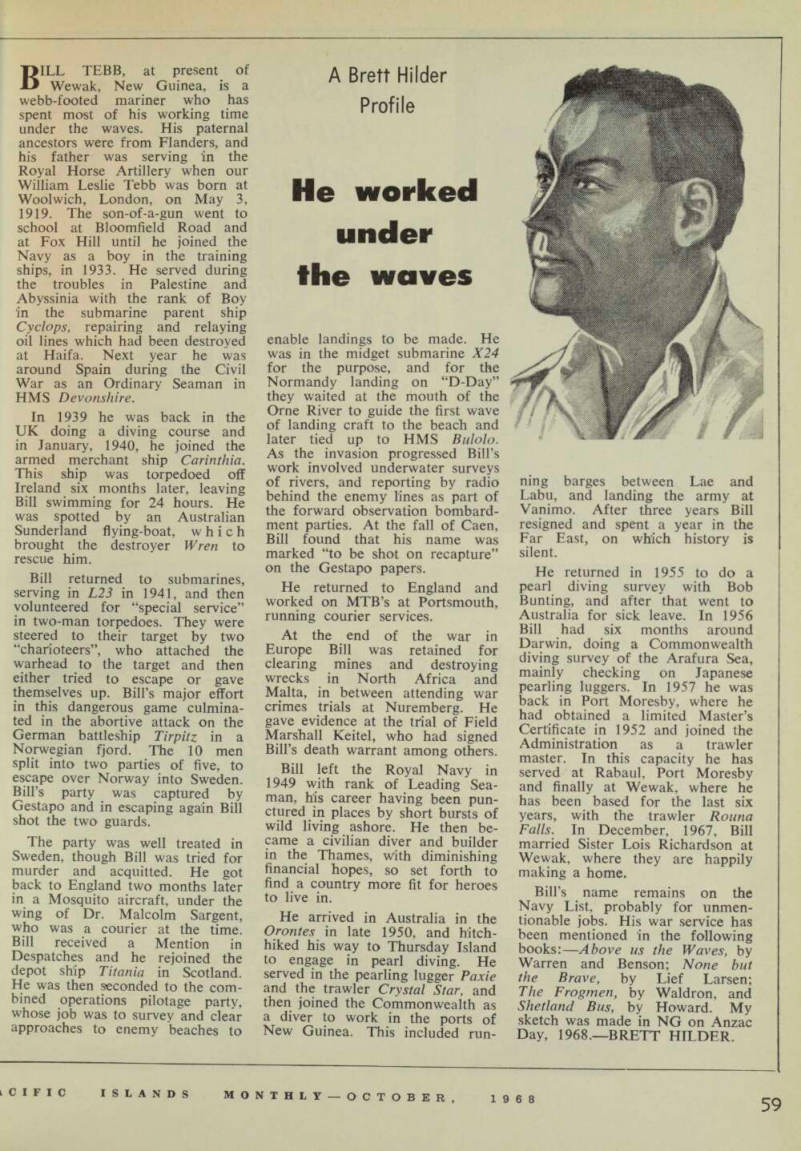
Bill’s name remains on the Navy List, probably for unmen tionable jobs. His war service has been mentioned in the following books: —Above us the Waves, by Warren and Benson; None but the Brave, by Lief Larsen; The Frogmen, by Waldron, and Shetland Bus, by Howard. My sketch was made in NG on Anzac
Day, 1968,