Norfolk is at the crossroads
pp. 63-65 · Read in the full issue


says its new administrator
From MERVAL HO ARE, in Norfolk Island Norfolk Island has reached a crucial stage in its develop ment: it is at the crossroads. This is the view of the island’s new Administrator, Air Commodore R. N. Dalkin, DFC, giving his first review of his plans for this Australian territory.
Addressing the Fourth Norfolk and Council at its first meeting cently he said; “It seems to me at a choice must soon be made we are to advance and make ogress. For example, on the one nd we have seen produced in :ent months a developmental re rt, a plan of the classic type, mpiled by a most experienced and pable developmental planner of the Ddern school, “On the other hand, a report ued by equally expert nature-loving nservationists takes a rather dif ent approach to the future course on which the island should ibark.”
Problems
The reports referred to are the )rfolk Island Planning Report 1968 Mr. H. L. Westerman (F/M, ig., p. 43) and the Conservation port 1968 by Professor John rner, Mr. C. N. Smithers and Dr.
D. Hoogland, Mr. Westerman stated that the md’s resident population could be 00-6,000 by 1980. Air Commodore Ikin considers that although mges lie ahead the resident popu ion will rise more slowly than s. No population explosion is icipated. \ir Commodore Dalkin sees one the problems as education. On rfolk, where education is free and npulsory, and where there is no ation, the cost, including capital it, of educating each child attend school in 1967 was in the inity of $350. With an increase the number of residents, and a responding increase in the number school children, costs within the ct few years might well be around )0,000 a year. \s the island’s total revenue for >6-67 was only about $396,000 id this included a Commonwealth nt of $66,000) the possible rise education costs could impose a ere strain on the island’s finances
—unless accompanied by a corres ponding increase in revenue.
Then there is the problem of legislation. Although many ordinances were passed during the last few years, and some are currently in the draftsman’s hands, a number of Norfolk laws require up dating.
Yet another problem is the ever increasing number of companies registering on the island. This, together with other developments, has resulted in a situation which the Administration is at present not fully geared to cope with. The Registrar’s department, the Works organisations and possibly other Administration sections, are currently under estab lished or understaffed.
Air Commodore Dalkin is in terested in tourism, and hopes to see the number of visitors rise beyond the 1967 peak figure of 8,422.
He believes that Norfolk has a tremendous amount to offer the tourist. The island’s scenic beauty, the traditional, unhurried way of life and the wide variety of sports avail able to out-door enthusiasts—in particular walking, rock-fishing, swimming and golf—all help to make the island a popular holiday resort.
Proud tradition
Mainlanders can meet the friendly descendants of the Bounty men and their wives—people with a proud tradition. Many a pleasant hour may be spent wandering through the old convict settlement at Kingston, and there are the added attractions of duty-free shopping and good accommodation at reasonable prices.
Air Commodore Dalkin speaks highly of the Qantas and Air New Zealand services which conduct flights to and from the island.
However, he stresses that the pressures of tourism must not be permitted to get to the self-defeating point where the identity of the island is threatened.
He points out: “A UNESCO study in 1966 showed that there is a close relationship between the restoration and preservation of cultural property (e.g., historical sites and monuments, landscapes, parks, natural sites) and the development of tourism.
“The notion of tourism being an ‘industry’, and having consequential economic benefits, is not always fully realised by people,” he says.
“Tourism can undoubtedly bring very significant economic benefit to an area which that area cannot always earn in any other way; frequently several times greater than any other potential earnings.
Tourist revenue
“Some figures are revealing. The US Department of Commerce estimated that some two dozen tourists per day throughout the year would be economically comparable to acquiring a new manufacturing in dustry having an annual pay-roll of SUSIOO,OOO. It has been estimated in Britain that a town has only to attract one overseas visitor every night to earn a gross annual revenue of $A1,750. The tourist as a con sumer not only comes with money in hand, he pays his own freight!
“Income from tourism can be made to be relatively stable. Sight seeing as a ‘product’ can be sold over and over again.”
Air Commodore Dalkin, who has a university degree in history, political science and international relations, is intensely interested in Norfolk’s history. Under his leader ship a few local enthusiasts have already banded together and formed an historical society. This is an
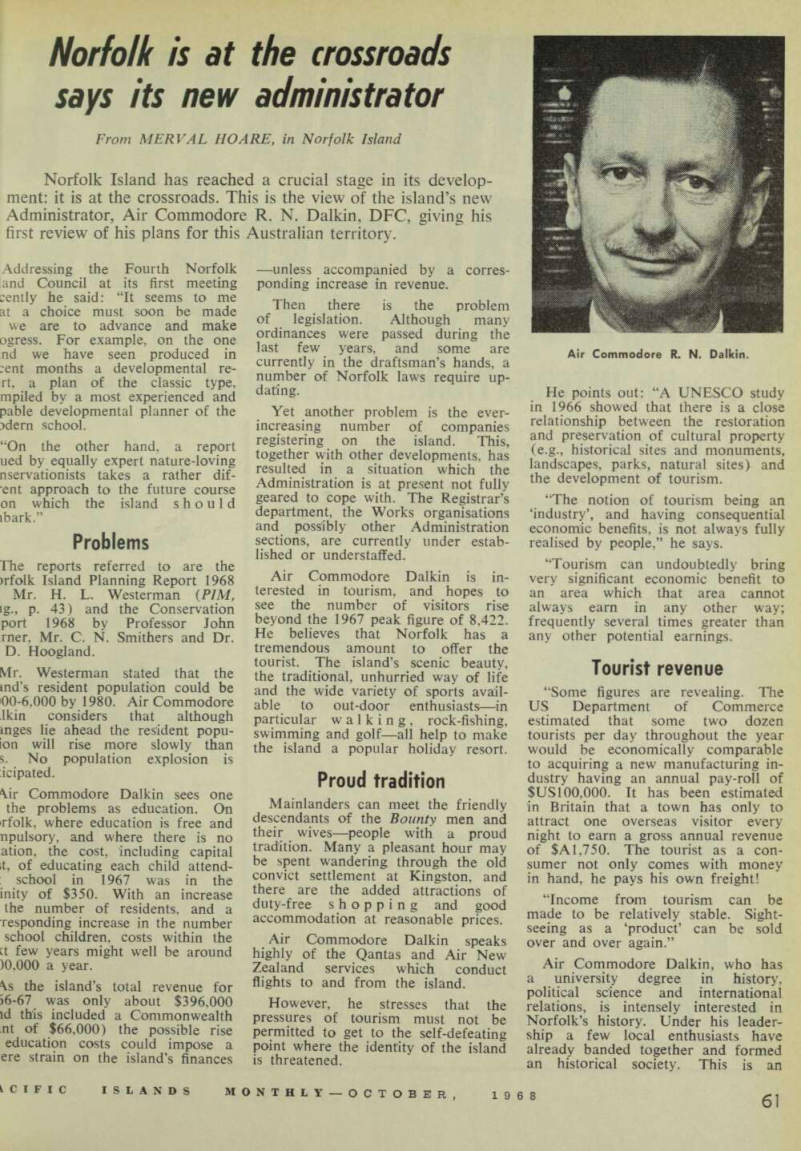
Air Commodore R. N. Dalkin.
stitution long overdue on Norfolk.
He also has plans for a museum house what is available of the and’s historical documents and tifacts. A well-stocked museum uld become a star tourist attrac m.
“Norfolk Island,” said Air Com xlore Dalkin, “with its two main earns of history, the convict period d the Pitcairn-Norfolk era, would an ideal venue for a properly ganised symposium of historians, rtanists, architects and other pro isional groups should also be en uraged to hold “working holidays” the island.
Norfolk Islanders
dn a double royal
IHE Queen has granted her patronage to the Norfolk Island gri cultural and Horticultural ciety, which has been functioning ermittently on the island since last itury. At the same time, the wfolk Island Flora and Fauna ciety has been told that the Duke Edinburgh had consented to be ne its patron. This society, was med only last year. Norfolk, dis ced by Cook in 1774, was settled ►m Botany Bay in 1788, and thus :ame the second British settlement be established in the South cific.