The Editors Mailbag
pp. 54-56 · Read in the full issue
Canberra denies withholding support from NG University
Sir, —The article entitled “New Guinea University Frets About Its Future” ( PIM , Aug.) would have its readers believe that the Australian Government is unconvinced on the impor tance of the university and is withholding financial support.
This does not accord with the facts.
It was the government that ap pointed the Currie Commission and it was the government that took the decision to establish the university. 1966/67 was the first full financial year of its operation and its income from grants and scholarships has in creased from $l.B million in that year to almost S 3 million in 1967/68, and in the current year the total funds that will be available for uni versity purposes including a govern ment supported loan will be some $3.85 million.
The government will continue its support in the future because it believes that the work of the uni versity is important.
It is true that the government did not accept proposals put to it by the university last September involv ing a build-up of enrolments of 825 equivalent full-time students by 1970 and requiring an allocation of some $4.5 million in 1968/69. This is hardly a cut back in expenditure (as the article describes it) nor cause to make the university fret about its future.
The government announced its in tentions on the level of enrolments when the university was established.
Furthermore, the university authori ties were told what funds were expec ted to be available each year up to 1970. The government has not gone back on this.
Not accepted extra plans
What it has done is that it has not accepted more expansive pro posals put to it by the university.
Far from being cut back, expenditure in 1968/69 is expected to increase by very nearly $900,000 over that in 1967/68, and my understanding is that the university itself has accepted that the funds available to it in 1968/69 Will meet the financial re quirements of its present programme.
The reason for not accepting the university’s proposals was not, as the article seems to imply, purely one of funds. Not least of the considera tions is the limitation imposed by the numbers of students successfully completing the secondary courses at the high schools.
Moreover, the territory needs not only graduates in Arts, Law, Science and Education (the courses conduc ted by the university) but also suitably qualified people in fields such as Engineering, Agriculture, Medicine, Dentistry, Public Admini stration, Forestry, Accountancy, Busi ness, Surveying and Teaching and there must be a flow of students into the institutions conducting these courses.
There must also be a flow of young people from secondary schools directly into the Administration and private enterprise. A greater number of students could enter the university only at the expense of these other very important needs.
In 1968 very nearly 80 per cent, of the students who passed the School Certificate examination pro ceeded to further training. No student was denied the opportunity of further education; the intakes into other tertiary training institutions fell
well below their targets for the ye Nor would it be correct to cc elude from the statement in 1 article that preliminary year numbi were kept down to around 100 tl this was the intake of new stude; for 1968. The total intake includi part-time and post-graduate studei was well in excess of 200.
Where are the graduates?
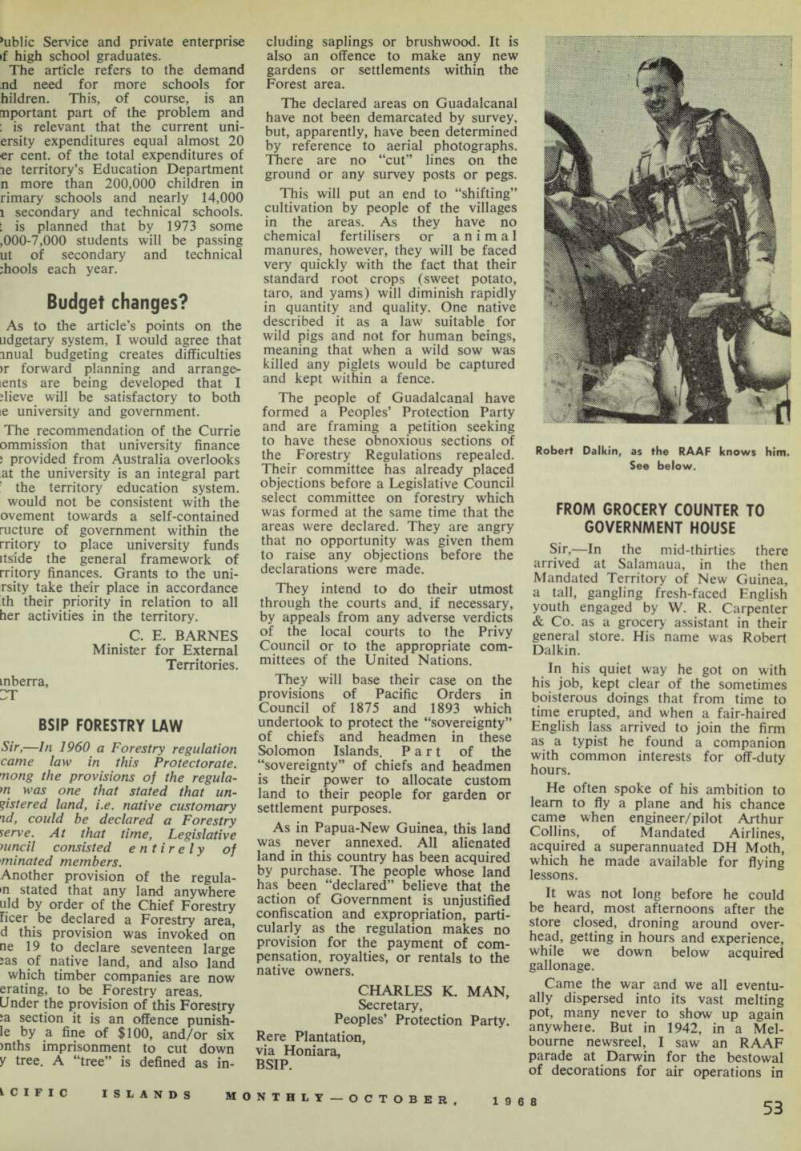
In support of the case for a m( rapid build-up of enrolments th envisaged by the government, 1 article quotes Dr. Gunther as sayi that if 2,000 graduate expatria could be replaced tomorrow, million could be saved every y< in salaries, i.e., more than the u versity would cost to operate for year.
The potential saving from 1 replacement of expatriate officers suitably qualified indigenous ofFio is real enough. The fact of 1 matter is, however, there are nothi like 2,000 expatriate Arts, Law a Science graduates in the territo Moreover, as I have pointed c above, a greater intake for the ti versity could at present only redr the intake to other fields and t saving would be no greater fre replacing, say, an expatriate A graduate than from replacing an ( patriate engineer or doctor or ag culturist and probably not ve much greater than from replacing expatriate clerk by a seconda qualified indigenous clerk.
It is clear that it would not in the interests of the territory concentrate on Arts, Law and Scien graduates and to neglect the train! of people in other fields or postpone any direct entry to t
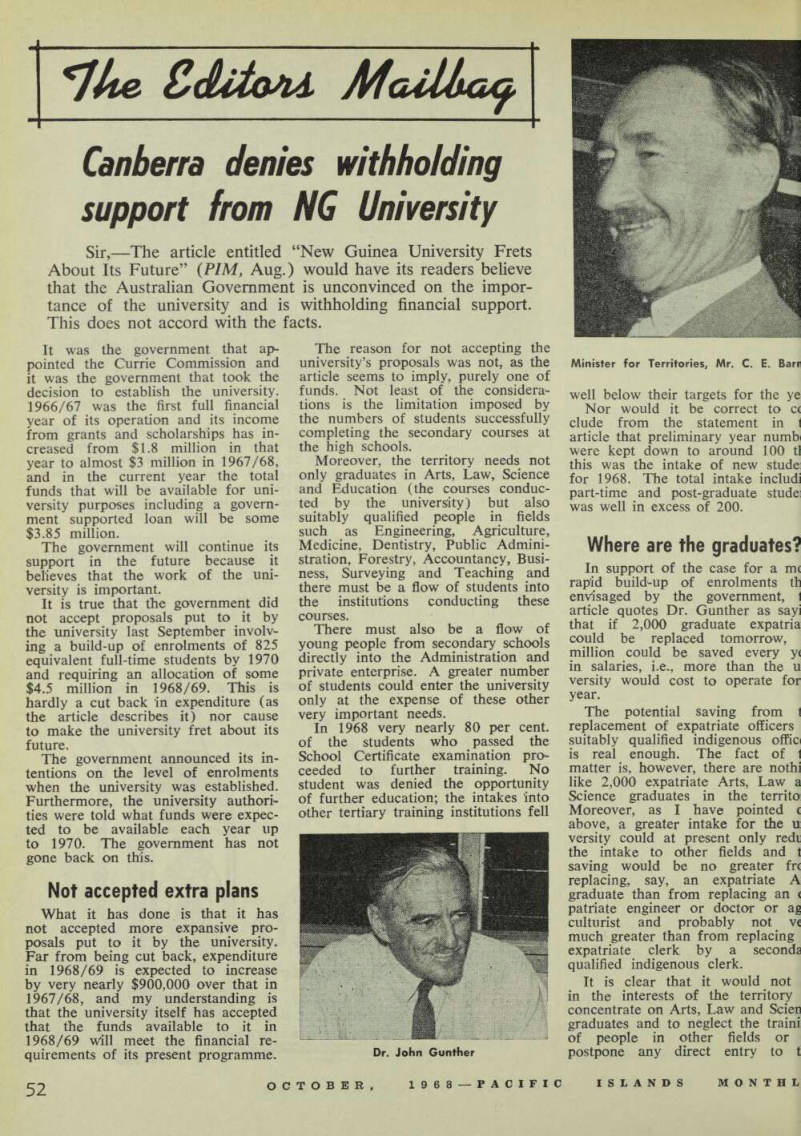
Minister for Territories, Mr. C. E. Barr
Dr. John Gunther
hiblic Service and private enterprise >f high school graduates.
The article refers to the demand nd need for more schools for hildren. This, of course, is an mportant part of the problem and ; is relevant that the current uni ersity expenditures equal almost 20 er cent, of the total expenditures of le territory’s Education Department n more than 200,000 children in rimary schools and nearly 14,000 i secondary and technical schools, t is planned that by 1973 some ,000-7,000 students will be passing ut of secondary and technical hools each year.
Budget changes?
As to the article’s points on the □dgetary system, I would agree that inual budgeting creates difficulties >r forward planning and arrange>icnts are being developed that I flieve will be satisfactory to both ie university and government.
The recommendation of the Currie ommiss'ion that university finance j provided from Australia overlooks at the university is an integral part ■ the territory education system, would not be consistent with the ovement towards a self-contained rupture of government within the rritory to place university funds its'ide the general framework of rritory finances. Grants to the uni rsity take their place in accordance th their priority in relation to all her activities in the territory.
C. E. Barnes
Minister for External Territories. inberra, 3T
Bsip Forestry Law
Sir, —In 1960 a Forestry regulation came law in this Protectorate, mong the provisions of the regula >n was one that stated that un gistered land, i.e. native customary nd, could be declared a Forestry serve. At that time, Legislative mncil consisted entirely of minuted members.
Another provision of the regula •n stated that any land anywhere uld by order of the Chief Forestry Ficer be declared a Forestry area, d this provision was invoked on ne 19 to declare seventeen large Jas of native land, and also land which timber companies are now erating, to be Forestry areas.
Under the provision of this Forestry Ja section it is an offence punish le by a fine of $100, and/or six mths imprisonment to cut down V tree. A “tree” is defined as in
eluding saplings or brushwood. It is also an offence to make any new gardens or settlements within the Forest area.
The declared areas on Guadalcanal have not been demarcated by survey, but, apparently, have been determined by reference to aerial photographs.
There are no “cut” lines on the ground or any survey posts or pegs.
This will put an end to “shifting” cultivation by people of the villages in the areas. As they have no chemical fertilisers or animal manures, however, they will be faced very quickly with the fact that their standard root crops (sweet potato, taro, and yams) will diminish rapidly in quantity and quality. One native described it as a law suitable for wild pigs and not for human beings, meaning that when a wild sow was killed any piglets would be captured and kept within a fence.
The people of Guadalcanal have formed a Peoples’ Protection Party and are framing a petition seeking to have these obnoxious sections of the Forestry Regulations repealed.
Their committee has already placed objections before a Legislative Council select committee on forestry which was formed at the same time that the areas were declared. They are angry that no opportunity was given them to raise any objections before the declarations were made.
They intend to do their utmost through the courts and, if necessary, by appeals from any adverse verdicts of the local courts to the Privy Council or to the appropriate com mittees of the United Nations.
They will base their case on the provisions of Pacific Orders in Council of 1875 and 1893 which undertook to protect the “sovereignty” of chiefs and headmen in these Solomon Islands. Part of the “sovereignty” of chiefs and headmen is their power to allocate custom land to their people for garden or settlement purposes.
As in Papua-New Guinea, this land was never annexed. All alienated land in this country has been acquired by purchase. The people whose land has been “declared” believe that the action of Government is unjustified confiscation and expropriation, parti cularly as the regulation makes no provision for the payment of com pensation, royalties, or rentals to the native owners.
Charles K. Man,
Secretary, Peoples’ Protection Party.
Rere Plantation, via Honiara,
Bsip.
From Grocery Counter To
Government House
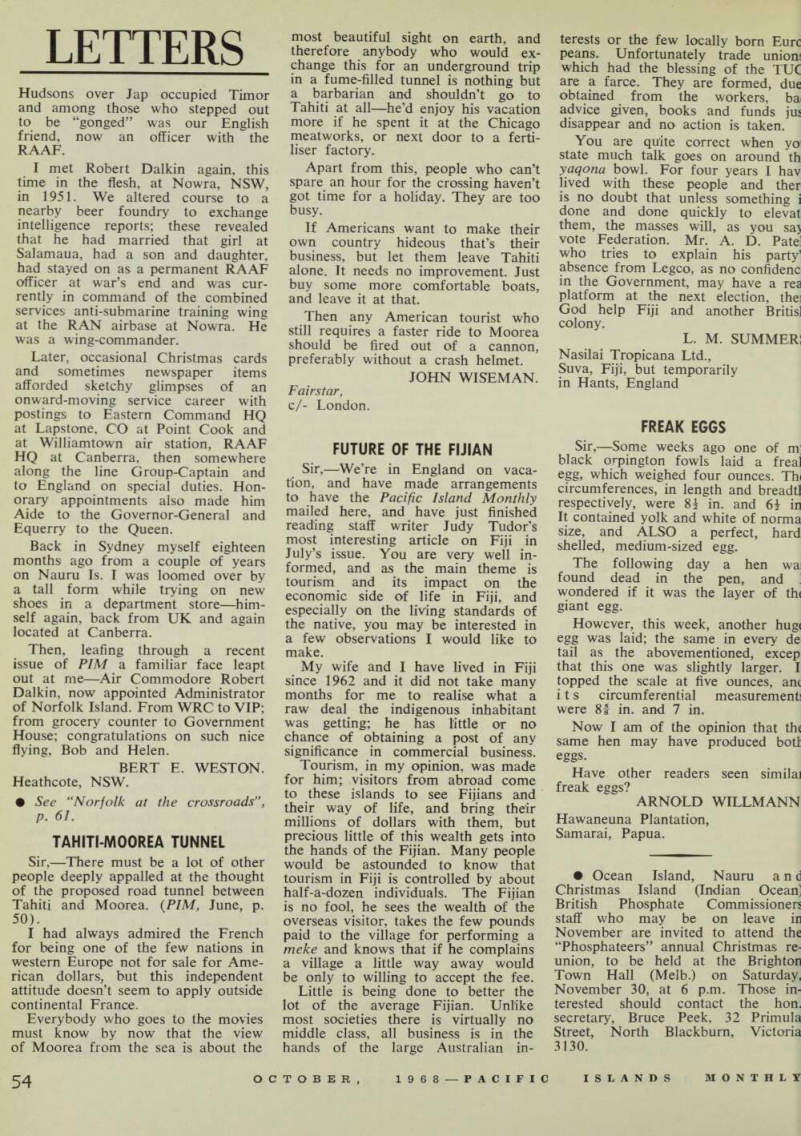
Sir, —In the mid-thirties there arrived at Salamaua, in the then Mandated Territory of New Guinea, a tall, gangling fresh-faced English youth engaged by W. R. Carpenter & Co. as a grocery assistant in their general store. His name was Robert Dalkin.
In his quiet way he got on with his job, kept clear of the sometimes boisterous doings that from time to time erupted, and when a fair-haired English lass arrived to join the firm as a typist he found a companion with common interests for off-duty hours.
He often spoke of his ambition to leam to fly a plane and his chance came when engineer/pilot Arthur Collins, of Mandated Airlines, acquired a superannuated DH Moth, which he made available for flying lessons.
It was not long before he could be heard, most afternoons after the store closed, droning around over head, getting in hours and experience, while we down below acquired gallonage.
Came the war and we all eventu ally dispersed into its vast melting pot, many never to show up again anywhere. But in 1942, in a Mel bourne newsreel, I saw an RAAF parade at Darwin for the bestowal of decorations for air operations in
Robert Dalkin, as the RAAF knows him.
See below.
Hudsons over Jap occupied Timor and among those who stepped out to be “gonged” was our English friend, now an officer with the
Raaf.
I met Robert Dalkin again, this time in the flesh, at Nowra, NSW, in 1951. We altered course to a nearby beer foundry to exchange intelligence reports; these revealed that he had married that girl at Salamaua, had a son and daughter, had stayed on as a permanent RAAF officer at war’s end and was cur rently in command of the combined services anti-submarine training wing at the RAN airbase at Nowra. He was a wing-commander.
Later, occasional Christmas cards and sometimes newspaper items afforded sketchy glimpses of an onward-moving service career with postings to Eastern Command HQ at Lapstone, CO at Point Cook and at Williamtown air station, RAAF HQ at Canberra, then somewhere along the line Group-Captain and to England on special duties. Hon orary appointments also made him Aide to the Governor-General and Equerry to the Queen.
Back in Sydney myself eighteen months ago from a couple of years on Nauru Is. I was loomed over by a tall form while trying on new shoes in a department store—him self again, back from UK and again located at Canberra.
Then, leafing through a recent issue of PIM a familiar face leapt out at me—Air Commodore Robert Dalkin, now appointed Administrator of Norfolk Island. From WRC to VIP; from grocery counter to Government House; congratulations on such nice flying, Bob and Helen.
Bert E. Weston.
Heathcote, NSW. • See “Norfolk at the crossroads”, p. 61.
Tahiti-Moorea Tunnel
Sir, —There must be a lot of other people deeply appalled at the thought of the proposed road tunnel between Tahiti and Moorea. (F/M, June, p. 50).
I had always admired the French for being one of the few nations in western Europe not for sale for Ame rican dollars, but this independent attitude doesn’t seem to apply outside continental France.
Everybody who goes to the movies must know by now that the view of Moorea from the sea is about the
most beautiful sight on earth, and therefore anybody who would ex change this for an underground trip in a fume-filled tunnel is nothing but a barbarian and shouldn’t go to Tahiti at all—he’d enjoy his vacation more if he spent it at the Chicago meatworks, or next door to a ferti liser factory.
Apart from this, people who can’t spare an hour for the crossing haven’t got time for a holiday. They are too busy.
If Americans want to make their own country hideous that’s their business, but let them leave Tahiti alone. It needs no improvement. Just buy some more comfortable boats, and leave it at that.
Then any American tourist who still requires a faster ride to Moorea should be fired out of a cannon, preferably without a crash helmet.
John Wiseman.
Fairstar, c/- London.
Future Of The Fijian
Sir, —We’re in England on vaca tion, and have made arrangements to have the Pacific Island Monthly mailed here, and have just finished reading staff writer Judy Tudor’s most interesting article on Fiji in July’s issue. You are very well in formed, and as the main theme is tourism and its impact on the economic side of life in Fiji, and especially on the living standards of the native, you may be interested in a few observations I would like to make.
My wife and I have lived in Fiji since 1962 and it did not take many months for me to realise what a raw deal the indigenous inhabitant was getting; he has little or no chance of obtaining a post of any significance in commercial business.
Tourism, in my opinion, was made for him; visitors from abroad come to these islands to see Fijians and their way of life, and bring their millions of dollars with them, but precious little of this wealth gets into the hands of the Fijian. Many people would be astounded to know that tourism in Fiji is controlled by about half-a-dozen individuals. The Fijian is no fool, he sees the wealth of the overseas visitor, takes the few pounds paid to the village for performing a meke and knows that if he complains a village a little way away would be only to willing to accept the fee.
Little is being done to better the lot of the average Fijian. Unlike most societies there is virtually no middle class, all business is in the hands of the large Australian in
terests or the few locally born Eure peans. Unfortunately trade union; which had the blessing of the TUC are a farce. They are formed, due obtained from the workers, ba advice given, books and funds jus disappear and no action is taken.
You are quite correct when yo state much talk goes on around th yaqona bowl. For four years I hav lived with these people and ther is no doubt that unless something i done and done quickly to elevat them, the masses will, as you sa> vote Federation. Mr. A. D. Pate] who tries to explain his party’ absence from Legco, as no confidenc in the Government, may have a rea platform at the next election, thei God help Fiji and another Britisl colony.
L. M. Summers
Nasilai Tropicana Ltd., Suva, Fiji, but temporarily in Hants, England
Freak Eggs
Sir, —Some weeks ago one of m black orpington fowls laid a freai egg, which weighed four ounces. Tb circumferences, in length and breadtl respectively, were Si in. and 6i in It contained yolk and white of norma size, and ALSO a perfect, hard shelled, medium-sized egg.
The following day a hen wai found dead in the pen, and wondered if it was the layer of th< giant egg.
However, this week, another hug( egg was laid; the same in every de tail as the abovementioned, excep that this one was slightly larger. I topped the scale at five ounces, anc it s circumferential measurement; were 81 in. and 7 in.
Now I am of the opinion that th< same hen may have produced botl eggs.
Have other readers seen similai freak eggs?
Arnold Willmann
Hawaneuna Plantation, Samarai, Papua. • Ocean Island, Nauru and Christmas Island (Indian Ocean] British Phosphate Commissioners staff who may be on leave in November are invited to attend the “Phosphateers” annual Christmas re union, to be held at the Brighton Town Hall (Melb.) on Saturday, November 30, at 6 p.m. Those in terested should contact the hon. secretary, Bruce Peek, 32 Primula Street, North Blackburn, Victoria 3130.