The Editavs Maillag
pp. 55-57 · Read in the full issue
Tears Of Gratitude
Sir, —If tears of gratitude could be sent by wireless, the Tongans would send them to the residents of Gisborne, NZ, to the NZ Minister of Justice, Mr. Hanan. Their humanitarian attitudes and gestures to Captain Tevita Fifita and his crew in their hour of rejection and desperate loneliness in New Zealand reaffirm my all-but-shattered faith in human kindness.
Captain Fifita and his crew sailed the 1,200 miles from Nukualofa to Auckland in the 36 ft yacht Asitalonoma, which was built in a backyard. They had hoped to get jobs so that they could buy a new engine for their yacht which was run by a four-cylinder Ford car engine. This was the very first trip of the Asitalonoma to any port outside Tonga. On arriving in Auck land, Captain Fifita and his crew were refused work of any kind, although jobs were available at the time.
The refusal of the New Zealand authorities to permit Captain Fifita and his crew jobs to enable them to purchase their very much needed, and often dreamed of, engine does aot come as a surprise.
As was pointed out in PIM [March, p. 19): “Tonga over the /ears has been getting the crumbs :rom the rich man’s table, while ier neighbours have been feeding generously at the same table”. One ’eels that if the Asitalonoma had ieen a yacht from one of Tonga’s reighbours the response from the mthorities in New Zealand would rave been different. But beggars can’t >e choosers.
The Tongans are fully aware that 'Jew Zealands unemployment policy nust be safeguarded, but it is amaz ng that such a rich country as New Zealand should make such a big issue >ut of the effort of a handful of ►oor Tongans to seek jobs to buy ri engine for their yacht.
As a Tongan, I find that the »hrase “extending a helping hand” which was introduced by highly ivilised white missionaries) now has false sound. Are policies more mportant than people?
However, despite what has tappened, I hold in the highest steem the very kind efforts of the esidents of Gisborne, who fed, lothed and housed Captain Fifita
and his crew and enabled them to buy their dreamed-of engine.
What the people of Gisborne did for these poor Tongans, I am sure, represents the true spirit of New Zealand.
Joe Fanamanu
Nukualofa, Tonga
P-Ng's Banking System
Sir, —When the Minister for Terri tories was in Port Moresby, Mr.
Sinake Giregire, the Ministerial Member for the Department of Posts and Telegraphs, P-NG, included the following in an address to the Min ister in the Goroka Local Govern ment Council Chambers: ... “In finance for the increas ing number of native businessmen in this territory, the Development Bank is not providing the facilities we hoped it would, primarily because there are insufficient branches. We in Goroka have sufficient native busi nessmen and small planters to warrant the establishment of a branch of the Development Bank here and I could name another 20 towns in this territory requiring the same facilities.
“In other words, there is a case for the Development Bank to be divided as was the Commonwealth Bank, namely, into a Banking Cor poration with a development bank, a savings bank and a trading bank.
Unless the Reserve Bank of Aus tralia and the trading banks in this territory are prepared to give the same proportions of overdrafts to de posits in this developing area, as they do in Australia, the territory’s own trading bank should be started immediately.
“However, I feel the trading banks could play a much greater part in the finance required for the develop ment of this territory, and the assist ance of native businessmen and in fact all businessmen, if the Reserve Bank in Australia would release some of the special account funds held on their behalf, and at this stage frozen, for the specific purpose of providing the increasing finance that is going to be required to de velop this territory, and finance the increasing number of small native businessmen.
“This, with the correct relationship with Australia, about which I am not going to speak now, will make this
territory one of the wealthiest parts of Australasia in the foreseeable future. We have the land, we have the labour. We only need the finance to develop it.
“As a businessman, I believe in competition, and I would urge the trading banks to stay in the territory to compete with the proposed terri tory bank and provide that competi tion which has enabled the Australian banks to play such an important part in the development of Australia.
“The releasing of special funds by the Reserve Bank will enable them to provide that additional finance that is not available under the present banking policy. I want their competi tion and I want our special bank so that we have the same banking system that is operating in Australia so successfully.”
The above speech was made by a man who, in my opinion, ranks third or fourth in the Ministers, because he is a Member of the Administrator’s Council the equivalent of Aus tralia’s inner cabinet. Also, he is under 35 years old, and has been regarded by some Europeans as pro gressive.
If these are the views of a relatively progressive Minister, they give an indication of the native people’s conservative approach to territory affairs.
Stephenson Fox.
Goroka, New Guinea.
Holm Withdrawal
Sir, — PIM, July (p. 97) carried an article regarding four new cargo runs to the Pacific Islands. While I have no desire to cross swords with Mr.
Rilk, the Australian manager of Columbus Lines, and can accept defeat by a larger and wealthier organisation, for the sake of putting the record right I would like to contradict the portion where Mr. Rilk says he spoke to me and I refused to co-operate with his company. The fact is that I have never spoken to Mr. Rilk and I feel that the “co operation” has been very one-sided.
What actually happened was that I had a ring from his Auckland agent asking if I would co-operate with them, and as a result of this phone call it was agreed that two days later I should have discussions with one of their representatives in Wellington.
When I approached this representa tive for discussions he advised me that he thought there was now nothing to discuss.
I am not bearing any malice in this matter, which as far as I am concerned is now history. But as I have been very keen on co-operation
tween shipping lines, I feel I would e to have my say.
Your article also implied that dumbus Lines had the support of : South Pacific Export Action Com ttee. In fact, this committee was ; up by our firm at the request the Government and has worked vays in very close co-operation th us.
It should be mentioned that dumbus Lines also approached the wernment for assistance and when s was refused they increased the ight rates drastically.
You mentioned that our company d requested a subsidy of fZ 150,000 from our Government, lat we asked for was a repayable in by way of a guaranteed freight • a period of one or two years.
J. F. Holm,
Managing Director dm & Co. Ltd., dlington • For a full record of Holm’s ■■hdrawal from the Melanesian vices readers should see the long ter in Aug. “PIM” (p. 55) from >lm’s general manager, Mr. I. A. ■Kay.
How Ugly Can You Get?
sir, Percy Chatterton suggests \M, July, p. 52) that ‘New means’ is a clumsy, ugly name for people. I would like to remind i that it is not nearly as ugly ‘Singaporeans’ or ‘Sabahans’, ich refer to the people of gapore and Sabah, respectively, knd ‘Nugini’ could be pronounced h the Nug rhyming with snug to ke it sound like an Australian original word.
Vhat about the Republic of lanesia, Pangu, East Irian, or just in unaltered Papua and New inea?
Vhat is so wrong with the bird paradise as an emblem? It may be found in every region of ma-New Guinea, but neither is kiwi found in every region of v Zealand. The important thing heir uniqueness to the respective ntries, like the kangaroo and emu Australia.
John Milne
igkok, uland
> Reader Milne, formerly of stern Samoa, may not have read ?ust “PIM”, in which Percy
Chatterton (p. 52) says that “Nugini” is sloppy usage and that “Niugini” (the word which won Ada Ole Anna Arisa, 10, the “Find a Name” con test) is correct.
Lieutenant Pilsbury
Sir, —I refer to your article “Lieut.
Pilsbury goes home” (PIM, Aug., p. 30). The aircraft was found by Mr.
Michael Clayton, a surveyor em ployed until recently in the Buin area of P-NG; not by Father O’Sullivan.
Mr. Clayton was engaged in survey work in the vicinity of Kangu Hill, and by sheer chance one of his survey lines went across the Corsair. He then reported the find to the ADC in Buin, and to others. Father O’Sullivan reported this find to some Air Force officers while in Australia recently, and it was an Air Force officer who excavated the remains.
In recent weeks the Buin area has been visited by more people excavat ing remains of soldiers—Japanese soldiers. Headed by Mr. Hamasaki, a former battalion commander on Bougainville, a team of 30 excavated the remains of nearly 700 Japanese soldiers buried in this area.
The bones were reverently placed in plastic and nylon bags, and taken back to Japan. Mr. Hamasaki esti mated (from the few remaining re cords and his own knowledge) that nearly 12,000 Japanese dead are buried in southern Bougainville nearly 25 per cent, of the Japanese force here in the war. Most of these died of hunger and disease.
Harry B. Ogilvy
Patrol Officer.
Buin. Bougainville.
Png.
Where Is It?
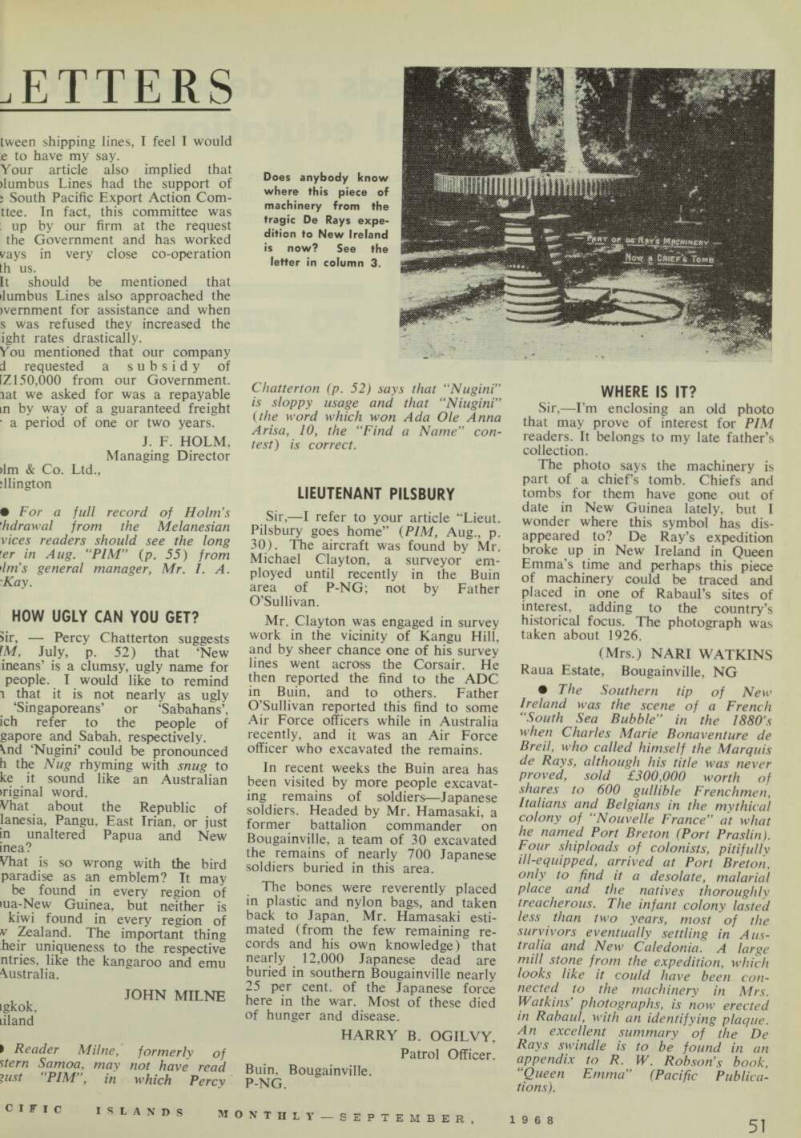
Sir, —I’m enclosing an old photo that may prove of interest for PIM readers. It belongs to my late father’s collection.
The photo says the machinery is part of a chiefs tomb. Chiefs and tombs for them have gone out of date in New Guinea lately, but I wonder where this symbol has dis appeared to? De Ray’s expedition broke up in New Ireland in Queen Emma’s time and perhaps this piece of machinery could be traced and placed in one of Rabaul’s sites of interest, adding to the country’s historical focus. The photograph was taken about 1926.
(Mrs.) Nari Watkins
Raua Estate, Bougainville, NG • The Southern tip of New Ireland was the scene of a French “South Sea Bubble” in the 1880’s when Charles Marie Bonaventure de Bred, who called himself the Marquis de Rays, although his title was never proved, sold £300,000 worth of shares to 600 gullible Frenchmen, Italians and Belgians in the mythical colony of “Nouvelle France” at what he named Port Breton (Port Praslin).
Four shiploads of colonists, pitifully ill-equipped, arrived at Port Breton, only to find it a desolate, malarial place and the natives thoroughly treacherous. The infant colony lasted less than two years, most of the survivors eventually settling in Aus tralia and New Caledonia. A large mill stone from the expedition, which looks like it could have been con nected to the machinery in Mrs.
Watkins’ photographs, is now erected in Rabaul, with an identifying plaque.
An excellent summary of the De Rays swindle is to be found in an appendix to R. W. Robson’s book, “Queen Emma” (Pacific Publica tions).
Does anybody know where this piece of machinery from the tragic De Rays expe dition to New Ireland is now? See the letter in column 3.