more Pacific
pp. 49-53 · Read in the full issue

PanAm announces more Pacific and Oantas protests
By a staff writer
The Australian Government, under pressure from its national airline, Qantas, strongly opposed Pan Ameri can’s plans to almost double its trans pacific services from September 6.
Without prior approval from Aus tralia, PanAm Director for Australia, Mr. Rush S. Clark, said in mid- August that his airline would increase flight frequencies between Sydney and the United States from seven to 12 times a week.
But a week later Australia granted PanAm only two of its five new. proposed services, giving PanAm nine flights a week each way, the >ame as Qantas.
Pan Am’s statement won the com pany a lot of publicity—as did a limilar one earlier this year that s anAm would inaugurate weekly lights from Sydney to Tokyo, via juam. Australia objected shortly be bre the proposed first flight, and the ervice was never begun.
If PanAm had won approval for 12 services it would have been offer ng better frequencies on Qantas’ lome ground.
Qantas, of course, doesn’t want this o happen. If it ever does, Qantas vill insist on increased frequencies or itself and another termination ►oint on the west coast of the US— .os Angeles.
Mr. Clark said Pan Am’s new ser ices would include non-stop flights rom Honolulu to Sydney, thus laking the first two-stop (Honolulu nd San Francisco) flights from Jew York to Sydney.
With load factors below 40 per ent. on trans-Pacific air traffic at resent the argument for sharply icreased frequencies is hard to nderstand.
CO strengthen and widen its in fluence on regional Pacific Is mds routes, Fiji Airways Ltd. elcomed its fifth and sixth partners i August—the Tongan Government nd the Western Pacific High Com u'ssion.
With a limited number of shares, le new partners will take up seats n the airline’s crowded board (Fiji Jrways is equally owned by Qantas, iir NZ, BOAC and the Fiji Govern lent). Their inclusion in Fiji Air ays means that the airline can in-
Tease its flights to Honiara (com nission headquarers since 1952) and Nukualofa.
Shortly after this news, the Fiji Sovemment announced that it was lolding “aviation talks” with the Vestern Samoan Government. It is possible Western Samoan Govern nent, or the Apia-based Polynesian Urlines Ltd., may become Fiji Air vays’ seventh shareholder.
Also, Fiji Airways could become i minor shareholder in Polynesian Airlines, particularly following the ate August news that Pan Arneri an’s plans to start flights between he two Samoas in September has ieen called off. The Western Samoa Jovemment blocked PanAm follow ag cries that the service would put 'olynesian out of business.
Meanwhile, many were asking that s one of Fiji Airways’ major bug ears has been getting its four owners ? agree on policy and equipment in tie past, what will happen in the Liture with two additional opinions y contend with?
A FTER over 20 years of a trans-Pacific air “infrequency”, Canadian Pacific Airlines will start :s first weekly Australia-to-Canada ir services, via Fiji and Hawaii, on tovember 1, using 135-passenger )CB’s.
After November, the Australian irline Qantas will also change to r eekly its fortnightly flights with •oeing 707’s from Sydney to 'ancouver, via Fiji, Hawaii and San rancisco.
CPA has operated fortnightly nee its first trans-Pacific commercial ight, with a 32-seat pressurised DC4, n July 13, 1949. The fortnightly :hedule has been hard to sell. Now, -PA is hopeful traffic will build up— it does, CPA will introduce to re run 199-passenger DCB-63 stretch” jets shortly after June, 1969.
CPA feels Canadians want to see lore than just Australia or New ealand when they travel the South acific route, and they will promote >urs to NG from Australia, through ieir selling agents in the territory— msett.
Canada also has extensive mineral ad timber interests in the territory Placer, International Nickel, Cultus acific and Bougainville Develop lent Corporation), and CPA can aunt on some steady business, from icse quarters.
A new weekly service six weeks fter the International Air Transport
Association’s chin-wag over air fares at Cannes, France, in mid-September, would also give CPA bigger nails to drive if it continues to press for big cuts in trans-Pacific ordinary fare rates.
In the past, CPA has won itself some publicity with its repeated calls for air fare cuts on the South Pacific —exposing the only cracks in the ranks of the six trans-Pacific opera tors in this area. At the September Conference, opposition to any sub stantial air fare cuts is likely to be too strong. But there are hopes that a compromise may ensue in the form of extended excursion fares. rE Gilbert and Ellice Islands Colony has called for airline operators to make proposals for an internal air service in the colony.
Aided by heavy construction equip ment transferred from the defunct nuclear testing site in Christmas Island, the colony is stepping up work on airstrips on main islands of the widely-scattered group. A light plane on July 10, made the first landing since World War II on a mud-rolled 2,600 ft airstrip on Abemama and a second strip on Tabiteuea is expected in September. Air Pacific Ltd. and Fiji Airways Ltd. are reported among those airlines interested in running the service.
FRENCH Polynesia’s internal air line, RAI (a subsidiary of UTA- French Airlines), hopes to begin four-times-a-week return flights between Papeete and the newly-built airstrip on Moorea, 12 miles away, with a new Twin Otter aircraft. RAI is obviously expecting a considerable
leap in the number of travellers to beautiful Moorea now the partly-UTA owned Hotel Mediterranee resort is getting underway. Support by Austra lian tourists for the resort is still below hopes.
VISITORS to Western Samoa in the first half of this year totalled 3,972 to show an 8,4 per cent, in crease over the same period for last year. Visitors from the United States jumped 38 per cent, to 1,662, but visitors from New Zealand showed a slight fall. Average age of the visitors was 43 and average stay almost four days.
The increase in visitors is expected to accelerate over the second half of the year, says PlM’s Apia corres pondent.
These results are slightly ahead of predictions made by travel consul tants several years ago, which claimed that by 1970 visitors would total 20,000 annually, and that the tourist industry would shortly be one of Samoa’s largest money earners.
In line with the growth of the tourist industry, several big hotel plans are in the negotiating stage.
The Australian company of Travelodge has now put forward plans to the Government for a Sim upgrading of the Casino Hotel now owned by the Government Hotel Development Corporation ( PIM , Aug., p. 41); and a group of United States investors has put forward pro
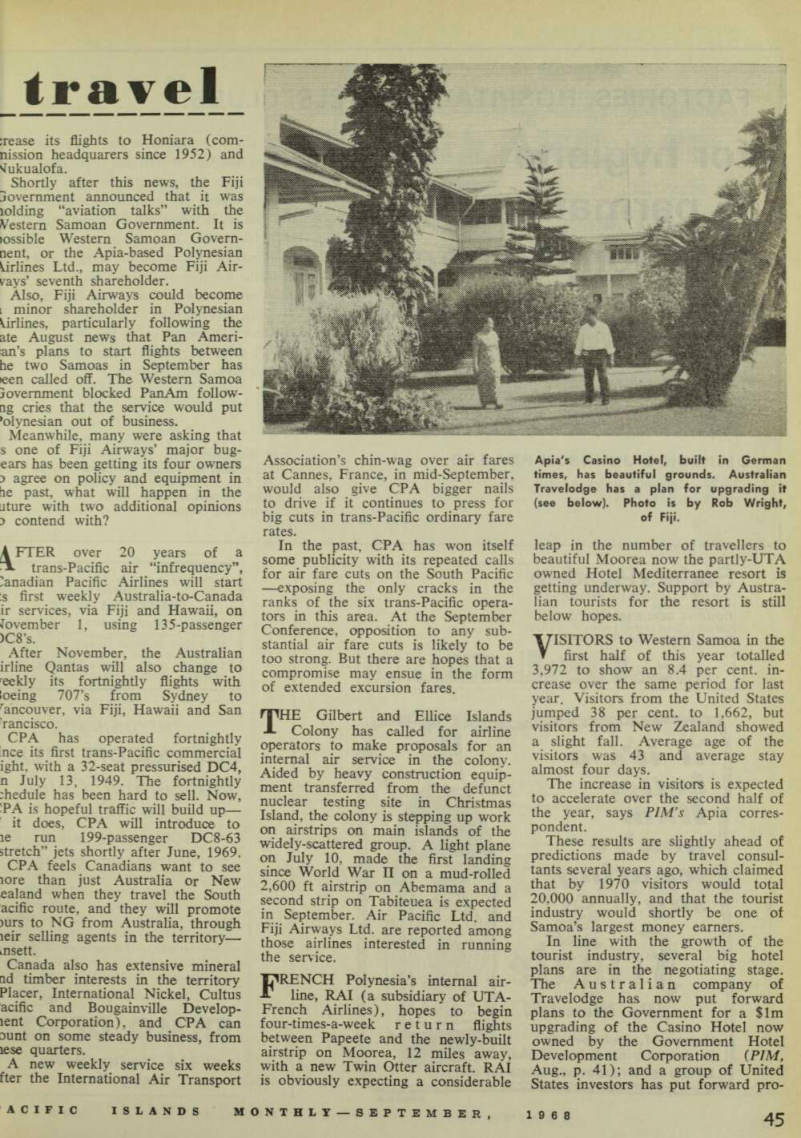
Apia's Casino Hotel, built in German times, has beautiful grounds. Australian Travelodge has a plan for upgrading it (see below). Photo is by Rob Wright, of Fiji.
osals envisaging a SHm hotel n the site of the old quarantine tation at lanmeasina, a couple of hies out of Apia.
An engineering consultant on this roject arrived from New Zealand in august. Plans include reclamation f a part of the lagoon to provide better beach and swimming, and a larina for small craft and water ding. i GOOD example of the kind of tourist development going ahead Papua-New Guinea without any lss is to be found in the tourist sort which Mr. and Mrs. A. E. ridland have established at r anigela, in Collingwood Bay, on e very beautiful but little-known >rthem coast of Papua.
Mr. Cridland was once a well iown resident magistrate for the ipuan Administration. He retired 1940 and bought a rubber planta m at Cape Nelson in the Colling xxl Bay area, and, although driven it temporarily by the Japanese in sion, he and his family have lived that area ever since.
Learning of the eagerness of liters to the territory to see some ng of the real P-NG, he estab tied a tourist resort at Wanigela.
Parties of up to 20 people are :en to Wanigela for a stay of from ee days to a week and are accom >dated in a series of houses made native materials, with modem enities.
Pours for Americans are organ d by Mr. Lars Eric Lindblad, of idblad Travel Inc., New York, who ids tourists to the most interesting ces off the beaten track. All of tours to P-NG have followed the ic procedure—to Port Moresby lunch and then direct to nigela by air. (The Cridlands have ie-up with BOAC and TAA.) fhe American tours have proved successful that advanced book s have been made for 1969 and 0, for about 16 people in each ty of tourists.
"AA brings 14 people at a time Wanigela and they stay there for days after visiting the Sepik and Highlands. 4iss Alma Colomba, a tour con tor for Grandi Viaggi, of Turin, y, takes parties of Italian tourists Wanigela. ourists who visit the Wanigela )rt can travel by boat and canoe ig the coasts and rivers and visit quiet little beaches and the native iges.