travel
pp. 45-47 · Read in the full issue
The Ship That Will Bring
Tourist Dollars To Lau
A Regular Rim Department
Reporting News Of South
Seas Tourism And Travel
From The Inside.
Not so long ago a sturdy Norwegian-built cargo vessel with the name Alta on her bow regularly plied a hazardous route through some of the world’s iciest seas, hundreds of miles north of the Arctic Circle.
Commissioned in 1950 for service long the rugged north coast of lorway, the 701-ton Alta was named fter the tiny fishing village in Jtenfjord where the giant German attleship Tirpitz was sunk by the oyal Air Force in the closing years f World War 11.
Recently however, this itinerant orwegian lady has found herself a lace in the sun—but not the Mid ght Sun.
Now named the Tui Lau, she’s ie latest addition to Fiji’s inter land fleet ( PIM , Aug., p. 47). nder the command of youthful aptain Don Wendt, one of Fiji’s )lest masters and the first to obtain i extended ticket, she recently began weekly service carrying cargo and issengers between Suva, Cakaudrove id the beautiful, remote islands of e Lau Group, east of Viti Levu.
Colourful ceremony
Naming the ship in July (during colourful ceremony which included e presentation of tabua and the rowing of a tanoa of yaqona over r bows) the Vunivalu of Bau, Ratu jorge Cakobau, predicted that the a Lau —the second vessel to be quired by the Maritime Co erative Shipping Association Ltd. would play a vital role in the Dnomic advancement of the Fijian ople.
Through their membership of jian co-operative societies, hundreds Lau and Rabi Islanders own a rt of the Tui Lau. Ultimately, her □fits will be theirs—and, on paper least, the potential profits seem nsiderable. According to Captain endt’s estimation, a five-day trip th capacity passengers and cargo •eight charges are £F4/10/- per i) would gross £3,500. Total costs mid be around £1,200.
The islanders’ excitement at par ipating in such a creditable venture evident whenever the ship arrives
at a new port of call. They stream aboard to examine their “property”, exclaiming with awe at her size and fittings, even trespassing up to that sacrosanct preserve, the bridge, to chat with Captain Wendt—who re mains unperturbed by such ebullient behaviour.
For its passengers—32 first class, 27 second class and 47 economy— the Tui Lau is a new and fascinating experience in shipboard informality and it’s a trip to stir the pioneer spirit. Round trip fares cost £37/10/for first class, £22/10/- for second, and £l2/10/- for economy, with half fare for children under the age of 12 years.
Scattered as they are over thousands of square miles of ocean
(their aggregate area totals 178 square miles) the islands of Lau have a peculiarly elusive quality. When anchored in the lee of one, its nearest neighbour is generally wreathed in the blue mist of distance and the fact that relatively few people can quote statistics about Lau adds mystery.
You feel you’re the first to tread those fine white beaches—and certainly the spontaneous excitement of the local populace indicates how few European feet have paved the way.
During a recent voyage in the Tui Lau we made our first overnight stop at Vanua Balavu, the largest island in the group, with an area of 20 square miles.
Part of the southern section of Lau, Vanua Balavu is closer to Tonga than to Suva and it was at the village of Lomaloma that a Tongan chief called Ma’afu established a Tongan community in 1855. The 300 or so villagers, even if born in Fiji, still consider themselves purely Tongan. Strangely, they were the first Lauan inhabitants we were to meet.
Having dropped anchor a little after sunset, we faced a journey through unrelieved darkness, by punt and on foot, to reach Lomaloma, once an important cotton-growing centre. Here, we were treated to an impromtu display of Tongan action dancing and singing, a rare sight in Fiji unless imported. The Loma lomans, with an eye to supplementing village revenue, hope to polish their performance a little and present it as a regular tourist attraction— they’re aware of the tide which can follow the first ripples of tourism.
Among passengers on my trip— which took in Cikobia, Katafaga, Lakeba, Nayau, Oneata, Moce, Komo, Kabara and the Vanua Balavu ports—was the new Roko Tui Lau, Pita Matasau, who was transporting his family and furniture to Lakeba, administrative centre of the group.
A learned, eloquent Fijian from the province of Lomaiviti, the new Roko is enthusiastic about the advent of
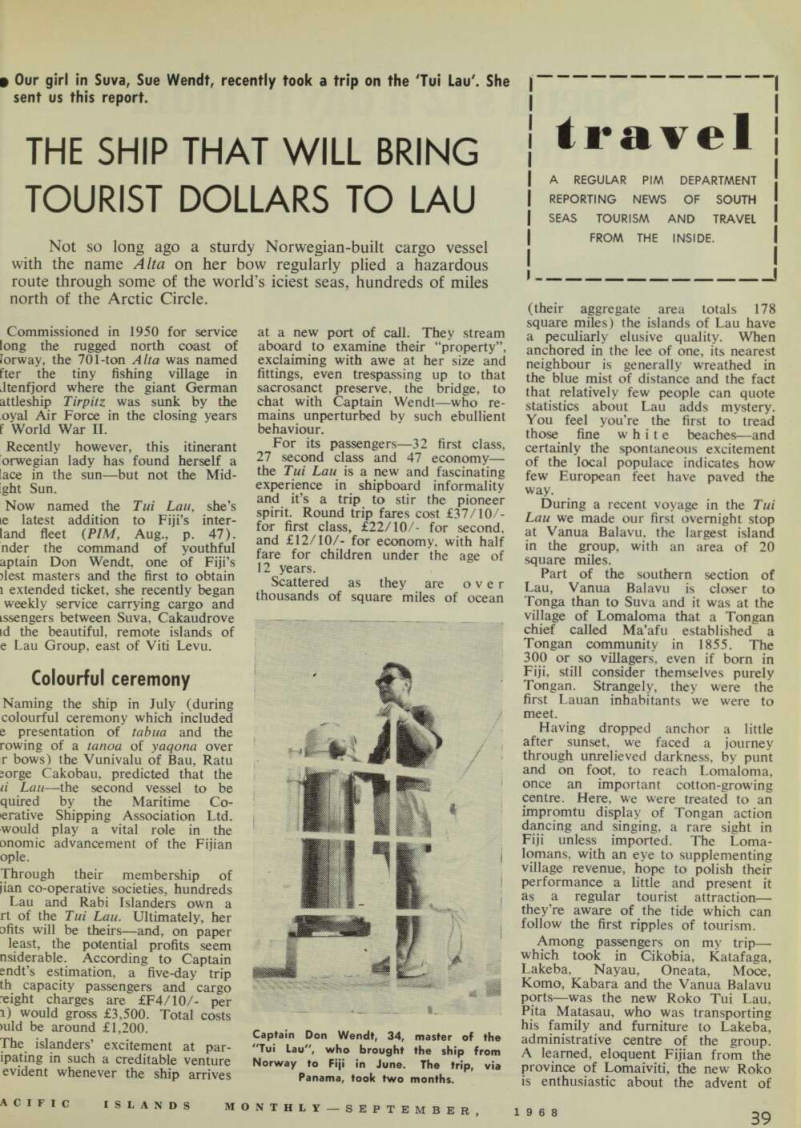
Captain Don Wendt, 34, master of the "Tui Lau", who brought the ship from Norway to Fiji in June, The trip, via Panama, took two months.
>urism as an added source of income om Lau.
“I am very very anxious to do ly best for the people of Lau, irticularly in financial matters,” he lid. “Lau might be one of Fiji’s lost affluent provinces, but the oney could be used more wisely.
“There’s so much to be done in ie field of education. There are ill many out here who never go i school at all. Tourism may help little towards financing a better stem.”
An airstrip at Lakeba, he added, ould be an enormous advantage bringing tourists to the area— though ships like the Tui Lau ould always play a valuable dual le in carrying both cargo and issengers.
At this stage though, the islands Lau are still unchanged, and the Hagers still relatively free from trat some consider the corrupting fects of commercialisation. Even e occasional bare-breasted maiden n be seen.
You can buy a necklace of shells r 2/- and on the sleepy island of oce some of the best tapa cloth be had anywhere is available at a tarter the Suva market price. (Moce is also remarkable for its nine inhabitants, who’ve obviously ard nothing of the dangers of •pulation explosion. I stopped unting at 40 but I’m sure there s quite as many dogs, all related, there are children. And there are mty of those.) Viewed purely in its role as a pra-carrying vessel, the Tui Lau 11 undoubtedly live up to Ratu iorge Cakobau’s predictions of sat economic benefit. But to the anders themselves and particu •ly the new Roko Tui Lau—its sst interesting contribution will be bringing the outside world in. At i rate the tentacles of tourism are iching out, it shouldn’t be too long fore far-flung Lau is in the swing
things, comparatively-speaking.
• UTA French Airlines will sup rt moves for expansion of South cific excursion air fare rates at s annual meeting of the Inter tional Air Transport Association at innes, France, in mid-September, ie airline, which calls its proposals romotional tariffs”, wants to attract Dre Australians who haven’t flown fore into its two Islands draw rds—Papeete and Noumea.