New Guinea needs a department
pp. 58-63 · Read in the full issue


of informal education
For a long time my attitude to professional “consultants” has been coloured by the views of one Parkinson, of “Parkinson’s Law” fame. However, the form displayed by the English consul tants called in to look at Papua-New Guinea’s transport problems has given me pause.
Two things which they have said have particularly pleased me. For one thing, they have praised the “self-help” efforts of Papuans and New Guineans, especially in the field of road building, and compared them favourably with those of the people of other developing countries. I believe that this praise is well deserved, though of course here and there one comes across less com mendable attitudes.
In the second place, they have ex pressed disagreement with the World Bank experts’ doctrine that economic factors must be paramount over human, social and political ones in the development of Papua-New Guinea. Some of us have been un happy about this doctrine for quite a long time, but we have been written off as sentimentalists. Pro fessional consultants are not senti mental; they can’t afford to be.
I hope that the consultants’ words will carry the weight they deserve.
Hard-boiled
“Hard-boiled” doctrines have been taking a knock in other fields too; for instance, in the field of education, where there has been a tendency to assume that we need university graduates so badly that the whole educational system must be geared to producing them, even if the result turns out to be that we produce nine social misfits for every one graduate.
The other day I heard of a 19year-old youth in one of the urbanised villages close to Port Moresby. He left primary school four years ago as a drop-out from Standard 4, since when he has spent most of his time idling in his village, a village in which subsistence garden ing, hunting and fishing have been virtually abandoned.
His story came to my notice when he was picked up by the police for stealing cigarettes from a trade store.
He got a two week gaol sentence, which will probably do him no harm but which won’t really solve anything.
There are scores, and will soon be hundreds, like him in the
To The Point
With
Percy
Chatterton
urbanised and semi-urbanised villages of Port Moresby and its environs.
It’s easy to say that these lads should be prepared to take pick-and shovel jobs. Perhaps they should, but at 15 or 14 or even younger, when they are eased out of primary school to make room for more promising youngsters, they are not sufficiently developed physically to tackle pick and-shovel jobs, even if the Depart ment of Labour, which has the last word until they are 16, was prepared to let them try, and even if their schooling had not conditioned them against doing so.
In one’s more pessimistic moments one feels that all their schooling has done for them is to unfit them for contentment in any walk of life open to them.
Recognition of the existence of thi problem is growing, but ideas o: what to do about it are not to plentiful.
Great credit is due to the Anglica Mission for setting up a Yout Employment Office, aiming speciall at placing teenagers in jobs, at thei Franciscan Friary at Koke. It ha already had some success; but th fact that it is currently advertisin for jobs for “100 employable youn men” suggests either that employei are not co-operating very heartily c that the jobs aren’t there (see p. 59] The technical division of th Department of Education is giving il vocational schools a new look. It i actively preparing to give speck training to teachers for these schooli and is looking at the idea of utilisin
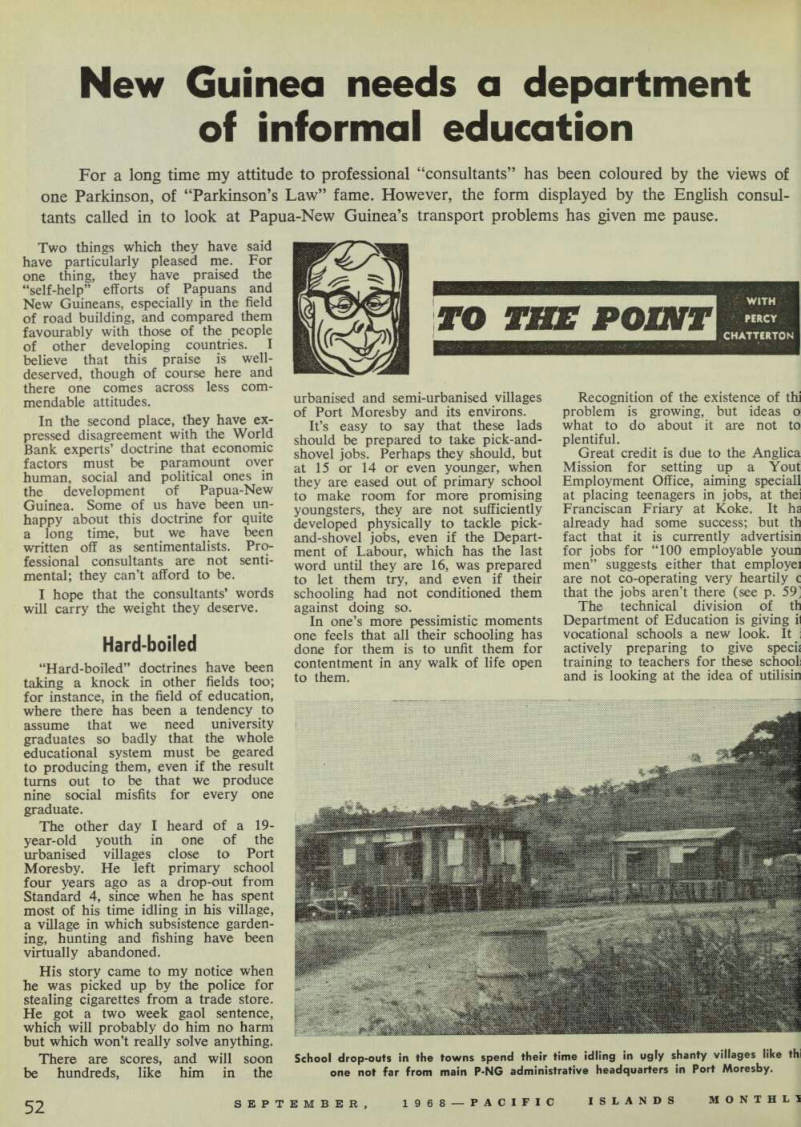
School drop-outs in the towns spend their time idling in ugly shanty villages like thi one not far from main P-NG administrative headquarters in Port Moresby.
the services of village craftsmen to teach traditional arts and crafts.
It is disheartening to hear that the implementation of this obviously sensible idea is bogged down by the difficulty of fitting such uncon ventional “teachers” into an over sophisticated Public Service.
Insofar as their aim is to re orientate their students towards village life, village crafts and rural occupations, these vocational schools :an do a very valuable job, especially f they are prepared, as Don Barrett las suggested, to take on not only school leavers as such but also youngsters who have already left ichool and have tasted the bitterness of finding themselves unwanted in a
vage-earning world.
In the urban situation it is a bit larder to see where they are heading, fhe “handyman” kind of skills their tudents will acquire are not likely 0 be of much use to them in getting obs, and there is only a limited scope or “cottage industry” types of money naking.
However, even if no more is tccomplished than to keep the Youngsters off the streets during heir middle teens, it will have been omething worth doing.
And there are all sorts of uncon rentional possibilities. Just this week 1 news item has told of a group of tudents in a vocational school in Vestern Papua which is being joomed to establish an airline Agency at their local airstrip.
What answers?
Efforts to find answers are not onfined to the Department of Educat ion. I have already described in this olumn a self-help scheme among iris at the Kaugere Community Centre. A similar scheme is now working very successfully among boys nd young men at the Hohola Com mnity Centre. I have just bought well-made set of book-shelves from tiese lads, and I believe that orders or various types of simple furniture re coming in well.
These schemes operate under the dng of the welfare branch of the )epartment of District Administra tor Another self-help venture of similar though more ambitious ind, this time promoted by an nthusiastic officer of the Department f Trade and Industry, is Port Moresby’s Welders’ Club.
These are all self-supporting efforts, lough the Welders’ Club is hoping or an Administration grant to help ; establish itself on firmer founda ions.
Some agencies have sought to
ameliorate the lot of the youthful unemployed by providing recreational facilities for them, and now DDA itself is reported to have entered this field. Admirable as such activities may be, they are a poor substitute for a job and a pay packet.
However, if DDA’s rugged chief, Tom Ellis, could be persuaded to turn out and lead the unemployed in a few Sue Becker type physical exercises on Ela Beach oval, and the Welders’ Club were allowed to take up a collection among the admiring spectators, two birds might be killed with one stone.
The spotlight has certainly been on education lately. The department has staged an “education week”, intended primarily to interest parents in what their kids are up to. A UNESCO expert has arrived to promote primary school science. The university’s foundation Professor of Education has delivered his inaugural lecture, and a distinguished visitor from the University of London is here to speak on “Education— Imported or Home-Grown?”
Our own Director of Education, on the eve of a study tour overseas, has let it be known that we may expect changes in the structure of our primary and secondary educa-
tion next year. A new Education Ordinance is reported to be in the making, though its contents are still very hush-hush, and a Curriculum Committee is rumoured to be work ing away like mad behind closed doors.
The Cinderella of the Education Department is adult education. Jim Horner is doing his lonely best, but he must have been a bit embarrassed when two Zambian visitors turned U P to see what we are doing in this field. The Press boys photographed him showing them a map of the territory, but I wonder what else he showed them, What we need is a new division in the department, which for want of a better name might be called the Division of Informal Education. (After Nancy Phelan’s book, Serpents in Paradise, I just couldn’t hear to hear it called Fundamental Education). As I think of it, it would take care of three areas of education which are outside the scope of main stream education.
The first of these would be adult education in the normally accepted meaning of the term. In this area we must aim at giving the customers what they want, not what we think they ought to want. And w© must
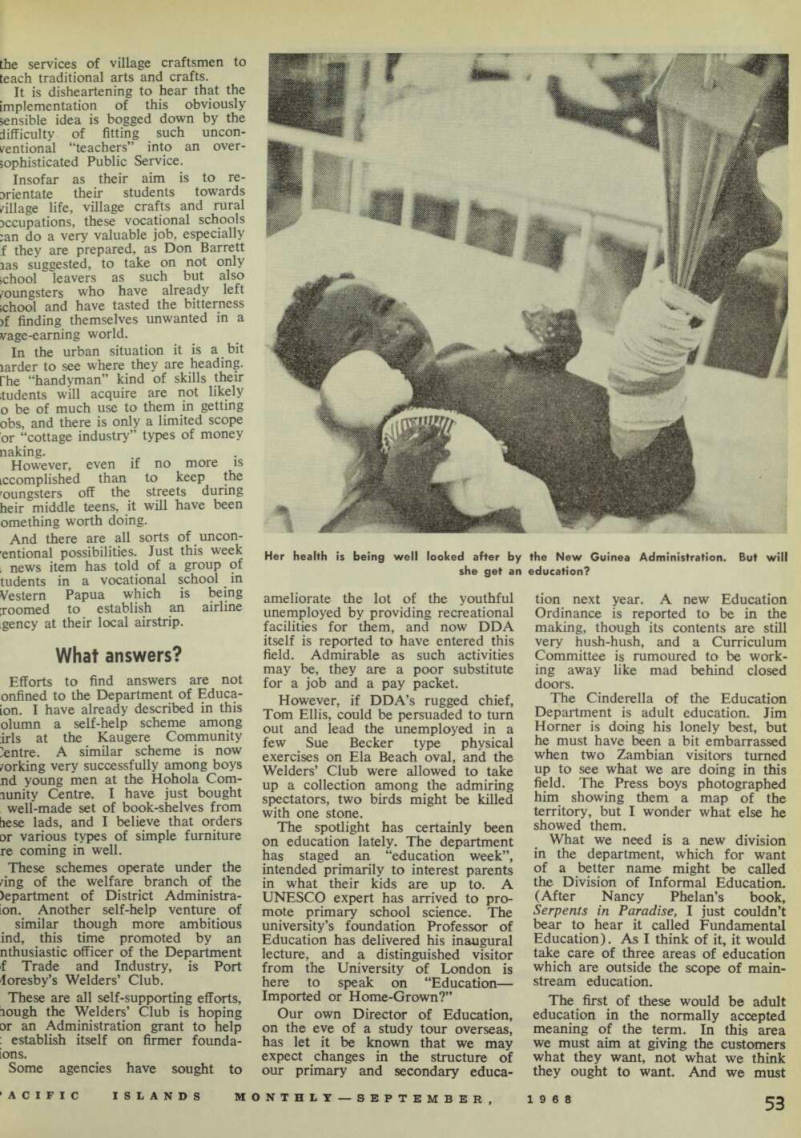
Her health is being well looked after by the New Guinea Administration. But will she get an education?
recognise that their wants are pretty utilitarian.
However, in a few years there may emerge a new class of adult student, those who are fairly well educated and reasonably well paid, and are looking for savouries rather than bread and butter. This is where the university could make a worthwhile contribution to adult education.
Another would be the vocational training of school drop-outs and un employed youths, at present being tackled uncoordinatedly by Educa tion’s technical division and through self-help schemes by welfare officers and voluntary agencies.
The third area in which such a division would operate would be one almost entirely neglected at present, the problem of providing some sort of preparation for adult life for the 50 per cent, plus of P-NG’s child population which has now, and will have in the forseeable future, no chance of securing a formal school education at all.
All that the Admnistration has done in this field so far has been to discourage the missions from trying to cope with it.
IN whatever other respects we may be backward in educational matters, we can at least claim to be up-to-date in one aspect—we have had our first student demonstration, which took place on the occasion of the South African Ambassador’s visit to Port Moresby.
Public reaction to it was, to me at any rate, unexpected. No huffing and puffing from Colonel Blimp. No scarifying comments from the High land Farmers and Settlers’ Associa tion. No suggestion that communist agitators are at work. Not even any sneers about academics. (After nearly half-a-century on this side of the world I still can’t get used to the Australian habit of using the word “academic” as a term of abuse).
Far be it from me to discourage our students from demonstrating.
But I would like to see them thinking up some fresher techniques than the display of scruffily written and often badly expressed slogans on placards and banners.
I was delighted with those demon strators on behalf of America’s poor who thought up the idea of obstruct ing Miami’s traffic during the Republican convention by driving a mule train through the streets.
True, mules aren’t easy to come by in Moresby. But we have plenty of push bikes. A covey of 50 or 100 well deployed pedal cyclists could attract quite a lot of attention to their cause during Saturday morn ing shopping hours.
Grin and bear it
used to be and what must inevitably come. Change is certain. The direc tion it will take seems less so.
In the meantime, for someone straight out of a homogenised, instant-mix, pre-packed, comfort conscious society like Sydney, life in the colony of Fiji presents more than a few surprises.
You learn to accept such minor irritations as weevils in the flour and unwashed, unpacketed rice, cock roaches in the cupboards and mildew on the floors, doors, clothes and furnishings. You grin and bear it, if you can, when a glorious-looking peach, costing perhaps l/6d, turns 3ut to be utterly tasteless because it’s i Californian import and, like many Dther foodstuffs here, has been sub ected to the rigours of deep-freezing.
Hurricane troubles
You accept philosophically the 'act that hurricane slats, ready to be vhipped over the windows, are an jssential part of household equip nent. (They tell me hurricanes come n 10-year cycles, but I haven’t been ible to work out whether we’re in he middle of a cycle or the end of me. Whichever it is, the hurricane lats are close at hand). It’s also lightly unnerving to hear tales of lisastrous floods and of the tidal vave which might have been lisastrous had it not been miracu ously deflected by the reefs ringing luva Harbour.
There are other minor hazards, pecially for government wives, rhey take the form of morning offee parties, seemingly innocuous •ut actually hotbeds of gossip, only ome of it based on fact but all of t lavishly garnished in the telling.
Ay initial shock at hearing some one’s reputation torn to shreds by he wife of an extremely prominent itizen has worn off now, since every ody suffers the same fate. And when // our reputations are in tatters, why wry?
No-one would consider us part of he cultural mainstream (Oh! Was here once live theatre, concerts, good ew films?) though the local radio tation does a sterling effort in im roving the minds of its English peaking listeners. I can’t vouch for he minds of Fijian and Indian udiences since their programmes are i Fijian and Hindustani.
A typical daily programme would aclude a mid-morning concert with .iza Della Casa, soprano, a mid
afternoon concert with Strauss, a late night (9.30 p.m.!) concert with Haydn, Britten and Stravinsky. To be fair, soap operas such as “A Portrait of Jennifer” offer a little light relief, but having managed to avoid listening to it in Australia it seems a little silly to risk becoming an ad dict in Fiji. With only one English language programme, English-speak ing listeners must submit to the turgid sentimentality of such serials or simply switch off.
Lifeless TV sets
Television is unknown of course, apart from curiously lifeless sets in duty-free stores, but the occasional television “personality” does pass through in the guise of tourist, bring ing a breath of promise—or is it a threat?—from the outside world.
The locals feel they can lay claim to at least one celebrity—Raymond Burr. Since the on-screen perpetuator of Perry Mason—the Lawyer who Never Lost—bought Naitaubu Island, his every move, including his inten tion of breeding pheasants on the island, has been followed with as siduous attention. One wonders how many of those who follow the actor’s activities with such interest have
actually seen him playing his famous television role.
Working wives are the rule rather than the exception in Fiji but to a newcomer, it seems a great deal of European skill is being wasted be cause of the delicacy (that word again!) of the employment situation.
Local labour must be utilised and one understands that—but surely there must be a way of preventing the talents of trained nurses, school teachers and so on from being wasted while their husbands are serving in banks and government positions.
While there’s a depressing lack of enlightenment in some spheres, (though perhaps no more than any where else), there’s evidence of spectacular achievement in others.
One is always bumping into cliques of business speculators, from Australia, America and occasionally England, speaking their own kind of linguistic shorthand and enthusing over the potential of this place, the untapped tourist markets (can there still be some?) the fortunes to be made, the nightclubs, new hotels, island resorts to be developed. And they hint darkly of vast financial resources upon which they can draw.
The amazing thing is that from week to week one can hear the same conversation from an entirely new set of mouths. The supply of potential new investors seems endless.
One wonders, if all the schemes came to fruition, where it would end!
Even 300 islands in the sun must have their limitations. . . .
• Despite widespread business specula tion, Stravinsky symphonies and the occasional presence of a real live TV star, there is still plenty of Islands tradition in Fiji. Below, Fijians ceremoniously prepare yaqona for a feast.