Yesterday
p. 91 · Read in the full issue
This month 20 years ago the territory of P-NG was in the making, A Bill to approve the administrative union of Papua and New Guinea had passed its first reading in the Australian Parliament. However, the Trusteeship Council of the United Nations had yet to grant its approval of the union.
And in July, 1948, at least four members of the UN —the US, Russia, China and Mexico —were critical of Australia's plan.
Nevertheless, Papua and New Guinea were soon (March, 1949 ) under one administration. This was one of the news items in PIM for July, 1948. Among others:
WITH swinging England only 18 years away, a group of British seamen did a bit of swing ing—and swaying—in Tahiti. It all happened when the British steamer Nesmiskan Park put into Papeete for water and provisions.
Not only did the sailors from this ship indulge in what Our Own Correspondent described as “an orgy of wine, women and song,” they were also caught red-handed smuggling cigarettes and food ashore. (They were fined 13,000 francs, about £A80).
The British sailors decided to put things right by hurling phos phate, wood and garbage at locals who happened to be passing the ship. The police were called and there was an ugly scene. The following day the British Consul, Mr. Henderson, spoke to the sailors, who demanded another night ashore and a pay advance of £1 each. Amazingly this was agreed to. Result: more fights.
THREEPENNY bits were re introduced in Fiji. Fifteen years before they had been abolished because someone thought it might make people more careful with their pennies.
Pennies had been produced with holes in them with the idea that people “would string them to gether”. Fiji pennies still have holes in them, but Fijians keep them in their pants pockets or purses, like everyone else.
Ferro-concrete chapels
were springing up all over Tonga, and the various denomina tions were buying trucks, lighting equipment, sedan cars and motor vessels. Reason for all this spending: the churches were sharing in the prosperity caused by the high price for copra. Ac cording to our man in Nukualofa, some devout Tongans had been giving cash gifts of up to £2OO to their church.
WHEN a cricket match was held between a team from the Port Moresby Cricket Club and a team of villagers from Hanuabada, the Administrator, Col. J. K. Murray made a special point of attend ing. And that was the start of some bad feeling in the ter ritory. Apparently the European cricketers either behaved in a surly manner in the Administrator’s presence, or ignored him altogether. The villagers, on the other hand, stood smartly to attention for the Administrator and at all times treated him with great respect. Information reach ing PIM from Moresby revealed that this demonstration of bad manners was not directed at Col.
Murray personally, and was not organised; it was merely an indication of the resentment felt by public servants at the way their pay claims had been handled in Australia. Nonetheless the incident was ugly enough to cause the president of the Port Moresby Cricket Club, Mr. Tom Flower, to resign.
PEOPLE in Honiara had a shoe problem, thanks to the stern eye of British bureaucracy.
Because the Protectorate’s laws precluded the immigration of a Chinese shoemaker, Honiara people had to post their shoes to Suva or Australia for repair. But unless they filled in a form in triplicate they ran the risk of not being able to get them back.
GIANT snails were still causing concern in New Britain, New Ireland and New Guinea. They had been released by the Japanese during World War ll—pre sumably as a food, though no
one has been able to prove that the Japanese ever ate them. The snails multiplied and, in 1948, were a big problem. No means had been found of controlling them in the jungles, and PIM suggested that the snails would remain a permanent curse. (They have —though a diminishing one.) SOUTH Sea gourmets may have forgotten themselves for a moment and licked their lips.
According to a PIM report, Sydney rock oysters and the Stewart Island (NZ) oysters were thriving at the Borron Plantation on Mago, Lau Islands, Fiji.
WHEN the Union Steam Ship Co. vessel, the Matua, ar rived in Apia, the strict polio quarantine restrictions then in force in Western Samoa led to “another difficult situation”. The man who found the situation difficult was Mr. W. O. Fry, manager of the Union Steam Ship Co. in Apia, who had, in the customary fashion, gone on board the Matua for dinner. It seems that this was a breach of the quarantine regulations, and Mr.
Fry was arrested and placed in quarantine for two days.
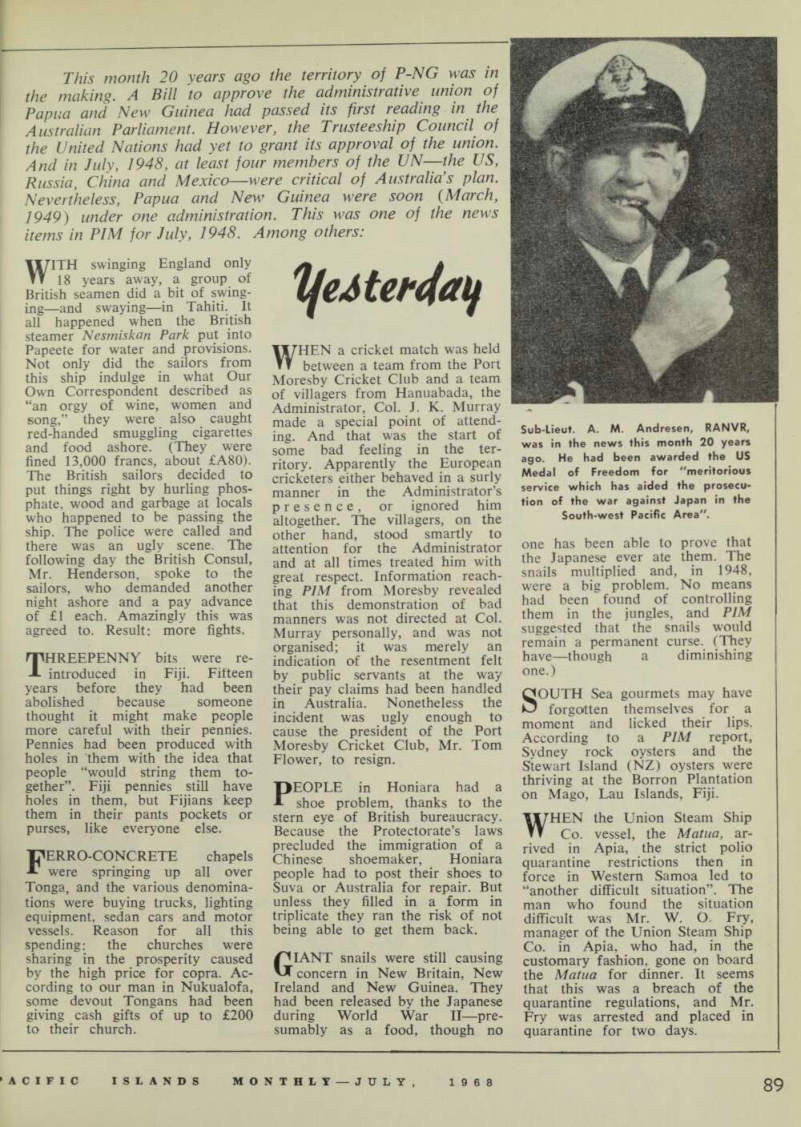
Sub-Lieut. A. M. Andresen, RANVR, was in the news this month 20 years ago. He had been awarded the US Medal of Freedom for "meritorious service which has aided the prosecu tion of the war against Japan in the South-west Pacific Area".