Stories the tombstones tell
pp. 87-89 · Read in the full issue
By MERVAL HOARE, on Norfolk Island.
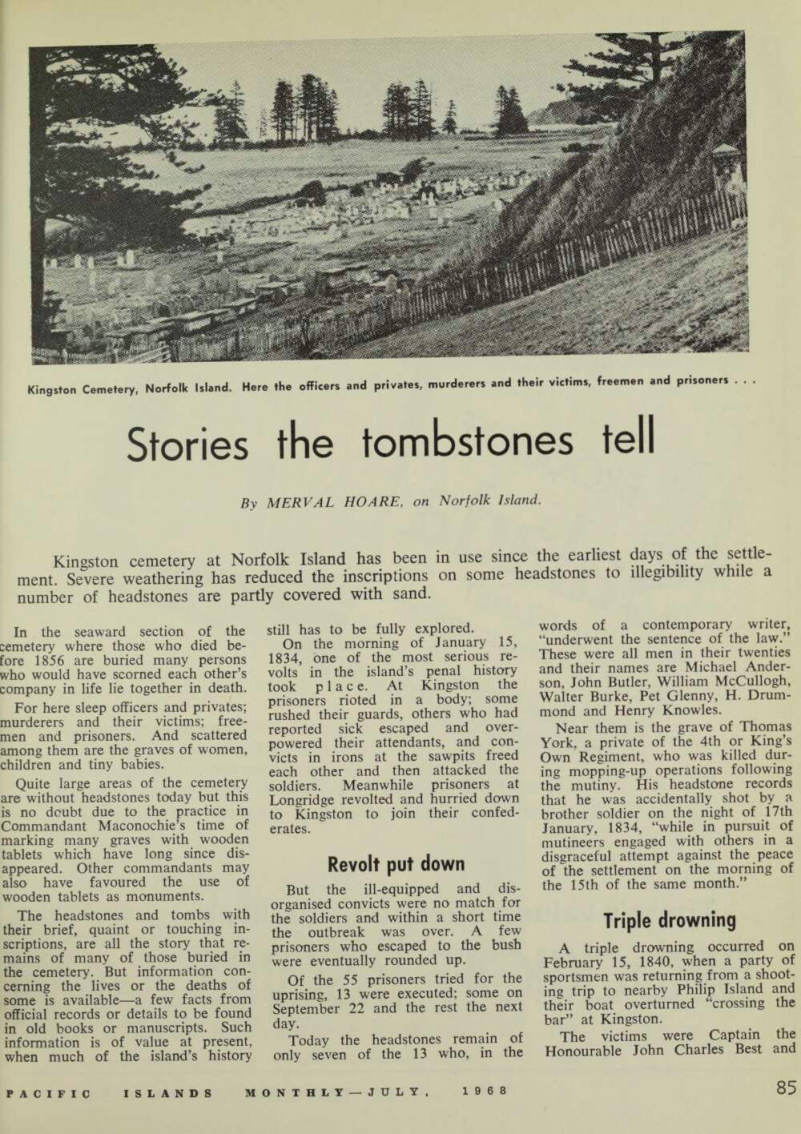
Kingston cemetery at Norfolk Island has been in use since the earliest days of the settle ment. Severe weathering has reduced the inscriptions on some headstones to illegibility while a number of headstones are partly covered with sand.
In the seaward section of the cemetery where those who died be fore 1856 are buried many persons who would have scorned each other’s company in life lie together in death.
For here sleep officers and privates; murderers and their victims; free men and prisoners. And scattered among them are the graves of women, children and tiny babies.
Quite large areas of the cemetery are without headstones today but this is no doubt due to the practice in Commandant Maconochie’s time of marking many graves with wooden tablets which have long since dis appeared. Other commandants may also have favoured the use of wooden tablets as monuments.
The headstones and tombs with their brief, quaint or touching in scriptions, are all the story that re mains of many of those buried in the cemetery. But information con cerning the lives or the deaths of some is available—a few facts from official records or details to be found in old books or manuscripts. Such information is of value at present, when much of the island’s history
still has to be fully explored.
On the morning of January 15, 1834, one of the most serious re volts in the island’s penal history took place. At Kingston the prisoners rioted in a body; some rushed their guards, others who had reported sick escaped and over powered their attendants, and con victs in irons at the sawpits freed each other and then attacked the soldiers. Meanwhile prisoners at Longridge revolted and hurried down to Kingston to join their confed erates.
Revolt put down
But the ill-equipped and dis organised convicts were no match for the soldiers and within a short time the outbreak was over. A few prisoners who escaped to the bush were eventually rounded up.
Of the 55 prisoners tried for the uprising, 13 were executed; some on September 22 and the rest the next day.
Today the headstones remain of only seven of the 13 who, in the
words of a contemporary writer, “underwent the sentence of the law.”
These were all men in their twenties and their names are Michael Ander son, John Butler, William McCullogh, Walter Burke, Pet Glenny, H. Drum mond and Henry Knowles.
Near them is the grave of Thomas York, a private of the 4th or King’s Own Regiment, who was killed dur ing mopping-up operations following the mutiny. His headstone records that he was accidentally shot by a brother soldier on the night of 17th January, 1834, “while in pursuit of mutineers engaged with others in a disgraceful attempt against the peace of the settlement on the morning of the 15th of the same month.”
Triple drowning
A triple drowning occurred on February 15, 1840, when a party of sportsmen was returning from a shoot ing trip to nearby Philip Island and their boat overturned “crossing the bar” at Kingston.
The victims were Captain the Honourable John Charles Best and
Kingston Cemetery, Norfolk Island. Here the officers and privates, murderers and their victims, freemen and prisoners . . .
'Hell of the Pacific'
Corporal J. McLoughlin, both of the oth or Queen’s Own Regiment, nd John McLean, the Superintendent if Agriculture.
The dead Captain Best, who was 0, has been described as a giant of i man; popular and hospitable; a :een sportsman and dog-fancier. But he Superintendent of Agriculture, iged 47, was evidently one of those larsh officials who helped earn Nor blk its title of “Hell of the Pacific.
The convict, J. F. Mortlock, in re erring to the tragedy, said “No jrospect of indulgence could induce he prisoners to endeavour to save a certain official, justly detested for his infeeling severity, whom they saw struggling in the boiling surf, but hey gallantly rescued his companion, he Honourable Captain Best, although ;oo late to prevent his shortly giving jp the ghost.”
Both Captain Best and Superin tendent McLean have massive built up tombs erected to their memory but poor Corporal McLoughlin lies under a plain headstone, now so weathered that his age is indecipherable.
Another man who lost his life through a boat accident was Alfred Essex Baldock, who was drowned on April 12, 1848, aged 27. Baldock was the island’s Chief Constable, but he had once been a convict. Like many another prisoner who was given authority, Baldock became a bully, and presumably no tears were shed by Norfolk prisoners at the news of his sudden death.
The tomb of George Hales, com mander of the General Boyd, who died on August 18, 1801, at the age of 47, is a reminder that whalers
called at Norfolk in the early days, for water and supplies.
The General Boyd was a whaling ship of 300 tons which carried 24 men and four guns. She left Sydney with a cargo of oil on July 25, 1801, and probably arrived at the island a week or so later. It was her com mander’s last voyage.
Captain Hales’ tomb is one of a group of built-up tombs situated in a far corner of the cemetery. It is ornately carved with angels’ faces and scrolls and features a Masonic symbol.
Susanna, the first wife of the Honourable William Pery, died on August 22, 1841, 15 days after giv ing birth to a daughter. She was 30.
Her inscription reads “Gifted with every good quality which could adorn life she was in their relative positions
the gentle and devoted wife, mother and friend. Distinguished for piety she bore her sufferings with the most Christian resignation, leaving this world in perfect love and confidence in our Lord and Saviour of redemp tion thro’ Him.” The baby, Susanna Emily, died six months later.
Susanna’s husband, the Honourable William Pery, was for several years the island’s Superintendent of Agri culture. He married again the follow ing year and became the second Earl of Limerick in 1844.
Young daughter
Elizabeth White Robertson, who died on Norfolk on January 11, 1847, at the age of 24, was the daughter of yet another Superintendent of
Agriculture—Gilbert Robertson.
A former editor of a Hobart paper.
The Colonist, Gilbert Robertson arrived on Norfolk with his family in 1844, and during his term there he was often in serious trouble with the commandant, John Price. On one occasion, Price accused Mrs. Robert son of giving tea and eggs to a prisoner. The convict, J. F. Mort lock, who acted as tutor to Robert son’s son, called daughter Elizabeth “the guardian angle of the family in a season of sharp distress.*' These persons then, among hundreds of others, rest in the old Kingston cemetery. There rest the whaler whose last port of call was Sydney Bay; the gentle mother and her child; the devoted daughter and the harsh officials; the redcoats who once marched down Quality Row, and the 13 desperate prisoners of the Crown —young men who revolted against Norfolk’s cruel penal system and paid for their temerity with their lives.
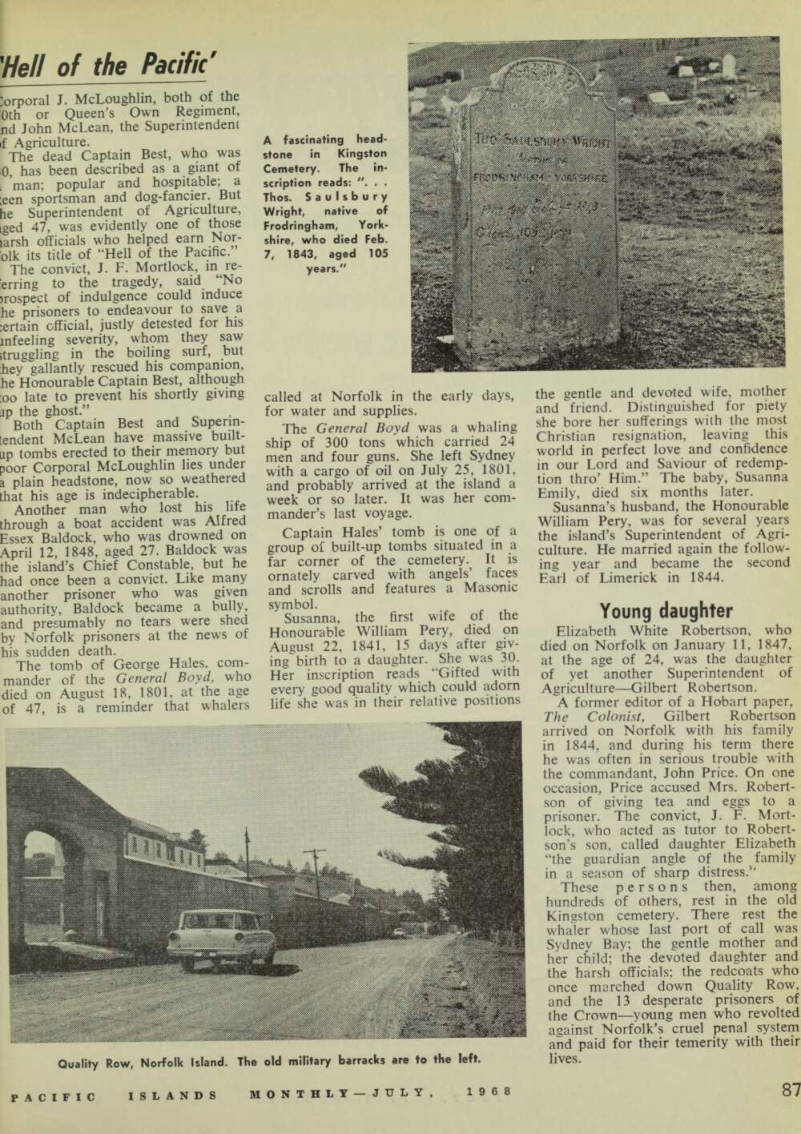
Quality Row, Norfolk Island. The old military barracks are to the left.
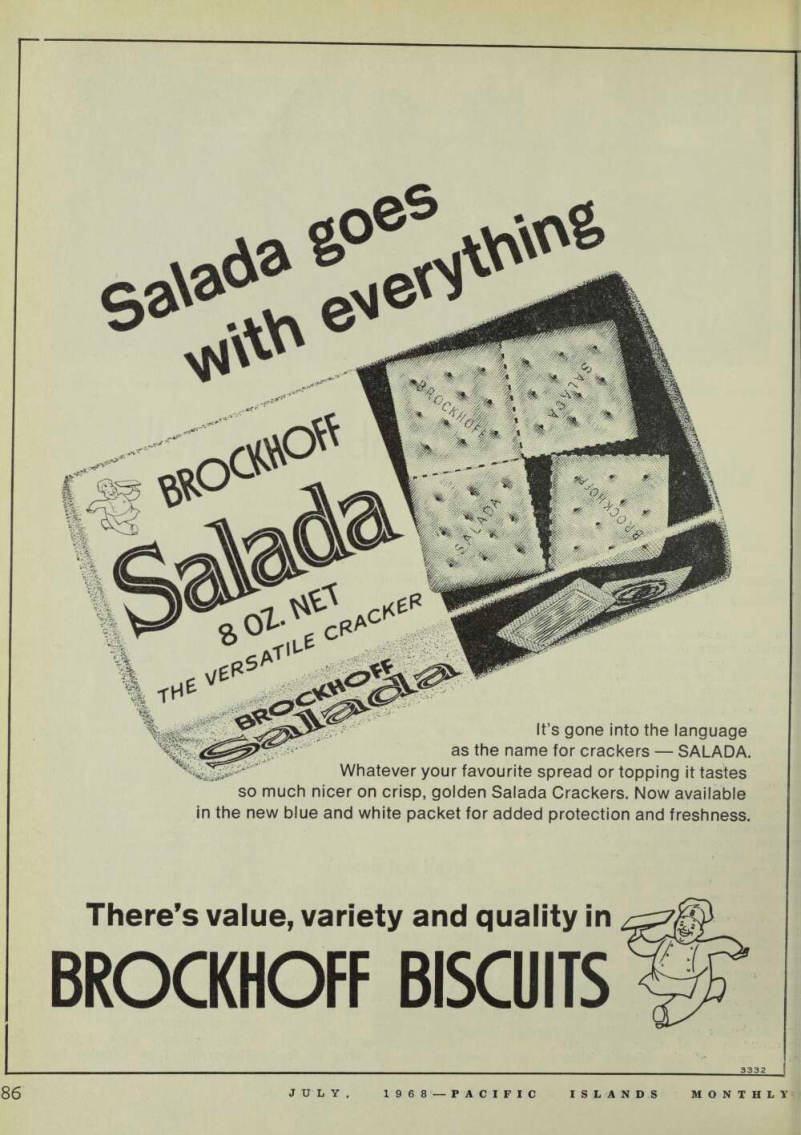
A fascinating head stone in Kingston Cemetery. The in scription reads: ". . .
Thos. Saulsbury Wright, native of Frodringham, York shire, who died Feb. 7, 1843, aged 105 years."