Bougainville's
pp. 83-85 · Read in the full issue
Pacific Islands Monthly
Magazine Section
Bougainville's boom and the men behind it
Bougainville is on the brink of a copper boom. CRA has been con ducting mineral surveys in the island's Crown Prince Ranges for several years, and it is now estimated that there are 230 million tons of copper-bearing ore in "them than hills". Here staff writer KEN McGREGOR tells for the first time the story behind Bougainville's present fortunes.
The huge carpet of dark moss ranging over the creekbed looked pretty uninteresting to the two tired prospectors. The moss was long and scraggy, and it looked as if it had been growing in the spot undisturbed since time immemorial. Never theless, Jack Comb and Captain Bob Palmer elected to give it another try.
So far their daylong panning ex jdition up the twisting Bougainville eek had revealed only small traces ; gold flakes—hardly the rich ore cals had talked of, a few days jfore, in nearby Kieta.
Both men climbed onto the slip ;ry bank and started chipping the loss from the rock. Their picks and lovels easily ripped off long sheets f moss to expose the naked rock.
“We had cleared a big patch when e saw it,” Mr. Comb said many sars later. “Long, shiny streaks of aid-bearing lode running along iterspersed with darker, greenish gns of copper.
“The copper wasn’t as shiny as re gold, but it was there all right.”
By turning over that moss way ack in 1929, the two prospectors lade the first real find of gold on ougainville and so started the land’s small Kupei goldmines which ourished through the 1930’5.
Nearly $60,000 in gold was taken ut of Kupei and nearby spots in le rugged, Crown Prince Ranges f Bougainville, before production etered out in the 1950’5.
Today, with the gold-producing ays largely forgotten, the Crown •rince Range area is poised on the
threshhold of huge copper operations which could make Bougainville the site of one of the world’s biggest copper mines.
Overshadowed
If plans go ahead to set up a copper mine, every enterprise in NG in the 1970’s and probably also the 1980’s will be overshadowed by Bougainville’s mineral exports.
But back to the beginning. . . .
After uncovering the moss, the jubilant Mr. Comb and Captain Palmer, both veterans of the Edie Creek goldrush three years before, marked the spot and quickly packed their gear.
They retraced their steps 3,500 feet down the Crown Prince Ranges to the creek mouth and Iwi Planta tion, then run by the popular Jimmy Joyes. They told him of their find.
Mr. Joyes had hired Mr. Comb and Captain Palmer through the Bougainville Syndicate which he had formed with a group of Adelaide businessmen early in 1929 to look for gold behind his plantation. He had met the two men during the Edie Creek goldrush.
Now that he knew there was gold
in the area, Mr. Joyes wasted no time in relaying the news to his Aus tralian partners. A mining consultant and metallurgist, Mr. E. G. Banks, was dispatched to Kupei to evaluate the find.
Mr. Banks and an assistant made tests on extracted concentrates of gold-bearing ore and yields indicated a commercial find.
Kupei gold was proclaimed in May, 1930. Word was soon out and pro spectors quickly drifted in to try their luck.
Miners like J. H. Ellis, P. A.
Logan, C. W. M. Evans and W. R.
Sergeyeff arrived. Mr. E. P. Holmes, Secretary for Lands in Rabaul for the mandated territory, arrived to take ore samples.
Major problem
Two mining experts from the Aus tralian steel maker. Broken Hill Pty.
Ltd., Messrs. F. R. Hockey and K. C.
Church, inspected Kupei sites in 1931. They found too little had been done by that stage to warrant further BHP interest.
Meanwhile, Mr. Comb and Cap tain Palmer, working for the Bougainville Syndicate, got busy.
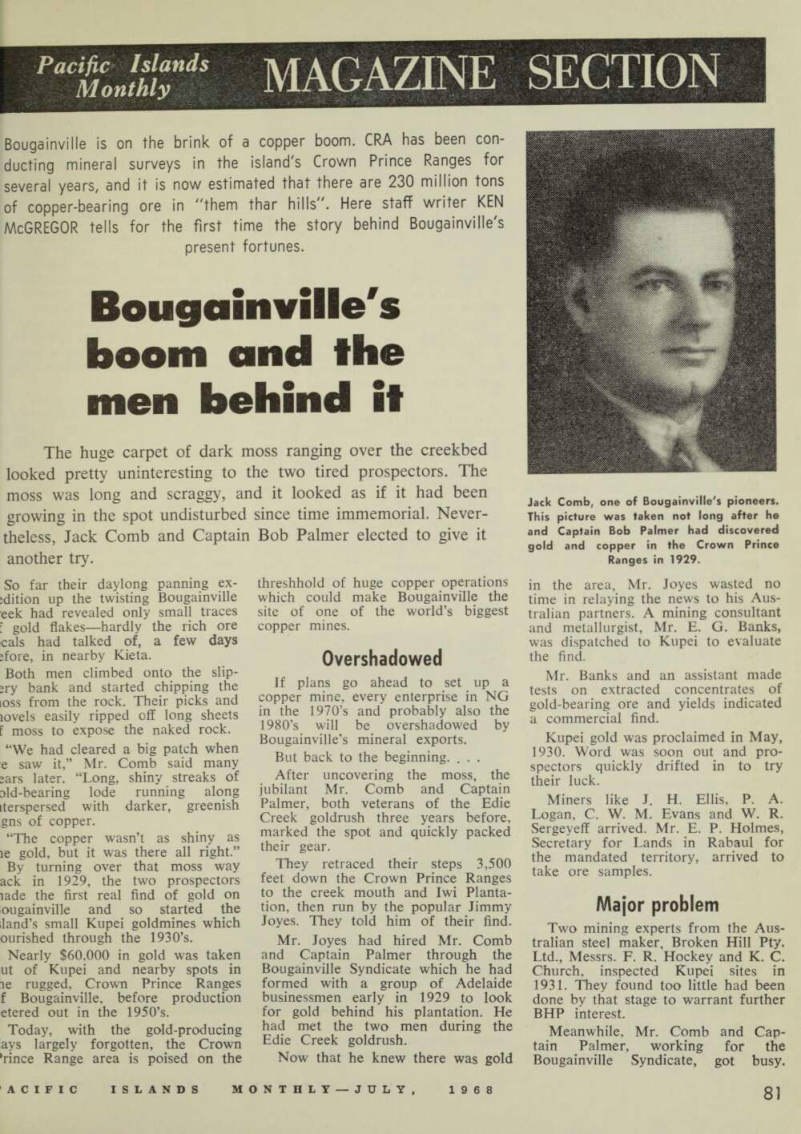
Jack Comb, one of Bougainville's pioneers.
This picture was taken not long after he and Captain Bob Palmer had discovered gold and copper in the Crown Prince Ranges in 1929,
Two other gold deposits are found
Mr. Comb sunk several small adits to test more ore. He found one major problem—it was difficult to extract the gold from its less profitable neighbour, copper.
Perhaps the best summary of Bougainville’s gold came from the famous “Sharkeye” Park, who wasn’t slow to show his face at Kupei.
Park had a good look around, and left, saying: “There’s gold there, but there’s too much bloody Bougain ville in it.”
Mr. Comb wasn’t discouraged, however, and he travelled to Sydney to build a two-head battery to work the Kupei diggings. He returned to Kupei and won over $2,000 of gold with the tiny battery.
About 1933 the Bougainville Syn dicate pulled out its interest in the small goldmine and sold its hold ings to Mr. Comb and Captain Palmer, who decided to work the mine in partnership.
Six months after the partnership began, Captain Palmer, an ex perienced Islands skipper, died sud denly on a visit to Rabaul.
Mr. Comb, who now lives in re tirement in Sydney, worked on alone for a short period and then sold out, for $12,000, to a second Bougainville Syndicate.
Before leaving, he installed a larger five-head battery for the mine’s new owners, who stepped up operations.
Two other deposits
By 1934, two other nearby gold deposits had been located at Moroni, south of Kupei, and at Panguna, east of Moroni. Both were high up in the Crown Prince Ranges and were discovered separately by two miners, Mr. C. W. M. Evans and Mr. G. A.
Myers.
Mr. Joyes, as interested as ever in ore, took out a prospect at Pan guna in 1935, A geologist for the NG Adminis tration, Mr. N. H. Fisher, made a report on the three areas in 1935, and said Kupei had lower-grade ore but cheaper mining costs than the two later discoveries.
No figures are available for gold production before 1935, but it is likely about $lO,OOO in gold was won up to this period. Production rose five fold in 1937 to 598 ounces, but in 1938 it was 100 ounces less.
Between 1930 and 1940, about $50,000 in gold was found. After World War 11, production didn’t start again until 1948, and then only lasted about three years.
A syndicate including Mr. R, Wat son and Mr. R. Doyle won some alluvial gold near Atamo, and two prospectors, Hetherinton ana Glee son, made small finds between 1949 and 1954.
Small finds were also made at Atamo and Karato to the north-west of Kupei, along the Kavarong River and in other spots in the ranges.
But by 1960 mining in Bougain ville seemed over. During that year a startled traveller reported that he had seen a large colony of bats in one of the dormant mine adits.
Then in 1961 a report on the Panguna gold-copper prospect was released by the Australian Bureau of Mineral Resources. It was com piled by Mr. J. E. Thompson, then a geologist working out of Port Moresby.
“The difficulties of access to the mineralised areas of the Crown Prince Range could possibly be borne by a large-scale copper-gold mining operation, but for small operators, interested only in gold, the area is not attractive,” Mr.
Thompson said in his report.
“From a regional aspect, t Kupei-Panguna-Moroni area is province of copper-gold mineralii tion which warrants reconnaissan investigation,” he said.
“The area of particular inten for copper mineralisation is t northern fall of the Crown Prin Range from Atamo to the foothii behind Kieta.”
Huge mine
Mr. Thompson’s report on Kupe copper possibilities came out at; time when the big, British-owm mining company, Conzinc Riotinr was searching eastern Australia t low-grade deposits of copper.
A company geologist, Mr.
Phillips, 32, took a trip to the Phill pines in May, 1963, and inspected huge copper mine in operation Cebu Island.
To Mr. Phillips’ thinking the were many geological differences I tween Cebu and the type of count CRA was looking at in Australia 1 copper.
He suggested it would be better look in the New Guinea Islands, the Solomons. A few months later was sent to have a look at a mine; prospect in the NG Highlands.
Nothing came of this trip but CE was still interested in two copper o currences in NG—at Kupei, Bougaj ville, and Bundi, south of Madang.
CRA re-read the Thompson rep»
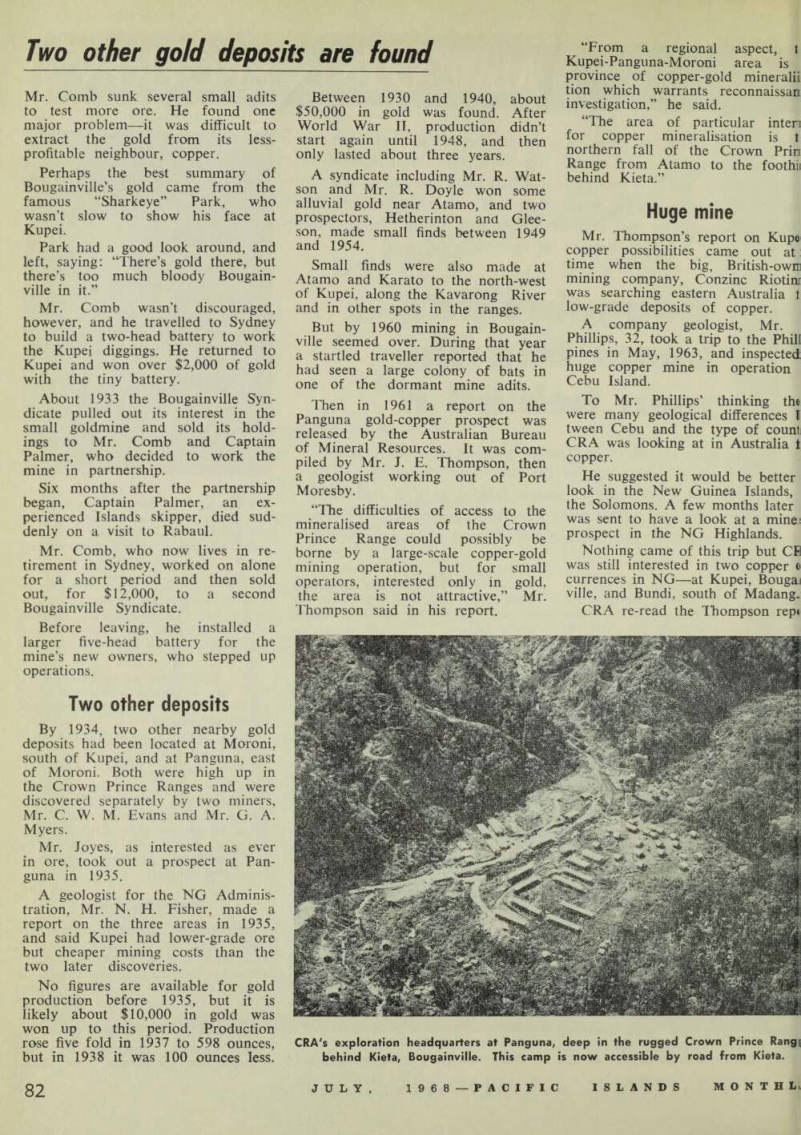
CRA's exploration headquarters at Panguna, deep in the rugged Crown Prince Rang behind Kieta, Bougainville. This camp is now accessible by road from Kieta.
d promptly applied for prospecting hts over 130 square miles behind eta —a request which was granted December, 1963.
Advice
In January, 1964, as a senior geo rist for CRA Exploration Ltd., a tolly-owned subsidiary of CRA, Mr. illips went to Kieta for a few days obtain advice from Administration icers regarding contact with Bou inville Islanders.
Two months later he was back with geo-chemist, Edgar Muceniekas, , two field assistants, Rex Brooks, , and lan Wilkie, 18, and a rep ientative of the NG Department of ines, Port Moresby, Neville Robin 3, 35.
Guides and carriers
The party stayed in Kieta only to y supplies and then wasted little le hiring a small boat which took ;m around to Arawa Plantation.
With a few Bougainville guides d carriers they walked up into the own Prince Ranges and reached the s of the old Kupei goldmine.
Heavy undergrowth, bushes and ig vines covered up any exposures outcrops of minerals.
The party operated from Kupei til April, examining sediment nples from nearby creeks and ers. Then headquarters were anged to Moroni Village, four miles ray on the western slopes of the own Prince Ranges.
Mr. Muceniekas was able to ana >e most sediment samples on the ot, but urgent specimens were shed to Kieta by runners. CRA ickly set up an improvised labora ry at Kieta.
Meanwhile, the explorations ex nded to nearby Panguna.
Mr. Phillips was convinced after eliminary investigations that the ea contained big copper deposits. In s reports to top CRA executives in eir Melbourne headquarters he gued that the terrain closely re mbled areas of Cebu Island.
Sediment samples held very strong >sitive copper responses, scattered
over a large area of several square miles. Results were deemed “en couraging”, and CRA decided that findings warranted diamond drilling.
CRA’s chief geologist, Mr. Clem Knight, arrived at Kupei in mid-1964 and called for a small one-ton rig, capable of drilling to 100 feet, to be brought in from Kieta, The trouble CRA experienced get ting the rig into Kupei, part by part, by small boat and Bougainville carrier, convinced the company that helicopters were the only answer for getting heavy and bulky equipment in to the area, and CRA began air lifting all its heavy equipment.
When the Kieta-Panguna road was completed early in 1967, helicopters were gradually phased out. The last copter airlift was completed early this year.
The first rig was too small, and it was quickly followed by two bigger rigs, both capable of drilling to 600 feet.
Operations started to build up fast during 1965. Extra field assistants and geologists arrived, and hundreds of local people found part-time or full time work, first under Mr. Phillips, who remained in charge of operations until September, 1966, and then under Mr. Colin Bishop who took over.
In May, 1965, CRA announced its “interesting copper prospect” near Kupei.
During the next three years this report was followed by others which estimated the copper-bearing ore at 90 million tons, 100 million tons and 200 million tons. The latest report, in March this year, put the copper bearing ore at 230 million tons.
Low-cost copper
And in May this year Mr. Val Duncan, chairman and chief execu tives of Rio Tinto-Zinc Corporation, told the company’s shareholders: .. We believe that Bougainville .. . will prove to be one of the low-cost copper producers when the final evaluation has been completed, and will moreover be a substantial gold producer. We hope to bring it into production by 1972”.
With an agreement for royalties signed with the NG Administration, a wealthy one-third partner in New Broken Hill, and overall exploration costs expected to top $l5 million, there seems little doubt, at this stage, of CRA getting US, European or even Japanese financial backing to go ahead at Panguna.
Reports early this year say that as Japan will be one of the biggest buyers of the copper, it is probable Japanese funds will be used to finance the mining. Seven big Japanese smelters have already formed a con sortium committee to begin negotia tions with CRA.
A final decision to go ahead at Panguna will be made by mid-1969.
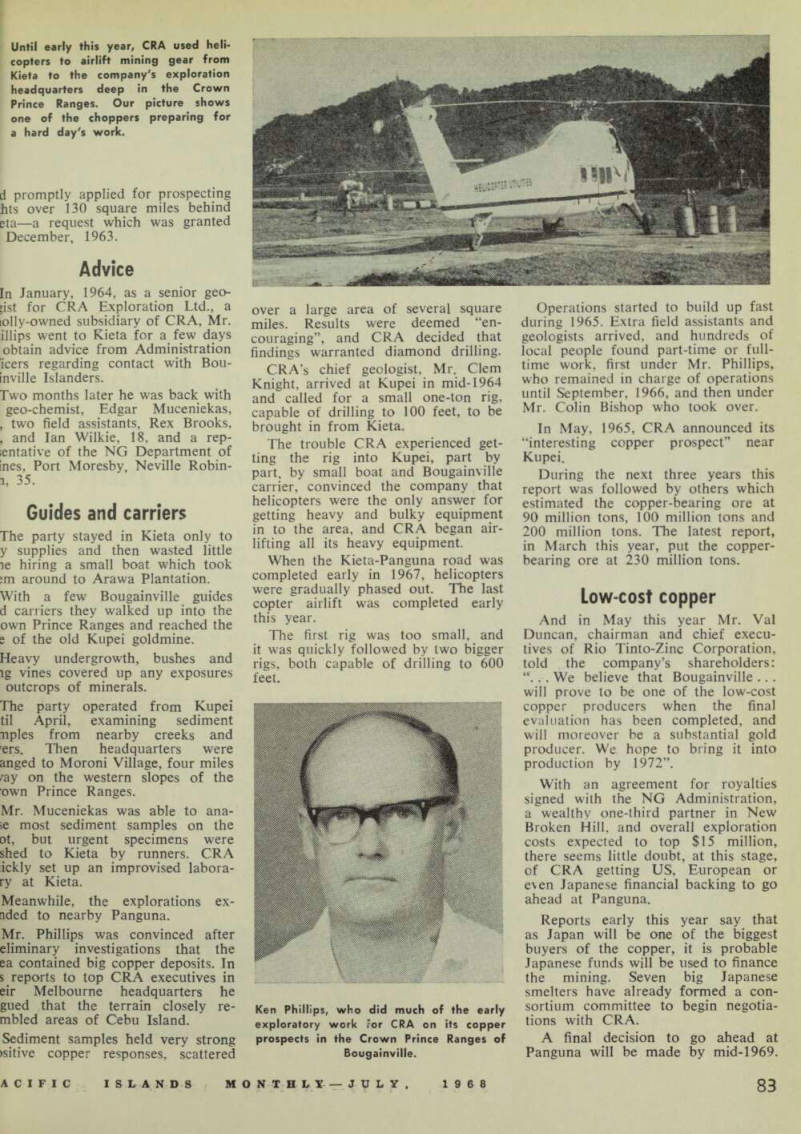
Until early this year, CRA used heli copters to airlift mining gear from Kieta to the company's exploration headquarters deep in the Crown Prince Ranges. Our picture shows one of the choppers preparing for a hard day's work.
Ken Phillips, who did much of the early exploratory work for CRA on its copper prospects in the Crown Prince Ranges of Bougainville.