Book Reviews
pp. 93-95 · Read in the full issue
Fascinating Islands material in early Sydney newspaper
Keen readers of literature on the Islands, whether early or current, have learned to keep an eye on the lists published by Australian booksellers under the general heading of “Aus traliana”. Australiana, both new and second hand, frequently includes material of special reference to the Islands, particularly accounts of the early days of the Australian colonies, when ships touched the Islands en route to Port Jackson.
What has developed into a useful >urce of Islands material is the jries of facsimile editions of the ydney Gazette, Australia’s first newsp aper, which began appearing in ydney town on March 5, 1803.
Original copies of this paper, are, f course, rare, so the publication in 963 of the first facsimile—volume of the Gazette from March, 1803, > February, 1804—was a significant yent for Australiana collectors who ould otherwise not have access to le paper.
Volumes two and three appeared iter and now volumes four and five, the period from March, 806, to August, 1807, have been deased in the one volume. The in :ntion is to publish facsimiles of 11 issues, and prices so far have been ithin easy reach of even the casually iterested reader.
The reason for the double-header itest release is that the fifth volume f the Gazette was in fact a frag lent of 42 pages with almost a two ionths’ gap in the middle and a >mplete breakdown at the end, leav ig another gap of eight months.
Early printing problems
In the meantime, Governor Bligh ad been overthrown by the rum jbellion, but the cessation of the aper was not due to political tur loil but to lack of sufficient paper i the infant colony. Before the final reakdown in supplies the newspaper as being printed on all types and aes of paper—some on very coarse rownish substances, thick, pulpy and dt-like, and some on a similar urplish paper, said to be wrapping aper.
The old, worn type and equipment sed by printer George Howe added > production problems, and have aiso
added to the problems of the Trustees of the Public Library of New South Wales, who are publishing the facsimile editions in association with Angus and Robertson Ltd.
The reproduction is being carried out by modern photographic and off set printing processes from the best surviving copies of the original news papers, but not even the best technical experts can restore ink impressions which were not there.
Better than originals
The publishers have been painstak ing in ridding the facsimiles of ex traneous marks in the paper or due to age, but they have been equally careful not to improve on the work of the originals. Nevertheless, the facsimiles are better than some originals, for we are getting the best
versions of those originals which are still available; and as an invaluable bonus we are getting something that was never in the original—a detailed index. Nothing is missed, every single reference is there, and there are ex cellent cross references.
This index makes a research tool out of what otherwise might have been a mere collector’s item. In this new issue, for instance, we can see
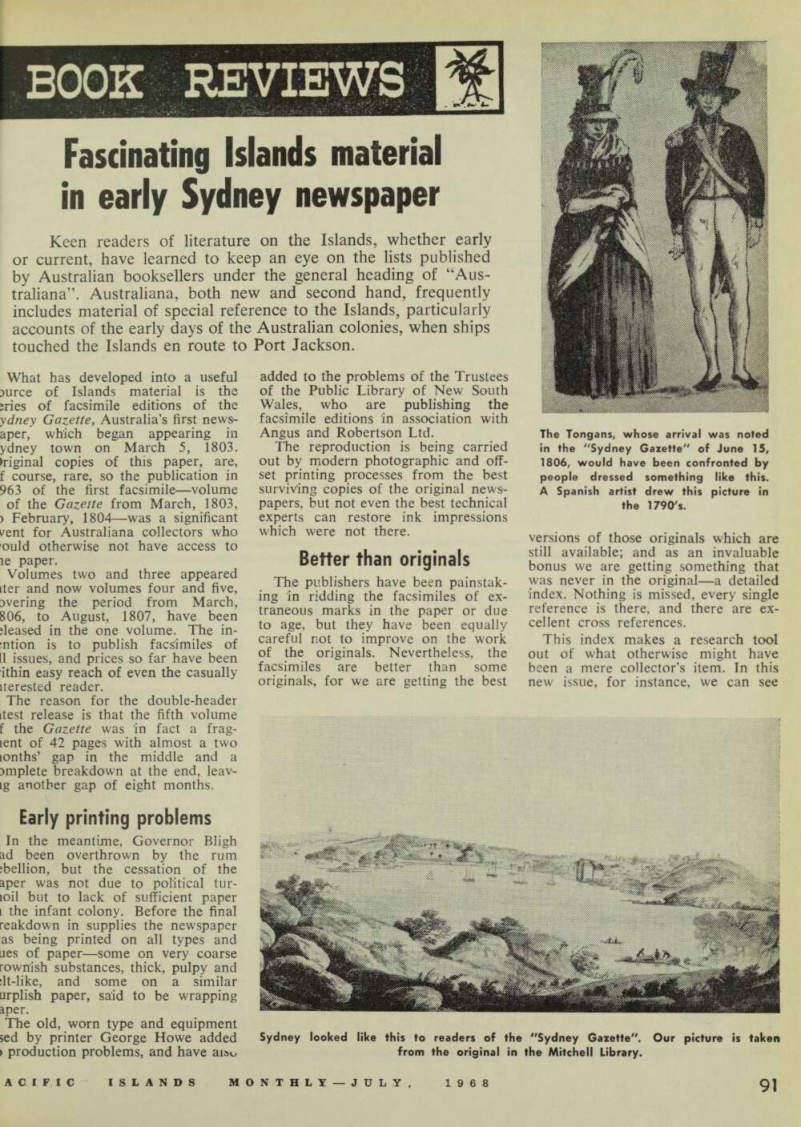
The Tongans, whose arrival was noted in the "Sydney Gazette" of June 15, 1806, would have been confronted by people dressed something like this.
A Spanish artist drew this picture in the 1790's.
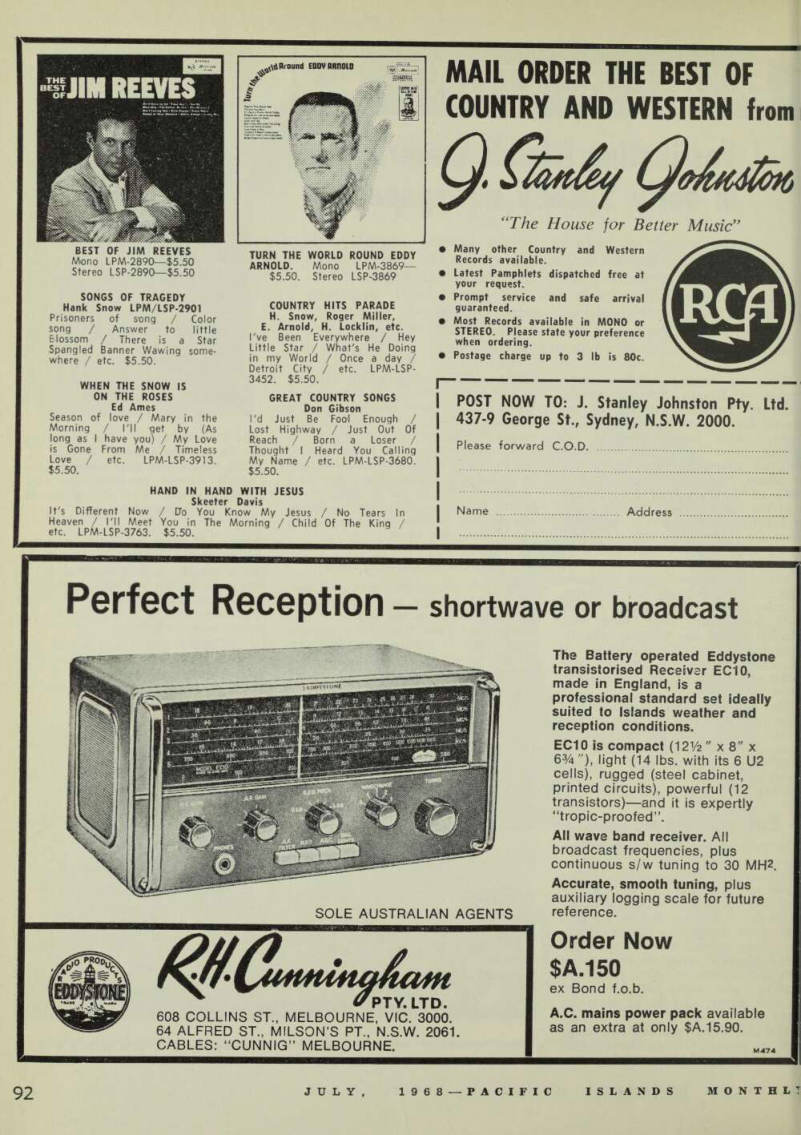
Sydney looked like this to readers of the "Sydney Gazette". Our picture is taken from the original in the Mitchell Library.
hey did like 'the flesh of swine
tantly that there are two refers les to Tongans and one to ngatapu, a dozen or so references Tahiti and to the Tatitians, two erences to Fiji, 15 references to irfolk Island, one reference to New inea, and two references to Pacific mders generally. The following racts indicate the kind of material be found in the Sydney Gazette : Fhe first is from the issue of June 1806. ‘Last Monday the sloop Hawkes ry t of 18 tons, out 5 months, ived from Otaheite in 8 weeks, /ing touched at Norfolk Island, her return from whence she sailed ortnight since. From Mr. Edwards, master, we learned that the island Otaheite is perfectly tranquil and it the missionaries settled there : in good health, Mr. Jefferson :epted, that gentleman having oured under a dangerous illness some time past. Mr. Edwards suc ided in procuring at Matavai about ic tons of pork, the salting down which he inspected himself and said to be better preserved than r before received from thence.
Pork scarce
‘Pork was rather scarce at Matavai ing to a festival that had shortly ’ore taken place, as on such :asions the natives voraciously de ared the flesh of swine in quantities it must very soon demolish their ole stock, unless prevented by an erdiction of the king against the j of it. At Ulitea it was supposed be more plentiful. ‘Mr. Edwards, entering inquisitively o the manners and prejudices of ; people, describes them as partial the customs of the English as they 5 represented to be, though to their igious persuasions they still con ue as obstinately attached as ever.”
Tongans meet Governor
From the issue of Sunday, June 15, 06: “Two natives of Tongataboo, a de and female, are brought hither the Criterion and last week pre ited themselves before His Excel icy [Governor King]. The woman rather a diminutive figure, her itures good, and her hair which is jetty black is frizzed all over so to give her little head the quaint pearance of a prodigious ball.
“The man, on the contrary, is of tall stature, well proportioned, his
countenance open, his complexion a very faint olive and features more nearly resembling those of a European than of the other inhabitants of the Southern Hemisphere hitherto intro duced by circumnavigation to our acquaintance. In fact, nature has bestowed a degree of expression upon this stranger’s countenance which would have given a high opinion of the friendly indications of his country men had not too many fatal instances proved the reverse —but at all events obtain a prepossession in his favour.
Inhospitable shore
“We must ever remember with aversion the dreadful murder of Captain Pendleton of the American ship Union and of Mr. Boston on their inhospitable shore, together with the inhuman massacre of the unfor tunate Captain Mellon of the ship Portland with that of his whole crew as narrated by Mrs. Morey, in our paper of the 4th of November, 1804, who accompanied Captain Mellon and was happily rescued from these barbarians by the Union after a three years’ residence among them.”—Sl.
(The Sydney Gazette. Volumes 4
and 5 in one volume. Angus and Robert son. $10.00).