Up The Fly In
pp. 63-65 · Read in the full issue
The Wake
Of D'albertis
From a Port Moresby correspondent Forestry Technical Officer Mrs. Andree Millar has just achieved an ambition—a voyage dong Papua-New Guinea’s mighty Fly River, in the wake of Italian explorer and naturalist, Luigi D’Albertis.
Bearded romanticist Luigi Maria D’Albertis made three voyages along he Fly River—raucously singing his irias, firing rockets of magnesium, gunpowder and phosphorous, put ing down mutinies, and losing most )f his Chinese crew to the head lunters and cannibals of the middle ind upper Fly.
D’Albertis stole native skeletons rom spirit houses, and came home rom one Fly voyage with a pickled mman head.
D’Albertis became notorious in a lotoriously dangerous area for white nen.
But he did keep a scientific journal »f his voyages, and he’s perpetuated n botanical science for his work in he Arfak Mountains of West Irian nd for his botanical collecting along he Fly.
The brilliantly red D’Albertis >eeper abounds in the Fly River ungles, D’Albertis’ name also bounds—D’Albertis Junction where he Ok Tedi or Alice River joins he Fly, and among others, D’Albertis Dome in the far south >f the West Sepik District.
Luigi D’Albertis voyaged nearly r OO miles up the Fly River, and vas probably the first European into vhat’s almost the geographical centre )f the great New Guinea island.
He was almost certainly the first laturalist along the Fly and while lis methods of collecting might have
been barbaric, his results and scientific observations are valuable.
AU this was 92 years aBa
New collectors
S'? 1 recently Mrs. Andree Millar, °f t * ie Papua-New Guinea Division of Botany at Lae, took time off to study the D’Albertis records and to go up the Fly to check the accuracy
of the D’Albertis observations, and to collect the specimens he described.
Papua’s Regional Agricultural Officer, Mr. Fred Kleckham, and Western District Agricultural Officer, Mr. lan Pendergast, went along too aboard the government trawler Anzana.
It was the first recorded botanical expedition right along the Fly, since D’Albertis in 1877.
Hundreds of botanical specimens— D’Albertis Creeper, dozens of orchids and plants and flowers —were collected and flown out to Lae so the government herbarium will be able to fill another gap in its botanical knowledge of P-NG.
Some of the specimens will be sent to Canberra, Melbourne, Sydney, Kew Gardens in England, Edinburgh and California.
As Mrs. Millar puts it, the govern ment wants to know what is growing where.
Triumph
“We want to know where to send visiting scientists so they’ll have a good chance of getting what they want. B> building up a wide know ledge of the territory’s botany, weUl know what areas will support certain plants. This knowledge could help, too, in the planning of food crops.”
Mrs. Millar has covered a lot of botanical ground in more than 20
• In 1876, D’Albertis voyaged along the Fly, singing arias and firing rockets. Recently a P-NG Forestry Technical Officer made the same voyage—but rather more quietly.
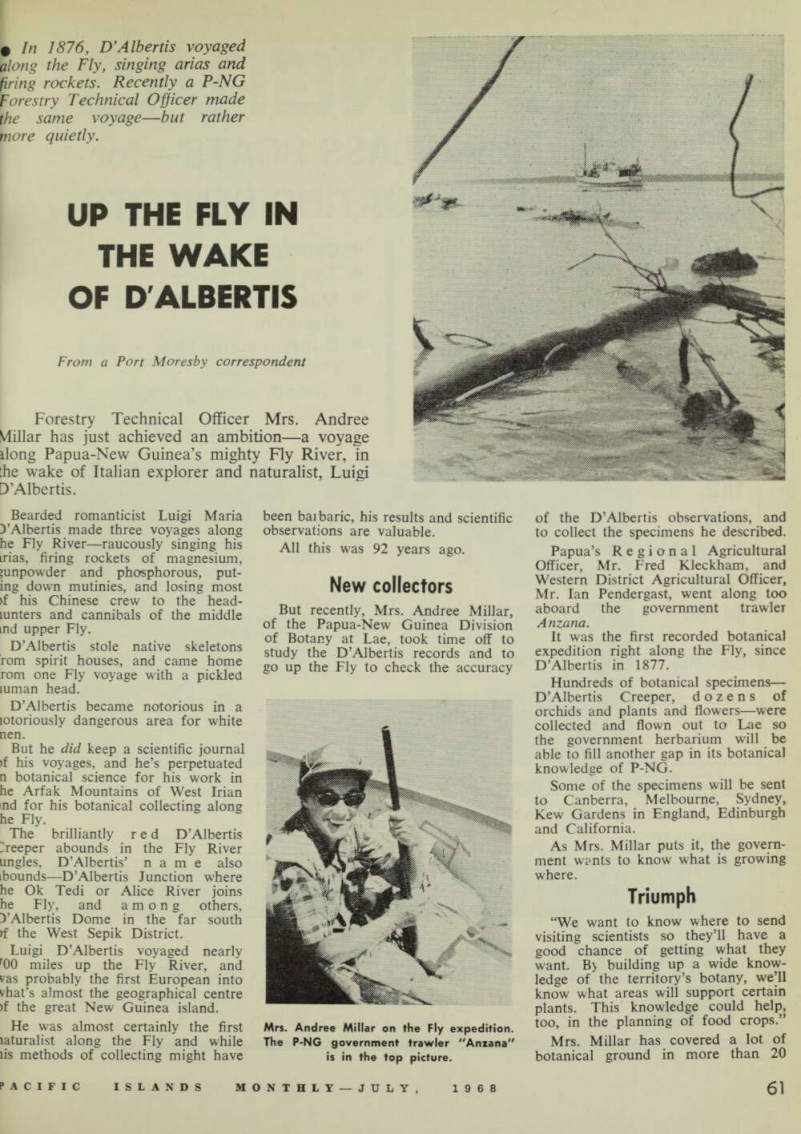
Mrs. Andree Millar on the Fly expedition.
The P-NG government trawler "Anzana" is in the top picture.
Precious orchids
years in the territory, but one of her greatest triumphs was the discovery on this trip of the common Queens land Onion Orchid near the water way which links the Fly River and Suki Lagoon, 250 miles up the Fly from Dam.
It’s the first time officially that botanists have found the Queensland Onion Orchid in he Territory.
According to Mrs. Millar and her companions, the discovery lends some weight to the old theory that there was once a land bridge between Papua and Australia’s Cape York Peninsula.
There was a moment of excitement when the Papuan cook aboard the Anzana threw out what he thought was an unused carton. It contained the three precious Onion orchids, and it floated downstream on a three or four-knot current, with Kleckham preparing to go overboard to retrieve it.
Quick action!
With the cook in a panic and Mrs.
Millar imploring quick action to save her specimens, the master of the Anzana , Frank Narua, put his ship into a quick turnabout. A chase of half a mile, and the Queensland Onion Orchids were safely aboard.
The Anzana voyage covered 820 miles from Dam to Kiunga, includ ing 200 miles up the Strickland and Herbert Rivers into Lake Murray.
If she can overcome the quarantine problems of shipping Papuan soil to Rome, Mrs. Millar will be sending two small jars of earth to be placed on Lugi D’Albertis’ grave.
The first jar is from Ellengowan Island in the middle Fly, where D’Albertis landed in 1875 from the Reverend Samuel McFarlane’s mission ship, the Ellengowan.
Died in Rome
The second jar of soil is from D’Albertis Junction, a few miles south-west of Kiunga.
D’Albertis died in Rome in 1901, aged 60, after building himself a Papuan-style house in the Pontine Marshes.
Papuans along the Fly River re member the name D’Albertis, handed down from father to son. Unless Papua-New Guinea’s Place Names Committee deems otherwise, D’Albertis will be on the map for ever.