Suva, City Of Cars, Cars, Cars...
pp. 66-67 · Read in the full issue
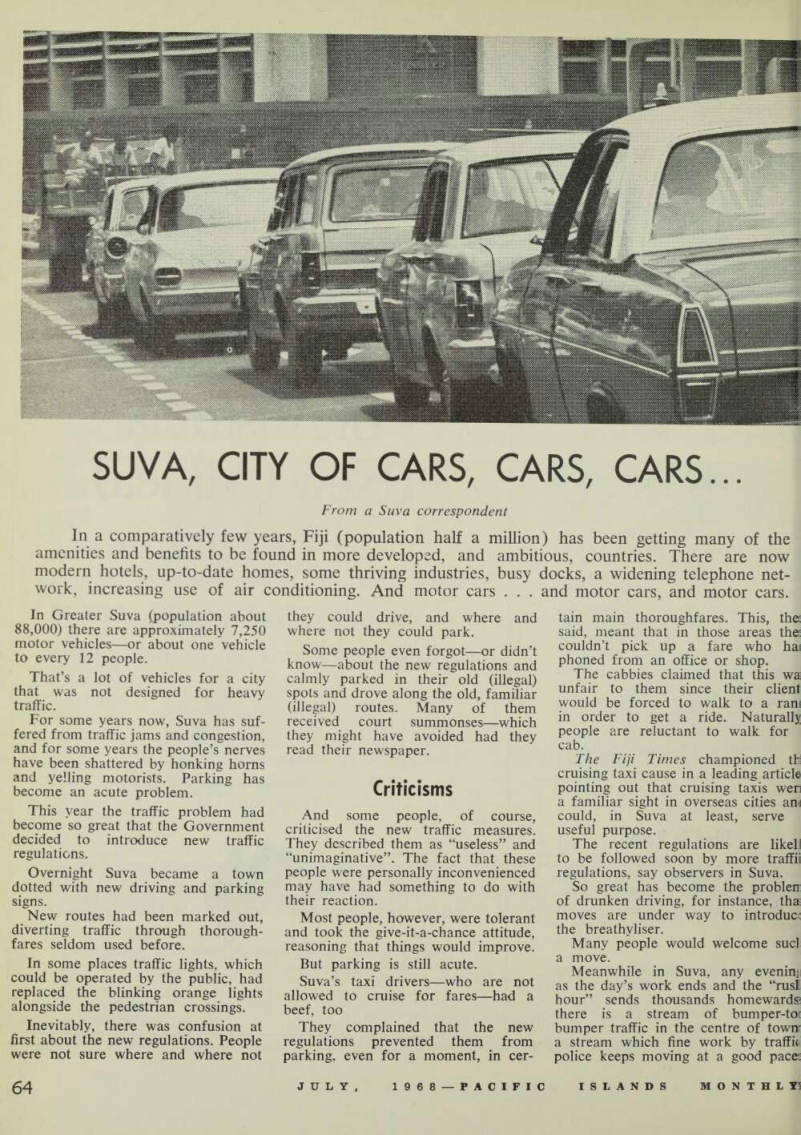
From a Suva correspondent In a comparatively few years, Fiji (population half a million) has been getting many of the amenities and benefits to be found in more developed, and ambitious, countries. There are now modern hotels, up-to-date homes, some thriving industries, busy docks, a widening telephone net work, increasing use of air conditioning. And motor cars . . . and motor cars, and motor cars.
In Greater Suva (population about 88,000) there are approximately 7,250 motor vehicles—or about one vehicle to every 12 people.
That’s a lot of vehicles for a city that was not designed for heavy traffic.
For some years now, Suva has suf fered from traffic jams and congestion, and for some years the people’s nerves have been shattered by honking horns and yelling motorists. Parking has become an acute problem.
This year the traffic problem had become so great that the Government decided to introduce new traffic regulations.
Overnight Suva became a town dotted with new driving and parking signs.
New routes had been marked out, diverting traffic through thorough fares seldom used before.
In some places traffic lights, which could be operated by the public, had replaced the blinking orange lights alongside the pedestrian crossings.
Inevitably, there was confusion at first about the new regulations. People were not sure where and where not
they could drive, and where and where not they could park.
Some people even forgot—or didn’t know—about the new regulations and calmly parked in their old (illegal) spots and drove along the old, familiar (illegal) routes. Many of them received court summonses—which they might have avoided had they read their newspaper.
Criticisms
And some people, of course, criticised the new traffic measures.
They described them as “useless” and “unimaginative”. The fact that these people were personally inconvenienced may have had something to do with their reaction.
Most people, however, were tolerant and took the give-it-a-chance attitude, reasoning that things would improve.
But parking is still acute.
Suva’s taxi drivers—who are not allowed to cruise for fares—had a beef, too They complained that the new regulations prevented them from parking, even for a moment, in cer
tain main thoroughfares. This, the; said, meant that in those areas the; couldn’t pick up a fare who hai phoned from an office or shop.
The cabbies claimed that this wae unfair to them since their client would be forced to walk to a ram in order to get a ride. Naturally people are reluctant to walk for cab.
The Fiji Times championed thl cruising taxi cause in a leading article pointing out that cruising taxis wen a familiar sight in overseas cities am could, in Suva at least, serve useful purpose.
The recent regulations are likell to be followed soon by more traffii regulations, say observers in Suva.
So great has become the problem of drunken driving, for instance, thas moves are under way to introduce the breathyliser.
Many people would welcome sucl; a move.
Meanwhile in Suva, any evening as the day’s work ends and the “rust; hour” sends thousands homewards there is a stream of bumper-toc bumper traffic in the centre of townr a stream which fine work by traffic! police keeps moving at a good pacee
mt still a stream which will inevit ibly grow as more and more vehicles snter the colony.
Moresby, too
Port Moresby has a growing traffic iroblem, too. Staff and students of he P-NG University, the police and Commonwealth Departments have co >perated in a traffic and parking urvey of Port Moresby.
About 80 preliminary year students fom the university are engaged in he work as part of their orientation r ear exercises.
The survey examined parking n the Port Moresby town area and Conedobu, and traffic at congested ntersections.
The survey was organised by Professor P. C. Ryall, Head of the Civil Engineering Department, In titute of Higher Technical Educa ion. He has had considerable ex perience of traffic engineering in the Jnited Kingdom and elsewhere.
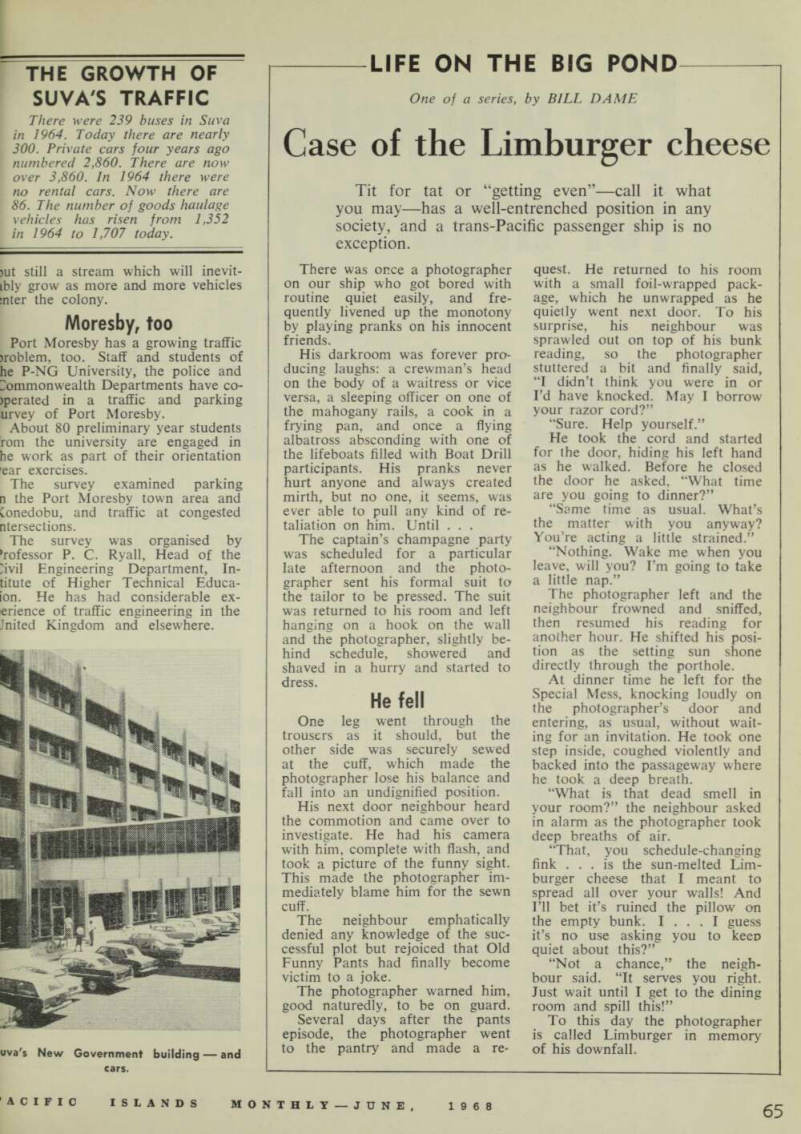
[?]uva's New Government building and cars.