They call
pp. 59-61 · Read in the full issue
him "The Master"
Work has no place in the life of Henry Gibson, karate expert. He says: "Work . . . will distract me.
You see, I am trying to develop my mind. The mind is the greatest dynamo in the universe."
From MATT WILSON, in Suva Odd Job, lan Fleming’s muscle-bound Korean karate ex pert, who hurls a steel-rimmed bowler at people he doesn’t like, would never find a place among the ranks of Henry Gibson’s disciples.
Odd Job is too much of a brute.
He isn’t gentle enough and obviously doesn’t spend enough time thinking about the spiritual side of karate.
“The trouble these days,” says 25year-old Mr, Gibson, of Vesi Street, Suva, “is that when karate is men tioned people think only of chopping with the hand and kicking.
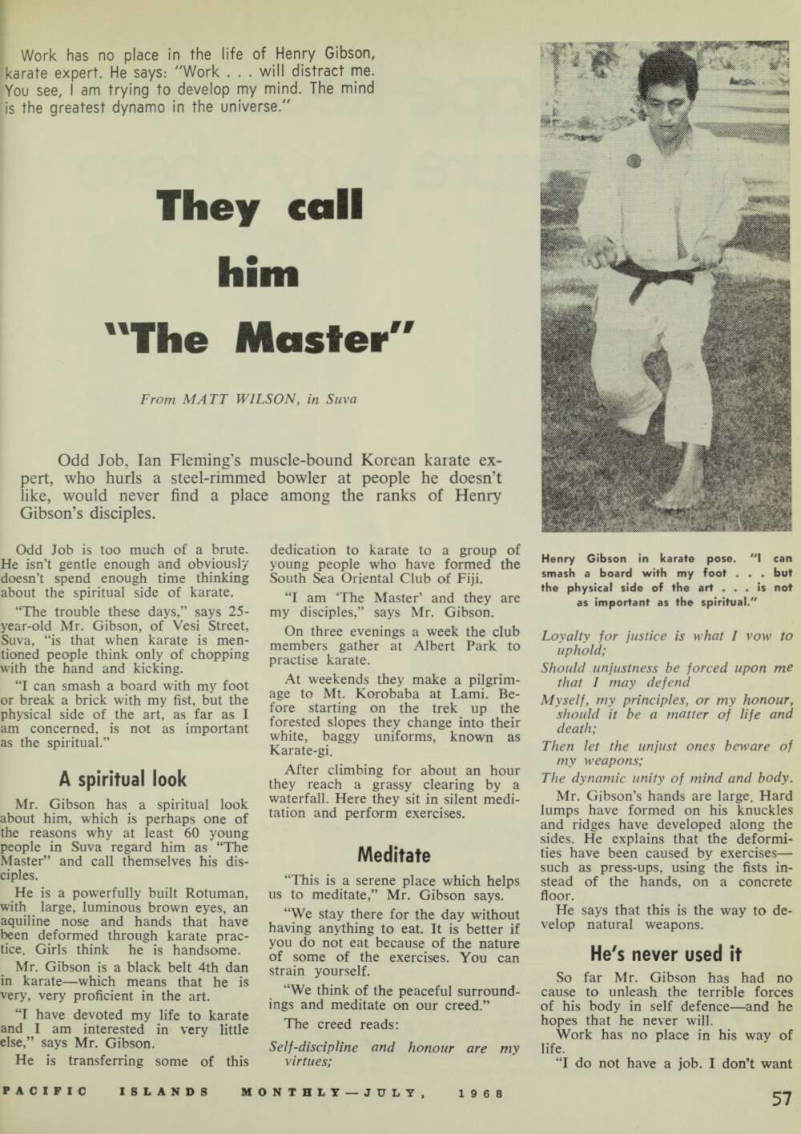
“I can smash a board with my foot or break a brick with my fist, but the physical side of the art, as far as I am concerned, is not as important as the spiritual.”
A spiritual look
Mr. Gibson has a spiritual look about him, which is perhaps one of the reasons why at least 60 young people in Suva regard him as “The Master” and call themselves his dis ciples.
He is a powerfully built Rotuman, with large, luminous brown eyes, an aquiline nose and hands that have been deformed through karate prac tice. Girls think he is handsome.
Mr, Gibson is a black belt 4th dan in karate—which means that he is very, very proficient in the art.
“I have devoted my life to karate and I am interested in very little else,” says Mr. Gibson.
He is transferring some of this
dedication to karate to a group of young people who have formed the South Sea Oriental Club of Fiji.
“I am ‘The Master’ and they are my disciples,” says Mr. Gibson.
On three evenings a week the club members gather at Albert Park to practise karate.
At weekends they make a pilgrim age to Mt. Korobaba at Lami, Be fore starting on the trek up the forested slopes they change into their white, baggy uniforms, known as Karate-gi, After climbing for about an hour they reach a grassy clearing by a waterfall. Here they sit in silent medi tation and perform exercises.
Meditate
“This is a serene place which helps us to meditate,” Mr. Gibson says.
“We stay there for the day without having anything to eat. It is better if you do not eat because of the nature of some of the exercises. You can strain yourself.
“We think of the peaceful surround ings and meditate on our creed.”
The creed reads: Self-discipline and honour are my virtues;
Loyalty for justice is what I vow to uphold; Should unjustness be forced upon me that I may defend Myself, my principles, or my honour, should it be a matter of life and death; Then let the unjust ones beware of my weapons; The dynamic unity of mind and body.
Mr. Gibson’s hands are large. Hard lumps have formed on his knuckles and ridges have developed along the sides. He explains that the deformi ties have been caused by exercises— such as press-ups, using the fists in stead of the hands, on a concrete floor.
He says that this is the way to de velop natural weapons.
He s never used it
So far Mr. Gibson has had no cause to unleash the terrible forces of his body in self defence—and he hopes that he never will.
Work has no place in his way of life.
“I do not have a job. I don’t want
Henry Gibson in karate pose. "I can smash a board with my foot . . . but the physical side of the art ... is not as important as the spiritual."
Peace in a painting
a job, I could work but I do not want to. Work, I feel, will distract me. You see I am trying to develop my mind. The mind is the greatest dynamo in the universe.”
He has no yearning for wealth and finds little use for money.
Doesn't seek wealth
“Money means nothing to me.
There is a lot more to life than earning money.”
The little money he does have usually comes from members of his club, who make voluntary donations towards his upkeep.
One of Mr. Gibson’s ambitions is to go to Okinawa to continue his studies with his own Master, Tahara Choel, also a black belt 4th dan.
The two met in Fiji when Mr.
Choel was a fisherman based at Levuka.
It is fascinating to watch Mr. Gib son perform his art.
On the green lawns by the Fiji Museum Mr. Gibson and his 30-year old brother, Mani, a black belt Ist dan, regularly perform routine exer cises.
Mr. Gibson will assume the “snake” stance and move with tightly con trolled grace—the exercise is designed to emphasise the grace of the body.
His brother will adopt the “dragon” stance and go through a series of exer cises illustrating the body’s strength.
Reverence
Petite brunette Emma Smith, 17, is one of the girl members of the South Sea Oriental Club.
A look of reverence comes to her pretty face as she talks about Mr.
Gibson.
“Yes, we call Henry The Master’ and we are his disciples. I think he is a very good teacher and a fine per son.”
Another way in which Mr. Gibson attempts to find spiritual peace is through painting. He is a talented and imaginative painter in the modern style.
Some people might brand Henry Gibson as a “non-productive” mem ber of society; a parasite without a shred of social responsibility.
They would be wrong. The mem bers of his club are acquiring quali ties of spiritual goodness and self discipline that have an important place in Fiji’s multi-racial society.
So perhaps Mr. Gibson is playing a more important role in Fiji’s de velopment than most people.