or Newpap? or Panegu?
pp. 54-58 · Read in the full issue

Well, is it Papua? or New Guinea? or Newpap? or Panegu?
As far as is known, the first European to propose a name for our island was Don Jorge de Meneses, a Portuguese mariner, who called it Papua. This was in 1526. Nineteen years later, in 1545, a Spaniard, Ynigo Ortis de Retez, named it New Guinea. What a pother those two started!
One further attempt at island-nam ing was made in the sixteenth century —Alvaro de Saavedra’s romanic fancy “Isla del Oro” (Island of Gold”). I have always felt that it was a pity that this name didn’t stick; it might have saved us from the Papua v. New Guinea controversy. And “Oroans” would have been a pleasant sounding name for its people.
However, an attempt to revive this name now might serve to remind the Oroans that in the meantime the white men have got away with most of the oro.
The search for a common name for the emerging nation which will (we hope) comprise the Australian Territory' of Papua and the Trust Territory of New Guinea has been vigorously revived after being (to gether with the search for a flag and an anthem) largely in abeyance since it was raised by the Guise Com mittee two or three years ago.
Now it has been re-activated by
To The Point
With
Percy
Chatterton
the Governor-General, the Roman Catholic Arch bishop of Port Moresby anc i ot^er sma n e r guns, and a prize been o ff erec j f or the best sug gested name. r)U U nrrnr This offer opens up long vistas of horror, with Paguinea, Panegu and Newpap in the vanguard, hotly pur sued by Paradesia and other luxuri ant fancies.
To some, of course, there is no problem. You simply call the place New Guinea, and if the Papuans
don’t like it that’s just too bad foe them. They’re in a minority, aren’j they?
For myself, I don’t object to “Nev Guinea”, though I think that “Nev Guineans” is a clumsy, ugly narm for its people. “Groans” would haw been much more euphonious.
The Dutch solved the problem ii what used to be their half of thr island by calling the land “Ney Guinea” and the people “Papuans”
For home consumption I think ths this would be a very happy solution but it is asking rather much of thr rest of the world to expect it to re member that “Papuan” means “in habitant of New Guinea.”
A possible solution, and one whic; rather attracts me, would be thr adoption of the Pidgin spelling Nl Gini, or perhaps better still, to tele scope it into a single word —Nuginr I still don’t like “Nuginian”, but suppose I should get used to it. Any way, to give it a trial flutter I pro pose for the rest of this article tr use “Nugini” for Papua and Ney Guinea, and “Nuginians” for Papuan and New Guineans.
“One Name, One Flag, On Emblem and One Anthem” has bee declared to be one of the planks o Pangu Pati’s platform. Let’s thin next about the flag and the emblem i A national flag for Nugini at thr juncture must be one which can W used while this country is still dependency of Australia, but whio won’t need too much alteration wh© independence comes.
This calls for a quartering repn senting Australia. It could be tH British Union Jack, as in the preset Australian flag, or the Australis coat-of-arms (or some other suitabc symbol of Australia), or perhaps tH latter superimposed on the former.
In the last-named case, all thr would be needed on independent!
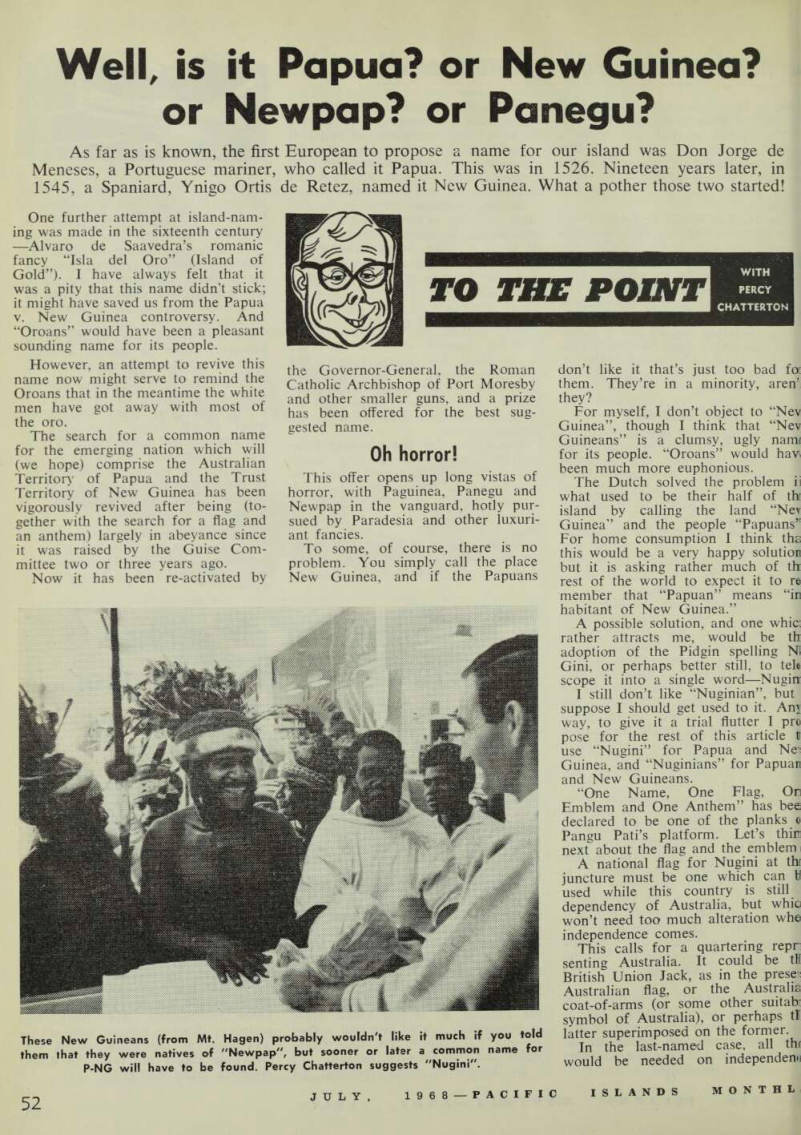
These New Guineans (from Mt. Hagen) probably wouldn't like it much if you told them that they were natives of "Newpap", but sooner or later a common name for P-NG will have to be found. Percy Chatterton suggests "Nugini".
yould be the replacement of the Aus ralian symbol by a Nuginian one. rhis assumes, of course, that by the ime independence day comes there dll still be a British Commonwealth, nd that Nugini will want to stay i it.
How national can you get?
The quest for an emblem should oncentrate on something which ould be used apparently as an mblem and could also be featured n the flag. And here we run into ifficulties, as Speaker John Guise iscovered when he wanted to wear “national” emblem for the cere lonial opening of the new House f Assembly. He finished up with ve!
What shall it be? A bird of para ise? Loud cries from the New ruinea Islands: “We have no birds E paradise here.”
A coconut tree? Tumult from the [ighlands: “We don’t have coconut ees.” And so on.
It seems just about impossible to nd any animal, bird, tree, flower or [ant (except perhaps the übiquitous veet potato) which is common to all ugini’s varied regions.
Perhaps the best solution would be >me stylised design which would raw on the art-forms of various >gions without identifying itself >ecifically with any.
What about an anthem? Papuans can’t avoid using the word here) ave a first-rate “national” song hich is very popular. Its tune, in a and adaptation, is used by the ABC ► open its early morning sessions, ut its words are in Motu, so that’s at. A number of attempts have ;en made to write a national song i English. Quite frankly, the ones have read seemed pretty wet.
Poets needed
Can the pidgineers find an answer >r us? And if so, can we take the sk of adopting it? Right now idgin is a very lively, expressive id acceptable means of communica on, as anyone who sits in the public dlery of the House of Assembly )on realises. But will it survive? nd what might be the attitude of le next generation but one to a ational anthem in Pidgin?
Perhaps we need a poet of the dibre of James McAuley to solve lis problem for us, and to save us om the banalities and sloppy senti icntalities of the rhymesters.
The call for these things—name, ag, emblem, anthem—are part of a all for national unity. True, they re among the trappings of unity.
They can stimulate its growth. But they cannot in themselves create it.
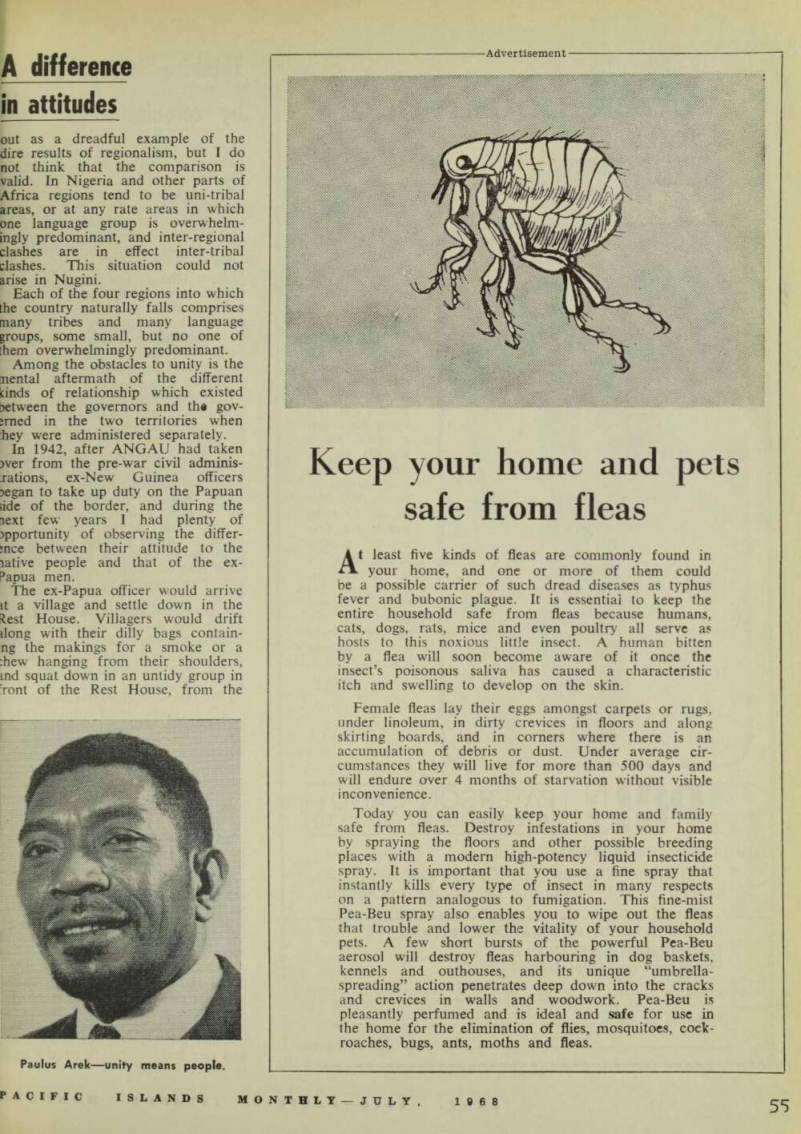
Paulus Arek, new MHA and exteacher, had some sensible things to say about unity in his maiden speech in the House. You can’t get unity, he said, by having lessons on unity in school. Unity is achieved when people from different tribal groups and cultural backgrounds work together to achieve a common purpose.
I am paraphrasing him from memory; he spoke in Pidgin and I “tion e ot hls he spe"u. fttak that this was the gist of it.
Experience of adult education in Nugini suggests that English language classes for adults with no previous knowledge of the language generally produce poor results, even when the students are quite pathetically anxious to learn it. The use of language laboratories and programmed leaming may change this situation, but I doubt it; and anyway, only the larger centres can aspire to these expensive luxuries.
A better approach seems to be to organise classes which aim primarily at teaching specific sought-after skills, and which, in the process, teach English incidentally.
Perhaps the same is true of national unity. We shall not get unity by
holding seminars on unity. But we stand a good chance of getting it as a by-product when people from dif ferent parts of Nugini with a common interest in some particular branch of knowledge or some particular form of skill come together to acquire that knowledge or practise that skill. That is why regional and national con ferences of representatives of local government, co-operatives and such like interests are so valuable, defenCe ° f re g' onal ' Sm This idea could well be extended to people with all sorts of other in terests, and the money spent in bring ing them together would be money well spent. The churches, in their own range of interests, are already doing this sort of thing on a con siderable scale, I have used the phrase “regional and national.” I am obdurate in my belief that a controlled measure of regionalism would be as beneficial in the sphere of government as it has already been in the sphere of admin istration, and would not endanger national unity; and I am not shaken when distinguished people for whose opinions I generally have a high re gard tell me I’m nuts, Nowadays, Nigeria is trotted out
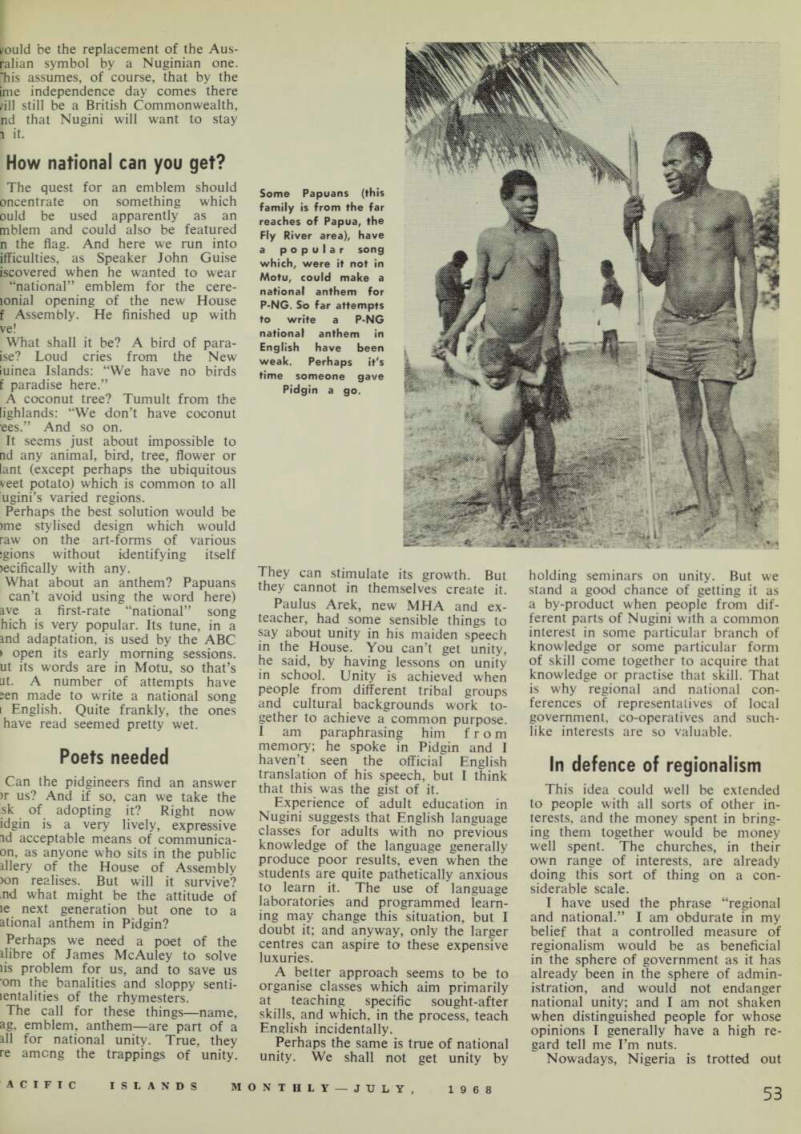
Some Papuans (this family is from the far reaches of Papua, the Fly River area), have a popular song which, were it not in Motu, could make a national anthem for P-NG. So far attempts to write a P-NG national anthem in English have been weak. Perhaps it's time someone gave Pidgin a go.
A difference in attitudes
out as a dreadful example of the dire results of regionalism, but I do not think that the comparison is valid. In Nigeria and other parts of Africa regions tend to be uni-tribal areas, or at any rate areas in which one language group is overwhelm ingly predominant, and inter-regional clashes are in effect inter-tribal clashes. This situation could not arise in Nugini.
Each of the four regions into which the country naturally falls comprises many tribes and many language groups, some small, but no one of them overwhelmingly predominant.
Among the obstacles to unity is the mental aftermath of the different rinds of relationship which existed between the governors and th« gov ;raed in the two territories when they were administered separately.
In 1942, after ANGAU had taken sver from the pre-war civil adminis trations, ex-New Guinea officers ?egan to take up duty on the Papuan iidc of the border, and during the lext few years I had plenty of jpportunity of observing the differ ;nce between their attitude to the lative people and that of the ex- Papua men.
The ex-Papua officer would arrive it a village and settle down in the [lest House. Villagers would drift dong with their dilly bags contain ng the makings for a smoke or a :hew hanging from their shoulders, md squat down in an untidy group in : ront of the Rest House, from the
Paulus Arek—unify means people.
Thinking influenced by colonial days
steps of which, or from behind j collapsible table set up at their foot the former ARM, now styled ADCX would talk to them and transact tho business which had brought hinr there. The proceedings were inr formal and generally, unless thti villagers had blotted their copy bool quite badly, friendly.
How different was the approach 01 the ex-New Guinea man.
“Tell your people to line,” h<j would command briskly.
I could hardly believe my eyes thi first time I saw the whole populatioi of a village falling-in.
Don’t misunderstand me. Thesi were able, hard-working and com scientious men, doing their job ii the way in which they had learneo to do it.
If they sometimes seemed over conscious of being officers in a work populated almost entirely by othe; ranks, that was perhaps a result cw the system. If they sometime: seemed less inclined to adopt « friendly attitude towards missionarie: than the Murray men had been, per haps that too was a consequence O' earlier experiences in a different em vironment.
I am not concerned here with the question of whether their way or the Murray way was the better. I merely make the point that they were dif ferent ways, and that these differ ences affected the mental attitude of the people over whom they ruledl Then there is Nugini’s “thirc world”—the Highlands—where the colonial impact has been briefer ir duration and different in quality’
Again the mental attitudes of the people have been affected by the at titudes of those who have ruled therm A recent article in New Guine* on current student attitudes in the University of Papua and New Guinea on social and political problems seems to indicate that, even though these young people were themselves borr in an administratively united terri tory, their thinking on some quite im portant issues has been influenced by the varying colonial experiences ol their forebears.
It looks as if a lot of hard argu ing and tossing around of ideas among the emerging intelligentsia of Nugini has got to go on before these diverse mental attitudes, inherited from colonial history, will be sublimated, and our feet firmly set on the path to national unity.