Magazine Section
pp. 83-97 · Read in the full issue
Pacific Islands Monthly
Tahiti: Island of love and politics
Since elections were held for French Polynesia's Territorial Assembly last September, the question of internal self-government for that territory has been a burning political topic in Tahiti. The demand for self government, however, is by no means of recent growth—as Robert Langdon explains in the following article, which outlines for the first time the extraordinary political events that have taken place in Tahiti since World War 11. The article is condensed from a new chapter which he has written for the third edition of his book, "Tahiti: Island of Love", just published by Pacific Publications Pty, Ltd.
Langdon, formerly assistant editor of PIM, has recently taken up a new post in the Department of Pacific History at the Australian National University, Canberra.
By Robert Langdon
which h ? cce P t . mst s u^ tlons fr* o ” l legitimate and constitutional government of Marshall Petain
le happenings in Europe was somemes vague and confused, the choice ill to Governor Chastenet de Gery. overnor de Gery, who had been in lice for a little over three years id who was described at the time i one of the best governors Tahiti ny e t V o r S .icT W with d p e ett„ d * WaS hiS Rut o 1 n ‘ . ,
me 25, he made™ dear'thlt, °n
s view, the people of Tahiti and e rest of French Oceania were still war as all.es of Great Britain,
was in keeping with the of the neonle 8 Rut acceptance ? of ’ the pjtai c ° ntradlctor y
wS and !L 8 T
tions pmanfr S re f ula ‘
Petain fnrT
the Tahitians f J ’
P * " e lt r s there was a strong response to Gen
fo?* toTght
on. e\erywnere to tight On July 13 1940 three dav« after Petain
£ e £ u ? llc ’ Ta . hltians went to the British consulate in Papeete and volunteered to fight with the Aus forces’ Eight da y s later > the Vl , ch y government ordered the con ™late . to be closed-for the first time since its establishment in 1837 - and ,he to a
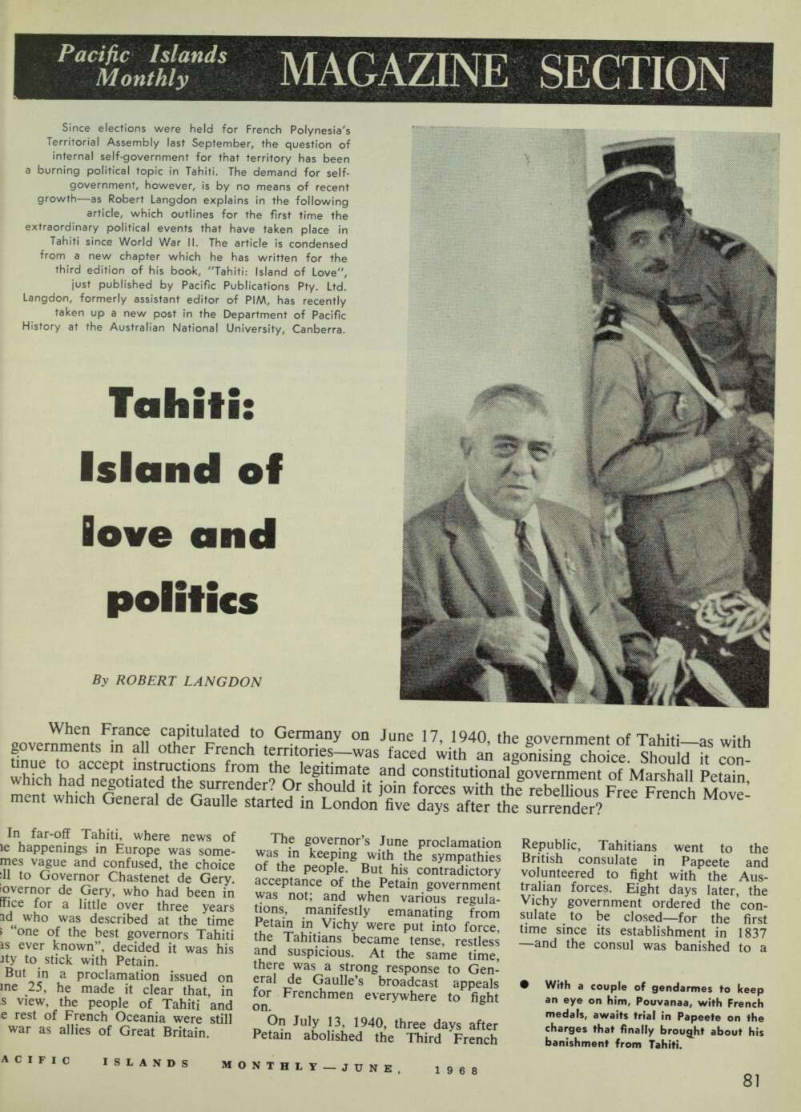
• With a couple of gendarmes to keep an eye on him, Pouvanaa, with French medals, awaits trial in Papeete on the
charges that finally brought about his
banishment from Tahiti.
They wanted de Gaulle
country district 20 miles out of town and placed under house arrest.
Incidents of this kind led to the formation in Tahiti of a Committee of Free France which forced the government to hold a plebiscite to determine the people’s views.
The poll took place in mid-August.
The result was remarkable. Only 18 people voted to remain under the Petain government, while 5,564 cast their votes for de Gaulle. In the cir cumstances, Governor de Gery had no option but to resign, and he left for Europe soon afterwards.
The government was then taken over by four prominent local people —Edouard Ahnne, Georges Lagarde, Emile Martin and George Bambridge —until Commandant Edmond Man sard, an old comrade of General de Gaulle, was appointed governor.
However, ill-health soon forced Man sard to resign in favour of a 32year-old French doctor, Emile de Curton, who had been in the terri tory for several years.
Dr. de Curton immediately got to work on the territory’s two most pressing problems defence and economic affairs. Within a few months, a contingent of 300 volun teers had been raised and trained to join the Free French Forces fighting overseas. They sailed from Papeete in April, 1941, and later fought with distinction in the Battle of Bir Hakeim (Libya), in Italy and in France.
With the promise of help from the British, Australian and New Zea land Governments, Dr. de Curton did what he could to reorganise the territory’s economic life, which, before the war, had been almost en tirely dependent on France, both for transportation and the sale of its products.
"Brunot revolution"
Dr. de Curton was managing Tahiti’s affairs to the complete sat isfaction of the local people when a strange top-level envoy from General de Gaulle arrived on the scene.
Within a few days, Tahiti was in turmoil again. The Gaullist envoy was Commandant Richard Brunot, a former French Commissioner in the Cameroons, who had been appointed French Governor-General in the Pacific.
He reached Papeete on June 6, 1941, and was received with full military honours by Governor de Curton. However, the Governor’s
welcome was apparently not as pro fuse as Brunot expected; and Brunot seems to have concluded from this that the Governor and his staff were plotting against him in some way.
The result was that 10 days after his arrival, Brunot announced —to the amazement of everyone in the colony —that he had assumed the governor ship of French Oceania and had signed a decree authorising the arrest of Dr. de Curton, his aide, two senior administrators, and the local troops commander.
A second decree ordered the intern ment of more than a dozen other senior officials for the duration of the war, and a third dissolved the Papeete municipal council and appointed an 11-man commission to run the town’s affairs.
The extraordinary Brunot revolu tion came to an end after three months following the arrival in Papeete of an almost equally strange Gau 11 is t envoy, Rear-Admiral Georges Thierry d’Argenlieu.
The admiral, who had been a Carmelite monk between the wars, and who had been serving as a French naval commander when the Germans invaded France, had joined de Gaulle in London after a daring escape from a German prison camp in Cherbourg. After serving de Gaulle in various capacities, he was sent to the Pacific as de Gaulle’s personal representative with the title of High Commissioner for Free France.
He arrived in Papeete on Septem ber 23, 1941, apparently with the express purpose of taking control of the Brunot revolution. He wasted
no time. Immediately after his arrival he suspended the Brunot administra tion, released the arrested and in terned officials on parole, ani appointed a commission to invest! gate the plot that Brunot claimed h had uncovered.
Within a few days, d’Argenlieu ar nounced that the commission ha found nothing in the nature of a pic and that the measures taken b Brunot were “unjustified”. Th admiral added that anyone who cor sidered that he had suffered materij loss as a result of Brunot’s actio could file a claim for reparations.
Similar palace revolution
The Brunot revolution having thi been ended, Admiral d’Argenlie
appointed Lieutenant-Colon
Georges Orselli to the governorsh; and departed in a warship for Ne Caledonia. (In New Caledonia, almost unb lievably, he staged exactly the san kind of palace revolution as Brun had done in Tahiti. He arrested ar deported New Caledonia’s high popular Governor Henri Sautot. T 1 American military commander hi to intervene to avoid civil war, ai de Gaulle had to recall his monki envoy to London.) As for his successor in Tahi Lieutenant-Colonel Orselli, he i mained in the governorship for ti rest of the war. There were no mo palace revolutions or coups d’eU Tahiti, in fact, was peaceful any island can be in times of ws It was even mildly prosperous, f a large force of Americans w
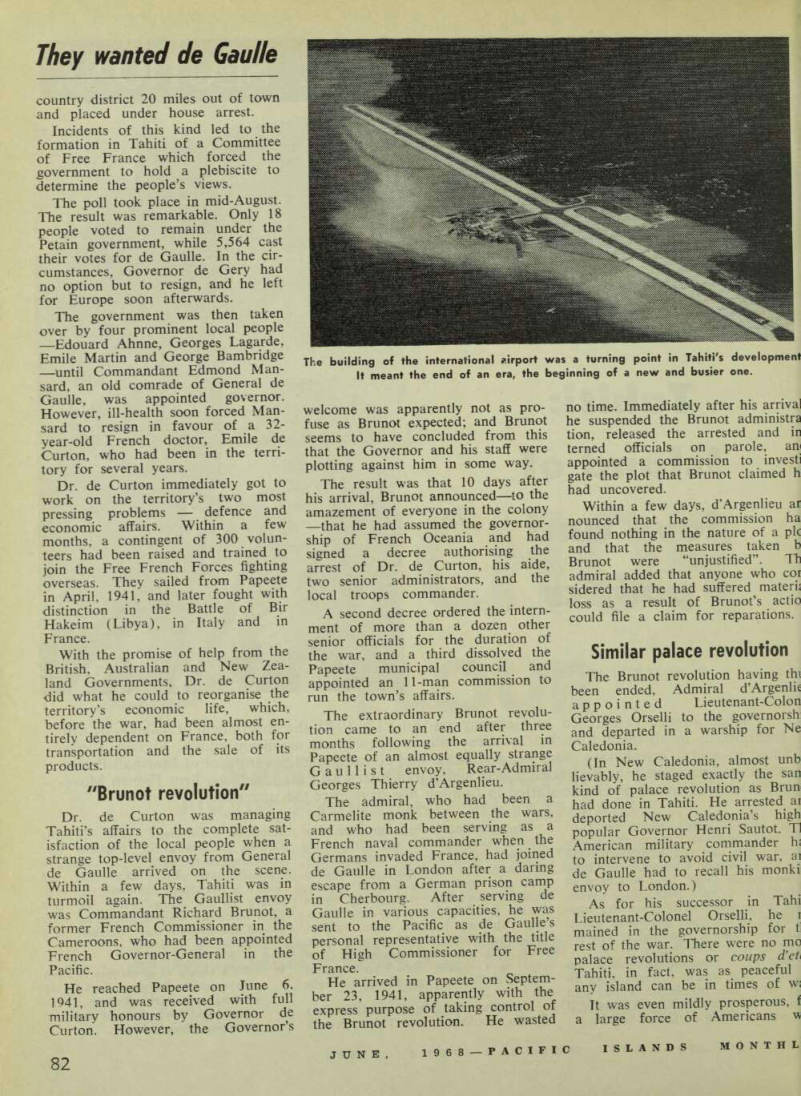
The building of the international airport was a turning point in Tahiti's development.
It meant the end of an era, the beginning of a new and busier one.
eventually stationed on neighbouring Bora Bora, and these men were eager buyers of every artifact and curios ity that Tahiti’s souvenir industry could turn out.
Trade unions formed
But the Americans at Bora Bora did not only bring dollars to French Oceania. They also brought new ideas, and these ideas allied with others picked up by Tahiti’s contin gent of soldiers overseas, began to manifest themselves soon after the war was over.
Trade unionism, for example, a notion unthought of in Tahiti before the war, spread through the island like the proverbial wild fire.
Each profession machinists, stenographers, school teachers, stevedores, etc. organised a “syndicate”, and by mid-1947 there were no less than 26 of them. There was also talk of nationalism.
One of the most active figures in this new, more aggressive Tahiti was a Huahine-born man, Marcel Pouvanaa a Oopa, whose blue eyes and fair complexion were an inheri tance from a Danish grandfather.
The fall of France in 1940 and the subsequent uncertainties in the gov ernment of Tahiti had diminished the prestige of France in his eyes and had caused him to become a Pahitian nationalist.
Being a persuasive orator, with a lair for Biblical allusions, his ideas soon won a band of followers, and n February, 1947, a Comite Pou vanaa was formed. Three months ater, the committee began pub ishing a regular journal, Te ira’tai, to air and disseminate its views. The committee’s aim, the irst issue of the journal said, was o “conduct Tahiti and its archi >elagos towards more political, ;conomic, administrative and cul ural freedom”. Articles in the iaper were strongly anti-colonialist nd anti-capitalist, and in favour, mong other things, of the “Tahi ianisation ’ of the public service.
Mass demonstration
On the morning of June 22, 1947, ie Pouvanaa committee showed that had already won wide support men it led a huge crowd of demon gators to the Papeete waterfront 5 oppose the landing of three new rench officials, who had arrived ;°m Marseilles in the liner Ville ’Amiens.
Many of the demonstrators were and so large were
Pouvanaa earns a martyr's crown
their numbers that the local police and troops were powerless to inter vene. For two days, they prevented the new officials from landing; and finally, the Governor (now Mr. J. C.
Haumant) ordered the Ville d’Amiens to anchor offshore for fear that things might take a nastier turn.
This move succeeded in taking some of the heat out of the situa tion; and after two more days, a couple of Navy launches were able to spirit the officials and their fami lies ashore in the early hours of the morning. Soon afterwards, the gov ernor proclaimed a state of emer gency, closed the office of the Pou vanaa committee, and arrested Pou vanaa and a dozen of his men.
Pouvanaa and company were held in custody for five months before being brought to trial on a series of charges involving a challenge to governmental authority. The trial aroused intense public interest, and it was clear from the outset that the people’s sympathy was with the accused.
A priest, Father Calixte, who spoke on behalf of the prisoners, declared that it was evident from the medals of World Wars I and II that some of them (including Pouvanaa) wore on their chests that they were not anti-French. Later, when the fore man of the jury told the court that there was nothing to prove that the accused were anti-French, or that
they had planned to overthrow the government or foment disorder, the spectators cheered heartily. Need less to say, a verdict of “not guilty” was announced.
Pouvanaa’s long imprisonment be fore his trial, and then his acquittal, earned him a martyr’s crown, which made him more popular than ever.
Two years later, when elections were held for a deputy to represent French Oceania in the French Par liament, he won the seat hands down with 9,818 votes to 4,679 for his nearest opponent. He was re-elected by equally impressive margins in sub sequent elections in 1952 and 1956.
He leads a party
Meanwhile, the Comite Pouvanaa had blossomed into a fully-fledged politial party, the Rassemblement Democratique des Populations Tahi tiennes (RDPT), or Tahitian People’s Democratic Assembly.
The RDPT put forward candidates m elections for the Territorial Assembly (local parliament) in 1953 and 1957, and won a majority of seats on both occasions. Pouvanaa did not stand for election in 1953.
But in 1957 he did so and gained a seat.
Pouvanna’s entry into the Terri torial Assembly followed hard on the heels of a law passed by the French Parliament which intro duced sweeping reforms in France’s possessions around the world.
These reforms represented an effort by the tottery French Government of the day to silence the growing cries of nationalism that were then being heard, particularly in Africa.
Under the new law, French Oceania was reconstituted as French Polynesia from August 10, 1957; the membership of its Terri torial Assembly was increased from 25 to 30; and the Assembly’s powers to make laws were consid erably extended. In addition, a council of government (cabinet) was created, with local people holding ministerial posts. The gov ernor of the territory was ex-officio president. Pouvanaa was named vice-president, and was thus its effective head.
The creation of the council of government represented Tahiti’s big gest political advance in nearly 80 years as a French colony. But it was not destined to last for long, for a series of events soon occurred which caused the governor to sus-
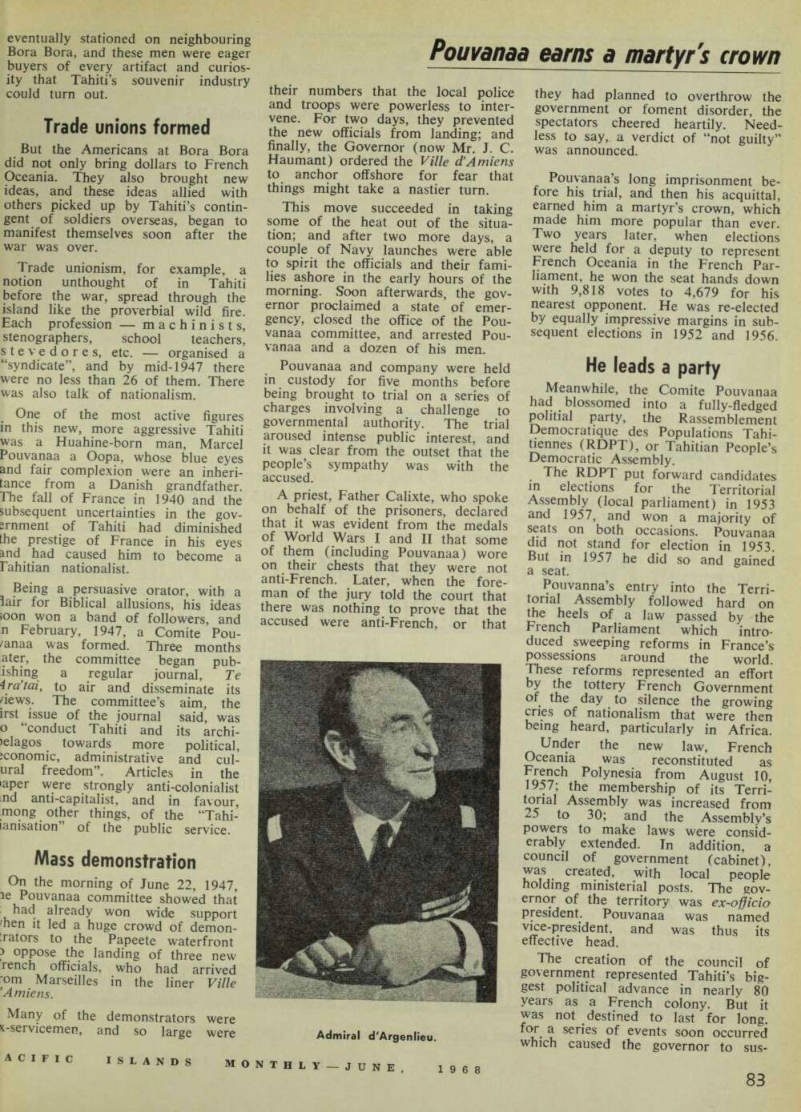
Admiral d'Argenlieu.
Protests against income tax
pend its operation indefinitely “in the interests of public order”.
The first event was an announce ment by Pouvanaa in April, 1958, that his party (which controlled the Territorial Assembly by 17 votes to 13) intended to secede from France and form an independent Fahitian republic. Shortly after wards, Pouvanaa’s party, the RDPT, introduced an income tax law in he Assembly, designed particularly o raise revenue from the (mainly Chinese) merchants and traders.
Not surprisingly, both the seces sion proposal and the income tax dan were strongly opposed by the .3 members of the opposition Demo ratic Union, which had the support ►f the trading community. And it uraed out that when it came to a tiowdown, Tahiti’s moneyed class ould shout much louder than Pou anaa’s followers, many of whom /ere scattered through the outlying slands.
When a shopkeepers’ strike was organised on April 29, 1958, as a )rot<est against the proposed in ome tax, everyone in Papeete topped work and thousands of idle workers gathered before the Terri jrial Assembly building on the waterfront. Insults were shouted at le 17 RDPT members who were pstairs. Some demonstrators tried > force their way into the building, ut were repulsed by militia and mdarmes.
Sanctuary
Pouvanaa tried to placate the owd by loudspeaker from a indow of the building. But he only flamed the demonstrators more when ; said that the income tax law ould be repealed when Tahiti be ime independent.
The demonstration got out of md when three trucks, laden with ones, provided ammunition for the jmonstrators to bombard the Aiding. Assembly members and Ticials cowered inside as about 60 indows were broken. They finally caped with a heavy police escort hen the fire brigade, which had been tiled out, turned its hoses on the :monstrators.
About 4,000 people then marched the residence of the newly-arrived wernor, Dr. Henri Bailly, where e Assembly members had been ven sanctuary. They demanded the
repeal of the new income tax law, and an assurance that the RDPT dominated Assembly would not sever Tahiti’s connection with France.
Meanwhile, other demonstrators stoned the house of Pouvanaa a Oopa.
Next day, the shopkeepers’ strike continued. About 5,000 people gathered grimly outside the Gov ernor’s residence while the council of government met to consider the situation. Tension eased when Pou vanaa came out and announced that the income tax law would be abro gated, Later, the demonstrators sang the Marseillaise as the Assem bly met and hurriedly repealed the law.
On May 3, 1958, 31 leading Tahitians, including the Assembly’s 13 Democratic Union members, signed a declaration affirming that, for them, the idea of a Tahitian republic was “an aberration”. The document conceded the right of French territories in Africa to seek independence, but claimed it was nonsense for French Polynesia to do the same. “We have enough free dom and have no need for more,” the signatories agreed.
While business in Papeete returned to normal after Tahiti’s first serious political disturbances since the Ville d’Amiens affair, one of the RDPT leaders (who later broke away from the party) cabled President Coty in Paris that the RDPT was “indefect ably attached to France”. This, however, did not conform with the general view, and another member, Senator Florisson, was sent post haste to Paris to present the party’s real views.
Four weeks after this, General de Gaulle again became leader of France. On September 27, elections for his new Constitution were held.
These gave the 15 French colonies throughout the world the chance to obtain independence simply by vot ing for it.
In French Polynesia, the poll was indicative of the discord prevailing there. Only 64 per cent, of the people voted to remain in the French Union the smallest “yes” vote in any colony except French Guinea, which overwhelmingly voted “no”.
Pouvanaa arrested
Pouvanaa, who had a strong in fluence on the big “no” vote with a campaign of “Tahiti for the Tahitians, and the French into the sea”, found himself in trouble within a few days of the referendum. On October 11, he and a number of his followers were arrested on a variety of charges
including having thrown “Molotov cocktails” in the streets of Papeete, and of having plotted to burn the town down. Pouvanaa’s house, the government claimed, was found to be defended like a blockhouse and to contain a large stock of “Molotov cocktails” and other weapons.
Pouvanaa was held in gaol for just over a year before being brought to trial in Papeete on charges of attempted murder, arson and the illegal possession of arms.
His trial, which was delayed by com plicated legal disputations, lasted three days. On October 23, 1959, he was sentenced to eight years’ im prisonment and was banished from Papeete for 15. (This meant that he was banned from the Tahitian capi tal until he was 79, as he was 64 when the sentence was imposed.) Fifteen confederates of Pouvanaa were tried at the same time. His right-hand man got six years’ gaol and was banned from Papeete for 15 years; another leader got six years’ gaol and five years’ banish ment; and the others received prison sentences of up to six years.
Although the Tahitians took a lively interest in the trials, the ver dicts were received calmly. This, on the surface, seemed to suggest that the Tahitians believed that Pouvanaa and his confreres deserved the sen tences they got. This, however, was by no means the case, for it has since become clear that, in the eyes of many Tahitians, the entire case against Pouvanaa and his followers was a fabrication, engineered by
John Teariki.
"Bounty"brings riches
officialdom to get a set of trouble some politicians out of the way.
Certainly, the disappearance of Pouvanaa from Tahiti’s political scene brought a claim to Tahiti that it had not known since the war.
Debates in the Territorial Assem bly became more restrained and much less radical; and as the Gov ernor had suspended the council of government after Pouvanaa’s arrest, the Tahitians were again without exe cutive power in their own govern ment.
Meanwhile, two decisions of great moment had been made which were to have far-reaching repercussions on everyone in Tahiti. One was a decision by Metro-Goldwyn-Mayer to make a new film version of the Nordhoff and Hall classic, Mutiny on the Bounty, with Marlon Brando starring in the role of Fletcher Christ ian. The second was a decision by the French Government to build an international airport near Papeete so that a serious effort could be made to build up a tourist industry in Tahiti, and so provide employment for the increasing population.
Work on Tahiti’s airport got under way in mid-1959, and by October of the following year, it was ready for use. Three international airlines —TAI (French), TEAL (New Zea land) and South Pacific Airlines (American) immediately began using it, making four landings each week with plane loads of up to 66
passengers. Simultaneously, Metro-
Goldwyn-Mayer began flying in actors and technicians for the film ing of Mutiny on the Bounty. By mid-November, 1960, well over 100 MGM personnel were in Tahiti, and hundreds of Tahitians were on the MGM payroll as actors, extras, musicians, dancers, advisers, canoe makers and general assistants.
Prices sky-rocket
The increased influx of tourists as a result of the opening of the new airport and the arrival of the 100odd MGM personnel placed a heavy strain on Tahiti’s available accom modation and sent rents for houses,
flats and rooms sky-rocketing.
Wages spiralled at the same time, For MGM paid its employees on a scale previously unheard of in Tahiti.
MGM’s munificence knocked the bottom out of the local labour market, and one plantation owner :omplained, typically, at the time: “I used to be able to get my trees aluminium banded for five francs
apiece. Now I offer 10 francs and 20 francs and nobody’s interested.
They’re all working for MGM.”
Due to temperamental actors, disagreements over the direction, mismanagement, the weather, and a variety of other factors, the making of the Bounty film dragged on for oyer a year and brought wealth directly or indirectly to almost every Tahitian family.
One of the results was that the Tahitians discarded their old push bicycles and slow-moving ways, and took to riding motor-scooters, motorcycles and small cars at frightening speed.
Meanwhile, with tourism continuing to boom, land for hotels, shops, snack bars, etc., began to change hands at fabulous prices; and with fewer people working the land than previously, the prices of such commonplace products as coconuts, papaws, mangoes, bananas, taro, bread-fruit and avocados soared in
Un xT° n ‘ • •
Not surprisingly, many a tourist who went to Tahiti expecting to find it still more or less as it was in Can-
ss t c h^L d «
Sf perforce*, 0 were 3 *just ”as eager as anyone else to make a fast franc.
Mnrloar tacfmn rfuuear lesring Dase The Tahitians had scarcely had time to settle down to a more normal, less hectic mode of life following the departure of the MGM team when
the French Government leaked news that it planned to use one of the islands of French Polynesia as a nuclear testing base, It was rumoured at first that Man gareva, in the Gambiers, would be the site of the base. But in April, 1963, after eight months of specula tion, the government announced off dally that Mururoa Atoll, some 800 miles south-east of Tahiti in the Tuamotus, had been chosen as the Slte - Four other atolls - Anaa, Fteo, Fangataufa and Tureia—were to have roles in the testing project, an nouncement said, Governor Aime Grimald told a specially-convened meeting of the Territorial Assembly and the Papeete Municipal Council that Tahiti would play an important role in the project, as it would serve as a disembarkation point for men and supplies. The existing maritime traffic of 80,000 tons a year would increase by at least 50 per cent., he said, anc * to CO P e port of Papeete would be modernised at a cost of nearly SA6 million . , ,
i r r F° ho il
eCo "°' Tlle words were scarcely out of the Governor’s mouth when Tahiti began to swarm with officials and technicians concerned with the plan ning and execution of various aspects of the new P r °i ect - News that two battalions of For eign Legionnaires were to come to
(Continued on p. 95)
MGM's film version of the "Mutiny on the Bounty", made in Tahiti, brought wealth to almost every Tahitian family —and upset the labour market. MGM's
"Bounty" had plenty
of sail—plus two 500 hp engines.
the island as labourers brought a unanimous protest from the Terri torial Assembly. The Assembly complained in a resolution sent to President de Gaulle that “grave in conveniences” could follow the con tact of a peace-loving population with “elements noted for their vio lence”, The French President, how ever, ignored the Tahitians’ protests, as he did all other protests that emanated from their Assembly.
Indeed, when Pouvanaa’s party, the RDPT, and an off-shoot of it, the Pupu Tiama Maohi, circulated petitions in Tahiti in November, 1963, protesting against the invasion of the islands by French troops, President de Gaulle promptly out lawed both parties.
To do this, the President made use of a 27-year-old law which forbade “all associations or groups whose aim is to assault the integrity of the national territory”. The law also forbade such associations or groups to reconstitute themselves under different names. However, the in dividual members were allowed to retain their seats in the Territorial Assembly.
Organised political opposition to the nuclear testing project thus be came impossible on the part of the parties which were most closely identified with the Tahitian people, and the French plans rolled for ward more or less according to schedule.
Although at heart many Tahitians shared the views of the outlawed party members, they found the high wages paid to workmen on the nuclear testing project and its associated works programmes iOO enticing to resist.
The new port of Papeete, which had been created by reclaiming some 35 acres of coral reef, was officially opened at the end of Tune, 1966. Three days later, the first of a series of nuclear devices was exploded at Mururoa Atoll to the accompaniment of protests from all round the world. President de Gaulle, himself, visited Tahiti in September, 1966. en route to Muru roa to see one of the explosions.
While in Tahiti, he learned at first hand that there was still intense resentment against the nuclear pro ject. In a submission he received from John Teariki, the territory’s deputy in the French parliament, de Gaulle and his government were accused of deliberately exploiting the economic situation in the terri tory so that the Centre Experi mental du Pacifique (the organisa tion responsible for the nuclear tests) would become dominant.
Referring at length to Pouvanaa’s case, Mr. Teariki compared it with that of Maurice Lenormand, Pou vanaa’s counterpart in New Cale donia, who was stripped of his political posts in 1964 after being convicted of a charge involving sabotage. Teariki told de Gaulle: “The fate of our former deputy, Pouvanaa a Oopa ... still weighs heavily and bitterly in the hearts of Tahitians. Since his conviction, the events which have followed here— and elsewhere—have underlined the political character of the ‘affair’ which placed him in prison and exile. Pouvanaa a Oopa was no more an arsonist than Maurice Lenormand, deputy of New Cale donia, was a saboteur. Defenders of democratic freedom and territorial rights, both fell in the same way and in the same cause . . . .”
Mr. Teariki went on to say that most Polynesians did not wish to be separated from France, but they did wish that their relations with her might be “cleansed and regular ised’’ by a revision of the territory’s constitution. Article 73 of the Charter of the United Nations, he said, placed an obligation on France “to resnect the primacy of our in terests locally as well as our political aspirations in the progressive devel opment of our free institutions”.
Self-government platform
He added that he could not pre vent himself from telling President de Gaulle, in the name of the people of his territory, of the bitter ness and sadness they felt at see ing France fortress of the Rights of Man and home of Pasteur brought to disgrace by becoming a party to what Jean Rostand had called the “Atomic Gang”.
And further proof that the spirit and ideals of Pouvanaa a Oopa were still strong was revealed in elections for the Territorial Assem bly in September. 1967.
Tn these elections, two parties, led bv Messrs. Teariki and Francis Sanford, which had campaigned vig orously for internal celf-povernment, won a majority of the 30 seats.