Yesterday
p. 91 · Read in the full issue
June, 1948, and PIM eyed gloomily a world trying desperately to recover from World War 11. Our leading article for that month branded as “cunning political propaganda” the charge by Mr. E. J. Ward, Australian Minister for External Territories, that there was “native exploitation and slavery” in New Guinea. The leading article went on to lament the “Brown Brother complex” which pervaded the socialist administrations in Canberra and Whitehall—a complex which, according to our leader writer, had run “like a vicious epidemic all over the colonial Empire of the socialist-controlled European nations”.
Happily, with the exception of the “Jock” Garden case, few of the items in PIM for June, 1948, were as gloomy as the leading article, and June was merrier than the month of May. Here are some of the items from that issue of 20 years ago J 5
St cLe” ,he whth° ri r
volvcd Mr. Ward, Minister for External Territories, and caused L P e ol aii a he' lore ciii the ends were tried up r„ r clud h ed n on 2 MT2 1 i S a'r r ’ "3 day trhd d of Garden 2 ' John Smith’
nLITr.L P , John - lth
timber merchants, had paid
(Garden,‘his 3 s
Valley. Garden alleged that his son was a dummy for the Minister and that Ward had received £5,000 as his share. Mr. Ward was exonerated in the Royal Commission which followed the court case, and the other three men mentioned were cleared in another court case. All the hearings were of unusual interest to NG people A N Indian schoolboy wrote to the Fiji Education Department to say that if the Department did not admit him to the Teachers’ Training College (which was full) he was left with the choice of suicide and farming!
This letter was quoted by the actmg Director of Education, Mr. F.
R. J. Davies, in an address to the annual conference of the Fiji teachers Unon. Earlier, the president of the union, Mr. Han Charan, had said that although
there were 14,000 Indian children at school, there were another 17,000 Indians of school age without schooling.
RUMOURS that New Zealander Sir Peter Buck was to become an American citizen were firmly denied. In a letter to PIM, Sir Peter, the part Maori who had been given the directorship of the Bernice P. Bishop Museum in Honolulu and a Chair at Yale, wrote; “1 had decided to remain a British subject before the knighthood was conferred upon me (in 1946), and I propose to remain a British subject until the end of the chapter ... In spite of the evil days before the British Empire, there is some thing about the flag that stirs up the memories of one’s youth and training, and gives one a thrill to belong to it.”
A N by New Zealand National Airways Corporation —in the form of a three-column ad in NZ newspapers—was being made to shivering New Zealanders to “plan a fascinating winter holiday to Samoa via Fiji and Tonga”. The cost: £6l/4/- re turn. PlM’s writer said that many more people from Australia and New Zealand would spend their holidays in the Pacific if only the Islands had first class hotels and transport.
Tl/f O VIE star Jean Simmons didn’t help tourism much
by thoroughly de-glamourising
the South Sea Islands after a sojourn in Fiji to make a film, Blue Lagoon”. Her verdict: no gay lavalavas only khaki
shorts and skirts; no brightly coloured birds only the parrot she had brought with her.
AN announcement in Batavia, NEI, indicated that oil pro duction would begin in Dutch New Guinea in 1949. Produc tion would be handled by the New Guinea Petroleum Com pany, a combined Dutch, British and American company formed in 1934, Production was to be gin in the extreme western tip of the Vogelkop Peninsula, Com mented PIM: “It is encouraging ... to know that oil has been discovered in the great island of New Guinea and there is a reasonable hope that it will even tually be discovered on the Australian side of the border.”
The Dutch oil finally petered out and P-NG is still hopefully awaiting its bonanza. p/Af printed these howlers from Polynesian schools: • Mr. Winston Churchill saved the British Empire be cause he smoked cigars and it made him think. • The Resident Agent is a good man because when we drink orange beer he puts us in gaol.
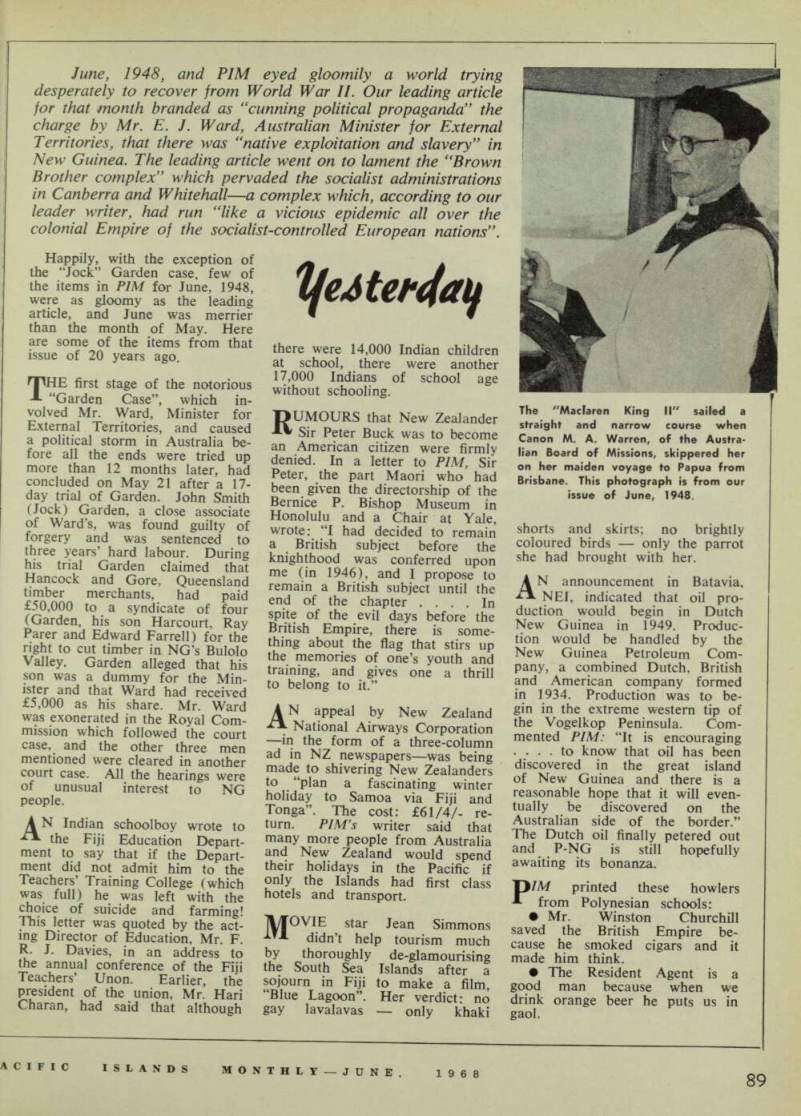
The "Maclaren King II" sailed a straight and narrow course when Canon M. A. Warren, of the Austra lian Board of Missions, skippered her on her maiden voyage to Papua from Brisbane. This photograph is from our issue of June, 1948.