Where will the Tongans go?
p. 74 · Read in the full issue
From a Nukualofa correspondent Tonga’s population problem is more and more being brought to attention these days. The present population of 77,000 in the kingdom is expected to double in the next 24 years, and there is apprehension about what this will mean in terms of unemployment.
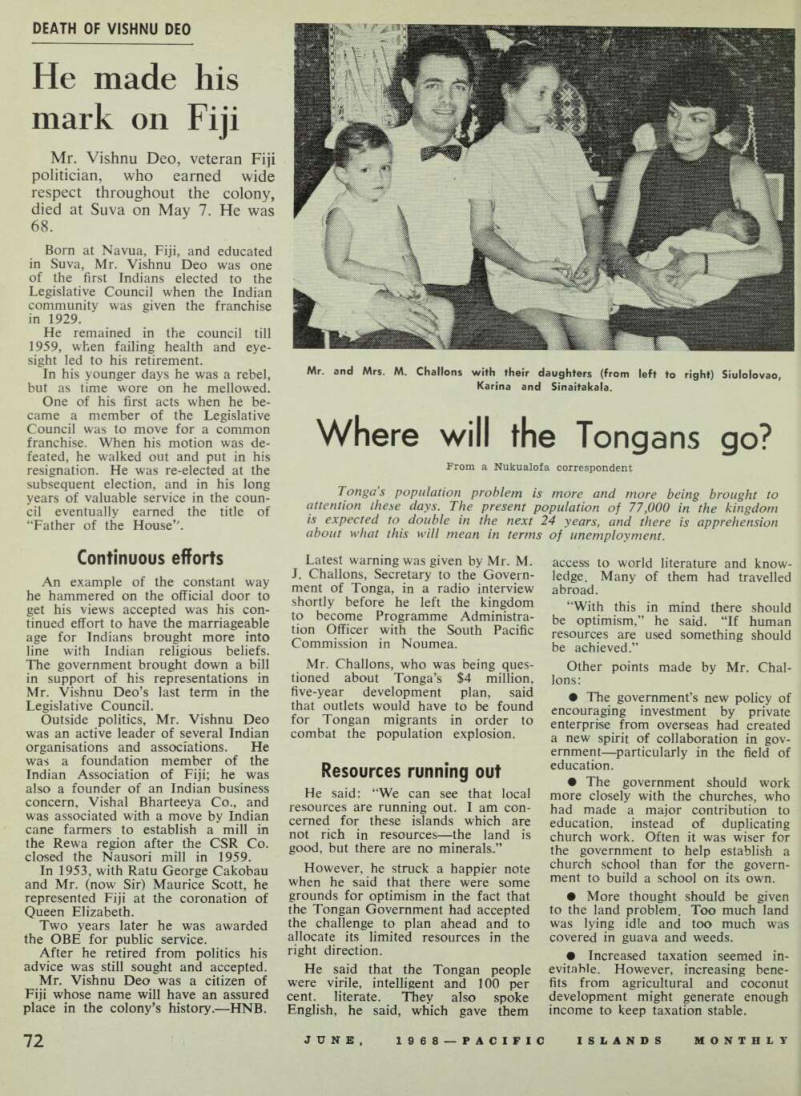
Latest warning was given by Mr. M.
I. Challons, Secretary to the Govern ment of Tonga, in a radio interview shortly before he left the kingdom to become Programme Administra tion Officer with the South Pacific Commission in Noumea.
Mr. Challons, who was being ques tioned about Tonga’s S 4 million, five-year development plan, said that outlets would have to be found for Tongan migrants in order to combat the population explosion.
Resources running out
He said: “We can see that local resources are running out. I am con cerned for these islands which are not rich in resources—the land is good, but there are no minerals.”
However, he struck a happier note when he said that there were some grounds for optimism in the fact that the Tongan Government had accepted the challenge to plan ahead and to allocate its limited resources in the right direction.
He said that the Tongan people were virile, intelligent and 100 per cent, literate. They also spoke English, he said, which gave them
access to world literature and know ledge. Many of them had travelled abroad.
“With this in mind there should be optimism,” he said. “If human resources are used something should be achieved.”
Other points made by Mr. Chal lons: • The government’s new policy of encouraging investment by private enterprise from overseas had created a new spirit of collaboration in gov ernment—particularly in the field of education, • The government should work more closely with the churches, who had made a major contribution to education, instead of duplicating church work. Often it was wiser for the government to help establish a church school than for the govern ment to build a school on its own, • More thought should be given to the land problem. Too much land was lying idle and too much was covered in guava and weeds. • Increased taxation seemed in evitable. However, increasing bene fits from agricultural and coconut development might generate enough income to keep taxation stable.
Mr. and Mrs. M. Challons with their daughters (from left to right) Siulolovao, Karina and Sinaitakala.