travel
pp. 41-43 · Read in the full issue

Will an aircraft be the coach that takes Cinderella Vavau to the ball?
From a Vavau correspondent
Vavau, 170 miles north of the Tongan capital of Nukualofa, has long been regarded as the kingdom’s Cinderella. As a rule, it has had to get along on second-hand equipment passed down from government departments in Nukualofa. With a population exceeding 12,000, the group still has no government secondary school, nor has its primary department been allotted even one of the Europeans or Tongan university-trained teachers so much in evidence in Nukualofa.
In the matter of tourists, Vavau ias fared no better.
Although its wooded hills and ong land-locked harbour make it me of the world’s beauty spots, it jets few tourist ships. Most are outed to the capital, a monotonously lat island which has comparatively ittle to offer in the way of scenic )eauty.
But Cinderella Vavau may at last >e brought into the exciting world )f tourists; for it is to have its own lirfield.
International
As it was originally planned, the eld was to have provided only a feeder” service between Vavau and "ongatapu, the island on which Nukualofa is situated. Such an rrangement would have kept Vavau i its traditional place as Tonga’s step-child”, but fortunately a fairy odmother appeared in the person of Ir. Joseph Furniss, who was sent > Tonga by the Technical Aid fivision of Britain’s Ministry of •verseas Development.
On his suggestion, the field has een extended to 3,400 ft, which will How it to be used by the DC3’s hich fly into Nukualofa and it ill become a regular stop in the ights which Polynesian Airways will in between Samoa and Nukualofa.
Ninety per cent, of the cost of ie field, which will have a 100 ft ide central strip paved with coral, ill be met by Great Britain; Tonga ipplies the rest.
Mr. Furniss says the field could ; ready for use by the end of March f the rains keep off”, but this is e rainy season so the opening date ay well be a bit later. In the mean ne work is proceeding under the rection of foreman Fred Cocker id Vavau Public Works head, ’lla escott.
To the local people, the airport has ready assumed a vast importance. 11 visitors are taken to see it
travel
and are urged to share the Vavau feeling that it is “the world’s most beautiful airport”.
That opinion, of course, is open to controversy, but there is no deny ing that the port has added new beauty to Vavau. It is built on the edge of a 500 ft cliff on the seaward side of the main island, just beyond the village of Leimatu’a. From the cliff is a breathtaking sight of the blue Pacific, edged by countless inlets and white sand beaches.
Coconut wireless busy
Looking south a whole “new” view emerges. Formerly hidden by the woods which covered the airport site one sees now the green slopes of the main island with, in the distance, the red roofed houses of the main town, Neiafu, and far beyond that
the distant islands and the white foam of surf breaking on the outer reef.
The coconut wireless has been functioning overtime since work began on the field in December.
Many Vavauans refer to it as a jet field (it is not—and, according to Mr. Furniss, could not be converted into one without great expense).
When Mr. Furniss asked US Peace Corpsman, Alan Burrus, a professional architect, to come to Vavau, rumours of an airport hotel immediately began to fly about. They were totally unfounded.
At present there is no money— either Tongan or overseas, for a hotel in Vavau.
What Mr. Burrus did design was a simple Tongan style shelter which will serve as a station for passengers, and that is the only building the airport is to have in the immediate future.
With present accommodation in Vavau limited to the Government
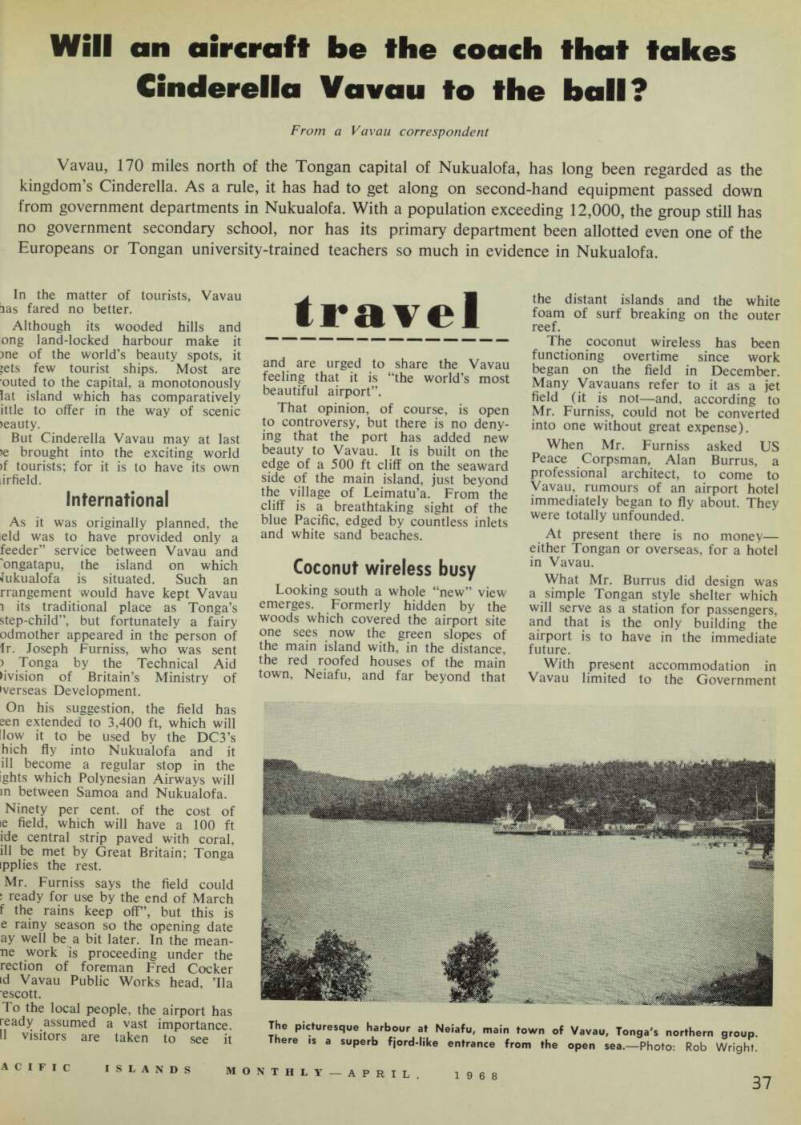
The picturesque harbour at Neiafu, main town of Vavau, Tonga's northern group.
There is a superb fjord-like entrance from the open sea.— Photo: Rob Wright.
Rest House, the Copra Board, and private families, it is doubtful if Vavau will very soon be attracting many tourists away from Nukualofa with its new Dateline Hotel, but the people are optimistic about the future.
“When they see Vavau, they’ll stay,” says one man, illustrating the general local feeling.
The first air service on the new field will be Polynesian Airways, but other companies have already shown interest. The Tongan Government is considering the purchase of a 10 seater Britten-Norman Islander for inter-island service. If that plan materialises it could do much to help Tongans get around their own country with greater ease.
Ma’afu Tupou, governor of Vavau, whose son Tu’a is a student at Uni versity of Hawaii’s East-West Center, says, “It will be a great help to people here who want to go to Samoa or Hawaii—or on to America”.
He reflects the thoughts of his people—more and more of whom are looking to the outside world.
Whatever the airport may really nean to Vavau, it seems certain that t has moved it for all time out of he Cinderella class and has created n the people a new sense of excite nent and optimism.
HANADIAN Pacific Airlines, which operates a fortnightly trans- J acific air service from Vancouver o Sydney or Auckland via Honolulu md Nadi, is likely to increase this ervice to once a week later this r ear.
When this happens, Qantas will Iso increase its similar service from Australia to Canada from once a ortnight to once a week.
No official announcement has yet •een made on the increased CPA ervice, but aviation circles under tand agreement has been reached etween the Australian and Canadian jovernments. CPA has been trying or several years to have its Aus ■alian services increased.
Last year the airline’s president, ir. J. C. Gilmer, on a visit to Aus 'alia, described the fortnightly srvice, “not a service but an in requency” ( PIM , May, 1967, p. 45).
Increased Australian and Canadian avel between the two countries and ersistent pressure from the Canadian rovernment are the reasons for PA’s coming weekly air service.