travel
pp. 45-46 · Read in the full issue
And what’s behind Fiji’s hotel occupancy figures?
“Fiji hotels with more than 30 beds had an average occu pancy rate of 56 per cent. The occupancy rate for hotels with less than 30 beds was much lower—only 31 per cent.”
Hotel interests in Fiji and travel nterests overseas who read this small laragraph in March in one of the egular weekly newsletters published y the Fiji Government Public Re gions Office took a long look at it.
The figures came from Fiji’s lureau of Statistics, and they referred ) occupancy rates for the colony’s 0-odd hotels, motels and resorts dur ig 1967.
What did the figures mean? Were icy a warning for investors that the iji hotel boom was about to burst -that the colony was building too lany hotels?
Boom continues
The question was of more than :ademic interest because hotel build g is continuing in Fiji and 339 :w rooms will become available in e colony this year, in five new )tels either just opened or about be opened.
In Suva alone hotel accommodation is more than doubled since 1965 ■om 117 to more than 520 rooms).
The travel business is not at all agreement on the interpretation these figures. One big group of jstralian hotel/motel interests de ribed a 56 per cent, occupancy rate “poor”. They said that if their cupancy rates dropped below 60 r cent, there would be a serious /estigation. This group was getting 80 per cent, occupancy rate.
At a Sydney news conference (held fore the occupancy figures were re used), Captain George Wilson, airman of Fiji Resorts Ltd., which ntrols three major Fiji hotels,The iian, Mocambo and Skylodge, said it Fiji could be over-catered for th bed accommodation for tourists, ere could be hardship for some teliers for a short time, par ularly for those in the Suva area.
Fiji Resorts was currently review : Fiji accommodation facilities, plain Wilson added.
Another firm which has tourist in ests in Fiji pointed to the special •ort on Fiji tourism done in 1965
travel
by the British firm of Harris, Kerr, Forster and Co.
In giving projections for hotel needs to 1970 the report calculated that “with the seasonal factors in volved in the flow of tourists to Fiji, it is reasonable to assume that the additional facilities provided should be expected to operate at average annual occupancy of 75 per cent, of the newly provided guest rooms.”
Future schemes
The report estimated that Fiji needed 800 additional rooms to cater for the scheduled increase of tourists by 1970, to be built at the rate of 130 additional rooms per year for the six years from 1965 to 1970.
The report said Fiji should reason ably expect to have from 85,000 to 90,000 visitors by 1970—an increase from 18 per cent, to 20 per cent, cumulative per year.
The report’s projections estimated total visitors in 1966 to be 44,000; m 1967 to be 52,000; for 1968, 61,000; for 1969, 72,000; and for 1970, 85,000. (In fact, Fiji in 1967 had a record 56,000 visitors, which was 26 per cent, more than in 1966).
The report suggested that the additional 800 hotel rooms needed could be located as follows: Coral Coast 350; City of Suva 200; general vicinity of Nadi airport 50; north coast of Viti Levu 50; three outer island locations of 50 rooms each, making 150.
In making suggestions for profit able hotel operations in Fiji, the re port based all its figures on room occupancy rates of 80, 70 and 60 per
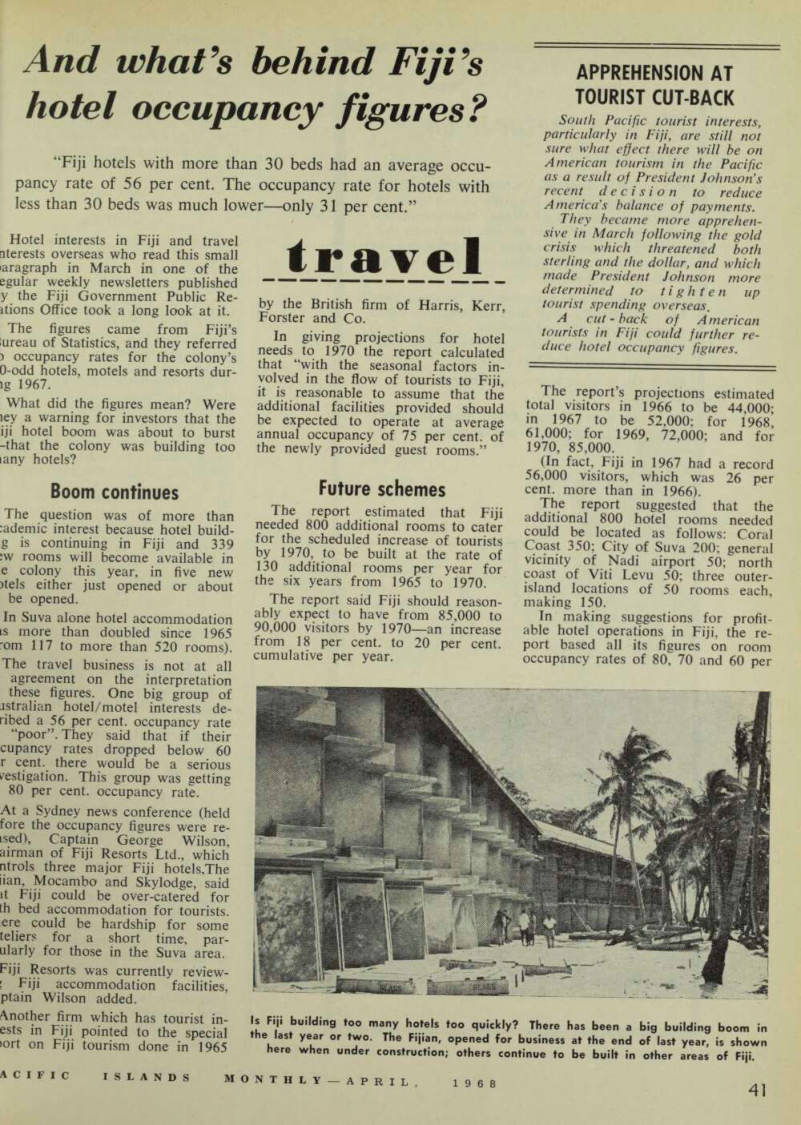
Is Fill building too many hotels too quickly? There has been a big building boom in the last year or two. The Fijian, opened for business at the end of last year, is shown here when under construction; others continue to be built in other areas of Fiji.
cent., but never lower than 60 per cent.
The report said there would be a higher percentage of profit in re lation to total sales and income in Fiji than the average to be found in hotels overseas, including the US.
The higher rate of profit per sales in Fiji was principally due to wages and other financial burdens per room being lower in Fiji.
Queries
The report said its estimate of an 18 to 20 per cent, tourist increase a year “might raise questions” in view of the fact that in some previ ous years, notably 1963 and 1964, annual increases had been as high as 33 per cent. However, introduc tion of duty-free shopping had been one of the factors causing these in creases, and in any case, in longer range projections “the prospect of general economic conditions, causing some slowing of the tourist flow, must be considered.”
This report, say some of today’s critics, seems to indicate that Fiji hotels are building too fast and that there could be, as Captain Wilson was possibly indicating, more empty rooms than the industry would like to see, until demand catches up with the supply.
But there is an opposing view ir Fiji. There are those who say thal the figure of 56 per cent, occupancy for the bigger hotels is not really a true indication of the current hotel business in the colony.
Figures are "higher"
They say several of the new re sorts, with full facilities for guests are enjoying 70 to 80 per cent occupancy rates and even higher while other modern hotels, because they were recently completed, only attract 30 per cent, occupancy.
It is these recently-completec hotels which brought down the over all average, they argue. Also big liquoi sales in Fiji hotels reduced overal costs, and other costs were less, there fore an occupancy rate of 56 per cent could well be satisfactory.
But how about the occupancy rate of 31 per cent, with hotels of les: than 30 beds? There is no opinion In fact there appears to be nc satisfactory conclusion for the debatt at this stage, and perhaps only timt —or more information—will tell Meanwhile, some people in the Fij hotel business are taking a mon cautious look at Fiji’s tourist de velopment.