Monthly
Pacific Islands Monthly
Registered at G.P.0., Sydney, for transmission by post as a newspaper.
April, 1968
News Magazine Of The South Pacific
• AUSTRALIA, 40c. • NEW ZEALAND, 45c. • FIJI, 3/9 • FRENCH PACIFIC ISLANDS, 55 FRCS. CFP. • U.S. PACIFIC TERRITORIES, 70c. • P.-N.G. AND ALL
Other Pacific Territories, 35C. Local Currency.
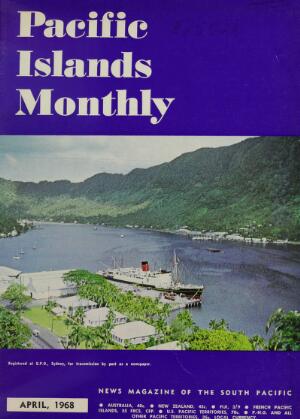
The Cover
One of the most colourful harbours in the South Seas is American Samoa’s Pago Pago (pronounced Pango Pango).
Our picture, showing the Union Steam Ship Coy’s inter-island vessel “Tofua” at the wharf, was taken by Ann Glenn, of the cruising trimaran “Rebel”.
Advertisements & other items, pp. 2-11 (8 items)
One flight...
1823 miles of extra care
Between Papua/New Guinea and Australia, everyone gets extra care when they fly TAA ‘Bird of Paradise’. Business or holiday travel, family travel or sentimental journey whatever your reason to fly, you’ll relax and enjoy TAA’s international standards of service with five hostesses to pamper your every need. Drinks are free first class. Meals are culinary masterpieces from canapes right through to cheese, coffee and mints. Everyone gets extra care on a ‘Bird of Paradise’ flight especially the youngsters, who’ll really enjoy their games and books. So take care to book TAA, and we’ll take extra care of you. Call your Travel Agent or TAA now.
Port Moresby 2101, Lae 2311, Madang 2478, Rabaul 2567, Goroka 8, Mt. Hagen 4, Wewak 103.
Fly TAA the Friendly Way
TAA
m
lllllllll III! 11l lIIIIIIMIIIIIIIIIIIIIIIIIII 111111111111111111111111 l 11111111111 l iiiiiiib
BURNS PHILP (SOUTH SEA) CO. LTD.
GENERAL MERCHANTS AND SHIPOWNERS
SHIPPING, CUSTOMS AND FORWARDING AGENTS
Fiji
SUVA
LEVUKA.
LAUTOKA.
LABASA.
SAVU SAVU.
BA.
SIGATOKA.
TAVUA.
TAVEUNI,
BRANCHES
Samoa:
APIA.
PAGO PAGO.
Tonga:
NUKUALOFA.
HAAPAI.
VAVUA.
NORFOLK ISLAND.
NIUE ISLAND.
AGENTS FOR:
QUEENSLAND INSURANCE CO. LTD.
BURNS PHILP TRUSTEE CO. LTD.
SHELL COMPANY (P. 1.) LTD.
OVERSEAS AGENTS
BURNS, PHILP fir CO. LTD., Sydney.
BURNS, PHILP Cr CO. LTD., London.
BURNS PHILP CO. OF SAN FRANCISCO.
SHIPPING AGENCIES
• The New Zealand Shipping Co. Ltd. • Shaw Savill & Albion Co. Ltd. • Port Line Ltd. • Bank Line Ltd. • General Steamship Corporation Ltd. • Blue Star Line • Cunard Line • Compagnie des Messageries Maritimes • British India Steam Navigation Co. Ltd. • Royal Interocean Lines • Nederland Line Royal Dutch Mail/Royal Rotterdam Lloyd.
EXCLUSIVE DISTRIBUTORSHIPS INCLUDE
• AKAI TAPERECORDERS • HELENA RUBENSTEIN • ROLEX WATCHES • DUNLOP PRODUCTS • HITACHI ELECTRONICS • REVLON COSMETICS • EPIGLASS PRODUCTS • HOLDEN VEHICLES • PENTAX CAMERAS • FERGUSON TRACTORS • JOHNSON'S WAXES • SUNBEAM APPLIANCES
INTERNATIONAL AIR TRANSPORT ASSOCIATION REPRESENTATIVES for
QANTAS EMPIRE AIRWAYS LTD. AIR NEW ZEALAND UNION DE TRANSPORTS AERIENS ALITALIA :: PAN AMERICAN AIRWAYS
ASSOCIATED COMPANIES
BURNS PHILP (NEW HEBRIDES) LTD.
AUTOMOTIVE SUPPLIES CO. LTD.
CORRIE & CO. LTD. • WROUGHT IRON AND STEEL
CONSTRUCTION CO. LTD. • BISH LTD.
SPECIALISED SERVICES
EXPERT ADVICE ON WORLD AND LOCAL TOURS
TRAVEL SHIPPING FORWARDING CUSTOMS
FORMALITIES INSURANCE.
REGISTERED OFFICE; SUVA FIJI
Code Address: "BURNSOUTH 1 11 1111 11 iiiiiiiiiiS^^
NlGf m *: * * i V# a*. o>, Arnott’s Nice Biscuits Crisp and sugar-sprinkled Arnott’s Lemon Crisp Biscuits With tangy lemon centres
ng*STZ
ora
biscuits m 'On
ntnWHEATM^
sH re dD HM Arnott’s Orange Slice Biscuits Tangy orange cream in biscuit sandwich Arnott’s Shredded Wheatmeal Biscuits Golden-grain goodness for morning tea.
& famcot ttlseuW
POUND NFTT
HAi' Arnott’s MILK ARROWROOT Biscuits All-day energy for children a favourite with all the family.
Arnott’s SAO Biscuits Ideal for snacks, suppers or between meal*. a* & Arnott's SCOTCH FINGER Biscuits Chunky and butter-rich, with the true shortbread flavour.
Arnott’s CHEESE JATZ Biscuits Crisp as could be with a fine cheese flavour perfect for entertaining.
There is no Substitute for Quality
WOCKHOW
Whatever the yoU
there’s on fu i ia ngeofde' icious Mak cfneods^t^ rf are s 0 mar* biscuits from *°ff ftom th e most varieties to choose from. nts . Brockhoff ‘ finest biscuits. zr-
THUMPS
CLIX
A tender golden crisp cracker that tastes as if it is already buttered. The cracker you can eat by itself, or with savouries or dips.
EDINBURGH
SHORTBREAD
Made in the true Scottish tradition with fresh eggs, sugar and rich dairy butter.
J 5 brockhok \
SavouryShapes
SAVOURY SHAPES
These delicious, one-bite ready-made savour ies are ready to serve anywhere, in convenient tray pack. tht
Salada
BROCKHOff
SALADA
A crisp, light, golden cracker to enjoy with all meals and snacks. The slight touch of salt brings out the full flavour of all spreads, toppings, & cheese.
Australia’s finest biscuits baked oven-crisp by Brockhoff.
Wrapped in MXXT/A, the most moistureproof ‘Cellophane’ in the world.
Look for the baker on the packet.
. BROCXHOff
RAISIN
ON
LUNCH
ITMI
BKXKHOIr
Malt-O-MilK
ARNOTT, BROCKHOFF, GUEST Ply. Ltd.
53-71 Huntingdale Rd., Burwood, E. 13, Victoria, Australia.
Cables ‘ Brockbick ’ Melbourne.
Telephone 28 2888
World
quality
ill W m Rf r- N fC J Only the world’s finest Virginia tobaccos are blended to produce ...
PLAYER’S
GOLD
LEAF
one of the great cigarettes
0671-5/67
ERINMORE
FLAKE OR
MIXTURE TOBACCO
IN VACUUM TINS
MIXTURE
such good rich flavour
-distinctive aroma
-there's more of both in ERINMORE
Erinmore makes friends in any company. Smokers welcome its good rich flavour. Others, womenfolk especially, enjoy its distinctive aroma. This comes from the century-old blending process, secret to the makers of Erinmore.
No other tobacco can give you so cool and sweet a smoke.
ERINMORE
Made in Northern Ireland by Murray, Sons & Company Limited, Belfast. Manufacturers of fine tobacco since II
the
4 Wifi: fe ■; ■r "I * W«Sf ■ 1
11 FUNGI-CHEK
.y siSsSpl Si / • :
DENTOLITI
TESTED PROVED, NEEDED AND USED EXTENSIVELY IN HOSPITALS, / FACTORIES, BREWERIES. FREEZING WORKS. WINE CELLARS AND PRI
HOMES THROUGHOUT N.Z.!
Fungi-Chek and Dentolite paint is the world's safest and most effei bactericidal and fungicidal paint. Fully guaranteed to inhibit mould fungi growth. Its quality rating is the highest. For the total eradicatic wall and ceiling mould get the guaranteed brand ... Fungi-Chek Dentolite. Write for Technical and General Information.
DENTON’S PAINTS (N.Z.) L
N.Z. LICENSEES:
111 GREAT SOUTH ROAD, PENROSE. P.O. BOX 22-146 OTA I
Australian
butter & cheese
... help children grow faster
... give children more energy
-s A ipyiii
AUSTRAU
Tom the rich pastures of Australia come the finest i dairy products including the finest cheese, butter, hee and canned or powdered milks. ■ Unsurpassed 3r flavour, Australian butter gives you full Vitamin A nd D content. Australian cheese gives you excellent oncentrated food value full of protein and rich i calcium. ■ For energy, goodness and flavour hoose Australian dairy products.
Always look for the word 'Australia' on the label Trade Enquiries to: Your resident Australian Trade Commissioner or— Australian Dairy Produce Board,
G.P.O. Box 1657 N,
Melbourne, Victoria, Australia. 3001. .
Quick easy construction of a Pyneboard built-in unit Pyneboard saves money and labour. Pyneboard is easy to use and it cuts to any shape without loss of strength. Panels quickly glue and screw together to make strong, rigid units. Off-cuts can be butt-glued and used. The smooth surface of Standard Pyneboard is a splendid base for paint or plastic laminates. Sheet sizes in Standard Pyneboard up to 16' x 6'.
Timber Veneered Pyneboard is veneered with actual timber to give you genuine timber grains on a strong, stable, panel product. A decorator effect for furniture and built-ins that can only be achieved with natural wood. Choose Walnut, Maple, Black Bean, Coachwood and many others.
Also paint grade veneer for easy painting. Panel sizes up to 8' x 4' in 5/8", 11/16", 3/4", 13/16" thicknesses.
PYNEBOARD
for built-ins
shelving
furniture
partitions
lUILDIHS^Sx^MATERIALS
EXP .PlB9
Made in Australia. Marketed by
CSR BUILDING MATERIALS SALES PTY. LTD.
AVAILABLE FROM—New Guinea & Papua: Burns Philp (N.G.) Ltd. Island Products Pty. Ltd., Pt. Moresby. The New Guinea Company Ltd. Steamships Trading Company Ltd. Fiji, Tonga, Samoa: Burns Philp (S.S.) Co. Ltd. W. R. Carpenter (Fiji) Ltd. Morris Hedstrom Ltd. Solomon Islands: Tischler Constructions. New Hebrides: C.F.N.H., Santo & Vila. Norfolk Island: Irvine's Building Supplies.
Remember
the good times
Nl** >a« Ca?»t h’ & ■ >
with Kodak color film.
Don’t talk about your good times.
Keep them alive with Kodak color film.
Kodachrome film makes brilliant color slides. Kodacolor film makes the best color prints.
For even better memories, have big color enlargements made from your color slides or color negatives.
You can have color slides taken, too, from your Kodacolor negatives.
And for travelling convenience, remember to carry Kodak Prepaid Processing Mailers (for Kodacolor or Ektachrome film). Your prints will cost less, and you’ll see them sooner.
There are Kodak dealers throughout the islands. They’ve got the Kodak film you want.
Remember today in pictures with Kodak film.
KODAK (Australasia) PTY. LTD. 379-381 George Street, Sydney
Kodak
1
ACIFIC ISLANDS MONTHLY— APRIL, 1968
2
APRIL, 1968 PACIFIC ISLANDS MONTHLI
3
ACIFIC ISLANDS MONTHLY APRIL, 1968
April, 1968 Pacific Islands Monthl
5
ACIFIC ISLANDS MONTHLY APRIL. 1968
7
ACIFIC ISLANDS MONTHLY APRIL, 1968
9
ACIFIC ISLANDS MONTHLY APRIL, 1968
Pacific Islands
Monthly
Established 1930: 38th Year of Publication.
Owned And Published By
Pacific Publications Pty. Ltd.,
29 Alberta St., Sydney, N.S.W., 2000.
Postal Address: G.P.O. BOX 3408, SYDNEY,
N.S.W., 2001.
Telegraphic Address: PACPUB, Sydney.
Telephones: 61-9197, 61-7101, 61-4369.
Chief Executives: Managing Director: R. W. Robson.
General Manager: Selwyn Hughes.
Book Publishing Division
Editor: Judy Tudor.
Pacific Islands Monthly
Editor: Stuart Inder.
Assistant Editor; Robert Langdon.
Branch Offices
Melbourne: Newspaper House, 247 Collins St., Victoria, 3000. Tel.; 63-7053.
Fiji: Pacific Publications (Fiji) Ltd., Fiji Times Building, 20 Gordon Street, SUVA. Tel.: 25601.
Fiji Times Office, Vidilo Street, LAUTOKA.
Tel.: 60-422.
Papua-New Guinea: Pacific Publications (N.G.) Pty. Ltd. Representatives; Mrs. Joan Carter, P.O. Box 16, PT. MORESBY (Tel.: 2504); The Manager, P.O. Box 227, LAE; Mr. Steve Simpson, P.O. Box 154, RABAUL (Tel.: 2547).
Representatives
New Zealand: J. D. Whitcombe, C.P.O. Box 2229, Queen Street, Auckland. Tel.: 76056.
United States: Mrs. A. L. Craib, 782 Neilson Street, Berkeley, California, 94707.
United Kingdom; S. R. Warman, Candlewick House, 116-126 Cannon Street, London, E.C.4.
Tel.; Mansion 3674/7.
H. A. Mackenzie, 4A Bloomsbury Square, London, W.C.I. Tel.: Holborn 3779.
Agents
All main trading firms and stores in the Pacific Islands.
Pacific Publications Pty. Ltd. is the Australian agent for THE FIJI TIMES.
Subscription Rates:
"Pacific Islands Monthly" is air-freighted to all subscribers and agents in the South Pacific; copies to other areas go by surface mail.
Australia (incl. Lord Howe Is., and Thursday Is.): $4.50 Aust.; Papua-New Guinea, Norfolk Is, Nauru, 8.5.1., G. & E. Group, Tonga and New Hebrides; $4.00 Aust.; New Zealand: $5.25 NZ; Cook Is., Niue and Western Samoa: $4.00 (local currency); Fiji £2/5/- (local currency); American Samoa and U.S Pacific Territories: $B.OO (local currency); French Pacific Territories —New Caledonia, Tahiti, etc.; 660 French Pacific francs; United States of America: $9.00 U.S.; United Kingdom and elsewhere; £2/15/- Stg.
Airmail postage to USA, UK and elsewhere is additional.
Up Front
with the editor
The fact that this month happens to be the first anniversary of this column probably is of no significance to anybody but me. And its significance would no doubt have been lost on me too if it weren’t for a cryptic message passed to me recently from Percy Chatterton, in Port Moresby, which said, “Tell Inder if he’s not going to write his column I’m not going to write mine!”
THE reason for Mr. Chatterton’s message was that my Up Front piece had been omitted from a recent issue (for technical reasons, as it happened). Although I haven’t com pared notes with Mr. Chatterton, I don’t deceive myself that he thought my column so valuable he would go to the lengths of literary blackmail to get it back in the journal.
I believe, after 12 months of regu lar columnising, that what Mr, Chatterton probably had in his mind, but which he expressed in the prudent manner we have come to expect from him, is “Tell that louse that if he hasn’t the fortitude to stick to his monthly chore why should he expect me to stick to mine?”
Chore is the active word here.
I have for Mr. Chatterton a private admiration for his strength of purpose in producing each month, right to deadline and with no editing necessary, his literary lucky-dip of human interest and sagacity.
His column demonstrates both his intellectual capacity and the inner reserves that made him such a notable missionary for so many years.
I hope I can continue to publish him regularly without being expected to emulate him, and thus to be found wanting.
Having made that confession, I want to add that although Percy cannot write anything in his column which is not to the point, any regular readers of this particular column up front should not expect me to say anything of special significance.
Certainly they should not expect Up Front to contain monumental editorial expressions of policy, of the “Where We Stand” variety. When this column crept into PlM’s pages 12 months ago I did not intend that it
should be anything more than a gossipy selection of personal com ments on Pacific people, places and happenings. It wasn’t and isn’t PlM’s leader page.
I admit it is probably a reflection of editorial opinion in that it reveals my own attitudes at times. But so does the rest of this magazine reflect the editor’s attitudes. Editing is a very personal matter; it’s what an editor selects as being significant that puts a particular stamp on his journal.
Editorial board?
I don’t know how else you can edit, unless you do it by editorial board, as some do, in which case you might as well get yourself a more stimulating job as foreman of a factory making toothbrush handles.
PlM’s policy has never been directed by an editorial board. PIM has no policy—if by policy you mean that on the wall we have a printed list of attitudes we must not take, or lines over which we must not step.
We do have a personal yardstick, so ordinary that I blush to record it. It’s simply that we try to report, in readable English, the significant and interesting developments in the Islands, for the information of the people who live in the Islands. Just that.
Many readers don’t understand this, including, I suspect, Ken Inglis, Professor of History, at the Univer sity of Papua-New Guinea, who managed to indicate in a paper last year that some of the views of a PIM correspondent in New Guinea were at variance with the truth and that this material was unhelpful. I don’t consider it is PlM’s task to
record each Pacific development as a balanced academic thesis.
We don’t always agree with views we publish. A correspondent or con tributor may see a situation in terms that we don’t agree with, but so long as we feel his assessment has been made honestly and constructively he is welcome to our space. Sometimes, in fact quite often, he might be biased —and so might we!—but isn’t there honest bias?
The way I see it, the South Seas at this dramatic stage of its develop ment is a melting pot of opinion and lias, and what PIM has to do is to reflect it.
Some interpretation is also required )f us, on those occasions when a traight report would virtually be neaningless. It might be accurate o report that P-NG had a new >olitical party, but the fact wouldn’t >e in any context until we explained hat several others already existed, md tried to explain what they stood or and how they were being received n the territory.
Also on occasions it is up to us o indicate how we feel about particu ar issues and thus bring to attention evelopments which we think are eing overlooked or misunderstood.
When most people outside the ’ooks regarded Albert Henry as an iterfering upstart we said he was dnning popular support in the Cooks nd that he should be taken seriously.
Wien Hammer Deßoburt was getting le long run-around from Canberra, IM was stressing that the real depth f Nauruan nationalism was not eing recognised by the people in uthority, to their own and to the lauruan’s detriment.
Which if any of the material that oes between our covers, recording ic moods, the hopes, joys and biases f the South Pacific, is relevant in le long-term is for the historians a decide. When, 10 or 20 years om now, the PhD scholars of the outh Pacific universities make their ritical footnotes to the material we rint today, I merely hope they ill at least find that our motives >r publishing it were honest.
Stuart Inder
Advertisements & other items, pp. 13-18 (2 items)
11
ACIFIC ISLANDS MONTHLY APRIL, 1968
Give It
WATER DOUBTFUL?
t*t«l TR E ATM ENT
The models in the BK series are the most effective and modern units available and are quickly installed by a plumber in the supply line or over a bench. Models available for filtering and sterilising, fluoride removal, cloth filter (as used for photographic and X-ray washing), straining models, taste improving filters (removes stale, foul and chloronous tastes). Mail coupon below for free fully descriptive literature.
PCI
N Z
PATERSON CANDY
INTERNATIONAL (N.Z.) LTD
WATER AND FLUID TREATMENT SPECIALISTS
3-5 Eden Street, Newmarket. P.O. Box 9065, Auckland, 1.
Telephone 50-173. Telegrams: Patcandy, Auckland.
PATERSON CANDY INTERNATIONAL (NZ) LTD.,
P.O. Box 9065, AUCKLAND 1.
Please send me leaflet CMF267 Name Address
CPI/Q/68
w 9
AUSTRALIA'S LARGEST
GLASS MERCHANTS
& MIRROR
MANUFACTURERS
• Sheet Figured Rolled and Plate Glass: Cut-to-size or in Case lots. • “Armourplate” Glass. • Structural Glass. • Spandrel Glass. • Solar Insulation Glass. • Glare Reducing Glass. • Anti-Glare and Heat Absorbing Glass. • Multiple Glazing Units. • Safety Glass. ★ V
GLASS DIVISION
• Laminated & Toughened Glass. • Diffuse Reflection Glass. • Glass Blocks. • Glass Louvre Blades. • Brilliant Cutting. • Sandblast Decoration. • Stone Engraving. • Glass Bending. • Roof Lights. • Glazing Bars. • Mirror Fitting Sundries. cut to any size, shape or • “Copperbak” Mirror cut-to-size and in stock sizes. • Gold framed Wall Mirrors. • Unframed Wall Mirrors. • Cheval and Vanity Mirrors. • “Golden Ray” and “Platnum”
Mirrors. • “Triple Tone” Mirrors. • “Glitterlite” Flexible Mirrors. • Antique Mirror. • One-Way Vision Mirrors. • Mirror for Industry. ign.
SHOPFITTING DIVISION
• Shop Fronts and Interiors • Club, Hotel & Cafe Interiors • Architectural Metalwork • Detailed Joinery • “Permalock” Partition Component Parts • “Penciline” Partitioning • Crush Bars and Kick Plates • Counter Screens and Grilles • Show Cases and Counters • Metal Mouldings Shopfronts and Interiors can • “Kawneer” Aluminium Sections • Entrance Doors and Screens • “Armourplate” Doors • Metal Nosing • Metal Letters • “U-rect-it” Store Equipment • “System Abstracta” Display Fittings • Glass & Shop Fitting Trade. Tools, Supplies be supplied prefabricated for installation by others Hardware &
BUILDING MATERIALS DIVISION
• “Formica” Decorative Laminate • “Formica” Engraving Material • “Bangor” Sliding Door Tracks • "Masonite” and “Masonite” Products • “Cowdroy” Track and Accessories for sliding glass doors and windows • “Cowdroy” Cupboard and Door Tracks • “Lidco” Track for sliding glass doors and windows • “Lidco” Multiframe aluminium extrusions and accessories • “Pyneboard” and “Caneite” • “Vinlon” Rigid Vinyl Roofing and Sheeting • “Blu-line” Insect Gauze • “Clip-on” Stainless Steel Fly Screens • “Naco” Adjustable Louvres • "3M” Contact Adhesives.
ORDERS AND ENQUIRIES THROUGH THE GENERAL MERCHANTS IN YOUR AREA.
CATALOGUES AND PRICE LISTS AVAILABLE.
All the best
from Australia
Phoenix Biscuits! Best for goodness.
Best for flavour. Best for freshness. Silver foil wrapped to arrive as fresh as the day they were baked. a m w * «• 0 w c# m m
CREAM CRACKER
BISCUITS
80JS
CREAM CRACKERS
Flavoursome and filling! A light, creamy cracker that’s a low calorie favourite. Ideal for diet control.
Contains health-giving yeast.
COCONUT CREAMS
Wonderful flavour! Baked with the finest quality tropical coconut and crammed full with coconut flavoured cream.
M4<VM/671
measure master
QI "[»««<*» QC[ Tiki trroliri turn 1 1 1 11 1 imtimlnui nirtin ’ i l l ; o*l nTrtiiiitfrrffrjTffl Made especially for those who value top craftsmanship and accuracy above everything, the Rabone Chesterman 2 and 3 feet folding boxwood rules are an object lesson in how good all rules should be. Built to last a lifetime, they'll measure up to anything.
Available from Ironmongers and Tool Dealers. io m m §s iU
Rabone
Chesterman
Rabone Chesterman Ltd.
Birmingham 18, England.
r M 2<s a n I 3
SEPPELT
AUSTRALIA’S LEADING WINE
IN 39 COUNTRIES
Seppelt Solero Sherries Sweet, Medium and Dry are the results of blending nine good vintages over fourteen years in ageold casks. They are the perfect appetizers before meals, or may be served at any time of the day.
Seppelt's knowledge of wine-making ensures that each Seppelt wine is true to its type and comparable to the world's finest.
SEPPELT
SOLERO
SEPPELT
SOLERO
; S H E R R \W
VIEDIUM
T)RY
Do the right thing every time— always serve Seppelt wine. m WINNER OF AWARD FOR OUTSTANDING EXPORT ACHIEVEMENT
For workshop...
for industry
■■■pH
LhJml
Industrial Gases
COMWELD Gas Welding & Cutting Plants; Rods & Fluxes; Flame Cleaning, Flame Hardening & Flame Heating Equipment.
EMF
Electric Welding
Equipment
Arc Welding Machines; Automatic Welding Machines; Electrodes.
Arnold-DeVilbiss
Spray Painting
Equipment
including spray guns, air filters and compressors—to multi-purpose units with spray booths and a full range of automatic equipment.
GIG can meet all your requirements for welding, cutting, bending, shaping and spray painting with equipment and instructive literature that cannot be matched.
Available only from
CIG NEW GUINEA PTY. LTD., P.O. BOX 93, Lae.
CIG’S LOCAL TECHNICAL SALES REPRESENTATIVE: Mr. R. L. Steadson.
CIG New Guinea Pty. Ltd., P.O. Box 1636, Boroko, T.P.N.G.
BOROKO MOTORS LTD., P.O. Box 72, Mt. Hagen.
MADANG SLIPWAYS LTD., P.O. Box 47, Madang.
N.G.G. TRADING CO., Milford Haven Road, P.O. Box 151, Lae.
BOROKO MOTORS & TRANSPORT PTY. LTD., P.O. Box 102, Port Moresby.
J. L. CHIPPER & CO., Box 228, Rabaul.
MESSRS. COLLINS & LEAHY PTY. LTD., P.O. Box 57, Goroka.
INDUSTRIAL GASES FIJI LIMITED, Box 687, G.P.0., Suva. 2504/67
Holbrooks brew
the purest vinegar
Every drop crystal-clear to make the most delicious dressings and mayonnaise. Holbrooks use only the purest ingredients in their vinegar. Holbrooks is the brand you can trust whenever you cook. It is clearer to the last drop.
spark
Q
HOLBROOKS
White vines
Q
J®®IBHOOKS
Q
f IOiBROO
Holbrooks
off
the party
Three ways to nibble merrily through a party . . . Holbrooks olives, gherkins and onions. Or, toss them through a salad . . . serve as side dishes ... or enjoy them just for themselves. Holbrooks pick only the tenderest, choicest olives, gherkins and onions for bottling, maintaining a superb quality you can rely on always.
For trade enquiries: Reckitt & Colman Pty. Ltd., Wharf Road, West Ryde, N.S.W., Australia.
Cables: Reckitts, Sydney.
A RECKITT & COLMAN PRODUCT
H81992P1M
In This Issue
Neral
anders' Association 30 lines to increase service 39 ms for Melanesian Airline Assn, 45 lining volunteers 67 chairman talks on Islands 71 a on a Pacific liner 86 nting for opals 92 Id life in the South Seas 93 jth Seas paperbacks 93 w ship for Union Steam 101 pper retires 103 w liner for Pacific run 103 go service suspended 109
Ok Islands
w political developments 19 headway politically 57 <atere" under repair 11l itical developments 18 ustrial troubles 19 charm of Levuka 33 i many hotels? 41 rist cut-back 41 abans may go to UN 63
Another seven-headed snake? 69 Looking for phosphorites 103 "Wallisien" sold 103 Better navigational facilities 107
French Polynesia
More tourists last year 43 "Phenomenal" bibliography 91
Gilbert And Ellice Islands Colony
Banabans may go to UN 63 A "brave" ship bought 103 New master for "Moana Raoi" 109
Lord Howe Island
Intrepid airman lands 30
Nauru
New official 119
New Hebrides
Land of the Big Nambas 46 Calling in the old money 48
Niue
Radios galore 61
Norfolk Island
Tax time again 64 Island of inspiration 95
Papua-New Guinea
New stamp issue 20 South Pacific Games plans 20 Death of Eric Feldt 22 Election report 23 The future of the Territory 24 New Assembly "enlivened by radicals" 25 Primary count details 27 Meeting of the ways 31 A nurse's story 91 Cook book 96 "Mangara" stripped for scrap 109 "Flush" of crayfish 11l Cocoa: Outlook bright 145
Pitcairn Island
A time for forgiving 81
Tonga
Royal wedding 21
Vavau to have airfield 37 The poet laureate 85 New island now a few rocks 103 Seafarers make news 109
West Irian
"Cynical abandonment" of West Irian 95
Western Samoa
Timber deal signed 22 Training of volunteers 67 Hurricane pictures 117 Pretty Samoan traveller 120
DEPARTMENTS: Up Front with the Editor, 10; Tropicalities, 30; Port Moresby Personality, 31; Travel, 37; Letters to the Editor, 49; To the Point, with Percy Chatterton, 50; Magazine Section, 81; Yesterday, 87; From the Islands Press, 88; Book Reviews, 91; Shipping, 101; Cruising Yachts, 113; People in Pictures, 118; People, 121; Business and Development, 122; Produce Prices, 125; Shipping, Airways Schedules, 127; Deaths of Islands People, 134; Index to Advertisers, 135; The Practical Planter, 137.
Still no political Opposition, and Fiji
wonders about the next moves
From a Suva correspondent April 1 Politically and industrially, the British crown colony of Fiji is in the balance this week. This is the week when we will know whether the legislature will have an official opposition or nine vacant seats to be filled at a by-election; and this is the week when the industrial scene will get either better or worse (see story, opposite page).
Politically, developments centre around the meeting of the Legislative Council which opened on Friday, March 29. When members filed into their seats on Friday, the nine mem bers of the Federation Party who make up the Opposition were not there.
Failure of a member to take his seat in the council for three succes sive meetings, unless the member has been excused by the speaker, means forfeiture of his seat. This is the third successive meeting the Oppo sition’s eight men and one woman have not attended.
But the meeting is not concluded yet and legally there is still time for them to appear. It seems most un likely they will appear.
Mr. A. D. Patel has been very ill and it is possible he could not appear if he wanted to.
Mr. Patel and his colleagues marched out of the council last Sep tember 1 when the government —the ruling Alliance Party rejected his resolution demanding the scrapping of the new constitution and new elections on a common roll.
"Won't come back"
He vowed the Opposition would not come back until his demands had been met. Although there have been all kinds of rumours, particularly re cently, nothing has been done public ally to indicate that Mr. Patel has had any change of heart. And it is not his way to climb back off a limb once he has publicly climbed out.
However despite Mr. Patel’s views, some members of his party appear to have been wavering, and there has been some bickering.
Meanwhile from an unexpected quarter a voice has been sounded which has been uncomfortable for the Federation. It is the voice of Tun U. T. Sambanthan, Malaysia’s Minister for Works, Posts and Tele communications. An Indian, a good speaker, astute politician and an attractive personality, he is the leader of a three-man Malaysian goodwill mission which has been visiting Fiji.
His advice has been the antithesis of all the Federation Party has been pouring out in its racial propaganda sheets.
Turn Sambanthan has said publicly that the world would be most happy if the immigrant races which had come to Fiji “took that glorious step of watering down their numbers in terms of (political) representation to give the Fijians that feeling of strength which would make them happy in this land, which is, after all, their native land”.
"Sensitive"
He said thai questions affecting different races, problems met with in running a multi-racial country, should be discussed behind closed doors. Multi-racial problems were difficult and sensitive things, he said, and if one side started shouting in public the immediate reaction would be that the opposition side would start shouting too.
“It only takes a few politicians to start shouting to rouse up the people, and once they are roused it is very hard to stop them,” he said.
Speaking at a civic reception given by the Mayor of Lautoka, Cr. Eddie Wong, Tun Sambanthan described
what he had found in Fiji as “mos sombre and menacing, with a reluc tance by the people in general t( recognise that this is the home o the people of Fiji”.
Stressing that a political solutioi must be found in Fiji, he said: “D< you find it by taking the Indian; who are better off than the Fijians and giving them political powe through one-man one-vote? Giv them the whole country to administe and expect the Fijians to becom political slaves?”
He asked if Mahatma Gandh would tell the Indians to press on fo the right of one-man one-vote, whid is a fundamental right of democracy to press on and get it and to hel with Fijians? Gandhi, he said, woul< have described such an act as “im moral and unethical”.
As one of the leaders of a multi racial federation of states, and as ai Indian, Tun Sambanthan’s advice wil have gone deep in many places.
There are signs that the Fiji Gov ernment is beginning to be worriet at the outpourings of racist hate fror the Federation Party’s propagand machine.
Writing in the Alliance Party’s ne\ paper, Ratu Mara expressed regre that “in Fiji today we see increasin;
Members of the Malaysian Mission which visited Fiji in March, with the Governor of Fiji, Sir Derek Jakeway (third from left). First on left is Tun Samban than, leader of the mission, with Enche Ibrahim Bin Adbul Rahman next to him and Tan Toh Hong on the right. Tun Sambanthan had some blunt things to say about racialism and political rights.
irts to create racial discord. These evident in articles full of racial 10m which, unfortunately, are in ne of the newspapers appearing flc after week in Fiji. When all ties are supposed to be dedicated the ideal of racial harmony for benefit of all in Fiji—and, indeed, r e repeatedly avowed this dedica i—the outpouring of such persis t, poisonous, provocative propa da is quite inexplicable. One can y wonder at the source and in ation of such stark racialism”, le followed that up with “it may 1 be that to curb such pernicious paganda, appropriate legislation / have to be introduced here”, dl this is telling against the eration Party. People can hate, majority of Indians and Fijians e little room in their lives for ng, unless it is whipped up con ously and there is always an end )atience under provocation. /ell, what if the Opposition does ;o the elections and wins back its s? The position would still be same, with the Alliance Party ling the government and the sration Party in opposition. Then t? Another boycott? Fiji this k; is wondering about the political re.
Charged With Murder
sonard James Staples, 45, of 1 Howe Island, will appear in a ley court on April 3 charged with ng murdered his 13-weeks-old 'hter, Teremoana Tehina Staples, r. Staples, a well-known yachts and Islands resident, is currently rietor of a Lord Howe Island
thouse, the Polynesian, which
led late last year.
Advertisements & other items, p. 20 (1 item)
18
APRIL, 1 9 6 8 PACIFIC ISLANDS MONTHLT
New Elections,
In The Cooks,
New Party
The Legislative Assembly of the Cook Islands was dissolved on February 9 and general elec tions will be held on May 1.
A new political party, the United Cook Islanders, has been formed. Rarotonga reports say that the Minister for Education, Mr. Mana Strickland, who re cently slated his government’s performance in an address given n NZ (see p. 57) will resign his cabinet position and from the Cook Islands Party, and stand as he Avarua candidate for the Jnited Cook Islanders.
On Fiji's
Disputes Ahead
Industrial Front
From a Suva correspondent Another period of industrial unrest is looming for Fiji, and once again much of it will stem from Nadi Airport, where Apisai Mohammed Tora is licking the wounds he got from the Austra lian economic expert, Professor Donald Cochrane, of Monash
University.
Mr. Tora, his advocate Mr. James Anthony (now of the Australian National University), and members of the Airport and General Workers’
Union, were hopeful of some success when they turned up for the arbitra tion proceedings at which the pro fessor inquired into the dispute be tween the union and Qantas Airways.
The union had refused to turn up for the inquiry into the dispute conducted by Sir Trevor Gould, the Australian judge, after the strike of airport workers last October. They didn’t want an inquiry, Mr. Tora said. They didn’t want Sir Trevor; they wanted arbitration and they wanted an economist to be the arbitrator. So they got one.
Mr. Tora claimed wage increases of from 100 per cent, for senior porters—2/6i an hour to 5/8 an hour—to 170 per cent, for a female attendant.
Fringe benefits
He also wanted fringe benefits— education allowances for children, treble rates for some overtime, 42 days’ a year sick leave entitlement, travel leave to Australia or New Zealand for the employee, his wife and not more than three children, and, for workers with more than 10 years’ service, 21 days annual leave and three months’ leave at the end of three years.
The union had high hopes of getting some of these things, but it didn’t get half.
The tribunal awarded wage in creases from 4d to 8d an hour, in two increments—half from Novem ber 1 last, and half from November next. There were a few other improvements and conditions.
If Mr. Tora expected to get more
he was shutting his eyes, some people said, to realities.
The English economic expert, Pro fessor Turner, who did a wages survey in Fiji, had stressed that wage increases should not be more than five per cent., otherwise the economy would suffer. Sir Trevor Gould was of the same mind.
As an economist, Professor Cochrane apparently decided he could not preach a different gospel.
“I am of the opinion that some thing round 6-7 per cent, a year is the limit for the rate of increase of this wage claim if undue disturb ance is not to be caused to the wage structure, price level and labour market or the rate of economic growth is not to be endangered,” said the professor making his award.
But Mr. Tora will have none of it, and backing him is Mr. Anthony who has other irons in the fire be sides workers’ wages.
Mr. Tora called a 24-hour token strike as a protest against the award and then called his members back to work after 24 hours. They had made their point, he said. He added that he supposed, as they had agreed to accept arbitration, they had a moral obligation to go along with
Hotel trouble
The moral obligation isn’t going to last long, though. More disputes are ahead.
On March 26 members of the Airport and General Workers Union voted to take strike action—agreeing that 28 days notice of intention to withdraw airport fire services should be served on the government.
Union members also voted to take strike action against eight Fiji hotels if they did not supply the union with information showing their profits.
Mr. Tora had served a log of claims on the hotels almost identical with the one he presented to Qantas. But he refused to begin talks with the hoteliers at the beginning of March because he said they refused to co operate with supplying him informa tion on which he could base his arguments for better wages and con ditions.
He wanted to know how much the companies had paid for the land how much for their hotels; what their wages and salaries bills were; what government concessions they had, and the amount of capital invest ment in the hotels.
The hoteliers turned his question naire down flat. A letter protesting against the refusal was sent to the Commissioner of Labour, Mr. K. D.
Harrap, and the signature on the
letter was that of the union’s in dustrial advocate, Mrs. Alberta Anthony, wife of Mr. James Anthony.
Several other wage awards have been made in Fiji involving increases to the order of 2d or 3d an hour, and since some employers seem to think it is time to dig heals in there is undoubtedly strife building up.
One development, which has noth ing to do with the direction Tora is going, is that the Transport Worker’s Union had demanded recognition from 15 bus companies.
The union has a large membership among the bus drivers and claims — probably quite rightly— that it is entitled to recognition, but the com panies don’t want to be in it.
The union is operating under the aegius of Fiji’s leading trade unionist Mr. Mohammed Ramzan, secretary of the Trade Union Congress.
If the union strikes, it will have the backing of the TUC, which is well led by moderates who have none of the wild-cat in their make up. But, there are signs that Mr.
Tora will call out his workers in sympathy, a sort of casting his net in troubled waters.
There are also ominous signs that the Fiji Dockworkers’ and Seamen’s Union will split. Union men at Lautoka have announced that they have broken away and will form their own union.
The Dockworkers have never had much to do with Mr. Tora and his unions and have been under the moderating influence of their ex secretary Isireli Naborisi and the TUC, but Isireli has departed for the outer islands and leadership has weakened.
The union is opposing the attempt to break away and it may be killed in the offices of the Registrar of Industrial Associations, who will want a good reason for recognising a breakaway body.
It is suspected that here again Mr.
Tora is making his influence felt, and that a new dockworkers’ body formed at Lautoka will become another member of the “awkward squad”.
Meanwhile a new bill introduced to the Legislative Council on Friday, which will make it harder for those in essential services to strike, could effect the airport workers notice of strike. The bill might also bring
some opposition.
The bill says that persons em ployed in essential services may strike “only in pursuance of a trade dispute with their employer”. Report of the trade dispute would have to made to the Commissioner of Labour and 28 days would have to elapse after the report. The Governor will pre scribe the form and manner in which strike notices are to be given.
Advertisements & other items, p. 21 (1 item)
19
CIFIC ISLANDS MONTHLY - A P R I L . 1968
They hope to make Games
a tourist success, too
From a special correspondent in Port Moresby
To make sure that the Third South Pacific Games, to be held in Port Moresby in August, 1969, are an outstanding tourist success, as well as an outstanding athletic success, Games’ organisers are attempting to arrange other territory events to coincide. The big hope at present is that the Mount Hagen Show will be held at the same time.
Other events which may be arranged to coincide with the Games are the Rabaul Show and the annual territory Festival of Drama in Lae.
The weather has already been arranged! The Games are being held from August 13 to August 23 —right in the middle of Moresby’s dry season and what the experts insist will be the fairest weather month.
The organisers are confident of a big influx of tourists from Australia, and they are hopeful that they will be able to attract visitors from Japan, Hong Kong, the Philippines, Hawaii, New Zealand, the United States and the Continent. Publicity brochures are being sent to these areas in an attempt to interest tourists.
These are big plans and they will take a lot of hard work to realise.
Already, with more than a year t go before the Games, hundreds c volunteers are helping with prepan tions.
Planning and publicity are not th only tasks facing the organisers in th territory. A 50-metre swimming poc and a major games arena are sti under construction.
The specially-constituted Organii ing Committee has named 17 sport it would like to see played at th Games.
Six of these—athletics, swimminj tennis, soccer, Rugby Union an basketball—must be held, but anothe 11 games have been provisional] added by P-NG. These are voile] ball, netball, softball, boxing, weigh lifting, judo, yachting, hockey, tab! tennis, golf and lawn bowls. Finj decision will depend on whether thei are enough entries.
Planning for these events is an in mense—and costly—job.
The cost of the Games to Noume reached a total of $4 million, wil great assistance being given to Ne Caledonia by the French Coven ment.
P-NG lacks the resources of Ne Caledonia, and a shoestring budget < $825,000 has been set for the 19( Games.
Of the $825,000, $150,000 hi been granted by the territory’s A< ministration to be spent before tl Games are held. The rest of tl money must come from public su scription.
Public funds will be collected I the South Pacific Games Trust. Th body will make sure that the mom is raised and spent in the best i terests of the people of the ten tory.
Air Commodore David Beye who has been appointed Executi' Officer of the Trust, says that son of this money will be raised in tl territory, but the great bulk of assis ance will have to be sought froi Australia. And he’s the fund raiser
Two of four stamps featuring frogs which are to be issued by P-NG on April 24.
The stamps are the territory's second flora and fauna conservation issue.
Advertisements & other items, p. 22 (1 item)
April, 1 9 6 8 Pacific Islands Monthl
[?]edding
They all lanced [?]t her [?]edding
From Betty Sanft,
in Nukualofa
Everyone loves a wedding—and Tongans are no exception.
In March, the Islanders enjoyed three days of feasting and re joicing to mark the first royal wedding in 21 years when Prin cess Fusipala, second daughter of Prince Tuipelehake, the Premier, and Princess Melenaite, was married to Hahano, only son of Vaha’i, noble of Fo’ui.
The Royal Chaplain, the Rev. G.
Harris, officiated. Guests from her Pacific territories and the outer ands gathered to take part in the lebrations.
The morning before the ceremony, e Registrar called at “Fatai”, home the bride’s parents, for the formal gistration of the marriage. At noon, e young couple walked from r atai” along the waterfront, to a sat feast on the malae (domain), aid a large, cheering crowd who ng and danced around the couple d their attendants.
Although not in full traditional adding dress, both were wearing remonial mats, kie, around the list, the number, age and quality which denote rank. The queen d Princess Melenaite wore 10 each i their wedding day but, during the tervening years, chiefs and corn oners have tended to wear numbers ove their station. The bride’s other therefore decided that the incess would wear six and her oom five, a fact that would be ►ticed by all Tongans present and rve as a deterrent to future abuse.
The king and queen sat with the X)0 guests in long sun-shelters at
right-angles to the royal marquee where distinguished guests were seated. The scene was reminiscent of coronation feasts with guests seated on the mat-strewn ground in front of paulas laden with fish, pork, yams, kumara and other Tongan delicacies and, in a traditional ceremony, kava and pigs were presented to the couple.
The feast was the culmination of celebrations at “Fatai”, where the traditional exchange of presents and food was carried out. On the spacious lawns friends and relatives met under the temporary shelters of coconut leaves and greenery, fes tooned with coloured lights. While the older men foregathered in the kava circle to reminisce, the young people sang and danced.
More than 350 guests filled the Royal Chapel to overflowing for the wedding service. The latecomers, who found only standing room on the porch or lawn, had a grandstand view of the bridal procession as it left the palace and followed a circular route to the chapel over a path covered with tapa cloth and fine mats. vWomen sat on both sides of the path.
The bride, on her father’s arm,
entered the chapel to the strains of
f^ ous
attired in a magnificent gown or white satin? with French lace sleeves and trim,’ and an over-gown of white chiffon. Her veil hung from a pearl coronet. Five young bridesmaids carried the 12-ft long tram of satin sister attende y , amniKutapu.
I n w hite tie and tails, the bnde groom was attended by three of his kinsmen, all nobles of the kingdom, As the couple emerged from the chapel, a spontaneous cheer went up from the large crowd assembled in the palace grounds and the adjoining malae. Everybody danced and laughed in happiness as the procession made its way back to the palace to be greeted by the king and queen, „ re <:eption “I" 1 V w toasts in cha p gne.
Both Tongan and European women were elegantly gowned. The dancing an d singing at the reception were more sophisticated than at the earlier celebrations. The splendid array of presents showed great imagination ° n .the part of those who live in this limited shopping centre, Fusipala is the first of the 10 royal children to be married. Of the others, some are already eligible—and all are attractive and accomplished. It is certain it will not be another 21 years until the next royal wedding.
Hahano and Princess Fusipala in cere monial mats at their wedding festivi ties. The last royal wedding in Tonga was the double wedding of the present king and queen and the king's brother, Prince Tuipelehake, to Princess Melanaite.
W. Samoa's valuable timber
deal is signed at last
From an Apia correspondent More than three years of negotiation and often bitter controversy culminated in Apia on March 19 when the Western Samoan Government and the US firm of Potlatch Forests Inc signed an agreement aimed at developing a multi-million dollar timber industry on the island of Savai’i.
Potlatch claims that if all goes well, within a few years the Samoan economy could benefit to the tune of s3i million annually—not much less than the entire national budget at present.
The agreement was signed by Western Samoa’s Prime Minister, Mata’afa, and Mr. Benton Cancell, president of Potlatch.
The signing took place at Pilot Point before several hundred legisla tors and members of the public in an atmosphere of official confidence and lingering private scepticism about the future.
“I am of the firm belief that this will be for the good of our people.
It will boost our economy and bring mutual benefits to ourselves and Potlatch,” the Prime Minister said.
Mr. Cancell said: “I feel sure this partnership will become a model programme for the relationship be tween a manufacturing corporation and an industrially undeveloped nation.”
40-year contract
Under the contract, which is initially for 40 years, the company intends to invest some $3 million over the next two years. In these two years, it will build a sawmill and veneer plant at Asau along with roads and other facilities to handle an annual harvest of 15 million board feet of lumber.
Within the following three years Potlatch plans to double its invest ment to $6 million and more than triple its timber processing capacity to 50 million board feet annually.
Western Samoa will get 25 per cent, of the net profits from lumber for the first 10 years of operation, in lieu of income tax. After that Potlatch will pay taxes as levied by the Government.
The general manager of Potlatch, Mr. K. Floan, said that a start on the mill would not be made until the company was assured of a minimum amount of timber supplies to ensure success.
He said there had to be a mini mum of 15 million board feet for 10 years and this would require timber leases to 15,000 acres in addition to government land.
He set October 1 as a target date by which sufficient leases should be arranged to enable a start on the mill. The building of the mill is expected to take about a year.
The project will initially employ 14 Stateside personnel and 125 Samoans.
Replanting problem
“With proper management 150,000 to 200,000 acres could produce 100 million board feet of lumber every year indefinitely,” Mr. Floan said.
The planting programme will be the responsibility of the newly created forestry section of the Samoan Government, with advisory assistance from Potlatch. The govern ment will also arrange timber leases on customary lands with the Minister of Lands acting as trustee.
Potlatch is a 60-year old company with timber resources in the United States of 1,300,000 acres. In 1966 it had sales of $267 million. This is its first venture outside the United States.
To many people in Samoa, the Potlatch deal with its massive in jection of cash, its employment and income opportunities, and inevitable widespread economic benefits, repre sents the first real breakthrough in the struggle to improve living standards that has been the main pre occupation of the government since independence six years ago.
To others it is just one more threat to the old way of life. • P-NG’s Chief Crown Prosecu tor, Mr. Oliver John Shaw, 55, on March 15 was fined $5O for having driven under the influence of liquor and was disqualified from driving for three years. He pleaded guilty in a Port Moresby court.
Death Of
Eric Feldt
By a staff writer
It is an extraordinary thing that the death of Commander Eric Feldt in Brisbane on March 12 at the age of 69 rated only three paragraphs in one of New Guinea’s two major newspapers.
Yet Eric Feldt himself, given the opportunity, would not have been critical; he was a man who never fussed or wanted any fuss.
By request there were no flowers, no naval honours at his funeral. But more than 200 people were there, including a number of the coast watchers in that RAN service he did so much to develop. And, of course, there were New Guinea old hands of that period before the war when District Officer Eric Feldt was an active, respected officer of the New Guinea Administration.
Born and educated in Queensland, he first went to New Guinea in 1923, as a Administration clerk at Rabaul.
Just previously he had resigned his commission with the RAN—having been a member of the original class of naval cadets at Jervis Bay in 1913. He had served as an officer in RAN and RN ships in World War I.
Within a year in NG he became a patrol officer, later an ADO and
(Continued on p. 133)
Eric Feldt.
finally in 1932 District Officer. One of his patrol jobs was to arrest, in 1931, the Kukukuku killers of German prospector Helmuth Baum.
He later became Morobe mining warden.
In 1939, with the Pacific War on the horizon, Eric Feldt was mobilised by the Navy and appointed Staff Officer (Intelligence) Port Moresby with the operational control of what became the famous coastwatcher net work of reporting stations, using civilians experienced in the area for surveillance. The detailed establish ment of the service had been done by Walter Brooksbank. Eric Feldt’s task was to extend the system from the Australian coast into P-NG and the Solomons, by selecting men and placing teleradios.
As Lt.-Commander G. H. Hill said in the foreword to Eric Feldt’s cele brated history, The Coast Watchers (which has appeared in three separate editions since the first one in 1946), the Islands service was “a monument to the efficiency with which Eric Feldt carried out his task. He was the man for the job and he did it in a way that none could have bettered. Himself an islander ... he knew the islanders Government official and planter alike—and was well-known and trusted by them. . . .
“He was, among other things, the link between the Director of Naval Intelligence on the one hand and the Island coastwatching personnel on th e S!£r er ’ They ’ lowing him, took the DNI and the Navy on trust be
cause of him. It was his personality, plus the Navy as represented by him, that caused Island coastwatching personnel who later rendered invalu able service as naval officers from behind the enemy lines, voluntarily to remain in Japanese-occupied territory when they could have been evacua ted, risking capture and death as civilian ‘spies’ at a time when they had no service status.”
The coastwatchers, among other things, allowed the Americans to retain Guadalcanal and Tulagi. For his work Eric Feldt was awarded the
Obe.
He retired because of his health in 1945 and lived in Brisbane, Despite his illness he never believed that retirement meant a man had to go to seed—and he deliberately made his retirement a busy one.
He also continued with his interest in territory affairs. Something he read in a book last year spurred him to write a long article in PIM last May defending many of the actions of the pre-war New Guinea admini stration. Some current opinions, he felt, were “less than just”. He pointed out, for instance, that the New Guinea administration had got no thanks for preventing a decline in New Guinea’s population at a time when other Pacific areas were under going a decline, He was a graceful writer, and a clear thinker. He was a sincere competent, fair-minded, reliable! kindly man, who made so many solid friends because he himself was one. His fine memorial is his New Guinea work, both as a pioneering civilian administrator and as a naval commander of great resourcefulness.
(If They're Not Kiaps Or Cultists)
Ng Electors Like Younger Politicians
From a Port Moresby correspondent March 22 During the second week of March the polling teams, like Gray’s ploughmen, were home ward plodding their weary way, after a strenuous month of vote collecting. Some of the candi dates had been doing quite a bit of plodding too, while others, more affluent, had been hopping along in light planes or helicopters ahead of the polling teams. Still others (and I am not sure that these were really the lucky ones) had had nothing to do after the first week but sit down and bite their nails while waiting for the counting of votes to start.
Counting began at 6 p.m. on l6. The counting of primary )tes is now completed, and the re ilts have been posted in the central lly-room at Port Moresby. Now Hows a further week during hich absentee and postal votes will ; reaching their destinations.
These will be opened and counted i March 30, and then will follow week or more of preference vote muting before we shall finally know r sure who’s in and who’s out. So me candidates have quite a bit of til biting to do yet.
To date only the four candidates ho were unopposed have been de ared to be members of the new ouse. But in about a quarter of e 84 electorates there can be no rious doubt about the result.
These are those in which there ere only two candidates, and those which one candidate has a clear ajority over the combined votes of I his opponents.
Barrett out
Among the regional electorates, Roy shton has a substantial majority 'er Don Barrett in East and West ew Britain, Dennis Buchanan has :feated his two opponents in the astern Highlands, and Tony Voutas is wrested the Morobe seat from ex >eaker Home Niall. Ron Neville outhern Highlands) and Joe Langro Sepik) were elected unopposed.
The remaining ten regional seats vait a decision on preferences.
Of the 69 open electorates, the re- It is certain or practically certain 20. Of these, five seats will be dd by Europeans and 15 by New uineans.
In a number of other cases the dications as to who will be elected e fairly strong; but prediction is Hind to be an uncertain business a system under which the in cating of preferences is optional.
Until the ballot boxes are re
opened for preference counting, no one can tell how many preference votes there will be.
However, even at this stage there are some general trends emerging. It looks as if there will again be a solid phalanx of members from the Highlands who will join Kaibelt Diria (re-elected for Wahgi) in his oft repeated plea of “Easy easy”.
To call these Highlands members conservatives is perhaps misleading, but they certainly believe in making haste slowly.
On the coast and in the islands it may be different. It looks as if there will be a swing to younger and better educated members, though it won’t assume landslide proportions.
In the Kerema electorate, for example, war veteran Gabriel Ehava Karava has been ousted by a young co-operative officer, Tore Lokoloko,
whose travels overseas have included a visit to India.
It’s not been a good election for ex-kiaps. (Native Affairs officers), True, Ron Neville has been re turned unopposed for the Southern Highlands Regional, and ex-PO Warren Dutton has won the North Fly seat.
No g 00( f or cultlStS 3 But Horrie Niall and Barry Holloway have both suffered defeat, Graham Pople’s chances of re-election appear slim, and Keith McCarthy has failed to bring off his meta morphosis from official to elected member.
It’s not been a good election for cultists either, Hahalis Welfare Society’s Francis Hagai has been defeated in North Bougainville; Tommy Kabu, who,
A Port Moresby voter casts her ballot.
Total votes cast in that area were dis
appointingly small,
according to some commentators.
though not perhaps a cultist, has often been suspected of cultist tendencies, has been unsuccessful in the Kikori electorate; and the cele brated Yali, contesting the Rai Coast, has suffered the supreme indignity of being beaten by a Papuan.
On the other hand, it’s been a good election for the Pangu Pati.
It is 100 early yet to say how many members it will muster in the House, but its total tally of votes in the electorates in which its candidates stood is quite impressive.
True, votes have been cast for in dividuals rather than for the party as such. However, the radical views of these individuals and their affilia tion with Pangu have been well known to the voters; and the Pangu men are justified in claiming that they repre sent a significant minority of the terri tory’s voters, and are not, as their detractors have sought to persuade us, a tiny clique of disgruntled towns men.
Jim McKinnon in
The All Peoples Party’s founder, Jim McKinnon, has won a sweeping victory in Middle Ramu, and several other members of this party are likely to be in the final round-up.
Both these parties may be expected to attract some as yet unaligned members to their ranks once the new House gets under way.
The other embyro parties do not seem to have made any significant im pact. Napro’s secretary, Goodwill Tabua, still has a chance, though rather a slender one, of winning the Gulf and Western Regional seat, but its leader, Bill Dihm, is out of the running in Rigo-Abau.
In 1964 there was a good deal of surprise expressed when it was found that six Europeans had been elected in open electorates. Many people had assumed that European candidates wouldn’t have a chance in unreserved seats. Now in 1968 it looks as if European candidates are doing at least as well as they did in 1964.
An interesting situation is emerg ing in the Central District of Papua, where the people have been in con tact with Europeans since the 1870’s, and where fairly radical points of view might be expected and are in deed found.
In the Central Regional electorate, two European candidates have polled 20,000 votes between them, while three Papuan candidates have mustered only 16,000.
While it is still not impossible that trade union leader Oala Gala Rarua, running third in the primary count, may pull it off on preferences, it seems more likely that the seat will go to Ron Slaughter, a former member of the old Legislative Council (that is, the legislature before the last Assembly).
This regional electorate comprises four open electorates. In Rigo-Abau, a European candidate is leading a field of nine, the other eight being indigenes. In inland Goilala, a Euro pean is running third in a field of eight.
No Europeans, no vote
In Moresby, with its fairly sub stantial European vote, potential in digenous candidates gave it a miss when two very well-known Euro peans announced their intention of standing. In Hiri, with an all-indigen ous line-up, one group of islanders refused to vote at all when they found that there were no Europeans standing and that they would have to choose between Motu and Mekeo candidates.
It looks as if there are still many Papuans who would prefer to be represented by a European rather than by a Papuan of a tribal group other than their own. Possibly, too, some of them feel that in the highly sophisticated venue of a Westminster style legislature a European can do more for them than one of their own people could.
With Home Niall, Keith McCarthy and Don Barrett out of the running, who will be Speaker in the new House? lan Downs was not an election candidate, and John Stuntz though not out of the race, will have to do pretty well with preferences if he is to win.
A number of names, both of Euro pean and indigenous members, are
Mr. J. K. McCarthy . . . out!
eing tossed around, but little pro ress will be made towards finding n answer to this question until the icmbers meet for their pre-session ;minar in May.
Once the Speaker and Deputy peaker have been chosen, the time ill come for the selection of those ho are to become ministerial and jsistant ministerial members.
No doubt those former under :cretaries who survive the elections -and on the whole they are doing iuch better than the prophets pre dated—will have a good chance of ;tting some of these jobs.
Complications yet
Altogether it has been a good ection.
Most candidates worked hard; e voters have taken a keen and in lligent interest in the exercise; and e returning officers and polling ams have done the same first-rate b they did in 1964.
It is clear that there are still some mecessary complications in the stem, which one might hope will i eliminated in 1972.
One is the system of voluntary pre rence voting, which is just a mess, nother is the system which allows voter to vote in the electorate in tiich he was born, even though he ay have lived and worked in (other electorate for many years.
Nevertheless, the 1968 elections ve good grounds for optimism iout the future of democratic gov nment in the territory, and fore adow the possibility of more re istic and vital clashes between dical and conservative viewpoints an any that occurred in the last ouse.
The Speaker, Mr. Horrie Niall . . . out!
Advertisements & other items, p. 25 (1 item)
23
ACIFIC ISLANDS MONTHLY APRIL, 1968
Pointers To
The Future
As 1,250,000 voters on the common roll cast their votes to elect the 94-member House of Assembly (compared with 64 in the last House) the terri tory in March received two pointers to its political future. • In Canberra, the Aus tralian Governor-General, Lord Casey, in outlining the Aus tralian Government’s plans at the opening of the new session of parliament, turned thumbs down on the possibility of P-NG becoming Australia’s seventh state. • Towards the end of a long tour of the territory members of a UN visiting mission said they felt, from what they had seen and heard so far, that the territory should not be hurried towards in dependence or self-government by outside pressure, and that national unity was necessary before the territory could be come independent.
Lord Casey told parliament that the destiny of P-NG was to become a self-governing country, and the government’s basic policy was to develop it for self-determination. He added; “Whether some sub sequent special relationship with Australia is worked out and what such a special relationship might be can only be worked out in the future between the then government of a self-governing P-NG and the then government of Aus tralia. But my government be lieves that the development of P-NG as a seventh state of Australia is fraught with diffi culties and that statehood as against self-government is not likely to be the outcome of development”.
Lord Casey said parliament would introduce legislation to give limited ministerial respon sibility to the P-NG House.
Chairman of the visiting mission, experienced NZ islands administrator Mr. J.
M. McEwen said in Rabaul that generally people had said, “yes, self-government is alright, but not yet”, Mr. McEwen said the degree of parochialism encountered by the mission had disturbed him.
'enlivened by the radicals'
The new Assembly will be 'enlivened by the radicals'
An election commentary by lAN DOWNS elected member of the P-NG legislature 1957-67.
No clear message comes through from the results of the New Guinea House of Assembly elections; but the results will have a profound effect upon the conduct of the House if for no other reason than that so many former members decided not to stand again and of those that did quite a high proportion were defeated.
The immediate problem will be to fill the Speakership with a man who has a confident knowledge of the House rules, the proper procedure and the standing orders which govern all debate. By tradition and practise the Speaker controls all activities within the House of Assembly and through the Clerk of the House the whole of the staff comes under his control.
Usually the job falls to a compe tent senior member who should be above the conflict of debate and beyond party or political ambition.
The Speaker of the House is virtually a law unto himself, and ranks high in precedence, alongside the Adminis trator and the Chief Justice.
In sporting terms, the Speaker is not only the referee but also the administrative head and the president of the league.
The defeat of three former mem bers whose main ambition in standing again was closely connected to a reasonable prospect that they would be nominated for the Speakership if elected to the House, has left the field open to endless speculation.
Who for Speaker?
With Niall, McCarthy and Barrett no longer available there is really no competent member with either the experience or the qualifications for the job.
Even those who come close to qualifying are either unlikely to be elected to parliament when all the preferences have been counted or else reluctant to terminate an active career on the floor of the House for the sake of the Speakership.
Among the European members few will have the time to give to the position because the Speaker of the House will have almost continual duties in Port Moresby.
Of those Papuan and New Guinean members who might be available,
only John Guise or Matthias Toli man seem to qualify; but both of these men have political ambitions of their own with strong prospects of filling ministerial positions.
When the members of the old House of Assembly came together for the first time to select a Speaker in 1964 they were only prevented from electing an official member by advice from the Administrator that he would not permit one of his officers to accept the position.
In the circumstances which now face the new members it seems reasonable to suggest that this policy should be reviewed and the 1964 decision not accepted as a precedent.
More than one able official mem ber from the last House will be facing retirement from the Public Service within the next two years, and it seems reasonable to suggest that ways and means should be found to extend their particular service by contract so that they could seek nomination as Speaker. Even if an official member took on the job for one or two years it would serve a very useful purpose, because it would enable a Deputy Speaker, perhaps lacking only in experience rather than competence, to gain the qualifications to take over smoothly.
The position is far too important to suffer the handicap of incompe tence, the debacle of chaotic meetings or maladministration. The Rule of Law begins in the House of Assembly and it must be upheld by the right man.
The trends in territory politics re flected by the results suggest that radicals and racialists have had some success; but this is tempered not merely by the big conservative bloc that has been returned from the High lands but by new faces in the coastal electorates who will bring youth as well as new ideas to the Papua-New Guinea parliament.
The struggle to establish a National
Socialist party with early ambitions to govern the country did not really begin during the elections; but it will obviously take place as soon as the new members come together in June.
In the meantime a number of election results remain to be deter mined by preferences; particularly in the Highlands, where multiple nominations will leave the final figures in doubt until the last preference vote has been counted.
Those who have criticised the system of preferential voting will have difficulty in suggesting anything better when one considers that electorates with fields of 12 candi dates and more—with half-a-dozen hopefuls around the 2,000 mark— could be won on a first-past-the-post system with perhaps 2,500 votes out of 20,000 votes counted.
Candidates who worked hard have generally been rewarded by success; but the number of people who did not vote seems to be much higher than in the last election.
One would have expected the total votes cast in the Moresby Open electorate to be a lot more than a mere 4,461, with the winner reaching the House of Assembly on a trickle of 2,604.
In Kikori, Tom Koraea had an absolute majority with 3,947. In the Nawae Open (an electorate in the heavily populated Wain and Naba country above Lae) only 5,131 first preference votes were counted and in Kerema only 3,788. Figures like these suggest a complete lack of interest in the election and make the successful candidates from these areas look rather unimpressive when they are compared to those who really got out the vote.
The voting percentages in the regionals look a little better and show much greater interest; but it will be
very hard on the basis of voting figures in this election to justify any further expansion in the number of electorates.
Nearly 9,000 informal votes were wasted in the Chimbu Regional electorate, 7,500 in the Eastern Highlands, 4,029 in East and West New Britain, 9,493 in East Sepik, 2,499 in Madang and 3,172 in Manus-New Ireland. These wasted votes are not merely an indictment of the patrols which went out to explain the elections and how to vote. They are an indication of the way in which the intense pride of the partly literate and the pride of some non-literate voters makes them claim an ability to read, write and under stand the ballot papers even if they know they will make mistakes.
Symbols?
The use of symbols rather than names could be reconsidered by the Electoral Officer in future electorates.
In at least three of the Regional electorates the informal vote could have influenced the result, and this defeats the purpose of any electoral system.
The motives which moved most candidates to stand for election are a personal matter; but some were candidates because minority groups urged them to try while others, in some Open electorates, felt that as prominent citizens it was expected of them.
A surprising number were strongly interested in standing for election be cause the salary would be attractive and their relatives were anxious to share their wealth.
Obviously there were many dedi cated candidates in all electorates and
the issue and the voting might have been more significant if some of the fields could have been thinned out to give the most promising and useful men more votes on clearly defined issues.
In a few Open electorates it was obvious that the minds of the people had been made up well in advance, and sitting members who defied these arrangements suffered salutary defeat.
Nevertheless, there were some cases in which dedicated men who served their people and the country well in the last House of Assembly received less than was due to them in the election. Dirona Abe, Robert Tabua, Singin Pasom, Gabriel Ehava Karava, were casualties which the country will sorely miss and if either John Stuntz or Zure Zurecnuoc do not get overwhelming preference vote support, the House will lose two out standing and competent personalities who will not be replaced.
The pattern of change and replace ment which is typical also of Local Government Council elections has been maintained with a few notable exceptions and even at this stage it can be confidently forecast that Euro peans who have won in some of the new Open electorates will be un likely to survive in politics beyond four years, and that Papuans whc have won in New Guinea electorates would be unwise to expect to repeal their success in 1972.
Highlands support
The overall composition of the new House of Assembly suggests that the government will have little trouble in the House if it can count on the support of the Highlands bloc and the 12 to 15 other members who will also support the government on all critical issues which challenge its authority to govern.
The House will be enlivened by the radicals and the racialists who will be more capably led in the early stages because they will have both purpose and some experience.
The really interesting development will be to see who will emerge as leaders from among the new mem bers. The talent is there, and in a year or two of working experience they will find their way to the top.
Form and style shown during the elections is no guide to performance in the House.
Finally, the character and per sonality of the new Speaker will be of vital importance in the first few meetings, because it is quite obvious that he will have very little ex perienced assistance from the floor of the House.
Matthias Toliman ... in! Is he Speaker material?
Zure Zurecnuoc ... is he In or out?
Advertisements & other items, p. 27 (1 item)
25
ACIFIC ISLANDS MONTHLY APRIL, 1968
Primary Count Details
In New Guinea Election
Here are the full details of the primary count in the P-NG elections.
Distribution of preferences was to begin on March 30, when postal votes closed. Preferences will decide some seats. An asterisk denotes an elected member of the old Assembly.
Bougainville Regional
Electorate
>ck Lee 7,159 >seph Adrian Lue 8,130 . F. Cooke 3,773 iformal 2,782
North Bougainville Open
Electorate
tmson Purupuru 2,624 onatus Mola (Absolute Majority) 6,011 rancis Hagai 1,292 [formal 173
South Bougainville Open
Electorate
*aul Lapun (Absolute Majority) • 9,735 idrew Komoro 2,092 formal 37
Central Regional Electorate
aughter 10,353 ivera Rea 2,092 ila Oala-Rarua 9,858 idy Anderson 10,074 vese Morea 3,407 formal 1,471
Goilala Open Electorate
itava Ivoro 1,833 le Katem 765 mis S. Mona 2,728 Iriko Rarupu 576 jnry Lehto 130 iga Lauva 2,353 .uai-Koitoi 818 hn Martin 2,349 formal 139
Hiri Open Electorate
sa Nguu 1,416 ma Kapena 3,987 len Rabura 571 inuela Albaniel Manu Mama . . . 324 ;orge Mapai 599 larlie Maino Aukey 3,432 formal 943
Moresby Open Electorate
ercy Chatterton (Absolute Majority) 2,604 K. McCarthy Makati 1,737 Formal 120
Rigo-Abau Open Electorate
otty Uroe 2,993 ,ka Saini 796 Irona Abe 1,789 11 Dihm 1,076 irk Bonio 227 oka Tom 594 iff lanamu 1,867 iruma Mareva 412 rati Taureka 477 Formal 263
Chimbu Regional Electorate
dfrey Agen-Dua 15,808 raham Pople (Bomai) 19,050 ic Pyne 25,020 Formal 8,788
Chimbu Open Electorate
banes Bande Yonduwai 913 gai Kora 1,039 >bame Kura 894
Joseph Teine 648 Malai Kama 199 Yomba Kara 191 Kuman Kwatininem 62 Kalap Kawa 2,588 Kambua Mondia 139 Miugwe Bina 1,192 Joseph Kauga Waibugl 483 Tokam-Kuman 486 Karigl Bonggere 2,814 Nime Mainggime 843 Kamane Au 639 Willie Kunauna 365 Informal 50
Chuave Open Electorate
*Yauwi Wauwi Moses 3,145 Kori Koma 1,019 Kuri Mori 1,057 Girimai Keka 510 Tom Toury Kumaniari 467 Tine Agengwa 1,913 Tabiei Maima Peta 445 Arigai San 2,103 Bai Amegao 572 Launa Numabo Mewea 1,992 Informal 16
Gumine Open Electorate
Kaupa Ninkama 416 Ninkama Yomba 240 Wemin Aure 2,053 Nebare Kamun 1,998 Galimei Boi 368 Briya Kia 323 Ninkama Bomai 1,552 Inuave Egaiano 2,142 Kua Galemei 329 Gare Kumulgaul 1,883 Nilkare Kaupa 1,165 Bilge Bria 1,610 Kobula Boi 56 Bre Wau 476 Biral Welabe 1,139 Kuman Dai 1,612 Informal 1,338
Kerowagi Open Electorate
John Waak 287 Asuwe Kawage 922 Danga Mondo 62 Wena Amugl 1,415 *Siwi Kurondo 2,892 Kair Gene 924 Wande Gundu 128 Dagi Mondo 806 Konia Dewe 3,281 Informal 33
Sinasina Open Electorate
Golabe Bulage 548 Kara Mintawa 449 Gabe Üba 1,873 Aulakua Maima 491 Gipmai Kiag 872 Aina Kuri 596 Leo Komi Miamil 1,340 Kantigane Endekan 941 *Waiye Siune 1,204 Kauba Pore 339 Kobale Kale 533 Kelaga Eremuge 1,599 Kalale Wei 648
Tongia Kauba 1,257 Wei Bagele 397 Waine Mogia 206 Informal 108
Eastern Highlands Regional
Electorate
*Holowei 17,148 Peter Fox 8,903 Dennis (Absolute Majority) 31,551 Informal 7,498
Daulo Open Electorate
Ruipo Okoroho 588 Kia Fetowe 1,681 Laki Sasu 1,327 Ikime Balo 615 *Sinake Giregire (Absolute Majority) 3,720 Informal 39
Goroka Open Electorate
John Akunai Rove 530 Ohuma Aize 118 Soso Subi OH Bulamakau (Seve Burikari) 1,399 Unapei Apojo 264 Isemuvo-Orokaviar (Isembo- Orokaviar) 363 Baito Hero (Asawaho Hero) 279 Majo Mori 709 Bunefa Mesuihafo 560 Giama Gena 203 Segeyaro- (Seles-Safagusave) 1,317 Akepa Miakwei 1,121 Lombuna Lo’Apei 1,386 Nagamisovo Sorihafo 108 Sabumei Kofikai 1,227 Atau Waukavi 582 Informal 103
Henganofi Open Electorate
Oto 956 *Bono Azanifa 3,560 Bosiki Saroke 826 Kimi Anozapme (Atiheme) 745 Ako’o Rihigepme 704 Kutanama lazameso 1,333 Nom Yamoro 331 Sununku Kroki’e 1,202 Informal 21
Kainantu Open Electorate
Tama Umpa’o 2,023 Igao Nesao 2,592 Bakuta 1,209 Casey 4,042 Zuraina Bolang 1,354 Kumaro Pinka 1,437 Informal 687
Lufa Open Electorate
Haniabu-Karuma 175 Pose-Ifanume 450 Kafia-Kemepa 644 Pupuna-Aruno 3,672 Abo-Yaruta 343 Tevinare Hume Atipu 1,490 Sunavi-Otio 2,452 Forapi-Maunori 623 Informal 4
Okapa Open Electorate
Kege Yasinamo 1,410 Arula Emasa 2,317 Hanenama Waijogu 1,325 *Muriso Warebu 2,560 Yasina Karabe 1,589 Eveto Vebuloya 792 Kugindame-Yawinum 1,990 James Makati (Rupen) 366 Informal 576 (Over)
East And West New Britain
Regional Electorate
♦Don Barrett 11,287 *Roi Ashton (Absolute Majority) .. 25,612 Informal 4,029
Gazelle Open Electorate
Mualat William Tawanga 771 Bolton Tamean 530 Stanley Tomarita 997 Price Albert G 564 ♦Matthias Toliman 2,669 Informal 161
Kandrian-Pomio Open Electorate
Julius Ayong 1,600 ♦Paul Manlel 536 ♦Koriam Michael Urekit (Absolute Majority) 8,269 Anton Bos 1,208 Pele Taol 324 Informal 107
Kokopo Open Electorate
Beniona Tokarai 434 Oscar Tammur (Absolute Majority) 3,656 Tokau Tologo 189 Vin Tobaining 944 Informal 143
Rabaul Open Electorate
Tomas Tobnnbnn 1,039 Isimel Towalaka 79 Samson Patiliu 1,268 Lawrence Lavatnl 639 Epineri Titimur 2,922 Tint Turmarum 1,228 Informal 453
Talasea Open Electorate
Maus Bala 153 Lima Yohanis 1,412 Akai 1,854 Theodore Kaiwa 632 Otto-Rerio 1,070 John Maneke 3,173 Alois Baki ’335 Informal 185
East Sepik Regional Electorate
Alan Davidson 11,352 Herman Kabai 11,049 ♦Frank Martin 7*728 Michael Tom Somare 18,207 Informal 9,493
Ambunti-Yangoru Open
Electorate
Matias Yeliwan Wabigau 148 Godfried Wogiamungu 3,279 Walinginjit Tambwindimi 670 Bonjui Patgowi 1,462 Alois Kauang 2,321 Labu Yawibery 1,074
Warasause-Yuambari *763
Nauwi 3,949 Mathias Yambunpe 560 Informal 142
Angoram Open Electorate
Pita Jonsen (Yang Pita) 2,875
Michael-Nanguromo 1,667
Mok (Hanabap) Kwongaban 467 Mando 1,493 Daniel-Gnren 1,855 Joseph Nimagore 722 Soni-Apapa 1,015 Informal 191
Dreikikir Open Electorate
Kokomo Ulia 6,198 Bulu 409 Peter Nim 2,279 Joseph Langu 5,003 Malken 401 Informal 68
Maprik Open Electorate
♦Pita Lus (Absolute Majority) ... 6,997 Bernard Richard Porter 54 ♦Pita Tamindei 1,406 Buigun 1,103 Makis Finch 25 Murray K. Phillips 567 Stephan Mairavi 323 Wangiwan 535 Informal 55
Wewak Open Electorate
Beibi 3,193 George Panao 1,958 Donigi-Samial 1,968 Wolfi Sauci 539 Informal 193
Madang Regional Electorate
Caret 21,193 Brus Jephcott 11,829 Witika T 10,049 Informal 2,499
Bogia Open Electorate
Leo Mondolan 2,077 ♦James Meangarum 2,637 Franz Nabura 214 John Sakiap 1,108 John Bareng 447 Robin 2,292 Informal 102
Mabuso Open Electorate
Saramuri-Sinamaiba 2,262 Tokop Siburia 577 Angmai Bilas 3,567 Bato Bultin 1,896 Informal 1,246
Middle Ramu Open Electorate
Tap Tap 579 Jim McKinnon (Absolute Majority) 6,271 Walai Toba 1,790 Informal 15
Rai Coast Open Electorate
Yali 3,189 laga Bakuk 140 John Poe (Absolute Majority) ... 5,409 Informal 79
Sumkar Open Electorate
Kaki Angi 947 John (Jon) Middleton (Absolute Majority) 7,075 Wadau Marun 684 Informal 332
Manus And New Ireland
Regional Electorate
Stanis Boramilat Toliman 4,007 Wally Lussick (Wali Lasik) 9,098 Sam (Samuel Kukuris) Nui 6,114 Informal 3,172
Kavieng Open Electorate
Michael Can Can Tsang 180 Pitamari 669 Perry Kwan 303 Alik Saul 68 Levi Mitting Osongmat 1,688 Daniel Bokap 2,572 Barol Kipong 47 Epel Sikeng Tito 995 Apelis Kasino 62 Eratius Hitter 710 Informal 229
Manus Open Electorate
Peter Pomat 1,391 Joel Maiah 667 ♦Paliau Maloat 2,637 Leo Nawa 352 Joe Malai 714 Informal 53
Namatanai Open Electorate
Ben Topikul 726 Paulo Dori 950 Julius Chan-Sungmen 3,296 Robert Sen Seeto 1,681 William Doris 520 Bruno Leo Sasimua 1,760 Informal 236
Milne Bay Regional Electorate
Cecil (Seselo) Abel 8,887 Elliott T. Elijah 7,596 Dennis Young 5,987 ♦John Stuntz 6,577 Informal 1,530
Alotau Open Electorate
Osinera Dickson 1,470 ♦John Guise (Absolute Majority) . . 9,504 Bondai Pita 454 Informal 390
Esa’Ala Open Electorate
Enosi Baloiloi 1,479 Joseph Wombu 722 Poate Henry Andrew 1,051 Norman Evennett (Nomani) (Absolute Majority) 5,251 Jo Wilkinson 932 Francisco Kalade 201 Informal 37
Kula Open Electorate
*Lepani Watson (Absolute Majority) 5,703 Goweli Taurega 1,048 Jack Patterson 2,068 Informal 276
Morobe Regional Electorate
*Toni (Anthony Constantine Voutas) (Absolute Majority) 31,539 *H. R. Niall 27,036 Informal 2,744
Finschhafen Open Electorate
Meek Singiliong 1,941 Martin Ningau 1,198 Somu Sigob 1,961 Simongi Kangiong 688 *Zure Makili Zurecnuoc 2,027 Morea Tabe 412 Informal 153
Huon Gulf Open Electorate
Michael Maraveta Kaniniba 2,273 Kwakem Yakamtung 1,749 Karo Ahi 1,567
Kabwum Open Electorate
Rauke Gam 2,413 *Stoi Umut 1,625 Fransing Ansuang 1,517 John Crowhurst 1,777 Buaki (Wajongi) Singery 2,043 Advent Tarosi 1,693 Informal 261
Kaindi Open Electorate
Anani 7,230 Kobubu Airia 4,856 Informal 260
Markham Open Electorate
Bibuai 2,294 Bilum Ganguts 1,552 Muruat-Wanmanda 1,154 Tom Lae 4,410 Informal 55
Munya Open Electorate
Philip Kaia 2,938 Mamakaua Kamak 2,271 Mangobing Kakun 3,497 Informal 158
Nawae Open Electorate
Bataningke Suanga 1,761 Tamae Dambin 1,249 ♦Singin Pasom 382 Patik Nimambot 1,703 Informal 36
Northern Regional Electorate
Bill Fielding 4,636 David Clark 2,183 Cromwell Uiari Burau 3,056 N.G. (Robbie) Robinson 662 McKenzie Daugi 4,292 Informal 1,050
Ijivitari Open Electorate
line 1,060 edric Malcolm Giles Siebel 39 hilip Undaba 619 tephen Isaac Tago 2,078 aulus Arek 3,792 (formal 164
Sohe Open Electorate
estcott Gegera 1,978 ilson Suja 2,478 esley Embahe 1,036
Sdric-Eupu 2,453
(formal 181
Southern Highlands Regional
Electorate
onald Thomas Dalton Neville— Unopposed Elected
Lalibu Open Electorate
aria Wanu 3.188 jurel Kenengeli 789 liembo Ugu 2,307 adi Nandi 816 iri Wari 2.625 1a Pia 2.448 inguma Oma 662 ake Itua 395 imuna Windi 2.194 iruba Wambi 656 [formal 12
Kagua Open Electorate
>so Ankima 1.330 iglipari-Ambilinai 771 Fambu Melo 604 >no-Ipapua 233 »po-Wainia 975 i,vala-Luna (Savale’a) 2,012 mu Parameli 963 ino-Belo 3,661 inaia-Pabe 995 formal 17
Koroba Open Electorate
idrew Andagari Wabiria (Absolute Majority) 7,111 irali Henabe 642 ko Agwane 1,103 ai Warang’gi 2,797 formal 39
Mendi Open Electorate
unbu (Daniel) Elia 1,473 ill (Francis) Wasi 1,371 i'll Wap 1,721 mdabi Tagua 828 ii Wali 2,201 lomei Pangial 2,948 somp Pendene 2,350 ndowe Womb 263 asun Koka 1,074 formal 26
Nipa Open Electorate
mko Mesenahabo 1,588 jgera Kibura 2.920 m’ei Lenep 571 gi Ebei’al 3.900 nt Humbi 3,020 aibo Awa 1,192 jmp Agop 1.320 formal 39
Tari Open Electorate
nga Tiri 1,962 gery Kati 2.147 gola 1,307 mengi Habolo 920 andabe Tiabe 653 bagua Limundu 746 ibe (Maikel) 986 itiabe Yuwi 1,497 itthew Mapiria 971 Formal 13
Western And Gulf Regional
Electorate
B. Counsel 9,436 John (Jock) Mclntyre 2,605 ral Asiba 4.267 todwill Tabua 6.377 Formal 7,747
Kerema Open Electorate
♦Gabriel Ehava Karava 1,488 Francis Pao Maiu 714 Toravila Isafe 423 Tore Lokoloko (Absolute Majority) 2,681 Informal 482
Kikori Open Electorate
Torn! Kabu 701 Albert Maori Kiki 2,387 Tom Koraea (Absolute Majority) . . 3,947 Morea Pekoro 116 ♦Keith Tetley 370 Ivia Laura 67 Informal 159
North Fly Open Electorate
Piwini Aiup 795 Sam Wingen 736 Simik Tire 997 Dutton Warren (Absolute Majority) 4,984 Informal 240
South Fly Open Electorate
♦Robert Tabua 1,375 Samuel Kloney 352 Niwia Ebia Olewale 3,574 Simoi Paradi 1,572 Arthur Wyborn 1,312 Rae Fisk 190 Awaga Asagi 755 Informal 535
Western Highlands Regional
Electorate
Nol Rutledge 3,997 John Watts (Jonwos) 32,524 Phillip Matuakan 4,948 ♦Keith Levy 24,787 lambakey-Okuk (Meknik) 9,888 Nita Wapurao 5,638 Philip Wamell 10,064 John Colman 15,863 Informal 3,169
Hagen Open Electorate
Pius Mark 1,404 Rungwa-Koimbunga 2,297 Komp-Dei 1,685 Kandelepo-lakumbu 1,812 Doa-Ments 1,247 Woiya-Rop 1,113 Pena Ou 2,152 Tomba Pugimbi 1,694 Pobuna Mis 353 Minembi-Ken 1,686 John Leahy 488 Informal 33
Jimi Open Electorate
Gisipa-Degimba 1,133 Tungga-Mainba 489 Kosinga Banga 2,078 Mai-Kope 1,205 Kolye-Suwi 1,823 Kaura Duba 2,932 Informal 6
Kandep-Tambul Open Electorate
Waria-Maginsa 2,430 Was-Pel 4,752 Nenk-Pasul 2,157 ♦Koitaga-Mano 4,464 Informal 31
Kompiam-Baiyer Open
Electorate
Traimya Kambipi 2,455 Tobedi Maladina 410 Toraso-Ibilya 1,000 Amai-Kemben 2,009 Lome Lembo 1,454 Kilis Kurup 800 Mako Pekawa 981 Tagio-Palimo 1,918 Informal 32
Lagaip Open Electorate
Leo-Raku 2,012 *Poio luri 3,105 Waro Kambilo 562 Ben Pukari 19 Yans Levatu 574 Don Kapi 1,628 Aiako-Waepe 2,801 Mara Kap 1,246 Obene Ala 2,203 Informal 23
Mul-Dei Open Electorate
Peruwa 2,276 Warike 959 Mek 2,967 Pung 2,556 El 1,394 Pim 454 Informal 10
Wabag Open Electorate
♦Tei Abal—Unopposed Elected
Wahgi Open Electorate
*Kaibelt Diria (Absolute Majority) 9,367 Tumun Dubura 5.779 Mugap Baugum 585 Informal 30
Wapenamanda Open Electorate
Roland Freund 2.832 Pakea-Kori 45 Inu-Rei 283 Kiowa Andali 331 ♦Leme langalyo 4,138 Ambui-Pulibilia 204 Kibunki Aitok 2.346 Informal 5
West Sepik Regional Electorate
Joe Paul Langro—Unopposed .. . Elected
Upper Sepik Open Electorate
Wesani Iwoksim —Unopposed .. . Elected
Wapei-Nuku Open Electorate
Ouwia Moala 3,099 Warenglei Amaro 2.996 Yakob Talis 4,637 Informal 89
West Sepik Coastal Open
Electorate
♦Wegra Kenu 189 ♦Makain Mo 1.108 Vincent Moihe 84 Awok Numolo 965 Joseph Akoni 135 Bewa Tou 1,975 Brere Awol 4,034 Yanepi Nimai’ie 1,520 Informal 332
Advertisements & other items, p. 29 (1 item)
27
ACIFIC ISLANDS MONTHLY APRIL, 1968
484 Faced
Electors
There were 484 candidates for the 84 elected seats in the new 94-member House of Assembly (10 official members will be ap pointed).
There were 69 Open elec torates and 15 Regional elec torates, but no poll was taken in four seats where candidates were unopposed.
Just under half—2l7—of the total number of candidates con tested seats in the 31 electorates in the thickly-populated High lands districts.
The election was spread over a month. The new Assembly is expected to meet in Port Moresby on June 4.
Advertisements & other items, p. 31 (1 item)
29
ACIFIC ISLANDS MONTHLY APRIL, 1968
Tropicalities
They danced the hula, drank kava (and other beverages), sang, talked, yelled, and really whooped it up Islands fashion, at the first social night of the Islanders Association of Sydney, held on March 23 at a Sydney community hall.
EVERY one of the 230-odd Islanders and friends obviously had a whale of a time, and certainly no one left until after an Island floor show had ended at about 1 a.m.
No one really knows just how many Pacific Islanders are living in Sydney these days, but there was no doubt they turned up in force to get this new Islands association off to a flying, if noisy, start.
Most of them were Fijians and their friends, but Samoans, Cook Islanders, Tongans and Tahitians also attended, many wearing colourful lavalavas, sulus or valas.
The almost non-stop attraction was music and fun from the “The Islanders”, a popular act well-known in Fiji and Australia.
Old-time residents from Fiji who attended the social night included Mr. and Mrs. Jack Curtis, Mrs. Emily Cubis and Mr. and Mrs. M. Griffen, all now living in Sydney. From Samoa came Mr. and Mrs. Gordon Bowan, and an old Tongan and Fiji hand was Mrs. Bonita Rounds.
Mr. Bob Major, the Fiji Govern ment Representative in Australia, was guest-of-honour. And, of course, we were there, too.
The floor show, which didn’t get going until after midnight, was worth waiting for.
Joint organisers of the association are Mr. W. (Bill) L. Matthias and Mr. W. A. Speers. Mr. Matthias, who absolutely insists on being called “Bill”, no matter who he talks to, is part-Samoan and Fijian and also leader of “The Islanders”.
Both left Fiji several years ago and have since been working in Syd ney. About a year ago they decided to form an association in Sydney where people from the Pacific Islands, or people connected with the Islands, could meet regularly for a celebra tion Island-style like the popular Polynesian Association meetings in Sydney. The organisers say there is room for both.
Bill told PIM that virtually anyone could join the association, but its
Sydney's
Islanders
Whoop It Up
main aim was to benefit the people of Fiji, “The Islanders” group would be house band of the association and appear at their social functions.
Before the association’s first social night, 58 people had joined.
It’s not hard to see this membership double (at least) in the near future, judging by the response at the asso ciation’s first function.
The next social night is on April 27, at Abraham Mott Hall, Millers Point. It starts at 8 p.m.
Intrepid airman
shows ’em Howe
X/ISITORS to Lord Howe Island on ▼ March 7 were given an im promptu treat just after lunch when, for the second time in the island’s history, a light plane made a suc cessful, forced landing on the island.
Sandringham flying-boats from Sydney land in the island’s beautiful, four-mile lagoon up to four times a week, but because of Lord Howe’s limited land area—3,22o acres—an airstrip has never been built.
The plane, a Fletcher monoplane, was on a delivery flight from New Zealand to Orange, New South Wales.
She left Norfolk Island for the Australian mainland but soon after passing Lord Howe ran into strong winds.
Her pilot, Derek Stubbs, an ex perienced DCS jet pilot with Air New Zealand, decided that the strong winds would cause him to run out of fuel. So he decided to land at Lord Howe.
He turned around and radioed a warning to the island that he was going to attempt a landing.
Mr. Les King, the island’s assistant
superintendent, quickly decided the best landing spot was along the fore shore bank of the lagoon. He placed landing indicators at appropriate places and had the Volunteer Fire Brigade alerted and several launches standing by in the lagoon near the landing area.
Meanwhile the 300-odd residents and tourists on the island had gathered to watch the landing.
The tiny Fletcher circled and made several very low passes over the land ing area—which was reasonably clear, but still rough.
Then the plane came in, making a smooth landing, pulling up only feet from the end of the rudimentary strip.
Three days later Lord Howe Islanders and visitors alike turned out again early in the morning to see Mr. Stubbs attempt a take-off.
Island Superintendent Mr. H.
Ward had the fence of the cricket ground removed to give the Fletcher a 150-yard run into a light westerly wind.
Well-wishers presented Mr. Stubbs with a bright lei and wildly cheered him as be boarded the plane. Minutes later he was gone after a perfect take-off.
Four hours later he reached Coff’s Harbour, New South Wales.
It was just 18 years ago that the Islanders had cheerfully helped
Bill Matthias, whooping it.
mother aircraft —a Belgian mono tlane—on an unscheduled visit.
A former Island Superintendent, dr. J. Mcßean, told us that this jrcraft had left Goff’s Harbour en oute for New Zealand.
“The NZ pilot radioed he was run ling short of fuel,” Mr. Mcßean aid. “He landed fairly late in the fternoon on the beach and was very ortunate because the sand was hard md the tide low.
“It wasn’t long after flying-boats lad started bringing tourists over rom Sydney. I can remember people ying for a good vantage point to ee the landing. The pilot only stayed bout an hour and I don’t think he vas able to get any extra fuel. He ook off again along the beach.”
Talking of unusual landings. . . .
In mid-February a Piper Comanche "win landed at a private airstrip on iid-Pacific Fanning Island. It had teen flown from Honolulu (more han 1,000 miles away) in 8i hours, "he plane, owned by West Australian nterests, was being ferried from the Jnited States to Australia by Duane iwitzer, who was accompanied by lis wife, Joan. Some fourteen days fter landing on the island (it did ome survey work) the plane took off or Australia, carrying with it the irst airmail to go from Fanning sland to Australia. Among that first latch of airmal was this report for VM from old friend Phil Palmer, aanager of Fanning Island Planta ions Ltd. His private airstrip is lamed “Fil’s Field”.
Meeting of the
ways in P-NG
A ROMAN Catholic priest has taken a service in an Anglican hurch for what is believed to be the irst time in Papua-New Guinea. He
is Father Des Moore, parish priest at the Port Moresby suburb of Boroko.
Father Moore had been invited by Canon lan Stuart, Anglican Rector of Port Moresby, to take one of the
Lenten ecumenical services in the newly built St. John’s Church.
Father Moore told the congrega tion: “I pray that it will not be long before we are all united together.”
He said the disunity of the churches had scandalised the world and led many people into disbelief. “Not only does this keep them out of the church,” he declared, “it also en dangers their immortal souls.
“Please God this service today will be the beginning of great things to come, when all men will pray to gether for the souls of all men.”
During the service the congrega tion of people from different churches in Port Moresby said psalms and the Lord’s prayer together.
Protestant ministers from various churches in the town have also been taking the lunch-time services in St.
John’s.
Canon lan Stuart (left) with Father Moore outside St, John's Church after the service.
Port Moresby
Personality
Eileen Tom comes from Hula in Central Papua, where she went to a mission school. At the age of 12 she commenced teaching at the mission, and remained until she was 17, and then trained as a nurse at the Kwato Mission, near Samarai. She used her nursing know ledge to assist the ANGAU in World War 11. After the war she married and moved to Moresby. Her family of eight children kept her busy, but she still found time to be a Guide and to work as a nurse at the Moresby General Hospital.
Two of her girls are married and one boy is in Australia, training as a police officer. The other children are at school in Moresby. Mrs. Tom is now at the Welfare Centre, training young native girls in sewing, cooking and housework, so they can take up positions in homes.
Through the centre she works in liaison with the YWCA and Red Cross and visits the hospital weekly, taking food and clothing.
Destitute cases in remote villages are assisted by the centre —Sibyl Lloyd.
Advertisements & other items, p. 34 (1 item)
World-Wide
HOLIDAYS
The prices don’t amount to much . . . yet these BOAC World-Wide Holidays offer more!
More places to go, more sightseeing, more time “there” instead of “going there.” And more comfort —because you’ll travel in the BOAC Armchair, the most comfortable economy class seat in the world.
All this, and the prices are lower!
Look at these examples—then see your BOAC Travel Agent, TAA, General Sales Agent for BOAC, or clip the coupon. And learn about the hundreds of BOAC World-Wide Holidays you can afford.
ROUND-THE-WORLD HOLIDAYS . . .
from 47 days and $1,497.
NORTH AMERICAN HOLIDAYS . . .
from 30 days and $999.
BRITAIN AND THE CONTINENT HOLI-
DAYS . . . from 41 days and $1,359.
FAR EAST HOLIDAYS . . .
from 15 days and $736.
GRAND ORIENT HOLIDAYS . . .
from 14 days and $670.
BRITAIN AND EUROPE HOLIDAYS
(VIA MIDDLE EAST) . . .
from 36 days and $1,360.
FIJI AND NEW ZEALAND HOLIDAYS
. . . from 11 days and $214.
These holidays are available for sale in Australia and T.P.N.G. only.
All prices quoted from Sydney.
ALL OVER THE WORLD
TAKES GOOD CARE OF YOU.
Please send me information about □ Round-the- World holidays □ Britain and Continental Europe holidays □ North American Holidays ] Far East/Grand Orient holidays □ Fiji and New Zealand holidays j (School project material) BOAC, 64 Castlereagh St., Sydney 2000
NAME..
ADDRESS
POSTCODE
BOAC:PSOOP.I.\^
BOAC with Air India, Air New Zealand and Qantas.
travel
The quiet glory of Old Levuka
A Regular Piaa Department
Reporting News Of South
Seas Tourism And Travel
From The Inside
Levuka, the historic old capital of Fiji, is not as far off the beaten track as many spots in the South Seas that have been pictured in these pages, the track to this town of old world charm is not as frequently beaten as it might be. Most tourists who make the grand tour of Fiji don’t go there, but roar around the main island of Viti Levu in a cloud of exhaust fumes from the travel agency’s taxi. A short and inexpensive side trip to the small island of Ovalau and its comfortable hotel would give them an experience that is different. Admittedly, they won’t see Ovalau from the same vantage point as did Rob Wright when he took the picture above—because Rob took this from a helicopter hovering above the Loreto Catholic Mission—but there are even more interesting scenes from the ground, as you can see on the next pages.
A couple of Levuka’s smallish residents can just be seen half way up the steps of historic Mis sion Hill. In another, long-gone era, many of Levuka’s prominent residents lived in homes to which access was gained by climbing these steps. They were also a favourite courting ground for some of the township’s young people in the early colourful days of the colony, before it was ceded to Queen Victoria; Europeans, too, once domin ated Levuka’s famed swimming pool, fed by the upper waters of Totoga Creek, and still a favourite haunt on hot days—a good spot for a small tanned body to get a deeper tan—or just to dream.
Levuka Public School, with its beautiful grounds (p. 35) was the seat of learning for many of the colony’s present-day residents and businessmen of prominence.
It is situated in the heart of the old township.
A relic of the old Levuka days not kept in the same state of repair, or as easy
find, as the school, is an old
►ncrete building at Vakadaci
tiich was erected by Jim Palmer, boatbuilder of pre-Cession lys. Palmer and his wife ori aally lived in a Fijian bure, an cepted form of accommoda )n in those days, but after sing that and a second one len hill tribesmen raided the wnship, Mr. Palmer decided on mething more substantial. He lilt his new house of cement d riverstone with walls more an two feet thick, and other 1 Levuka buildings of similar nstruction may still be seen.
Many of those oldtimers— finding J. B. Williams, the first nerican consul in Fiji, whose me is linked with early Pacific
history—are buried in a Levuka cemetery shown here being in spected by Levuka’s District Officer, Fijian Nat. Uluiviti and his young son. Levuka’s heyday undoubtedly was in the days before Fiji was ceded to Britain in 1874 and the stone where the Deed of Cession was signed is still to be seen.
Advertisements & other items, pp. 37-40 (3 items)
‘Cific Islands Monthly A P R I L . 1968
t
\Cific Islands Monthly Gives You
A COMPLETE COVERAGE OF PACIFIC NEWS
T as The Pacific Islands Monthly does more than just record the South Pacific news. PlM’s staff writers analyse significant events from reports received from Islands correspondents, and present the news against the background of the entire Pacific.
Fully illustrated, regular features include all the news of personalities, politics, economics and developments in the South Seas, plus views and comments, and a big section for the practical planter.
The Pacific Islands Monthly also contains authoritative historical features on the Pacific’s turbulent past, a big shipping section with a complete roundup of marine news; plus cartoons and sketches on the lighter side of the Pacific.
If the best in Pacific reading and entertainment is good enough, then you must get PIM every month.
USE THE FORM OVERLEAF TO BECOME A REGULAR READER. he News Magazine Of The South Pacific
■ an h «■ SUBSCRIPTION
Annual Rates from January 1, 1968 (If ordered direct from us) Australia incl. Lord Howe Is. and Thursday Is.) Papua-New Guinea, Norfolk Island, Nauru, 8.5.1. P., Gilbert and Ellice Is., Tonga and New Hebrides New Zealand Cook Islands, Niue and Western Samoa Fiji American Samoa and U.S. Pac. Territories ..
U.S.A
French Pac. Territories —New Caledonia, Tahiti, etc.
United Kingdom and Elsewhere Please enrol me as a subscriber to
Attached find payment of
subscription.
‘Pacific Islands Monthly”,
for years
(CAPITAL LETTERS)
NAME ...
ADDRESS
COUNTRY
PACIFIC ISLANDS MONTHLY
Box 3408, G.P.0., Sydney, N.S.W. 2001, Australia. (29 Alberta Street, Sydney 2000.)
B APRIL, 1968—PACIFIC ISLANDS MONTHLY
travel
Will an aircraft be the coach that takes Cinderella Vavau to the ball?
From a Vavau correspondent
Vavau, 170 miles north of the Tongan capital of Nukualofa, has long been regarded as the kingdom’s Cinderella. As a rule, it has had to get along on second-hand equipment passed down from government departments in Nukualofa. With a population exceeding 12,000, the group still has no government secondary school, nor has its primary department been allotted even one of the Europeans or Tongan university-trained teachers so much in evidence in Nukualofa.
In the matter of tourists, Vavau ias fared no better.
Although its wooded hills and ong land-locked harbour make it me of the world’s beauty spots, it jets few tourist ships. Most are outed to the capital, a monotonously lat island which has comparatively ittle to offer in the way of scenic )eauty.
But Cinderella Vavau may at last >e brought into the exciting world )f tourists; for it is to have its own lirfield.
International
As it was originally planned, the eld was to have provided only a feeder” service between Vavau and "ongatapu, the island on which Nukualofa is situated. Such an rrangement would have kept Vavau i its traditional place as Tonga’s step-child”, but fortunately a fairy odmother appeared in the person of Ir. Joseph Furniss, who was sent > Tonga by the Technical Aid fivision of Britain’s Ministry of •verseas Development.
On his suggestion, the field has een extended to 3,400 ft, which will How it to be used by the DC3’s hich fly into Nukualofa and it ill become a regular stop in the ights which Polynesian Airways will in between Samoa and Nukualofa.
Ninety per cent, of the cost of ie field, which will have a 100 ft ide central strip paved with coral, ill be met by Great Britain; Tonga ipplies the rest.
Mr. Furniss says the field could ; ready for use by the end of March f the rains keep off”, but this is e rainy season so the opening date ay well be a bit later. In the mean ne work is proceeding under the rection of foreman Fred Cocker id Vavau Public Works head, ’lla escott.
To the local people, the airport has ready assumed a vast importance. 11 visitors are taken to see it
travel
and are urged to share the Vavau feeling that it is “the world’s most beautiful airport”.
That opinion, of course, is open to controversy, but there is no deny ing that the port has added new beauty to Vavau. It is built on the edge of a 500 ft cliff on the seaward side of the main island, just beyond the village of Leimatu’a. From the cliff is a breathtaking sight of the blue Pacific, edged by countless inlets and white sand beaches.
Coconut wireless busy
Looking south a whole “new” view emerges. Formerly hidden by the woods which covered the airport site one sees now the green slopes of the main island with, in the distance, the red roofed houses of the main town, Neiafu, and far beyond that
the distant islands and the white foam of surf breaking on the outer reef.
The coconut wireless has been functioning overtime since work began on the field in December.
Many Vavauans refer to it as a jet field (it is not—and, according to Mr. Furniss, could not be converted into one without great expense).
When Mr. Furniss asked US Peace Corpsman, Alan Burrus, a professional architect, to come to Vavau, rumours of an airport hotel immediately began to fly about. They were totally unfounded.
At present there is no money— either Tongan or overseas, for a hotel in Vavau.
What Mr. Burrus did design was a simple Tongan style shelter which will serve as a station for passengers, and that is the only building the airport is to have in the immediate future.
With present accommodation in Vavau limited to the Government
The picturesque harbour at Neiafu, main town of Vavau, Tonga's northern group.
There is a superb fjord-like entrance from the open sea.— Photo: Rob Wright.
Rest House, the Copra Board, and private families, it is doubtful if Vavau will very soon be attracting many tourists away from Nukualofa with its new Dateline Hotel, but the people are optimistic about the future.
“When they see Vavau, they’ll stay,” says one man, illustrating the general local feeling.
The first air service on the new field will be Polynesian Airways, but other companies have already shown interest. The Tongan Government is considering the purchase of a 10 seater Britten-Norman Islander for inter-island service. If that plan materialises it could do much to help Tongans get around their own country with greater ease.
Ma’afu Tupou, governor of Vavau, whose son Tu’a is a student at Uni versity of Hawaii’s East-West Center, says, “It will be a great help to people here who want to go to Samoa or Hawaii—or on to America”.
He reflects the thoughts of his people—more and more of whom are looking to the outside world.
Whatever the airport may really nean to Vavau, it seems certain that t has moved it for all time out of he Cinderella class and has created n the people a new sense of excite nent and optimism.
HANADIAN Pacific Airlines, which operates a fortnightly trans- J acific air service from Vancouver o Sydney or Auckland via Honolulu md Nadi, is likely to increase this ervice to once a week later this r ear.
When this happens, Qantas will Iso increase its similar service from Australia to Canada from once a ortnight to once a week.
No official announcement has yet •een made on the increased CPA ervice, but aviation circles under tand agreement has been reached etween the Australian and Canadian jovernments. CPA has been trying or several years to have its Aus ■alian services increased.
Last year the airline’s president, ir. J. C. Gilmer, on a visit to Aus 'alia, described the fortnightly srvice, “not a service but an in requency” ( PIM , May, 1967, p. 45).
Increased Australian and Canadian avel between the two countries and ersistent pressure from the Canadian rovernment are the reasons for PA’s coming weekly air service.
Advertisements & other items, pp. 41-44 (3 items)
37
ACIFIC ISLANDS MONTHLY APRIL, 1968
WeVe got something to do with
the nearness of you
You could say we’ve shrunk the South Pacific. Sort of.
Now Samoa’s just a short hop from Fiji. French New Caledonia just an heure or two from New Zealand. Australia just a loud holler from New Zealand. And so on.
The same goes for the Orient, Tahiti, Hawaii and U.S.A. All are linked by AIR NEW
ZEALAND DC-8.
So the bigger we get, the smaller the South Pacific gets. With more flights.
More destinations. More service.
More of the good things of jet travel.
More often.
AIR NEW IE ALAND
with QANTAS and BOAC m * m ma V m ■ > m & m v a m m % ■: ■■■
ANZ6725
INTEROCEAN STEAMSHIP
GENERAL AGENTS
680 Beach Street, San Francisco, California 94109.
Telephone: 415-771-6400 ITT 910-372-7388 RCA 27-337 Cables:
'INTERCO'
POLYNESIA LINE LTD.
MOTOR VESSEL "GRAZI ELLA ZETA"
Regular Freight and Passenger Service between Pacific coast Ports of U.S.A.—Canada and Tahiti—Samoa (other ports on inducement)
MARINE CHARTERING AUSTRALIA PTY. LTD.
Box 1631, G.P.0., Sydney, N.S.W. 2001, Australia Telephone: 27-8505 Cables; "EXPLORER—Sydney"
PORT AGENTS
PAPEETE: Maison Morgan—Vernex, Cables—"Morex".
PAGO PAGO: B. F. Kneubuhl, Cables —"Kneubuhling".
ENGLAND—U.S.A.—EUROPE—CANADA—SOUTH AMERICA
SOUTH AFRICA—JAPAN
Australian International TRAVELCENTRE Pty. Ltd. will arrange steamer and air reservations on all principal services for travel anywhere.
BOOK NOW FOR 1968 AND 1969
STEAMER AIR RAIL MOTOR COACH RESERVATIONS COM Individual itineraries—a speciality—prepared FREE.
Tour Planning, Maps and Brochures Supplied.
Book Now With
AUSTRALIAN INTERNATIONAL TRAVELCENTRE PTY. LTD.
Carlton Centre, 55-63 Elizabeth Street, Sydney, N.S.W. 2000.
Phone: 25-6875 (six lines) Cables: TRAVAUST
OFFICIAL PASSENGER BOOKING AGENTS
STILL .. . the Territory's
premier camera / radio store
JUST ARRIVED: The sensational new OKI range of mono/stereo taperecorders—handbuilt by Japan's largest maker of quality telecommunications equipment. Alltransistorised, all solid-state, all QUALITY. Write for details.
CUSTOM DEVELOPING - PRINTING: Dissatisfied with the "sausagemachine"? Send your films to us for hand-processing by skilled European staff.
RABAUL PHOTOGRAPHIC
Box 164, Mango Ave., Rabaul, Papua-New Guinea Tel. 2677
It takes us Six weeks
to get Some People
to London
You can get to London in a day. Some people do. Most like to sample the interesting places that Qantas flies to on the way. Hong Kong. New Delhi. Teheran. Rome.
Athens. Vienna ... lots of fabulous cities to choose from. No extra airfare. And there*!! always be another Qantas jet along. 47 years of flying people have taught us when, where and how you like to fly. Go abroad with Qantas. And take a year if you like. Every day of the week, Qantas V-Jets fly out direct to Europe and London.
Ask your local Travel Agent or Qantas for details. ||fi AUSTRALIA’S WAY TO THE WORLD: AMERICA, ASIA, EUROPE AND AFRICA QANTAS. with AIR INDIA. AIR NEW ZEALAND, BOAC, MSA and S.A.A. 7Q3R r
SOUTHERN CROSS-NORTHERN STAR
Linking the
PACIFIC ISLANDS with . . .
England, West Indies, New Zealand,
Australia and South Africa j • One Class liners, Southern Cross (20,000 tons) and Northern Star (24,000 tons) —airconditioned with the latest in amenities.
Regular sailings approximately every six weeks via Panama Canal and South Africa, calling at a selection of the following ports: Fiji, Rarotonga, Tahiti, Acapulco, Balboa, Curacao, Trinidad, Barbados, Miami (Pt. Everglades), Bermuda, Lisbon, Southampton, Las Palmas, Cape Town, Durban, Fremantle, Melbourne, Sydney, Wellington, Auckland.
For full particulars apply: — Fiji—Any branch or agency of Burns Philp (South Sea Co. Ltd.).
Cable Address: Burphil.
Tahiti. Messageries Maritimes, Papeete.
Cable Address: Messagerie Papeete.
I i m
SHAW SAVILL LINE
travel
39
ACIFIC ISLANDS MONTHLY APRIL, 1968
travel
And what’s behind Fiji’s hotel occupancy figures?
“Fiji hotels with more than 30 beds had an average occu pancy rate of 56 per cent. The occupancy rate for hotels with less than 30 beds was much lower—only 31 per cent.”
Hotel interests in Fiji and travel nterests overseas who read this small laragraph in March in one of the egular weekly newsletters published y the Fiji Government Public Re gions Office took a long look at it.
The figures came from Fiji’s lureau of Statistics, and they referred ) occupancy rates for the colony’s 0-odd hotels, motels and resorts dur ig 1967.
What did the figures mean? Were icy a warning for investors that the iji hotel boom was about to burst -that the colony was building too lany hotels?
Boom continues
The question was of more than :ademic interest because hotel build g is continuing in Fiji and 339 :w rooms will become available in e colony this year, in five new )tels either just opened or about be opened.
In Suva alone hotel accommodation is more than doubled since 1965 ■om 117 to more than 520 rooms).
The travel business is not at all agreement on the interpretation these figures. One big group of jstralian hotel/motel interests de ribed a 56 per cent, occupancy rate “poor”. They said that if their cupancy rates dropped below 60 r cent, there would be a serious /estigation. This group was getting 80 per cent, occupancy rate.
At a Sydney news conference (held fore the occupancy figures were re used), Captain George Wilson, airman of Fiji Resorts Ltd., which ntrols three major Fiji hotels,The iian, Mocambo and Skylodge, said it Fiji could be over-catered for th bed accommodation for tourists, ere could be hardship for some teliers for a short time, par ularly for those in the Suva area.
Fiji Resorts was currently review : Fiji accommodation facilities, plain Wilson added.
Another firm which has tourist in ests in Fiji pointed to the special •ort on Fiji tourism done in 1965
travel
by the British firm of Harris, Kerr, Forster and Co.
In giving projections for hotel needs to 1970 the report calculated that “with the seasonal factors in volved in the flow of tourists to Fiji, it is reasonable to assume that the additional facilities provided should be expected to operate at average annual occupancy of 75 per cent, of the newly provided guest rooms.”
Future schemes
The report estimated that Fiji needed 800 additional rooms to cater for the scheduled increase of tourists by 1970, to be built at the rate of 130 additional rooms per year for the six years from 1965 to 1970.
The report said Fiji should reason ably expect to have from 85,000 to 90,000 visitors by 1970—an increase from 18 per cent, to 20 per cent, cumulative per year.
The report’s projections estimated total visitors in 1966 to be 44,000; m 1967 to be 52,000; for 1968, 61,000; for 1969, 72,000; and for 1970, 85,000. (In fact, Fiji in 1967 had a record 56,000 visitors, which was 26 per cent, more than in 1966).
The report suggested that the additional 800 hotel rooms needed could be located as follows: Coral Coast 350; City of Suva 200; general vicinity of Nadi airport 50; north coast of Viti Levu 50; three outer island locations of 50 rooms each, making 150.
In making suggestions for profit able hotel operations in Fiji, the re port based all its figures on room occupancy rates of 80, 70 and 60 per
Is Fill building too many hotels too quickly? There has been a big building boom in the last year or two. The Fijian, opened for business at the end of last year, is shown here when under construction; others continue to be built in other areas of Fiji.
cent., but never lower than 60 per cent.
The report said there would be a higher percentage of profit in re lation to total sales and income in Fiji than the average to be found in hotels overseas, including the US.
The higher rate of profit per sales in Fiji was principally due to wages and other financial burdens per room being lower in Fiji.
Queries
The report said its estimate of an 18 to 20 per cent, tourist increase a year “might raise questions” in view of the fact that in some previ ous years, notably 1963 and 1964, annual increases had been as high as 33 per cent. However, introduc tion of duty-free shopping had been one of the factors causing these in creases, and in any case, in longer range projections “the prospect of general economic conditions, causing some slowing of the tourist flow, must be considered.”
This report, say some of today’s critics, seems to indicate that Fiji hotels are building too fast and that there could be, as Captain Wilson was possibly indicating, more empty rooms than the industry would like to see, until demand catches up with the supply.
But there is an opposing view ir Fiji. There are those who say thal the figure of 56 per cent, occupancy for the bigger hotels is not really a true indication of the current hotel business in the colony.
Figures are "higher"
They say several of the new re sorts, with full facilities for guests are enjoying 70 to 80 per cent occupancy rates and even higher while other modern hotels, because they were recently completed, only attract 30 per cent, occupancy.
It is these recently-completec hotels which brought down the over all average, they argue. Also big liquoi sales in Fiji hotels reduced overal costs, and other costs were less, there fore an occupancy rate of 56 per cent could well be satisfactory.
But how about the occupancy rate of 31 per cent, with hotels of les: than 30 beds? There is no opinion In fact there appears to be nc satisfactory conclusion for the debatt at this stage, and perhaps only timt —or more information—will tell Meanwhile, some people in the Fij hotel business are taking a mon cautious look at Fiji’s tourist de velopment.
Apprehension At
Tourist Cut Back
South Pacific tourist interests, particularly in Fiji, are still not sure what effect there will be on American tourism in the Pacific as a result of President Johnson’s recent decision to reduce America’s balance of payments.
They became more apprehen sive in March following the gold crisis which threatened both sterling and the dollar, and which made President Johnson more determined to tighten up tourist spending overseas, A cut-back of American tourists in Fiji could further re duce hotel occupancy figures.
Advertisements & other items, pp. 45-46 (2 items)
41
ACIFIC ISLANDS MONTHLY APRIL, 1968
our staff
We’ve a torturer on
His name is George. He has hooks and weights and levers. He pulls at the back of chairs, thousands of times, simulating the wrenching they'll get in use. He drops the weight of a twelve-stone man onto the seat, for days at a stretch. Not gently, but with a flourish, as it were.
If our chairs can stand up to George, they'll take practically anything. The chair designs that pass, go around Australia to clubs, pubs, schools, auditoriums—often in humid and cold and dusty and hot places.
With them goes a ten-year structural guarantee.
Write to Harry Sebel, Chair man, for more about the graduates from George's torture chamber.
THE PFDPI F SEATING PEOPLE
Tempo De-Luxe chair Sebels (Aust.) Limited, 96 Canterbury Road, Bankstown 2200. Phone 70.0771 18123
SES3a.B2S
Big jump in
T ahiti travel figures for 1967
From a Papeete correspondent Tahiti’s tourist industry took a
artling upwards swing last year,
ith a percentage increase of 5.52 over 1966 figures, reflect g mainly the tremendous in ■ease in the number of US visi ts.
Of a total number of 23,574 >itors in 1967, 67.27 per cent., or ,857, were Americans. US visitors creased 57.12 per cent, in the year, ,092 having visited in 1966.
All these were air arrivals. In dition, another 43,021 visitors ssed through as passengers on 68 use ships which made Tahiti a port call.
The 1967 visitor figures were re sed in Papeete by the manager of ' Tahiti Tourist Development ard, Mr. Jean Pigoreau. He said irism, and in particular American irism, had become Tahiti’s major vate industry. [n 1966 Tahiti had 16,200 tourists, ich was less than had been )ected. In some previous years e bomb” had affected the figures, 1 in one year visitors were less n the previous year, but the latest ires seem to indicate that Tahiti yver this hump.
The reasons
fhe TTDB attributes the 1967 rt to three major factors: The TTDB “Come to Tahiti” advertising campaign, the first such advertising ever done by Tahiti, with ads appearing in both consumer and travel industry publications.
Strong promotion and advertising by the newly expanded Club Mediterranee, offering an attrac tively-priced package Polynesian vacation in its resort villages on French Polynesia’s outer islands.
Club Mediterranee, long popular j n Europe with its gregarious “vacation villages” for active young people, is just being dis covered by Americans in Tahiti. (Over)
• Substantial fare cuts on Pacific air routes, put into effect in April, 1967, and amounting to up to 30 per cent, reductions in fares on routes touching Tahiti.
The statistics showed a significant Irop in the age range of the average Fahiti visitor as well, attributable to 30th the youth appeal of Club Vlediterranee and air fare cuts, bring ng Tahiti within range of a younger ige group.
According to estimates based upon lotel rates, tour costs, restaurant >rices, etc., the average tourist in fahiti spends $4O a day during his tay, and the average length of stay n the islands during 1967 was 6.7 lays, again showing an increase over irevious years.
The greatest proportion by far of JS visitors (55.24 per cent.) are rom the West Coast. As do many >ther areas, Tahiti has winter and ummer visitor peaks, but these peaks re only slightly higher than the rest f the year, and Tahiti might well e said to enjoy steady year-round purism to match its pleasant year ound sub-tropical climate.
The TTDB expects visitor figures 3 maintain the present high rate f growth, and to increase even faster □on. Two new international-class otels presently under construction nd scheduled for opening within the ext year will more than double the umber of rooms available on Tahiti, lew air routes and increased direct :t service on established routes this ear will make the area more ccessible.
REPRESENTATIVES of eight air lines will attend a conference in .abaul on April 12-13 with the aim f forming a Melanesian airline ssociation which would pool lechanical and operational facilities i the area.
The eight airlines are Papuan jrlines, Territory Airlines, Crowley Jrlines, South Pacific Airlines, AA, Helicopter Utilities, Plantation barters and Missionary Aviation ellowship.
The conference has been arranged Y the Rabaul Chamber of Com lerce, which expects that Fiji Air ays Limited will also send a ;presentative.
EXPANSION of regional and -4 domestic air services of British ssociated territories in the South
Pacific were the subject of govern ment-to-government talks held in Suva in late March.
Three major powers—Britain, Australia and New Zealand—and five Islands governments—Fiji, Tonga, the BSIP, the New Hebrides and the GElC—were represented at the talks.
Representatives of four airlines— Qantas, BOAC, Air New Zealand and Fiji Airways Ltd.—also took part.
The talks primarily concerned Fiji Airways’ domestic and regional air services. The airline’s aircraft require ments several years ahead were closely looked at (Fiji Airways is
keen to acquire its second HS 748 prop-jet aircraft, as its first one has been very successful).
The talks also included proposed internal air services for the GEIC and Tonga, and a review of current in ternal air services in the BSIP.
The talks closely followed a New Guinea report that Megapode Air ways, a subsidiary of Crowley Air ways, Lae, is being sold to another New Guinea airline, Macair Holdings, of Goroka.
Megapode Airways, with two small planes, at present is the only internal airline operating in the BSIP.
Advertisements & other items, pp. 47-49 (3 items)
travel
43
CIFIC ISLANDS MONTHLY APRIL, 1968
Your Next Leave
Sydney’s Most Luxurious
Motel Apartments
MOTEL
1.0 D G E
34/44 New South Head Road, Edgecliff, Sydney, N.S.W., 3027, Australia.
Cables: "SAFSYD", Sydney Phone: 32-2215
MAGNIFICENT JAPANESE, FRENCH, TAHITIAN
APARTMENTS
Situated upon the foreshores of Sydney Harbour overlooking Rushcutter Park. Just a few minutes’ drive to Sydney Central and King’s Cross.
Panoramic water views.
Nowhere else in Australia can guests eat, sleep and entertain in the luxury of our INTERNATIONAL suites. Private shower/bath and toilet, kitchenette, phone, fridge, T.V., radio, etc.
PRESENT THIS ADVERTISEMENT FOR INTRODUCTORY 5% DISCOUNT
Drambuie
PRINCE CHARLES EDWARD'S LIQUEUR
More and more people are asking for the historic liqueur from Scotland.
The ancient recipe for Drambuie includes old Scotch whisky, heather honey and delicate herbs
YOUR NEXT LEAVE
Modern up to the minute homes at Palm Beach, Avalon, Newport, Church Point, Mona Vale, etc., available to Island Residents for Holidays. Write for information to:—
J. T. STAPLETON PTY. LTD.
ESTATE AGENTS.
133 PITT STREET, SYDNEY, 2000. 25-5305, 25-1737 or any of the Branch Offices located at Mona Vale. Newport, Avalon, Palm Beach.
SURFERS ACCOMMODATION CENTRE
Main Place, Broadbeach.
Phone; 9-4633. P.O. Box 158, Surfers Paradise.
Specialising in all types of accommodation on Queensland's famous Gold Coast. Enquiries promptly attended to.
• LETTING SPECIALISTS • PROPERTY
MANAGEMENT • REAL ESTATE AGENTS
•INSURANCE AGENTS • TRAVEL BOOKINGS.
A. J. D. McARTHUR (Manager).
KARLANDER NEW
GUINEA LINE LTD.
MILFORD HAVEN ROAD, LAE, N.G. TELEPHONE 2381
Regular cargo vessels trading between
Australia, Papua, New Guinea and
Solomon Islands
M.
SPECIALISING IN CONTAINER SERVICES
Agents:
PORT MORESBY—STEAMSHIPS TRADING CO. LTD.
SAMARAI—STEAMSHIPS TRADING CO. LTD.
RABAUL—RABAUL TRADING CO. LTD.
WEWAK—BRECKWOLDT & CO. (N.G.) PTY. LIMITED
KIETA—BRECKWOLDT & CO. (N.G.) PTY. LIMITED
MADANG—B. J. BACK PTY. LTD.
LAE—N.G.G. TRADING CO. LTD.
HONIARA—E. V. LAWSON LTD.
Managing Agents:
F. H. STEPHENS PTY. LTD.
5 Macquarie Place, Sydney, N.S.W., 2000, Australia. Telephone: 27-8311.
MELBOURNE—F. H. Stephens (Vic.) Pty. Ltd., off 544 Flinders St., Melbourne, 3000, Australia BRISBANE—F. H. Stephens Pty, Ltd., 30 Albert St., Brisbane, 4000, Australia
GOMIS
RENT-A-CAR & TOURS
See the picturesque Highlands of Papua- New Guinea. Numerous interesting local tours available or maybe you would care to join us in an unforgettable trip from Lae through Kainantu, Goroka, Chimbu.
BOX 113, MOUNT HAGEN.
Planning a trip to Honiara, Solomon Islands?
CONTACT BLUMS HOMETEL
Self contained modern flats with private toilet, shower, refrigerator and all modern facilities in each room. Low daily, weekly and monthly rates.
Cable or write: Blum's, Honiara, for bookings. Tours arranged.
RIM'S
PACIFIC
Colourful stories from “Pacific Islands Monthly”, by public servants, pub - keepers, ex- Governors, crocodile shooters, journalists, sea - captains and traders. Edited by Judy Tudor.
“Contributors to PIM are as varied a crowd of itchy-footed adventurers, beach-combers and rolling-stones as you are likely to meet with in print. . . “Thank you, Mrs. Tudor, for rounding up these nomadic authors and their off-beat stories.”— Ross Campbell, in the Daily Telegraph (Sydney).
Illustrated, 220 pages cloth bound. Price: Aust., and P-NG, $2.75 Aust., plus 13c posted; Pacific Islands and overseas, $2.75 Aust., plus 37c posted; U.S.A., $4.00 TJ.S. posted.
Available from:
Pacific Publications
Pty. Ltd.
29 Alberta Street, Sydney, 2000.
Whafr a wonderful way fro see
fascinating, friendly
FIJI?
At fabulous KOROLEVU BEACH HOTEL—the resort that made Fiji famous —at the air-conditioned CLUB HOTEL, SUVA, or at NANDI, LAUTOKA, TAVUA, BA and SIGATOKA, wherever you travel around Viti Levu, the main island in the Fiji Group, you'll find a warm welcome at a NORTHERN HOTELS Hotel. Discuss your tour with your travel agent, he will be happy to make all arrangements, or if you prefer, write to us direct.
NORTHERN HOTELS LTD.,
BOX 285, SUVA, FIJI
Australian agents: Shaul International, 7th Floor, 291 George St., Sydney, N.S.W. Telephone: 29-2701.
A dp® ■■ i iiiii 5 i a ? •.% The Superliner ‘Canberra’, 45,000 tons.
Run away to sea in a Superliner
or any other big P&O liner
If you yearn for adventure let P&O launch you on a travel experience which has no equal for excitement, variety and lasting memories.
Sailing with P&O means world travel in a lively easy-going atmosphere where good times are the order of the day . . . every day.
Each of our giant liners has acres of deck space for games or just relaxing; swimming pools, cafes, cinemas, shops. At night these floating hotels glitter with activity. There are ballrooms, lounges, night clubs and you’ll find fascinating shipmates in all of them.
Every P&O liner is fully airconditioned. The service is quietly efficient. It should be, there’s a crewman for every three passengers. A comforting thought.
The fleet includes ‘Orsova’, ‘Canberra’, ‘Oriana’, ‘lberia’, ‘Arcadia’, ‘Oronsay’, ‘Himalaya’, ‘Orcades’ and ‘Chusan’.
Whichever ship you sail in, whichever class you choose doesn’t really matter. What does matter is that you’ll have the most enjoyable time of your life because you decided to run away to sea with . .. ■
travel
45
ACIFIC ISLANDS MONTHLY A P R I L , 1968
of the Big Nambas
The One Pound Story
Adventures in the land of the Big Nambas
By George Balkanyi
The empty glasses are beginning to clutter up the mini-table in front of Edouard’s Snack Bar, the pastis* with its inoffensive looks, its charming colour and its unpredictable effects has eliminated all barriers of language, race and Condominium policies, and we are all happy and excited.
“We” are two Australians, one Frenchman, one Englishman and one American, called, of course, the Yankee.
I am the Yankee. The fact that I was born in Hungary and that I speak with a thick Hungarian accent does not seem to make any dif ference. I am still the Yankee.
Anyhow, today I am quite happy.
I am in the New Hebrides, in Vila.
My boat, the Nirvana, is anchored in one of the safest harbours I have ever seen and tomorrow will be the big day.
Tomorrow we shall leave at 6 a.m. and sail to Malekula to pay a visit to the Big Nambas. This has been decided by the chief of the ex-
pedition, my good friend Claude Mitride, the Frenchman of the group, Claude was born in the New Hebrides and is a man of many talents. He can quote the latest price of copra (his plantation is one of the most important in these islands), rope a cow like a professional cow boy from Texas, and is an outstand ing photographer. Claude is going to take us to a place on Malekula, from where a native of that island will guide us to the village of the Big Nambas tribe. * * Hs We have been planning this ex pedition for two weeks now, but something always went wrong or was missing. . . . And then, of course, the moon wasn’t right.
“Be patient,” Claude told me. “We must wait. You just can’t get there and walk in as you do in my home.
We must prepare everything.”
“But why?” I asked.
“Oh la la,” was the inevitable answer. “I told you a hundred times.
These are not ordinary people. These are the Big Nambas. A few years ago they were still cannibals and most of us here in the New Hebrides believe that even nowadays, on certain occasions, they—how do you say it in English?—they indulge in these practices.”
Then looking at my big smile, he added; “Oh, you crazy Yankee. . . .
You don’t believe me, do you?”
But tomorrow will be the big day.
The native guide has sent word that everything is—“go”. Contact has been made with the Big Nambas and they know we are coming. This
* Fastis is an aniseed aperitif.
is more than a lot of expeditions have achieved.
One more round of pastis and the details are ironed out. The chart is in front of us but it is not of much use. The western coast of Malekula is virtually uncharted.
Like an elephant
“Do not worry,” says Claude in his perfectly grammared English, “the place we are going to is only a few miles south of Elephant Point. This is a big rock that looks exactly as an elephant. From there you can see a village. Our guide will meet us there and will take us inland to the Big Nambas.”
“But Claude, how do you know?
Have you ever been there?”
“No, but I know.”
“OK. We shall leave tmorrow at 6 o’clock. Everybody on board at five-thirty.”
“I drink to that,” said the English man.
That means more pastis. Well, tomorrow will be another day. * * * We left, indeed, the next day— at 12 o’clock instead of six. A steady south-easterly pushed us. towards Elephant Point and the Big; Nambas.
On Claude’s recommendation we have on board a respectable supply of dark, rolled tobacco sticks. They'
"Nirvana"
• George Balkanyi, the author of this article, samples a piece of sucking pig on board his yacht "Nirvana".
You smile, but they
don't smile back
re much appreciated by the Big Mambas, who, strangely enough, are ipe-smokers.
Being a pipe-smoker myself, and ery proud of the dozen Dunhills eatly lined up on a rack in the lain cabin, I was literally thrilled y the idea of adding a Big Namba ipe to my collection and maybe aving one of those show off sessions 'here, with an obvious false modesty, ou let the other man examine your est piece and you just say: “Oh, lis one? . . . Yes, not a bad pipe”.
We also have cameras and tape reorders on board. Plenty of them.
Claude’s equipment alone takes ne of the two fore-cabin bunks, ut it really doesn’t matter since e all spent the night in the cockpit, atching the coast of Efate slowly ass by.
Then we approached Malekula. fe could see the coastline clearly nee it was full moon.
Little by little we all got the feel ig that we were engaged in “some n'ng”.
The absence of lights and the dark all of the bush created eventually pleasant little fear in one’s heart hich brought back all the stories id legends that the New Hebrides d timers like to tell while sipping pastis at Edouard’s Snack Bar.
Commandos go ashore
Needless to say, all the stories have me connection with cannibalism.
There is no doubt that a few sars ago the Big Nambas were mnibals. The question now is: Are ey still or are they not?
I have asked this question of many ;ople in Vila. I have talked to the ficials and to the missionaries. The iswer was always the same; “We >n’t know. . . .”
At dawn, a pale sun showed us e coast of Malekula. We cooked eakfast, we even talked Claude to eating some delicious ham and gs, and we made him admit that >u are not necessarily a barbarian you eat in the morning (a shocking ing for a Frenchman to do), and ' the time we were arguing about tio was to wash the dishes, ephant Point was in view.
At 10 o’clock we saw some smoke id before noon we were at anchor front of the village. A canoe
came towards us and our guide interpreter jumped on board with a
friendly—“morning Masta!”
From then on I just sat and listened. Pidgin English is not my cup of tea.
Presently, the dinghy was put into the water and the first “commando unit” went ashore with a load of photographic and electronic equip ment that would make any Japanese feel proud of his country. The second group followed and, finally, after making sure that the anchor was holding, I made for the beach carry ing my $l4 Kodak made in the
Usa.
* * * They say first impressions are always the right ones.
My first impression of the Big Nambas was that they are rather unfriendly. So was my second impression. Even today I have not changed my mind.
As soon as I jumped ashore, I found myself escorted by two young men, each carrying a bow and arrow and when I gave them a big smile and that good old American “Hi there”, I had no response whatever.
I stopped. They stopped. I moved.
They moved.
In the village I saw my friends standing in a circle, in the middle of which was Claude, the interpreter,
and a Big Namba, who was obviously the chief.
They were having an animated conversation. The chief was speaking in his language. The interpreter trans lated this into Pidgin, and Claude translated that into English.
Something wrong?
It soon became clear to me that something was going wrong, since the chief was constantly moving his head from left to right. This means “no” in every language.
Personally, I was fascinated by the nambas.
A namba is the only thing a Big Namba will wear.
But what is a namba?
Well, it really isn’t easy to describe. It consists of a belt, about 12 inches wide, which is made of vegetable fibre, and which goes round a man’s waist.
The man’s penis is wrapped in a long tail or loose vegetable fibre of a different kind, made into an elaborate braid, and the whole thing is lifted up as high as it can go and is secured to the belt. That is all. The rest of the body is un covered.
Some men have shells and beads around the ankles. Others have a bone inserted in the nose. Almost
When George Balkanyi went ashore at Malekula, he found himself es corted by two young men, each carrying a bow and arrow.
When he gave them a big smile and a "hi there", he says he got "no response whatever".
everyone has an ornament in his ear lobe—a bone, a fish hook, a safety pin.
The men are thick set and their skin is dark. Their chests are hairy and some are bearded. They all have one thing in common—when you smile to them, they don’t smile back. * * * I looked around to see what the women were like, but I couldn’t see I learned later that they live in locked* 6 i?n ar when an( v' , h at tkey ’ are Women ™ v ‘ Slt °r® arrive. w °men are not even allowed to enf „h , n ' y n! 11 e e n" ar^ C 0 ? S,d f red pure enough to prepare the food.
I never found out who washes the ai vy s ’ ' ; . th . e ‘hree-way conversation was going on. said W rTand U e ‘° said Claude. said ’ h h ‘ m h 6 baCC °’
Claude looked embarrassed.
“I’ve already given it to him,” he said. “He just took it and keeps saying ‘no’ ”
I looked at the chief. He was a young man, well-built and in many ways different from all the other men. He was wearing, of course, the namba, a bone in his nose and a piece of fur in his earlobe. But in
addition to all this, he had a big comb, carved out of wood, in his hair. Everything in his attitude denoted authority, He was still shaking his head from left to right but it was obvious he was weakening, I could see in his eyes that the whole scene was amusing him and that sooner or later he would say “ves”
T ‘ tri w} , on
JgXZls seemed if hav^reached
e &JSS! hi 'xLTh.'ef u£d
his arm asking for silence and in a very c ear English pronounced these words: .. Qne ® ound V- We all looked at each other. The negotiations were re-established strictly on a financial basis and finally the “visitor’s team” had to surrender . The deal was: Qne picture nound' YeS ’ tbe 0nl V Words that *6 Big Nambas know of the English language are: “One pound”. r Strangely enough they learned it kta * ial m ° V j e makers of Mondo Cane who had no time to waste. They wanted to film the Big Nambas and their way of life—and *bey paid for it.
As far as the chief was con cerned, there was no reason why we shouldn’t do the same. But as far as we were concerned there was an
excellent reason—we did not feel disposed to pay one pound for each picture.
Yet what else could we do? Pick up the anchor and sail back to Vila without a picture? Face the boys at Edouard’s Snack Bar and listen to their “I told you so’s?”
Never!
We tried really hard. We tried in English, in French and in Pidgin.
The only answer we had was: One pound.
I shall not enter into the details.
Neither shall I report the terms of the conversation that the visiting team had before the complete, un conditional surrender. I shall only say that we took some pictures. Not many, but we took some.
I admit that I felt a strange com pulsion to go to the chief, shake his hand and say: “Good man! Don’t waste your time here in Malekula.
You should be in Madison Avenue selling advertising!”
From there on everything went quite well. When the pictures had been taken and the pounds had changed hands, a big spirit of fraternity descended upon all of us.
We were invited to share the chief’s dinner, which consisted of an excellent stew of . . . well ... of an excellent stew and rice.
We had hot tea, white and sweet, and we left, late in the evening, happy and penniless, with the same feeling that a child has the day he finds out that Santa Claus does not exist.
It had been an interesting trip, we had met interesting people, we had seen very little, and we had learned a good lesson. The days of tobacco sticks, mirrors and coloured ribbons are over. The new deal is: One picture, one pound. Take it or leave it.
In the good old days, when the Big Nambas were less money-conscious than they are now, this photograph of one of their number was taken by Irving John son of the schooner "Yankee".
Advertisements & other items, p. 51 (1 item)
47
ACIFIC ISLANDS MONTHLY APRIL, 1968
Soon It Will Be The
Two Dollar Story
Although Australia has been using decimal curency for more than two years now, in the backblocks of the New Hebrides Australian pounds, shillings and pence are still going the rounds.
However, the Condominium Gov ernment is now making a serious effort to call in the old money and exchange it for new, A government ship was due to visit Ambrym, Pente cost and AAalekula for this purpose in March, and a number of other islands in April and May. Presum ably, the Big Mambas' stock phrase will soon be "two dollars" instead of "one pound".
The Editor's Maillag
Old Friends In The
New Hebrides
Sir, —Enclosed is my cheque for renewal of my subscription to PIM.
I would like to compliment you on the magazine, its coverage and presentation. I would like to read more about the Southern New Hebrides, particularly Aneityum, Futuna, Tanna and Aniwa.
Although it is over 20 years since I lived on Aneityum, I still cherish many happy memories of the island and its people and would like to know what, if anything, is going on there now.
Is Harry Freeman still alive, Don Wilkinson still on Tanna, big Jimmy from Futuna (what a great big time wrestler he would have made), an enormous man with a heart of gold, I will never forget the evening spent on Futuna, when I recruited Jimmy and his pals. Then there was Oily Jones, whom I last heard of in New Caledonia and many others, too many to name. Then there was the dry Christmas of 1943 and the Morinda unexpectedly arriving on New Year’s Eve with six cases of beer, three of wine, one of gin and no groceries, and a good time was had by all six of us.
And New Year’s Day, when Commie’s girls and a lot of children brought me baskets of fruit and bunches of beautiful orchids, just for the love of it.
The Aneityumese were truly splendid people, and I guess they will always be, in my memories anyway.
So if you have any news of those islands and their people, you will have at least one interested reader.
Jack Thompson
Box 384 Loxton South Australia • Reader Thompson will be in terested to know we are preparing a magazine article about those days and some of those names for an early issue.
New Guinea Hotels
Sir, —I have just read the article by James Anderson on his views of Papua-New Guinea’s hotels (Feb., p. 50). The gentleman does not seem to have a very good impression of territory hotels. Well, he should come up to the Highlands for a visit.
We don’t mind if he is a journalist, millionaire, or just one of the “mob”.
I don’t believe anyone could honestly say that the people of the
Western Highlands—private, Admini
stration or hotel proprietors—go out of their way to be rude or inconsider ate to visitors. Rather we make it our
business to make them welcome.
Possibly the reason is there are no coconut palms to sleep under.
So, if you please, just drop him a line to tell him to come up here and enjoy Territory friendship.
Michael A. Emery
Minj, New Guinea
Viwa's Solar Still
Sir, —In PIM February (p. 65), a story on a solar still in Viwa, Fiji, does not give any credit to the Uni versity of California and the South Pacific Commission, who sponsored the project first in Lautoka and then in Nadi. Professor E. D. Howe worked on it from 1964 to 1967 and I joined him in 1965.
G. L. Chan
Public Health Engineer South Pacific Commission, Noumea • Our apologies to Mr. Chan.
Full details of the valuable Pacific wide solar still experiments of Pro fessor Howe and Mr. Chan are already scheduled for an early issue of PI M’s Practical Planter section.
Sir, —I observe in an article, p. 65 of your February issue, a statement to the effect that the topography of Viwa shows the highest point at six feet above sea level.
Are you sure, or are you just quot ing from The Fiji Islands (Derrick) page 220? Because I think a walk on the island would show this to be in correct. It is indeed a lovely little island.
J. Hodgen.
Rockdale, N.S.W.
Our report, from our Lautoka correspondent, said the island was “about six feet” above sea level.
Volume 3 of the invaluable Geo graphical Handbook series on the Pacific Islands produced by the British Naval Intelligence Division in World War II says: “Viwa Island (lat. 17 deg. 09 min. S. long. 176 deg. 54 min.
E.) lies about 13 miles north-west of Way a, on the Great Sea reef; it is roughly circular, about two miles across and only 7 ft above sea level.
Is has its own fringing reef, which ex tends in an unbroken area for two or three miles to the south' ’. Perhaps Viwa-ites can solve the reader’s prob lem.
Fijmndians For Australia
Sir, —I think Australia could very well assist Fiji with our embarrassing population problems, by taking or ad mitting on a regular quota, Fiji-born Indians who are generally good citizens, with sound financial back ground and who have a real desire to settle in Australia as bona fide citizens and not try to drain out its resources, as some have done in parts of the world.
I feel the idea of admitting to Australia, on a regular quota, selected types of good Fiji-born Indians whose parents came to Fiji under the in denture system will serve a two-fold purpose. Firstly, it will serve Fiji in helping her population problem, and secondly it will help Australia in overcoming her problem of labour shortage.
Satyendra Pratap Sharma
General President.
Transport Workers’ Union of Fiji, Nadi, Fiji.
Pacific Aviation Society
Sir,—As you know, Australia has an Aviation Historical Society, as has New Zealand, but neither of these societies is very interested in South Pacific or even Papua-New Guinea aviation history. Several interested people—including myself as the stirrer —are trying to form a South Pacific Aviation Historical Society, to gather and record early aviation history in the South Pacific Commission’s area, so that this history is not lost for all time. As this society becomes estab lished I shall keep PIM informed.
PIM will be made an honorary mem ber, for you will never realise the help and information obtained through back issues of PIM and the Yearbooks. Though in many cases the information was sparse, the lead was there.
Allan Bovelt.
Cf- Engineering, NZ National Airways Corps, Rongotai Airport, Wellington, New Zealand.
Despite appearances, there's plenty
of self-help in New Guinea
These are days in which it is fashionable to sneer at the welfare state, and in Papua-New Guinea it is not uncommon to hear voices, sometimes the voices of Europeans whose jobs carry entitlement to quite generous “perks”, raised against the demoralising practice of giving “hand outs” to the indigenous population.
ris presumably with the worthy object of avoiding demoralising Papuans and New Guineans in this way that the Administration with holds from its indigenous public servants the rent allowances it gives to its expatriate ones, while at least one department store denies to its indigenous employees the discount on their personal purchases enjoyed by its European staff.
Actually the area of completely free hand-outs is steadily dwindling.
Parents are now called upon to make a contribution towards the cost of their children’s education, and Papuans and New Guineans, other than children, are charged for treat ment, whether as out-patients or in patients, in our major hospitals.
Admittedly the actual amounts charged are small, but they are not insignificant in relation to wage levels.
Still the demands that the Admini stration should provide this or that or the other continue to flow in from all sides.
Even the visiting UN Mission has been bombarded with them—more
To The Point
With
Percy
Chatterton
roads, more bridges, more airstrips, more schools, more aid-posts and so on.
Amidst this chorus it is always pleasing to hear of groups of people, large and small, who are trying to do things for themselves.
Highlanders at work
The most spectacular of these do it-yourself efforts have occurred in the Highlands, where they have the numbers required for staging spectacles and the physical vigour often lacking in the more enervating climate of the lowlands.
Up there, men, women, and even children, have achieved remarkable
feats of road building with picks and shovels, and even on occasion with digging sticks and bare hands.
A good deal more of this do-it yourself road building could be done if the Administration was able to give more help in surveying the routes for such roads to follow.
Within what has been for the past four years my parliamentary con stituency there is an upland area where English potatoes and other cool climate vegetables can be grown.
It is nearer to the Port Moresby market than any other comparable area.
Although it is sparsely populated as compared with the Highlands, the people who live there have repeatedly expressed their willingness to get cracking on a do-it-yourself road which might ultimately join up with the professionally constructed one which the Administration is steadily pushing out from Port Moresby in that direction. But they need expert advice as to the best route for such a road to follow.
Appeals for this sort of help come from all over the territory; un fortunately the Administration is always chronically short of surveyors.
But the Institute of Higher Technical Education is now providing a course in surveying, so in a few years there should be an outflow of indigenous surveyors to catch up with this shortage. It may then be possible to give the do-it-yourself enthusiasts the help they need.
The professional road builder may look down his nose at the result, but it seems clear that many of the less economically promising parts of the
Self-help in Papua takes in a variety of useful tasks—such as selling cheap lunches outside the Port Moresby high school.
territory will never be opened up at all unless they are opened up on do-it-yourself lines.
Projects such as road building call for sustained effort by large groups of people. But there are less ambitious projects which quite small groups of people can undertake.
The word “drop-out” has been much bandied about in the territory of late.
It refers to school pupils who, after completing the primary course, fail to qualify for secondary education, as well as to those who fall by the wayside even before they reach the top of the primary school.
Smaller undertakings
It is recognised that these young people represent both an educational and a social problem, and possibly a potential political hazard.
Some years ago, a group of girls who fell into this category ap proached the Welfare Officer in charge of the Kaugere Community Centre in Port Moresby. This officer, Mrs. Thelma Price, since awarded a well deserved MBE, suggested that they might set themselves up in business to provide cheap lunches for pupils attending the neighbouring schools.
This they did, calling themselves modestly “the School Lunch Group”.
They prepared sandwiches, meat pies and fruit drinks, and sold them outside the schools at lunch time.
Proceeds were banked, and after bills had been paid the profits were shared.
At first they needed a good deal of help from the staff of the centre in ordering supplies, banking pro ceeds, and working out a fair alloca tion of profits. But they soon learned to handle these matters themselves.
Now, six years later, they are still in business, and they have branched out into the making of school uni forms and other types of dress-mak ing. Sometimes they undertake laundry work.
Just recently they received a rush order for pillows. They filled the order, but they had to fill the pillows, in a land where the kapok tree thrives, with kapok imported from Java at 60 cents a lb.
New idea
The group normally numbers about 20, but its personnel is continually changing. Most of the girls who join it stay with it for from six to 12 months, after which they use the know-how they have acquired to get a wage-earning job. So junior mem bers graduate to seniors and new
“drop-outs” join as juniors. Some times they have “old girls” of the group coming back to visit them.
It is a moot point whether this venture should be regarded as a business enterprise or as a self supporting vocational school. What is certain is that it has made life meaningful for a number of teenage girls who would otherwise have lapsed into frustration.
And except for minimal guidance by the staff of the centre, and some help in such matters as designing and cutting out dresses from voluntary helpers drawn from Port Moresby’s European community, it has been essentially a do-it-yourself exercise.
Recently the centre has been help ing a quite different group to solve its problems in the do-it-yourself manner. These are shanty dwellers who want to get better housing, but who are not able either to meet the rent charges for even the most modest Housing Commission house or to qualify for a building loan to enable themselves to build their own.
Possibilities were tossed around, and it was suggested to them that if they made and stock-piled a supply of stabilised earth bricks they would be able to build the houses they wanted.
A hand-operated brick making machine was loaned to them, and they were instructed in its use. From there they went ahead and now have 5,000 bricks stock-piled—more than enough for the first house. Three groups of shanty dwellers are in volved, two from the Papuan Gulf and one from the hinterland of the
Some of the self-help group try on newly made school uni forms. Girls in the group often graduate to wage-earning jobs.
• Some people make school uniforms, and even kapok pillows.
Central District, and they hope eventually to build sufficient houses to re-house all the people of their groups.
In the meantime they have applied for and been granted blocks for the first three houses, one for each group, in the Sabama low-covenant area. Unfortunately these are rough hill-side blocks with rocky outcrop, and a lot of levelling will be in volved in their preparation.
Building their own
PWD’s Building Research section, which launched them into brick making, is supplying plans for the houses, and members of Rotary have undertaken to advise and help them in their siting and building problems.
There will certainly be problems to be overcome, and perhaps not the least of them will be that of main taining enthusiasm for an exercise which will take quite a long time to complete.
When the first three houses are completed, there will come the problem of deciding which members of the groups are to occupy them.
This will no doubt be done by the time-honoured Papuan method of going into a huddle and arguing about it until a decision is reached either by consensus or exhaustion.
Oddly enough, these time-honoured Papuan methods often work extremely well.
I am not suggesting, of course, that this sort of thing only happens at Kaugere. I have no doubt that it is happening in many other parts of the territory too. And it is just as well that we should remind our selves of this when we feel inclined to think of territory life as one long, loud cry for hand-outs.
There is one common feature in most of these exercises in do-it yourself, and that is that the people concerned are generally not able to go it entirely alone, but need some sort of help in getting off the ground.
One reason for this is that they are frequently either illiterate or only marginally literate. In Australia, the do-it-yourself enthusiast has re course to books and magazines which tell him how to go about it—or at worst he can follow the instructions on the packet!
In New Guinea this sort of help can only be got by personal contact with people who have the necessary
know-how. Fortunately there are people both inside and outside the Administration who are prepared to go to quite a lot of trouble to provide this help.
At present they are mainly ex patriates, but as time goes on we may hope that more and more educated Papuans and New Guineans will be prepared to use their expertise not only to earn a living for themselves but also to lend a helping hand in this sort of way to some of their less privileged com patriots.
If they are not, it will not be for lack of a good example set by many public spirited Europeans.
And this brings me to the question of overseas volunteers. The people I have been talking about so far are
overseas folk who are already here, and who are willing to give up a part of their leisure to voluntary service.
There are also those, mainly young people, who come to New Guinea under the auspices of such bodies as “Australian Volunteers Abroad” and its British counterpart “The Overseas Service Bureau”, and work for one, two or more years on a keep-plus-pocket-money basis.
Any scheme of this kind is bound to throw up a few misfits, and there have probably been some cases of the right man being used in the wrong job, but by and large these young people have done a good job here and have been warmly apprecia ted by the Papuans and New Guineans among whom they have worked.
So far these volunteers have served with missions, local government councils, co-operatives, workers’ asso ciations and such-like bodies.
Their direct use by the Admini stration has been a vexed question.
The Public Service has been cagey about it, and the Public Service Association has come out flatly against it.
Difficulties
I think that this is a pity. 1 recognise the difficulties, and it is obvious that there are some areas of administration in which the use of volunteers would be unsuitable.
But there are other areas, such as education, health, agriculture and trade and industry, in which suitably qualified volunteers could be used to great advantage.
It should not be impossible to work out a set of rules under which their services could be used in these ways without endangering the position of public servants as such.
As I see it, the intransigent attitude of the PSA is likely to pro duce one or other of two results. It may produce a rift between overseas and local officers within the Public Service.
On the other hand, if the local officers side with their overseas colleagues on this issue, it may well create a rift between them and their compatriots outside the Public Service who appreciate the contribution to the development of their country which is being made by the volunteers.
Either of these outcomes would be deplorable.
• See The Volunteer; Historic New Phase in Pacific Development, p. 67.
• House building—including the making and stockpiling of bricks —is among the self-help occupations discussed by Mr. Chatterton in this article.
Advertisements & other items, pp. 57-60 (1 item)
Cigarette!!
All over the world, on six continents, in 160 countries, on 100 airlines and 150 shipping lines, the swing is to Rothmans, the world’s largest-selling King Size Virginia. Rothmans choice mild tobaccos and finer filter are known throughout the world for the cooler, smoother, more satisfying taste they give. Try them now and you’ll agree, Rothmans King Size really satisfies.
WORLD'S LARGEST SELUNG KING SIZE VIRGINIA
Marmie says:
Young lions roar
for Marmite,
the appetite builder
Finicky eaters soon become hearty eaters when you give them Marmite. On toast. As a hot drink. Blended into your cooking. Marmite is an excellent source of Vitamin B, helps to build vitality while it sharpens their appetites. It’s the little extra something Marmite has.
THE WONDERFUL FAMILY OF
HEALTH FOODS
0
SANITARIUM
M m M 3.6
Choose your
size from
the
Electrolux
new economy line
a \ o /V 7 • Full range of models • Low priced • Economic to run O Luxuriously equipped © Efficient • Renowned for reliability
NEW COMPRESSOR REFRIGERATORS
For homes with electricity. These elegant models are fitted with extremely economical cooling units which compress electricity costs to the minimum.
KEROSENE REFRIGERATORS
For perfect cooling in non-electrified areas. Electrolux kerosene refrigerators are completely silent and have no moving parts to wear out. ~cc
nilin^
The new Electrolux economy line offers you a full range of refrigerators which caters for everybody—with both compressor models that really economise on electricity and kerosene models.
There s a wide range of sizes, all beautifully equipped, with plenty of space for food and large bottles. You'll find exactly what you need in the size that you want —in the Electrolux new economy line.
Ditributed by:
W. R. CARPENTER & CO. LTD.
NEW GUINEA CO. LTD.
Rabaul, Madang, lae, Mf. Hagen, Minj, Goroka.
BURNS PHILP (N.H.) LTD., Vila, Santo
and their agents
MORRIS HEDSTROM LTD.
Fiji, Western Samoa, Tonga.
ISLAND PRODUCTS LTD.
Port Moresby.
E. V. LAWSON, Honiara
ill : vegemite, Tomato and honest-to-goodness kraft Cheddar Cheese
The sandwich
The bread and butter supply energy and Vitamin A. The tomato adds Vitamin C, the vegemite* yeast extract supplies the precious B group Vitamins for healthy vitality, and the kraft Cheddar Cheese is packed with strengthening protein and calcium, kraft Cheddar has the fresh taste the whole family goes forand they thrive on it!
After all, it takes 8 pints of fresh, creamy milk to make every pound of kraft Cheddar Cheese-that's why you can rely on its purity and nourishment.
You couldn’t eat better or enjoy lunch more!
KRAFT
KRAFT
■Bill O
* BMI
Eli
for good food and good food ideas
REGD.TRADE MARK
Cabinet Minister Slates
Disillusionment since self-government
Own Government's
Performance In Cook Is.
After 2T years of internal self-government, the Cook Islands Government has carried out virtually none of the promises in its election platform, and the country is now probably worse off than it was before under New Zealand control.
This is the opinion of the Cook islands Minister for Education, Mr.
Mana Strickland, who delivered a 3aper on “Colonialism and Selfgovernment, Exemplified by Events n the Cook Islands” at the 40th \NZAAS congress in Christchurch, Vew Zealand, in January.
Mr. Strickland said that the Cook slands Government had made no leadway towards laying down a con- :rete development plan for his ountry, and certainly not a com- (rehensive economic development dan - “Our country,” he went on, “is ileedmg from the constant loss of ts life-blood—the young and indiligent youth who still emigrate beause of lack of satisfactory opporiimties locally and from disillusionien *- ,
Top heavy finances
Our constitution still does not give s a complete and firm grasp on our iternal affairs. Our finances are top eavy against us. Our local governlent, agriculture, local industries, ical shipping, overseas marketing, 3-operatives, land laws and social ;rvices are either limp or are not Tectively directed.
We have neither internal air serces nor a policy set for tourism. ur policy for making our public ;rvice „ our very own is still a • , . , . .
Mr. Strickland quoted to the con- -ess various platforms from the P° llcy * nd /hen denbed what if anything, had been )ne to implement them.
He said that the Premier, Mr Ibert Henry, had often spoken of e administration s desire to reduce ; need for financial assistance from ew Zealand. However, these were •nly words. No practical solution id been applied to achieve this end.
Under self-government, Mr. Stricknd said, the Cook Islands Govern-
ment had acquired as a going con cern an expansive “welfare state.”
It was continuing to expand its social services “quite beyond local capacity to finance and operate without con siderable external assistance.”
“So far,” Mr. Strickland said, “no facilities have been provided to the people of the Cook Islands to in vest money in their government, although schemes have been proposed for it.
“Nowhere in the requests for financial assistance to the New Zea land Government has a mention been made on the need of a marine biologist to examine and report on the potentialities of our marine shelves, and lagoons; nor of the need to get a team of geophysical sur veyors to investigate the strata of our volcanic atolls and their approaches.
“We may possess easily accessible valuable natural resources, but we appear not interested to find out about them ”
Inral rnimrilc LUtdi tuuntilS Mr. Strickland said that plans to give local communities increased opportunities to take part in govern ment and to run their own affairs had “limped” because of serious errors and omissions in legislation The Rarotonga Island Council had not been replaced by new district councils, although these were created.
Instead, some of the functions of local governments had been taken over by the central government.
Nothing had been done towards the establishment of local courts and no district had been brought in to play a role in the solution of land problems, Referring to agriculture Mr Strickland said that no overall im provement in the production of the main crops, citrus and copra, was possible while nothing new was done about marketing, Nothing, he said, had been achieved
to bring the price paid to Cook Islands copra growers to the same level as that paid to Western Samoan growers by the same buyer in New Zealand. Meanwhile, some growers in the northern atolls could not average an income of five cents a day. Yet there was considerable scope for increasing copra yields in those atolls.
Education
Mr. Strickland said that in educa tion the government’s policy was still that of its predecessor—to equip children so that they would leave their family for work in New Zea land.
Yet there was sufficient land for “more than one project to involve a good number of our youth” and there were “over 100,000 acres of mostly excellent lagoons bounded by 250 miles of reef around our islands to sustain more than one fishery pro ject, again capable of satisfactorily occupying many of our youth.”
Co-operatives
Mr. Strickland said that despite the new government’s promise to “give every encouragement to soundly based projects sponsored by the co operative movement”, it repeated the practice of its predecessor of en couraging competition against the “principal sectors of development of the movement”.
“The one help which the govern ment provided for the movement, a legacy from the previous one, was the audit and advisory services of the Department of Co-operatives,”
Mr. Strickland said.
“However, it is sad to state that despite the fact that about half the
Mana Strickland.
total expenditure of the department went to salaries, etc., of two imported officers, audits and reports to com mittees of societies are even now from about one to two calendar years in arrears of the particular time on which actual transactions took place.”
Mr. Strickland said that the co operative movement in the Cook Islands was not allowed to have its own co-operatives council to act as the connecting link between the now scattered co-operatives, particularly in matters of co-operative education, staff training supervision and democratic representation.
Mr. Strickland said that although it was a plank of the government’s policy that the people should have the fullest confidence in the land system and its administration by the Land Court, the court still did not have the people’s fullest confidence.
“Apart from the general feeling prevailing in Rarotonga and some other islands, there are islands that do not allow the Land Court to have anything to do with their land matters,” he said.
Referring to education, Mr. Strick land said that children were still free .o leave school in the Cook Islands at the age of 15 “even if many of hem have hardly begun their secondary schooling”.
Big increase in prices
He went on: “While there is a ?reat need to increase our primary reduction . . . compulsory education should continue for your people who :annot prove that they are usefully accupied up to the age of 18.
“Land development schemes, narine development schemes, voca ional training workshops, etc., all hese could materialise under such a suggested scheme.”
Mr. Strickland criticised the present ystem of price control in the Cook slands, which, he said, was in the lands of a Price Tribunal consisting )f a busy public servant, the manager >f the most influential firm in the ;roup, and a private elderly local >erson.
He added: “It is estimated that the ost of living of the basic worker in the Cooks] has risen by about 3-1/3 per cent, from the date of elf-government up to and including he change over in currency.
“Devaluation effects are, in the neantime, not visible, but if no
better measures are taken, the cost of living will rise to new heights.”
Mr. Strickland said that little had been done to implement the present and previous governments’ policies of replacing imported public servants with Cook Islands public servants.
Less had been done in government departments to see that imported officers gracefully accepted the fact that it was their moral duty to pass on to their assistants as much of their knowledge and experience as they could within the period of their term.
Internal air services
On the question of the ratio be tween the average pay of local officers and imported ones, no appreciable move had been made to reduce the gap.
Mr. Strickland said that the gov ernment had not lived up to its promise to investigate the possibility of establishing an internal air service.
Although more than one island prepared their airstrip for the purpose, and although more than one offer has been made to government, no action has yet been taken,” he >aid, “though the need for this service, particularly for mercy flights, is great and urgent because of the termination of services by the Laucala Bay oase”.
Advertisements & other items, pp. 61-64 (3 items)
57
ACIFIC ISLANDS M O N T H L Y - A P R I L , 1968
Morris
HEDSTROM
LIMITED
HEAD OFFICE; SUVA, FIJI
LONDON OFFICE
Morris Hedstrom Limited Candlewick House, 116/126 Cannon St.,
LONDON, E.C.4.
AUSTRALIAN REPRESENTATIVE
W. R. Carpenter & Co. Ltd. (Merchandise Division) the A.&N.Z. Building 68 Pitt Street, Sydney 2000
REGISTERED CABLE ADDRESS:
DEUBA—SUVA, MORRISHED—LEVUKA, CAMOHE-
SYDNEY, SUVAMARK—LONDON, MORRISCO
NUKUALOFA, DEUBA—APIA, CODES: ALL
For Friendly Service and complete satisfaction it s Morris Hedstrom Ltd. in
General Merchants
Produce Buyers
Importers and Exporters
Plantation Owners Commission and Insurance Agents
AGENTS & DISTRIBUTORS FOR;
Adhesive Tapes, Ltd.
Bush Radios, Ltd.
Bowater—Scott Corporation, Ltd.
China Navigation Co.
John Dewar £r Sons, Ltd.
Electrolux Limited.
Evinrude Outboard Motors.
Ford Motor Co.
General Electric Co. Ltd.
Goodyear Tyre & Rubber Co.
Guinness Exports, Ltd.
Medley, Thomas & Co. Ltd.
Imperial Chemical Industries, Ltd.
Matson Navigation Company.
Mobil Oil Australia Pty. Ltd.
Max Factor & Co. Inc.
Napier Bros. Ltd.
Parker Pen Company Ransomes, Simms £r Jefferies, Ltd.
Rootes, Ltd.
Smiths English Clocks, Ltd.
Tanqueray Gordon & Co. Ltd.
Taubmans, Ltd.
Yorkshire Imperial Metals Ltd.
Morris Hedstrom Limited are
LLOYD'S AGENTS
in Fiji and Samoa
FIJI - SAMOA - TONGA
sa/aat Cat6u/icfJL
&a/aat Ca
& mat CaMwufJi
&'want CatSmcfJi
o It’s worth saying over and over again because there’s a glass-and-a-half of pure, fresh, full-cream milk in every half-pound of Cadbury’s Dairy Milk Chocolate. No other chocolate can possibly give you that creamy, creamy Cadbury taste. Look for the famous purple and gold wrapper.
CADBURY'S
DAIRY MILK CHOCOLATE
the biggest selling block chocolate in Australia MD7/16/7
SPECIFIED FOR
THESE
COMMONWEALTH
DEPT. OF WORKS
PROJECTS:
New Guinea Housing for Papuan Infantry Regiment.
Taurama Army Barracks.
Commonwealth Banks.
Reserve Banks Honiara, Port Moresby.
Lae Army Barracks.
P.M.G. Station, Rabaul.
Australian Capital Territory Orroral Valley Tracking Station. 2CA Canberra.
Tidbinbi I la Tracking Station.
Bureau of Mineral Resources.
The Secretariat Building.
Royal Military College —Duntroon.
Dept, of Navy— H.M.A.S. Harman Barracks.
Northern Territory Darwin Hospital.
Reserve Bank.
Commonwealth Education Dept.
R.A.A.F. Hangars.
New South Wales Holsworthy Army Camp.
R.A.A.F. Base, Richmond.
Kapooka Army Camp.
D.C.A. Buildings, Mascot.
Atomic Energy Commission. ... and similar projects in other States.
Fiji Derrick Technical Institute, Suva.
Suva Post Office.
Brownbuilt
the strong roof!
I
Here’s proof:
Brownbuilt’s unique button-punching process.
Tests supervised by the Department of Civil Engineering, University of Melbourne, proved the ability of the Brownbuilt decking system to withstand upward suction loads equivalent to winds of cyclonic force.
POSITIVE CONCEALED FIXING.
Brownbuilt’s great strength lies in its deep rib profile, concealed fixing method and exclusive, proven button-punching process for sheet interconnection. The combination of all three results in a completely secure, weatherproof, maintenance-free roof unaffected by heat expansion.
Note these other features: 1. Greatest span strength permits economical roof frame designs. 2. Most versatile—adaptable to all roof designs . . . flat skillion, steep pitch, up-and-over and radial pitch. 3. Wide selection of materials—galvanised steel, copper, aluminium, stainless steel, pre-coated “COLORARMOR.” 4. Unmatched service—qualified technical representation coupled with smooth-running shipping facilities through our Export Division.
Prompt and complete documentation—we take care of the details.
Brownbuilt
METAL SECTIONS DIVISION
499 Princes Highway, Kirrawee, Sydney, 2232.
Cable: AAetform.
Local Distributors Morobe Constructions Pty. Ltd., Saraga Street, 6 Mile, Port Moresby.
D. C. Watkins Ltd., Angau Drive, Boroko, Port Moresby.
John Stubbs & Sons (Papua) Ltd., Lawes Road, Port Moresby.
Madang Building Supplies, Madang.
Lae Plumbing Ltd., Lae.
Reddy Constructions, Suva, Fiji.
Audits out of date
There’s a bright
new night life on Niue
THREE hundred cheap Japanese transistor radios imported by the Niue Government went on sale to the island’s public in late January.
They were imported so that the Niue people can listen to Niue’s new broadcasting station ZK2ZN. A batch of 200 cheap radios some months ago sold out immediately, and there was a waiting list for the new ship ment.
Cheap radios and ZK2ZN have made a difference to village evening life on Niue. Formerly, in the early evening, small family groups could be seen huddled around gasoline lanterns having their evening meal; then the lights would be extinguished and the villages would be quiet, ZK2ZN has added two hours to the night and its programme now can be heard in most houses.
Advertisements & other items, pp. 65-66 (1 item)
of hardware
a full range
INCLUDING
No. 2258 Padlock No. 234 Padlock »otv. n No. 210/211 Streamlatch No. 245 Padlock No. 201 Nightlatch NO. 203 Deadbolt No. 570 Series Cylinder Mortice Locks & Latches No. 400 Door Closer No. 402 Door Closer No, 137 Locking Lever Handle No. 590 Short Back Set Cylinder Mortice Deadlocks No. 270 Coin Machine or Cabinet Lock
LOCK
UP
U/ITU
locks for
every purpose
No. 2258 Padlock Safe, inexpensive 5-disc tumbler padlock. Solid die-cast case.
Brass shackle. 900 key changes.
No. 211 Streamlatch Solid brass cylinder and bolt.
Over 78,000 different key patterns.
Many popular durable finishes.
No. 234 Padlock 5-pin tumbler mechanism. 78,000 key changes. Solid extruded brass case, steel shackle.
No. 245 Padlock For heavy duty, top security. 5 pick-proof tumblers. 78,000 key changes. Solid extruded brass case. Shackle locks both sides.
No. 570 Series Cylinder Mortice Locks and Latches All moving parts are of solid brass, precisely machined and finished to give a lifetime of service.
No. 201 Nightlatch Solid brass bolt works on a double spring action. 78,000 key changes.
No. 400 Door Closer Pneumatic action. Specially designed for use on medium internal doors up to 70 lbs. weight.
“Hold-open” checking device holds door open at any desired angle.
No. 402 Door Closer Fast, positive pneumatic action.
Powerful internal spring. Easy to regulate closing speed. Exclusive “hold-open” feature.
No. 203 Deadbolt Ideal for back doors. 78,000 key changes.
No. 590 Short Back Set Cylinder Mortice Deadlocks For hinged or sliding metal or wooden doors.
No. 137 Locking Lever Handle 5-disc tumbler mechanism. Locks or unlocks with a 90° turn of key.
Actuating mechanism also engages or disengages with a 90° turn of lever handle when the assembly ( is unlocked by the key.
No. 270 Coin Machine or Cabinet Lock 5-disc tumbler mechanism. 960 key changes. Adaptable to a wide variety of applications and functions.
U/ITU 111 l Manuf arturrd in Australia by
lndustries
/JA Victoria, Australia
ROLLS
C r
ROYCE
.m mmm
r.:, m
mention our name in
SIERRA-LEONE
ROLLS
R
ROYCE
or
Alice Springs, Taipeh,Teheren,
Lima, Madrid or Hudson's Bay.
You’ll find the same answer. Rolls-Royce performance proved diesels are sure doing a job for us.
Low overhaul costs, continued reliability, strong service backing . . . that’s Rolls- Royce.
Find out for yourself. If you’ve got a diesel problem, a Rolls-Royce man is as near as your ’phone. Here’s precision engineering (to your specifications, if necessary) by diesel trouble shooters. Men to solve your problem with an engine to give your equipment a real profitable future.
Remember, they’re as near as your phone . . . reach out and ring them now.
ROLLS-ROYCE DIESELS
ROLLS-ROYCE OF AUSTRALIA PTY. LIMITED,
68-70 Marigold Street, Revesby, N.S.W., 2212. Phone 77-0641 74 Fletcher Street, Essendon, Vic., 3040. Phone 37-8116 Box H 617, G.P.0., Perth, W.A., 6001 QLD. Evans Deakin & Co. Pty. Ltd., Ryan House, Charlotte St., Brisbane, 4000.
S.A. Taylor’s Marine Sports Centre Pty. Ltd., 27 Gilbert St., Adelaide. 5000.
W.A. Winterbottom Holdings Ltd., 199 St. George’s Terrace, Perth. 6000.
TAS. C. H. Smith & Co. Pty. Ltd., 16-22 Charles Street, Launceston 7250.
N.G. Mainland: Steamships Trading Co. Ltd., Port Moresby, Papua, N.G.
Off Shore Islands: Theo Thomas & Co. Pty. Ltd., P.O. Box 84, Kokopo, via Rabaul, N.G. 8.5.1. P. Quan Hong Pty. Ltd., Box 45, P. 0., Honiara. RR 2999 M
z.’trsr^A’ist
Banabans may go to the United Nations
The Banaban people of Ocean
Island, still annoyed at what they
say is an unfair deal over phos phate royalties, may take their problems to the United Nations.
They have been advised to approach the Committee of 24 sometime before May, in an effort to get a greater share of the phosphate money.
Manager of the Rabi Island Coun cil, Tebuke Rotan, said in February that the advice to go to the UN was given to them by Mr. A. D. Patel, Fiji lawyer, who is also leader of the Fiji Opposition. Mr. Patel has been retained by the Rabi Island Council as its legal adviser. Rabi Island, in the Fiji group, has been the Banabans’ home since the end of World War 11.
Tebuke said the council felt Mr, Patel’s proposal was a good one, and Mr. Patel was now preparing a case for the UN, using information abtained recently when the Rabi [sland Council and about 40 land owners made a special 20-day round /oyage to Ocean Island and Nauru.
Very upset
“Mr. Patel accompanied our party md saw things for himself,” said rebuke. “The council paid him •FIOO a day to accompany us. We ilso took with us a surveyor from labaul, New Guinea, Mr. John Villiams, who checked our old land loundaries. It was all very interest ng what we found there. Our people i/ere very glad to go home after all hese years and see things for them elves.”
Tebuke said that the BPC workers
on Ocean Island had bulldozed an old cemetery and the Banabans were very u P set about this. They also found ! hat the BPC had built houses on land whlch had not been leased to them. The BPC had only recently applied for leases, but the houses had been built « for vears » * . * . , Rpr 1 ? e " W e lc Bot . thee we found the had ? ee F W u° r u in ? F hos l £ ” h ? f which had not ,^ ased ’ J. ebuke . said, and they a . workl . ng m B ht and day to but they f.T found them at U!” enough-we i-p . 1 , , , , , . 1 ebuke said that although the mam j°b of the party was to fix the vanous land boundaries, they were unable to locate a lot of them, and no records were left after the war. deci R d^- that 7t 50 Banaban * from R abi, m ke“
z.’trsr^A’ist
fc.tt waf nThope rtte
being able to remain on the island without BPC help. They intended to take up this matter with the BPC T-Kn . • A D , ...
JjJuke said the Banabans did not e JPect the BPC to pay more for its P hos P h ate, as it had already agreed to pay the world pnce. Extra money for the Banabans had to come from the s h are now divided between the Banabans and the Gilbert and Ellice islands Colony. The Banabans got 7/. a ton and the GEIC 40/f d G f which 35/ ld was a spec i a i tax X bi^er share for the Banabans would thus have to come from the GEIC share. The position was very dif ficult.” « n ‘ r .. . . ... .. „
Tp . flnii »?t°* Wl -?u
* a ?£ ed :r ?*• 18 Wlth Britain. It I* about the division of the money.
of tlxed°mm^
than five times what we are paid in r ° ya, "' eS f ° f ,he ph ° Sphate ”
Below, Rabi Island, unlike Ocean, is high and green. Rabi is pronounced Rambi.
Advertisements & other items, p. 67 (1 item)
65
ACIFIC ISLANDS MONTHLY APRIL, 1968
On Norfolk
Tax Time Again
Island
From Merval Ho Are,
on Norfolk Island Norfolk Island residents pay no income tax. Their only direct taxation is paid under the Public Works Ordinance, which states that men between 21 and 55 who have lived on the island for six months must pay between $lO and $2O a year, depending on the number of dependants —or in lieu of payment to perform
public works over a period of
from five to 10 days as the Ad ministrator directs.
Calls are made half-yearly, in May and October, so shortly the familiar lists containing the names of those called will appear on the Court House door at Kingston and the door of the Burnt Pine Post Office, as well as in the main stores.
The work allotted is usually road maintenance and the clearing of noxious weeds from the roadsides and reserves. The workers must provide their own transport and bring their own tools.
Nevertheless, very few Norfolk citizens do public work these days.
It’s business as usual for the shop keepers and their assistants when the public works calls are posted up.
They pay up
Those in regular employment prefer to pay the $2O a year rather than absent themselves from lucrative occupations to work on the roads.
Retired men are seldom, if ever, seen on the roadsides attacking the lantana and tobacco bush with mattocks and slashers. All in all it seems cheaper and more convenient to pay than work. The Administration got $3,087 from this source in 1966.
But paying instead of working has not always been the case. In the old days, and in fact until comparatively recently, islanders and “mainlanders” turned out in force to do their allotted tasks.
The custom of public work is based on an old system of community labour which at one time involved nearly every able-bodied man over 18. The system has changed slightly
over the years but the principle is the same —community work on the public facilities.
Law No. 10 of the original Norfolk laws given by Governor Denison in 1857, required the Chief Magistrate to superintend the execution of all public works. This responsibility was later shared by the councillors. Also, fines levied by the Chief Magistrate could sometimes be worked out on the roads and this became a popular way of meeting such obligations.
How it has altered
A wide variety of tasks once came under the heading of public work.
Apart from the obvious tasks of repairing roads, bridges and piers the men were occasionally employed in fencing the cemetery, planting marram grass at Kingston to prevent erosion, and clearing the streams.
When an attempt was made to cut a passage into Emily Bay towards the end of last century the project was tackled as “additional public work”.
Reports reveal that in 1884 each man over 18 worked 3i days a month, for six months of the year, at public work. But later the men were allowed to choose between working or paying a small sum for each day not worked; in 1917 this rate was 4/- a day. As wages went up the rate increased until it reached today’s figure of S2O in lieu of 10 days work, which is rather un realistic.
Everybody in!
Public works lists were once almost completely filled with the names of Norfolk Islanders, but the recent influx of mainlanders has brought changes. Of the total of 295 men called up in the last public works call in October, 1967, only 80 were Norfolk Islanders.
Last year it was proposed in the Norfolk Island Council that women should be included in the public works calls. It was not suggested they should work on the roads but that they should contribute financially to the upkeep of the highways. This proposal was not followed up, but there is always the chance that some future council, desperately seeking new ways to raise revenue, will ap prove this measure and have it passed in Canberra. The next council elec tions will be held in July, but it would take considerable courage for any candidate to advocate public works levies for women. He would risk the loss of the women’s vote.
Advertisements & other items, pp. 68-70 (2 items)
(arnation
r»AOC maws, m
c OND'ENSED
M i UK
f 'jil te^ p cream
SWEE
A
(arnation
V^PRODUCT
Now you can enjoy Peacock Full Cream Sweetened Condensed Milk... a top quality condensed milk made by the producers of Carnation Evaporated Milk. It’s on sale at your local store at a value-for-money price.
Complexion
Advertisement This nourishing beauty oil that can be used as a truly superb foundation beneath make-up represents a perfectly balanced supply of those elements that closely approximate nature’s skin food. Harsh weather, unintentional neglect and sometimes the stealthy erosions of Old Father Time rob the skin of its vital emollients and fluids, but modern science now makes it possible to overcome most of the hazards that can beset a beautiful complexion.
In some countries of the world this beautifying moist oil is known as oil of Olay and in Britain it is known as oil of Ulan, and complexions of every type benefit from its beautifying influence, rapidly begin to recapture the smooth radiance of youth and the soft bloom of true loveliness.
New Beauty
for your
Complexion
Today even a drastically devitalised complexion can be brought back to exceptional life and loveliness through the scientific discovery of a tropical moist oil which is unprecedented in its ability to restore natural, beautifying oil and moisture to the skin cells. Simply by smoothing this remarkable beauty fluid over the face and neck it is possible to encourage the skin to function as primarily intended, constantly maintaining its petal-soft smoothness and dewy perfection.
The moist oil is isotonically balanced, exerting a sufficiency of pressure to merge easily with the skin’s own fluids rather than ride inconsequentially on the surface, and its rich values are able also to influence the replenishment of the plasma colloids (water carriers of the skin). It has hygroscopic properties which attract and draw moisture to the skin from the atmosphere, and the complexion is therefore able to resist falling prey to wrinkle-dryness.
Beauty Skin-care
Consultants
Recommend
For sheer loveliness in complexion beauty, consultants are now recommending that a film of moist tropical oil of Ulan should always be smoothed over the face and neck before applying make-up. This will nourish and beautify the skin as well as protect it against the drying effects of wind and weather. * * * Keep your complexion constantly beautiful by anointing the skin every day with a film of tropical moist oil. This unique beauty fluid is important to every type of complexion because it assists nature in the maintenance of a natural oil and moisture balance on the skin surface. Stroke the moist oil of Ulan in an upward direction from the neck until the entire complexion is covered with a lovely, dew-like film. Used as a powder-base, you will find that oil of Ulan not only beautifies and protects the skin against drying, wrinkle-making effects of the weather but ensures that your make-up smooths on evenly and has a remakably finer finish.
w*
Quick and easy
Heinz Salads...
taste like you
worked for hours!
How long should you spend preparing salads this summer? As long as it takes to open a can! Heinz salads on lettuce make a complete meal fresh, delicious and so easy! Or use them as a tempting garnish. There are seven Heinz salads. Try them all!
Heinz Salads
taste like you worked for hours!
NET nu mm> t i
POTATO
SALAD
Ift 011 f 5 n £ r" dks s si □ Potato Salad □ Vegetable Salad.
These two favourites come in two sizes, including big family size. □ Potato Salad with Ham □ Potato Salad with Chicken □ Vegetable Salad with Tuna □ Vegetable Salad with Chicken □ Hawaiian Rice Salad.
Heinz Salads taste like you worked for hours!
development: The Volunteer
Historic new phase in Pacific development: The Volunteer
By Ron Crocombe
The Peace Corps operates a training camp on the beach at the end of Molokai, one of the smaller Hawaiian Islands.
They recently trained a group of about 70 volunteers there for two years service in Western Samoa and they kindly invited me to join them for a couple of days, living with the volunteers and participating in the training programme.
They were near the end of a solid three months course of training, with classes beginning at 7 a.m. and end ing at 7 p.m. Mondays to Fridays, plus Saturday mornings. In addition, films, slides and talks on Samoa were given on many evenings.
Great emphasis was placed on language, and Samoan teachers (some brought to Hawaii for the purpose, others already resident in Hawaii) spent several hours every day with the trainees, who were encouraged to talk Samoan at every opportunity, in class and out.
The training programme was com prehensive and included staff from the Government of Western Samoa, the University of Hawaii and from the Peace Corps. Teachers and students impressed me as being of generally good quality.
Students were given a broad introduction to Samoan history, geography, economy and society as well as specific training in the fields in which they were going to work (most were teachers of English or agricultural extension workers).
To give them some familiarity with living conditions in Samoan villages, they lived in households, each of which was controlled by one of the Samoan teachers acting as household head in the Samoan manner. Some Samoan foods were served, dress was Samoan style, and many practices common in Samoan villages (includ ing obligatory church attendance on Sundays) were observed.
Just like Samoa
There are certainly limits to how much can be taught in such a pro gramme, but it nevertheless had a number of advantages. It weeded out many who decided (or for whom the training staff decided) that this was not the life for them—and it is much better to weed them out before arrival than have them fail in the field.
Secondly, it gave a very compre hensive introduction to the kinds of life and the kinds of problems they would meet in the field, and gave them some idea of how such problems might best be handled.
With all its shortcomings, it struck
me as perhaps the best training given by any government, mission, com pany or other organisation for work in the Pacific Islands.
The Samoan and Tongan govern ments do not now normally hire many expatriates at overseas rates of pay. As their contracts expire, the present ones are being replaced by volunteers from the US, Aus tralia, New Zealand, and the United Kingdom. Cost is one factor, but increasingly the independent govern ments in the Pacific are looking for expatriate staff who will live among the village people and at standards similar to those of islanders doing similar work (such as senior school teachers, agricultural officers and public health officers).
A new phase
These volunteers are part of an historically important new phase in the development of the Pacific area (and indeed of the developing countries of the world as a whole).
Generally the first agents of change were commercial—ship-owners and traders who imported manufactured goods, exported raw materials from the islands, and introduced a cash economy. Then came the missions, working at a more personal level, and spreading secular as well as religious teachings. They soon out numbered the expatriate businessmen.
Somewhat later came the colonial governments, working at first on a fairly narrow front concerned mainly with law and order, but after World War II expanding to a wide front of economic, social and political development. At that stage they out numbered both mission and business people.
After 1947 the international organisations entered the field—South
• German colonialism was an important phase of Western Samoa's history.
Scenes such as this, taken in Apia's main street on the Kaiser's birthday at the beginning of the century, are gone from Samoa. Today, the volun teer worker is creating an equally historic phase of Pacific history in Samoa and other islands, Dr. Ron Crocombe, of the P-NG Research Unit, points out in this article. It was written for PIM in Honolulu.
Pacific Commission, World Health, United Nations Development Fund, etc. Their staffs continue to increase.
But the latest group, which only began in the last few years, are the volunteers. They already outnumber the expatriates from business, missions, overseas governments and international agencies put together in Micronesia, Western Samoa and Tonga. Present trends indicate that this will also be the case in several other Pacific territories within the next year or two.
Five years ago there were less than a dozen volunteers working in the Pacific islands. By 1967 there were over 1,000. By the end of 1968 there will be nearly 2,000 from five different nations.
Change has been quick
All the sending organisations plan continuing increases in the numbers they are sending and other organisa tions from at least five other nations are planning to offer volunteers for service in the Pacific area.
This change has come about so quickly that many people have not caught up with it, or with its many implications. In the early 1960’s no one would have dreamed of this taking place, and even today it is difficult to keep up with the spread of the movement, and with the socio political changes both in the islands and abroad that are accelerating it all the time.
There is little doubt that the most pervasive outside influence in the Pacific islands in the 1970’s will be that of the voluntary worker.
Like the businessmen, missionaries and civil servants who preceded them (and who will continue working at the same time) the volunteers will make some mistakes and some enemies, along with doing much pro ductive work and making many friends.
And like their predecessors, being for them or against them is of little relevance: the historical fact is that they are here and increasing all the time. The important issue is how to get the most value from their presence.
Advertisements & other items, pp. 72-73 (1 item)
the Fiat
I '
It's called
- H \ m 9 ■ Feei its power. Discover *ts tots! comfort. i/Ve with its technical progress ami security .
Twin omimti camshaft engine. 90 hp (din) 5 seats 100 mph. Complete range of accessories ' -■ ' ■ ' ' - ' - "■ ;
SSHHHHnnHHBHHBHBHI
Another Fiat Success
The FIA T 125, just selected as "CAR OF THE YEAR" in Stockholm, now joins the famous “124” in FIATS family of award winners to bring you top value and performance in every class!
FIAT MOTORS OF AUSTRALIA
DISTRIBUTORS: N.S.W. Grenville Motors (Sales and Service) Pty. Ltd., Cnr. Flinders and Albion Streets, Sydney 314183 and 119 William Street, Sydney 31 0333 VICTORIA Willys Motors (Australia) Pty. Ltd., 79 Yarrabank Road, South Melbourne 69 7411 QUEENSLAND Willys Motors (Aust.) Pty. Ltd., 359 Wickham Street, Valley, Brisbane 51 5221 and Evans Road, Salisbury North, Brisbane 472041 SOUTH AUSTRALIA Miles Motors Pty. Limited, 222 Morphett street, Adelaide 516315 WESTERN AUSTRALIA Premier Motors Pty. Limited, 999 Hay Street, Perth 215511 TASMANIA Davies Pty. Ltd., Wellington and Frederick Sts, Launceston 22 381 NORTHERN TERRITORY Favaro Motors Pty. Ltd., 1 Stuart Highway, Darwin 3955/6
AMERICAN SAMOA
Silver Star Transport Inc.,
P.O. Box CB-4,
PAGO PAGO.
FIJI
Motibhai & Co. Ltd., P.O. Box 40, BA.
NAURU ISLAND
Nauru Co-operative Society,
NAURU ISLAND.
NEW CALEDONIA
Agence Automobile, P.O. Box 579,
NOUMEA.
NEW GUINEA
Andersons (Pacific) Trading Co.
P.O. Box 415,
LAE.
Ottley Bros. Pty. Ltd., P.O. Box 4,
MOUNT HAGEN.
Andersons (Pacific) Trading Co.
P.O. Box 223,
RABAUL.
NEW HEBRIDES
Societe Bourgeois & Cie., P.O. Box 28,
PORT VILA.
NEW ZEALAND
Torino Motors Pty. Ltd., P.O. Box 6240,
AUCKLAND.
NORFOLK ISLAND
Red Rental Car Co. Ltd., P.O. Box 147,
NORFOLK ISLAND.
PAPUA
John Buchan Motors Pty. Ltd., P.O. Box 102,
PORT MORESBY.
SOLOMON ISLANDS
Chan Wing Motors Ltd., P.O. Box 820,
HONIARA.
TAHITI
Agence Tahiti Poroi, P.O. Box 83,
PAPEETE.
WESTERN SAMOA
E. A. Coxon & Co. Ltd., P.O. Box 38,
APIA.
More About Septcephalic Snakes
From DIANA NIZETTE in Lae “PIM” of January tells of a reported seven-headed snake seen in Fiji. Here is a story about another.
In early 1954 my husband and I took our three children for a short holiday in a village up the Sigotoka Valley. Our house-girl, Valetina, took us home with her, and no one, anywhere, ever had a warmer welcome.
On our first night in the “koro”, after the “yaqona” ceremony, an old man reputed to be the son of a cannibal and called “Rogou nive megi megi” (the coconut fibre who tells a story ) kept us enthralled with tales of the old days and some fascinating legends. One such story con cerned a seven-headed snake.
We were told that some 15 years previously, it had been reported that a priest, looking through a telescope, had seen the seven heads of the serpent writhing and rearing in the early morning sun. The snake was supposed to live in one of the many caves in the nearby mountains.
Legend has it that the body of the snake has never been seen—only the heads, and that in each of the heads there is a diamond; also that wherever the snake has passed, gold will be found. Should a concerted effort be made to find the snake, the gold will disappear.
We were also told that, on occasions, an old Fijian had been seen feeding the snake.
The night wore on with tales of talking bones, cave entrances pass able only to virgins, and other equally fascinating subjects. . . .
Over the years these tales had slipped my mind, but now Vm wonder ing if any other seven-headed snakes have been sighted in Fiji besides the one in Sigatoka in 1939 that we heard about and that in Ba in 1967 described in January “PIM”.
Advertisements & other items, p. 74 (1 item)
Dunlite 5S5S£
ft
ENGINE DRIVEN
POWER PLANTS
Diesel, petrol, kerosene operated, fixed installation or portable types. Single or 3-phase, A.C., D.C.
Capacities from 1 to 150 KVA. Featuring famous "single-unit" design for greater operating safety and ease of maintenance. Complete package, ready-to-run units with no special installation requirements. Dunlite power plants are regularly supplied to the Administration of the Territory of Papua and New Guinea.
Ask for a copy of "10 Essentials" which shows step by step how to choose the correct size and type of plant suitable to your power needs.
WIND DRIVEN
POWER PLANTS
Will provide full lighting facilities and operate household appliances. Fully geared and operate even in a 7 m.p.h. breeze—suitable for all conditions and climates. Generators are totally enclosed, dust and waterproof. Particularly noted for absolute reliability. Available in 12, 32, 50, 110 volt —capacities: 300 to 1,500 watts.
BRUSHLESS
ALTERNATORS
Dunlite sets a new standard with the elimination of all wearing electrical surfaces.
Alternator is self exciting— self regulating—self protecting—and with DIOTRAN solid state control. Can be supplied with your choice of diesel engine.
BELT DRIVEN
ALTERNATORS
The easiest way to convert your present stationary engine to a 240 volt A.C. supply. Will operate all A.C. appliances, power tools, projectors, radios, etc.
No intricate wiring—simplicity to install—easy to maintain. Available in capacities 1 to 30 KVA single phase, 12-75 KVA 3phase.
HEAVY DUTY
BATTERY CHARGERS
Available in a range of sizes for 2 to 36 volt batteries.
Simple to operate—robust— portable. Fitted with specially designed double wound transformers, tapped to give complete changing current control without the use of resistors. Low operating cost, easily read ammeter, maintenance free, complete with lead and clips. Approved by all Australian authorities.
Have you all the electric power you need for your property 7
DUNLITE
make a range of
POWER
PLANTS
to suit every possible need
DUNLITE 5S5S£
21-27 Frome Street, Adelaide, South Australia 5000.
Cables/Telegrams—"Dunliteco" Adelaide.
Distributed by: Rural Services Pty. Ltd., 65 Ipswich Road, Woolloongabba, Brisbane.
N.G.G. Trading Company Ltd., Lae.
Colyer Watson (N.G.) Ltd., Goroka.
New Britain Electrical Co., Rabaul.
need guarantees,
P-NG investors need guarantees, says BP's head
By staff reporter KEN McGREGOR
What does the new, young chairman of the venerable island trader, Burns Philp and Company Ltd., think of the future of the South Seas? To find out, I recently spent an hour talking with Mr. David Burns in his re furbished, but modest, wood-panelled first-floor office in company headquarters in Bridge Street, Sydney.
With only a dozen weeks behind him in the “chair” of the big firm, Mr.
Burns said he fully intended to take more interest in his company’s Pacific Islands interests in his new capacity.
He admitted he didn’t have as wide or as extensive a knowledge of the Islands “as I perhaps should”, and emphasised that he would make up for this as soon as possible, partly through more islands trips.
His office adjoins the BP board room, which has austere portraits of former directors covering much of its wall space, and is only two doors away from the roomier office of Mr.
P. T. W. Black, BP general manager and a current top decision-maker of the company.
At 39, Mr. Burns is about three years younger than when his father, Mr. James Burns, began his long reign as chairman. Mr. Burns, Jr., is married with five children—two sons and three daughters—and lives with his family in the Sydney suburb of Rose Bay.
Many visits
Mr. Burns said that for the past 11 years he had spent his time in specting company interests in Aus tralia and New Zealand.
Last year he had made two month long fact-finding trips to Fiji, both Samoas, Tonga and all the major centres in NG.
He also represented his company at the coronation of King Taufa’ahau in Nukualofa.
“We are interested in re-investing more money in both the Pacific Islands and Australia,” he said. “But we must take into account the fact
that Australia is one of the world’s most stable countries politically while no one knows what will be happening in the Islands, particularly New Guinea and Fiji, in 10 or 20 years time.
“Events could blow up politically in the Islands in the next few years, while—why, if this happened in Aus tralia, it would be almost the end of the world, wouldn’t it?
“While our company’s basic in dustries in the Islands will always re main shipping, trading and planting, we have in recent years diversified considerably in setting up new ventures.
Tourist interests
“For example, we are interested in tourism in the Pacific Islands and our interest in this activity, which we think will grow more, could possibly rival the extent of our shipping in terests in years to come.
“Burns Philp is interested in any aspect of tourism which could be profitable. We own two Fiji hotels —the Hot Springs at Savusavu and the Garden Island, Taveuni.
“In Australia we are currently building a modern motel at Cairns and are completely rebuilding our Lowths Hotel, Townsville, on very modern standards.” (Mr. C. H, Carpenter, new chair man of the W. R. Carpenter Group, BP’s big rival in most Pacific Islands, indicated late last year his company
would step up investment in tourism —particularly Fiji.) Mr. Burns felt that Tonga’s recent decision to alter its Treaty of Friendship with Britain would not bring about any change in BP trad ing investments in Tonga.
New Guinea situation
“As Tonga has been a self governing kingdom for very many years, I can’t see any change in its traditionally friendly attitude towards overseas companies taking place now,” he said.
One of the chief things Mr. Burns is concerned about is the problem of what will happen to the invest ments of planters and businessmen should P-NG become independent suddenly.
BP, through their many New Guinea subsidiaries, control the biggest group of copra and cocoa plantations in the territory, handle a very big percentage of the terri tory’s retail and export-import trade and provide the biggest and most regular shipping service to New Guinea from Australia—NG’s biggest trade partner.
Mr. Burns’ company has more at stake than any.
He concurs with many others from the territory in thinking that the NG Administration or the Australian Government could let investors have some way of insuring their invest ments. (Some others argue that lack
of government assurance is severely holding back overseas investment in NG).
Last year, the influential Planters’
Association of New Guinea—of which BP is a member, but with only one vote like all members— called for some sort of guaranteed protection for European investments.
Mr. Burns said another of the main problems facing his firm and other firms operating in the Islands was finding houses for staff and find ing staff, particularly tradesmen.
“Our housing problem is a particu lar bugbear in NG where it has been necessary to employ more Europeans than in Fiji. In Fiji it is possible to secure Fijians and Indians who are suitable to our requirements and who already have homes.”
He likes the Gilberts
Mr. Burns said his favourite islands were the low atolls of the Gilberts and the Line Islands.
“Fifteen years ago I joined our ship, MV Muliama, on a recruiting trip to Fanning and Washington Islands, We took labour over from the Gilberts and brought back labourers who had completed their contracts,” he said.
“I don’t know if it was the islanders or the actual islands but I have ever since had a great affec tion for the Gilberts and always take an interest in happenings up there.”
Mr. Burns joined Bums Philp in March, 1947, when 18, and he qualified as an Associate of the Society of Accountants in 1953.
In those early years, the whole BP empire was guided by the firm hand of the legendary, late Mr. I.
Mitchell.
From 1947 to 1952 Mr. Burns worked for the then Burns Philp Trust Co, Ltd., except for six-months aboard the MV Bulolo as an assistant to the purser, the well-known, late Mr. Ben Allen.
During most of 1952 and 1953 Mr. Burns was in the island depart ment at the Sydney office handling freight and forwarding, including checking copra from New Guinea.
The next three years included a brief period in the BP London office, inspection trips to the New Hebrides and New Zealand and about a year divided between the claims and accounts departments of head office.
And which branches hasn’t the new BP chairman visited in his company’s South Seas domain? Daru in the Gulf of Papua, Levuka in Fiji, Niue. Norfolk Island and Haapai and Vavau in Tonga. Not many, but he intends to see them.
Advertisements & other items, pp. 76-84 (2 items)
and mosquitoes
■Advertisement PC* It A f. v
Keep your home safe
from dangerous flies
and mosquitoes
Most housewives know only too well the annoyance caused by flies and mosquitoes that invade the home, but not all are aware that these insect pests are guilty of conveying all manner of germs that are dangerous to human beings. One fly may carry over three-and-a-half million virulent bacteria, and the bite of a single mosquito could transmit malaria, dengue, yellow fever, encephalitis or filariasis.
It is probably all too easy to regard as harmless those two houseflies buzzing around your living-room but stop and consider that if their progeny manage to survive every hazard you will have 382,020,000 billion descendants to deal with before the summer’s end, and it becomes imperative that you kill those flies forthwith!
Mosquitoes also multiply at an alarming rate, and even in our enlightened era this dread insect still kills a million people a year. Since it needs water in order to begin breeding, initial preventive measures point to the elimination of all places where small reservoirs of water might collect, such as old tins or bottles, fire buckets, roof gutters or drains.
The housewife has a particularly successful means at hand for instantly killing insect invaders, thanks to the development of a powerful safe aerosol spray insecticide ideal for domestic purposes because it does not contain any of the poisonous chlorinated hydro-carbons and is therefore perfectly safe to spray near children, food and pets. Because of its complete ease of application, high concentration and exceptional factors of safety, Pea-Beu aerosol fine-mist spray may be used to keep kitchen, pantry, living-room, bedroom, nursery and cellar pest-free. Its “umbrella-spreading” action expands widely and deeply, requiring an economical minimum of spraying to destroy flies, mosquitoes, cockroaches, fleas, moths, bugs and ants.
Philips
for excellent
musical
reproduction
A Philips radiogram brings hours of pleasurable listening to your favourite records or your preferred radio programme. All Philips radiograms have a mellow intimate sound and refined, modern styling.
F9X3BA. Fully compatible stereo radiogram LW. MW and 4 x SW. F + FM/Stereo.
Hi-fi stereophonic loudspeakersystem.
Electro-acoustical reverberation unit.
A wealth of special features.
F6XSSA. Stereo radiogram with rapido sound and lighted record changer compartment. MW and 5 x SW. Record changer fully automatic, four speeds.
FBXSSA. De luxe radiogram with fine acoustical properties, dark high-gloss finish. Hi-fi sound reproduction through 6 twin-cone loudspeakers. Four speed changer.
PHILIPS
PHILIPS
for lasting value
* NYI PLAY ROUND. Hygienic and safe —raises baby off floors. Gentle nylon mesh sides help baby learn to stand and walk. Built-in floor pad. Polythene “teething" rim.
Chromed legs.
F.K.2FPC
ms i
: vv
fit#?
S *C# V NY4 FOLDING COT. Folds for storage or travel. Gentle nylon mesh sides. Polythene rim. Chrome steel legs. Fitted with Hygienic, allergy free foam mattress —it’s washable. ■ m NYB COMBINATION BABY CARRIER. Indoors, outdoors —from birth onwards, you'll find Frazer’s new baby carrier the best baby seat in town. Washable terry towelling accessories. Adjustable sunshade. .
niiiiii mu
liiniiii iiii
IHIIIVX* S
!E i i m -A
KBS
MMI
18A IRONING TABLE. Lightweight 54" x 15" metal top with sparkling gold trimmed baked enamel underframe.
Shaped legs for sit-down ironing. De luxe ironstand, sleeveboard, sheetrail and cord holder. Fitted with wheels.
Hygienic foam underpad.
GFS CAPRI SETTING. Fully galvanised, gracefully fashioned wrought iron styling All white seasoned timber battens on white enamelled frame. Plastic glides on feet.
LU
leisure furniture with
•» 41
Kuienoioyi
i FABRIC
m *
door
outdoor
in pi ■ - Kurehalon’s exclusive stabilised weave won’t droop or fade in searing sun and heat, won’t rot or lose its shape.
Kurehalon cleans easily with soap and water.
Kurehalon’s vibrant, weather-fast colours of Red, Blue, Emerald and
Mandarin keep looking
bright and new, season after season.
A. GFI9 RECLINER. Electrogalvanised tubular frame, both ends adjust to any desired position. Folds flat to Floral covered cushion at head and floral cover at foot
GFI3 ARM CHAI
Lightweight foldir aluminium frame Weather resistant a poly-varnished ar rests
GFI 4 ROUND CHAIR.
Stacks for storage. Gold anodised aluminium frame.
Ideal indoors or out to A. GFIB LOUNGER. Lightweight folding aluminium frar Adjustable back and foot rest Poly-varnished arm rests.
A GF26
” HAMMOCK.
Electrogalvanised tubular metal frame Stores compactly Well padded headrest Available with colourful sunshade.
I ▲ GFI7 LAZER. Electro-galvanised contoured health chi Poly-varnished arm rests Trade Ballande (Aust ) P,y Ltd , Burns Philp Ltd r* r* rs . J J Italian uc j riy I_LU , Dumb rnnp Lia Carpenter Group Companies, Steamships Trading Company Ltd . Nelson & Robertson Pty. Ltd , C. Sullivan (Export) Pty. Ltd
2 Doors? If you have a
4 Doors? 4-wheeled need,
1 Tonner? NISSAN
2Tonner? has the answer!
And who doesn't need some kind of a vehicle these days, what with so much going on in our lives. That's why NISSAN has built its line of vehicles around a flexible choice, to bring you maximum performance, maximum economies— to suit your need and suit your pocketbook. Whether it's a passenger or pickup, large or small, there's NISSAN vehicle to give you exactly what you want! DATS UN
•mm NISSAN MOTOR CO.. LTD.
Available at: BOROKO MOTORS LTD. RABAUL GARAGE LTD. SUVA MOTORS LTD.
Port Moresby, Lae, Madang, Rabaul.
Mt. Hagen.
Suva, Lautoka.
NISSAN's Newest!
The DATSUN 1600 Luxury Sedan.
Latest in the family of rally-winning DATSUN cars that have won friends in 90 countries. New independent rear suspension in the 5-passenger 1600 cc sedan assures remarkable stability and balance. Powerful 96 hp OHC engine with top speed of 100 mph. New wide-angle curved windows; no front corner vents.
Standard safety features such as impact absorbing body panels, interior crash padding, safety belt anchorages, etc.
The DATSUIM 1000
Compact Comfort!
Economical to pnaintain, the DATSUN 1000 is an ideal light family car.
Its rugged 1000 cc 62 hp engine and short turning radius (13.1 feet) give it superb handling characteristics in congested city driving. Top speed of 84 mph. Generous storage space and 5-passenger riding room.
Wrap-around windshield, fully synchromeshed 4-speed transmission.
Unitary body construction.
DATSUN Pickup-
Versatility Pluaf
An economical hauler, this utility pickup pulls 2,205 pounds efficiently through city traffic and over the steepest hills. All steel corrugated platform, spacious cab, independent front suspension, safety belt anchorages plus a sturdy 67 hp 1300 cc overhead valve engine add up to superior hauling performance.
NISSAN JUNIOR-
-2 Tenner Hauler I Longer truck life for rapid turnaround and quick, easy loading.
The durable, economical 1900 cc 92hp engine gives unsurpassed climbing and acceleration. Independent front suspension, all-steel platform, roomy 3-passenger cab with sofa-soft cushioning. Wide vision windshield and windows. Long wheelbase, low center of gravity give outstanding road holding, loaded or unloaded.
an Extra
27Zextra power
37<rextra speed
p m M m i ii k.
Flick a lever. Feel the immediate, smooth, responsive surge of power to overcome that tough spot. Flick it back. Instantly your original ground speed is restored for normal going —no declutching, no loss of engine or PTO speed or power. This is fingertip farming at its best. This is 434 Speed Amplifier at work.
Speed Amplifier gives you 16 forward gears ... an extra ratio in each gear, 27% extra power or 37% extra speed. Safe? You have engine braking in every gear. No roll-back on slopes either, even when starting off on hillsides.
Why not ask your IH distributor to demonstrate the advantages of this 40 h.p. Speed Amplifier tractor.
Compare its price. Compare its value. You won’t do better anywhere else.
FOR FURTHER INFORMATION, CONTACT:
■ HI NEW GUINEA: N.G.G. Trading Co., Lae.
Steamships Trading Co. Ltd., Rabaul.
New Guinea Goldfields Ltd.. Wau.
Auto Repairs, Banz.
Wewak Engineers, Wewak.
TAHITI; Hintze & Company, Papeete.
PAPUA: Steamships Trading Co. Ltd., Port Moresby.
SOLOMON ISLANDS: Solomon Motors Ltd., Honiara.
NEW HEBRIDES; Kerr Bros. Pty. Ltd., Sydney.
FIJI: Niran|an's Auto Port, Suva and Lautoka.
NEW CALEDONIA: Agence Automobile, Noumea.
H2126/E/32
tip
\^ 6 $ V-O fi\ 6 t» G IP \t* -St i^
VAA
*' vv . ft\6 sH tHu A \?f^ P^Llt e^>' 6® ★ Length sorted bundles save tallying costs ★ Monthly deliveries .-c a®
Z6SI
m Wm Robert Hutchinson has a name for making the very best flours, sharps and meals Robert Hutchinson has many years of know-how in producing quality flours, sharps and meals.
These products are brought to you in jute, calico and hessian sacks, flour and meal also being available in drums. An important feature of Hutchinson flours and sharps is that they are entoleted, a process ensuring outstanding keeping qualities even under the most adverse conditions.
Write Robert Hutchinson for full details: ■ Baker’s Flour ■ Wheaten Sharps ■ Wheaten Meal ■ Biscuit Flour ■ Cake Flour b Hutmill Stock & Poultry Food.
Robert Hutchinson Limited
Hartington Street, Glenroy, Victoria, Australia. Telephone 306-7261. Telegraph “Hutmill”
75
‘ACIFIC ISLANDS MONTHLY APRIL 1968
Magazine Section
Pacific Islands Monthly
Pitcairn Island feels the tread of V.I.P. feet
By PASTOR W. G. FERRIS, Seventh-day Adventist missionary on Pitcairn
The first week of December last year was a rather exciting one for Pitcairn Island. It could have been termed “Armistice Week”.
December 7 was the 150th anni ersary of the death of Captain High, and the island commemorated tie event by issuing three beautiful ew postage stamps depicting events i his life.
A 20-cent stamp shows his tomb i London. An eight-cent stamp lows him being cast adrift by letcher Christian. And a one-cent amp depicts Bligh and his little lunch.
Christian and his folk mutinied gainst Bligh nearly 180 years ago. ow their descendants on Pitcairn ild him in honoured memory.
Governors visit
It happened in the same week as e Bligh anniversary that a repre ntative of Her Majesty the Queen, e Governor of Fiji, Sir Derek keway, arrived on Pitcairn on an ficial visit.
He flew from Fiji to Tahiti and me the rest of the way in a small iierican ship. He arrived in beautiful ;ather and came ashore in style.
I had the honour of driving him state to the Square where all the
people had gathered for the official reception.
Qur vehicle was a Morris Mini M oke given To the Seventh Adventist missionary on Pitcairn by the Central Pacific Union Mission, which had reached the island in the passenger-freighter Amaleric on November 25. The Mini is Pitcairn’s first motor car.
The Governor looked good in his “* SPeeCheS ° f " 8 c . u , L When they were finished, the Gov ernor called John Christian up and presented him with the documents and P a P ers that made him an MBE.
Fletcher’s descendant has thus now been honoured by a forgiving Queen, and a forgiving Pitcairn gave feasts and presents to the Governor, when Sabbath dawned His Ex cellency expressed a desire to attend church for the n a m , vitS ‘ h ' S a " d , m ‘ f d h l m read lesson scripture - t Blb e ‘ He dld ?° Y niCely ’ and it W3S an historic moment when the Bible that had meant so much to the families of
the Bounty sailors in bringing about this forgiving spirit, could be read once more by the representative of the Queen.
In the evening, my wife invited the members of the Island Council and their wives to dine with the Gov ernor at our home.
This meant catering for 25 all told, but with five tables in our large lounge room there was plenty of room tor all. We prepared everything on Friday, and borrowed the best of everything to make the tables look like a banquet fit for a governor.
The ladies all brought prepared tood and there was plenty to spare It was a happy gathering, and every one dressed up.
The folk said it was the nicest gath ering that Pitcairn had had for a l 01 ?f . whlle - A grand concert was held in the hall that night and all enjoyed it.
Next day, we went for a tour of the island. His Excellency, Pervis Young, (the magistrate), Mr. Warner (the Government adviser) and I as driver climbed the hills.
We went to spots I had not seen before, and it meant some walking down and up steep trails to see all the plantations of trees that are grow ing very nicely.
The ladies had provided cool drinks
The "Bounty" Bible, now a revered relic on Pitcairn, was given to an American visitor to the island in 1837 and for the next century or so it remained in the United States. It was returned to Pitcairn in 1951.
The Governor of Fiji, Sir Derek Jakeway, "looked good" to the Pitcairners in his official uniform. The picture was taken when Sir Derek was sworn in as Governor in Suva in 1964.
: various points to keep us going. /e visited the radio station, then ent to the satellite tracking station id met the American boys.
We had our pictures taken with big satellite camera worth thousands dollars. His Excellency took the ;gative to Fiji, so we may see a •py some day.
We then followed new roads.
New world
The little Mini was a real bless and the Governor never stopped ying how delighted he was with r performance.
We crossed the mountain through large cutting and went down into d’s Side. This was a new world
to me, and His Excellency was amused that he had to come to Pit cairn Island to show me some of the interesting places. We returned to Adamstown and had lunch with the school teacher at the school.
His Excellency then met the Island Council and answered many questions.
That night, His Excellency provided a real banquet feast for everyone on the island. The food was brought ashore from the ship, and this was his farewell gathering. He had come as Governor of Pitcairn Island and all fell in love with him for the kindly man he was.
Rain began to fall on the Monday morning of the Governor’s departure as I drove him to the Edge to board his ship.
It seemed a tearful farewell. He invited nine Pitcairn boys to go with him to Tahiti to see the land of their mothers. They went, and have since returned home again.
NZ Governor-General's visit
Sir Derek Jakeway was Pitcairn’s first official vice-regal visitor. But only a week earlier, the island had had an unofficial call from Sir Arthur Porrett, who has since been sworn in as Governor-General of New Zealand.
It happened that when the Ceramic arrived from London, my wife was dreadfully worried about the illness of the teacher’s wife, Mrs. Reeves.
She appeared to have pneumonia
and was very sick. So a message was sent to the ship’s doctor to come ashore to see her and some other patients.
It turned out that the doctor could not come, but there was a passenger who could, he was none other than Sir Arthur Porrett, who, with his lady and party, was on his way to New Zealand to take up his appoint ment.
Sir Arthur is a retired surgeon to Her Majesty the Queen.
Sir Arthur Porrett sought per mission from “high up” to be landed on Pitcairn to take a look. But the powers that be said, “No, it is too dangerous.”
However, when he heard that Pitcairn needed a doctor, he said, ‘They won’t let me go ashore as Governor-General, but they can’t stop me from going ashore as a surgeon!”
We went aboard the Ceramic and were officially introduced to the vice regal party. Blenda Christian and Menan presented flowers to Lady Porrett, and we gave gifts to His Excellency.
Ours from the church was an illum inated address of welcome, beauti fully painted and printed on a Pit cairn skeleton leaf. It looked good framed.
When the doctor and his party came ashore, ropes were tied around the ladies as they climbed down Jacob’s ladder. I heard an officer say to one of the Pitcairn Island boys, “I knew you were a good fisherman, but
[?]n Christian, a descendant of mutineer cher Christian, who received the in [?]jia of Member of the Order of the [?]ish Empire from Sir Derek Jakeway [?]uring the Governor's visit to Pitcairn.
Whether you go into Pitcairn's Bounty Bay by longboat or by molor-boat, as is more usual these days, the experience is always an exciting one. Two vice-regal repre sentatives of the Queen can now claim experience.
never heard tell of you having a rovernor-General’s daughter on the ad of a line before.” The captain’s ife came along, too.
We quickly made Bounty Bay and imbed the hill. Motor bikes took ic medical folk to see the sick, and tractor and trailer with boards >r seats took the party around. They id lots of fun.
I rushed around and with the help : two ladies prepared morning tea our house for the vice-regal party.
They all came down on the trailer id seemed to enjoy the fruits and inks provided. They were de >htful folk, and appreciated every ing we did. My wife appreciated e medical help and advice.
The visit afterwards to the Square, inic, and to the church proved teresting, and His Excellency stood verently before the Bounty Bible id thought of what it had done r Pitcairn.
We returned to the bay and out the ship where the 70 passengers id crew cheered as the VlP’s mbed the ladder.
We said farewell to real friends the ship sailed away for New :aland. They all loved the Pitcairn rewell songs.
I was sorry that the mini-moke d not arrived when they called, t it came two days later and was wonderful help to the Governor Fiji.
Radio station plan
Another recent event of interest is the return to Pitcairn of Tom iristian and his wife Betty from ;ir trip to America.
Tom is the wireless station matt er here. He has been working at ; Voice of Prophecy centre in Los igeles.
He took a special course in the of running a broadcasting station, th the thought in mind that some y he might run one here on Pit rn.
Fhis is really going to function, i plans are already drawn for the ildings. I have a real vision of : possibilities of the station.
By ham radio we have been talk ; to the world. I spoke to a man Nazareth in Palestine the other :ht, and surely we could preach the issage unmolested from this Seventh / Adventist isle. I hope that we i make capital of this and not let ■ chance slip out of our hands, poke with Tom Christian and Sir rek Jakeway about it while the wernor was here. The Governor not object.
Fhis could mean the best income t Pitcairn could provide for the ure. What a mission programme!
Advertisements & other items, pp. 85-88 (4 items)
81
IC I F I C ISLANDS MONTHLY APRIL, 1968
April, 1 9 6 8 Pacific Islands Monthli
Heuessy Brmdy
ANZ.324.A
A N Z
W A*N'Z BANK
CHEQUE ACCOUNTS
SAVINGS ACCOUNTS
AUSTRALIA AND NEW ZEALAND BANK LIMITED - AUSTRALIA AND NEW ZEALAND SAVINGS BANK LIMITED pi*
A COMPREHENSIVE AND PROGRESSIVE SERVICE
THROUGHOUT THE SOUTH WEST PACIFIC
IS PROVIDED AT THE FOLLOWING A.N.Z. BANK BRANCHES PORT MORESBY, Champion Parade. BOROKO (Sub-branch), Hubert Highway, Port Moresby.
LAE, Cnr Coronation Drive and 7th Street. BANZ (Agency), Highland Farmers’ and Settlers’ Association Clubrooms.
MADANG, Kasagten Road. MOUNT HAGEN, Main Street. RABAUL, Mango Avenue. LAUTOKA, Naviti Street.
NADI (Agency), Queen's Road, Nadi. SUVA, Victoria Parade. HONIARA, British Solomon Islands Protectorate.
HEUESSY BRMDY
ESTABLISHED IN COGNAC SINCE 1765
Over 200 years of experience and the finest stocks of aged Cognac in the world.
An indispensable and comprehensive tourist guide
RAMBLER'S GUIDE to NORFOLK ISLAND <
y " Available from: SAI .00 plus 15c posted, < PACIFIC PUBLICATIONS PTY. LTD., 29 Alberta St., Sydney, N.S.W. 2000. <
mum i •‘■l - < I I
EXTERIOR
CRYtIC
GLOSS
« GLOSS
ACr YLIC house PA iN ' T 100% A
SPRUCt
Lehigh house p aiN r j HH
VIVID WHITE
< ms*m mm
VIVID WHITE
mm ■ ■ ■: '*£ *** * * *■ r
“Wet” paint.
For any time of the year.
Want to paint during the ‘wet’? No problem.
Just decide between a full gloss and a subdued one.
Get Dulux* ‘Spruce’ or Dulux ‘Lo-Gloss’ and go for your life.
If the surface is damp, who cares? Either paint will still go on happily.
In fact, they like water so much, you wash out last several seasons longer.
Shiny ‘Spruce’ or not-so-shiny ‘Lo-Gloss’.
P.S. We make them in New Guinea now so we know they're right for New Guinea conditions. your brushes in water when you’re finished.
With either of these paints you just push on regardless of the surface.
Masonry, galvanised iron, timber or fibre—they’re all the same to ‘Lo-Gloss’ and ‘Spruce’.
Why not dress up your house now?
In a coat that will 'Dulux is a registered trade mark of BALM PAINTS LTD.
IlSffil
83
CIFIC ISLANDS M O N T H L Y A P R I L , 1968
Jonga
A Brett Milder Profile
Poet Laureate of Jonga
Tu-ivakano is an elderly Tongan courtier full of old-world courtesy and charm. He has been Tonga’s chief songster for most of his long life.
He was born in 1893, and was called Kiu, and did not succeed to the noble title of Tu’ivakano until 1963. This title dates back to about 1800, during the hectic period of contact between Tonga and Fiji.
A Fijian chief named Tui Soso, of Lakemba, went to northern Tonga to deliver a large canoe, and the Tui Kanokupolu granted him some land at Nukunuka and also gave him his baby son to adopt.
This baby became the first Tu’ivakano, the “Vakano” part of the title being of Fijian origin.
The present Tu’ivakano still possesses the original grant of land among his estates.
His grandfather was Prime Minister of Tonga from 1912 to 1922.
The Fijian Tui Soso acted as matapule to the king in the ancient kava ceremony, in which the kava bowl is made from the hull of an old canoe, and the drinking cups are made from a banana leaf, shaped by heat into a cup, instead of the more modern belo made of a half coconut shell. This ceremony, called taumafakava, was used at the installation of Tonga’s present king in 1967.
The present Tu’ivakano first made his name in song in 1915, when his Hiva Kakala, or love song, won the laurel and was used by Prince Tungi (the present king’s father) to woo Princess Salote.
This song was successful, for Tungi married Salote in 1917, a year before she became queen.
Tu’ivakano used to accompany the Queen on her travels, and in 1967 he went with the present king and queen on their first visit to Haapai and Vavau after their coronation.
Tu’ivakano’s wife died in 1966, and he may be seen every day walking to visit her grave, which lies between his town house and the British Consulate on the waterfront at Nukualofa.
He has six children, one daughter and five sons, of whom the eldest is Siale Kaho (Charlie) aged 15 and at present at school in New Zealand. The daughter’s name is Fulipua’a Tonga. The four younger sons are Toloafe, Siutuu Hetonga, Sione Fonua and Fuatau.
At Queen Salote’s request Tu’ivakano wrote the closing theme for the Tongan Broadcast ing Station, This is called Hiva Faka Mavae or the Farewell
Song.-
Brett Milder.
Advertisements & other items, p. 89 (1 item)
85
LCIFIC ISLANDS MONTHLY APRIL, 1968
A Classic Case Of
Working Life On The Big Pond
The Biter Bit
One of a series, by BILL DAME
Life on a trans-Pacific luxury liner is champagne, filet mignon and glittering parties for the passengers, but for the crew it’s hard work. The excellence in service that we strive to give creates tensions that have to be relieved. There are usually enough laugh-creating incidents that provide the escape valve for this tension, but if a spontaneous one doesn’t develop we sometimes resort to practical jokes.
A particular staff member —let’s refer to him as Mr. “A” (for Antagonist)—had a running, good natured feud with the Pastry Chef.
This feud was the main source of amusement in the Special Dining Room.
Mr. A, in a booming voice of mock anger, insulted the selection of lavish desserts each day for months, insisting that they were pre pared mixes. The entire crew knew that the dedicated chef, a European whose English was poor, spent long, careful hours with each delicious, delicate offering; but the chef was a proud man and always defended his excellent creations with a mixture of fractured English and furious fist shaking at Mr. A.
Poetic justice
Came All Fools’ Day, and the Pastry Chef held a whispered con ference with Mr. A’s waitress, a girl who believed in poetic justice.
Mr. A’s favourite dessert, chocolate petits fours, was on the menu. He ordered a serving and ate contentedly while the waitress and the Pastry Chef watched quietly, but with grow ing alarm. After Mr. A swallowed a bite or two, the suddenly worried Pastry Chef grabbed what was left, took a bite, chewed furiously, turned pale, then rushed into the galley, followed by the protesting waitress and by bewildered Mr. A.
The Pastry Chef yelled to his assistant, “Vere is dot special choco late I maked for dis bum? Dere was a cherry on the side”.
“What was so special about it? It was just sent out.” .
“Oh, no! Dot was Lux soap inside!
Vich waitress?” There was now agony in his voice.
“I don’t know. They all look alike from back here!”
The Executive Chef and the Maitre d’ were summoned and learned of the crisis. Which un suspecting passenger was about tc get chocolate-dipped Lux soap foi dessert? Both chefs cursed and the waitress began to cry.
To the rescue
The Maitre d ’ quickly took a re a! serving of petit fours into the dining room and with a practised glance he scanned the dignified diners. There near the centre of the room he sav a tray of desserts about to be served one of them was petit fours with the telltale cherry. He unobtrusively exchanged plates and walked calmly towards the galley, followed by the silent, questioning gaze of the waitress who was about to serve it As the Maitre d’ entered the galley the anxious Pastry Chef, weepini and wringing his hands like Aida ii Act 111, took an eager bite of the offending “thing”, then spat viciously into the garbage can while half of the galley staff looked on in wonder.
Washing out his mouth he ex claimed, “Nefer I thought dat soa] would taste so goot!”
Nefer again did Mr. A insult th desserts.
Advertisements & other items, p. 90 (2 items)
86
APRIL. 1968-PACIFIC ISLANDS MONTH 1 ’
Guides!
TWO
NEW
PACIFIC
GUIDES!
10th edition
PACIFIC ISLANDS YEAR
BOOK and WHO'S WHO
Covers in detail every Pacific Island in the 68 million square miles of the world's largest ocean.
Each territory is dealt with exhaustively— geography, history, method of government, people, industries, trade, commerce, transport and communications, listings of public servants, business firms, etc., big tourist guide and Who's Who section.
PRICE: $7.80 Aust., plus 50c posted; Pacific Islands and overseas countries, $7.80 Aust., plus 90c posted; U.S.A., $lO.OO U.S. posted.
RAMBLER'S GUIDE TO
NORFOLK ISLAND
by Merval Hoare
A history and visitor's guide to historic Norfolk Island, the result of years of research.
The 2nd edition is completely revised, with a new colour cover, and several pages of pictures.
With the aid of large-scale sectional maps this valuable and fascinating book takes today's visitors to every point of interest on this tourist-conscious island.
PRICE; $l.OO Aust., plus postage.
Available from
Pacific Publications
ffnj\ 1 Pty. Ltd.
J 29 Alberta St., Sydney 2000. (Box 3408, G.P.0., 2001.)
Yesterday
When the worst cyclone in 15 years hit Noumea on March 14, 1948, a woman carrying her baby to safety was thrown against a truck and killed and damage on land and sea ran into millions of francs. More than 30 inter-island ships were sunk or destroyed, three French Naval patrol boats were sunk, two Catalina-type planes were seriously damaged, installations at nearby Tontouta international air port were wrecked and hundreds of buildings in Noumea were damaged or destroyed.
THE Noumea cyclone was one of the main news items in PIM for 20 years ago this month.
Other items in that April, 1948, issue were:— REPORTS of a rich new gold field near Wabag, in New Guinea’s Western Highlands, had sent miners rushing to the scene from most of the main towns in the territory. The Leahy brothers —Jim, Mick and Dan—were at the forefront of the rush.
Mr. Islay Mcowan, A
former top public servant in Fiji for many years and also former British Agent and Consul in Tonga from 1917 to 1926, died in Sydney in April, aged 77. He started as a clerk in the office of the Colonial Secretary, Fiji, in 1892.
Trans-pacific shipping
services were to cease for the first time for many years when the chartered vessel Marine Phoenix completed her voyage at San Francisco in May, 1948.
Matson Line had decided to sell its two liners, Mariposa and Monterey, and the Union Steam Ship liner Aorangi was not expec ted to resume her New Zealand- United States run until late 1948.
ADMIRAL Tamura Ryukichi, who ordered 23 captured Aus tralians to be executed by strangu lation in March, 1944, at New Ireland, was hanged in March, 1948, after an Australian War Crimes Court in Hong Kong found him responsible for the murders, THE British Phosphate Com missioners, who lost five of their big freighters in World War 11. had bought the new freighter MV Levuka from W. R. Car penter and Co. Ltd. for service to and from the phosphate deposits on Nauru and Ocean Islands.
MR. A. J. VOGAN, well-known throughout the South Seas for his work on archaeology and his interest in native races, had died in Sydney after an accidental fall. He was 89. He visited the Fly River, Papua, as a member of an exploring expedition in the 1880’s and from then on travelled widely, claiming credit for dis covering ancient Chinese inscrip tions on the wall of a cave in the Yasawa Islands, Fiji.
A GROUP of 36 young men and women from Vancouver had decided to set up a “model community” in 1949 on an island in Tonga or Fiji. PIM claimed it was the 104th enterprise of its kind that it had reported.
“No consideration appears yet to have been given to such mundane things as how they are going to eat, or what Sir Brian Freeston (Fiji’s Governor) or Queen Salote (Tonga) will say when they learn that one of their islands is being pinched,” a PIM writer said. “The idea is that one just sits in the sun, and makes love, and eats bananas. The other 103 groups had the same idea.”
REPORTS that 300 Chinese had dug themselves in a defensive perimeter, with machine-gun posts, and were defying the Australian Administration on Manus Island, New Guinea, were investigated by a 50-man police detachment flown in from Port Moresby. The detachment found no signs of a general disturbance, only ill-feel ing between Chinese and natives concerning assaults on native women.
CUTHBERT’S Goldmine Ltd., whose activities had been interrupted by the war, had re sumed goldmining on Misima Island, Papua, while another firm.
Gold Mines of Papua, had started exploration. (Today, after a 10year search. Pacific Islands Mines Ltd. is still continuing the work).
Mr. A. W. Moverley, A
New Zealander, had been appointed the first official school teacher on Pitcairn Island. A pre-fabricated schoolhouse was being shipped to Pitcairn from England for him.
In March, 1937, PIM reported that an Apia town planning committee, headed by Mr. A.
G. Smyth, was planning to open up the numerous waterfalls on Upolu for the pleasure of citizens and tourists. Among the waterfalls they had in mind was this one at Seseu, in Lua tuanu'u village, eight miles from Apia on the Falefa road.
Before World War I, the water fall had been known as "Schultz's Shower" because the German Governor, Dr. E.
Schultz-Ewerth, used frequently to bathe there—sometimes at six o'clock in the morning.
Advertisements & other items, p. 91 (1 item)
87
ACIFIC ISLANDS MONTHLY APRIL, 1968
From the Islands press
ONE afternoon I was listening to one of the professors of American history.
He gave such an interesting talk about the battle between the Japanese and the Americans on Betio. We were so surprised when he told us he was one of the Americans who fought in the battle.
Then, he said that before he left for America, he thought that he would see a monument to honour those who lost their lives during the battle.
But when he arrived he could not find any such memorial.
I sat on my chair feeling very ashamed because I think that it is 25 years now since the war and nothing has been done in memory of those who lost their lives in order to save us from the Japanese.
I wonder if the people of Tarawa could not build and equip a building which would honour those brave young men and at the same time benefit the com munity. thus promoting the ideal of service to others for which they gave their lives. — Letter from Lise Moeafu in the GEIC news letter, “Colony Information Notes”, Tarawa.
THE crew and officers of the two US destroyers, USS Edwards and Chevalier, seemed to enjoy their brief stopover in Pago Pago.
In fact, so much so that the ships had difficulty reassembling their crews for departure.
Both the Island Moon and Pago Bar enjoyed a booming business, complete with prone sailors and a few brawls, A local resident was heard to remark that the Navy was certainly upholding tradition of long standing.
One of the destroyers issued a brief warning blast and departed about 6 p.m. As it turned around and headed for the open sea, two sailors were seen anxiously flag ging the local launch, Faafetai, to “follow that ship”.
The destroyer slowed and the sailors were hoisted aboard.
Last seen, they were “double timing it” towards a group of officers on the bridge, anxiously checking uniform creases and the shine of their belt buckles on the
way. Item in the “News Bulletin”, Pago Pago.
FREEDOM of the press has arrived in Yap District (Caroline Islands).
The first independent Yapese Newspaper, the Mogethin, rolled off the presses on January 26, 1968.
The idea for establishing Mogethin has been in the minds of several of the Yapese people for some time and the necessary decisions and preparations for the new paper were made towards the end of 1967.
The Mogethin, which means “what’s new?” has an all-Micro nesian staff which is being assisted by Peace Corps Volunteer ad visers. The paper is being printed at the Good News Press, which is located at the Protestant Mission.
Financial support and material support for the paper is coming from private and government advertising, subscription fees, and funds supplied by the Community Action Program. Item in the “Marianas Bulletin”, Saipan.
THERE is every indication that this month could be the driest February for Lord Howe Island on record. Only 11 points of rain have been recorded . . . and these few points were recorded over three separate days.
The dry weather is having a disastrous effect on pastures on the island. Many old-time resi dents state that it is hard to remember the grass having suffered to the present extent.
The hot, sunny days and clear skies have provided wonderful tourist weather . . . but even tourists are looking for rain now to lay the dust on the roads and freshen up the many lawn areas around the island.
Several homes and some guest houses are short of tank water and are obtaining supplies from other sources. Item in the “Signal”, Lord Howe Island.
IWISH the [Western Samoan] Government would make clear its policy with regard to road maintenance. It has all the appearance of being like the Potlatch deal.
If the road to the airport
deteriorates at the present rate, it will not be long before I cannot use my car, and if the government does not intend to do repairs then it would be better for me to order one of the small hovercraft for use on the road.
Seeing that there is not even patching going on it appears that the trouble must be lack of money, and if this is the case, then I can well imagine the Cabinet deciding to make the usual poor group of taxpayers bail them out again.
When are we going to hear of a member of parliament with enough courage arising from un selfish thought, proposing a poll tax?
I have spoken to many a Samoan who thinks this should be done.
Of course, anything under the name of tax is unpopular, but there is a painless way of collect ing and that is through the church.
No matter what amount of money the church asks the Samoans for, they always seem to get it. I suggest that a special tax be put on the churches until our financial state improves, and I am sure the money will be forth coming. Letter from “Tax ridden”, in “The Samoa Times”, Apia. r E response of the Transport Control Board to remarks on the transport system in these islands [Western Samoa] is enough to take a reader’s breath away.
Government is evidently prepared to tolerate the fact that safety for the public must be sacrificed for the sake of convenience.
Part of the overhead which must be borne by bus operators and boat owners, apart from items like dishonest accounting of fares by some employees, is the tax on fuels.
Twelve sene a gallon on motor spirits, four sene on diesel. For this tax payment they receive absolutely nothing to help them in providing an essential service.
The whole amount, some $175,000 in 1966, disappears in the limbo of General Revenue. —Editorial in “The Samoa Times”, Apia.
IF the eternal “tourism” of Suva were kept in its right place in relation to the affairs of Fiji, perhaps we could learn more of the real problems of the country and our government devote more
)f its time to solving the problems >f remote districts.
My wife received a letter a ew days ago from a sister in Jouthern Lau describing the hard hip suffered by the people in hat area resulting from hurricane md drought.
With sometimes only one meal l day of finger-thick tapioca or :umala, life in Southern Lau is ather a contrast to that of the yell-fed citizens of Suva.
In normal times copra proceeds ould provide what root crops acked but the hurricane damage if the last few years still has its ftermath in greatly reduced or ion-existent coconut yield.
Government assistance has nerely become a gesture with iags of rice.
Government vessels, usually neandering around Fiji with elaxing officials enjoying the sea ir, could be diverted to the iseful task of transporting Lauans d their destinations for three lonth periods of work.
If necessary, part of, or all, lie costs of transport could be orne by interested planters who ould also advance on wages for nmediate use by the relatives of le men in their food problems.— ,etter from W. Smith, Navodo, Mkaudrove, in “The Fiji Times”, CWO unexplained lights in the sky over Rabaul puzzled labaul residents late last year.
First reports came from a DCA mployee who could be con dently expected not to confuse 'hat he saw with (a) a balloon, b) an aircraft, or (c) a satellite.
On a clear night recently this bserver reported having seen a right light travelling east-west bove the town.
At a point above the town the ght changed course and travelled irectly upwards, diminishing in ize. Its colour was orange-white.
The second sighting, a few ights afterwards, was made by a oung European corporal of the NGVR, who was on training xercises in a near-Rabaul area.
His UFO travelled north-south, lowed a distinct tail, as that of small comet, and soon after bservation, veered upward and anished to a pinpoint.
Both lights were visible for bout 30 minutes.
Question: Who is looking at us? -Item in “Rabaul Reporter”.
Advertisements & other items, pp. 92-94 (3 items)
April, 19 6 8 -Pacific Islands Monthli
89
ACIFIC ISLANDS MONTHLY APRIL, 1968
S. E. Tatham
& Co. Pty. Ltd.
MELBOURNE, AUSTRALIA
G.P.O. Box 8, Cables “SET"
Telephone 60-1125
SOME OF THE FIRMS
WE REPRESENT ARE
Sunshine Biscuits Sunrise (Confectionery) Flamenco. (Instant Coffee) Cremota (Quaker Oats, Jets) Merchants (Canned Soft Drinks) Hancock’s (Spaghetti, Cereals) Melbourne Canning (Jams, Bleach) Water Wheel (Flour, Sharps, Wheat) General Food Corporation (Twisties) Edward Zorn (Margarine, Cooking Fats) Macßobertson’s (Chocolates, Confectionery) Rodd (Cutlery) Palm (Mattresses) Esteel (Cookware) Vendolux (Cafe Bars) Warner-Drayton (Fans) Mitchell’s (Abrasives) Regent (Swiss Watches) Gainsborough (Furniture) Austramax (Pressure Lamps) Preservene (Soap Products) Charles Tims (School Requisites) Ascow and Philadelphian (Shirts) Lawn Chair and Tubco (Garden Furniture) Sunrise Lustretone (S.S. Sinks, Plumbers’ Supplies) Electronic Industries (Electrical Household Appliances)
DIRECT ENQUIRIES WELCOMED
Associate Company
S. E. TATHAM (FIJI) LTD.
Sova / G.P.O. Box 67t.
Lautoka, P.O. Box 366
EXPORT AGENTS
PACIFIC ISLANDS
AGENTS
m w 1 « % Australian buying and shipping agents for the Gilbert and Ellice Islands Colony Wholesale Society i i
SINCE 1924
Hakluyt Society Extra Series, Volume 36 The Journals of Captain Janies Cook, Volume 111 The Voyage of the Resolution and Discovery: 1776-1780 Edited by JOHN C. BEAGLEHOLE The journals trace Cook’s third, and last, voyage in search of the ill-famed North-Western Passage— the voyage in which Cook met his death in a clash with the natives of Hawaii. ‘Professor Beaglehole completes his authoritative edition of the voyages of Captain James Cook, R.N an astonishing accomplishment, unequalled in the literature of exploration and with few rivals in any branch of historical research.’ The Geographical Journal In two parts £l5 155. net the set Hakluyt Society Second Series, Volume 131 The Journal and Letters of Captain Charles Bishop on the North-West Coast of America, in the Pacific
and in New South Wales, 1794-1802
Edited by MICHAEL ROE Captain Bishop was master of the Ruby , trading in the Pacific. His journal and letters give a vivid picture of the organization of his ship, the people and ports he visited, and the reaction between traders, missionaries, administrators and local inhabitants. 425. net
CAMBRIDGE UNIVERSITY PRESS
£
LET'S GO COUNTRY AND WESTERN
LATEST CBS RELEASES
JOHNNY HORTON ON STAGE
The Battle of New Orleans; North to Alaska; Got the Bull By the Horns.
SBP/BP 233 398. $5.25
JOHNNY CASH'S GREATEST HITS
Jackson; Ring of Fire; I Walk the Line; It Ain't Me Babe; Don't Take Your Guns to Town; etc.
SBP/BP 233 428 $5.25
TONIGHT CARMEN—By Marty Robbins Loves Gone Away; Chapel Bells Chime; Spanish Lullaby; Bound for Old Mexico.
SBP/BP 233 436 $5.25
HELL BENT FOR LEATHER
—By Frankie Laine Rawhide; High Noon; Mule Train; Cool Water; Along the Navajo Trail.
KLLS 1669 $5.25
THE REAL THING—By Doug Ashdown Baby, You've Been on My Mind; High Flying Bird; Sometime Lovin'.
BP 233 317 $5.25
"ALL THE WORLD IS
LONELY NOW"
By CAL SMITH.
Stereo PKS 6078 Mono PK 6078
"THE STATLER
BROTHERS SING
THE BIG HITS"
By THE STATLER
BROTHERS.
Stereo SBP 233 456 Mono BP 233 456 -Jc Many More Country and Western records Available. -K Latest Pamphlets dispatched free at your request. -K Prompt service and safe arrival guaranteed. -K Most records available in Mono or Stereo. (Please state when ordering). -K Postage charge up to 3 lb is 80c.
“The House Of Better Music”
437-9 George Street, Sydney, N.S.W., 2000
PHONE: 29-5252.
Phenomenal value
[?]n new work by French scholars
If there is anyone anywhere who till has any doubts that, for its size, r ahiti is the most written about stand in the world, then he should ake a look at, and physically feel he weight of, a monumental biblio raphy on the subject that has just >een published in Paris.
The bibliography is the work of •ather Patrick O’Reilly (a French lan, despite his name) and Edouard teitman, who have been engaged on t off and on for the past 28 years.
Entitled Bibliographic de Tahiti et 1 e la Polynesie francaise, the book uns to 1,046 pages and weighs 4 lb oz. It contains 10,501 entries. Its üblishers are the Societe des )ceanistes, Musee de I’Homme, Paris.
Jnlike previous publications of this rganisation, the Bibliographic de 'ahiti is in hard covers.
The new bibliography completes a otable quartet of bibliographies on tie French Pacific islands, which have een published by the Societe des )ceanistes.
13 sections
Like its predecessors, the new ibliography is divided into 13 actions —bibliographies and works of jference; voyages; geology; botany; oology; geography, ethnology; istory; economy; medicine; litera jre; beaux arts; and periodicals, lost sections are further divided ito sub-sections.
Where appropriate, the entries in ach section are arranged chrono igically, so that in the Voyages jction, for example, one progresses 'om books and accounts by the early panish and Dutch explorers, down irough Wallis, Bougainville, Cook, ligh, etc., to such modern travellers s Alain Gerbault and Thor leyerdahl.
Each item in the bibliography— rhether a book, pamphlet, or article i a periodical—is briefly described nd/or evaluated, so that a researcher i likely to have a pretty fair idea of r hat to expect before consulting any em.
The amount of information in the ibliography is positively phenomenal, nd one can only wonder at and dmire the dedication, energy and nthusiasm of the men who have rovided others with such a valuable )oI. —RL. (PRICE: Not available.)
Out among the Sepik's
Book Reviews
Out among the Sepik's mothers and babies
As an author, Sister Elizabeth Burchill is a deceiver.
She gives you the impression she is no writer and has nothing of interest to impart, but by the time you’ve finished reading what she’s had to say you’re glad you didn’t miss her.
She did it once before in Inna mincka, and she’s done it again in New Guinea Nurse. She proves that the simple narrative style can be deceptively fascinating if the narrator herself is interested in what she has to tell you.
New Guinea Nurse is based on Sister Burchill’s experiences as an infant welfare sister at Maprik, in New Guinea’s Sepik. She had never heard of Maprik until she went there from Thursday Island in 1961, and in the first two chapters of her slim book she really does have noth ing much to say as she sets the scene.
But when Sister Burchill gets on to the job of nursing, out among the Sepik mothers and babies, you find yourself following her narrative with out pause although she had no special adventures.
Many another New Guinea welfare nurse with longer experience in the territory than Sister Burchill would have more incidents to relate, but the difference is that they haven’t related them, and should they ever do so perhaps they won’t be as straightforward about it as Sister Burchill.
Little things
The little things, the little thoughts, give this story its character. These are the things that the sister likes to record. She writes: “In retrospect one remembers the simplest clinic happenings with nostalgia. The human emotion ex pressed in little incidents of pathos, trust and helpfulness that occurred every day. Who could forget the abrupt interruption of an unabashed small boy suddenly breaking away from his mother’s side in the long queue, and rushing towards me at the table as if hypnotised, mouth wide open for inspection.
“Or the appeal of the tiny, pixie faced girl standing mute before the table, solemnly lifting one grubby garment above the knees to draw attention to a little skin sore I had previously missed, complete trust in her large, brown eyes?
“The sharp perception, quick understanding, and swift reaction of native women in unforseen situations evoked my surprise and admiration,”
And again: “I remember seeing one day a tiny girl, barely out of the toddler stage, who seemed to symbolise the un changed pattern of village life. She stood aloof from a clinic crowd, naked and pot-bellied, with the most utterly solemn expression I have seen on the face of a child of such tender years. Already she wore the badge of womanhood. A miniature bilum filled with goods completely covered her tiny back. She looked so forlorn in that unguarded moment. What might the future hold for her in this backward area?”
Death
Sister Burchill manages to share her new experiences with the reader.
Here she talks of death.
“Death came in ways previously unknown to me. Perhaps saddest of all were the unheralded deaths of children through accidents or suicidal violence. One day the Aus tralian in charge of Wingei Mission Station came to the hospital to report
the death of a three-year-old native girl who had fallen into a wild pig trap. This is a deep pit lined with upright native spears and camouflaged with grass and twigs. The unfortunate child fell into the pit, was impaled on the spears, and was almost blood less when found.
“I had never previously heard of death by sago poisoning nor of the great danger hidden in a block of wild sago prepared for cooking. Eating bad sago was a deliberate way of ending life and the suicide of a little girl as the result of this ancient method was particularly poignant. The six year-old was an emotionally unstable child, and thwarted by parental re primand one day, deliberately ate a portion of sago that had become bad, suffered the distressing effects of bacterial poison, and died in hospital.”
This is a strangely illuminating
little volume.-
SI.
(New Guinea Nurse. Rigby Ltd.
$3.25.)
Advertisements & other items, p. 95 (1 item)
91
ACIFIC ISLANDS MONTHLY APRIL, 1968
In Search
Of Opal
Rockhounds who delight in the thrill of the chase will be captivated by Archie Kalo kerinos’ “In Search of Opal” — the author’s personal story of how he won riches at Coober Pedy, in South Australia.
He was a doctor at Collarenebri, NSW, when he caught opal fever and began his treasure hunt. This beauti ful book takes us into the fields and among the outback characters, of whom the author himself is un doubtedly among the more colourful.
His enthusiasm is catching. The 85 photographs—every one of them in full colour —splendidly illustrate his real life story. He has added, for the benefit of rockhounds, a detailed, illustrated classification and description of Australian opal.
This is a book for the specialist, certainly, but also for all gemstone lovers and for those everywhere who
enjoy a true adventure story.-
EW.
(IN SEARCH OP OPAL. Ure Smith Pty.
Ltd. $6.95.)
Advertisements & other items, p. 96 (1 item)
Pacific jhe/lj
fleu> authoritative
handbook oh
Walter O. Cernohorsky has had a shell-collecting field-trip lasting virtually 15 years —ever since he first went to Fiji to live. His new book, Marine Shells of the Pacific condenses that experience into a handbook of 248 pages designed for the amateur who has passed beyond the stage of picking dead shells up from the beach and who now wishes to take his hobby seriously. It is also of great interest to professionals who, except for occasional field trips, work far away from the areas where Pacific shells are found.
Cernohorsky’s interest in shells was first aroused when exploring Queensland’s Great Barrier Reef in 1951 and his scientific interest was fostered by Dr, F. A. Schilder, professor of zoology at Halle University. Dr. Alison Kay of the University of Hawaii and other zoologists and curators of museums subsequently encouraged him to work on the little-known molluscan fauna of Fiji and the Pacific. He has recently been appointed conchologist to the Auckland War Memorial Museum.
The author has contributed articles to the learned journals of malacological and conchological societies all over the world and is honorary conchologist of the Fiji Museum. His contacts with other collectors in the Pacific have provided him with an unrivalled knowledge of his subject.
Although the greater part of Marine Shells of the Pacific is devoted to descriptions and plates of 440 shells there are chapters on the evolution of gastropods, the classification of mollusca, notes on the animal within the shell, including its feeding mechanism, and for advanced students of conchology there are instructions for the removal of the radulae or lingual ribbon.
Notes on collecting techniques and the arrangement and preservation of a shell collection are followed by a chapter on shell photography, a subject usually neglected in a book of this sort.
A glossary of scientific and unusual terms will help the new collector over this particular hurdle and there is a detailed index.
PRICE: Australia and P-NG, $6.50 Aust., plus 17c posted: Pacific Islands and overseas countries, $6.50 Aust., plus 49c posted; U.S.A. $B.OO U.S. posted.
Order from the publishers, or direct from Islands or Australian booksellers.
440 SHELLS DESCRIBED
SHELL PHOTOGRAPHY
Pacific Publications Pty. Ltd.
29 Alberta Street, Sydney, 2000. (Box 3408, G.P.0., Sydney, 2001).
good and
Picture books:
not so good
ONE of the most interesting picture books to come into our office is Wild Life of the South Seas, one of Constable and Co.’s Wild Life series. In 216 pages, 24 of them in colour, we get a well-selected series of pictures—many of them spectacu lar, most of them absorbing—show ing the animal life of Oceania, Galapagos, Australia, the Indo-Pacific and Indonesia. The definition of the South Seas of the title is thus a wide one, but the areas are of course related.
The impact of the book is enhanced by the use of pictures from a great number of photographers— Fiji’s Rob Wright is among those represented. There are some excellent aerial pictures of the South Seas, particularly a wartime one of Nauru, which helps place the animal life in its setting. The book sells for $6.40 and is distributed in Australia by Hutchinson.
New Guinea book
In for review at the same time, aut not of the same quality, is John Cockcroft’s Isles of the South Pacific: D apua and New Guinea, New Britain, New Ireland, Bougainville, which is a large size book of pictures md text on the territory. Mr.
Cockcroft wrote the text and took nost of the pictures. The book sells or $5.00, and presumably the pub ishers, Angus and Robertson, have )ne eye on New Guinea sales because he picture lines are also in Pidgin.
Why New Britain, New Ireland md Bougainville are tacked on to he title as if they were not part )f Papua-New Guinea is not clear, mt apparently we are to get more )f the same thing because the jacket ells us that A&R also has in prepara ion Isles of the South Pacific: New Zealand, Samoa, Fiji, Tonga, Rara onga, Lord Howe, Norfolk, and Isles >/ the South Pacific: Honiara, Santos, Vew Hebrides, New Caledonia, r arawa {Gilbert), Funafuto {Ellice), r ahiti {Marquesas, Society). (The iuthors of these later volumes, I lope, will correct some of the pub isher’s spelling, and also reveal that loniara is not really an island, that lanto is in fact part of the New lebrides, that Tahiti is not in the Marquesas, and possibly indicate
South Seas Paperbacks
Among the new Pan paperbacks to come our way are two that deal largely with the South Seas.
One is J. B. Priestley’s novel Faraway (first published in 1932).
This is basically about an un charted island somewhere be tween Tahiti and Easter Island, which is full of pitchblende, or uranium ore.
The novel sounds rather far fetched these days, but Priestley’s descriptions of Tahiti, which he expressly visited to obtain local colour for the novel, will make interesting reading for those who know Tahiti today. Faraway sells in Australia for $1.15.
The other new Pan book con cerning the South Seas is Geoffrey Bennett’s Coronel and the Falk lands (90c) an account of the battles between British warships and Germany’s Pacific squadron in World War I.
The German squadron included three ships whose names are particularly familiar to students of Pacific history.
One, the Nurnberg, raided Fanning Island on September 7, 1914, and dislocated communica tions over the trans-Pacific cable by destroying equipment at the cable station.
Two others, the Scharnhorst and Gneisenau, are celebrated for their
bombardment of Papeete on Sep tember 22, 1914, when several people were killed and extensive damage was done to the town.
None of the three ships, how ever, lasted long after these spectacular exploits for all were sunk by Admiral Sturdee’s fleet in the Battle of the Falklands early in the following December.
After having lost one Scharn horst in battle, one might have expected the German admiralty to have been chary about giving another battleship the same name.
But, no. In 1939, Scharnhorst became the name of a new 32,000ton German battleship.
This vessel sank the British air craft carrier Glorious in 1940, menaced Allied ships in the Atlantic in 1941, and harassed the Murmansk convoys in 1942. until she was finally sunk by British forces off the North Cape of Scandinavia on December 26, 1943.
The story of the second Scharnhorst’s career is also the subject of a new paperback.— The Drama of the “Scharnhorst >> by Fritz-Otto Busch (Horwitz,
Sydney, 70c).
RL.
Damage caused by the shelling of Papeete by the "Scharnhorst" and "Gneisenau" in September, 1914.
which of the two Samoas the book will be talking about.
None of this, of course, has any thing to do with the present volume on New Guinea by John Cockcroft.
Mr. Cockcroft is described as hav ing led an adventurous life as horsebreaker, drover, rough rider in the Northern Territory and Western Queensland, as a soldier for six years, as a cattle station manager in New Caledonia, an officer of the P-NG Administration in Port Moresby, Lae, Rabaul and Samarai, a national broadcaster, TV producer, docu mentary award winner, script writer, film director and editor of an inter national radio and TV magazine.
Nevertheless, he hasn’t produced a satisfying book on P-NG. Many of his black and white pictures give the appearance of having lost definition by having been taken off transparencies, and some others simply lack impact, so that one wonders why they were included— as for instance the murky cloud shot on page 57 mostly filled with a wing of an aeroplane. One large aerial photograph of the Port Moresby wharf area (not taken by Mr. Cock croft) has been reversed, with con fusing geographical results. The picture layout is generally poor.
Perhaps these deficiencies may have been balanced with good text, but the text is dull and uninspiring.—SI.
Advertisements & other items, p. 97 (1 item)
93
ACIFIC ISLANDS MONTHLY APRIL, 1968
Oceanic
Artists
QCEANIC Mythology —covering in text and pictures Polynesia Micronesia, Melanesia, and Australia —is the latest in the mythology series by the big British publishers, Paul Hamlyn Pty. Ltd., who have recently begun operations in Australia. High print figures are apparently one of the reasons the group is able to sell an expensive-looking volume like this at a low price. Oceanic Mythology has 140 pages, beautifully bound and produced, with 24 colour plates, and the price is only $2.50. It is edited by Roslyn Poignant, and the text gives a clear straightforward back ground to the areas covered. The illustrations are well selected to show a variety of art forms. There is a good index and a further reading list.
A more specialised work is Carl A. Schmitz’s Wantoat — Art and Religion of the North-east New Guinea Papuans. This book, pub lished by Paul Flesch and Co., sells for $5.95 and carries more text than pictures. It discusses the art and culture of the people living in the Finisterre and Saruwaged areas of the Huon Peninsula and is founded on field work carried out in 1955 and 1956 by Professor Schmitz, of the University of Basel. This is one of Paul Flesch’s Art in its Context series, and Professor Schmitz goes to some pains to show, successfully, that the apparent poverty of art in the area covered becomes a merit if the student closely studies its affiliations and intentions. This book, although attractively produced, is for reading and absorbing; it is not intended for
coffee table perusual.
EW.
Advertisements & other items, p. 98 (1 item)
fast printing
For efficient
of all types of booklets, magazines, newsletters, bulletins in New Guinea ask the Papua New Guinea Printing Co. Pty. Ltd. manufacturers and suppliers of commercial and job printing, stationery, rubber stamps. i
Papua
new guinea
printing co.
pty. ltd.
P.O. Box 633 Cables & Telegrams: Port Moresby Printer Port Moresby
ONE SEA SHELL WORTH $2,000!
Gold on your sea beach, if only you knew your shells!
Now, for the first time, a dual book offer with a full-colour guide and market price-list of the sea shells of
the SOUTH PACIFIC.
SEA SHELLS OF THE WORLD
780 shells in colour, 160 pages, by Dr. R. Tucker Abbott. Regularly $l.OO. and
VAN NOSTRAND'S STANDARD
CATALOGUE OF SHELLS
303 pages, 11,000 species listed, many in colour. Lists $50,000 worth of shells.
Purchasers listed. Regularly $6.00.
Rush me this unique offer. I enclose only $6.25 U.S. for both books. I enclose an additional $l.OO for air book postage.
Name Address Mail to: Wynterwade and Associates, 375 Selby Lane, Atherton, California, 94025,
U.S.A.
[?]nspiration
Norfolk Island [?]s home and [?]nspiration
Norfolk Island is both home nd inspiration for Mrs. Merval loare. While there she has written books of poems and two istories of the historic island.
The first history, the popular ambler’s Guide to Norfolk Island, as just gone into a second edition, wised and enlarged. A full history to be published later this year by ic Queensland University Press.
Merval and Raymond Hoare, both ew Zealanders, went to Norfolk land 19 years ago following their arriage in Wellington. In the home at Raymond Hoare built, Merval arted to keep a journal which ;came the basis of her histories.
They did not have a car when
they arrived so Merval explored the island on foot, and recorded these excursions together with the history and the legends of this small Aus tralian-administered island in the South Pacific.
As she delved deeper into the island’s history, starting with its dis covery by Captain Cook on October 10, 1774, the British occupation in 1788, followed by the first and second penal settlements and then the Pitcairn period from 1856, Mrs.
Hoare became fired with enthusiasm to write more.
“I went to libraries in New Zealand, to Sydney’s Mitchell Library and got photostats from the British Museum and from the Tasmanian archives,” Mrs. Hoare told me re cently, as we sat in her homely, comfortable living room overlooking Cascade Bay—one of the loveliest spots on the island.
Her typewriter was on the dining table and she could look across the hills as she worked.
“It was pretty primitive in some ways when we first arrived,” she said.
“There were less than 100 cars on the island then, but now there are about 700 vehicles plus the motor scooters.”
Today most visitors hire scooters or cars for their sight-seeing or shopping (Norfolk Island’s goods are duty-free) and there is not a great deal of exploration on foot. Today’s visitors are fortunate that Mrs. Hoare did her exploring the casual way, and has passed on her discoveries.
Yet at heart Merval Hoare is a poet—a fact which is clear when you read some of her descriptions of the island in Rambler’s Guide.
Although she has had three books of poetry published, she told me wist fully, “Nobody reads poetry”. And she added, “Do you?” —Lois Miles.
Merval Hoare.
"Cynical abandonment"
in W. New Guinea
Comments on the world political situation, mostly seen through the eyes of her husband, are an interesting facet of “Ambassador’s Wife”, by Jean Spender, wife of former Aus tralian diplomat and president of the International Court of Justice, Sir Percy Spender, which has just been published by Angus and Robertson ($4.25).
Talking of Sir Percy’s view on Indonesia’s claim to West New Guinea, in the debate which arose during Sir Percy’s term as Australian Ambassador to the US, Lady Spender says her husband held the firm opinion that Indonesian’s claim had no basis, and that all the peoples of the island of New Guinea should be left to work out a common destiny. The UN resolution to hand over the people of West New Guinea without their consent, to Indo nesia, was in Sir Percy’s view “the most cynical abandonment by that organisation of the basic principle of self-determination of peoples”.
Lady Spender adds: “Fine words were used to smother up the deal. I am unhappy to say my husband’s beliefs seem to be borne out by what has taken place since”.
Advertisements & other items, pp. 99-100 (2 items)
95
ACIFIC ISLANDS MONTHLY APRIL, 1968
(the best books on)
We sell
sea shells at the
bookstore
A rare reference reproduced . . .
SWAINSON’S
EXOTIC CONCHOLOGY
Edited by R. Tucker Abbott. So rare that the British Museum and the Library of Congress only just recently obtained copies of Swainson’s early 19th century description of rare shells, and it's now available in a beautiful, facsimile edition. Gilt-edged and finely bound, it reproduces the original 48 full-color lithographs and text as well as new, modern notes and analysis by Dr. Abbott.
Limited edition. 168 pp. 9" x 12"
VAN NOSTRAND’S
STANDARD CATALOG
OF SHELLS, 2nd Edition.
Edited by Robert J. L. Wagner and R. Tucker Abbott. New features: revised minimum-to-maximum prices • three more major shell families and new listings in the ten already included • unique classification system • “Regional Quick Lists’’ now cover all the British Isles and Victoria, Australia • list of world-record shells with pertinent data • color illustrations of 46 shells, including 15 rare Marginellas • 300 line drawings.
A must for shell fanciers and collectors. $5.95 $30.00 A new standard in shell identification . .. . iw 120 Alexander St.
Princeton, N. J. 08540
PtSQDWHOD
BY PERFORMANCE
Proved by sa/es too
For
fens, scores or hundreds of
circulars, office forms, price lists,
minutes, multi-colour drawings,
memos, specifications, etc.
Simply type, write or draw in up to seven colours on ONE Fordigraph paper master Put it in here
and get a copy per second!
FORDIGRAPH
CONSUL
DE LUXE
MODEL
Less than Viz per copy!
Automatic Consul inkless (spirit) duplicator produces up to 500 copies in up to seven colours simultaneously from one original.
Clean and simple to use. No inks or costly stencils, no involved preparation. Also low-cost electric Consul De Luxe model and lowerpriced hand-fed Consul.
PHONE 25 2821 NOW
OR WRITE OR CALL FOR DEMONSTRATION,
FORDIGRAPH, 428 GEORGE STREET, SYDNEY
Having Trouble Deciding on a Birthday Gift?
May we suggest a 12 months 7 subscription to
Pacific Islands Monthly
Full subscription details on page 10.
Of Ships And
The Sea
For anyone who loves gossip about old ships and the sea, there are few periodicals that give better value than the Annual Dog Watch (80c), published for the Shiplovers’ Societies of Aus tralia by the Shiplovers’ Society of Victoria, Box 1169 K, GPO, Melbourne, Victoria. The latest issue (No. 24) contains the usual quota of interesting sea yarns, but none, this time, that particularly concern the Pacific,
Better Than
Bride Price
ONE or other women’s organisa tions in the South Pacific Islands is always producing a recipe book.
They vary in objective, price and quality.
The latest is Entertaining in Papua and New Guinea, produced by the Boroko branch of the P-NG Country Women’s Association and selling at $l.OO post free, from Box 1222, Boroko. We confidently recommend it.
It’s a no-nonsense cook book of 100 pages, prepared by practical territory wives, using ingredients normally obtainable in the territory.
You could in fact get the ingredients anywhere in the South Pacific.
Here we have commonsense recipes for savouries, soups, fish, poultry, meat, etc., with a special section on the kind of things to have with your coffee, and six life-saving pages on emergency meals (tuna and spaghetti bake, beef hotpot, curry from tinned meat or fish, quick Spanish rice, pork fritters).
There are some local dishes (such as anisu—cooking banana and meat) but wisely these have been kept to a minimum, for this book is not for those seeking exotic new taste thrills.
On the other hand, local foods are woven into the general recipes—such things as kaukau patties and baked papaw. Under the drinks section there is chilled mango delite (take one dozen mangoes and peel) and verandah punch (oranges, lemons, freshly-made tea, soda water, ginger ale), plus others with an alcoholic kick. This little book could well be standard issue for all young New Guinea patrol officers not yet pre pared to invest in a wife.
Advertisements & other items, pp. 101-104 (2 items)
97
ACIFIC ISLANDS MONTHLY APRIL, 1968
Daihatsu Builds Versatile Trucks
1 L % HI
LINE
A DAIHATSU HI-LINE pick-up truck is available n standard body (6 feet) or long body (8 feet). i'ou can get it in 68HP or 85 HP. And no matter vhich Hi Line model you choose, you also get Daihatsu dependability and economy. This is a )ick-up that works extra hard for you —the minjte you put it to work. Handles a 1-ton payload.
Seats three in comfort. Has four forward gears, three of them in synchromesh for long engine life and low fuel consumption. Great styling, too Your Daihatsu dealer would be happy to compare the performance of the Hi-Lme with any other truck in its class and price range. Why not visit him 7 Today.
DAIHATSU KDGYD CO., LTD.
Osaka. Japan ;ales Promotional Representative: DEMKA PTY., LTD SYDNEY i.stributors: Port Moresby: E.E. Kriewaldt & Co.. Ltd. Goroka: Collins & Leahy Ltd. Wewak- Wewak Taxi Service Rabaul- l l .Jn C t° ’ PtV " LtC l ? Solomon: Zephyr Service Station Pty., Ltd. A. Samoa: Max Haleck Inc. N. Caledonia- Sodete Caledo- - sKB;Spren,.ce K B ; S pren,.ce IT™* & San '° : Pen,eCoS ' PaCifiC SA ' F ' fi: Ba Mot ° r Par,S L,d ' Cook: Cook Trad,ng
12 SI PS *l2 23
tt u&'&e* wjv. mm -j
Flour that s
MILLED
FRESH
when called for by
your shipping agent
IV M 1 «
: agsgt '£«*•»» m.ife S A I fi 1 19 £* *
4 s*.| st tJ3 5^
*S 5 * ®S’ j 3
~n
*»®JCWTS
* / F / y 4f > ♦ Milled fresh—when called for—then packed in clean, strong sacks or drums. That’s the reason why Mungo Scott's have the largest output of any mill in Australia.
Mungo Scott’s skilled laboratory staff put to practice, every modern method to ensure you receive the finest quality entoleted flour.
Since 1894 . . . Mungo Scott "a good firm to do business with.’
We pride ourselves on documentation.
Bakers Flour Sharps Meals Cake Flour Biscuit Flour Sponge Flour
Materials
on the
j0b... g o w
equipment
on the
plantation.
They all need protection.
And the best covering you can get is . . .
Mylex Vynaprufe
RVISO
The unique construction of Mylex ‘Vynaprufe’ RVISO makes it the best protection you can get a tough nylon mesh laminated between two layers of super-strong vinyl. Best outside because it remains unaffected by all weather conditions. Goods are carefully protected even if out in the open for months at a time. Best inside, because it’s lightweight, easier to handle, and has exceptional tear resistance. And in various colours including safety colour for night-driving yellow. Mylex ‘Vynaprufe’ won’t rot or mildew. Is impervious to oil, grease and fertilisers. Is waterproof a wet tarpaulin is never a problem. You just fold it and stow away. Mylex ‘Vynaprufe’ RVISO. Best protection a man can get!
See for yourself. Fill in this coupon. We’ll send you samples. Right away.
TO: Export Division NYLEX CORPORATION LIMITED, 165 Cremorne Street, Richmond, Melbourne, Victoria, Australia.
Please forward brochure and samples of ‘Vynaprufe’ RVISO for use as Name;— Company Address:-
Vi % X delft 61 ’ - \‘M e nt. s ? e AV- C° s c.
VOL
,b^^ in Vaster-
A ;e-v:f^ ,oo,:
el ’ cnll s viiv s V ° 3 *ptf* dil - t ° . Oft
VJftV*® ~VR
A ? 0& t f TiO
d P ottS
- 'Sfess.js^a
■ an- , te wrru'- «“■% 3 W^'
ca^G feS®’ ei -
trorrv^ttO^^oV
AGENTS: Papua and New Guinea: Steamships Trading Co.
Ltd., Port Moresby, Samarai, Lae, Madang, Rabaul. Wewak: Burns Philp (New Guinea) Ltd. Kavieng; Burns Philp (New Guinea) Ltd.
New Caledonia: Etablissements Ballande, Noumea. 8.5.1. P.: British Solomons Trading Co. Ltd., Honiara.
New Hebrides: Les Comptoirs Francais des Nouvelles-Hebrides, Vila and Santo.
Fiji: Morris Hedstrom Ltd., Suva, Lautoka, etc.
Western Samoa: Morris Hedstrom Ltd., Apia.
Tonga: Morris Hedstrom Ltd., Nukualofa and Vava’u.
Tahiti: Etablissements Donald, Papeete.
Japan: Butterfield & Swire (Japan) Ltd.
Tokyo, Yokohama, Osaka, Kobe and Nagoya.
Eastern Managers: Butterfield & Swire, 9 Connaught Rd., Central, Hong Kong. 1 H CN CO
SWIRE & YUILL PTY. LTD.
8 Spring Street, Sydney. Telephone: 27 4701.
Agents for
THE CHINA
NAVIGATION CO. LTD.
Cruising Yachts
Pacific Shipping And
Danish-built ship to replace "Matua" on Islands run
The Union Steam Ship Co. has bought a Danish ship, the 23-year-old Argentinean Reefer, to replace the ageing Matua, which will go out of service in three or four months She operates out of Auckland to Fiji, Tonga and Western Samoa
fhe new ship formerly belonged J. Lauritzen Lines, of Denmark. : is only half as big as the Matua 1,808 tons—and is not at present id to carry passengers.
She was launched in Denmark in 1940, but was not completed until 1945 as Denmark was under Nazi occupation for most of that period.
The Argentinean Reefer is 374 ft long, with a beam of 51 ft, and has a draft of 19 ft.
The Matua is 370 ft long, has a beam of 50 ft and a draft of 21 ft.
The Argentinean Reefer will have more refrigerated space than the Matua, which is apparently a con cession to big NZ fruit-importing firms which have complained about the shortcomings of the Matua for fruit shipments from the Islands.
The additional refrigeration space will also be useful for the carriage of frozen meat and vegetables to the Islands.
The Argentinean Reefer will undergo modifications for her new work before leaving for New Zealand, where she is expected in June or July.
She is expected to go into service about August.
In the meantime, the Matua, which is due for survey later this year,
will continue her Auckland-Lautoka- Suva - Nukualofa - Apia - Suva - Auckland run.
When she is withdrawn from service she will be sold.
The Matua was built at Newcastle on-Tyne, England, and was launched in March, 1936. She sailed for the Pacific via the Panama Canal a few months later and ran aground at the first island she called at—Aitutaki, Cook Islands.
High reputation
She limped to Auckland with both propellers damaged and most of her rudder broken off, and was unable to begin her scheduled service to the Central Pacific for two months.
Originally, the Matua made two round trips to the Islands each month. Her first run was from Auck land to Tonga, Apia, Suva and re turn. Then she would sail from Auckland to Rarotonga and the Northern Cooks and back.
The Cook Islands calls were re duced in 1940 and eventually eliminated.
In her long service to the Islands, the Matua built up a high reputation and won an affection something akin to that of New Guinea people for the Bulolo.
For several years during World War II she was the only regular shipping link that Fiji, Tonga and Samoa had with the outside world.
The "Matua", pictured alongside Apia's deepwater wharf in 1966.
Wspecting Job For
Jl Ship
The Fiji-registered vessel Taranui 11 prospect for phosphorites on the lathams Rise, near the Chatham ands, off New Zealand’s South and, in April.
Taranui arrived in Suva last year d had a special instrument for sp-echo sounding installed for her ;anographic work, which she does charter for three months of the it for the NZ Government.
Previously, the Taranui, which is ned by three NZ mariners, took t in a scientific expedition in the lomons. She has a Fiji crew.
00,000 Ship
R G.E.I.C.
\t a cost of more than $A500,000 GEIC Government has bought 1,200-ton passenger vessel to ruit workers for the phosphate losits on Ocean Island and Nauru. 1 for general passenger work, fhe ship will be called Ninikoria, aning “brave” after a previous IC vessel.
Captain E. V. Ward, well-known :aptain of the colony’s two Moana ?is was in Newcastle, England, March, supervising the conversion the vessel, which was formerly a »oslavian coastal trader. She is it years old and 220 ft long.
Vhen work is completed. Captain rd will command the Ninikoria her delivery voyage to Tarawa, bably about June, he Ninikoria will cruise at 12 ts, with a maximum speed of 15 ts.
Unikoria will have the following
roximate accommodation: First
class air-conditioned berths, with toilet and baths for 12; second class air-conditioned berths for 25, and a fourth class passenger room for 120.
Captain Ward, the GEIC’s senior master with 20 years’ service, sailed the first Moana Raoi from Hong Kong to Tarawa in 1958. Last year he delivered the second Moana Raoi from Hamburg for the Wholesale Society.
To help him with arrangements
for the Ninikoria in England is Mr.
R. W. “Torchy” Sellars, the vessel’s second engineer.
Ill-Fated "Wallisien"
Up For Sale
The 530-ton motor vessel Wallisien, which was wrecked on Nukutolo Reef, about 30 miles south-east of Taveuni, Fiji, last May (PIM, June, 1967, p. 101) was sold in mid-March to McNicholl Industries (Fiji) Ltd.
Fiji’s Receiver of Wreck said some fixtures and fittings remained on the Wallisien, and that Customs duty would be considered as included in the price tendered, but the highest tender would not necessarily be accepted.
Wallisien’s former skipper, Captain Ernse Wilhelm Lamberty, is now in charge of the Burns Philp trader, Konanda, which is working out of Santo, New Hebrides.
From Islands Skipper
To Old. Land Agent
Selling land and letting flats on Queensland’s famous Gold Coast is quite a change from commanding Island traders and other ships in the backwaters of the Solomons or the New Guinea Islands, but Captain A.
J. D. McArthur is willing to give it a go.
He retired in January after two
id a half years as skipper of the ell-known Conzinc Riotinto ex oration ship, Craestar, to take up i interest in a Broadbeach real tate and letting agency, Surfers ccommodation Centre.
During his work for CRA, Captain cArthur, a New Zealander, took e Craestar to almost every island oup in Melanesia in a broad arc Dm Wewak in the north to Santa Da in the Solomon Islands.
Vhen a landing pad was constructed card the Craestar for a helicopter, G territorial quickly dubbed the 0 ft vessel the “world’s smallest ■craft carrier”.
Captain McArthur’s Islands sea periences go back 36 years to when skippered the small Auckland cht Heartsease on a six-month jise of the Pacific Islands.
Captain McArthur took a liking the Islands and in 1932 got a ) as skipper of the vessel France, tdmg for W. R. Carpenter and Co., 10 were then operating in the lomons.
The France was one of the best own schooners in the South Seas ;n —she had previously spent feral years collecting flora and ma in all the Pacific Islands for ; Whitney Syndicate of New York.
Captain McArthur skippered the mce for about two years, plying ween Rabaul, New Britain, and rpenter trading posts in the lomons.
In 1934 Carpenters gave him com
aptain A. J. D. McArthur and his wife.
nand of another well-known vessel —the 820-ton steamer Durour— >ought by the group in 1926, The Durour carried timber on :ontract for the Kauri Timber Co. *ty. Ltd., which had valuable timber eases on Vanikoro, in the Santa Cruz jroup of the Solomons.
For two years Durour plied be kveen Vanikoro and Melbourne. She lad a mixed crew —a New Zealand kipper, a British chief engineer, a )anish mate, three Chinese engineers, Malayan cook, and several Solomon slanders as crew.
Everything was said in Pidgin mglish.
In late 1934, Captain McArthur Dok the small island trader Dawaun rom Tulagi, then the administrative entre of the Solomons, to Vanikoro 3 pick up several stranded Danes, 'hose vessel, Monsunen, had been wrecked on the island a month before.
One of the Danes, Hakon Mielche, iter wrote a successful book, Let’s ee if the World is Round, which the Monsunen’s voyages nrough the Atlantic and Pacific Iceans.
Captain McArthur was depicted as devil-may-care, cursing Scottish ja-captain in the book, which is ill one of the most readable and musing traveller’s descriptions of the outh Seas in the 1930’5.
Captain McArthur left the Durour nd the Solomons in 1936 for Queensland, where he spent the next 5 years as harbourmaster and pilot i Port Alma, Townsville, and Bris ane.
He “retired” about four years ago, nly to take command of the raestar in mid-1965. He “retired” gain in January to set up in business i Queensland.
“More and more territorians from few Guinea and public servants in »e Solomons are looking for an ivestment in Queensland,” he told IM in March, “I hope to give a >ecial service to these people be mse I have an idea of how they link and what they are looking for.
“There is a lot of New Guinea loney from Australians and Chinese Ding into land in south Queensland ; the moment.”
Iji Plan For Better
Avigational Facilities
The Fiji Marine Department has unched a scheme to improve arine facilities in the Colony with grant of £25,000 from the Govern ent.
Half of the grant will be used »r fairly extensive reef blasting, to ve better access to harbours and ichorages.
The remainder will be spent on
new lighthouses and improving existing lighthouses.
According to the Marine Department there are not enough lighthouses in Fiji.
The department hopes to rectify the deficiency. As part of its plan, it has imported five new lighthouses from the UK The lighthouses are revolutionary in design and operate o« batteries/ They use only small light bulbs, and the outer glass is ground to magnify the light.
The lighthouses cost about $1,300 each, installed.
The department expects three of them to be in service late in April or early in May at Makogai, Vatu-i- Ra passage and Yadua.
The department some time ago carried out a pilot scheme in reef blasting at Fulaga and Kabara in t* l6 Lau Group, They improved access to those j s > a l .° an extent that copra
luTrsTuXS injure
than previously, Soon after the department launched its scheme, the director of a UK lighthouse firm, Mr. K. Sutton-Jones, arrived in Fiji to discuss the
ossibility of Fiji buying more light ouses and navigational aids.
He said that flashing beacons owered by solar energy would be racticable for the Western Pacific.
The beacons are a British inven on.
Fiji at present uses gas cylinders >r its navigation beacons. These ave to be refilled when the gas is sed.
Captain A. Newport, the Fiji lirector of Marine, said recently that ne of the major problems with larine lighting in Fiji is the supply f power to isolated stations, of hich there are many in Fiji waters.
That was why his department was iterested in solar energy and also ind-driven generators, he said.
The beacons under consideration ave a solar energy panel which ansforms the sun’s rays into ectrical energy for keeping a battery larged.
Ew Master For
Moana Raoi"
Captain Peter King, 28, has taken as master of the GEIC Whole ile Society ship, Moana Raoi. He icceeds Captain Robin Bibby, who is gone to the UK for leave.
Captain King served his apprentice lip in tankers and for the last ght years has been with the NZ lipping Co.
Md Of The Line
Or The "Mangara"
After nearly 25 years of trading id transporting among the New uinea Islands, the well-known 85 motor vessel Mangara was being ripped for scrap in Rabaul in arch.
The vessel first appeared in the ew Guinea Islands during World ar 11, carrying up stores and pplies for the Australian Army.
In 1946 the vessel was acquired r the Production Control Board, >w the Copra Marketing Board, and ed for plantation inspections. Two issenger cabins were installed.
The Mangara was sold to the NG in the early 1950’s id since then she has been used r transporting government officials outposts which cannot be reached r plane.
Edlloyd Suspends
Lands Service
Nedlloyd Line’s six-weekly cargo rvice from Europe to New Guinea, e Solomons and the GEIC has been mporarily suspended because of the ntinued closure of the Suez Canal.
Last year, all shipping lines which irmally serviced the South Pacific.
via Suez diverted their ships through the Panama Canal, or around South Africa.
Nedlloyd diverted its ships around South Africa and continued calls at major NG ports, Honiara, West Irian ports and Tarawa.
Early this year this service stopped, but a three-weekly Nedlloyd cargo service from Europe, via Panama, to all major ports in Polynesia and Fiji has continued.
In early March, the line’s Sydney agents, Royal Interocean Lines, issued a circular to all shippers and export-import agents concerned with Nedlloyd’s Melanesian calls.
The circular said Nedlloyd Line had made “great financial sacrifices”
because of the comparatively low level of cargo offerings to West Irian and New Guinea.
The line was not yet able to nominate its next sailing, although it hoped the MV Seine Lloyd, sailing from Rotterdam on June 21, might be available to call at a number of NG and West Irian ports,
Tongan Seafarers
m rue mcia/c mc " CY¥;> In separate incidents in March, travelling Tongans made the news— in Fiji, New Zealand and Tonga.
Three Tongan stowaways tried un successfully to land unnoticed in Auckland in mid-March. The trio
ived off the Union Steam Ship reighter Tofua in Auckland Harbour nd swam three miles to the nearest each —and into the waiting arms of le police.
The three were expected to be harged under the Immigration Lestriction Act of landing unlawfully i NZ.
Meanwhile, the New Zealand abour Department refused work ermits for 13 Tongans at Gisborne, i NZ’s North Island.
These Tongans arrived in Auck ind recently on the 33 ft Tongan acht Aositolonoma, under Captain lavid Fifita, of Minerva Reef fame FIM, March, p. 103).
NZ Gisborne fruitgrowers opposed le labour department’s decision not > allow the Tongans to work. There as, said the fruitgrowers, a labour lortage.
Four other Tongans were in the 2ws in March, when they reached akeba, in Fiji’s Lau Group, in double-ended 30 ft whaler.
Tonga’s Criminal Investigation •epartment asked Fiji police to seize le whaler and arrest the youths, he department alleged the whaler ad been stolen on February 22.
The youths are Vanila Fotofili, of latuku, Lopeti Palu and Fono aingaa, both of Tungua, and Tevita iosio, of Eua.
Akatere" In Nz
Or Repairs
The well-known, 200-ton Cook lands trader Akatere, which was imaged in the December hurricane i the Cooks, was in Auckland in larch for repairs.
When the hurricane struck, katere was in Avatiu Harbour, arotonga. Her master. Captain A. ickering, immediately put to sea— ith no cargo and only her oil drums ; ballast—into winds estimated at )0 knots.
Huge waves threatened to capsize the Akatere, but the little trader managed to run before the southerly winds, blowing her out of the hurricane area ( PIM, Feb., p. 109).
Papuans Cash In
On Crayfish
Papuans at Kairuku, 75 miles north of Port Moresby, have taken full advantage of a recent “flush” of crayfish in Kairuku waters.
In early March 13,000 lb of green crayfish tails from Kairuku left Port Moresby by ship for the United States,
The big shipment was the result of co-operation between the Kairuku Fishing Co-operative Society and a local European businessman.
Papuans near Kairuku used out riggers to trap and hold the crays in large netting catchments set off shore. Pick-up boats then systemically collected the catches and they were processed at a modern factory at Kairuku.
Uncooked tails were quick frozen and packed in cartons for shipment.
The 600-member society then shared its facilities with the European to ship the crays to the United States.
Captain Fifita.
In The News This Month
roa itolonoma ;k Dolphin rpso lira ;star aun our T3L ice idom
i Flight
na rtsease y irn lues del Mar II anda gara
Matua Moana Raoi Monsunen Nexus Ninikoria Northern Star Rehu Moana Renee Tigh Seafari Seine Lloyd Southern Cross Ta’aroa Taurua Tofua Triton Valiant Vaquero Wallisien Youth
Advertisements & other items, pp. 105-106 (3 items)
101
CIFIC ISLANDS MONTHLY APRIL, 1968
April, 1968-Pacific Islands Monthl
Cummins
Service the Seaboard
u V
OUT WITH THE OLD
r / W
IN WITH THE NEW
CUMMINS
DIESEL.
No matter WHAT the trouble may be or WHEN it occurs, we expect our customers to call us whenever they need service. We
xS*" “ HHESHHEHSS
Australian Distributors mu
CUMMINS DIESEL SALES & SERVICE
(AU STRA L IA ) PTY. LTD.
CUMMINS
o Head Office: Ferndell Street, South Granville, N.S.W. 632 0231 Melbourne 546 8691 Brisbane 68 2146 Adelaide 62 1936 Perth 65 1314 Launceston 6 2326 Townsville 9 3287 Grafton, South Grafton 255
Tonga's New Island Is Just
A Few Jagged Hocks Now
That new island on Tonga’s Metis Shoal, which belched into existence i December in a flurry of fire, steam and molten rock, is now nothing ut a few jagged rocks showing through the water.
The latest report on the island was made by a vulcanologist from the mithsonian Institution, Dr. Charles Lundquist, who visited the “island” n February 19.
Dr Lundquist found that all volcanic activity had ceased and that °i late January €S emitted ’ as was the case during the sighting ,jP. r - Lindquist went to Metis Shoal in the Tongan vessel Alaimoana , accompanied by a diver.
The diver was able to stand in five feet of water, with a heavy nderhtm WHe f ° Und the SUrface continu ously moving Rocks a foot in diameter were washing back and forth as he picked v samples for Dr. Lundquist to study.
New Liner For Pacific Run
Rarotonga and Papeete are to be regular calls for the 20,000-ton liner “Akaroa”, which the Shaw Savill Line will introduce on its Aus tralasia-UK run in July. ‘‘Akaroa” will supplement two other Shaw Savill liners, “Northern Star” and “Southern Cross” on the run, which call at Suva, Rarotonga and Papeete.
Before Shaw Savill bought her early this year, “Akaroa” operated on a South America-UK run. She can carry 476 one-class tourist passengers.
July J S 6 W ' ll leaVC Sydney on her fi rst trip across the Pacific on Cads at Melbourne, Auckland and Wellington, “Akaroa” is scheduled to reach Rarotonga on August 3 and Papeete on August 5.
Advertisements & other items, pp. 107-116 (8 items)
103
CIFIC ISLANDS MONTHLY APRIL, 1968
104
APRIL, 1968 PACIFIC ISLANDS MONTHL
OCitWOKI diesel
MANY OF THE WORLD’S TOP BOATS
*1 I V» iTi. :
KELVIN
ARE POWERED RY
OCitWOKI diesel
POWER RANGE
10 s.h.p. to 320 s-h-P-
Illustrated:
Top; "WINDHOEK" of Walvis Bay, S. Africa; powered by 180 s.h.p. model T 6.
Below: "FAIR ISLE" of Leith, Scotland; speed 10£ knots with her T 8 240 s.h.p. Kelvin.
A policy of continuous research and development keeps Kelvin Diesel in the forefront, based on a real appreciation of what the fishing industry requires and the experience of supplying engines to every part of the world. Kelvins are basically robust, compact and absolutely dependable units; the larger models incorporate a series of proved developments such as multiple gear-driven ancillary drives for low or high speed, some clutch operated, some constant running, suitable for power steering, constant running pumps, generators, compressors or for a hydraulic power block. The Kelvin hydraulic reverse/reduction gear gives tailshaft speeds as low as 300 r.p.m.
HE BERGUS-KELVIN CO. LTD., Dobbies Loan, Glasgow, Scotland MVeW- GUINEA f E RRI?ORY OF tfpUA & NEW GUINEA TERRITORY OF PAPUA * NEWGUIN
0. BOX NO. 154,
iBAUL,
iW GUINEA
Don't paint it!
coat it with . . .
VERSATILE ALL-PURPOSE POLYURETHANE
PAINT ON PLASTIC
|ormineH
(MSB*
r r brilliant
gloss
£ Paint's a little out of date now Forminex plastic coatings are here. They'll cover anything . . . floors, furniture, timber, cement, boats . . . anything. And what a finish! Diamond-tough, with an incredible gloss, in colours or clear. For more information see your local dealer.
Available throughout the South Pacific from: BROWN & WOOD LTD., BURNS PHILP & CO. LTD., GILLMAN & CO. (AUST.) PTY. LTD., NELSON & ROBERSTON PTY. LTD., STEAMSHIPS TRADING CO.
LTD., W. R. CARPENTER & CO. LTD., ISLAND PRODUCTS PTY. LTD., NEW GUINEA CO. LTD., MORRIS HEDSTROM LTD., HOME DECORATORS PTY.
LTD., THEO. THOMAS & CO. PTY. LTD., W.S.T. (SALES) PTY. LTD.
IN GOOD COMPANY
Motor Vessel
"GIPSY'
Owner:
N. Buckland, Eden, N.S.W.
mourn scorn I v.'rJ .-I none me mmm m scorn In company with continuous working craft throughout the world, "GIPSY' operates under reliable Gipsy is fitted with the heavy duty Gardner 6LX Marine Diesel Engine, set to develop 110 B.H.P. at 1300 R.P.M. (this is a continuous rating). The 6LX is designed for fresh water-cooling with an engine-mounted header tank. Remote control arrangements tor reverse gear and engine speed are available including hydraulic single lever controls.
DIESEL
POWER
Gardner 6LX marine diesel engines with alternative settings up to 144 B.H.P. can be supplied, depending on application.
Other engines in the Gardner range offer ratings from 28 to 260 B.H.P.— all with the same world wide record of reliability and long service.
Generations of operators have, and still do, place their faith in Gardner diesel engine design, performance and trouble-free economy.
Prompt Service and Spare Parts Gardner offers a range of engines virtually custom built for every type of craft —new or old. Full specifications are available from: l o |e Agents for N.S.W., Papua, New Guinea and South West Pacific Islands
PERRIER & DICKINSON
PTY LTD.
Telegrams: "FERREOUS", Sydney
SALES SERVICE SPARE PARTS:
Herbert Street, Artarmon, N.S.W., Australia.
Telephone: 43-1215
POSTAL ADDRESS
We con arrange SALE • PURCHASE • DELIVERY • CHARTERING of Most Types of Vessels We have a consultancy department and we invite shipowners and operators to approach us when considering any items appertaining to the purchase of new or second hand tonnage. We can investigate, develop and operate all forms of shipping projects on an international basis and work is already being undertaken by us in this We Specialise in the Delivery of Ships.
CHARTS • HYDROGRAPHIC PUBLICATIONS
We are principal agents for the sale of British Admiralty, New Zealand and RAN. charts and Hydrographic Publications. We carry large stocks and will airmail your orders. field.
NAVIGATION FOR
YACHTSMEN
This correspondence course bv Caotain G.
TRANS PACIFIC MARINE LTD
P.O. Box 3269, Auckland, T. N.Z.
Cables: "PACMARINE", Auckland.
MILLERS LIMITED
MARINE & GENERAL ENGINEERS
BOILERMAKERS
BOAT-BUILDERS
FOUNDRYMEN
SHIP-REPAIRERS
A m s - VESSELS UP TO 500 TONS GROSS CAN BE OVERHAULED AND FITTED OUT AT OUR WHARF. SLIPPING FACILITIES FOR VESSELS UP 1,000 TONS GROSS CAN BE HANDLED AT THE GOVERNMENT SLIPWAY, WHICH IS AVAILABLE TO US.
Modern Machinery Largest Work Shops in Colony Providing Efficient Service
MILLERS LIMITED
P.O. BOX 296, SUVA, FIJI
M. R. HORNIBROOK
(PTY.) LIMITED
SHIPBUILDERS
NEWSTEAD, BRISBANE, QLD.
XT' mi mLm. <***• a ■ * n & Tug “Bulimba”, 48 ft. in length, powered by Gardner 6L38 engines.
Enquiries invited for Small Steel Ships and Barges. Dry Dock; Machine, Electrical and Woodworking Shops available.
PHONE: 51-1831
TELEX: 40358
MARINA
TRANSISTORISED TRANSCEIVER I
Renowned for clear
reliable, long range
communication
xv wuo
rev!
L 3,^ W T
f/MMG?
<s> m Manufactured & Distributed by
FERRIS BROS.
PTY. LIMITED
(A Division of Ferris Industries Limited) (with which is associated Transceiver Corp. of Australia),
BROOKVALE, N.S.W. 2100.
PHONE: 93-0221
Equipped with the most advanced printed circuitry, specially designed for marine, island and inland use. "Marina" models feature high power, excellent range, economical power consumption and simplicity of operation.
From 30 to 105 watts, 1.6 to 10.5 MHz. \ To Ferris Bros. Pty. Ltd., 752 Pittwater I Rd., Brookvale, N.S.W., 2100.
" Send me details of Marina Transceivers.
NAME
■ADDRESS
STATE P.C
I PHONE
f P.!.M. 468
FIRST QUALITY
I
AES
rrnvr]
For further particulars contact:
WM. BRECKWOLDT &
CO
RABAUL—P.O. Box 222. Tel.: 2143
MADANG—P.O. Box 185.
PORT MORESBY—P.O. Box 409.
LAE—P.O. Box 1.
KIETA—P.O. Box.
WEWAK—P.O. Box 178
HONIARA—P.O. Box C 5 Tel.: 84
APIA —P.O. Box 47. Tel.: 76-3 R
SYDNEY—G.P.O. Box 5027.
Tel.: 61-7110. y
MOORHOUSE
WATER BOILER
• Uses Light Solid Fuel • Boils in 10 to 12 Minutes • Built of Copper • Installed in a Few Minutes • Filled from a Tap or Bucket • 15,000 in twice daily use on Australian Dairy Farms 16 gall, size $90.50 10 gall, size $80.75 F.o.b. Sydney, Includes Packing.
MOORHOUSE THE MACHINERY MAN PTY. LTD.
P.O. Box 78, Nowra 2540, N.S.W., Australia.
AGENTS WANTED
CAPTAIN W. L. KENNEDY
(Established 1931)
SHIPBROKERS, BUSINESS Cr REAL ESTATE
32-34 Bridge Street, Sydney 2000
’Phone: 27 3797. Cables: “CAPKEN”, Sydney.
CARGO VESSEL. 480 ton dwt., built 1953, good class position with Lloyds, one hold, 2 hatches, well maintained. $90,000.
DIESEL TANKER. 117 ft x 24 ft, about 200 tons dwt., in full survey. $65,000.
TWIN DIESEL, STEEL CARGO VESSEL, Carry around 200 tons, one hold, large hatch, el. winches, in survey. $50,000.
CARGO VESSEL, 66 ft x 18 ft, wood copper sheathed, 260 h.p. diesel, excellent condition. $36,000.
CARGO VESSEL. 60 ft x 18 ft, 5L3 Gardner diesel, large hatch, winch and derrick, accommodation aft. $12,500.
LICENSED PASSENGER FERRY. 72 ft x 17 ft, Gardner diesel BL3, carry 174 persons in survey. Suitable easy conversion cargo. $40,000.
TRAWLER. 50 ft x 15 ft, built 1964, 140 h.p. Rolls-Royce diesel, fully equipped and in survey. $21,000.
FISHING VESSEL, 35 ft x 11 ft 6 in. x 6 ft, 90 h.p. diesel, ideal work or tow launch. $6,300.
NEAR NEW WORKBOAT. 27 ft x 9 ft 8 in., 4 cyl. diesel, all new less than one year, cabin and large cockpit. $6,500.
We shall be pleased to obtain independent surveys of any craft we offer and subsequently arrange delivery either on ship’s deck or sea as desired.
BRAYBON
PORTABLE
PETROL
ELECTRIC
SETS
POWERED BY
fFOUR CYCLE INDUSTRIAL ENGINES
DOMESTIC APPLIANCES
T.V. AND POWER TOOLS
MODELS AVAILABLE:
1,000 WATT 240 VOLT $250.00
2,000 WATT 240 VOLT $350.00
4,000 WATT 240 VOLT $450.00
Plus Tax (if applicable) and freight Capital Cities.
Distributed by:
STEAMSHIPS TRADING CO. PTY. LTD.
Papua and New Guinea.
MANUFACTURERS TERMS ARRANGED
BRAYBON BROS. PTY. LTD.
27-33 Washington Street, Sydney. Phone: 61-6853.
Keep your "PINT
intact
We have available a folder in which you can bind 12 copies of the “Pacific Islands Monthly" yourself. The folder has a dark green plastic cloth cover with "Pacific Islands Monthly" In gold letters on the back. It will keep your copies of "PIM" in their original condition and make a handy reference library of Pacific Islands affairs.
Price $2.00 Aust. ($3.00 U.S. post free)
PACIFIC PUBLICATIONS PTY. LTD.
29 Alberta Street, Sydney, 2000, N.S.W., Australia (Box 3408, G.P.0., Sydney, 2000.)
"COBUILT"
MACHINERY FOR THE BAKER AND PASTRYCOOK
Peter Coe produce a complete range of quality machinery for the Baker and Pastrycook. Also distribute machinery on behalf of other world-known manufacturers. Our equipment includes: • CUSTOM BUILT OVENS (reel, swing troy, tunnel) • PROVERS • COOLERS • CONVEYORS • HIGH SPEED MIXERS Second-hand equipment also available We also specialise in the supply of second-hand equipment. All units completely reconditioned and guaranteed to be in first-class order.
For an independent quote on all classes of bakery and pastrycook equipment please contact:
PETER COE DISTRIBUTORS PTY. LTD.
80 The Boulevarde, Caringbah, N.S.W., 2229, Australia.
105
ICIFIC ISLANDS MONTHLY APRIL, 1968
107
ACIFIC ISLANDS monthly APRIL, 1968
108
APRIL. 1 9 6 8 -PACIFIC ISLANDS MONTHLI
109
ACIFIC ISLANDS MONTHLY APRIL, 1968
111
ACIFIC ISLANDS MONTHLY APRIL, 1968
Cruising Yachts
• FREEDOM, 42 ft yawl, with ter and Joan Smith, of Britain, t Papeete in early February for molulu where the Smiths hope to 1 her and fly back to England.
Freedom arrived at Papeete from ickland last December ( PIM , Feb., 115). • ISBJORN, 39 ft ketch, with Dr. ivid Lewis, his wife, Fiona, and sir children, Suzie, six, Vicky, ir, and Barry, 19, left Plymouth, gland, on March 7 for Suva, via nama.
After his arrival in Suva—about y—Dr. Lewis will start a two-year earch fellowship with the Depart nt of Pacific History at the Aus lian National University, Can •ra, to study sailing techniques used South Sea Islanders.
He is particularly interested in the Caroline, Marshall and Solomon Islands.
Mrs. Lewis and her daughters will fly to Canberra from Suva. The children will continue their educa tion in Canberra while Dr. Lewis and Barry do their sailing research.
Last year the Lewises completed a three-year, 40,000-mile circum navigation, which finished in Plymouth. Their vessel on that trip, the catamaran Rehu Moana, was mentioned in these columns many times. • VALIANT, 40 ft ketch, with Trixie and Bill Moving, was in Honolulu in early January with plans for short cruises among the Hawaii Islands.
Valiant picked up Jack Ferguson at Matahiva Atoll in the Tuamotus last year ( PIM, May, 1967, p. Ill) after he spent five months stranded on the atoll following the loss of his ketch Te Matangi there in July, 1966. • FREE FLIGHT, American yacht, with Willie and Shirley Barnes, was at Balboa, Panama, in January after an extensive stay in the Galapagos Islands late last year.
The yacht had a pleasant return trip from the Galapagos—making the first 600 miles in four and a half days and the last 200 miles under power. • CALYPSO, 30 ft Tahiti ketch, with Mr. and Mrs. Ron Mitchell, and their son, Ron, 17, all of
David Lewis, who will be back in Pacific soon in the 39 ft ketch [?]jorn", is here seen in South Africa 1966 with his two daughters, Vicky [?]) and Suzie, and Miss Priscilla Cairns, [?] acted as navigator on his voyage in the catamaran "Rehu Moana".
Queensland, left Papeete on February 27 for Hilo, Hawaii.
Calypso reached Papeete late last year from Brisbane, via Whangerei (NZ) and Raivavae, Austral Islands (PIM, Dec., 1967, p. 119). After cruising around the Hawaii Islands, the Mitchells plan to sail to Sitka, Alaska. • TA’AROA, 50 ft American yacht on her way from Australia to Indonesia, was forced to put back into Darwin in February because of engine trouble and crew problems.
It was the second setback for the Ta’aroa since she left Sydney in mid-1967 after a Pacific crossing.
She was severely buffetted for about 100 miles off the Queensland coast during heavy weather in June, 1967, and had to be towed ashore for repairs (PIM, Aug., 1967, p. 111).
Ta’aroa is owned and skippered by Californian, Mr. Jack Sederlund. In 1966 and 1967 she made stops at the Marquesas, the Tuamotus, the Societies, Rarotonga, both Samoas, Vavau (Tonga) and Fiji. • NEXUS, 30 ft fibreglass sloop, with Californian Chuck Harris, was to leave Papeete on March 19 for NZ. The sloop arrived at Papeete late last year (PIM, Dec., 1967, p. 117) with two other Americans, Dick Burns and John Wyness of Long
Beach, California, who have sine gone their separate ways. • SOLO, 57 ft Sydney yawl, witl Swiss-born skipper Vic Meyer an< crew Mary Peitsch, 30, of Lo Angeles, and Alison Holster, 33, o Sydney, left Sydney on March 2'. on Solo’s second cruise round th world. She will make a east-abon passage.
Pacific Islands’ stops will be mad< at Suva, Apia, Tonga, possibly N 2 Tahiti and the Galapagos Islands.
Later calls will be made at Hawai San Francisco and Acapulco.
Miss Peitsch previously appearo in these columns in 1963-64 as i crew member of the 65 ft schoone Flying Cloud, which called at Thurs day Island and Queensland’s Grea Barrier Reef. Flying Cloud met Sol at the Barrier Reef on that voyage.
Solo and her skipper are we] known to many Islands people. The; were in PIM about two years ag< when she reached Sydney after he first circumnavigation. • QUEST, 30 ft cement-built an steel-framed New Zealand yacht, wa at Lord Howe Island in mid-Marc from New Zealand. After a shoi stopover, anchored at Sylph’s Hoi at the northern end of the island’ lagoon, Quest was to sail for Sydne and then Queensland’s Great Barrie Reef.
With Quest were Keith Bellingharr Milson Hutchinson and Ta n i Barford.
• Black Dolphin, 40 I
ketch, with owner-skipper Olive Peak, 66, and crew Geoffrey Tayloi 40, and Bob Griffes, 35, will leav Sydney in late April for Bali, Indc nesia, via Queensland’s Great Barrie Reef and Torres Strait.
The ketch reached Sydney froi Queensland and New Zealand o February 1.
Black Dolphin had remained i NZ for a year while repairs wort $22,000 had to be made after sh was dismasted off Auckland earl last year.
he originally left San Diego, ifornia, on April 15, 1966, and le stays at Nukuhiva, Papeete, orea, Raiatea, Bora Bora, Raro ga, Niue, Vavau (Tonga) and a before reaching NZ.
Ir. Peak, an affable, retired ifornian oilman and fruit farmer, PIM he bought Black Dolphin the early 1960’s after his wife I and he sold his properties. le set out to see the world in ck Dolphin after five years of el by other means in Canada and itral America.
Ir. Grifies, from Newport Beach, ifornia, was a real estate salesman >re he took to cruising. Mr. lor, an electronics expert, joined :k Dolphin when she stopped in >sa Heads, Queensland, early this Ir. Peak said that in Vavau, gans came out to the Black phin in outriggers every morning ging for clothing or anything board. fhey tried to steal anything they d lay their hands on—blankets, ks, pillows, ashtrays,” he said, was the only instance of begging encountered in the South Pacific.
Fhe Tongans insisted on staying
on board all day and were a nuisance.
So we cut short our stay and sailed for Suva.” • VAQUERO, Chuck Kenahan’s 32 ft New Zealand cutter, was in Broken Bay, north of Sydney, early this year awaiting a new mast and a new mainsail before continuing a cruise of the Pacific Islands.
Vaquero spent several months in Port Moresby last year ( PIM , Apr,, 1967, p. 113), before leaving on November 15 for a slow 29-day trip to Sydney. On the trip Chuck lost a new $3OO mainsail overboard and had two jib halyards damaged.
• YOUTH, 35 ft South Aus tralian steel-hulled sloop skippered by Allan Quigley, of Adelaide, was to leave Rabaul in March for further cruising of the New Guinea Islands.
The sloop underwent a general refit in Rabaul in late February.
Youth appeared in these columns late last year after she arrived at Port Sandwich, Malekula, New Hebrides, on September 29 (P/M, Nov., 1967, p. 107). • HELLY, 38 ft American sloop, reached Sydney in mid-March from Auckland, NZ.
The sloop left Panama last July
"Black Dolphin".
and made stops in the Galapagoi Islands, French Polynesia and th< Cook Islands before reaching N 5 late last year ( PIM, March, p. Ill) Helly was bought in Panama b] three former US Air Force men— Ken Grant, Winslow Brabson am Ben Kajer. • C AMIR A, 41 ft yawl, witl four Italian migrants to Australia— Bruno Vatta, Nino Yugovaz, Luciam de Gastani and Luigi Romolo—wa to leave Sydney on March 31 fo Trieste, Italy, via the Pacific Island and Panama.
Calls in the Pacific Islands will b< made at Noumea, Fiji, Tonga, th< Cook Islands and French Polynesia The four men, all naturalised Aus tralians, migrated from Italy 12 year ago and began building their yaw in a Sydney backyard three year ago.
Lloyd Triestino supplied all thei initial supplies for the trip free. • TRITON, 35 ft Sydney registered trimaran, with three ga] bachelors, lan Eeles, Don Mormi and Tony Spooner, left Papeete ii February to cruise in the Tuamotu and Marquesas Islands before head ing for Honoloulu.
The trimaran reached Papeetj from Rarotonga on December 1' (PIM, Feb., p. 114). • TAURUA, yacht which hat been in Papeete for several weeks left on February 13 for Honoluh with skipper Chris Christopher, am crew Scott Daniels and Jim Franken Mr. Christopher is delivering th< yacht for her owner, Stanley Miller who was in France on business ii February.
Advertisements & other items, pp. 117-120 (4 items)
113
CIFIC ISLANDS MONTHLY APRIL, 1968
I better
80ft. SCHOONER
FOR SALE
Dim: 80ft x 21ft x 7ft 3in, 82 gross reg and 47 net reg 140 tons dw. Last load in May, 67 was 140 tons of salt.
Main engine Burmeister & Wain 116 HP quiet, slow-turning diesel. Built oak and beech by leading Danish shipyard 1937.
Excellent condition. New sails, mizzen mast. Wireless station, nautical instruments, almost new Johnson radiotelephone, echo-sounder, radio direction finder, etc. New stainless steel galley, 5 butane tanks, main cabin wood paneling, lots of lockers. 500-gal main water tank, two sump pumps and tanks.
Large main open hold for cargo or redesign to cabins, bunks. Large hatch with covers. Rigged for long-range Pacific sailing with small crew. $35,000 US dockside shipyard Denmark or $45,000 delivered and complete in Pacific. Write Stewart Fern, 115 Ohana St., Kailua, Hawaii, for more details.
if it 9 s a
I better
1 Rum
you 're wuntin say it’s blended Overproof, underproof, in quarts, pints & 5 oz. flasks BLENDED AND BOTTLED BY JOHN WALKER AND SONS LTD. aa
Where Are You? 1
Where are you, yachtsman? When have you been? Where are you goin next? For years, PlM's yachting column have served as a post office to kee everyone interested in cruising yachts i touch. Why not drop us a line fron your next port of call?
Y our F amily’s
Future is no Job
for Amateurs
Your best friend may be most devoted and conscientious-but unless he’s a professional at the job, he’s not the man to manage your Estate.
Estate management and planning are highly sophisticated activities, requiring expertise and training. These qualities are at your service through Burns Philp Trustee Company Limited. It is, indeed, the surest safeguard of your family’s future.
Ask for the Company’s 20-page brochure at any B.P. Branch. It explains why this professional Executor should accept full responsibility for your assets and for those who will benefit from them. Executive Officers at Head Office handle the business affairs of every Islands client. A senior executive of Burns Philp Trustee Company Limited visits Papua-New Guinea every few months. Should you need urgent advice, write to the Head Office now. You will not place yourself under any obligation.
BURNS PHILP TRUSTEE COMPANY LIMITED
AT* Th e * Executor: Administrator: Trustee: Attorney: Agent Directors: J. D. O. Burns. P. T. W. Black. E. P. Lee. L. N. Stanford.
Manager: A. H. E. Furze.
Secretary: J. H. L. Bathgate, F.E.T.I.
Head Office; 7 Bridge Street, SYDNEY. Box 543, G.P.O. 2001.
Telegrams: “BURNSTRUST”, Sydney. Also Registered Offices at Melbourne, Brisbane, Port Moresby (Papua) and Vila (New Hebrides).
Canberra Agent: BURNS PHILP TRUSTEE COMPANY (CANBERRA) LIMITED, Landtrust Building, East Row, CANBERRA CITY, ACT. 2601. 9.574
BISH LIMITED
(. Established 1906)
ENGINEERS
li 3 Suva Slipways ships slipped up to 1,000 tons.
SHIP REPAIRS, ALL FORMS OF MARINE AND
GENERAL ENGINEERING
Metalock Engineers, Services available for East and West Samoa, Tonga and Fiji Islands.
Steel Fabrication, Iron and Brass Founding by
BISH LIMITED
Manager: A. M. R. Bennett, 8.E.M., R.E.A., A. 1., MAR. E. (LON).
Residence Phone 23117.
G.P.O. BOX 172, WALU BAY, SUVA
Cable Addresses: General & Marine Engineering;
"BISHLIMITED", SUVA.
Metalock Engineering:
"METLOK CAST",
SUVA
AMBITIOUS BUSINESSMAN
WANTED
Earn up to $l,OOO per week
This could be your opportunity to become a successful distributing Agent for Trelawney Component Manufactured Homes in your area.
We want a progressive person of integrity.
Preferably with some knowledge of building,
although this is not absolutely essential as our complete assistance to our exclusive Agents enables them to build up a dynamic business.
The building of an exhibition house in your area puts you in a premier position. For this purpose you will need some capital or we can assist in this regard.
Write now giving full details of why you think you would be a successful Agent in your area.
Replies in first instance to:
Trelawney Developments Pty. Ltd.
Box 44, P. 0., Edgecliff, N.S.W. 2027.
BORO
t
MEANS QUALITY,
COMFORT,
DEPENDABILITY
AND
PERFORMANCE
to the most competitive prices in Australia
BORO YACHT DESIGNS
Hilly St., Mortlake Point, Sydney.
P.O. Box 126, Burwood, N.S.W., 2134.
Designers and builders of fine yachts and commercial vessels in steel, timber and fibreglass up to 100 feet.
114
APRIL 1968 PACIFIC ISLANDS MONTHL
115
CIFIC ISLANDS MONTHLY APRIL, 1968
Society Islands
Cruising in the Society Islands
Seafari, 40 ft trimaran with Roy and Betty Milford; Ghana, 30 ft ketch, with Frank and Marlene Bennett and Hugh Bennett; Renee Tigh, 30 ft ketch, with Earl Koepe and Kevin Hann; and Erava, 30 ft cutter, with Fred and Mike Sibthorpe, were all cruising the Society Islands out of Papeete in February before leaving the group.
Seafari is due to head for NZ in April and Renee Tigh is to head for Australia. Erava and Ghana will also sail west.
Ghana is on a circumnaviga tion, out of Tacoma, Washing ton.
Advertisements & other items, pp. 120-122 (2 items)
116
APRIL, 1968 PACIFIC ISLANDS MONTHLI
New Guinea
AND AUSTRALIA. THE PACIFIC AND SOUTH-EAST ASIA
A magazine of fact and ideas!
New Guinea is the first magazine devoted to New Guinea’s economic, social and political problems in development. It also takes notice of other Pacific islands.
Included among contributors are top Australian writers on South-East Asia and the Pacific, politicians and New Guinea leaders.
Published quarterly by the Council on New Guinea Affairs, New Guinea covers the vast and complex problems of Papua-New Guinea in a lively but responsible way, not only placing this territory in an Australian context, but in a Pacific and South-East Asian perspective.
Keep informed on New Guinea—wherever you may live.
USE THE FORM OVERLEAF TO BECOME A SUBSCRIBER.
SUBSCRIPTION FORM
ANNUAL SUBSCRIPTION (4 ISSUES): Australia, New Guinea and New Zealand — $2.00 Aust. post free. Elsewhere —$2.20 Aust. post free.
Please enrol me as a subscriber to “New Guinea Quarterly”.
Attached find payment of for years
subscription.
(CAPITAL LETTERS)
NAME ...
ADDRESS
COUNTRY
NEW GUINEA QUARTERLY
Box 1813, G.P.0., Sydney, N.S.W. 2001, Australia. (29 Alberta Street, Sydney 2000.)
D APRIL, 1968—PACIFIC ISLANDS MONTHLY
Blow
Apia's
Big
Western Samoa's development plans have been set back again following the February hurricane—the second big one in two years. There had been no warning this time—people woke on a Saturday morning to a howling wind and saw roofing iron flying through the air. These photographs, by Andy Forsgren, show some of the scenes in Apia. At top, Samoans search the tangle of debris and wreckage on the Apia waterfront for suitable pieces of fire wood. There was enough for everyone. Above, R. I.
Stevenson's historic old home, Vailima, lost its roof for the second time in two years, but damage was not as bad as last time. At left, Prime Minister, Fiame Mataafa (centre), stands in front of what was once hs office verandah, inspecting the damage to the main government administration building.
ABOVE, relaxing on a site canteen at Kieta, Bougainville, are mining workers with Conzinc Rio Tinto's big copper explora tion—which is expected to give New Guinea a great new mineral industry. RIGHT, the Anglican Assistant Bishop of New Guinea, the Rt. Rev. George Ambo, who in April sets off from Port Moresby on the first stage of a six months' world tour. He will preach in Jerusalem over Easter and will attend the Lambeth Conference in Britain in July and August with the Bishop of New Guinea, David Hand.
Below, well-known Apia personalities Alan Grey (manager of Aggie's Hotel) and David Ashby (manager of the Government's produce division) are also successful Apia yachtsmen. Mr. Grey holds an inscribed tankard as first winner of the Steinlager Trophy, the senior championship trophy, and Mr.
Ashby holds the new permanent trophy as 1967 winner.
The Governor of Fiji, Sir Derek Jakeway (background, left) watched a geography lecture in progress when he made a recent informal visit to the South Pacific University in Suva. He was shown around the campus by the acting Vice-Chancellor, Sir Norman Alexander, seen with him.—Photo: Nitin Lal.
Advertisements & other items, p. 123 (1 item)
121
•ACIFIC ISLANDS MONTHLY APRIL, 1968
Pacific People
in Pictures
[?]isiting Apia recently were Australian businessmen [?]ever Kyle and Douglas Stewart. Mr. Stewart was vestigating a proposal that Travelodge Australia [?]d. develop, with the Samoan Government, a big [?]otel on the site of the old Casino. No decision has yet been made.—Photo: Andy Forsgren.
[?]r. John Ayers, 39, of Victoria, who has ken up his new post as Secretary of [?]ealth and Education in the Republic of [?]auru. He is married, with five young [?]ildren, ail of whom have accompanied him to Nauru.
ABOVE, Radio Fiji's roving reporter Mr. Devakar Prasad in March began a month's tour of the United States as a guest of the US Government. He is one of 21 journalists from Asia and the Pacific who are making the tour. BELOW, photo graphed in Sydney are West Samoans Hana Talimaio, Watson Afa'ese, Sister Vaoese Potoi and Ualesi lerome. Sister Potoi recently graduated from the Sydney Sanitarium and is now training for her obstetrics certificate at the Queen Victoria Hospital, Launceston. The others are alt pursuing various studies in Australia.
• Miss Fay Sapsford has come a long way from Vaimoso, near Apia, Western Samoa, where as [?] 12-year-old she so impressed Father Aston of the Anglican Church School at Mato'otua that h[?] arranged for her to attend Dannervike High School at Hawkes Bay, NZ. She then took an office job in Dunedin, earning enough to pay for a night technical course on bookkeeping machines and business management. Able to choose positions to suit herself, she came to Sydney last October and is now ready to move on. Her ambition is to work her way "right through and round Australia. Telephotos took the picture in Sydney.
Advertisements & other items, pp. 125-126 (2 items)
123
ACIFIC ISLANDS M O N T H L Y A P R I L , 1968
124
APRIL, 1 9 6 8 PACIFIC ISLANDS MONXHLI
People
a The Very Reverend Father fichael Coppenrath has been ppointed Coadjutor Archbishop of apeete, Tahiti, with the right of suc ;ssion, and Apostolic Administrator f the same archdiocese. Archbishop aul Maze will retain the title of the ■chdiocese.
Archbishop Coppenrath is the first ically-born Archbishop in the mth Pacific Islands. He was born Tahiti in 1924 and ordained to e priesthood in 1954. His paternal andfather was Dutch and his other French. As a young man he as sent to France for studies, where 5 went to the Paris Seminary of sy-Les-Moulineaux and later the niversity of Poitiers. Here he >tained a licentiate in Letters and Civil Law.
In 1954 the Archbishop of Tahiti nt him to Rome, where he obtained e Doctorate in Canon Law from e Gregorian University. Back in ihiti in 1959, he worked in parishes, Light in the Catholic Schools and is in charge of the Youth Move snt and of the Catholic Press. In 66 he became Vicar General of 2 Archdiocese of Tahiti. • Mr. Michael J. Challons will ive his post as Secretary-to-Govern ;nt, Tonga, in April to become Pro imme Administration Officer with ; South Pacific Commission. This a new senior post following the re ganisation of the secretariat. He 11 work directly under the Secre y-General.
Assistant Secretary-to-Government,
r. Tnoke Fotu Faletau, will become ting Secretary until another ex triate officer assumes the post. So ', no candidates have been pro sed.
Mr. Challons arrived in Tonga in tober, 1963. Previously he had ved with the Western Pacific High mmission office in the Solomon mds.
Vfr. Faletau, who began his gov iment service in 1958 as a junior rk in the Treasury Department, I been Assistant Secretary since 55.
Mr. Jack Riechelmann, public in itiation officer, will serve as Act- Assistant Secretary. • While on leave in Australia last ir, Mr. Ronald Harry Gibbs, an distant District Officer at Esa’ala the Milne Bay District of P-NG,
went to the aid of a policeman who was being attacked by a gang of youths in Penrith, NSW.
Last month Mr. Gibbs was pre sented by the P-NG Commissioner of Police, Mr. R. R. Cole, with a certificate of appreciation commend ing his action.
He is the first field officer to re ceive this award. • Mr. Donald R. Tindal has been appointed Attorney-General of the US Trust Territory.
He succeeds Dr. Robert K. Shoe craft, who became the Chief Justice of the territory on February 1. • District Commissioner Mr. L.
J. O’Malley, will retire from P-NG’s Public Service in April after 34 years in the territory.
Mr. O’Malley went to the terri tory in 1934 as a Patrol Officer with the Papuan Administration. He is at present District Commissioner for the Manus District.
As a junior officer he took part in the historic Strickland-Purari patrol, led by Mr. Ivan Champion.
Mr. O’Malley served in Kerema, in the Gulf District; Rigo, and Goilala in the Central District; Misima, Samarai and Baniara, in the Milne Bay District; and at Kairuku and Abau in the Central District.
He was appointed District Com missioner in 1957 while stationed at Kikori, in the Gulf District.
He served with ANGAU during the Pacific war and on discharge had reached the rank of major.
Mr. O’Malley was stationed in Kikori from 1951 to 1958 prior to his posting to Lorengau, Manus. • Three young geologists from the British Solomon Islands toured P-NG and Australia during March under United Nations Fellowships. They are Mr. William Saemanea, Govern ment assistant geologist; Mr. Nelson Legua, Government geological as sistant; Mr. Samuel Iko, Government geological assistant. • A former medical assistant with P-NG’s Department of Public Health has now rejoined the Depart ment—but this time as a fully qualified doctor. He is Dr. A. D.
Parkinson, who served as a medical assistant at Maprik in the East Sepik District about 10 years ago.
In 1962 he was granted a scholar ship by the Administration to study medicine at a university in Australia.
In 1965 he qualified as a doctor and took his MB and BS from the University of Adelaide. He spent the last two years at the Royal Hobart Hospital.
• Venerable mariner Captain Andy Thomson took a round trip on the Islands trader Akatere recently from Rarotonga to Auckland, NZ, to, in his own words, “get a bit of a break”.
Captain Thomson, who turned 81 early this year, is very active although he is supposed to be living quietly in retirement in Rarotonga. Daily routine includes feeding several pigs, 100 chickens and ducks, minding a large vegetable garden and doing physical exercises—including press ups.
He is one of the last of the “old time” skippers of the South Seas and is perhaps best-known as former master of the traders Tagua and Tiare Taporo, which plied between the Cook and Society Islands before World War 11. • Mr. H. L. Williams, at present District Commissioner of the Northern District of P-NG, is to become District Commissioner of the New Ireland District. He will replace Mr. H. P Seale.
Mr. Williams, who has served in the Eastern Highlands, Morobe and Madang Districts, will be replaced in the Northern District by Mr. D. R.
Marsh, who returns from leave in mid- April.
Mr. Marsh, previously stationed at Mendi in the Southern Highlands, has served in the Western and Central Highlands. • The District Commissioner for the Southern Highlands of P-NG, Mr.
D. J. Clancy, represented the Terri tory at a conference for District Commissioners in the British Solomon Islands in March. • The Rt. Rev. A. T. Hill, who retired as Bishop of Melanesia last June (P/M, June, 1967, p. 75), left Sydney on March 25 for Rabaul. He plans to do honorary work for the Anglican Mission, near Kandrian, in West New Britain. Much of it will be with the Melanesian Brotherhood.
In Sydney he told PIM that since leaving Honiara last July he had visited Suva and Auckland, sailed to Vancouver from Sydney on the now defunct Lakemba, travelled across Canada and spent several weeks in England and Scotland before return ing to Sydney in early March on the P and O liner Oriana. • Mr. S. J, Taylor, Suva city engineer for five years, will return to Sydney in May to take up a new post with the NSW National Parks and Wildlife service. Mr. Taylor and his wife, Wendy, have been prominent tennis players in the colony, Mr.
Taylor having represented Fiji at the Noumea games.
Advertisements & other items, p. 127 (1 item)
125
CIFIC ISLANDS MONTHLY APRIL, 1968
palm development
Business and
Development
Fiji is hopeful of oil palm development
By a staff writer
“Import substitution” is Fiji’s current policy for the de velopment of its natural resources. Fiji’s Minister for Natural Resources, Mr. D. W. Brown, says the colony will go all out to concentrate on the production of rice, beef, dairy products and fish so as to cut down on the import bills for these requirements.
But he also has some hopes for some new export industries, particu larly oil palm.
In March Mr. Brown concluded a 3,000 mile tour of Malaysia, and a visit to Australia, to gather develop ment information, and he passed through Sydney “very pleased” with what he had found.
Mr. Brown, 46, is a former farmer and agricultural school principal in Fiji.
Rice, beef
He said Fiji imported £BOO,OOO of rice a year, and consumption con tinued to grow. The colony had applied for a UN grant for a pre investment survey of irrigated rice possibilities on the Rewa, and he was hopeful the experts would arrive by July The plan was to irrigate and drain 8,000 acres of the left bank of the Rewa, to be followed by 5,000 acres on the right bank.
Information from this survey might help in plans to bring 12,000 acres of rice under irrigation at Navua.
He said he saw much irrigated rice in Malaysia, including varieties under double cropping, and he had been assured that double cropping was viable in Fiji.
Speaking of beef, Mr. Brown said that the colony was just reaching self sufficiency and would soon export beef to other territories. Wallis Island and the Gilberts had had small trial shipments. There was promise of a good industry. In Queensland and NSW he had got the promise of help in establishing a structure for the meat industry.
He hoped that the Japanese fish freezing factory at Levuka would move into canning of fish after it had completed a pilot project on tuna. Fiji imported £350,000 worth of canned fish last year.
Imports of Oregon had already dropped considerably, and local timbers were taking more of the market following last year’s re organisation of the Fiji timber in dustry. Merchants were pushing local timbers.
West Australian Plywoods Ltd. whom he had visited on his trip, were seriously considering setting up a veneer project on Vanua Levu, and were also looking at the possibility of a plywood factory in conjunction with their sawmill operations.
“We have got to chase these im port substitutions if we are to pro gress,” Mr. Brown said.
Oil palm
Mr. Brown had an extensive tour of oil palm projects in Malaysia. He saw one area of 23 acres of oil palm, some of it planted on steep slopes (“this surprised me”, he said). The general manager was a Malay aged about 30. This was run in con junction with a land settlement scheme.
In Malaysia the system was to build complete towns, with the settlers buying their own houses and being shareholders in the agricultural de velopment. The land was government owned. The settlers went off from the town each morning to work at any kind of job on the oil palm project that needed to be done.
He was impressed with the vitality of this method over the usual scheme of individual settlement on separate blocks. This way, an inexperienced man was not faced with failure.
Mr, Brown was very hopeful of Fiji’s oil palm prospects. He said Morris Hedstrom’s Rewa lease had lapsed (the firm was now working at Taveuni and Vanua Levu) but a trial plot of oil palm planted by the
Commonwealth Development Com pany about four of five years ago on 40 acres at Navono, Vanua Levu, had produced results well up to expecta tions.
He expected a decision soon or whether the CDC would extend the scheme to about 3,000 or 4,000 acres, thus launching Fiji into an oil pain industry such as New Guinea wai developing.
While in Malaysia Mr. Brown alsc took a look at rubber, which once grew in Fiji. Although world rubbei prices were depressed, he felt tha new wind-resistant, high yielding type: might be economic in Fiji today anc the colony would carry out trials.
Ford plan for
New Guinea
The Ford Motor Company o Australia is planning to build j vehicle assembly plant in Papua-Nev Guinea. It is a long-term project The director of Ford’s operation in Australia, Mr. W. D. Bourke recently inspected likely sites for ; plant at Port Moresby and at Lae.
He said that design planning wa being carried out to produce vehicle specially suited for Papua-Ne\ Guinea. New suspension systems special tyres, and air conditionin were being considered.
Mr. Doug Brown.
Flour war win
hr Australia
f and loss for Fiji?)
Fiji suffered her worst ihortage of flour and sharps for nany years in February. The
hortage was caused by the Fiji
jovernment’s banning in Janu
iry of all imports of French flour
ind sharps, coinciding with the
hree-week breakdown of the rSR freighter Rom —the only
egular shipper of Australian
lour and sharps to the colony.
Rona suffered rudder damage on er way to Suva from Sydney in late anuary and had to return to Sydney or repairs. She sailed for Fiji with ig quantities of flour and sharps on February 17 and returned to Sydney n March 12.
Normally stocks of flour and sharps re held in Fiji for short term needs nly because of the risk of weevil ifestation. Big Suva sellers quickly ecame very short of both foods in arly February.
Their position was partly relieved dien the P and O liner Arcadia rrived with a special consignment of our.
"Foot and mouth"
The Fiji Government announced tat it had banned the French flour nd imports because of the risk of X)t and mouth disease, and the eed to protect the developing beef idustry.
But it was a ban which delighted Lustralian flour millers, who have )ng complained of France’s “unfair” olicy of exporting cheap, subsidised our and sharps to the Pacific Islands, articularly Fiji.
In 1967 France exported more than ,000 tons of sharps to Fiji and nearly ,000 tons of flour.
The French prices for flour and harps lowered ex-wharf prices in iji, cutting down imports from the olony’s biggest supplier, Australia.
French flour and sharps benefited te colony’s two biggest traders— turns PhiJp (SS) Co. Ltd. and lorris Hedstrom Ltd., who pre iously made only a small margin of rofit— about 5 cents Aust. a bag.
Australian flour millers were selling our to Fiji at “cut-throat” prices in n attempt to compete with French our.
Both traders imported the French
produce and made much higher profits than on Australian flour and sharps.
Now, with the ban applied, and Australian flour set to dominate the Fiji market again, prices seem certain to go up to the public in Fiji. Aus tralian millers, not worried by French competition, may sell at higher prices.
No official French protest against the ban had been heard up till late March, but French flour millers ob jected strongly to losing a fast-growing market they had developed only over the last couple of years, Australian millers believe the ban on French flour could spread to Papua-New Guinea, the BSIP and
Western Samoa —a development they would relish because with French produce heavily subsidised by the French Government they cannot com pete with France’s prices.
Is worst over
tor rubber?
Sharply reflecting the current very low prices on world markets for natural rubber, three Papuan rubber planters—Rubberlands Ltd., Kerema Rubber Ltd. and Koitaki Para Rubber Estates Ltd.—all announced falls in profits and omission of dividends in March.
Rubberlands Ltd.’s net profit for
the year to December 31 last fell nearly $7,000 to $13,170.
Worst hit was Kerema, whose profit fell from $21,000 in 1966 to $3,807 in 1967. Koitaki, whose financial year ends on June 30, did not an nounce any figures, but directors said earnings were lower and interim dividend was being omitted.
Despite the current doghouse posi tion of rubber producers, Papuan growers are “cautiously optimistic”— they believe prices have already hit their lowest and must now recover.
Higher profits
for W.R.C.
Despite significant losses arising from devaluation of Fijian and UK currencies, Island trader, planter and investor W. R. Carpenter Holdings Ltd. has reported higher half-yearly profits and declared an increased in terim dividend.
The devaluation losses are a re minder that fellow Islands traders, Burns Philp and Co. Ltd. and Burns Philp (South Sea) Ltd., will sustain similar—and likely bigger—losses in the current year.
In mid-March the directors of W. R. Carpenter declared an interim ordinary dividend of eight per cent., or four cents per 50 cent share, pay able on April 30—for shares registered at March 27.
Last year the company paid an in terim dividend of 7i per cent., fol lowed by a final dividend of 82 per cent., making a total of 16 per cent for the vear.
The directors report that interim accounts presented by subsidiaries in dicate an increase in turnover and earnings of the group when compared with the corresponding period of the previous year.
Aggregate profits of the group for the half-year showed an increase of 13 per cent., after taking into account certain losses on currency devaluation in respect of companies whose six months’ period ended in December, 1967.
Further devaluation losses of approximately $200,000 will be absorbed in the current half-year and profits for the full year to June 30 will be “at least maintained,” directors say.
Sir Donald Cleland, who recently retired as Administrator of Papua and New Guinea, has joined the board of W. R. Carpenter (TPNG) Ltd.
Mr. Walter Randolph Carpenter has been appointed chairman of W. R.
Carpenter (TPNG) Ltd. in succession to Mr. C. H. V. Carpenter, who re tires from the board. The other directors are:
Messrs. S. S. Proud, of Sydney.
C. B. Bailey, of Port Moresby.
L. E. Clayphan, of Rabaul, and C. W. Batten, of Mount Hagen.
Mr. Clayphan has been appointed managing director of Coconut Pro ducts Ltd. and chairman of its sub sidiaries —Island Estates Limited, Tovarur Plantations Ltd., and Gama Plantations Limited.
In a newly-reorganised manage ment structure, divisional general managers of the group are: Tea estates, Mr. C. W. Batten; desiccated coconut, Mr. H. J. Rothkirch; auto motive, Mr. J. L. Graham, assisted by Mr. James Whiley; general merchandise, Mr. G. Motthershead.
Plastics plant
opens in Fiji
Cups, saucers, salt and pepper shakers and a variety of other plastic household articles started popping out of a machine at Lautoka, Fiji, in February as another secondary in dustry got under way in the colony.
With machinery imported from Hong Kong, Mini Moulders (Fiji) Ltd., a newly registered company with a majority of shares held by New Zealand interests, has established a factory in the western district capital and hopes to capture a substantial share of the household plastics markets both in the colony and in other Pacific territories.
An earlier attempt to set up pro duction at Nadi, 20 miles from Lautoka, failed as the local power supply was not sufficient to keep the factory in production for 24 hours a day.
The process used by Mini Moulders is injection moulding. Dies for the machinery are supplied by New Zea land subsidiaries, and raw materia) comes from NZ and Australia.
The company plans to extend its activities into the extmsion system of manufacture for rigid and flexible piping up to six inches in diameter.
Machinery installed at Lautoka already is fully automatic and operated by local staff trained on-the spot.
When in full swing the factory expects to employ up to 200 local staff and become a substantial factor in export earnings.
Rise in the
copra market
Chairman of the P-NG Copra Marketing Board, Mr. lan McDonald, made the following comment on the world copra market in Port Moresby on March 23; Although there has been little
activity in the copra market for some weeks, prices have remained firm.
There has, in fact, been some in creases because of the restricted supply situation which has been in sufficient to fulfil demand except at increasing prices.
Prices for Philippines copra fixed by the London Copra Association rose from SUS 267 per ton on March 1 to SUS 277 by mid-month, with every indication of remaining around that level.
Copra exports have continued to decline, particularly from the Philip pines, and there does not appear to be much hope of any increase in supplies to Europe for some time.
This situation has been caused by typhoon damage. However, with reasonable rains and new trees com ing into bearing, the supply position could improve by June/July this year.
Other than in Lauries, the market in edible oils has remained dull, with little inclination on the part of sellers to put supplies on the market at present prices.
It seems fairly certain that the present-day shortage of supply can only lead to an increasing demand for edible oils, and consequently in creased prices. This situation could eventually react against copra when, as can be expected later this year, production in the Philippines re covers to normal levels.
Cheaper fuel, no
wharf, for Norfolk
Plans by Mobil Oil Australia to build a bulk fuel depot at Ball Bay, Norfolk Island, raised local hopes in March that the island was at last to get an overseas wharf which would allow small ships to discharge cargo directly, instead of into lighters. But it won’t happen.
Mobil is certainly building a depot at Ball Bay, at a cost of $150,000. which will mean cheaper fuels for Norfolk.
Mr. N. D. Hack, manager of Mobil’s Islands division, said in Mel bourne in March that the company had called for tenders and one should be accepted towards the end of March to start work immediately. The com pany hoped to have the bulk plant completed by July-August.
Mobil Oil is not building a deep water wharf. Instead the plant will be serviced by two small ships of the company’s fleet, which will anchor off-shore and pump through a floating pipe-line.
Mobil has contributed towards the cost of a sealed road to the plant site which is being built by the Adminis tration.
Advertisements & other items, pp. 128-129 (3 items)
April, 1968 Pacific Islands Monthl
127
ACIFIC ISLANDS MONTHLY APRIL, 1968
a packaging
when you have
problem ...
New Guinea Containers Pty. Ltd. can help you solve it. We have the facilities and experience to advise you how to acquire the right pack at the most attractive price.
If your problem concerns packaging in fibre board, glass or plastic, we can help you.
The technical facilities and economical production methods of the A.C.I. Group of packaging companies are at your disposal, bringing you the latest developments in all types of packaging.
It's worth remembering your packaging problems are our concern.
New Guinea Containers Pty. Ltd.
Ist Floor, Kam Hong Building, Coronation Drive, Lae.
Tel. 2674.
A Group Member of
REG. TRADE MARK
ACI 329/68
Produce Prices
(Unless otherwise stated, quotations are n Australian currency. Australian dollar equals $l.OO New Zealand; 9/7 Fiji; 98 French Pacific francs; $1.23 Western Samoa; $l.OO Tonga; 9/3 sterling and
11.12 Usa.)
Copra
PAPUA-NEW GUINEA:—AII production s delivered to Copra Marketing Board, jontrolled by six members, including three >lanters’ representatives. The board directs listribution and sales, and makes pay nents to the producers. Production goes nainly to (a) Unilever, in UK, (b) Aus ralia for local consumption, (c) crushing nill in Rabaul, and (d) Japan (surplus is available). Prices generally tally with uling rate in Philippines with premiums or hot-air dried.
P-NG purchase prices for copra de- Ivered main ports in March were hot ir dried, $156 per ton; FMS $153 per on; smoke-dried, $l5l per ton.
FIJI:—The Fiji Coconut Industry Board ixes the prices to be paid for Fiji opra on a formula based on that for •hilippines copra, and taking into account reight, taxes, selling costs, shrinkage, tc. The copra must be graded at centres n Suva, Levuka, Lautoka, Savusavu and ’aveuni. Prices in Suva to April 21 fere: Ist grade, £F92/12/6; 2nd grade, EFB7/15/-; CAS, £F77/17/6. A scale of eductions has been established for copra elivered to grading centres other than uva.
WESTERN SAMOA: —All production is old to the Copra Board of Western lamoa at fixed prices. The Board makes ayments to producers through its agents -the local firms—and sells the copra on he open market with a portion to Abels td. NZ. Prices in March were SWSI22 or grade one, SWSII7 for grade one un dried, and SWSIO9 for grade two.
TONGA; All copra is sold to the Tonga bpra Board which sends it to Europe nd the open market. March prices to rowers were STIS3 first grade and STI2I ;cond grade.
SOLOMON IS.: All production marketed irough official BSI Copra Board, at rices based on Philippines rate. Output oes to Unilever, UK; to Australian
crushers; and the balance on to the open market. Prices on Mar. 26 were: Ist grade, $120; 2nd grade, $116; 3rd grade, $lO6 per ton, BSIP ports (Honiara, Yandina and Gizo).
GILBERT AND ELLlCE:—Production marketed in Europe through official Copra Board, at prices based on Philippines rates less freight, etc. The Copra Board subsidises the price at $67.20 per ton for first grade.
NEW HEBRIDES: —Copra sold direct by planters to France and Venezuela. Official market. Price on Mar. 16 was $lOB (10,800 Pac. Francs). French price was 1,292 francs per metric ton, c.i.f., Marseilles.
COOK IS.: —Copra goes to Abels, Ltd., of Auckland, who operate the only NZ copra crushing mill. Price paid is average London price for previous three months, less handling charges. Prices for April, May and June, have been fixed, subject to freight adjustment, at $NZ218.28 first grade, hot air dried; $NZ216.19 first grade, sun dried, and $NZ214.63 standard grade, all per ton packed f.o.b.
Other Produce
BECHE-DE-MER: Chang Sing Loong Co., Suva, quoted F 2- (4 in. to 7 in.) to F3/- (9 in. to 11 in.) lb for well processed commercial varieties.
Honiara.—Live slugs, over six inches, black —six for 10c, other colours—l2 for 10c.
COCOA:—lslands prices are usually based on the rates for Ghana cocoa.
On Mar. 21 they were £ Stg.2Bo per ton, c.i.f., UK (June-Aug.).
On Mar. 26, Quote No. 1: In store Rabaul, export quality $490 per ton, ex wharf Sydney, $555, and declining. Quote No. 2: Best quality, ex-wharf Sydney. $550, in store NG ports $478 (for UK, Continent and USA shipments).
W. Samoa. —Latest prices quoted in Sydney, on Mar. 13, were: Grade 1, £Stg.29o; grade 2, £Stg.26o per ton, f.0.b., Apia (Feb.-Mar. shipments).
COFFEE. P-NG: Mar. 26, Quote No. 1. good quality A grade 37c to 40c per lb; B grade 37c to 38Vic; C grade 35c to 36c; X grade 36c to 39c and native X grade 33.5 c to 34c (ex-store Sydney).
Crocodile Skins. On Mar. 26
Sydney buyers quoted for 12 in. and over, first grade quality as follows; P.-N.G.— $3.00 per in., f.o.b. P-NG ports, small scale (salt water); large scale (fresh water) $2.00 per in. 8.5.1., Honiara: $1.89 per in. Gizo: $2.10 per in.
GREEN SNAIL SHELL.—A Sydney buyer quoted: Mar. 26, No. 1, Ist grade, $5OO, f.o.b. Islands ports, 2nd grade, nom., $240 on wharf, Sydney. Honiara: 16c lb.
PAPUAN GUM; New Guinea graded gum $lB5 per ton, f.0.b., Samarai, un graded gum $174, f.0.b., NG.
PEANUTS.—P.-N.G.: Sydney agents re ported Mar. 26, f.0.b., Lae; Kernels— white Spanish 15c lb.
PEARL SHELL. Torres Strait Pearl shellers’ Assn, recently quoted these prices for MOP: AA grade, $1,250 per ton; A $1,450; B, $1,800; C, $1,900; D, $1,220;
E, $Boo And Ee, $6Oo.
Solomons. Honiara, mother of pearl blacklip 15c lb, goldlip 20c lb.
Cook Islands.—Penrhyn Island, SNZ7OO (approx.), f.0.b., Rarotonga.
RICE (Aust.): Prices, until Mar. 31, 1969, are—P.-N.G.: Dried brown rice, 112 lb bags, $136 per ton, f.o.w. Sydney or Melbourne. Vitamin enriched white rice, 56 lb bags, $153 per ton, f.o.w. Brown,
40 lb bags $146 per ton. Other Pacific Islands: Polished white (56 lb bags) or dried brown rice (112 lb bags), $l6l per ton, f.o.w.
RUBBER. P-NG price is based on Singapore rates, which on March 22 were; Prompt nominal shipment 49% Malayan cents per lb; April, M 49 7 /s cents per lb and May 49% cents, per lb (all about 14y 2 Aust. cents per lb).
SHARK FINS: Chang Sing Loong Co., Suva, offers P4/6 per lb for well-dried fins of commercial quality. ICEP Pty. Ltd., 22 Taylor St., North Curl Curl, Sydney, quote 65c to 85c lb., ex-store Sydney, according to quality.
TROCHUS. —A Sydney buyer indicated the following quotations to Islands pro ducers: Mar. 26 Papua $175-$lB5 per ton; N.G., 8.5.1.—5150-$l6O per ton. f.o.b. Islands ports—direct shipment to overseas markets.
TURTLE SHELL.—BSI: first grade un marked 60c to $1.50 a lb at Gizo.
VANILLA BEANS.—Victor Karp Tulk & Co., Sydney, buy mainly from Tahiti for Sydney and Melbourne essence makers.
Prices on Mar. 26 were: white and yellow label processed, standard packs, $5.30, green label, $5.20, c.i.f., Sydney.
Uk, Us Quotes
COPRA: LONDON, Mar. 22, Philippines, in bulk, SUS2BO per long ton, c.i.f.
UK/Nth. European ports. US Pacific Coast, Philippines, SUS24O per short ton.
Coconut Oil: London, Mar. 22,
Ceylon, 1% in bulk, £Stg.lBl per ton, c.i.f. UK/Nth. European ports.
Rubber: London, Mar. 22, Spot
17V 4 d Stg. lb; Apr. 17%d Stg. lb; June 17%d Stg. lb.
Exchange Rates
FIJI. —Through Bank of NSW, ANZ ank, Bank of NZ, Bank of Baroda. ustralian dollar on Fiji pound, buyer .0235, seller 2.0576. Fiji-London, £F104.5 ) £Stg,loo.
WESTERN SAMOA.—Through Bank of Western Samoa, controlled from NZ, seller M to SWS Tala 1.2470.
Norfolk Is. And Papua-New
UlNEA.—Australian currency used; no cchange payable in transactions with ustralia.
French Pacific Colonies.—Pacific
•ancs (CFP) are used in New Cale jnia, New Hebrides (jointly with Aus alian dollars), Wallis and Futuna lands and Fr. Polynesia. French Bank, ydney, on Mar. 26, quoted: Selling, oumea and Papeete, 98 Pac. francs to Aust.; approx. 90 Pac. francs to US $; oumea 18 Pac. francs to 1 French franc sonversion rate: 1 Pac. franc equals 055 French franc). Paris-London: Buy ig 11.82 francs to £Stg. Also, £Stg. juals 214.53 Pac. francs.
Stock Market
Sydney stock exchange share price in dex for ordinaries on Mar. 25 was 464.10. On Feb. 26 it was 460.89.
Last Sales
Sydney
Feb.26 Mar. 25 A. Lemon .50 . . . .76 .73 ANG Hold. 1.00 .90 .90 Bali Plantations .50 .54 .52 Burns Philp 1.00 . . 3.45 3.30 Burns Philp (SS) 2.05 3.40 3.20 Camelec .50 . . . .55 .54 Carpenter .50 . . . 2.00 1.96 Choiseul Plntn. 1.00 2.90 2.70
C.S.R. 1.00 . . . .
4.65 4.43 Dylup Plntn. .50 . .63 .68 Fiji Industries 1.02 . 2.30 2.32 Hackshalls .50 . . 1.87 1.75 Kerema Rubber .50 .20 .15 Koitaki Rubber .50 .54 .52 Lolorua Rubber .50 .35 .33 Makurapau Plntn. .50 .50 .50 Mariboi Rubber .50 .30 .27 Plantation Hldgs. .50 .36 .35 Queensland Ins. 1.00 5.25 5.25 Rubberlands .50 . . .25 .20 Sogeri Rubber .50 . .58 .56 Sth. Pac. Ins. .50 . 1.98 1.98 Steamships Tdg. .50 .53 .58 Watkins Cons. .50 . .78 .72
Oil And Mining Shares
C.R.A. .50 ,
10.50 12.00 Emperor .10 ... . 1.00 1.90 NG Gold Ltd. .35 . .72 .80 Oil Search .50 . . .87 .73 Pacific I. Mines .25 .58 .55 Papuan Apin. .50 . .39 .40 Placer Dev.* . . . • No par value 27.00 29.50
Advertisements & other items, pp. 131-132 (2 items)
129
ACIFIC ISLANDS MONTHLY APRIL, 1968
The Bank Line
MANAGERS •
NEDLLOYD LINES
NEDERLAND LINE • ROYAL DUTCH MAIL ■ AMSTERDAM
ROYAL ROTTERDAM LLOYD ROTTERDAM
REGULAR SAILINGS BY FAST, MODERN, CARGO VESSELS
from CONTINENTAL PORTS yia PANAMA to
PAPEETE, APIA, NUKUALOFA, SUVA and NOUMEA
from CONTINENTAL PORTS and U.K. via SUEZ to PORT MORESBY, HONIARA, RABAUL, LAE and MADANG
heavy-lift facilities—refrigerated space—cargo deeptanks
excellent passenger accommodation
other ports called at subject to sufficient inducement Ets. Donald Tahiti, Papeete.
W. R. Carpenter & Co., Suva.
Nelson & Co. Ltd., Apia.
For further particulars apply to agents
son & Co. Ltd., Burns Philp (South Sea) Co. Ltd., Agence Maritime Pentecost, Nukualofa.
Noumea.
Wm. Breckwoldt & Co. (8.5.1. P.) Burns Philp (New Guinea) Ltd., New Guinea Company Ltd., Pty. Limited.
Port Moresby & Lae.
Rabaul & Madang.
THE BANK LINE
MONTHLY SERVICES
UNITED KINGDOM AND CONTINENT
TO AND FROM
PAPUA, NEW GUINEA AND THE SOLOMON ISLANDS
ALSO :
FIJI, TONGA, SAMOA AND TARAWA TO UNITED KINGDOM AND CONTINENT ☆
U.S. GULF/AUSTRALASIA SERVICE VESSELS CALLING AT
FIJI, ETC., WHEN SUFFICIENT INDUCEMENT OFFERS FROM U.S, GULF PORTS &
FOR PARTICULARS APPLY:
THE BANK LINE (AUSTRALASIA) PTY. LTD., SYDNEY, N.S.W.
Shipping, Airways
Information
Shipping Timetables
• PIM's shipping and airways schedules are revised each month just before publication from infor mation supplied by the shipping and airways companies. Detailed information on ships' sailing dates should be obtained from shipping agents.
AUSTRALIA - FIJI - USA - CANADA Pacific-Australia Direct Line, owned by xe Transatlantic Steamship Co. Ltd., of weden, operates a fast cargo service, eparting Adelaide, Melbourne, Sydney ad Brisbane every three to four weeks »r Lautoka and Suva en route to West oast, USA, and Canada.
Details from Trans-Austral Shipping ty. Ltd., 275 George Street, Sydney 29-2551).
Brisbane - Sydney -
West Irian - Indonesia
The P.N. Djakarta Lloyd Shipping ompany operates a monthly cargo service om Indonesia to Sukarnapura, Brisbane, Sidney and Melbourne with three 12,000m freighters.
Details from John Manners and Co.
Vust.) Pty. Ltd., general agents, 4 Bridge t., Sydney (27-9164).
Sydney - Fiji
CSR operates a passenger/cargo run ith the MV Rona, departing Sydney rery three to four weeks for Suva and autoka and return.
Details from Colonial Sugar Refining Co. td., 1 O’Connell St., Sydney (2-0515).
YDNEY - FIJI - TONGA - SAMOA Union Steam Ship Co. maintains six-weekly cargo service with the aimate from Sydney to Lautoka, Suva ncluding transhipments for Vavau and iue), Nukualofa and Apia with return i Sydney via Auckland. The return trip icasionally takes in Malua (Fiji) and auranga (NZ) for timber.
Details from Union Steam Ship Co. of Z, 247 George St., Sydney (2-0528).
Sydney - Fiji/Tahiti - Uk
Chandris liners Australis and Ellinis aintain a two-monthly passenger service om Sydney via NZ, Suva (Australis ily), Papeete (Ellinis only) to Southamp n, returning via South Africa.
Details from Chandris Line, 135 King ;., Sydney (28-2451).
Sydney - Geic - Honolulu
Columbus Lines of New York, operate jproximately monthly passenger-cargo ilings from West Coast, USA (with casional calls at Papeete or Pago Pago) Australia and New Zealand, returning a Tarawa, GEIC (with transhipments to ajuro in the Marshall Islands) and anolulu to Los Angeles or Vancouver.
Details from American Trading and lipping Co. Pty. Ltd.. 19 Bridge Street, rdney (27-4149).
Sydney - Lord Howe - Norfolk
Is. - New Caledonia
Jacques del Mar II (owned by Societe Maritime Caledonienne, Noumea), makes a regular three weekly passenger-cargo voyage from Sydney or Melbourne to Lord Howe, Norfolk and Noumea.
Details from P. H. Stephens Pty. Ltd., 5 Macquarie Place, Sydney (27-8311).
Sydney - New Caledonia -
New Hebrides - Fr. Polynesia
Messageries Maritimes Line passenger cargo vessels, Tahitien and Caledonien from Marseilles, via West Indies and Panama, call regularly at Papeete, Taiohae (Marquesas Group), Vila, Noumea and Sydney, and return by same route.
Polynesie maintains three - weekly passenger sailings between Sydney, Noumea, Vila and Santo.
Details from Messageries Maritimes, 2 Young St., Sydney (27-2654).
SYDNEY ■ NZ - FIJI - HAWAII -
Canada - Usa
P. and O. Lines passenger vessels call approximately monthly at Auckland, Suva and Honolulu on eastbound and westbound voyages between Sydney and Vancouver, San Francisco, Los Angeles, with occasional calls at Pago Pago and Tonga.
Details from P. and O. Lines of Aust.
Pty. Ltd., 55 Hunter St., Sydney (2-0317).
SYDNEY - NZ - FIJI - TAHITI -
Panama - Uk
Southern Cross and Northern Star passenger vessels each make four round the-world voyages per year, from Southampton, UK, alternatively via South Africa and Panama, calling at Sydney, Wellington, Auckland, Rarotonga, Suva, and Papeete.
Details from Shaw Savill Line, 8a Castlereagh St., Sydney (28-1828).
Sydney - Nz - Tahiti -
Panama - Usa
Holland-America Line passenger vessel Maasdam leaves Sydney twice a year for Panama and USA, calling at Wellington and Papeete.
Details from Holland-America Line, cnr.
Bridge and Pitt Sts., Sydney (27-6432),
Sydney - Norfolk Is. - New
Hebrides - Bsi
MV Tulagi (passenger-cargo) leaves Sydney about every six weeks for Norfolk Is., Vila, Santo, Honiara and BSI ports.
Details from Burns, Philp and Co. Ltd., 7 Bridge Street, Sydney (2-0547).
Sydney - Papua - New Guinea
Australia-West Pacific Line operates a regular cargo/passenger service from Mel bourne, Sydney and Brisbane to Port Moresby, Lae, Madang and Rabaul.
Details from Wilh. Wilhelmsen Agency Pty. Ltd., 13 Bridge St., Sydney (27-6301).
Burns Philp passenger/cargo vessels maintain regular services from the Aus tralian East coast to New Guinea ports.
Braeside sails every eight weeks from Melbourne and Sydney to Pt. Moresby, Samarai, Rabaul, Wewak, Madang, Lae, Port Moresby, Sydney. Melbourne.
Malekula maintains a seven-weekly service from Sydney and Brisbane to Lae, Manus, Kavieng, Rabaul, Bougainville ports and return.
Moresby maintains a service from Sydney and Brisbane to Lae, Madang, Rabaul and return to Brisbane and Sydney.
Montoro sails every four weeks from Sydney to Brisbane, Port Moresby, Samarai and return.
Details from Burns, Philp and Co. Ltd., 7 Bridge Street, Sydney (2-0547).
China Navigation vessel Papuan Chief leaves Sydney every two weeks for Bris bane and Port Moresby.
Details from Swire and Yuill Pty. Ltd., 2 Spring St., Sydney (27-4701).
Karlander New Guinea Line cargo vessels Sletfjord, Saidor, Sarang and Sletholm leave Sydney approx, weekly for P-NG ports, calling at Brisbane, Pt.
Moresby, Samarai, Rabaul, Lae, Madang, Wewak, Kieta, Pulleborn, Gizo, Honiara, Buka and Vanimo.
Details from F. H. Stephens Pty. Ltd., 5 Macquarie Place, Sydney (27-8311).
Amplex NG Lines, with the freighter Jette Bue, operates a three-weekly service from Sydney to Lae, Rabaul and Pulleborn, and return.
Details from Auscan Shipping Pty. Ltd., 68 Pitt St., Sydney (28-0721).
Sydney - P-Ng - Far East
Austasia Line’s passenger/cargo vessels Australasia and Malaysia run monthly between Australian ports (turn round at Melbourne) and Singapore, via Pt.
Moresby and Djakarta.
Details from Blue Star Line (Aust.) Pty. Ltd., 32-34 Bridge St., Sydney (27-1271).
Australia-West Pacific Line vessels maintain a passenger/cargo service from Adelaide, Melbourne, Sydney, Brisbane to Lae thence Taiwan, Hong Kong and Manila, with return to Australia occasionally via Island ports.
Details from Wilh. Wilhelmsen Agency, 13 Bridge St., Sydney (27-6301).
China Navigation Co. Ltd. cargo vessels Woosung, Wenchow and Wanliu call monthly at Rabaul, Lae and Madang on their way north from Melbourne, Sydney and Brisbane to Hong Kong, Okinawa and Japan.
China Navigation Co. Ltd. vessels Changsha and Taiyuan provide a monthly passenger-cargo service calling at Pt.
Moresby when northbound between Aus tralia, Manila, Keelung and Hong Kong.
Details from Swire and Yuill Pty. Ltd., 8 Spring St., Sydney (27-4701).
Dominion Far East Line vessels Francis Drake and George Anson maintain monthly passenger-cargo services between Sydney and Japan (via Manila, Hong Kong and Formosa), return via Guam.
Details from H. C. Sleigh Ltd., 115 York Street, Sydney (2-0253).
Europe - Tahiti - New
Caledonia - Australia
Messageries Maritimes vessels Marquisien, Malais, Mauricien and Maori, run monthly between France and New Zealand or Australia via Panama Canal, calling at Papeete and Noumea.
Messageries Maritimes passenger-cargo vessels Vivarais, Vanoise, Velay, Ventoux and Vosges run monthly between France and Noumea via South Africa and Aus tralia. From Sydney, vessels go to Noumea: return to France via Brisbane and southern Australian coastal ports.
Details from Messageries Maritimes, 2 Young St., Sydney (27-2654).
EUROPE - TAHITI - W. SAMOA -
Tonga - Fiji - N. Caledonia
Nederland Line Royal Dutch Mail and Royal Rotterdam Lloyd operate a regular passenger/cargo service from the Con tinent and UK every three weeks via Panama to Tahiti, Western Samoa, Fiji and New Caledonia, and every alternate month from Panama to Tahiti, New Cale donia and New Zealand. Transhipments for Tonga, Am. Samoa, Niue and Fiji ports are off-loaded at Suva (Fiji) and Apia (Western Samoa).
Details from Royal Interocean Lines, 261 George St., Sydney (2-0573).
Far East - Fiji
China Navigation Co. Ltd. vessels Kwangsi, Norman, Nanchang and Kwangtung operate a monthly passenger cargo service from Japan and Hong Kong southwards to Fiji direct, returning to Japan via NZ and the Far East.
Details from Swire and Yuill Pty. Ltd., 8 Spring St., Sydney (27-4701).
Far East - Fiji - Nz
Royal Interocean Lines operate a monthly return service with the Straat Torres, Straat Madura and Hoetmon from Hong Kong, Bangkok (opt.), Pt. Swetten ham and Singapore to Fiji and NZ, calling at Suva and Lautoka, and returning via the Philippines.
Details from Royal Interocean Lines, 261 George St., Sydney (2-0573).
Far East - P-Ng
China Navigation vessel Ninghai main tains a regular passenger/cargo service from Japan to Lae and Pt. Moresby, thence Tasmania, Melbourne and Fremantle.
Details from Swire and Yuill Pty. Ltd., 8 Spring St., Sydney (27-4701).
FAR EAST - P-NG - BSI - NEW
Hebrides - New Caledonia
China Navigation vessels Chefoo, Chengtu and Chekiang maintain a monthly cargo service from Japan and Hong Kong to Rabaul, Kavieng, Madang, Lae, Samarai, Pt. Moresby, with regular calls at Wewak, Honiara, Santo and Noumea returning to Japan direct.
Details from Swire and Yuill Pty. Ltd., 8 Spring St., Sydney (27-4701).
JAPAN - SAMOA - FIJI - N.
Caledonia - N. Hebrides - Bsi
Daiwa Navigation runs a monthly passenger/cargo service from Japan via Guam to Apia, Pago Pago, Suva, Labasa, Lautoka, Noumea, Vila, Santo and Honiara.
Details from Banno Oceania Ltd., Suva.
New Zealand - Cook Is.
NZGS Moana Roa (40 passengers) makes monthly trips from Auckland to Rarotonga, with calls at Niue and other Cook Islands when cargo warrants.
Details from NZ Department of Island Territories, Wellington (71-846) or any office of Union SS Co. of NZ, Ltd.
NZ - FIJI - TONGA - SAMOA Union Steam Ship Co. passenger/cargo vessels Tofua and Matua depart from Auckland alternately every two weeks for Fiji, Tonga and Samoa.
Tofua maintains a service every four weeks from Auckland to Suva, Pago Pago, Apia, Niue, Vavau, Nukualofa, Suva, and return to New Zealand (usually Auck land).
Matua maintains a service every four weeks from Auckland to Lautoka, Apia, Nukualofa, Suva, and return to New Zealand (usually Auckland).
Details from USS of NZ, Quay and Commerce Sts., Auckland (40-430).
Nz - New Caledonia -
Norfolk Island
Holm and Co. Ltd. vessel Holmburn provides a two-monthly service from NZ to Noumea and Norfolk Island and return.
Details from Holm and Co. Ltd., Cus toms Street East, Auckland (49930).
Nz - Tahiti - Cook Islands
Holm and Co. Ltd. passenger-cargo vessel Magga Dan maintains a two monthly service from Auckland, NZ, to Papeete and Rarotonga, with calls at Lautoka, Suva, Apia and Nukualofa when cargoes warrant.
Details from Holm and Co. Ltd., Customs Street East, Auckland (49930).
New Zealand - Tahiti - Uk
New Zealand Shipping Co. Ltd. vessels Ruahine, Rangitoto and Rangitane, operating between NZ and UK, via Panama, make a call every two months at Tahiti, northbound and southbound.
Details from NZ Shipping Co. Ltd., Customhouse Quay, Wellington, NZ.
Nth America - Tahiti -
Am. Samoa
Polynesia Line vessel Graziella Zeta maintains a regular seven-week cargo route (with limited passenger space) from Los Angeles, San Francisco, Coos Bay
(British Columbia) to Papeete and Page Pago and return the same way.
Details from Marine Chartering (Aust.)!
Pty. Ltd., Box 1631, GPO, Sydney (27-8505).
Tonga ■ Fiji • Australia
The Tonga Copra Board vessel Niuvakai operates a seven-weekly passenger-cargo service from Melbourne and Sydney to Lautoka, Suva, Apia, Page Pago and Nukualofa.
Details from Burns Philp and Co. Ltd., 7 Bridge Street, Sydney (2-0547).
Tonga - Fiji - Samoa
Tonga Shipping Agency operates s cargo-passenger run from Nukualofa and Fiji (Suva, Lautoka, Ellington, Rotuma) with MV Aoniu. Calls are also made at required at Apia and Pago Pago.
Details from Burns Philp (SS), Suva.
UK - PANAMA - SAMOA - FIJI The Fiji Direct Service is maintained by Conference vessels, sailing at regulaj monthly intervals out of London, vis Panama, for Apia, Suva and Lautoka Bethell, Gwyn and Co. Ltd., act as Load ing Brokers in London.
Details from Burns Philp (SS), Suva UK - PAPUA - NG - BSI Bank Line operates a monthly dired service from Europe via South Africa t( Pt. Moresby, Samarai, Lae, Madang Wewak, Kavieng, Rabaul and Honiara occasionally extending to Tarawa, GEIC or Vila and Santo, New Hebrides.
Details from Bank Line (A/asia.) Pty Ltd., 269 George St., Sydney (27-2041), UK - TAHITI - NZ - AUSTRALIA Cogedar Line vessel Flavia, operates I passenger service four times a year fron Southampton, via Panama, Papeete an< Auckland, to Sydney.
Details from agents: H. C. Sleigh, 11!
York St., Sydney. (2-0253),
Usa - Am. Samoa - Hawaii
Australia
Matson-Oceanic Line operates i monthly passenger-cargo service from Loi Angeles with the Sonoma, Sierra am Ventura. Regular calls include Sydney Brisbane, Melbourne, Adelaide, Burnie Pago Pago and Honolulu.
Details from Matson Lines, 50 Younj St., Sydney (27-4272).
USA - PACIFIC PORTS - NZ •
Australia - Usa
Bank Line Ltd., operates regula: services from US Gulf ports to Australii and NZ. Frequency of sailings ofiferin) fortnightly availability for calls at Suvi and Lautoka on demand.
Details from Bank Line (A/asia.) Pty Ltd., 269 George St., Sydney (27-2041).
Matson Line liners Mariposa am Monterey maintain a regular passenger, cargo service every three weeks from Sai Francisco and Los Angeles to Bora Bora Papeete, Rarotonga, Auckland, Sydney and return via Noumea, Suva, Niuafoou Pago Pago and Honolulu to San Francisco Details from Matson Lines. 50 Yount Street, Sydney (27-4272).
Usa - Tahiti - Australia
Farrell Lines passenger-cargo ships on S Atlantic Coast-Panama-Sydney service take three-weekly calls at Tahiti on mthbound voyages.
Details from Wilh. Wilhelmsen Agency, J Bridge St., Sydney (27-6301).
USA - TAHITI - SAMOA - FIJI -
New Caledonia
Pacific Islands Transport Line's vessels horsgaard and Thor I maintain approxl ately monthly services from West Coast th. American ports to Papeete, Pago ago, Apia, Suva, Noumea, occasionally tutoka, Vila and return.
Details from Trans-Austral Shipping Pty. td., 275 George St., Sydney (29-2551).
Advertisements & other items, pp. 133-134 (2 items)
131
ACIFIC ISLANDS MONTHLY APRIL, 1968
132
APRIL, 1 9 6 8 PACIFIC ISLANDS M O N T H L 5
Airways Timetables
(International Dateline is crossed be een Nadi and Honolulu.)
Trans Pacific Services
rDNEY - BRISBANE - HAWAII - US QANTAS (with 707’s) iurs.: Dep. Syd. 1700, arr. Bris. 1815, dep. 1900, arr. Honolulu 0740, dep. 0900, arr. San Francisco 1545. iurs.: Dep. San Francisco 1745, arr.
Honolulu 2055, dep. 2230, arr. Bris. 0400, dep. 0450, arr. Syd. 0605.
SYDNEY - FIJI - HAWAII - USA QANTAS (with 707’s) i.: Dep. Syd. 1500, arr. Nadi 2050, dep. 2135, arr. Honolulu 0540, dep. 0900, arr. San Francisco 1545. ies.. Sat., Sun.; Dep. 1700, arr. Nadi 2250, dep. 2335, arr. Honolulu 0740, dep. 0900, arr. San Francisco 1545. >n., Wed., Fri., Sat.; Dep. Syd. 1900, arr. Nadi 0050, dep. 0135, arr. Hono lulu 0940, dep. 1100, arr. San Francisco 1745. m., Wed., Fri., Sun.; Dep. San Francisco 2000, arr. Honolulu 2310, dep. 2359, arr. Nadi 0415, dep. 0500, arr. Syd. 0710. in., Tues., Fri., Sat.: Dep. San Francisco 1745, arr. Honolulu 2055, dep. 2230, arr. Nadi 0245, dep. 0400, arr. Syd. 0610.
BOAC (with 707’s) es., Thurs., Sun.: Dep. Sydney 1900, arr. Nadi 0050, dep. 0135 Wed., Fri., Mon. (cross Dateline) arr. Honolulu arr. San Francisco 1745. es., Thurs., Sat.: From London, New York, dep. San Francisco 2000, arr.
Honolulu 2310, dep. 2359 (cross Date line) arr. Nadi Thurs., Sat., Mon. 0415, dep. 0500, arr. Sydney 0710. fDNEY - FIJI - TAHITI - MEXICO QANTAS (with 707’s) d.: Dep. Syd. 2000, arr. Nadi 0145 Thurs., dep. 0230, arr. Papeete 0845 Wed., dep. 2230, arr. Acapulco 1230 Thurs., dep. 1130, arr. Mexico City 1220 (to London). t.: Dep. Mexico City 2200, arr. Acapulco 2255, dep. 2355, arr. Papeete 0400 Sun., dep. 0500, arr. Nadi 0745 Mon. dep. 0830, arr. Syd. 1045
Sydney - Hawaii (Via N. Cal,
FIJI, NZ OR AM. SAMOA) - USA PANAM (with 707’s) Tues., Wed., Fri., Sun.: Dep. Sydney 1730 (arr. Nadi 2320, dep. 2359), Honolulu arr. Tues., Wed., Fri., Sun. 0805, dep. 1000 for Los Angeles, arr. 1655.
Mon.; Dep. Syd. 1600 for Noumea (arr. 1930, dep. 2030), Pago Pago (arr. Mon. 0145, dep. 0235), Honolulu (arr. Mon. 0840, dep. 1000), Los Angeles, arr. 1655.
Thurs.: Dep. Sydney 1600 for Auckland (arr. 2045, dep. 2145) for Honolulu, arr. Thurs. 0815, dep. 1000 for Los Angeles, arr. 1655.
Sat.. Dep. Syd. 1600 for Auckland (arr. 2045, dep. 2140), Pago Pago (arr. Sat.
0205, dep. 0245), Honolulu (arr. Sat, 0850, dep. 1000), Los Angeles, arr. 1655.
Sun., Mon., Wed., Fri.: Dep. Los Angeles 2030 for Honolulu, Nadi, arr. Tues., Wed., Fri., Sun. 0515, dep. 0615, and Sydney, arr. 0825.
Sat.; Dep. Los Angeles 2030 for Honolulu, Pago Pago, arr. Sun. 0510, dep. 0610, Noumea, arr. Mon. 0755, dep. 0845, Sydney, arr. Mon. 1035.
Tues.: Dep. Los Angeles 2030 for Hono lulu, Auckland, arr. Thurs. 0745, dep. 0825 for Sydney, arr. 0930.
Thurs.: Dep. Los Angeles 2030 for Hono lulu, Pago Pago, arr. Fri. 0510, dep. 0610, and Auckland, arr. Sat. 0845, dep. 0930 for Sydney, arr. 1035.
NOTE: Pan Am times will alter from April 28.
• PlM's shipping and airways timetables are correct to time of publication.
Sydney - New Caledonia -
Fiji - Tahiti - Usa
DTA-French Airlines (with DCS’s) Wed.: Dep. Syd. 0940, arr. Noumea 1320, dep. 1435, arr. Nadi 1720, dep. 1805 (cross Dateline), arr. Papeete 0020 Wed., dep. 1000, arr. Los Angeles 1955.
Prl.: Dep. Los Angeles 2345, arr. Papeete 0610, dep. Sun. 0800 (cross Dateline), arr. Nadi Mon. 1035, dep. 1120, arr.
Noumea 1215.
Pri.: Dep. Noumea 1435, arr. Nadi 1720, dep. 1805, arr. Papeete 0020 Fri., dep. 1000, arr. Los Angeles 1955.
Wed.; Dep. Los Angeles 2345, arr. Papeete 0610 Thurs., dep. 0800 Fri. (cross Dateline), arr. Nadi 1035 Sat., dep. 1120, arr. Noumea 1215, dep. 1330, arr.
Syd. 1525.
NOTE: Some UTA times will change in April—see your travel agent or UTA.
SYDNEY - NEW ZEALAND - FIJI -
Hawaii - Canada
Canadian Pacific (With Dcs’S)
Alt. Sun. (Apr. 14, 28): Dep. Syd. 1800, arr. Nadi 2355, dep. 0040 Mon. (cross Dateline), arr. Honolulu 0850 Sun., dep. 1010, arr. Vancouver 1735 Sun.
Alt. Fri.: Dep. Vancouver 1800, arr. Hono lulu 2145, dep. 2245 (cross Dateline), arr. Nadi 0305 Sun., dep. 0345, arr.
Syd. 0600.
Alt. Sun. (Apr. 21, May 5): the DCS’s will end and start at Auckland, leav ing at 2105 and arriving at 0640.
NOTE: CPA operate a weekly Toronto- Honolulu run (Fri., Sun.) and a Vancouver-Honolulu run nine times per week. The airline’s trans-Pacific times will change from April 26.
Sydney - Nz - Hawaii Or
Tahiti - Usa
AIR-NZ (with DCS’s) Wed., Fri.: Dep. Syd. 1500, arr. Auckland 1945, dep. 2100, arr. Honolulu 0720, dep. 0830, arr. Los Angeles 1525.
Sun.: Dep. Syd. 1815, arr. Auckland 2300, dep. 2359, arr. Papeete 0655, dep. 0800, arr. Los Angeles 1750.
Wed., Sun.: Dep. Los Angeles 2000, arr.
Honolulu 2315, dep. 0030, arr. Auck land 0715 Fri., Tues., dep. 0900, arr.
Syd. 1005.
Pri.: Dep. Los Angeles 2000, arr. Papeete 0215 Sat., dep. 0330, arr. Auckland 0715 Sun., dep. 0900, arr. Syd. 1005.
Nz - Am. Samoa, Tahiti Or
Hawaii - Usa
PANAM (with 707’s) Mon.: Dep. Auck. 2355, arr. Papeete 0640 Mon., dep. 0750, arr. Los Angeles 1735.
Thurs.: Dep. Auck. 2145, arr. Honolulu 0815 Thurs., dep. 1000, arr. Los Angeles 1655.
Sat.: Dep. Los Angeles 2359, arr. Papeete 0615 Sun., dep. 0700, arr. Auck. 1015.
Sat.: Dep. Auck. 2140, arr. Pago Pago 0205, dep. 0245, arr. Honolulu 0850, dep. 1000, arr. Los Angeles 1655.
Tues.; Dep. Los Angeles 2030, arr. Hono lulu 2350, dep. 0100 Wed., arr. Auck land 0745 Thurs.
Thurs.: Dep. Los Angeles 1400, arr. Hono lulu 2350, dep. Fri. 0100, arr. Pago Pago 0510, dep. 0610, arr. Auckland Sat. 0845.
Indonesia - Darwin - Noumea -
Nz - Tahiti - Usa
Uta Airlines (With Dcs’S)
Wed.: Dep. Djakarta 2020, arr. Darwin 0225 Thurs., dep. 0305, arr. Noumea 0905, dep. 1020, arr. Auckland 1340, dep. 2345, arr. Papeete 0630, dep. 0900, arr. Los Angeles 1955.
Mon.: Dep. Los Angeles 2345, arr. Papeete 0500 Tues., dep. 0645, arr. Auckland 1030, dep. 1230, arr. Noumea 1415, dep. 0820 Thurs., arr. Djakarta 1240.
Australia-Far East
Sydney - P-Ng - Philippines -
Hong Kong
QANTAS (with 707’s) Thurs.: Dep. Sydney 0900, arr. Pt.
Moresby 1235, dep. 1335, arr. Manila 1625, dep. 1710, arr. Hong Kong 1855.
Fri.: Dep. Hong Kong 2100, arr. Manila 2240, dep. 2325, arr. Pt. Moresby 0625 Sat., dep. 0725, arr. Sydney 1055.
Australia-New Zealand
Brisbane - Auckland
QANTAS/AIR-NZ (with 707’s and DCS’s) Three times weekly, both ways.
Brisbane - Wellington
AIR-NZ (with Eiectras) One service weekly, both ways.
Melbourne - Auckland
QANTAS/AIR-NZ (with Eiectras) Four times weekly, both ways.
Melbourne - Christchurch
QANTAS/AIR-NZ (with Eiectras) Five times weekly, both ways.
Melbourne - Wellington
QANTAS/AIR-NZ (with Eiectras) Three times weekly, both ways.
Sydney - Auckland
QANTAS/AIR-NZ (with 707’s and DCS’s) Daily both ways.
BOAC (with 707’s) Twice weekly, both ways.
PAN AMERICAN (with 707’s) Two services weekly, both ways.
Sydney - Christchurch
QANTAS/AIR-NZ (with DCS’s and 707’s) Daily both ways.
Sydney - Wellington
QANTAS/AIR-NZ (with Eiectras) Daily both ways.
Australia-Pacific Islands
Sydney - Fiji
AIR-INDIA (with 707’s) Tues.: Dep. Sydney 1045, arr. Nadi 1630.
Wed.: Dep. Nadi 0800, arr. Sydney 1025.
Sydney - Lord Howe Is.
AIRLINES OF N.S.W. (with Flying-boats)' About twice weekly from Rose Bay. Time of departure depends on high tide in the lagoon at Lord Howe Is.
Sydney - New Caledonia
QANTAS/UTA (with 707’s) Mon., Fri.: Dep. Sydney 1100, arr. Noumea 1440, dep. 1600 for Sydney, arr. 1755.
Tues., Sun.; Dep. Noumea 0930, arr. Syd. 1150, dep. 1310, arr. Noumea 1715.
SYDNEY - N. CALEDONIA - FIJI - Ni UTA AIRLINES (with Caravelle) Tues., Sun.: Dep. Noumea 0930 foi Sydney, arr. 1150, dep. 1310 foi Noumea- arr. 1720.
Sat.: Dep. Noumea 0930 for Auckland arr. 1320. dep. 1500 for Noumea, arr 1705-
Sydney - New Zealand - Fiji
BOAC (with 707’s) Mon., Sat.; Dep. Sydney 0900, arr. Auck land 1345, dep. 2130, arr. Nadi 002< (Tues., Sun.).
Tues., Sun.; Dep. Nadi 0505, arr. Auck land 0755, dep. 0930, arr. Syd. 1035 thence London via Singapore.
Sydney - Norfolk Is.
QANTAS (with DC4’s) Wed., Sat.: Dep. Sydney 0800, arr. N 1445. Plight extends NI-Auckland-N Wed., Sat. only (See “NZ—Pacifi Islands”).
Thurs., Sun.; Dep. NI 1445, Sydney, an 1845.
Australia - P-Ng
Trans Australian Airlines and Ansett ANA each operate from Sydney or Mel bourne to Pt. Moresby and return fiv times a week, with Boeing 727’5.
Northbound
Ansett-ANA; Mon.; Dep. Melb. 0700, ar: Syd. 0805, dep. 0835, arr. Bris. 0941 dep. 1035, arr. Pt. Moresby 1325.
Wed.; Dep. Syd. 0630, arr. Bris. 074( dep. 0820, arr. Pt. Moresby 1110.
Fri.: Dep. Syd. 0700, arr. Bris. 08K dep. 0850, arr. Pt. Moresby 1140.
Sat.: Dep. Melb. 0715, arr. Syd. 082( dep. 0910, arr. Pt. Moresby 1250.
Sun.; Dep. Syd. 0700, arr. Pt. Merest 1040.
TAA; Tues., Thurs., Sat., Sun.; Dep. Sy 0700, arr. Bris. 0810, dep. 0850, ar Pt. Moresby 1140. (Sun. 10 min later).
Fri.: Dep. Melb. 0700, arr. Syd. 082 dep. Syd. 0910, arr. Pt. Moresby 125*
Southbound
Ansett-ANA: Mon.: Dep. Pt. Moresby 141 arr. Bris. 1655, dep. 1800, arr. Sy 1910, dep. 2000, arr. Melb. 2110.
Wed.: Dep. Pt. Moresby 1200, ar Bris. 1440, dep. 1545, arr. Syd. 165 dep. 1800, arr. Melb. 1910.
Fri.: Dep. Pt. Moresby 1230, arr. Bri 1510, dep. 1615, arr. Syd. 1725, de 1800, arr. Melb. 1910.
Sat.: Dep. Pt. Moresby 1340, arr. Sy 1710, dep. 1800, arr. Melb. 1915.
Sun.; Dep. Pt. Moresby 1130, arr. Bri 1410, dep. Bris. 1500, arr. Syd. 161 dep. Syd. 1800, arr. Melb. 1910.
TAA: Tues., Thurs., Sat,: Dep. F Moresby 1230, arr. Bris. 1510, de 1545, arr. Syd. 1655, dep. 1800, ar Melb. 1910.
Fri.: Dep. Moresby 1340, arr. Syd. 1705, dep. 1800, arr. Melb. 1910. un.: Dep. Pt. Moresby 1240, arr. Syd.
L 605, dep. 1800, arr. Melb. 1910.
TAA and ANA each operate a weekly €4 from Sydney to P-NG with cargo ily. These are; NA: Thurs., Dep. Syd. 1930, arr. Bris. 2205, dep. 2320, arr. Pt. Moresby 0610. it.: Dep. Pt. Moresby 0800, arr. Bris. 1440, dep. 1735, arr. Syd. 2015. &A: Sat., Dep. Syd. 2000, arr. Bris. 2245, dep. 2310, arr. Pt. Moresby 1610 Sun., dep. 0735, arr. Lae 0900. on.; Dep. Lae 0630, arr. Pt. Moresby 0755, dep. 0845, arr. Bris. 1545, dep. 2015, arr. Syd. 2305, dep. 0005, arr.
Melb. 0250 Tues.
Queensland - Papua
TAA (with Friendships) on.: Dep. Townsville 1230, arr. Cairns 1325, dep. 1430, arr. Pt. Moresby 1650. ed.: Dep. Pt. Moresby 1445, arr. Cairns 1705, dep. 1800, arr. Townsville 1855.
ANSETT-ANA (with Viscounts) mrs.: Dep. Cairns 1340, arr. Pt. Moresby 1600. i.; Dep. Pt. Moresby 0745, arr. Cairns 1005.
New Zealand-Pacific Is.
Nz - Am. Samoa
PANAM (with 707’s) L; Dep. Pago Pago 0610, arr. Auckland Sat. 0855. t.: Dep. Auckland 2140, arr. Pago Pago Sat. 0210.
Nz - Fiji
AIR-NZ (with DOS’s and Electras) ily: DCS dep. Auckland 2130, arr. Nadi 0020, dep. Nadi 0505, arr. Auckland 0755.
DCS dep. Auckland 0100, arr. Nadi 0350. 70TE: Mon., Sat. flights ex-Auckland 1 Tues., Sun. flights ex-Nadi are •rated by BOAC.
Nz - Fiji - Am. Samoa
AIR-NZ (with DCS) ;., Dep. Auckland 0800, arr. Nadi 1050, dep. Nadi 1145 (cross Dateline), arr.
Pago Pago 1445 Fri.
Dep. Pago Pago 1600 (cross Date line), arr. Nadi Sun. 1700. dep. Nadi 1800, arr. Auckland 2050.
PlM's airways schedules are arranged alphabetically from point of departure under five main headings: Trans pacific Services, Australia-New Zea land, Australia-Pacific Islands, Inter- Territory Services and Internal Ser vices.
Nz - New Caledonia
Air-Nz (Dcb’S)
Sun.: Dep. Auckland 1300 for Noumea, arr. 1445.
Sun.: Dep. Noumea 1600 for Auckland, arr. 1930.
Nz - Norfolk Is.
AIR-NZ (with Qantas DC4’s on Charter) Mon., Wed., Sat.: Dep. NI 1600, Auckland, arr. 1945.
Tues., Thurs., Sun.: Dep. Auckland 1030, arr. NI 1330.
Nz - Tahiti
UTA-French Airlines (with DOS’s) Pri.: Dep. Auckland 2345 for Papeete (cross Dateline), arr. Fri. 0635.
Thurs.r Dep. Papeete 0725 for Auckland (cross Dateline), arr. Fri. 1055.
Inter - Territory Services
Chile - Easter Is. - Tahiti
LAN-Chile (with DC6-B’s) Monthly services operate from Santiago to Papeete, via Easter Island. Aircraft spend a four-day stopover in Tahiti before returning to Chile.
Details from LAN-Chile, Santiago.
Fiji - Gilbert & Ellice Islands
Fiji Airways Ltd. (With Hs74B)
Alt. Sun. (Apr. 21, May 5); Dep. Suva 0700, arr. Nadi 0735, dep. 0830, arr.
Funafuti 1130, dep. 1215, arr. Tarawa 1545.
Alt. Mon. (Apr. 22, May 6): Dep. Tarawa 0800, arr. Funafuti 1130, dep. 1215, arr. Nadi 1515, dep. 1600, arr. Suva 1645.
Fiji - New Hebrides - Bsi
Fiji Airways Ltd. (With Hs74B)
Thurs.: Dep. Suva 0700, arr. Nadi 0735, dep. 0830, arr. Vila 1000, dep. 1045, arr. Santo 1145, dep. 1230, arr.
Honiara 1535.
Fri.: Dep. Honiara 0730, arr. Santo 1030, dep. 1115, arr. Vila 1215, dep. 1300, arr. Nadi 1630, dep. 1715, arr. Suva 1750.
Fiji - Tonga
Fiji Airways Ltd. (With Hs74B)
Wed., Sat.: Dep. Suva 1000, arr. Tonga 1300, dep. 1345, arr. Suva 1445.
Fiji • Western Samoa
Fiji Airways Ltd. (With Hs74B)
Tues.: Dep. Suva 0745 (cross Dateline), arr. Apia Mon. 1145.
Mon.: Dep. Apia 1230 (cross Dateline), arr. Suva Tues. 1430.
Hawaii - Am. Samoa - Tahiti
PANAM (with 707’s) Tues.: Dep. Honolulu 1300, arr. Pago Pago 1710, dep. 1755, arr. Papeete 2145.
Tues.: Dep. Papeete 2255, arr. Pago Pago Wed. 0105, dep, 0145, arr. Honolulu! 0750, dep. 0900 for Los Angeles, arr., 1555.
New Caledonia - New Hebrides
UTA (with DC4) Tues.: Dep. Noumea 0800, arr. Santo 1040, dep. 1110, arr. Vila 1215, dep. 1530, arr. Noumea 1725.
Fri.: Dep. Noumea 0800, arr. Vila 0955, dep. 1315, arr. Santo 1420, dep. 1450, arr. Noumea 1730.
NEW CAL. - WALLIS IS. - NEW CAL UTA (with DC4) Second Wed. each month.
Wed. (Apr. 10, 24): Dep. Noumea 0800 arr. Wallis 1530.
Thurs. (Apr. 11, 25): Dep. Wallis 1100 arr. Noumea 1630.
New Guinea - West Irian
TAA (with DOS’s) Fortnightly flights leave Lae, vis Wewak, to Sukarnapura and return th next day (Apr. 9, 23).
P-Ng - Solomons
TAA (with Fokker Friendships) Fues.: Dep. Pt. Moresby 0700, arr. La< 0800, dep. 0840 for Buka, Munds Yandina, Honiara, arr. 1630.
Wed.; Dep. Honiara 0730 for Yandim Munda, Buka, Rabaul, Lae, Pt. Moresb arr. 1415.
The Fokker calls at Yandina on alternat Tuesdays (Apr. 16, 30), and Wednes days (Apr. 17, May 1).
Tahiti - Usa
UTA-French Airlines (with DOS’s) Wed.: Dep. Papeete 1000, arr. Los Angelc 1955, dep. Wed. 2345, arr. Papeel Thurs, 0610.
Fri.: Dep. Papeete 1000, arr. Los Angeh 1955, dep. Fri. 2345, arr. Papeete 0611 Sat.: Dep. Papeete 0810, arr. Honolul 1340, dep. 1505, arr. Los Angeles 220 i PANAM (with 707’s) Thurs.: Dep. Los Angeles 1300, dep. Horn lulu 1730, arr. Papeete 2255.
Fri.: Dep. Papeete 0130, arr. Honolu] Fri. 0650, dep. 0900, arr. Los Angeli 1555 Fri.
Sat.; Dep. San Francisco 2200, dep. L< Angeles 2359, arr. Papeete 0615 Sun Mon.: Dep. Papeete 0750, arr. Los Angel Mon. 1735, arr. San Francisco Mo 1950.
Tues.: Dep. Papeete 2255, arr. Pago Pa{ Wed. 0105, dep. 0145, arr. Honolu 0750, dep. 0900, arr. Los Angeles 155 Tues.: Dep. Los Angeles 0830, arr. Horn lulu 1150, dep. 1300, arr. Pago Pa( 1710, dep. 1755, arr. Papeete 2145.
W. Samoa - Am. Samoa
Polynesian Airlines (With Dcs)
Daily: Dep. Apia 1600, arr. Pago 164 dep. Pago 1705, arr. Apia 1745.
Mon., Wed., Thurs., Fri.: Dep. Apia 08C arr. Pago 0840, dep. Pago 0905, a: Apia 0945.
Sun.; Dep. Apia 0445, 0545, arr. Pa 0525, 0625, dep. 0630, 0730, arr. Af 0710, 0810.
W. Samoa - Tonga
Polynesian Airlines (With Dcs)
Sun.: Dep. Apia 0830, arr. Tonga Mo H3O.
Mon.: Dep. Tonga 1215, arr. Apia Su 1515.
W. SAMOA ■ WALLIS IS. - FIJI
Polynesian Airlines (With Dc4)
fues., Dep. Apia 1330 (cross dateline), arr. Nadi 1630 Wed., dep. 0345 Thurs., arr. Wallis Is. 0630, dep, 0700 (cross dateline), arr. Apia 0940 Wed.
Dep. Apia 0645 (cross dateline), arr.
Wallis Is. 0725 Sat., dep. 0745, arr.
Nadi 1045, dep. 1145 (cross dateline), arr. Apia 1700 Fri.
Internal Services
Fiji
Fiji Airways, with Herons, DC3’s and , HS74B operates regular services to jabasa, Matei, Nadi, Suva and Savusavu.
Details from Fiji Airways, Victoria •arade, Suva.
French Polynesia
RAI, with DC4’s and a Bermuda flying oat, operates regular services to Bora Jora, Huahine, Papeete, Raiatea and langiroa.
Details from RAI, Quai Bir Hakeim, ‘apeete, or any UTA office.
Guam - Us Trust Territory
Pan American Airways, under contract, rith SAl6’s and DC4’s, operates regular ervices to Guam, Koror, Kwajalein, lajuro, Pagan, Ponape, Rota, Saipan, 'ruk and Yap.
Details from any Pan-Am office.
Papua - New Guinea
TAA, with Fokker Friendships, DC3’s, ?win Otters and Aztecs, operates regular ervices to Baimuru, Baiyer R., Balimo, Janz, Buin, Bulolo, Buka, Cape Gloucester, Jape Hoskins, Chimbu, Daru, Finschhafen, Jaraina, Goroka, Gurney (Samarai), acquinot Bay, Kandrian, Kavieng, Eerema, Kieta, Lae, Madang, Malalaua, lanus, Minj, Misima, Mt. Hagen, Munda, fissan Is., Popondetta, Pt. Moresby, tabaul, Talasea, Wabag, Wakunai, Wau, Vapenamanda and Wewak.
Ansett-MAL, with Fokker Friendships, )C3’s and Piaggios, operates regular ervices to Altape, Ambunti, Angoram, Janz, Bulolo, Brave, Goroka, Hayfield, alibu, Kainantu, Kagua, Kavieng, Cundiawa, Lae, Lumi, Madang, Mendi, Mt. Hagen, Momote, Nuku, Pt.
Moresby, Rabaul, Tari, Telefomin, Vanlmo, Vabag, Wapenamanda, Wau, Wewak and rangoru.
Papuan Airlines Pty. Ltd., with DC3’s ,nd Piaggios, operates regular services to iroa, Balimo, Bereina, Cape Rodney, )aru. Gurney, Kairuku, Kokoda, Losula, 4t. Hagen, Paili, Popondetta, Pt. Moresby, torona, Tapini, Vivigani, Wanigela and Voitape.
New Caledonia
Air Caledonie, with Herons and Aztecs iperates regular services to Hienghene, louailou, Isle of Pines, Kone, Kouaoua, Coumac, Lifou, Mare, Noumea, Ouvea, •oindimie, Thio. Tiga and Voh.
Details from Air Caledonie, Noumea.
New Hebrides
Air Melanesia, with Drovers, operates egular services to Aneityum, Epl, Srromanga, Lamap, Longana, Norsup, santo. Tanna, Tongoa and Vila.
Details from Air Melanesia, Vila.
Solomon Islands
Megapode Airways, with Apache and love aircraft, onerates regular services o Auki. Avu Avu, Barakoma. Honiara Gra Kir? Marau, Munda, Sege and randina.
Details from Megapode Airways. PO Box .03, Honiara. BSIP.
Advertisements & other items, pp. 135-139 (6 items)
133
ACIFIC ISLANDS MONTHLY APRIL, 1968
©Aiwa Line
DIRECT MONTHLY SERVICE
JAPANGUAM & SOUTH PACIFIC
M.V. "SAMOA MARU" V-6
Dep. JAPAN June 3.
GUAM June 8.
PAGO PAGO June 18.
APIA June 18-19.
SUVA June 21-22.
LABASA June 22-23.
LAUTOKA June 24-25
NOUMEA June 27-29.
VILA July 9.
SANTO July 10-11.
Heavy lift, reefer space available.
Subject to alteration with or without notice.
Next Sailing — M.V. “Tokai Maru”, V-6.
THE DAIWA NAVIGATION <O., LTD.
OSAKA: "DAILINE" TOKYO: "FUNEDAILINE"
AGENTS:
GUAM: Atkins, Kroll (Guam) Ltd.
APIA; Burns Phi Ip (South Sea) Company, Ltd.
PAGO PAGO: B. F. Kneubuhl.
NUKUALOFA: Tonga Shipping Agency.
SUVA: Banno Oceania Ltd.
LAUTOKA: Banno Oceania Ltd.
NOUMEA: Agence Maritime Pentecost.
SANTO: South Pacific Fishing Co. (N.H.) Pty. Ltd.
VILA: Burns Philp (New Hebrides) Ltd.
HONIARA: British Solomons Trading Company Ltd.
PAPEETE: Etablissements Baldwin.
UNION STEAMSHIP CO. OF N.Z.
LIMITED
Serving the Pacific for nearly 100 years.
Regular Sailings by Modem Vessels
From Sydney to Lautoka, Suva (including transhipments for Vavau and Niue), Nukualofa and Apia.
Also from Auckland to Lautoka, Suva, Pago Pago, Apia, Niue, Vavau, Nokualofa and from New Zealand to Port Moresby direct.
Ship your cargo by a Union Company Vessel.
BRANCHES AT ALL MAIN AUSTRALIAN, NEW ZEALAND AND ISLAND PORTS.
FIJI DIRECT SERVICE
via PANAMA Regular Sailings every four weeks
London to Suva & Lautoka
Through Bills of Lading to LABASA - LEVUKA - APIA - PAGO PAGO
NUKUALOFA - VAVAU - NIUE
For further particulars apply to BETHELL, GWYN & CO. LTD. BURNS PHILP Beaufort House, Gravel Lane, (SOUTH SEA) CO. LTD.
London, E.l. Suva
AUSTRALIA-WEST PACIFIC LINE
KID GLOVE SERVICE
Exporters/Importers. Your cargo to and from Papua/ New Guinea is assured “Kid Glove Service” when entrusted to Australia-West Pacific Line.
By advanced, modern techniques in cargo handling, the proven service of A.W.P.L. is still second to none in the Papua/New Guinea Trade.
Your cargo is treated V.I.P. when shipped A.W.P.
For further enquiries, please contact A.W.P.L. Agents: — Sydney, Melbourne and Brisbane —Wilh. Wilhelmsen Agency Pty. Ltd.
Adelaide —Dalgety and New Zealand Loan Ltd- Lae, Rabaul, Madang—New Guinea Company Limited.
Port Moresby—lsland Products Limited,
AUSTRALIA WEST PACIFIC LINE
PACIFIC ISLANDS TRANSPORT UNE
Owners: Thor Dahls Hvalfangerselskap A/S—Sandefjord, Norway.
Motor Vessels "THORSGAARD" and "THOR I"
Regular Freight and Passenger Services between Pacific
Coast Ports of U.S.A. and Canada
and
TAHITI - SAMOA TONGA FIJI NEW CALEDONIA
NEW HEBRIDES
GENERAL STEAMSHIP CORPORATION LTD
General Agents 1 Bush Street San Francisco 4, California, U.S.A.
APlA—Burns Philp (South Sea) Company, Ltd.
PAPEETE Agence Maritime Internationale Tahiti.
PAGO PAGO—G. H. C. Reid & Co.
NOUMEA—Etablissements Ballande.
SYDNEY—Trans-Austral Shipping Pty. Ltd.
SUVA-—Burns Philp (South Sea) Company, Ltd.
LAE/RABAUL—Burns Philp (New Guinea) Ltd.
PORT VILA Comptoirs Francais de Nouvelles Hebrides.
134
APRIL, 1968 PACIFIC ISLANDS MONTHL
135
ICIFIC ISLANDS MONTHLY APRIL, 1968
136
APRIL, 1968 PACIFIC ISLANDS MONTHL
Death of Eric Feldt
137
Death of Eric Feldt (from p. 22)
PACIFIC ISLANDS MONTHLY APRIL, 1968
Deaths Of Islands People
Dr. C. M. Churchward One of the Islands most noted linguists, the Rev. Dr. C. Maxwell Churchward, died recently in Suva.
He was 79.
Dr. Churchward’s most recent work included the preparation of an English-Tongan dictionary and a Tongan grammar. He was commis sioned by the Tongan Government in 1953 to carry out this work.
When he died, Dr. Churchward had been working for two years on a translation of the Old Testament into Tongan, The work is not com pleted.
Before starting work in the trans lation of the Old Testament, Dr.
Churchward revised the Tongan New Testament —a task which took him three years.
The revision of the New Testament will be published when the translation of the Old Testament has been com pleted.
As a Methodist missionary at Rotuma, Fiji, in the 1930’s Dr.
Churchward prepared a Rotuman Grammar and Dictionary which was completed in 1940.
He also prepared A New Fijian Grammar published in 1941.
A funeral service was held for Dr.
Churchward at Centenary Methodist Church, Suva. He was buried at Old Suva Cemetery.
Mr. Andrew Leslie Michel Mr. Andrew Leslie Michel, who more than earned the unofficial title of New Guinea’s “Mr. Sport” dur ing the 1950’s and early 1960’5, died in a Sydney hospital on March 16, aged 68.
Mr. Michel first arrived in New Guinea during World War II as a captain in the Australian Army, based at Rabaul.
A couple of years after the war he left the Army and joined W. R.
Carpenter and Co. Ltd. for five years, working as an accountant at Rabaul.
Mr. Michel took a keen and active interest in most territory sports— these included Rugby League, swim ming, athletics, basketball just about anything.
It wasn’t unusual to see him selling programmes or tickets at cricket matches.
As president of the Rabaul Cricket Club he boosted membership and introduced native members for the first time.
About 1951 he left Carpenters and moved to Port Moresby as secretary for three Papuan rubber companies—
Kerema, Rubberlands and Mariboi.
It was a position he held for the next 15 years.
He increased his already big in terest in local sports, encouraging sportsmen and sportswomen in almost every field.
When the first New Guinea team went to the Commonwealth Games, at Perth in 1962, Mr, Michel wasn’t the manager, but he did more than anyone else to get it there, to see the team was well organised, and that funds were raised. More than £B,OOO came from NG.
He had formed a P-NG British Empire Games Association, with him self as president, to ensure P-NG sport came of age in 1962.
Soon after the Games, he was awarded the MBE for his services to NG sport.
In January, 1967, he retired to Syd ney to live with his wife, Anne, in the Sydney suburb of Ashfield. Mr.
Michel is survived by his wife and his two daughters and one son.
Ratu Josefa Lalabalavu Ratu Josefa Lalabalavu, Tui Cakau and Paramount Chief of Cakaudrove, Fiji, died in hospital at Suva on March 16, aged 52. He suffered a stroke at Taveuni on March 15.
Ratu Josefa was educated at Taveuni and at Queen Victoria School.
He joined the Fiji Military Forces at the outbreak of World War 11, and on his discharge in 1944 joined the Fijian Administration.
He later became a Fijian magis trate and served in several provinces before resigning to return to Somo somo on Taveuni.
He was a member of the Great Council of Chiefs for more than 10 years and a member of the Cakau drove Provincial Council for more than 20 years.
He left a widow and two daughters.
Mr. C. S. Reay Mr. Charles Stuart de Cairos Reay, who died in Fiji on March 18, aged 72, gave a lifetime of service to the Colony, which con tinued well past his retirement.
Much of the credit for the Colony’s bus transport system was due to him.
It may not be a particularly modern service judged by best over seas standards, but it was in chaos when Mr. Reay, as chairman of the
Transport Control Board and backed by a competent field staff, started to bring some orderliness to the transport industry in the mid-1950’5.
Mr. Reay was born in Fiji, and worked there all his life, except for service in France in World War I and a short period in Mauritius and East Africa.
Mr. Reay joined the Fiji Public Service in 1914. He was a Districl Commissioner from 1927-1938; and was posted to Mauritius and Northern Rhodesia in 1939.
In 1940, he returned to Fiji as Industrial Relations Officer and be came Commissioner of Labour in 1942, He retained the post until 1954, and then was appointed chairman of the Transport Control Board.
Under his guidance an informal atmosphere developed for public hearings of the board, which was often a major factor in bringing “warring” factions in the transport industry together.
In 1960 he became the first chair man of Fiji’s Public Service Com mission, and without any guidelines soon had it operating smoothly.
Mr. Reay married in 1934, and his wife predeceased him.
He left three daughters, two of whom are married to top Fiji Public Servants —Jill, the wife of Mr. J. P, Barron, the Director of Public Works, and Margot, wife of the Director of Audit, Mr. K. A. W.
Johnson. The other daughter, Judy, lives in England.—HNß.
The late Mr. Les Michel.
Index to Advertisers
dams Industries . 65, 72, 148, 150 ir New Zealand Ltd. . .. 38 .N.Z. Bank Ltd 82 rnott, Brockhoff & Guest Pty. Ltd 4 rnott, Wm. Pty. Ltd. . 2, 3 ustralian Consolidated Industries 123 jstralian Dairy Produce Board 7 jst. International Travel Centre Pty. Ltd 39 \LM Paints Ltd 84 ink Line (Australasia) Pty.
Ltd., The 126 irgius-Kelvin Co. Ltd. .. 104 ■thell, Gwyn & Co. Ltd. .. 131 sh Ltd 115 urn. A, J. & G 44 O. 32 iro Yacht Designs ..116 aybon Bros. Pty. Ltd. .. 112 eckwoldt & Co. Wm. .. 110 itish Tobacco Co. (Aust.) Ltd 5 ownbuilt Ltd 60 unton & Co 148 P. •• 1, 114, 148, cov. iii dbury-Fry-Pascall Pty, Ltd. 59 mbridge University Press . 90 rnation Company Pty. Ltd. 64 rpenter, W. R. & Co. Ltd. 55, cov. iv assifed 135 e, Pe. Distributors Pty.
Ltd 112 mmonwealth Industrial Gases Ltd 15 mmonwealth Trading Bank 142
Crammond Radio Co 149 C.S.R. Building Materials Sales Pty. Ltd 8 Cummins Diesels Sales & Service Pty. Ltd 102 Cystex 146 Daihatsu Kogyo Co. Ltd. .. 97 Daiwa Shipping Line .. .. 129 Denton's Paints (N.Z.) Ltd. . 6 Drambuie Liqueur Co. Ltd. 43 Dunlite Electrical Co. Ltd. . 70 Facade Bookshop 144 Fern. S 113 Ferrier & Dickinson Pty.
Ltd 106 Ferries Bros. Pty. Ltd. . ..110 Fiat Motors of Australia Pty.
Ltd 68, 69 Fiberglass (Aust.) Pty. Ltd. 151 Filmo Depot Ltd 144 Fordigraph Pty. Ltd 96 Forminex Pty. Ltd 105 Frazer, A. W. A., Pty. Ltd. 74, 75 Frigate Rum 113 General Foods Corporation N.Z. Ltd 135 Gillespie Bros. Pty. Ltd. .. 152 Gomis Rent-a-Car 44 Grove, W. H. & Sons Ltd. 138 Handi Works Pty. Ltd. .. 138 H. J. Heinz Co. (Aust.) Ltd. 68 Heiron & Smith 146 Hellaby, R. & W., Ltd. .. 144 Hollands, Keith, Shipping Co. Pty. Ltd 142 Hornibrook, M. R. (Pty.) Ltd 109 Hutchinson, Robert Ltd. .. 80
International Harvester Co. . 78 Johnson, J. Stanley .. .. 90 Karlander New Guinea Line 44 Kennedy, Captain W. L. .. 11l Kerr Bros. Pty. Ltd 150 Kraft Foods Limited . . . . 56 Lingard Investments Pty.
Ltd 148 Mendaco 146 Mick Simmons 146 Millers Ltd 108 Moorhouse The Machinery Man Pty. Ltd 11l Morris Hedstrom Ltd 58 Motel Lodge 44 43 Mungo Scott Pty. Ltd. .. 98 Murray, Sons & Co. Pty.
Ltd 6 Nederland Line & Royal Rotterdam Lloyd .. .. 126 Nelson & Robertson Pty. Ltd. 152 N.G. Aust. Line 100 N.Z. Forest Service .. . . 79 Nissan Motor Co. Ltd. . 76, 77 Nixoderm 146 Northern Hotels Ltd 44 Nylex Corporation Ltd. .. 99 Ogden Industries Pty. Ltd. . 61 Pacific Islands Society, The 144 Pacific Islands Transport Line 133 Pacific Publications Pty.
Ltd 44, 86, 92 Papua-New Guinea Printing Co. Pty. Ltd 94 Philips, N.V 73 Phoenix Biscuits 13 P. & 0. Orient Lines of Aust. Pty. Ltd 45 Polynesia Line Ltd 39 Qantas 40 Qld. Insurance Co. Ltd. .. 146
Rabaul Photographic 39 Rabone Chesterman Ltd. . . 14 Reckitt & Colman Pty. Ltd. 16 Rolls-Royce of Aust. Ptv.
Ltd 62 Rothmans of Pall Mall (Aust.) Ltd 53 Sear & Gunn Sales Pty. Ltd. 150 Sebels (Aust.) Ltd 42 Selected Products 144 Seppelt, B. & Sons Pty.
Ltd 14 Shaw Savill & Albion Co.
Ltd 40 Small & Shattell Pty. Ltd. .. 147 Southern Pacific Insurance Co. Ltd 151 Stapleton, J. T., Pty. Ltd. . 43 Stewarts & Lloyds (Dist.) Pty. Ltd 149 Sullivan (Export) Ltd. . ..147 Surfer's Accommmodation Centre 44 T.A.A cov. ii Tait, W. S. & Co. P/L .. 140 Tatham, S. E„ & Co. P/L 89 Trans Pacific Marine Ltd. 107
Trewlawney Developments
Pty. Ltd 116 Turners Supply Co. Ltd. .. 150 Twiss & Browning & Ha Howes (Export) Ltd. .. 82 Union Steam Ship Co. of N.Z. Ltd 131 Van Nostrand Inc 95 Victa Mowers 151 Vi-stim 150 Weymark Pty. Ltd 148 Whites Aviation 148 Wilhelmsen, W., Agency P/L 132 Wynterwade & Associates . . 94 Yorkshire Insurance Co. Ltd. 144
Advertisements & other items, pp. 141-142 (2 items)
139
ACIFIC ISLANDS MONTHLY APRIL, 1968
Foods
GENERAL
...bring you the goodthings in life! ptH iff ms m a lTa Good things like Bluebird Potato Chips. American processed, salted, greaseless. The - cns P> crunchie potato chips. Bluebird another quality General Foods product.
'A> Trade enquiries to General Foods Corporation (N.Z.) Ltd., P.O Box 722, Auckland, N.Z.
A 4216
Classified Advertisements
Per line, 60c Aust.; Minimum rate. 4 lines.
ACCOMMODATION
SUN, SURF, HOLIDAY. New 8 storey luxury home units. Ocean front, one block from shops, large pool, full service optional, covered car park, elevator, realistic tariffs. Sahara Court, Surfers Paradise, Q’ld., 4217.
WANTED
ARTIFACTS, handicrafts, stonecarving, featherwork, and other interesting items from the South Pacific. One piece or an entire collection, please send photos, price and description. I must have every interesting item I can find. Jon Keen.
C/- Round-The-World Imports Inc., 929 Auahi Street, Honolulu, Hawaii, 96814.
PAN PACIFIC SERVICES would like to hear from any Pacific Islands persons producing handcrafted goods (carvings, sculpture, jewellery, etc.) for export.
Details, descriptions, price, etc., to: Box 556, P. 0., Canberra City, A.C.T., Australia.
WANTED BUTTERFLIES
From All Islands in the Pacific, Common or Rare and the larger Moths from any Island in New Guinea Borneo Indonesia Malaysia India Philippines —or anywhere in the world. Collectors who can supply good quality—prefect Butterflies, please write. Will pay for all samples, plus postage.
Use strong box for mailing, Free Instruction-
BUTTERFLY CO.,
291 East 98th St., Brooklyn, 12,
N.Y., U.S.A.
FLEETS. 54 ft promenade deck carvel cruiser with flying bridge, built to highest standards 1963, twin 6 cyl. 137 h.p. Rolls- Royce diesels, master’s stateroom aft, deckhouse 20 ft long, diesel auxiliary, 2 way radio, echo sounder, refrigerated cabinet, hot showers, etc. Fleets, Rowe’s Building, Edward St., Brisbane. Cable: “Fleets”, Brisbane.
BODEN’S BOAT DESIGNS. The well
known Naval Architect, Cecil E. Boden, has compiled two excellent Boatbuilding Books for the amateur builder. One is a manual on Boatbuilding, the other a Design Book describing and pricing over one hundred boats to build. These books can be yours for $3.20 including postage. 3 Rawson Place, Sydney, N.S.W., 2000, Australia.
STAMPS fir COINS
TOP PRICES PAID FOR ISLAND
STAMPS. Current issues, old accumulations (used or unused), covers, collections. ‘Seven Seas Stamps Pty. Ltd., Sterling Street, Dubbo, N.S.W., 2830, Aust.
STAMPS, wanted, mint or used, British Solomon Is., Christmas Is., Cook Is., Fiji, Nauru, Norfolk Is., N.Z., Papua-N.G., Pitcairn Is., Tonga. St. George Stamps and Coins. Box 27, P. 0., Beverley Hills, N.S.W., 2209, Aust.
CONCRETE BLOCK MACHINE, Makes
blocks, flags, edgings, screen-blocks, garden: stools —up to 8 at once and 96 an hour: SAB3 c.i.f. main ports. Send for leafletss Forest Farm Research,
N.S.W., 2753.
FERRO CONCRETE BOATS. Our ex
perience is your safeguard, we can confidently undertake any assignment fon hulls from 26 ft to 75 ft. Several boats; already operating in the Islands. Fok quotations etc., write: Ferro Cement Ltd.
P.O. Box 2393, Auckland, N.Z.
TIMBER WORK BOATS, designed anc built. Let us quote for your requirements Bindley & Roberts, Menai, Sydney, 2232 E Aust.
FOR SALE
M.V. "KATHY"
38 ft steel, diesel cruiser, built 1962.
Luxury accommodation. $12,000 0.N.0.
Contact; Hulbert, P.O. Box 348, Rabaul,
T.N.G.
FOR SALE
MARINE WORKSHOPS AND SLIPWAY
MADANG, NEW GUINEA.
• Comprises 3* acres land, Township of Madang Slipway recently overhauled • Capable of taking ships 110 tons deadweight • Fully equipped machine shop • Spacious welding shop, fully equipped • Wharf, deepwater anchorage on two sides • European and native staff quarters Manager's residence.
INSPECTION INVITED.
Inquiries to Box 44, Madang, New Guinea.
BOOKS, MAGAZINES, ETC.
ALL BOOKS AND JOURNALS ON AUS
TRALASIA AND THE PACIFIC BOUGH!
AND SOLD. Catalogues issued and sen free on application. Correspondence in vited. Berkelouw, 114 King St., Sydney 2000. Telephone: 28-7874.
LARGE TWO COLOUR ILLUSTRATEI
CATALOGUE of Modern Adult Novels, Ar Books and Magazines, send Internationa Reply Coupon value 1/-, fast and rehabl mail order service. Jasmit Publication (Dept. PIM), 42 Station Road, Padiharr Lancashire, England.
TRADE ENQUIRIES
MAIL ORDER. Whatever you might wan from Hong Kong (Photographic and Cin Equipment, Transistor Radios, Household Appliances. Chinese Brocades, Plasti Flowers, Cultured Pearls, etc.) we cai supply you. Right prices apd persona care assured. Please write us fo quotations. Filmo Depot Ltd., 313 Marin.
House, Hong Kong. Established in Hon Kong since 1936.
EXPORT, new surplus stock. Garments shorts, trousers, footwear, cloth, radio! umbrellas, rainwear, watches, can furniture, pomade, perfumes. Import fungus, birdnest, sharkfin, shell. Johnso: Young Co.. Box 423. Hong Kong.
HALVE YOUR POSTAGE BILLS
Urgent Memo . . .
Bank Managers, business office managers and heads of commercial firms.
With the increased cost of postage your overheads will be rising but we can help you to reduce this cost and, in many cases, to cut it in half. How? . . .
Please read on.
We are a firm of stamp dealers established for over 20 years, and we are willing to pay very high prices for used postage stamps that you will receive during normal course of business. There are two suggested methods we would like you to consider and we leave it up to you to decide the one best suited in your own particular case. However, we would favour the first one but would accept either. (a) Retain the whole envelope bearing the stamps if it is the normal business size. (b) If the envelope is larger than normal please arrange for the stamps to be neatly cut off the envelope making sure the whole postmark is included.
When you consider you have enough please pack securely and send to us by registered post. The same day the package reaches us we shall evaluate and send payment to you by airmail. For most “Islands” payment would be at half face value of the stamps.
Take advantage of this offer and start cutting your postage costs NOW.
MIDEAST STAMP COMPANY
Woolstone, Faringdon, Berks., England.
What You Should Know
The Practical Planter
About Soils
Compiled by the Editor of “Power Farming” Magazine, Sydney.
Some fundamental knowledge of soil structure, together with an understanding of the importance of organic material and crop residue treatment, and the role of micro organism activity in the soil, provides a basis for a wise choice and use of tillage machinery.
.S A R E composed of aggregates articles which contain both solid inal and spaces called voids. ;e aggregates may be subdivided their constituent particles by iical and mechanical means. n the constituents retain their ical and chemical identity and ot be subdivided further they are d ultimate particles. Usually ' aT 9 . non -P° r ous and have actenstic crystal structures. timate particles differ in shape size as well as in composition, for each soil they collectively ;itute an unchangeable characterwhich allows soil to be compared, Strurtlirp ic Imnnrtant aiFUCTUre IS important 1 soils may be defined in terms e range of sizes of their ultimate :les, and soil structures describe ispects of the size, shape and igement of the soil particles and . Structure is important in its on the growth of plant because tie direct relationships between percentages of solid, liquid, and
gas aeration, water movement, and root penetration. Soil structure is a dynamic aspect of the soil, which varies with moisture content and vegetation, and which may be modified by cultivation.
The strength properties of soils are a result of structure, particle size distribution, and the physio-chemical properties of the soil colloids. They affect the ease with which soil can be cultivated, and the mechanical strength of agriculturally important structures, such as dams and embank ments. They also have a direct effect on the ability of soil inhabiting organ isms to move through the soil. Con sistence describes the mechanical behaviour of the soil when worked.
Crumbly consistence, which coincides a limited moisture content range is agriculturally desirable.
Structure develops in field soils by different processes and some produce smaller aggregates and pores than
others. Each microclimate, type of vegetation, and form of management produces its characteristic structure.
For example, alternate freezing and thawing produces a satisfactory structure for seedbeds in a field rough ploughed at the start of cold winters.
This is associated with ice crystals shattering the large, moulded aggregates produced by cultivation in wet conditions.
Shrinking and swelling also de velops structural units, as in the so called “self-mulching” soils. These often have a highly developed structure of loose granules and large pores in the surface horizons.
Vegetation also develops structure both by the mechanical action of roots, and by adding organic matter from which micro-organisms produce organic substances that stabilise aggregates produced mechanically.
This effect is more obvious under grass because the roots are more vigorous and voluminous. Tillage practices aim to develop structures which provide satisfactory environ ments for the germination of seeds and the establishment of crop plants.
Structure is a facet of the soil en vironment, and it is important in agriculture because the arrangement of the aggregates and pores affects: • The movement of heat, and hence the temperature regime. • The movement of water, the soil moisture characteristic and therefore, the water regime. • The movement of air, and there fore the composition of the soil atmosphere, • The mechanical strength of the soil which affects the emergence
[?]ie of the information for this report been derived from "Fundamentals of dern Agriculture", published by Sydney University Press, 1967.
of seedlings, the root-hold, and the amount of work a root or organism must do to move through the soil. )rganic matter decomposition is ntially an oxidation process
light about by micro-organisms,
in any process of this nature, greater the supply of air, the e rapidly will the process of lation take place and the more ipletely will the organic matter ppear. Cultivation causes much mic matter which was previously ected to some degree from lation, to be exposed and broken n by micro-organisms, hese points indicate the part that ivation plays in causing the rapid ppearance of organic matter and hasise that unwanted cultivation ild not be carried out especially sandy soils. Once the organic ;er content of a soil has been seri y depleted, its restoration to any g like its original level is a slow costly process. rop residues must be managed to ide suitable conditions for sowing s. The retention of residues on surface of the soil for as long riod as possible is important for umber of reasons, particularly the summer months. Some of 5 reasons are to protect the sur soil from the beating action of Irops; to reduce evaporation s; and to slow down the move ; of water over the soil surface, providing time for more corn absorption. op residues left on the surface reduce erosion and provide ture retaining mulches.
Too much tradition?
il tillage is a manipulation of soil to achieve physical condi that are satisfactory for the ination, establishment, and th of plants is one object of cultivation. Other objects, like g and burying of weeds or mulch to reduce evaporation, involve ;ame reactions. In soil physical », the objects of cultivation may 3 alter soil thermal properties, aeration, hydraulic conductivity nfiltration, and evaporation from oil. e methods vary in detail but the :sses involve the mechanical ing of the soil in such a way failure patterns develop. The re it aggregates and fragments are anged to increase the specific tie of the soil. The optimum ure condition for each soil to
produce the desired structure is a characteristic of each soil, and the experienced farmer knows that there are only a few days in each year when cultivation improves the soil structure. At all other periods the soil is too wet or too dry.
Soil tillage is probably the world’s largest materials handling operation.
Each year, in the US, more than 250 billion tons of soil are turned or stirred in the production of feed and fibre. Much of this soil is stirred several times by tillage and cultiva tion operations, yet most of the tillage and soil moving implements now in use have been developed on the basis of field experience rather than scientific knowledge of the relationships be tween soil characteristics and forces that would influence equipment de sign. As a result, tillage and other types of field equipment frequently use an excessive amount of power, for they are not as effective as they should be. Their use over a long period may result in excessive com paction or other damage to the physical character of the soil.
Don t over-cultivate
Cultivation is an aspect of soil management and crop production that has received a great deal of at tention since the earliest days of agri culture. One result of this is that many operations are carried out be cause they are traditional, little thought often being given as to whether a particular operation really is necessary and if so what its function is.
A mistaken idea held by many people is that the greater number of cultivations carried out and the more thorough they are the better will be the crop that is grown. This line of thinking must be seriously challenged by the very encouraging results which have been obtained by chemical methods of seedbed preparation.
Adequate, but not excessive, cultiva tion should be the aim, to reduce both crop production costs and loss of soil structure and soil organic matter.
Many farmers cultivate their land too often, resulting in a marked de terioration in soil structure and organic matter content. This con dition, in turn, forces the farmer
into further cultivation to try to overcome such conditions as surface crusting or soil compaction which are themselves caused by excessive cul tivation. This vicious circle can only be broken by positive action, such as a period under pasture.
Consideration of the main pur poses of cultivation may lead to a better appreciation of what is re quired, These are the change in structure of the soil; to destroy weeds and conserve moisture; and to man age crop residues.
Changing the structure of the soil may be necessary to obtain better water-holding capacity and to im prove aeration. These will provide a better environment for germination of seeds and for the growth and functioning of the roots of young plants. But often deterioration in soil structure is brought about be cause of compaction by heavy imple ments, by working at high speeds or by carrying out the operation when the soil is either too wet or too dry.
If cultivation is to improve soil structure it must be done when the soil has a suitable moisture content.
If the soil is too dry when cultivated it tends to break up into lumps. When it is too moist, the cementing material binding the crumbs or aggregates is very soft. This results in the creation of a compact mass or a puddled soil.
Use of mulches
Soils which have become com pacted due to over-cultivation usually have to rely on a change in the farm ing system to bring about a lasting improvement. It is excessive cultiva tion and not the growth of a crop that destroys soil structure.
The destruction of weeds is an im portant function of cultivation and is necessary to eliminate or reduce competition for water and nutrients.
Transpiration by plants is one of the greatest sources of water loss from soils. Weed control, therefore, becomes of great importance in pre venting or reducing this source of moisture loss. Cultivation does not conserve moisture because it creates a mulch but because it removes all plant growth from the soil surface, thus reducing losses by transpiration to a minimum.
The concept of a soil mulch being
essary to conserve moisture can be supported by experimental fence except under very special aimstances such as when the water le is within three or four feet of surface. Under most conditions water table is much deeper than and a mulch has little direct ct in conserving soil moisture, n most soils the rate of evapora i from the soil surface is much re rapid than capillary movement water, and a layer of dry soil ormed without any cultivation be required. The amount of moisture during the development of this layer is no greater than that lost formation of a mulch by cultiva i. There is no evidence to sug that a mulch formed by cultiva is any more effective in prevent further moisture loss than a irally formed mulch, is stated previously, weeds are of it importance as a medium for water loss. Consequently, mulch is only important in so far as ivation forms a mulch during d control operations. As far as d control is concerned, this :tion could probably be just as performed by chemicals, with sfits in many cases to soil structure ervation, A point in favour of irbing the surface soil in the pro of weed control by cultivation lat there will generally be better irption of rainfall, because sur run-off is impeded to some ex by the rough surface, he main conclusions that can be vn from work carried out in tralia and overseas are that >ture conservation by cultivation ue almost entirely to weed con and that pulverising surface for the sole purpose of creating ulch is not effective in reducing iture losses. As far as conserva of soil moisture is concerned, cultivation practice that does not rol weeds and at the same time It in increased moisture intake Mention during the storage period 3th unnecessary and undesirable.
Tiile the important role that cul ion plays in agriculture must be gnised it must also be recognised there are a great many myths :iated with it. There can be no tion that excessive cultivation is mental as far as soil structure oncerned and that it increases of production. The use of crop systems which require the least ant of cultivation has consider merit.
Advertisements & other items, pp. 143-148 (5 items)
Practical Planter
141
CIFIC ISLANDS MONTHLY APRIL, 1968
142
APRIL, 1968 -PACIFIC ISLANDS MONTH
Hanoi
W. H. GROVE
& SONS LTD.
Established 1896
P.O. BOX 490, AUCKLAND,
NEW ZEALAND.
ISLAND
MERCHANTS
REPRESENTING
MANUFACTURERS
THROUGHOUT THE
PACIFIC ISLANDS
In Fiji as
W. H. GROVE & SONS
(FIJI) LTD.
He'd do better with a
HANOI
KERO-PET
Stormproof
LANTERN !
Twice as bright as electric light 1 Don't put up with dim, eye-straining light get a HANOI Pressure Lantern for brilliant 300 candle-power lighting in your home, caravan for fishing, boating ANYWHERE! gives you approximately 12 hours of brilliant lighting.
The HANOI is completely stormproof, easy, safe to use and one filling Beautifully finished, rustproofed. You can pay a lot more for a lantern, but you can't buy better.
AVAILABLE IN KEROSENE AND PETROL MODELS
Other HANOI quality products include: The HANOI Portable Twin- Burner Stovette and the HANOI Pumpless Petrol Iron. Ask for HANOI! \ \ i / I I £ KM / % V / / \
HANOI WORKS
Compo Rd., Salisbury North, Ph. 47 2121
BRISBANE, QUEENSLAND, AUSTRALIA
WE ARE BUYING AGENTS
Since 1890 W. S. TAIT & Co. Pty. Ltd.
31 Macquarie Place, Sydney, N.S.W., 2000
POSTAL ADDRESS; Box 5315, G.P.0., Sydney 2001.
TELEGRAPHIC ADDRESS: "Success", Sydney.
FOR PROMPT, CAREFUL AND
EXPERT ATTENTION TO
REQUIREMENTS OF
MERCHANTS IN
THE PACIFIC
A ILLlll mm
in the
Pacific of
As
REGARDLESS OF THE
PRODUCT, OR THE
ORIGIN, WE
CAN SUPPLY
fOUR
MEEDS.
CANNED FISH
BISCUITS
GROCERIES
DRIED PRAWNS
STOVES
TORCHES
TOOLS
EDIBLE OILS
"FULDA" Tyres '"MYNOR" Cordials "ROWCO" Scrubcutters "SEBEL" Steel Furniture "RIVIERA" Casual Shoes
'MISS MUFFET" Jams
"NOBEL" intercom Phones "HOADLEYS" Confectionery "FAIRWAY" Fibreglass, Lifebuo- Rafts, etc.
PLASTEVIC" Vinyl Antifouling Pfi
AND
STAINLESS STEEL SINKS
KEROSENE IRONS
KEROSENE REFRIGERATC
OREGON TIMBER
TOYS
TEXTILES
BLANKETS
SACKS
PAPER PRODUCTS CIGARETTES
WE SELL ON WORLD MARKETS
Coffee • Cocoa • Shell • Copra, etc
SPECIALISTS IN ALL FAR EAST 6001
W. £ 7. 21 Macquarie Place, Sydney, N.S.W. 2000 POSTAL ADDRESS: Box 5315, G.P.0., Sydney 2001.
TELEGRAPHIC ADDRESS: "Taitco", Sydney.
WE ARE SELLING AGENTS
c
INFORMATION IS NOT LIKE OIL
Searching for oil is sometimes chancy— you may strike it, or you may not.
Information is not like oil, however. It is there, waiting for you.
You can get the information you require about Australia through the Commonwealth Trading Bank of Australia.
With a network of over 1,000 branches covering every part of Australia, the Commonwealth Trading Bank can provide up-to-the-minute, accurate information on Australia’s economic structure, its markets, raw materials, primary and secondary industries, trade and investment opportunities.
To tap this wealth of information write to the Chief Manager, International Division, Commonwealth Trading Bank, Box 2719, G.P.0., Sydney, N.S.W., Australia, 2001.
COMMONWEALTH TRADING BANK
of Australia
CAIRNS DRYDOCK AND ENGINEERING COY.
CAIRNS, NORTH QUEENSLAND, AUSTRALIA
DRYDOCKING REPAIR
FACILITIES
to handle all classes of
BOTH WOOD AND STEEL VESSELS
Up to 200 ft. Length Overall
All classes of wood and steel vessels built to client's specifications.
Wholly owned subsidiary oj:
KEITH HOLLANDS SHIPPING CO. PTY. LIMITED
23A Spence St., Cairns, P.O. Box 892, Cairns, Queensland
143
I F I C ISLANDS M O N T H L Y A P R I L , 1968
Practical Planter
144
APRIL, 19 6 8 -PACIFIC ISLANDS MONTH
New cane harvester can
cut 85 tons per hour
A new machine which cuts up to 85 tons of cane per hour has entered the mechanical cane harvesting field, and is now available to sugar growers in Queensland and northern New South Wales. It is the Greaves Super Har vester, which was designed and built by Greaves Enterprises in Woongarra, Qld. Fiji growers will be terested in its details.
THE SUGAR industry in Australia has undergone rapid changes in mechanisation during the past few years, and nowhere has this been more evident than in the field of mechanical harvesting. Labour shortages, and a fall in sugar prices, forced cane cutting contractors and growers alike to look seriously at mechanical harvesting methods, and it is now estimated that about 85 per cent, of all cane produced in Queensland and northern NSW is mechanically harvested.
The Greaves Super Harvester, which is claimed to be the ultimate in cane harvester design and efficiency, features a 6.354 Perkins diesel engine, which Perkins Engine Pty.
Ltd. consider to be one of the most unusual applications for this particular model engine.
The unit is fitted with an automatic transmission and has fourwheel drive steering. The driving and steermg arrangement, combined with the design of the base, enables the machine to operate with full efficiency in wet and dry conditions. The
cane cutting mechanism is operated hydraulically, and the operator can control each operation individually if required.
The harvester cuts the cane at ground level and lops the top off in one operation. The whole stick is then passed through the machine and into the bins at the back of the machine until they are full. The operator pulls a lever, and two neat bundles of cane are left behind the harvester.
These bundles are then picked up by a loader and placed on the cane trucks for transport to the mill, The cane loader is also a four-wheel drive, four-wheel steer machine, and is powered by a Perkins 4.270 engine with a torque converter transmission, The boom turntable swivels 360 degrees as does the cane grate.
Other details and price of this machine are not yet available for publication here, but the accompany ing photograph gives some indication of the extensive research and develop ment which has gone into the design of this machine.
Advertisements & other items, pp. 147-148 (2 items)
145
3 I F I C ISLANDS MONTHLY APRIL, 1968
Practical Planter
146
APRIL, 1 9 6 8 PACIFIC ISLANDS MONTHL
Business
Cocoa Is His
Mr. W. M. Middleton, one of New Guinea’s most success
ful and experienced cocoa
growers, has run cocoa and copra plantations on the rich volcanic soil of Karkar Island, near Madang, for the past 35 years.
His property, called Kulili Estates, covers about 2,700 acres. About 2,200 acres are under cocoa trees interplanted with coconuts. The cocoa trees are growing up to 1,100 feet above sea level.
Mr. Middleton arrived in Papua in 1910 and spent several years with a branch of the Bank of New South Wales at Samarai. In World War I he spent nearly four years in the services in Europe and the Middle East.
After working on several Expropriation Board planta tions after the war, he bought Kulili Estates in 1927.
Mr. Middleton is one of the very few private planta tion owners of that period to survive the depression and retain his properties.
With a philosopy of “when money is plentiful, save, and when it is scarce, buy at cheap prices”, he re-invested all of his small profits in replanting cocoa and copra.
Mr. Middleton escaped from Karkar in a small boat a few days before the Japanese cap tured the island in World War 11. He returned about two years later to find most of Kulili destroyed by heavy bombing.
From then onwards, he began the long, slow job of clearing and replanting Kulili, this time putting in more and more cocoa trees.
Today, Kulili vies with New Britain and Bougainville in the production of cocoa. This is a clear indication of the pro gress Mr. Middleton has made since the war.
Mr. Middleton
other cocoa diseases
Combating D and other cocoa diseases
By W. M. Middleton
of Karkar Island, New Guinea
One of the biggest problems facing cocoa producers to lay especially in the Rabaul-Kokopo Districts of New juinea—is the incidence of Dieback disease.
was first discovered in recent s on Kulili Estates, Karkar id, some 10 or 12 years ago and is taken a large amount of labour ontrol it. he fungus Diplodia is always ent and known throughout the d by its attacks on other com ity-producing trees. usually gets an entrance through branches where there is a wound ait and spreads until it reaches trunk, eventually killing the tree. 0 chemical treatment has yet 1 found for Dieback. The big :ulty is that the fungus works ugh the centre of the wood of :ocoa tree. Sprays are useless. allowed to get out of control it d ruin a plantation. From lory this happened in cocoa areas ted around Buna and Dobadura o 60 years ago.
The disease can be treated if it is noticed in time on the branch and the affected part is cut off to at least six inches from where the fungus finishes.
Care should be taken to burn all the diseased wood from treated or dead trees.
Specimen pod
Some trees appear to be more resistant to Dieback than others and it may be a good idea, when a diseased tree is cut out, for the labourer to bring in a specimen pod, if possible.
This may enable one eventually to get an idea of what type of tree may be more resistant to the disease.
If seed from these trees is selected to be used for new plantings, it may reduce the incidence of the
disease, but it will take some time to prove this.
Cocoa in New Guinea has, for the most part, been interplanted with coconuts—the latter providing the shade.
This shade is adequate when the coconuts are about 15 to 25 years old—when they attain a height of about 30 to 40 ft.
When they get higher— to 50 or 60 ft—the shade generally is not sufficient and too much sun gets through to the cocoa trees below.
Cocoa needs some sun, but not a lot.
Shade would not be sufficient in some of the old coconut areas of Rabaul and Kokopo, which were planted by the Germans before World War I.
On Kulili we have tried to find out when the cocoa trees are getting too much sun by seeing if the trees are shaded sufficiently at midday.
If they are not, we plant a quick growing fern, like Leucaena glauca, near the over-exposed trees. This seems to help control Dieback.
Too much sun and wind are the
n things that damage cocoa ige. It follows that a healthy is more resistant to disease, anker is another disease prevalent 4ew Guinea. It can be recognised n the cocoa tree trunk exudes a jry fluid. his disease is caused by the ;us Phytophera, which is pink. lodia is a greyish colour, ther pests, such as the Lognicorn le and several types of borers, sometimes do quite a lot of iage on plantations but they ;rally can be controlled, eaf beetles and white ants also e trouble at times but can be Led by constant supervision and ying. think it is very important to clean s from around the cocoa trees cultivate the earth around the of the trees where some pests their eggs. he basis of growing cocoa essfully. in my opinion, is keep the plantation in good order ;r leguminous creepers and the itant use of indigenous labour ombat pests and diseases in areas re they are present. young cocoa trees are ted it is advisable to keep the of the young trees clear of grass weeds. The trees then will grow )t quicker than if they had to pete with undergrowth, flien preparing cocoa beans the t important thing is the ferment of the beans. Poorly fermented >a will result in inferior products, n Kulili, cocoa beans are lented for eight or nine days the cocoa is turned in ferment boxes every 48 hours.
The beans should start to heat up during the first 48 hours and reach their zenith in about seven days.
Then the heat will gradually decline, but still retain reasonable heat.
Sun dryer
The normal method is to use a thermometer to register the but it can also be judged fairly accurately by putting one’s hand down to the centre of the box.
After the eighth or ninth day, the cocoa is put out on the sun dryer for about four days, depending on the weather.
It is raked over and turned con tinuously to ensure even drying.
When sun-dried, the beans are finished off in a rotary hot air dryer which gives them a good polish, which generally appeals to the buyers.
However, if no mechanical dryer is available, a complete sun-drying produces good beans if they are turned frequently and they can be polished to improve their appearance.
With sun-drying and mechanical hot air drying of beans, there is little chance of the beans shrivelling. If the beans are put straight into the dryer from the fermenting box some shrivelling could occur because of the quick drying.
Buyers say sun-drying helps to give the cocoa a good flavour and more gradual drying prevents the beans from shrivelling. However, all my remarks are based on my experience at Kulili and they may not necessarily apply to all other cocoa-growing areas of the territory, where planters have their own methods.
Advertisements & other items, pp. 149-150 (3 items)
147
Practical Planter
CIFIC ISLANDS MONTHLY APRIL, 1968
148
APRIL. 1 9 6 8 -PACIFIC ISLANDS MONTHL
Hellaby’S
€ A m
jmwysyjt
CANNED MEATS
ff
CROWN
PACIFIC
ARROW
ff
jifll
ff *Ro m f f m 5 hella^c *..r in
HOW TO CLEAN AWAY ACNI
Send for Brochure all about ACNEBA latest scientific treatment for all victii of Acne, Blackheads, Pimples, e ACNEBAN is a safe, sure home treatme that gives unbelievable results within weeks.
Write your name and address <
BLOCK LETTERS) to:
SELECTED PRODUCTS, DEPT. Pim 4
Box 5189 GPO, Sydney, Australia
Introducing
CORRASCOPE FILM
in Beautiful Colour.
50 ft. (8 mm.) 100 ft. (16 mm.)
200 DIFERENT SUBJECTS
Japan Hong Kong Philippines Vietnam Bangkok Singapore Borneo Ceylon India • Teher Greece France Italy Sp< Switzerland Netherlands Engla U.S.A. Panama PeTj Boli' Honolulu Taniti Fiji, Etc.
Catalogues Upon Request
FILMO DEPOI
313 Marina House, Hong Kong
FACADE BOOKSHOP
PING'S ARCADE, RABAUL, T.N.G.
P.O. Box 542 Fiction, Penguins and Pelicans, technical and specialised texts, juvenalia, art docks, magazine subscriptions.
Write for our comprehensive catalogue.
THE
YORKSHIRE INSURANCE
CO. LTD.
(Incorporated in England)
Australian Control Office: 20 Queen St., Melbourne, 3000. Manager for Australia: H. N. Crawley.
ALL CLASSES OF INSURANCE
Including FIRE • ACCIDENT • GUARANTEE • MOTOR • WORKERS • MARINE PAPUA AND NEW GUINEA BRANCH: James Arcade, Cuthbertson Street, Port Moresby.
Manager, J. L Walters.
CHIEF ISLAND REPRESENTATIVES
Port Moresby, James Services Pty. Ltd.; Rabaul, A.S.P. (N.G.) Ltd.; Lae, New Guinea Industries Pty. Ltd.; Madang, C. Sidaway; Manus, Edgell & Whiteley Ltd.; Honiara, 8.5.1. P., E. V. Lawson, Ltd.; Suva, Williams & Gosling Ltd.; Noumea, R. Laubreaux; Norfolk Island, Martins Agencies; Apia, E. A. Coxon & Co.
The Pacific Islands Societ
Box 2423, G.P.0., Sydney, 2001.
Phone: 59-1778.
A social and cultural centre for th interested in the Pacific Islands.
Regular meetings and social gatherin with lectures, are held at the Femin Club Rooms, 7th Floor, 77 King Sydney, on the last Thursday of es month at 8 p.m.
Spices can be alternate crops
What to grow as well as cocoa? That's the question New Guinea lanters, particularly in the Madang, Rabaul and Kavieng Disticts, have een asking recently’. With world prices for cocoa fluctuating widely rom week to week planters see a need to diversify and grow other roduce to fall back on when cocoa prices are down.
One of the best answers to the problem is to grow spices. Ginger, epper, chillies, cinnamon and cardamons —they all would be suitable ir New Guinea coastal conditions.
Already, small experimental crops of pepper and chillies are under ay at Rabaul and Madang and small quantities have been sold locally nd on the Australian market.
In a series starting in June, “PIM” will, in its Practical Planter ection, examine in turn —starting with pepper—all the spices that could e successfully grown in many areas of New Guinea, and indeed other acific Islands.
"PIM” will detail the climate, soils and altitude best to grow spices nd outline methods of cultivation, harvesting and preparation, all impor mt factors for planters contemplating diversifying their crops.
Growers
Outlook Bright
For Ng Cocoa
New Guinea cocoa growers
expect to produce 25,000 to
27,000 tons of cocoa beans in the 1967-68 season, due to end
on March 31, and present price
indications are that they should do well with their crop. A total of 30,000 tons has been pre dicted for 1968-69.
Preliminary figures reveal that 20,870 tons were exported in 1966-67.
These figures contrast markedly with the 1965-66 result, when severe drought in the rich cocoa-growing area around Rabaul, coupled with an outbreak of the fatal Dieback disease, pegged output to 16,781 tons.
This was almost 4,000 tons lower than the 1964-65 figure.
Ghana, the world’s biggest cocoa producer, on which cocoa prices are based, will produce slightly in excess of 400,000 tons in 1967-68 —a heavy production.
Her total to February 22 was 396,039 long tons.
The other big African producer, Nigeria, produced 208,000 long tons to the same date—about 30,000 tons below the figures for the previous year.
World cocoa prices in February were weaker because of profit-taking by speculators in London and New York and also the news that cocoa manufacturers in Holland had ground 19 per cent, less cocoa in January than in the same month of the previous year.
Speculators had earlier responded to forecasts of a shortfall in cocoa production and had bought at high prices. Recently, it appeared that the shortfall would be less serious when more cocoa appeared, and prices fell.
NG cocoa in demand
In mid-February, French West African cocoas were in short supply and European buyers showed better interest in alternative cocoas—par ticularly New Guinea produce.
Good demand also came from Australia, and New Guinea prices compared favourably with Ghana.
January exports from New Guinea totalled 2,196 tons—of which 434 tons went to Australian ports.
Advertisements & other items, pp. 151-160 (9 items)
149
CIFIC ISLANDS MONTHLY APRIL, 1968
150
APRIL, 1968 PACIFIC ISLANDS MONTHL
Miunt
FieryEczena
Ouickly Curbed
Don't let ugly, disfiguring Pimples, Ecaema, Acne, Ringworm, Psoriasis, Blackheads or Aching, Cracking, Peeling, Bumtarn Ssln Troubles make life miserable and spoil your fun.
Don’t be embarrassed and feol Inferior because of a bad skin.
How every chemist has a new American Hospital Discovery sailed Nixoderm that stops the Itch In 7 minutes, kill* germs and fungus and in 24 hours begins to heal the skin clSir, soft and smooth. No matter how long Cu have suffered or what yon ve tried, get Nixoderm from S»ur chemist to-day under poslve guarantee to return your money If not entirely satisfied
MICK SIMMONS
“The Home of Sport"
Sydney's Leading Sports Store
Everything for the Sportsman . . .
Surfing and Spearfishing • Golfing Requirements Equipment • Guns and Accessories • Baseball • Body Building • Boxing Apparel • Football (all codes) • Hockey • Ski Wear • Judo • Squash • Tennis • Cricket Headquarters: 137 King St., Sydney. G.P.O. Box 4057, Sydney 2001, and 720 George St., Haymarket, N.S.W.
MIUNt
Mum
If you cough, wheeze, can’t breathe or sleep well due to Asthma, Catarrh or Bronchitis attacks, get MENDACO from your chemist or store today.
MENDACO works through the blood and bronchial tubes to dissolve and remove offending phlegm congestion. Then your cough is curbed, you can breathe freely, sleep like a baby, and regain natural energy.
Satisfaction or money back is guaranteed. Save this notice.
For over 80 years Australia’s leading supplier of
BILLIARDS & SNOOKER
■ S-
TABLES &
EQUIPMENT
Heiron & Smith are suppliers of Billiards and Snooker Tables in various sizes and accessories to Australia's leading clubs and private homes.
For further particulars write to:
HEIRON & SMITH
Billiards House, 93 York St., Sydney. Phone: 29-6060, 29-6069
Rid Kidneys of
PflisonsiAads
If you suffer from Rheumatism, Sleepless Nights, Leg Pains, Backache, Lumbago, Nervousness, Headaches and Colds, Dizziness, Circles Under Eyes, Swollen Ankles, Loss of Appetite or Energy, you should know that your system is being poisoned because germs are impairing the vital process of your kidneys.
Ordinary medicines can’t help much, because you must kill the germs which cause these troubles, and blood can’t be pure till kidneys function normally.
Stop troubles by attacking cause with Cystex—the new scientific discovery which starts benefit In 2 hours. Cystex must prove entirely satisfactory and be exactly the medicine you need or money back is guaranteed. Get Cystex from your chemist or store today.
QUEENSLAND INSURANCE CO. LTD.
(Incorporated 1886 in Australia) Assets Exceed $40,000,000.
Head Office: QUEENSLAND INSURANCE BUILDING, 80-82 PITT STREET, SYDNEY.
Specialists in South Sea Fire, Marine & Accident Insurance Apply to: — FlJl—Branch Office, Suva: R. Quartermaine, Manager and at
LAUTOKA, BA, LEVUKA, LABASA—Burns
Philp (South Seas) Co. Limited. Resident Officer at Lautoka: S. D. Sharma.
NOUMEA—W. Johnston.
VILA —Burns Philp (New Hebrides) Limited.
SANTO —Burns Philp (New Hebrides) Limited.
PAPUA & NEW GUINEA, PORT
MORESBY —D. J. Granter, Manager for Papua & New Guinea.
PORT MORESBY, SAMARAI, LAE,
MADANG, RABAUL, KAVIENG—Burns
Philp (New Guinea) Limited. Resident Officer at Rabaul: A. Leong. Resident Officer at Lae: J. D. Maclean.
HONIARA (8.5.1. P.): Breckwoldt & Company (8.5.1. P.) Pty. Limited.
PAGO PAGO: Burns Philp (South Sea) Co. Ltd.
OTHER SOUTH SEA ISLANDS: Burns
Philp (South Sea) Co. Ltd.
Also at any of the Company’s Offices in Australia or N.Z.
★ SULLIVAN EXPORT SERVICE ★
C. SULLIVAN (EXPORT) PTY. LTD.
4th Floor, Kemblo Building,
60 MARGARET STREET, SYDNEY, 2000, N.S.W.
Telephone: 29-8144 (6 lines). Telegrams and Cables: CHASULL, Sydney.
C. SULLIVAN (Q'LAND) PTY. LTD.
Empire House, cnr. Queen & Wharf Sts., Brisbane. 4000 (G.P.0., Box 1697 V, Brisbane, 4001.) Telephone: 24958. Cables and Telegrams: CHASULL, Brisbane,
C. SULLIVAN (N.Z.) LTD.
Windsor House, Queen Street, Auckland Telephone: 43-307. Telegrams and Cables: CHASULL, Auckland.
Offices at: LONDON, SAN FRANCISCO,
AND AT SUVA AND LAUTOKA, FIJI;
RABAUL AND LAE, NEW GUINEA.
s&s PORTABLE DOUGH BRAKE
.i • h* r~# • Can be used anywhere in Bakehouse. • Rollers best cast iron, machined and polished. • Rollers are instantly reversing with reversing switch. • Thickness guage fitted. • Direct Driven with Electric Motor. • Tables of steel and can be lifted when not in use. • Guards and Scrapers Sup-
plied.
DIMENSIONS:- Length sft. Width 3ft.
Height 4ft. 3ins.
Motor housed underneath and dust proof.
SMALL & SHATTELL PTY. LTD.
BAKERY ENGINEERS
41-49 JOHNSTON STREET, FITZROY, MELBOURNE, 3065, VICTORIA.
•Advertisement
Soften
Those Forehead
Cherish the smooth serenity of your forehead by firmly coaxing a film of vitalizing night cream into the skin from brow to hairline, using the fingers of both hands in upward movements.
Now, placing the hands on the centre of the forehead with fingers interlocked, pull the fingers apart, so that the Ulan vitalizing night cream is smoothed across the forehead to ease away any vertical lines.
Established Cable Address:
1870 “WEYSEAS, SYDNEY ”
Place yourselves in the hands of Specialists for your requirements in
FRESH FRUIT & VEGETABLES
POTATOES & ONIONS
★ We invite your enquiries WEYMARK & SON (Overseas) Pty. Ltd.
14-18 STEAMMILL STREET, SYDNEY, N.S.W. 2000
BURNS PHILP (New Hebrides) LTD.
REGISTERED Office: VILA, NEW HEBRIDES
Branch office at SANTO
Exporters, Importers and General Merchants
Commission, Shipping and Custom Agents
Representatives for BURNS PHILP TRUSTEE CO. LTD., QUEENS- LAND INSURANCE CO. LTD. AND LLOYD’S OF LONDON, Agents for SOCIETE DES PETROLES SHELL DES ILES FRANCAISES DU PACIFIQUE, and numerous overseas manufacturers of all classes of merchandise.
Sydney Agents: BURNS, PHILP & CO. LTD., 7 Bridge St.
San Francisco Agents: BURNS-PHILP CO. OF SAN FRANCISCO INC., 311 California St.
London Agents: BURNS, PHILP & CO. LTD., 35 Crutched Friars, E.C.3.
EDUCATIONAL
Increase your I.Q. with Send 5c stamp for FREE Brochures of Fascinating Brain Games to: "Games for Thinkers",
BOX 3702, G.P.0., SYDNEY,
or 141 York Street, Sydney, 2000.
PLAIN AND
MLP RAISING
FLOUR.
CUk /pi^/
ESTABLISHED 1868
Agents for Fiji, Tonga and Samoa: C. SULLIVAN (PACIFIC ISLANDS) LTD., Suva, Fiji
AIRVIEWS OF
NEW ZEALAND
Photographs of every district . . . also pictorial ground scenes. Representative views of South Pacific Islands.
Pictures supplied for use in books or feature articles—send for price
' S ' WHITES AVIATION LTD.
C.P.O. Box 2040, Auckland, New Zealand.
1 m
STEWARTS AND LLOYDS
IN THE PACIFIC ISLANDS
PIPES FOR TROPICAL CONDITIONS
• Steel Pipe—Galvanised, Ungalvanised, Screwed and Socketed or Plain End for pressure and structural applications • Steel and Malleable Screwed Pipe Fittings • Linepipe and Buttwelding Fittings for welded pipeline installations • Steel Piling Tubes • Cast Iron Pipes • Electric Conduit—Steel and P.V.C. • Light-Gauge Precision Steel Tube • Plastic Pipes—P.V.C. and
Low and High-Density Polythene.
For enquiries and supplies contact the following merchants: — Burns Philp (New Guinea) Company Ltd.
Burns Philp (South Sea) Company Ltd.
Morris Hedstrom Ltd.
W. R. Carpenter (Suva) Ltd.
Millers Ltd.
I. H. Carruthers Ltd. 0. F. Nelson & Co. Ltd.
Steamship Trading Co.
Island Products Ltd.
The New Guinea Company Ltd.
Rabaul Metal Industries Ltd.
STEWARTS AND LLOYDS (DISTRIBUTORS) PTY. LIMITED
Herbert Street, St. Leonards, N.S.W. 2065.
S&LS6IOA
Increased POWER Greater RELIABILITY and PERFORMANCE
m
LoXmt CRAMMOND - CTR 66 TRANSCEIVER
a . • For all Marine and Land based services where reliable long distance communication is essential. • Size 13 in. x 17 in. x 8 in. Weight 30 lbs. 12 or 24 Volts DC.
• P.M.G. APPROVAL.
ITS all NEW! and features
★ Fibreglass printed circuit boards for reliability. ★ Silicon Transistors.
SILICON Transistors, the latest advance in solid state circuitry providing GREATER RUGGEDNESS . . . GREATER
RELIABILITY.
. . . You'll like the New Styling, too!
2-TONE BAKED ENAMEL FINISH
Transmitter input power 70 watts —50 watts Aerial Power. Tuning meter, plus tuning light for ease of transmitter tuning, 5 transmitter channels —Receiver tunable 2-10 Megacycles and Broadcast Band with crystal locking provision on 5 channels. Full 3 Watt Receiver Audio Power.
Automatic Noise Limiter. Full reverse polarity protection. Low battery drain. Gimbal Mounting Bracket. Fibreglass Whip Aerials and bases. Model CTR 66 L for services restricted to 25 Watts Aerial Power.
CRAMMOND RADIO Mnfg. Co. Pty. Ltd.
463 VULTURE STREET, EAST BRISBANE
QUEENSLAND. AUSTRALIA.
ALL ENQUIRIES DIRECT OR SEE YOUR LOCAL CRAMMOND AGENT
Advertisement
Lemons
For Beauty
To keep your skin clear and fair you need the natural cleansing and bleaching tonic of lemons. Ask your chemist for a bottle of lemon Delph the latest type skin refresher used by beautiful women throughout the world. Lemon Delph makes the complexion, neck and shoulders fair and lovely as it melts out plugged pores, closes them to a beautifully fine texture. Lemon Delph freshener is excellent for a quick cleanse or to quell a greasy nose. A little brushed on the hair will give it the glamour of sparkling diamonds. This is a luxury skin freshener, cleanser and tonic.
SEAR & GUNN SALES PTY. LTD.
44 Hotham Parade, Artarmon, N.S.W., 2064, Australia • Manufacturing specialists of builders' hardware and plumbers' brassware. • Pre-fabricated, pre-tested, bath and shower, shower and sink sets complete with cocks and spouts. • Full range of copper and brass sewerage fittings, low and high pressure brassware, etc. • Quotes quickly supplied for housing projects, motels, hotels and hospitals.
Free Brochures Supplied Upon Request
TURNERS & GROWERS LTD.
AUCTIONEERS FRUIT & PRODUCE MERCHANTS
AUCKLAND, NEW ZEALAND
WE SPECIALISE IN THE EXPORT TO THE TROPICS
OF NEW ZEALAND PRODUCE, POTATOES, ONIONS,
APPLES AND FRUITS IN SEASON
All Inquiries to our Export Organisation:
Turners Supply Company Limited
Box, 1370 Cables Auckland, N.Z. “Tusco”, Auckland
HAVING TROUBLE DECIDING
ON A BIRTHDAY GIFT?
May we suggest a 12 months subscription to P.I.M.
IWIUDIID
Vigour Renewed
WITHOUT OPEMTION
If you feel old before your time or suffer from nerve*, brain and physical weakness, you win find new happiness and health in an American medical discovery which restores youthful rim and vigour quicker than gland operation. It is a simple home treatment In tablet form, discovered by an American doctor. Absolutely harmless and easy to take, but the newest and most powerful invlgorator known to science. It acts directly on your glands, nerves and vital organs, builds new, pure blood, and works so fast that you can see and feel new body power and vigour in 34 ts 41 hours. Because of it* natural action on glands and nerves, your power and memory often
improve amazingly.
And this amazing new gland and vigour restorer, called VI- Btim. ha* been tested and proved by thousands in America, and is now available at all chemists here. Get VI-Stint from your chemist to-day. Put It to the test. See the Mg improvement In 14 hour*. Take the full bottle under the guarantee that it must make you full of vim. vigour and energy, and feel !• to 30 yean younger, er money back.
V r* fit • To restore
Vi-S times'
KINKELDER Spraying Equipment
Produced by Leading European Specialists in Plant Protection There is a model for
EVERY
PLANTATION,
CROP,
BUDGET and Most makes of Tractors With the "KINKELDER" LOW VOLUME mist blowing system you can SAVE UP TO 40% on your Spraying Costs— Write for free brochure describing this system to: Sole Distributors for Pacific Islands —
KERR BROTHERS PTY. LIMITED
4 O'Connell Street, Sydney 2000.
P.O. Box 3838, G.P.0., Sydney 2001. Cable Address: "Carefulness".
AUTHORISED
ertfUiSS
MOST
XPERIENCED
FIBERGLASS
FIRM IN THE
SOUTHERN
HEMISPHERE!
i have everything in Fiberlass—and the know how! ite for FREE pamphlets on
Fiberglass sheathing and
"ARMOURGLASS"!
are at present appointing il agents in the South Pacific I would welcome enquiries.
THOUSANDS OF SATISFIED
CUSTOMERS
(A/asia.) Pty. Ltd., /Vidoughby, N.S.W., Australia erglass is here for GOOD!
Turn grass into lawn easier with a ’6B
iCTA
Obtainable from: SUVA MOTORS LTD., Suva, Lautoka.
ISLAND PRODUCTS LTD., Port Moresby.
NEW GUINEA CO. LTD., Rabaul, Madang, Lae, Mt. Hagen, Mini, Goroka.
Specialising in Pacific Islands
Insurances
FIRE • MOTOR VEHICLE • MARINE • HULLS AND CARGO
• EMPLOYER'S LIABILITY.
Bonds—in accordance with Administration Ordinances —COPRA insured from drier to buyer—and all other classes arranged at lowest current rates.
Established Agencies throughout the Territory of Papua and New Guinea.
RABAUL, T.N.G. —Managing Agents: New Guinea Co., Ltd. Island Representative: J. V. Marten, Rabaul Branch.
SUVA, FlJl —Colony of Fiji Branch Office: McGowan's Building, Margaret Street, Suva. Branch Manager: L. M. Rolls.
SOUTHERN PACIFIC INSURANCE CO., LTD.
Head Office: The Wales House, 66 Pitt Street, Sydney 2000.
1 e_Le_f Le_x_
MARINE CONTROLS
TO SUIT ALL CRAFT
STEERING
SINGLE LEVER THROTTLE AND
GEARSHIFT CONTROLS
THROTTLE AND CHOKE CONTROLS
FOR POWER BOATS AND YACHTS
REMOTE CONTROLS FOR ALL USES
INCLUDING DIESEL ENGINES
Available from
TELEFLEX PRODUCTS (MARINE) PTY. LTD.
cnr. Clarendon & Campbell Sts., Artarmon, N.S.W. 2064. Telephone: 43-5679
AUSTRALIAN & PACIFIC ISLAND DISTRIBUTORS
TRADE INQUIRIES WELCOME
To
TELEFLEX PRODUCTS (MARINE) PTY. LTD.
cnr. Clarendon & Campbell Sts., Artarmon,
N.S.W. 2064.
Please send me without obligation or cost full particulars and details on: (Indicate with X literature required)
TELEFLEX
□ STEERING FOR INBOARD APPLICATION.
□ STEERING FOR OUTBOARD APPLICATION.
□ STEERING FOR AQUAMATICS.
□ SINGLE-LEVER THROTTLE/GEAR SHIFT CONTROL
INBOARD.
□ SINGLE-LEVER THROTTLE/GEAR SHIFT CONTROL
OUTBOARD OR AQUAMATICS.
□ THROTTLE OR STOP CONTROL.
□ DUAL STATION CONTROLS.
□ IF INTERESTED IN PACIFIC ISLAND DISTRIBUTION.
NAME
ADDRESS
A* 5 ED
the
50 C I LLE S P I E S Gillespie’s Anchor Flour is milled from selected high quality Australian wheats and is entoleted for purity. Its consistent high quality has made it the best-known, most asked-for brand of flour in the Islands. (Entoletion is a special purifying process which reduces the risk of insect infection.)
NCHOR
FLOUR
GILLESPIE BROS. PTY. LTD., ANCHOR FLOUR MILLS, SYDNEY, 2000. Cable Address: Gillespie, Sydney GILLESPIE BROS. (Q'LD.) PTY. LTET., Albion, 4010, Brisbane.
(newguinea) Fh
V GENERAL MERCHANTS,
’ SHIPPING & CUSTOMS
AGENTS
ead Office: Port Moresby, Papua Cable Address: burphil.
AGENTS FOR: DISTRIBUTORSHIPS
INCLUDE:
Burns Philp Trustee Co. Ltd.
Queensland Insurance Co. Ltd.
Lloyds of London Stewarts & Lloyds Distributors Pty. Ltd.
Shell Company (Pacific Islands) Ltd.
OVERSEAS AGENTS:
Burns Philp & Co. Ltd., all Australian States Burns Philp & Co, Ltd., London Burns-Philp Co. of San Francisco Inc.
TRADE INQUIRIES INVITED
SHIPPING AGENTS FOR:
Bank Line Ltd.
Burns Philp & Co. Ltd.
Cogedar Line Campagnie Des Messageries Maritimes Crusader Shipping Co. Ltd.
Cunard Steamships Co. Ltd.
Nederland Line Royal Dutch Mail P. & O. Orient Line Royal Rotterdam Lloyd The Indo-China Steam Navigation Co. Ltd.
Beresford Pomps Briggs & Stratton Engines British Paints Buckingham & Carnatic Textiles Canon Cameras "Cecoco" Machinery Conditionaire Air Curtain Doors international Majora Paints "John" Valves Joseph Lucas Electrical & C.A.V. Equipment Land Rovers & Rover Cars Massey-Ferguson Tractors and Equipment Mikimoto Pearls National Radios & Appliances Noritake Chinaware Pioneer Chain Saws Rover Power Mowers Sunbeam Appliances Tempair Air Conditioners Vauxhail Cars & Bedford Trucks
EXPORTERS OF:
Coffee & Cocoa Beans, Peanuts, Rubber & Trochus Shell.
AIR LINE AGENTS FOR:
Ansett-A.N.A.
Trans-Australia Airlines Qantas Empire Airways international Air Transport Representatives
BRANCHES ond SHOPPING
CENTRES:
PAPUA: Port Moresby, Boroko, Samarai, Popondetta and Oaru.
TRAVEL DEPARTMENT:
Consult our experienced personnel for planning world wide travel.
NEW GUINEA: Rabaut, Kokopo, Kavieng, Lae, Wewak, Madang, Goroka, Wau, Buiolo, Kainantu and Mt. Hagen.
SHOPPING CENTRE
W.R.CARPENTER & CO.LTI
M v A* * Z
GENERAL MERCHANTS
For more than 50 years the W. R brought progress and service to the salers and retailers; as buyers copra, coffee and cocoa beans,- an facilities which have contributed ment of the area.
Carpenter Group has ole ro uce and re devel The Group is a buyer of merchandise from world markets, and holds many valuable agencies. These include • ELECTROLUX • NISSAN/DATSUN • DEWARS WHISKY • FORD • GORDON'S GIN • VICTA MOWERS
• EVINRUDE OUTBOARD MOTORS • CHRYSLER
Associated companies of t Group in the Pacific Islan include:
PAPUA/NEW GUINEA
Island Products Limited New Guinea Company Limited Coconut Products Limited Boroko Motors Limited
FIJI
W. R. Carpenter & Co. (Fiji) Ltl Morris Hedstrom Limited Island Industries Limited Suva Motors Limited
W. R. CARPENTER & CO. LTD
HEAD OFFICE: 68 PITT STREET, SYDNEY, N.S.W., AUSTRALIA I
CABLE ADDRESS: TELEPHONE: LONDON OFFICE:
"CAMOHE". 25-5421. 116-126 CANNON STREET, E.C.4. »
151
CIFIC ISLANDS MONTHLY APRIL, 1968
152
APRIL, 1968 PACIFIC ISLANDS MONTHL
154
APRIL, 1968 PACIFIC ISLANDS MONTHL
155
CIFIC ISLANDS MONTHLY APRIL, 1968
Published by PACIFIC PUBLICATIONS PTY. LTD., 29 Alberta Street, Sydney, 2000. (Telephone: 61-9197). Wholly set up and printed
printed in Australia by The Sydney and Melbourne Pub lishing Co. Pty. Ltd., 29 Alberta Street, Sydney, 2000.
Cific Islands Monthly April, 1968
Page scans (160)
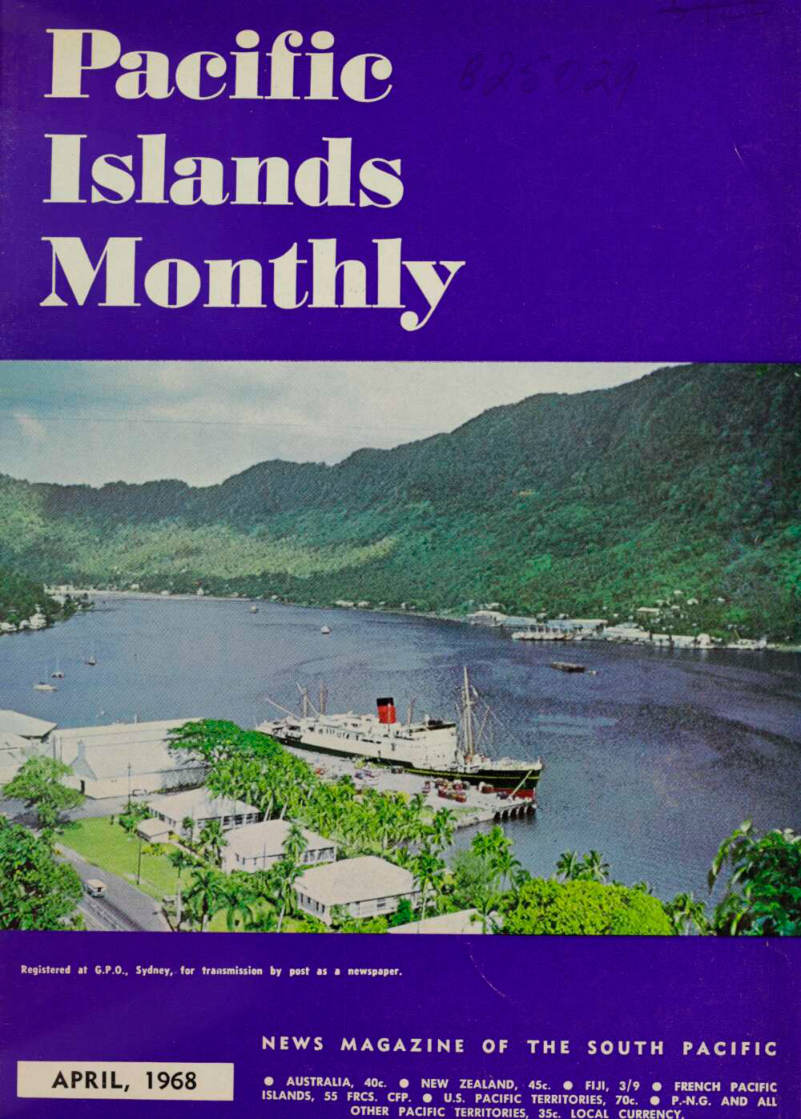 1
1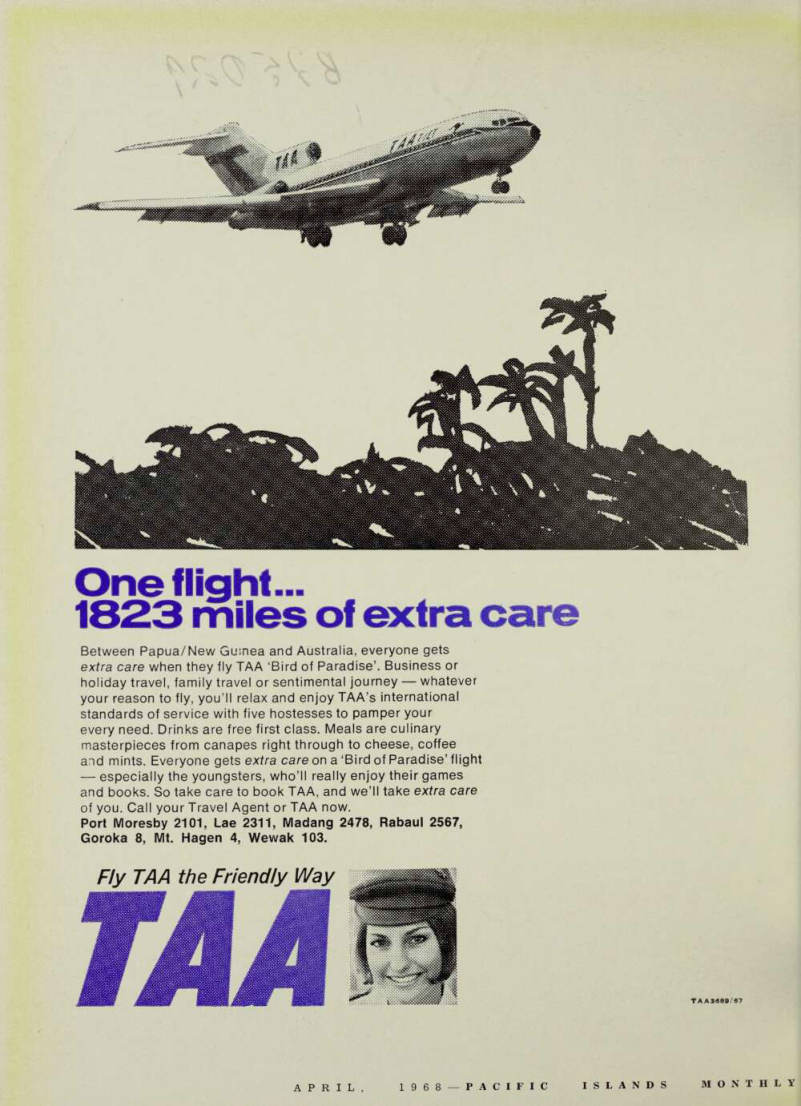 2
2 3
3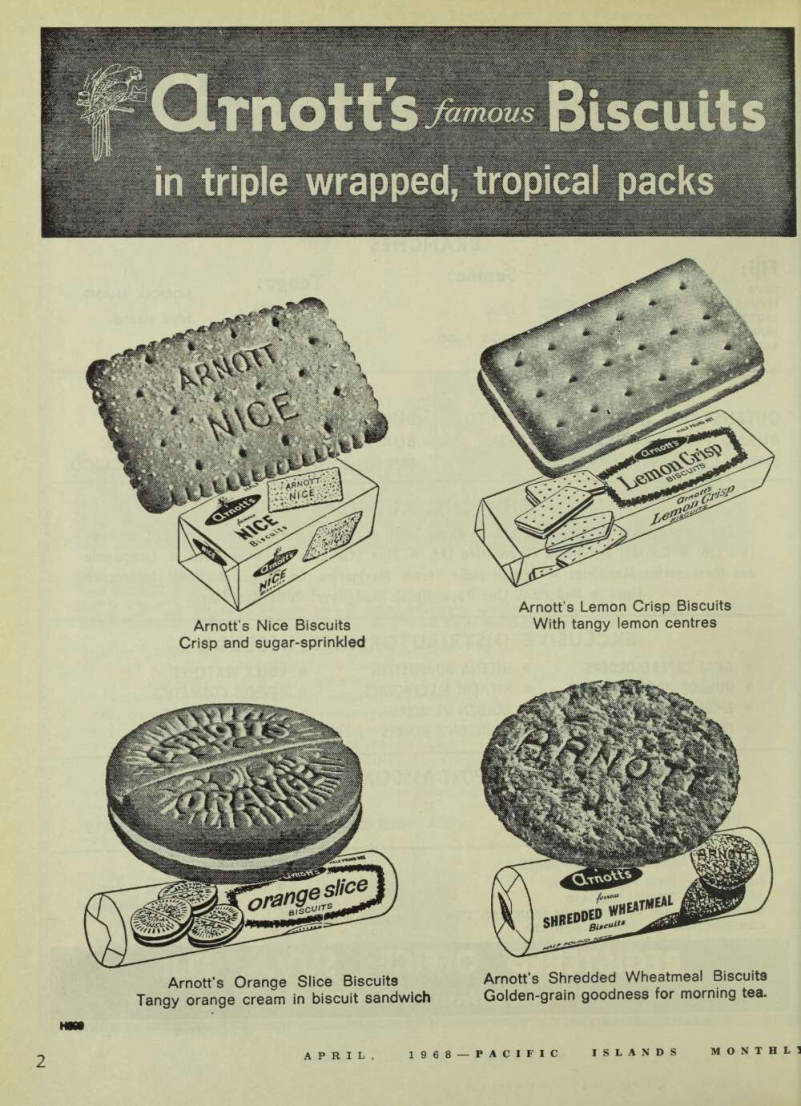 4
4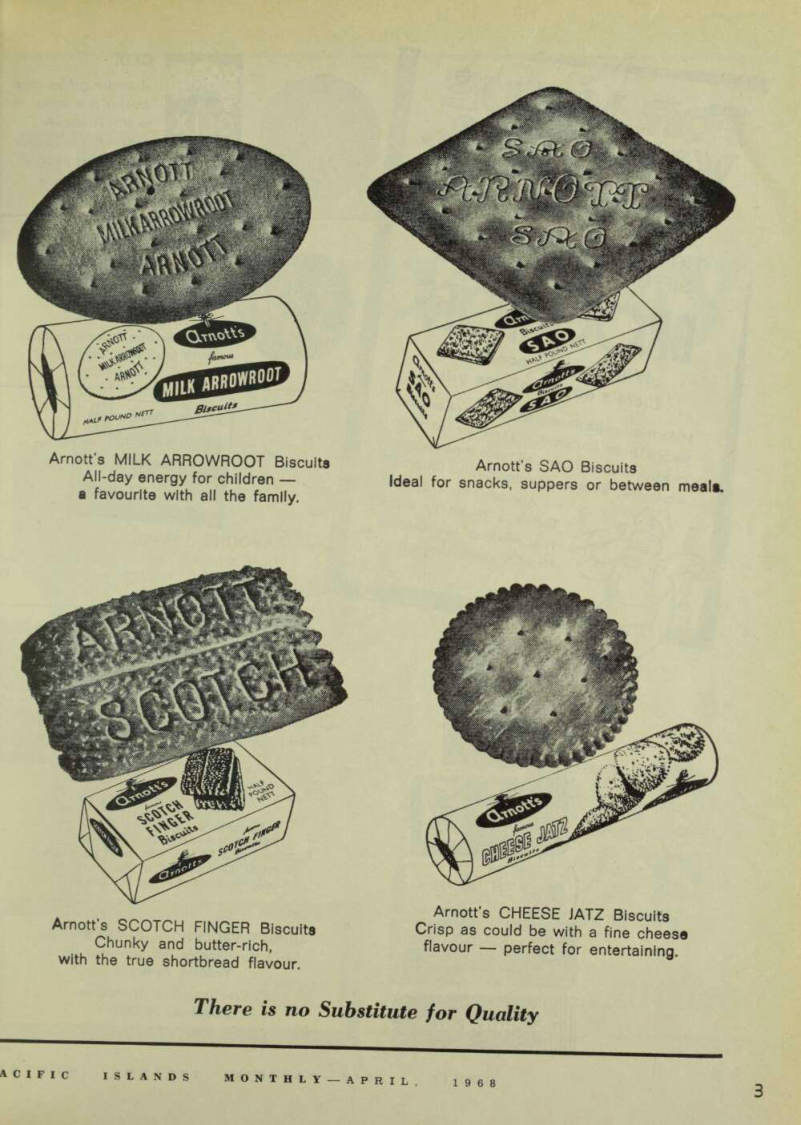 5
5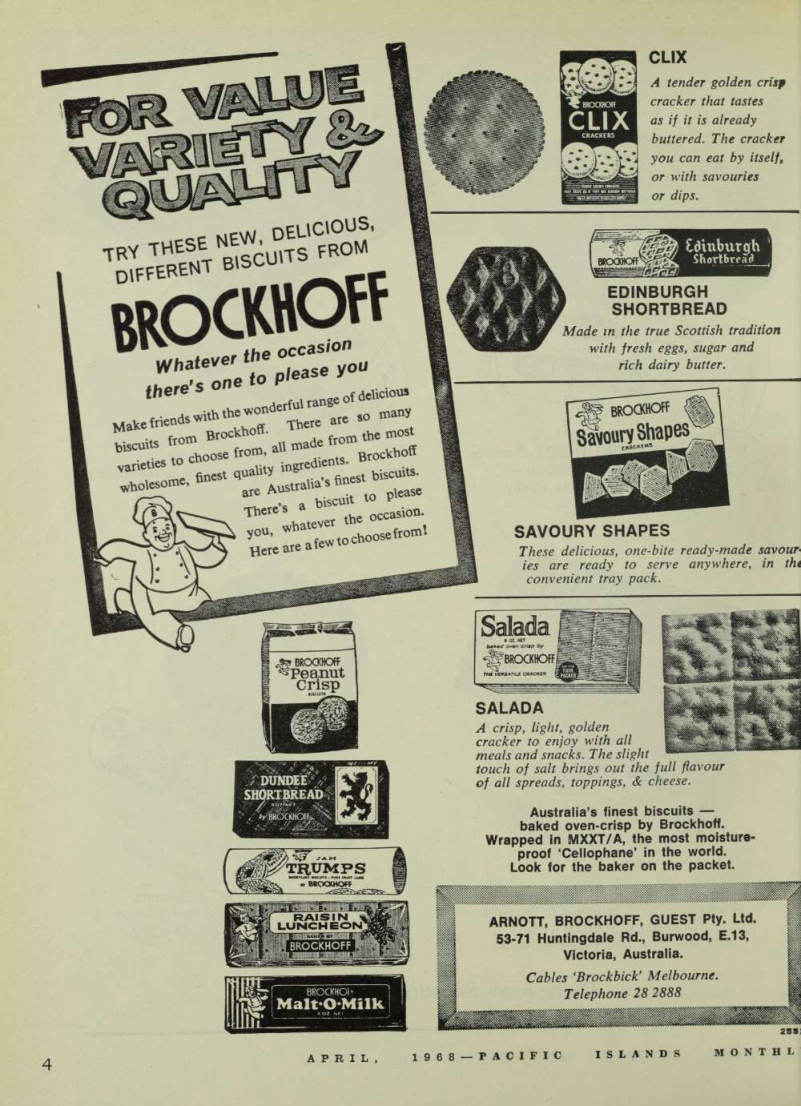 6
6 7
7 8
8 9
9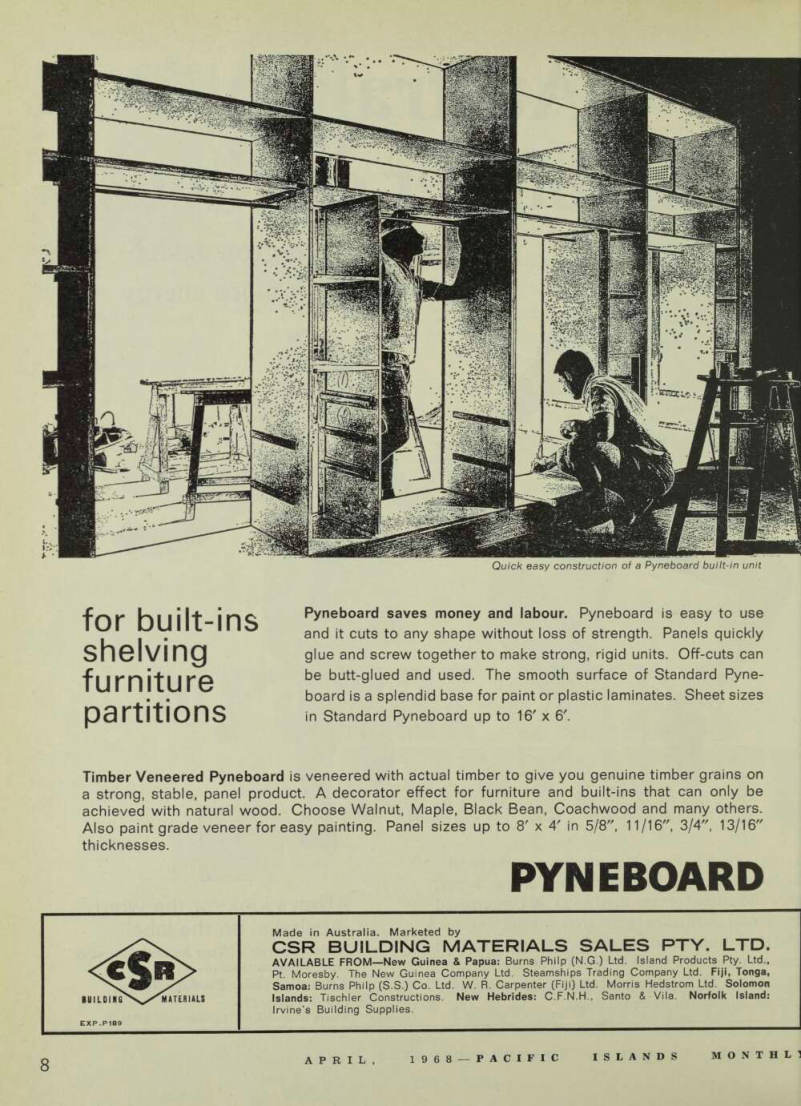 10
10 11
11 12
12 13
13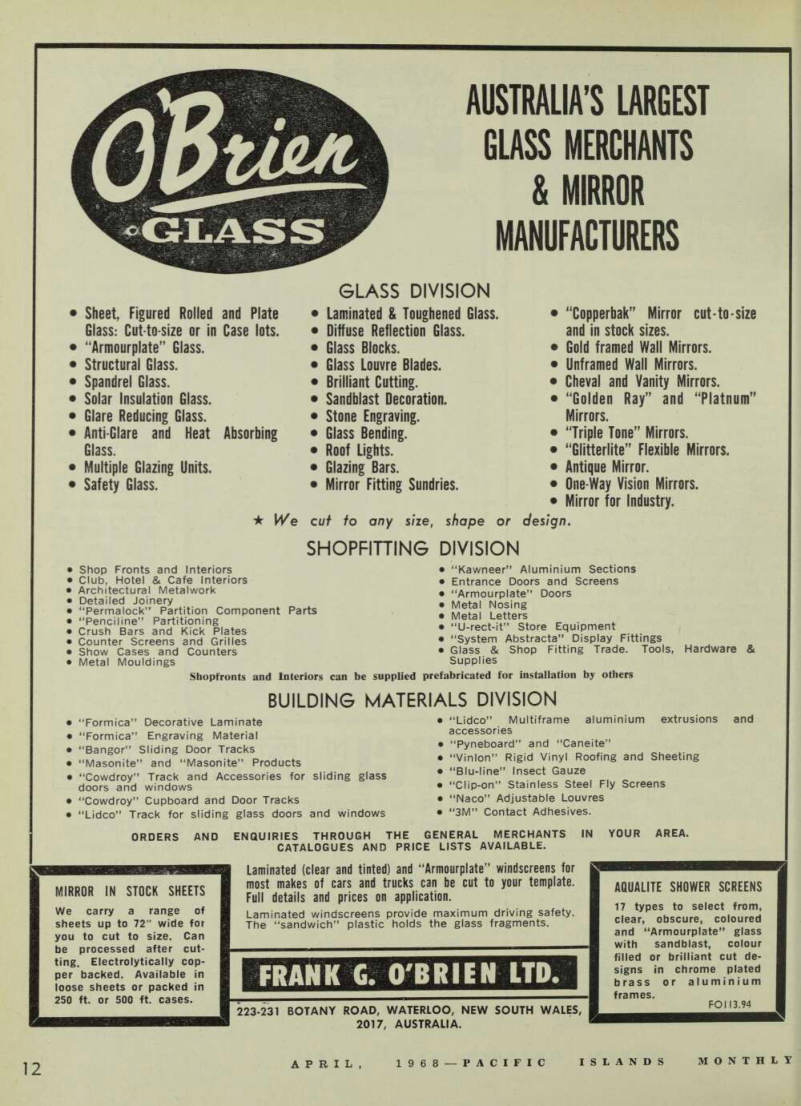 14
14 15
15 16
16 17
17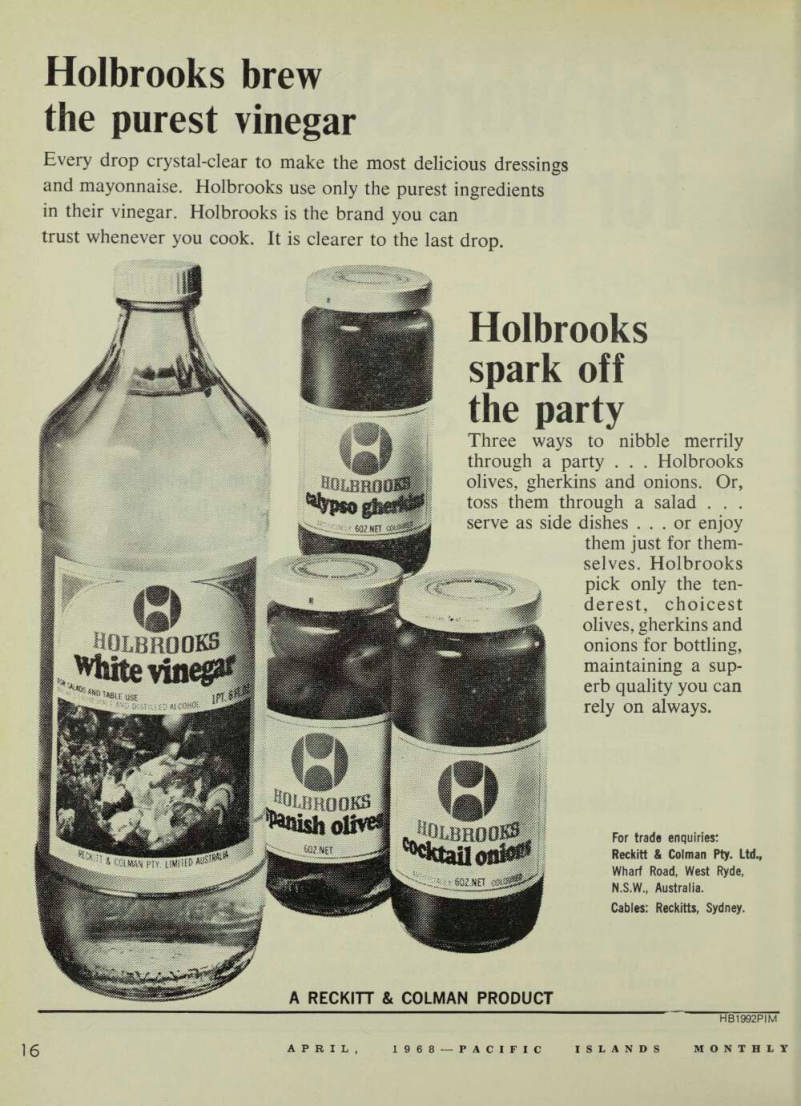 18
18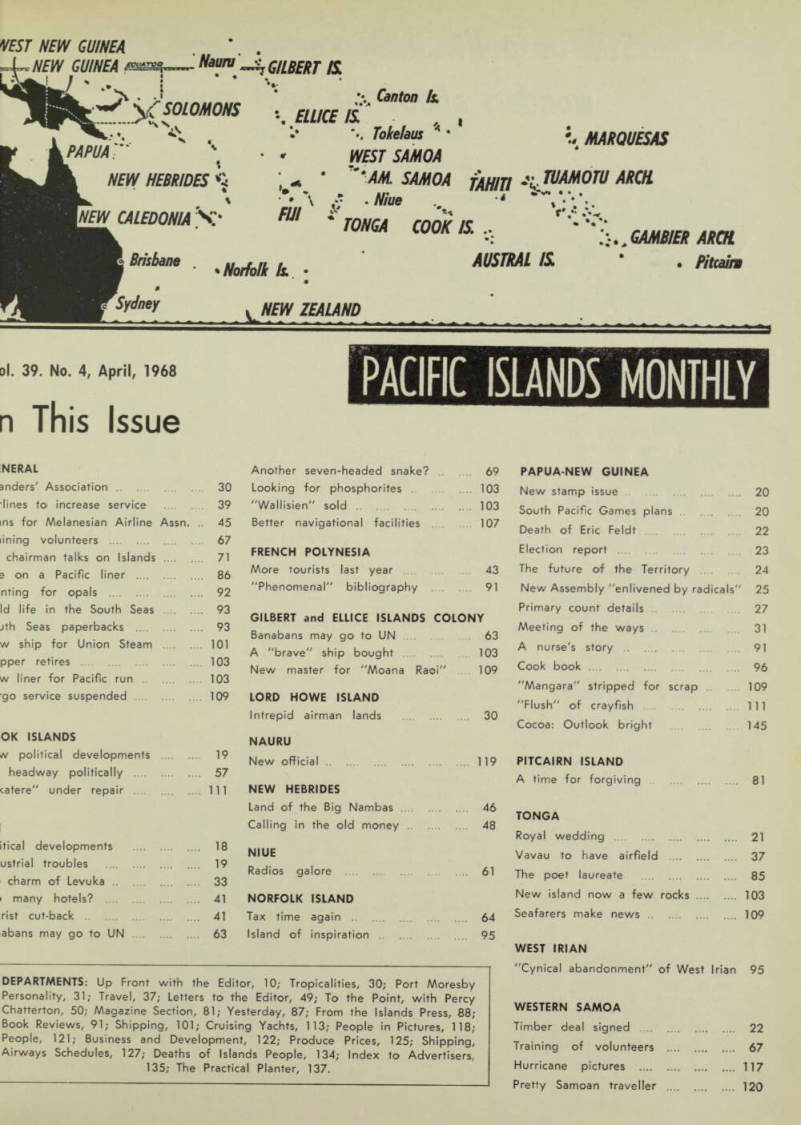 19
19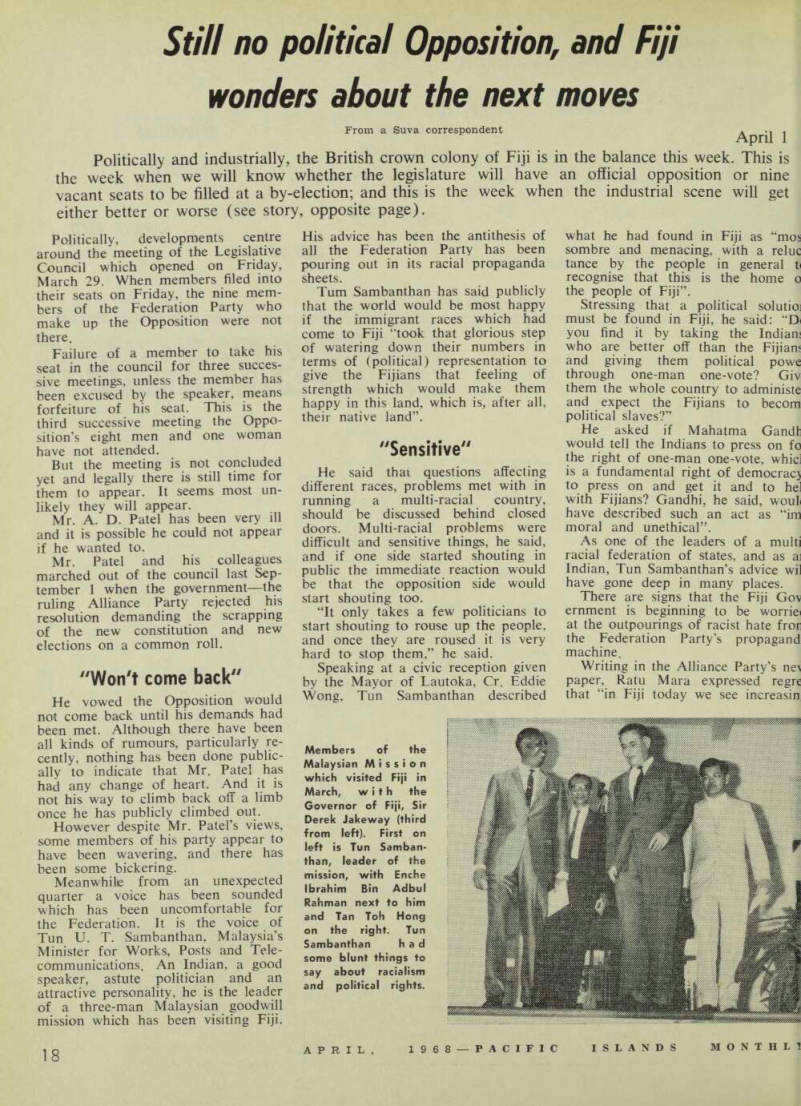 20
20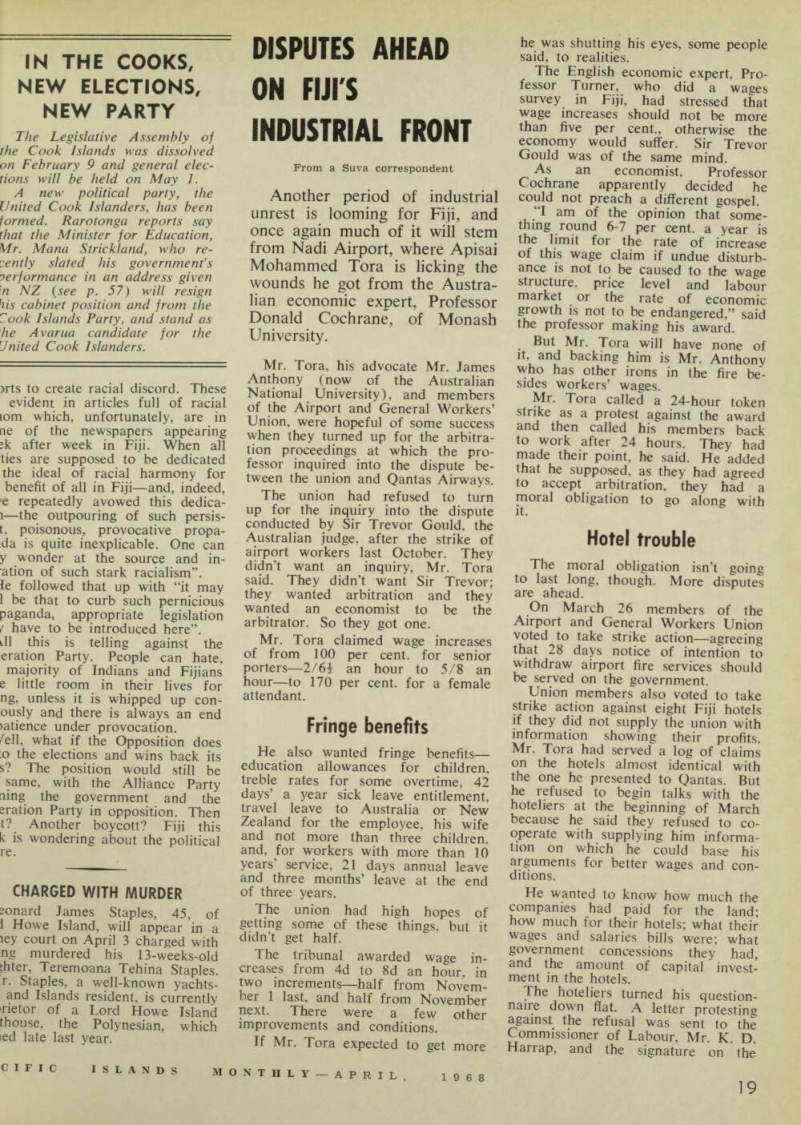 21
21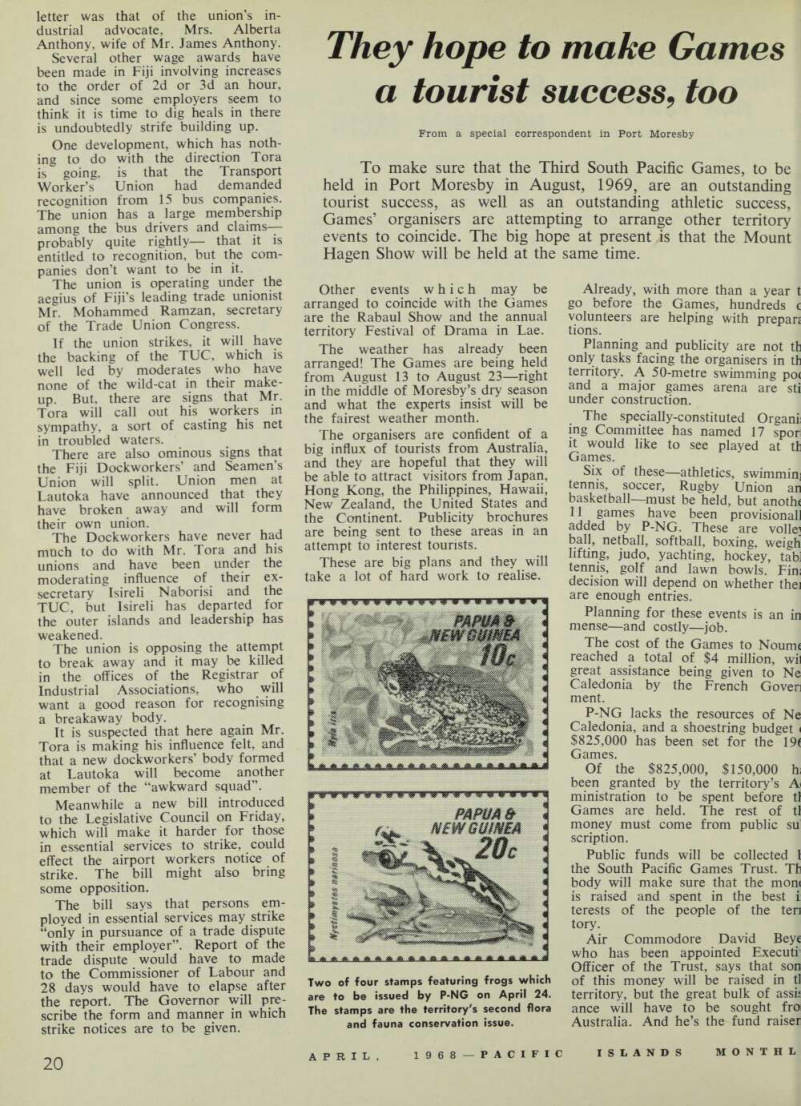 22
22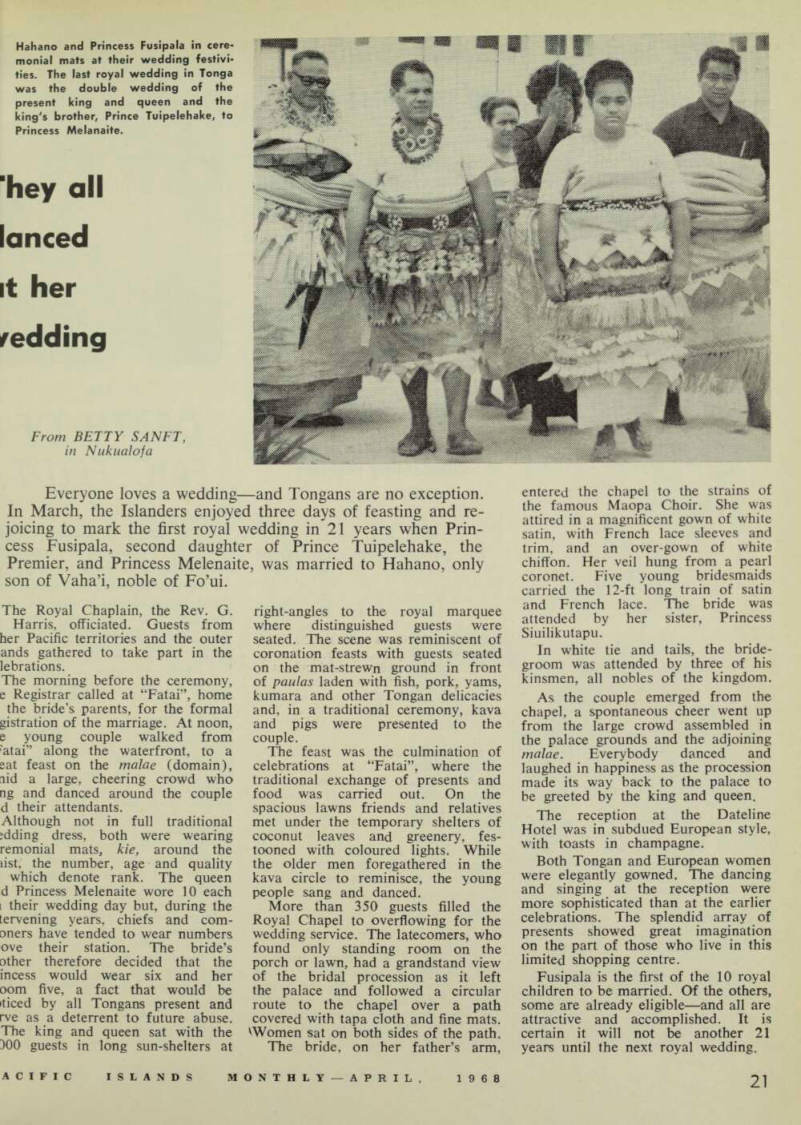 23
23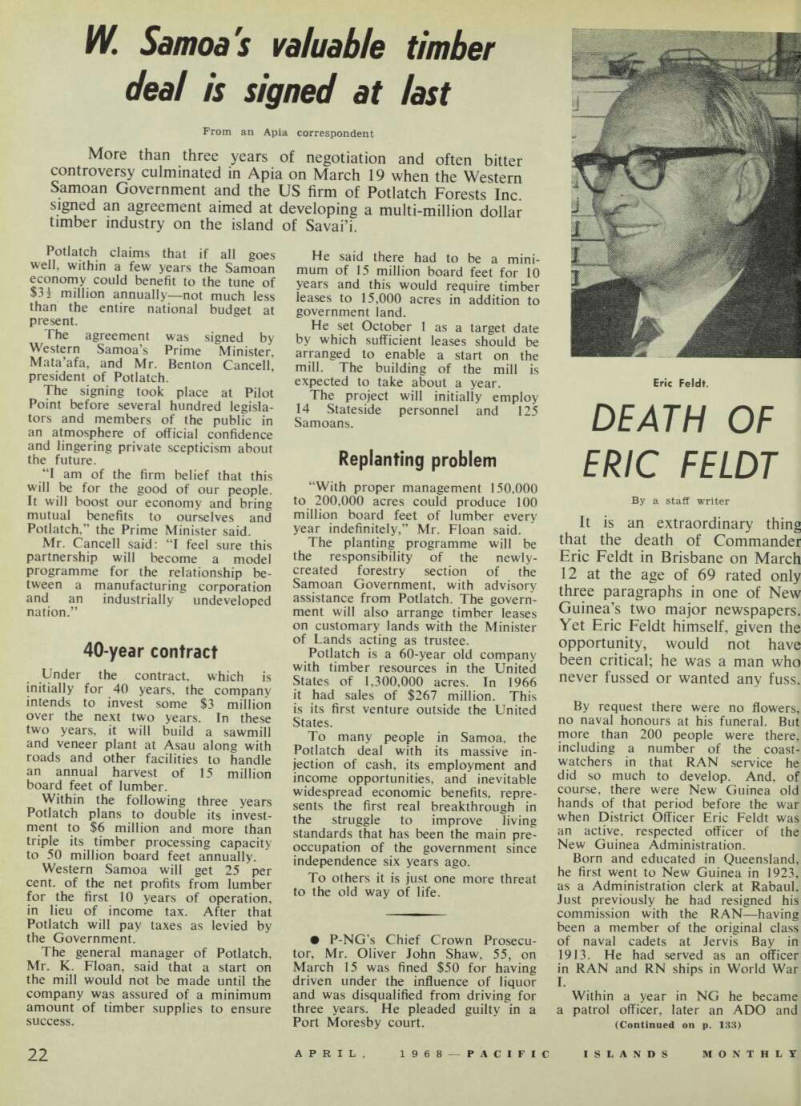 24
24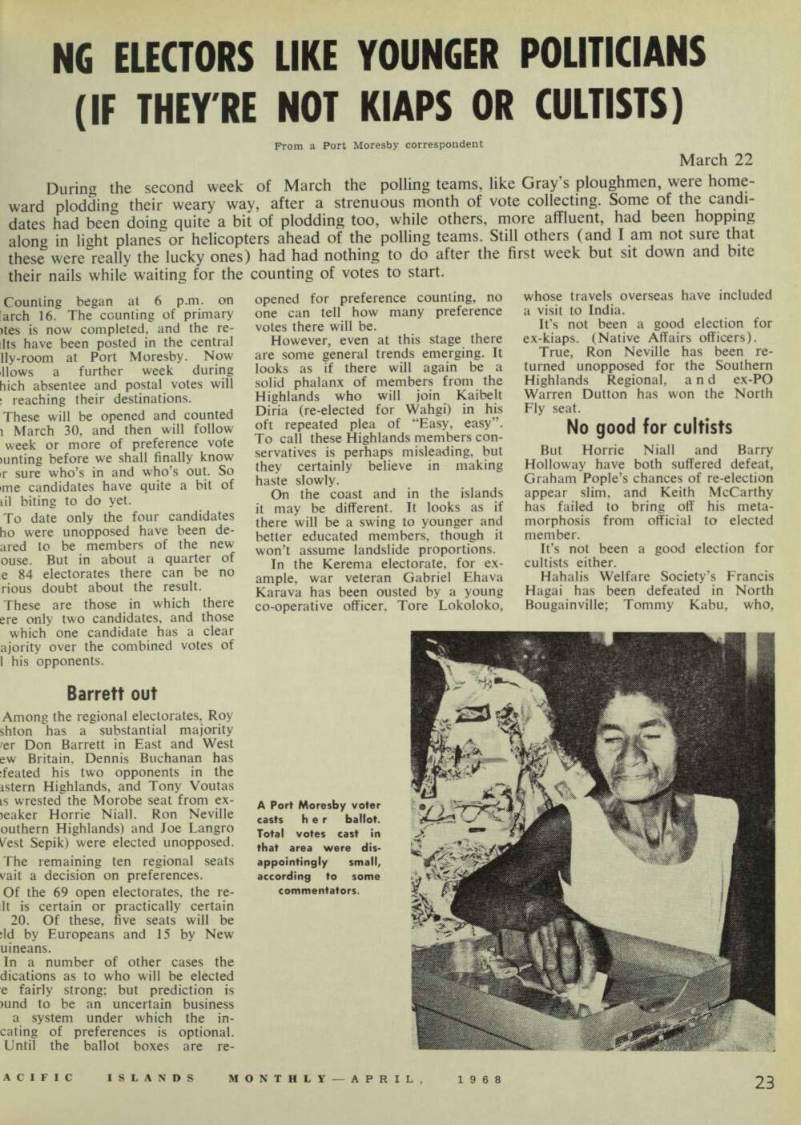 25
25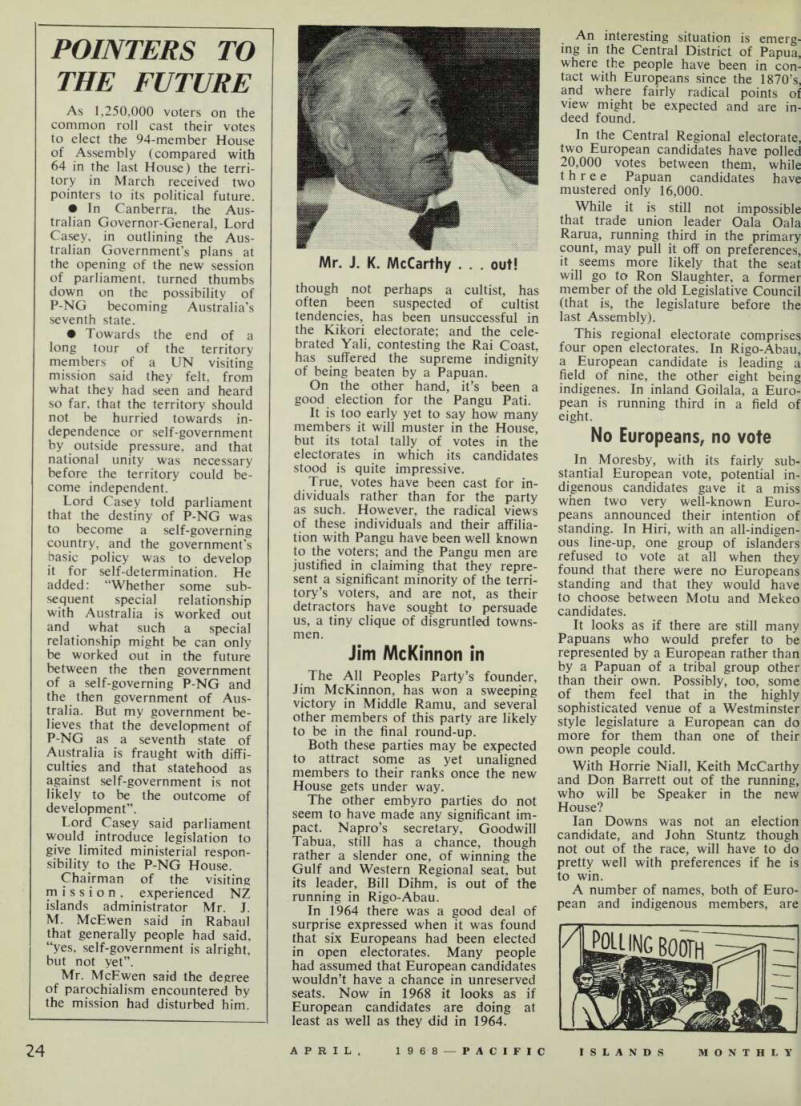 26
26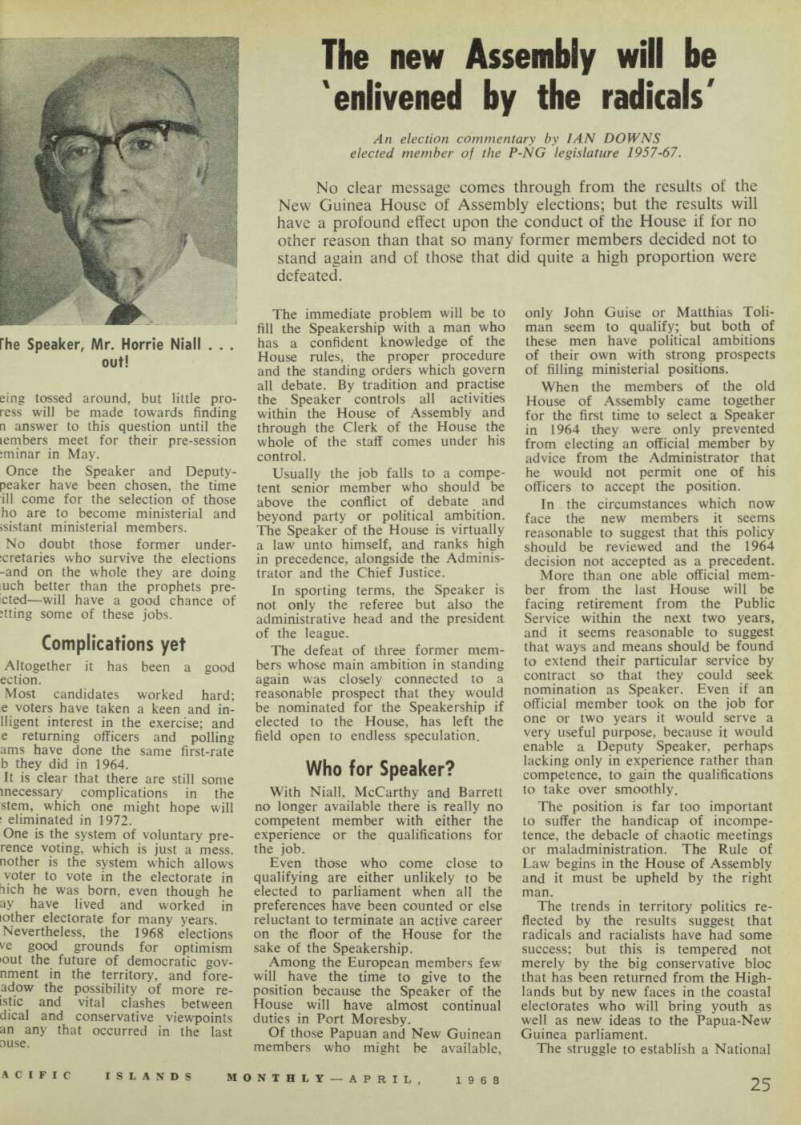 27
27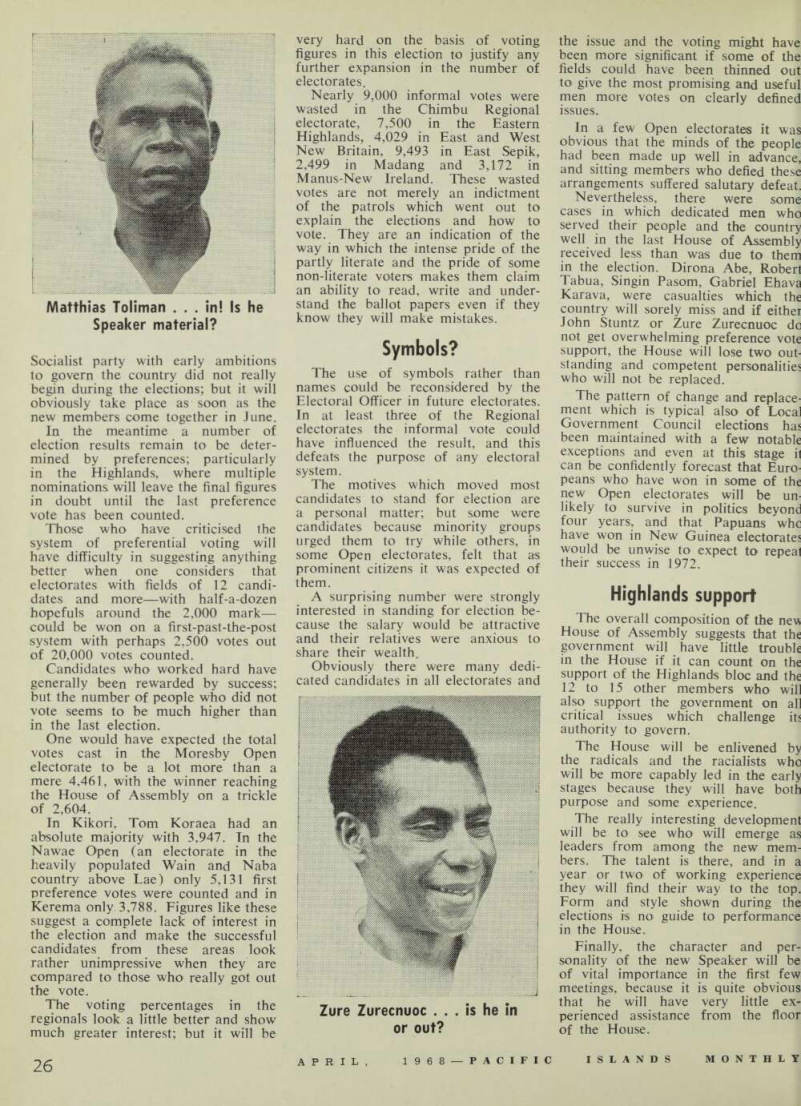 28
28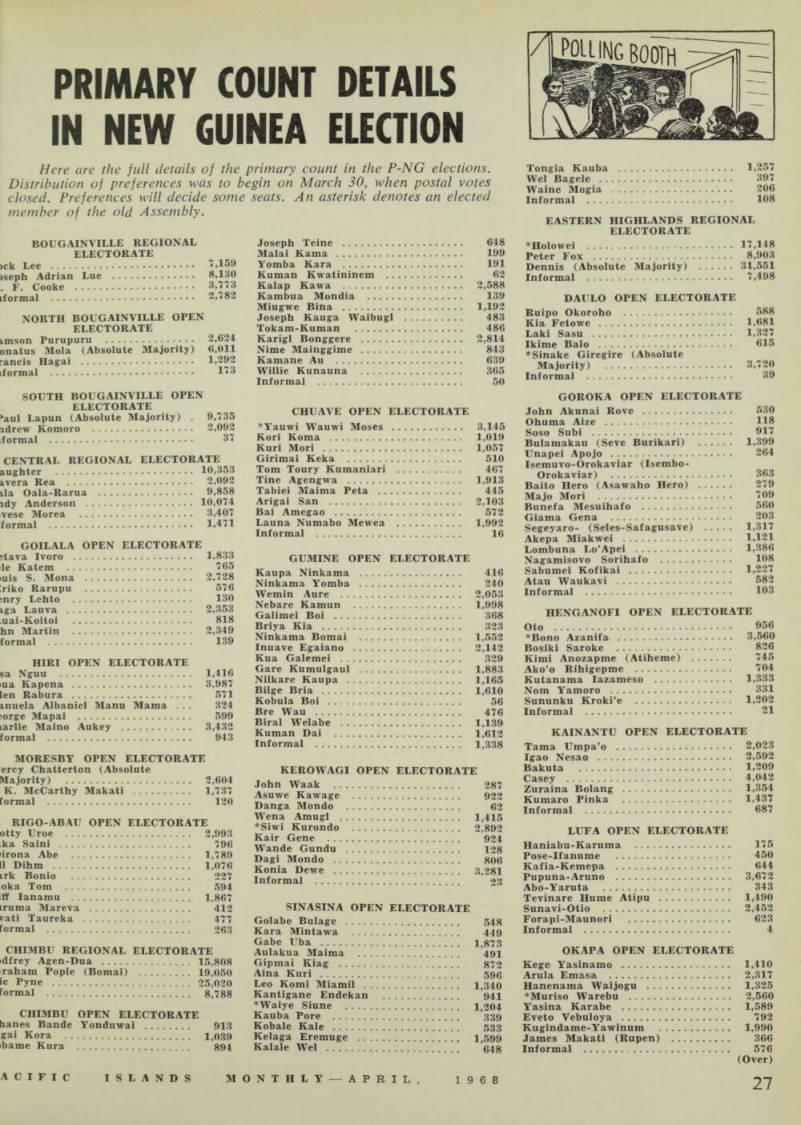 29
29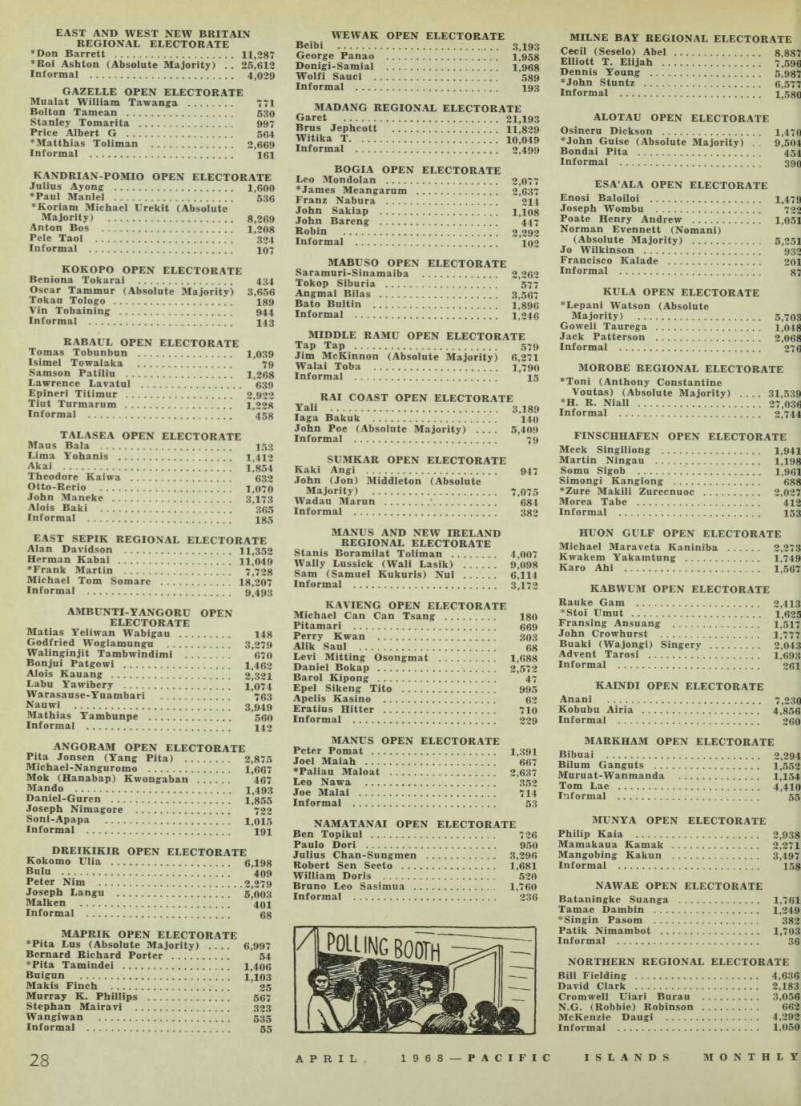 30
30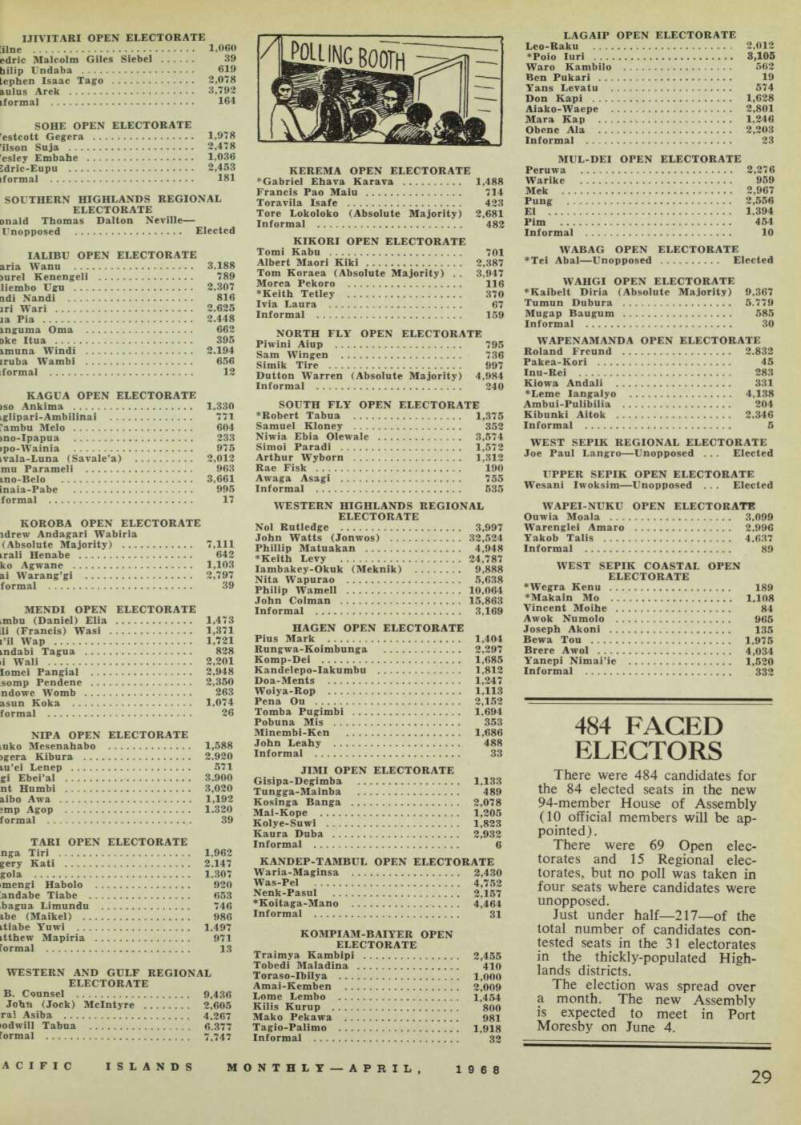 31
31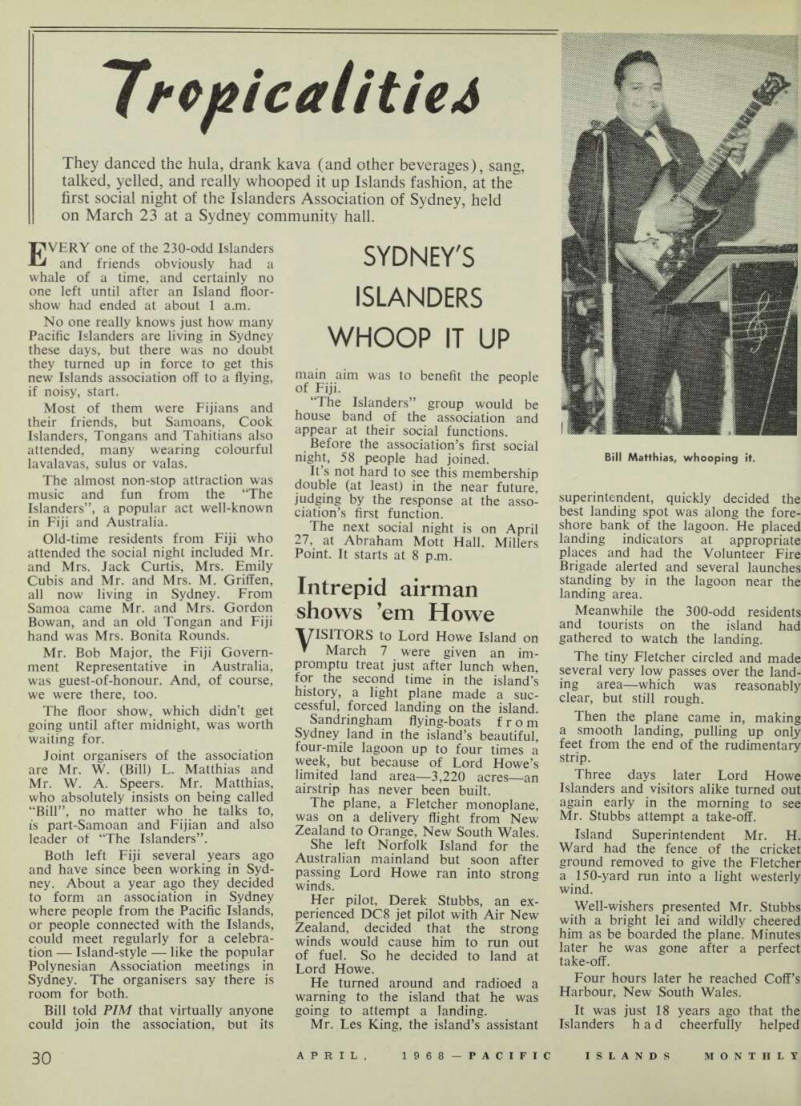 32
32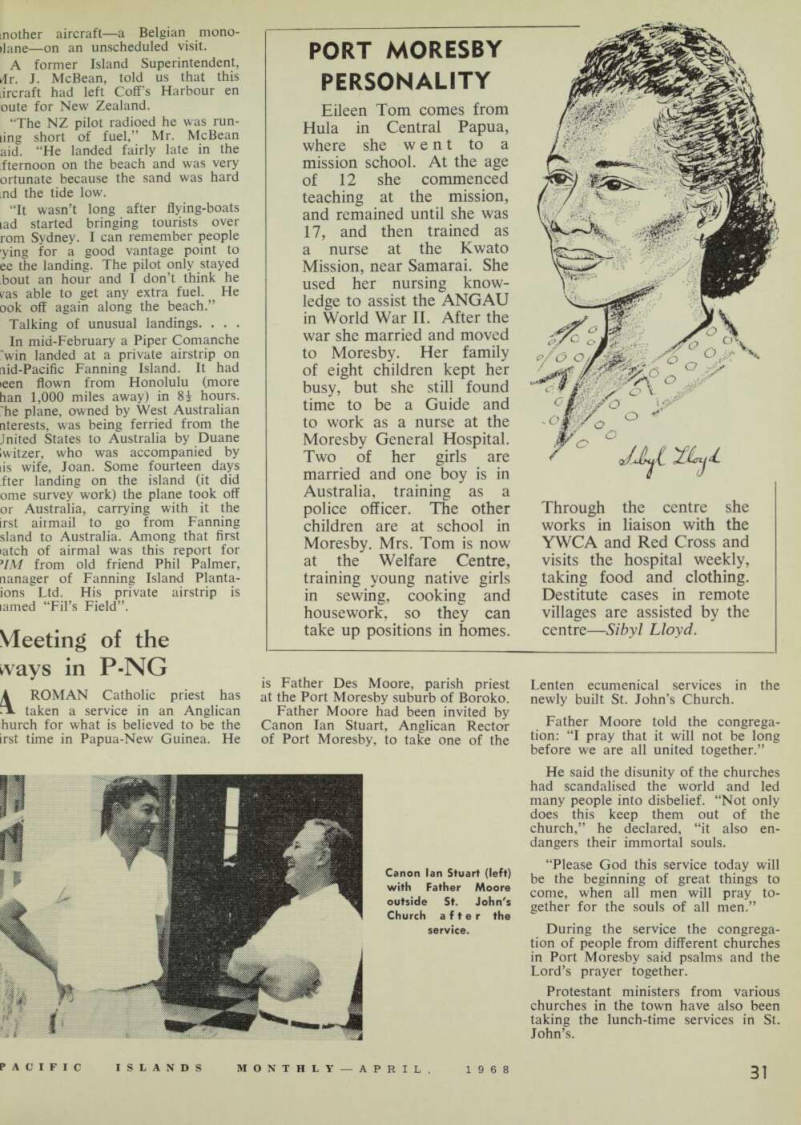 33
33 34
34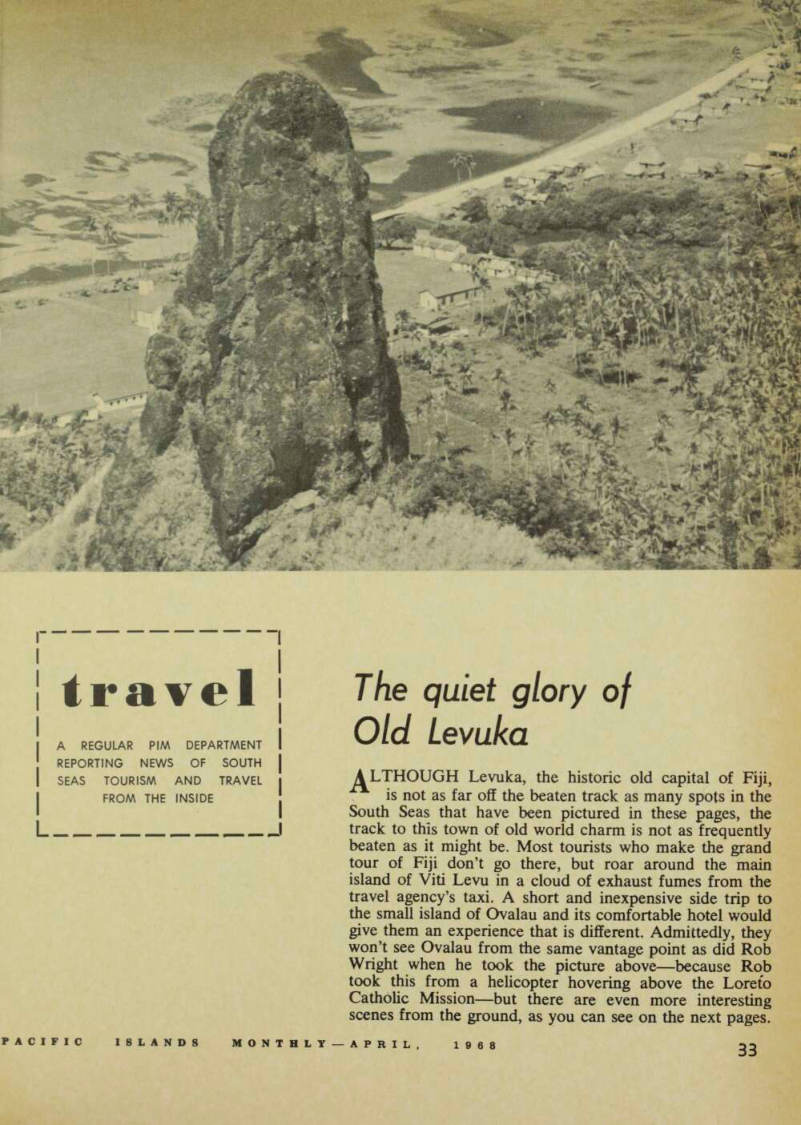 35
35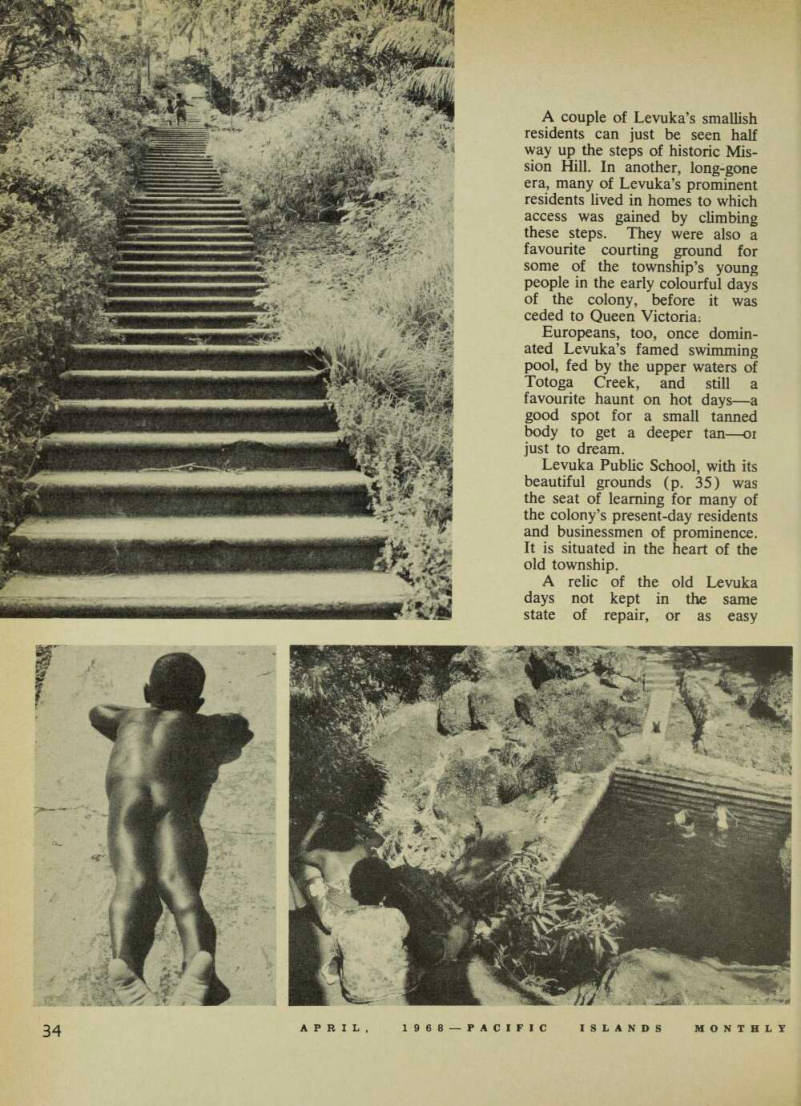 36
36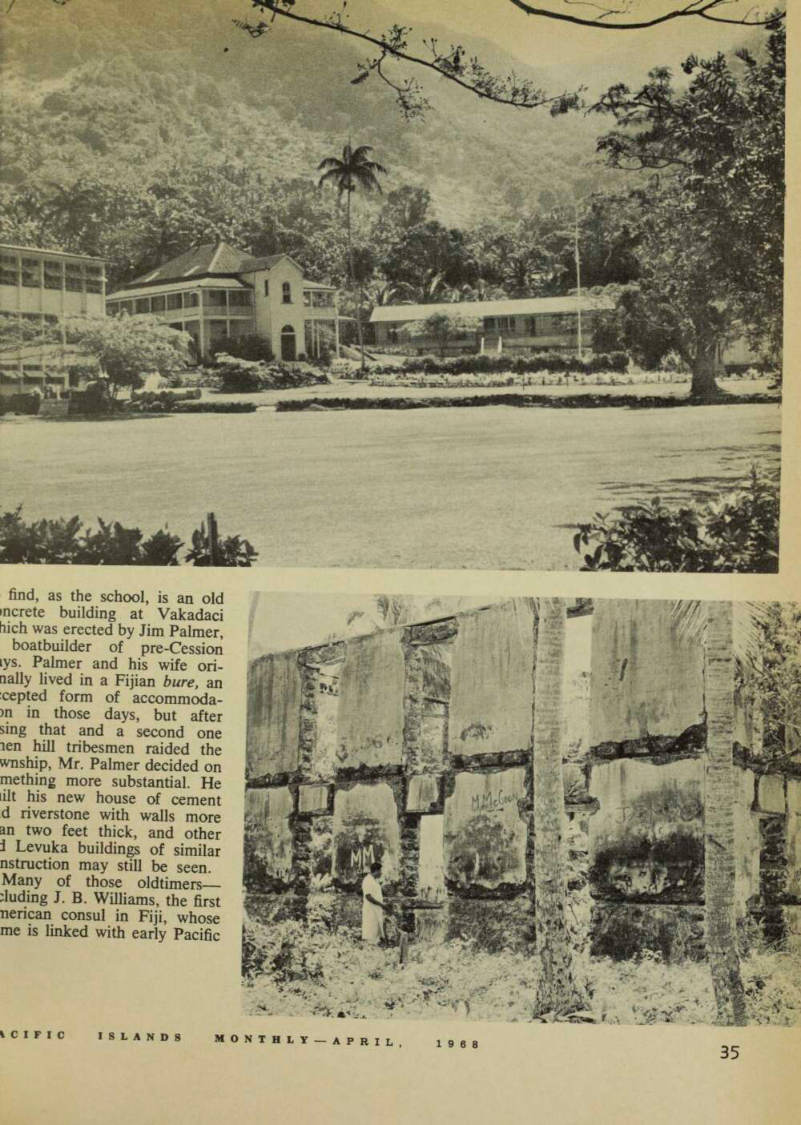 37
37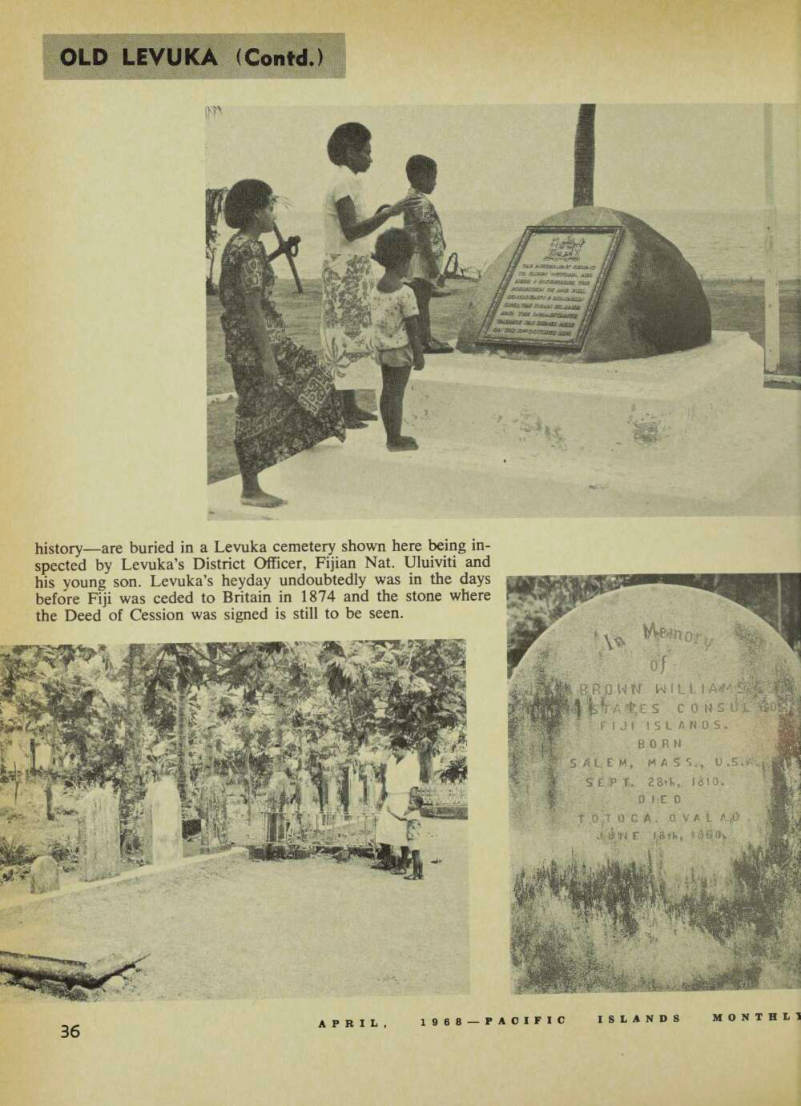 38
38 39
39 40
40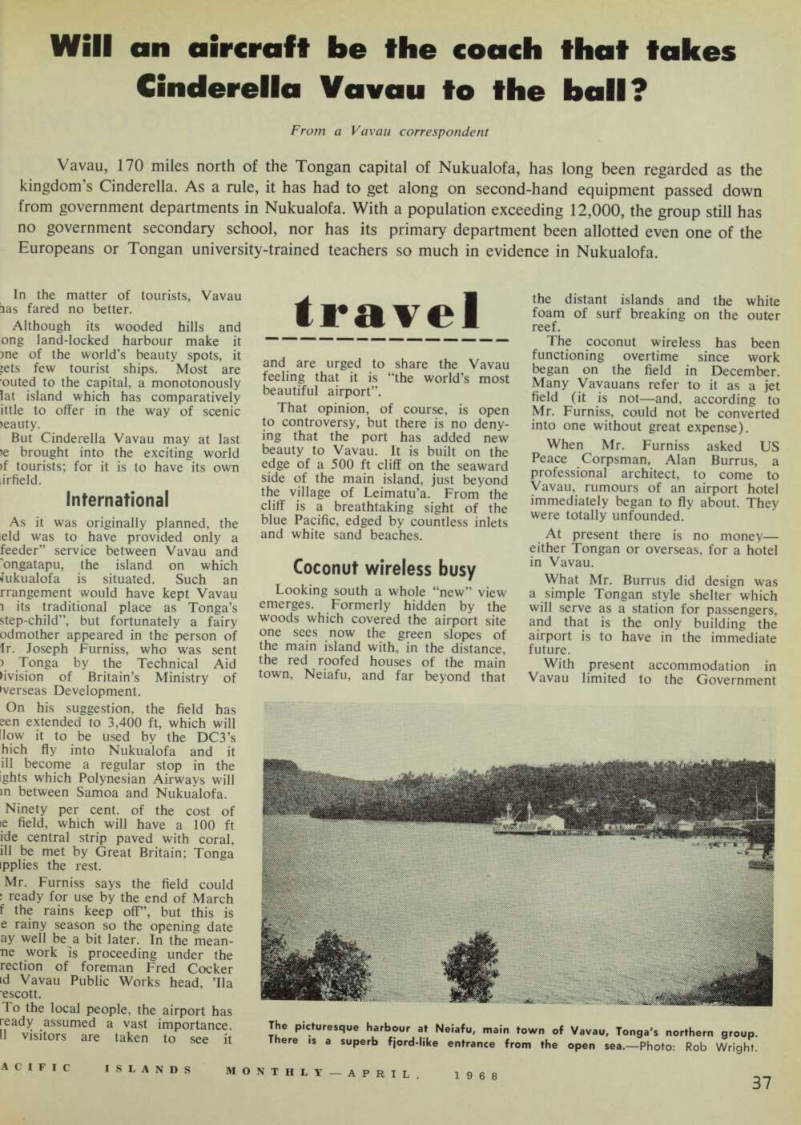 41
41 42
42 43
43 44
44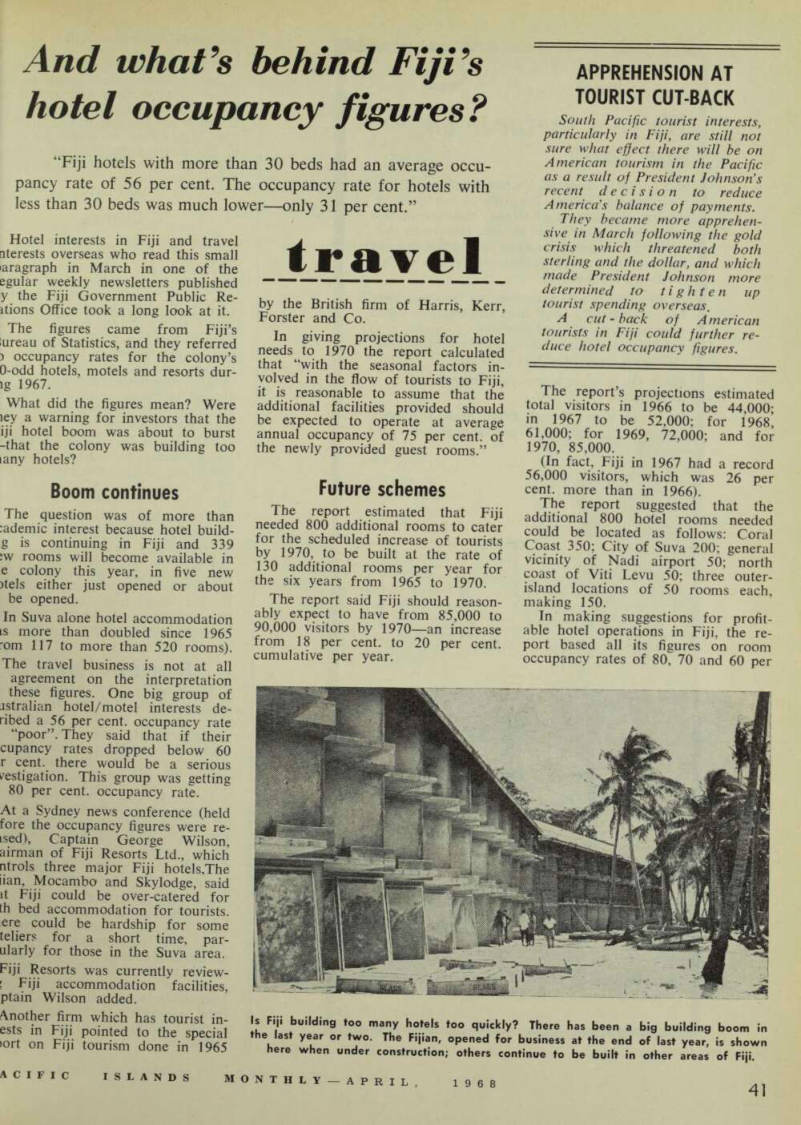 45
45 46
46 47
47 48
48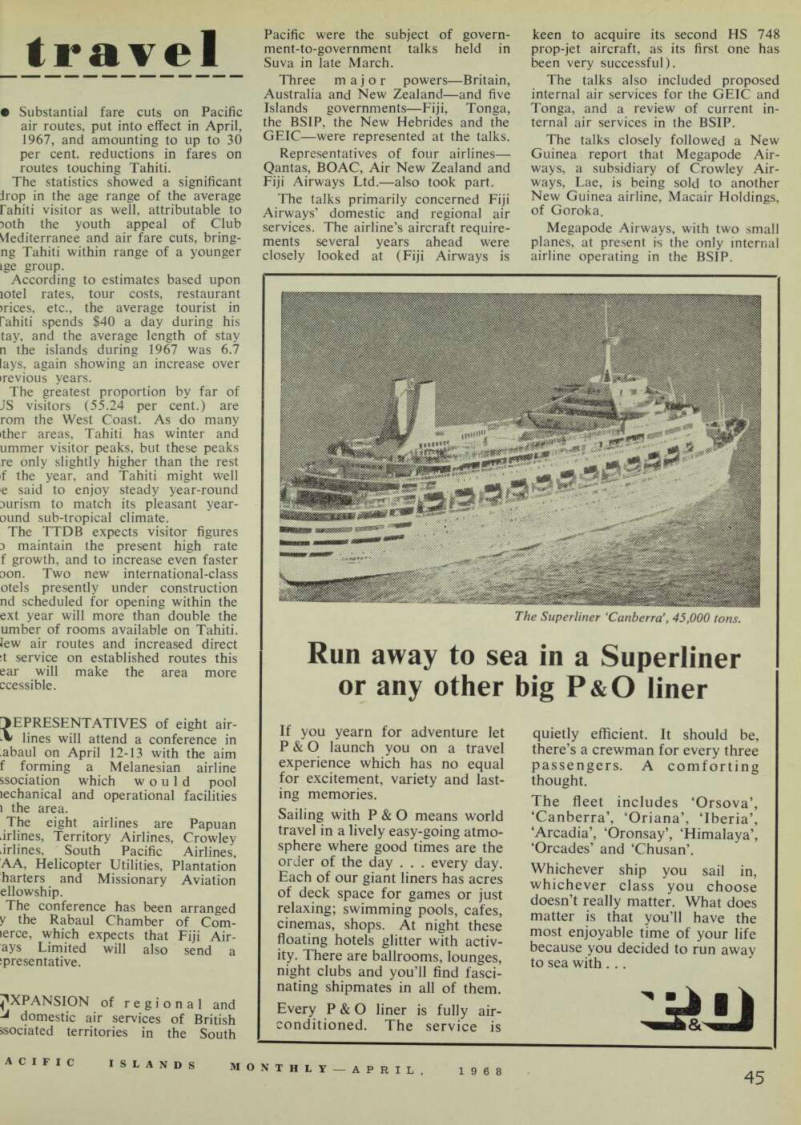 49
49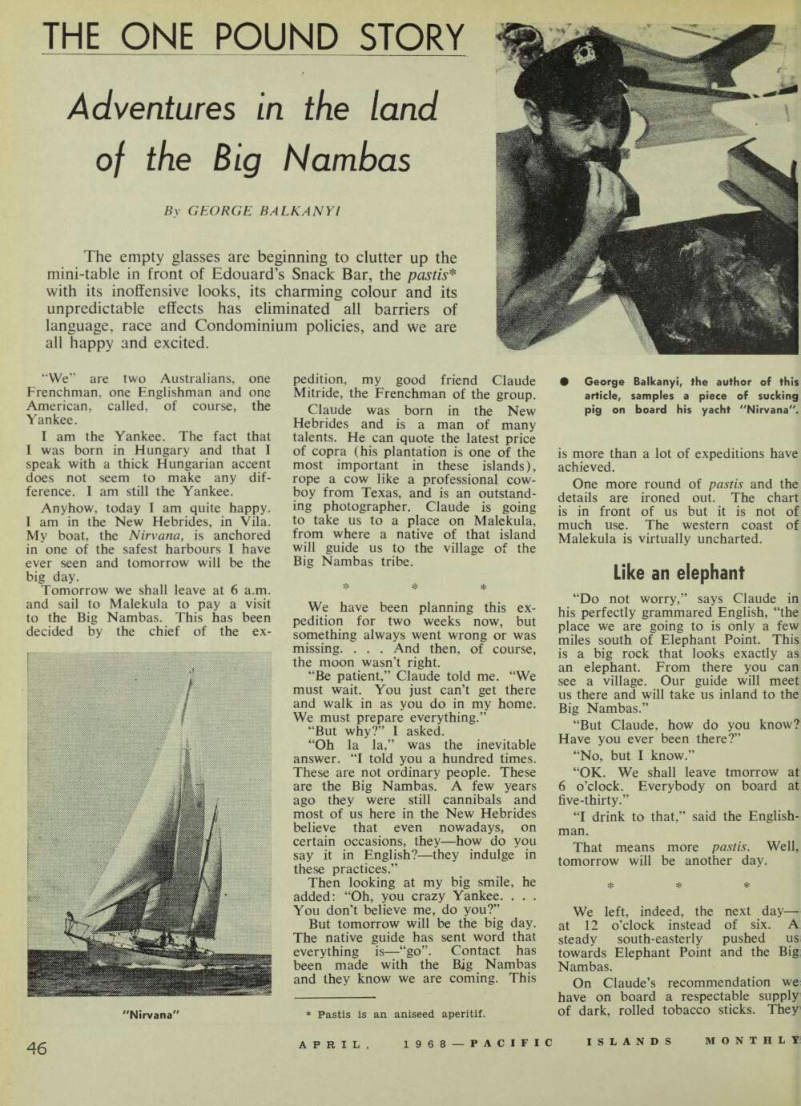 50
50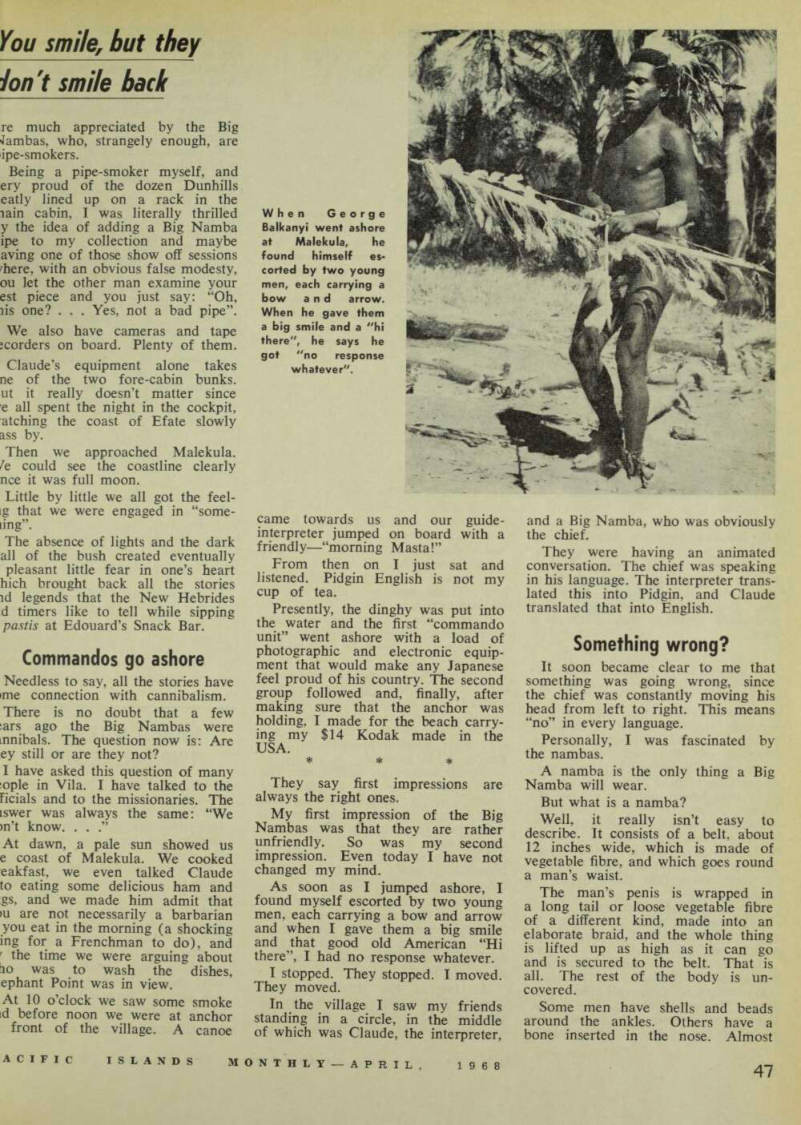 51
51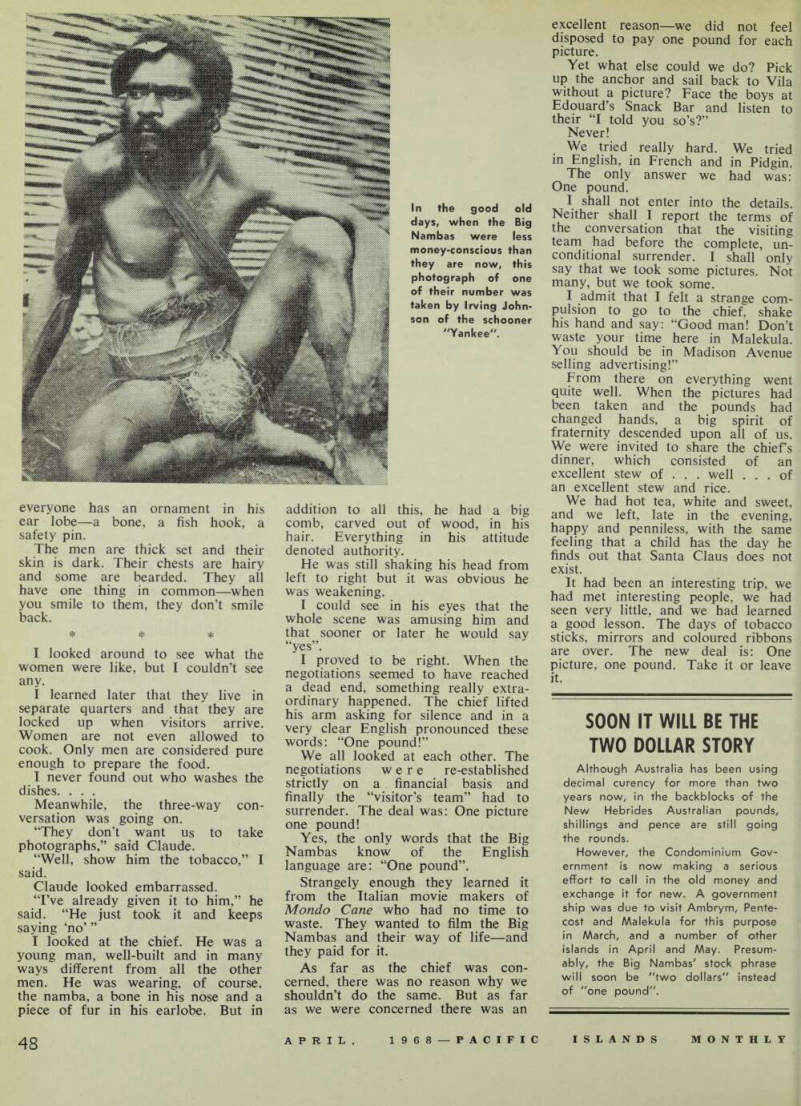 52
52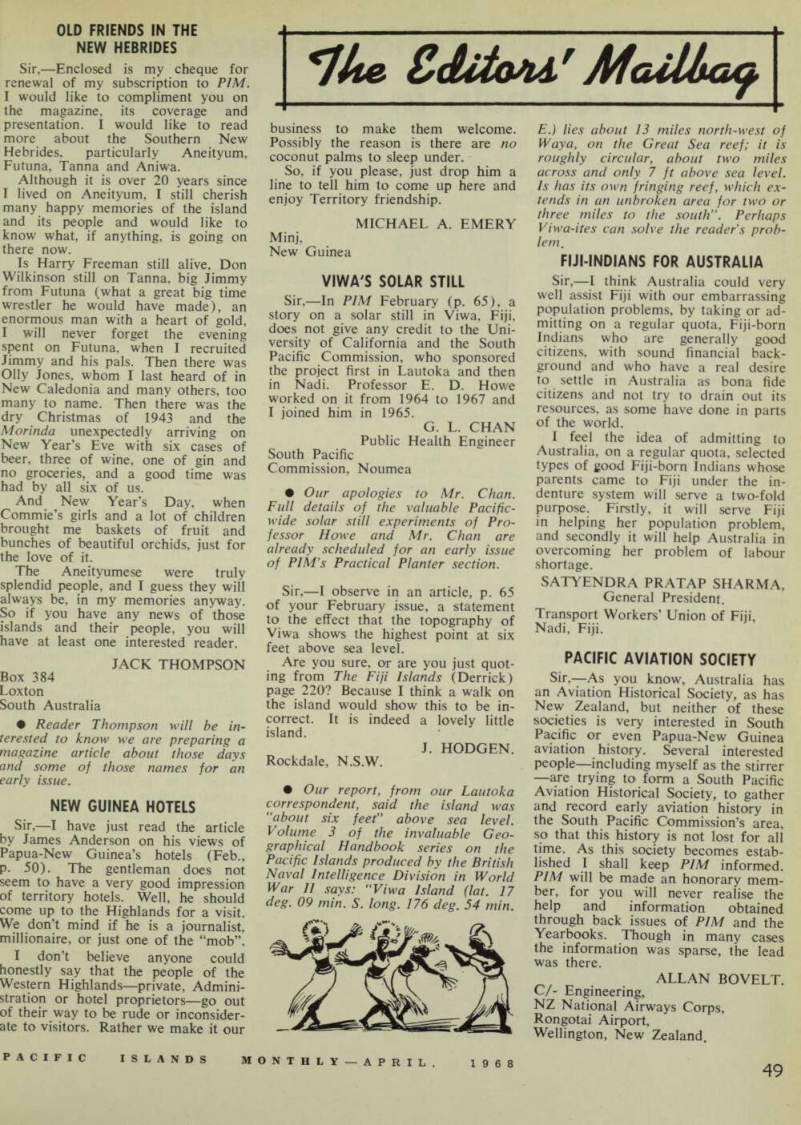 53
53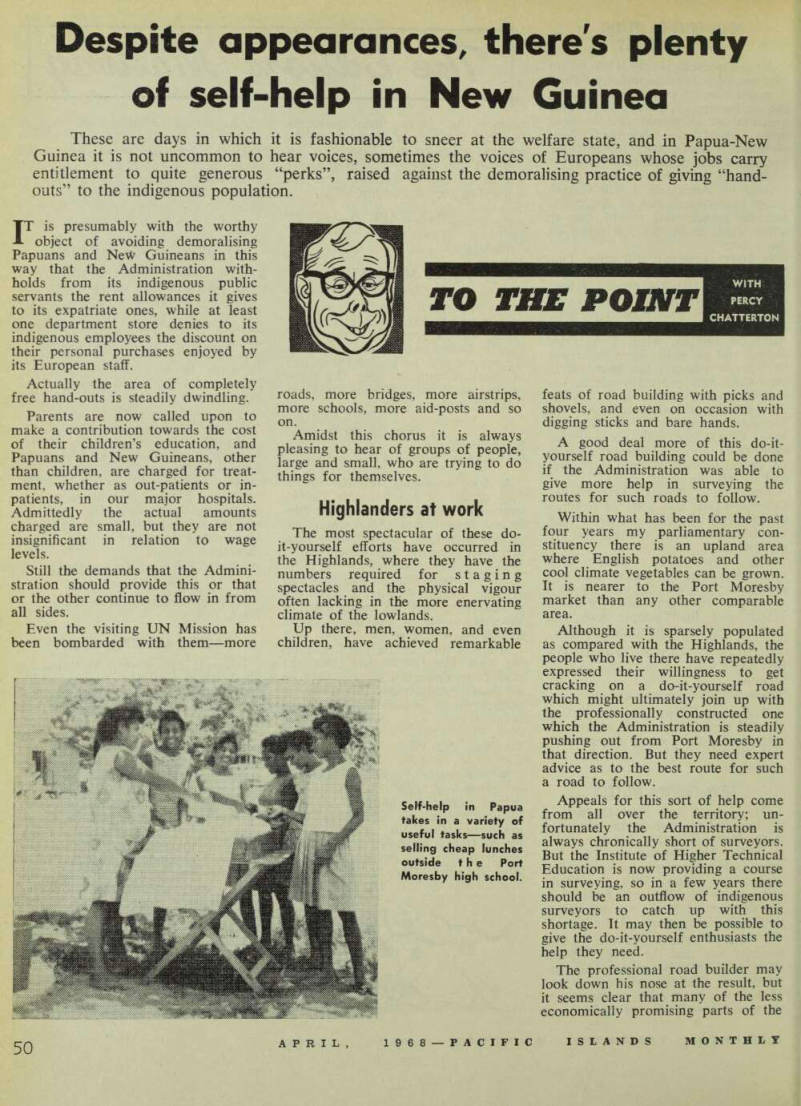 54
54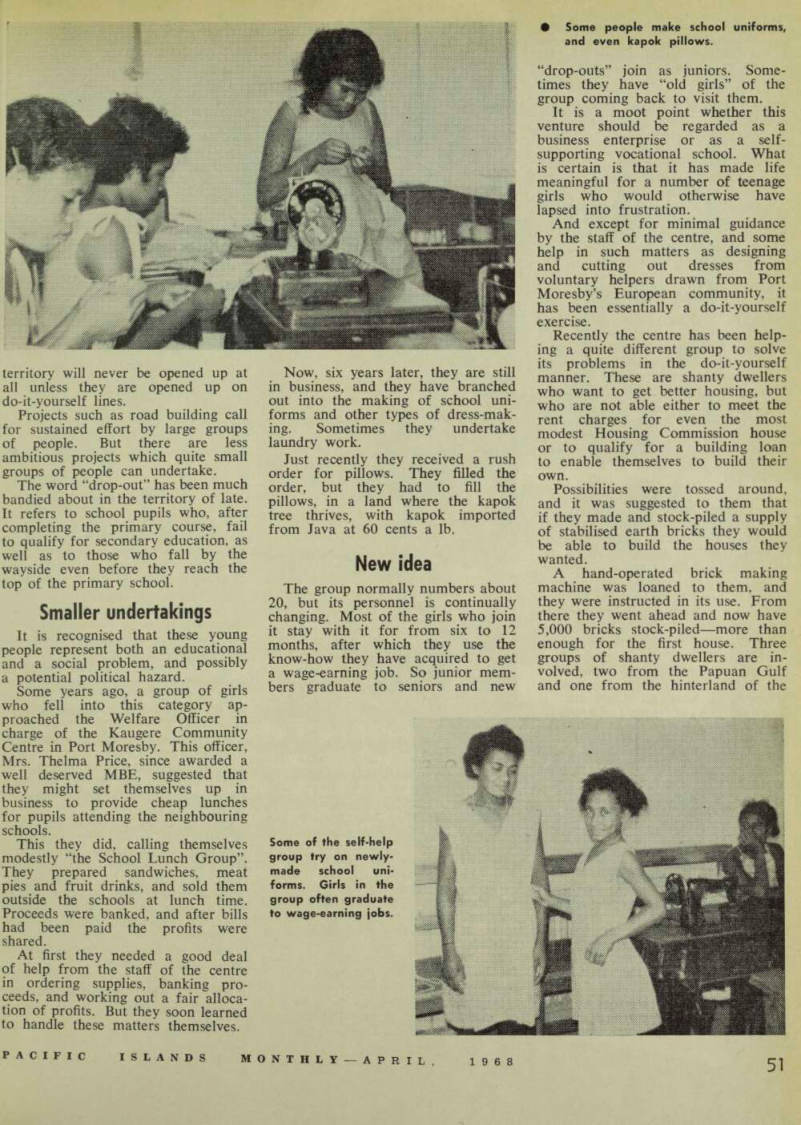 55
55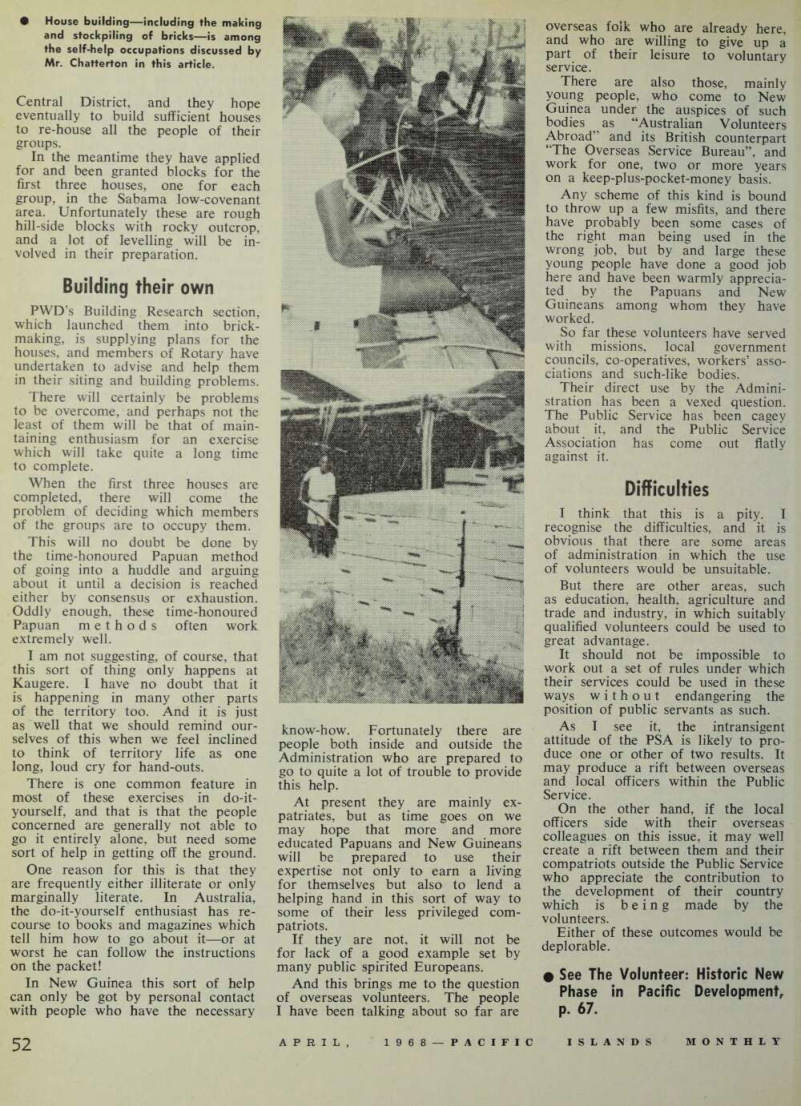 56
56 57
57 58
58 59
59 60
60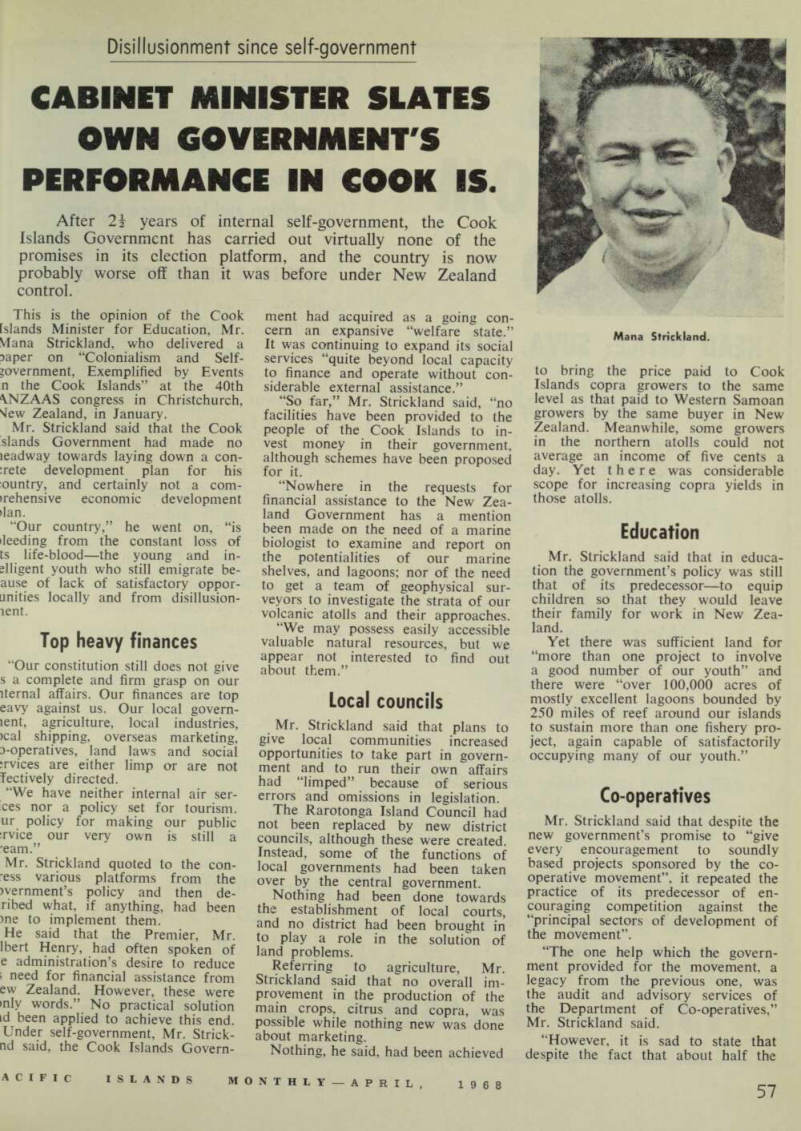 61
61 62
62 63
63 64
64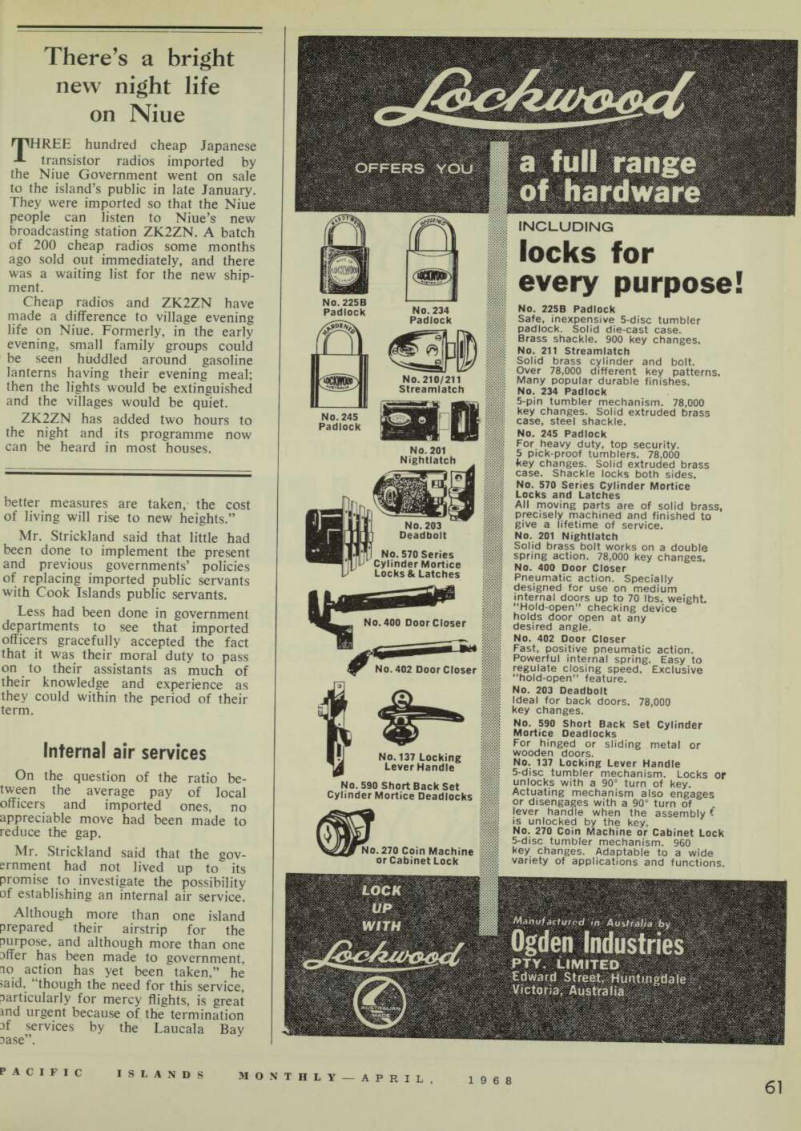 65
65 66
66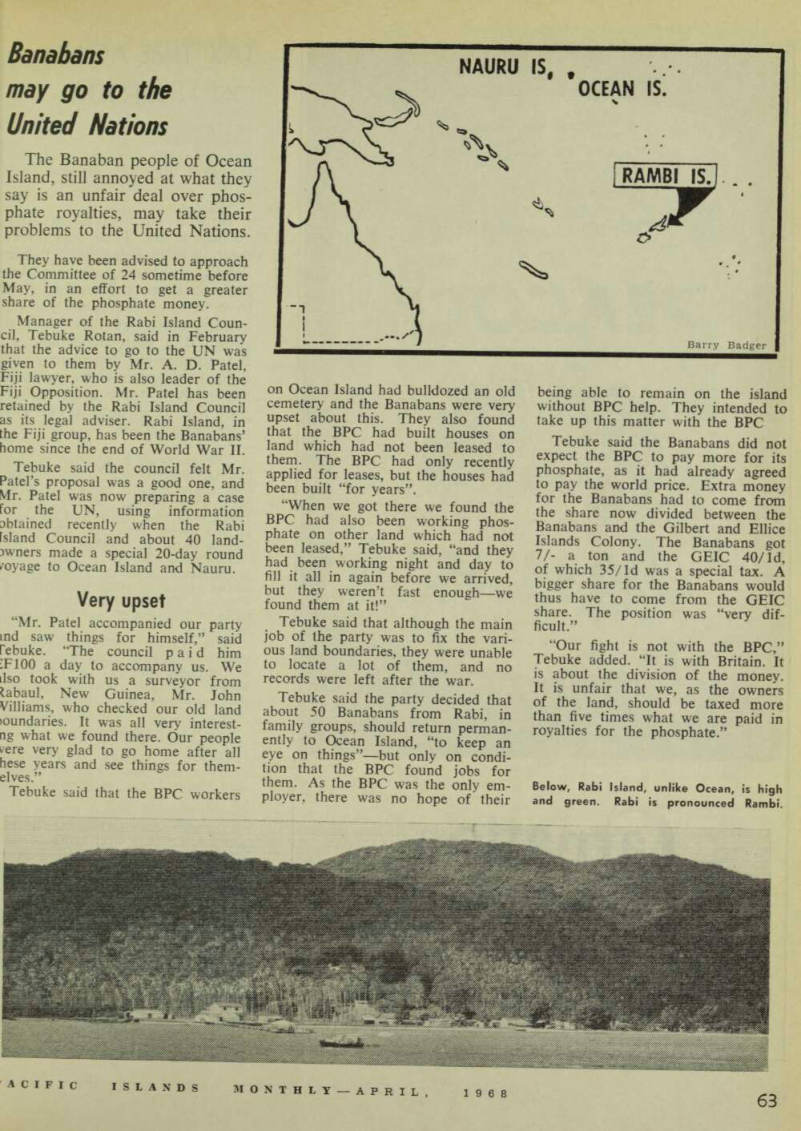 67
67 68
68 69
69 70
70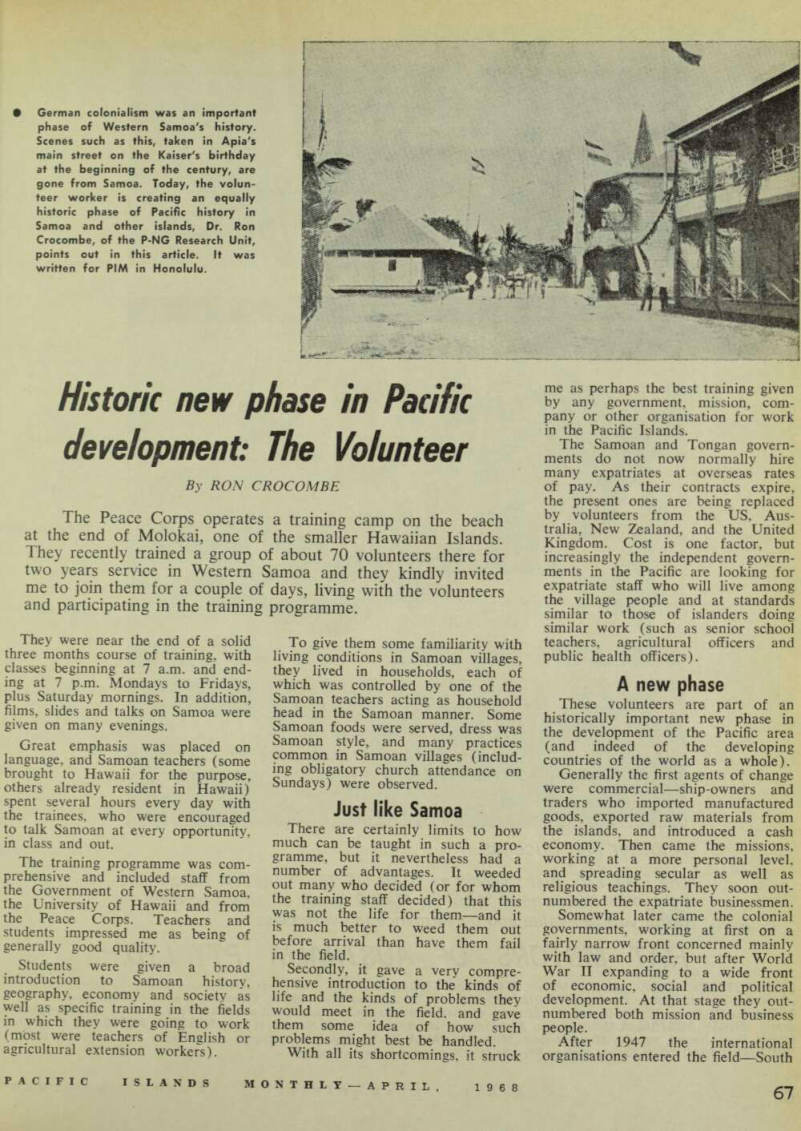 71
71 72
72 73
73 74
74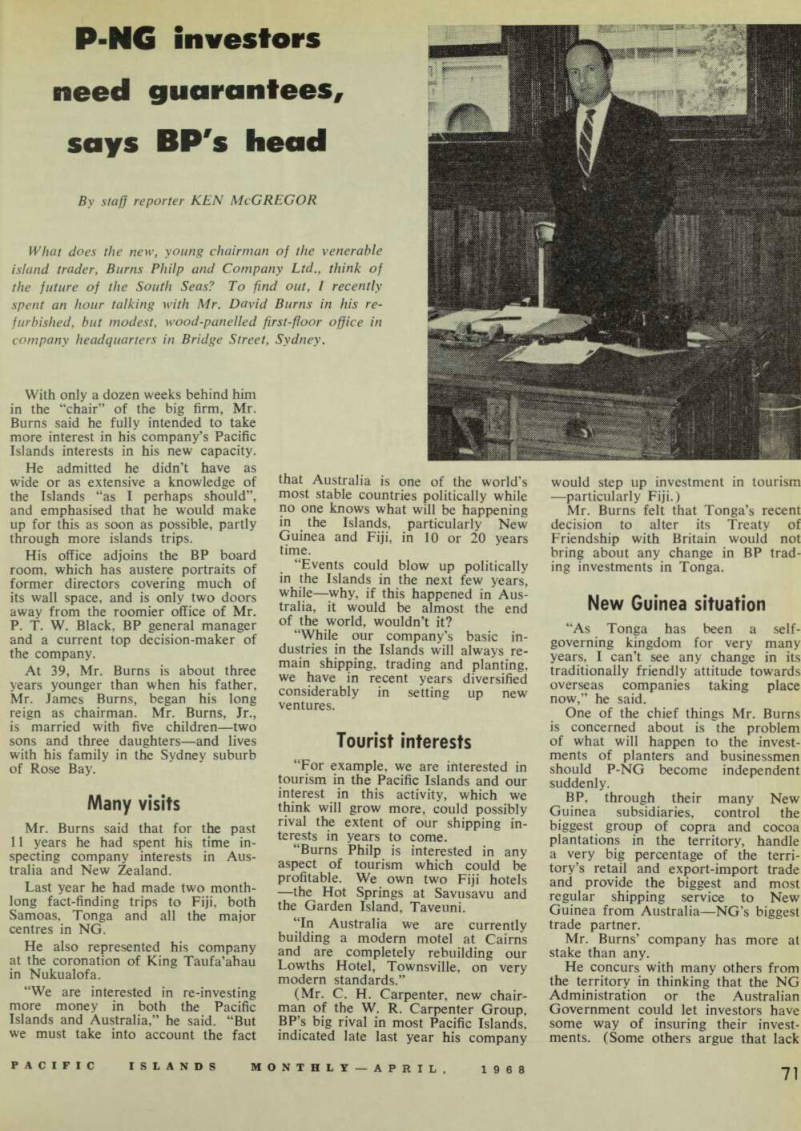 75
75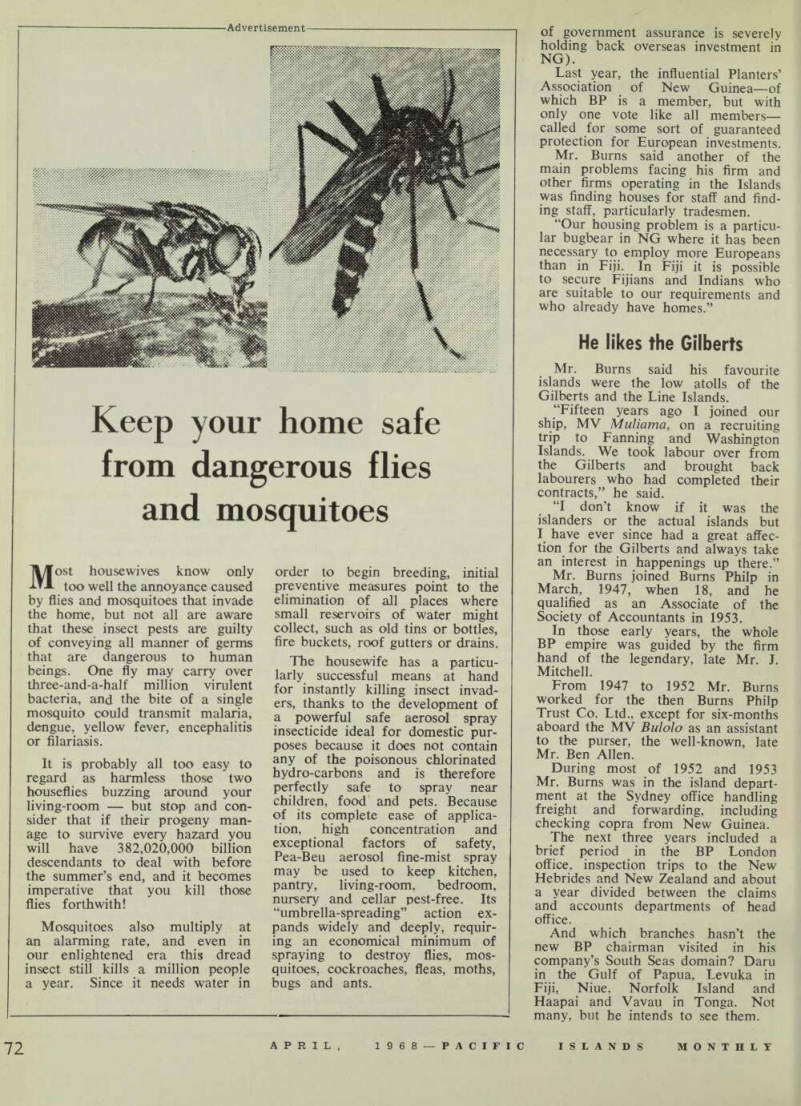 76
76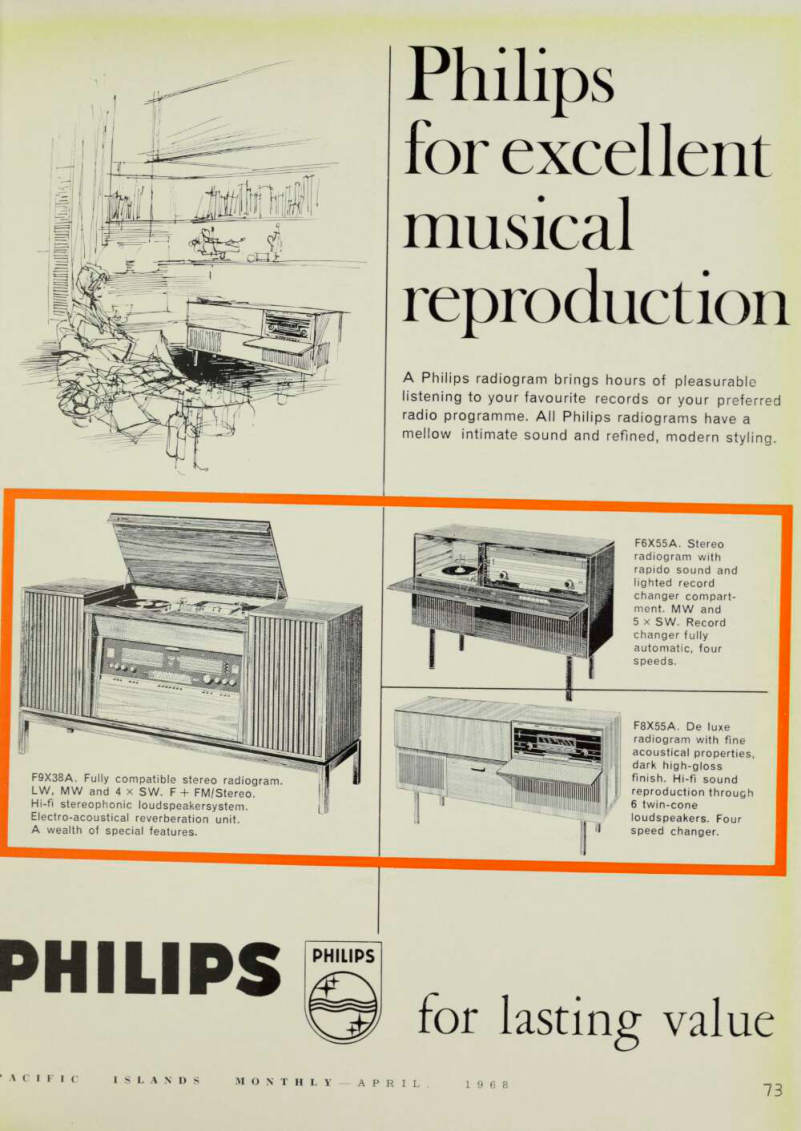 77
77 78
78 79
79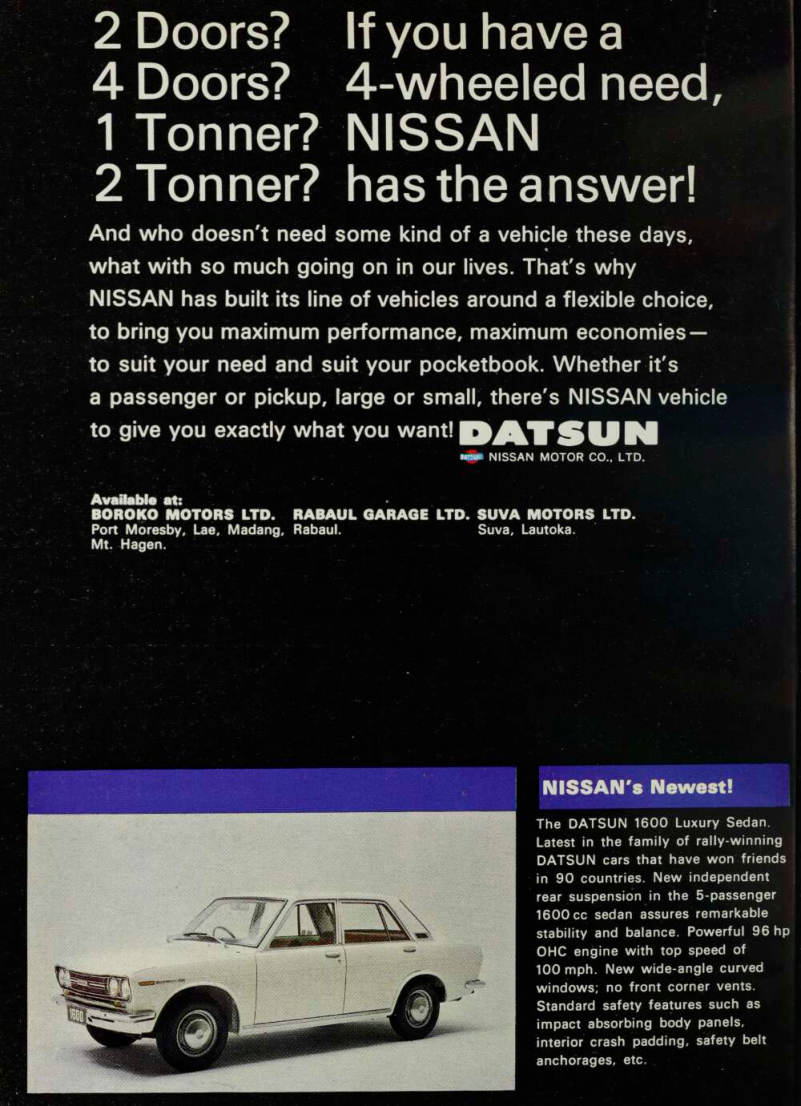 80
80 81
81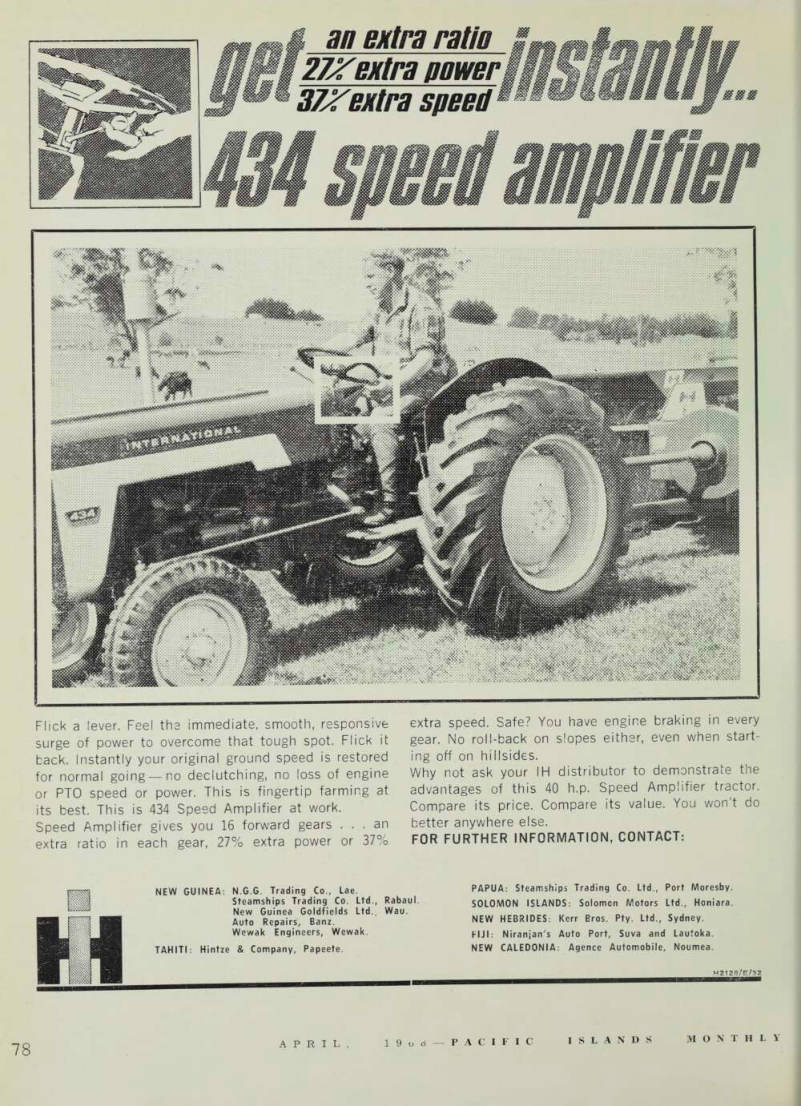 82
82 83
83 84
84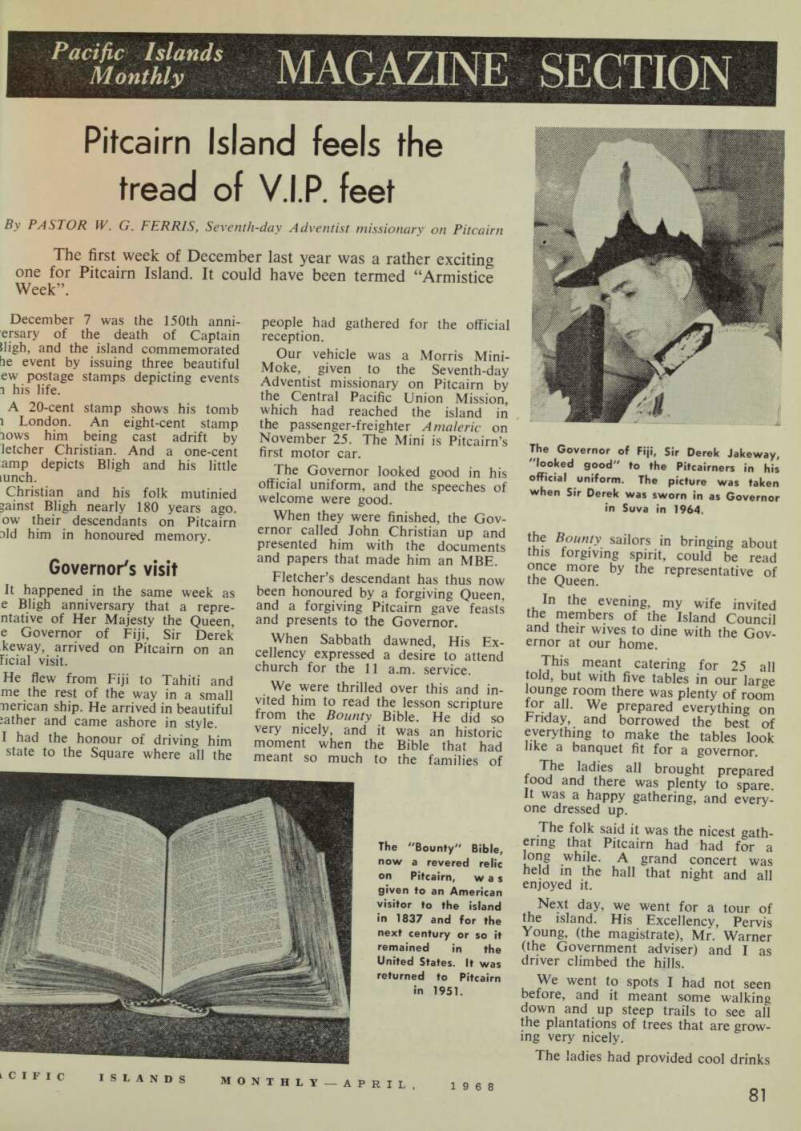 85
85 86
86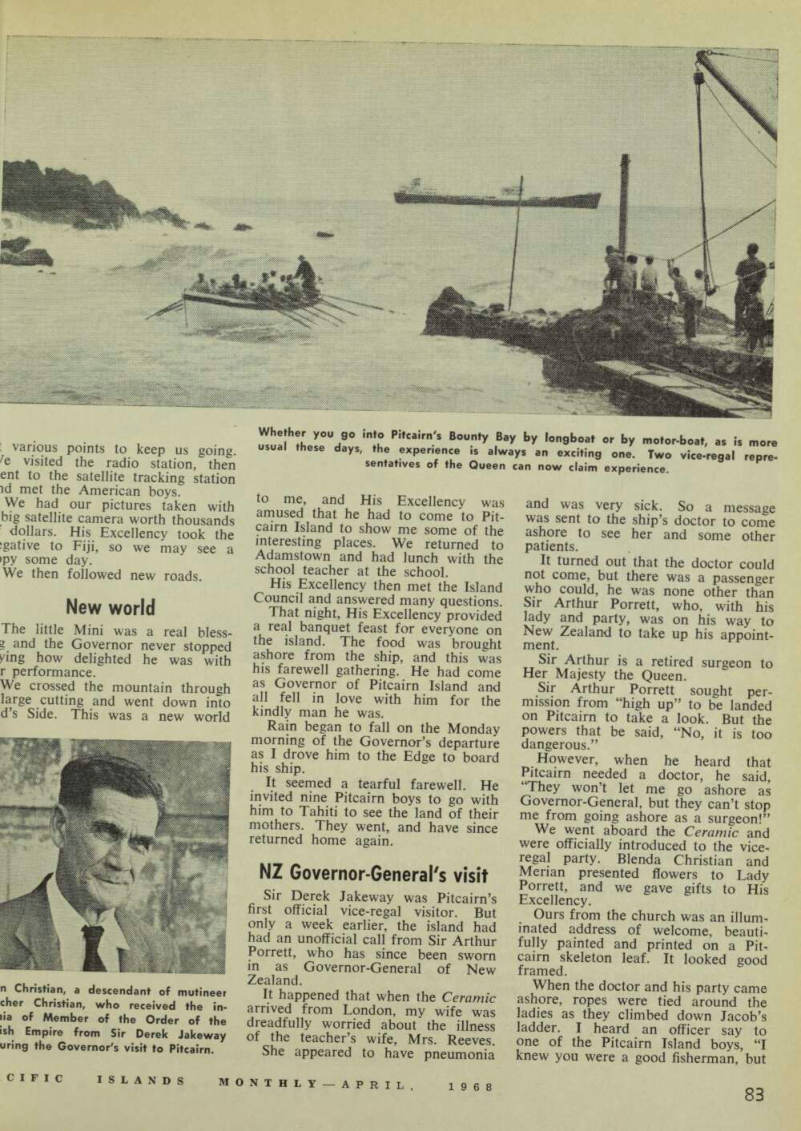 87
87 88
88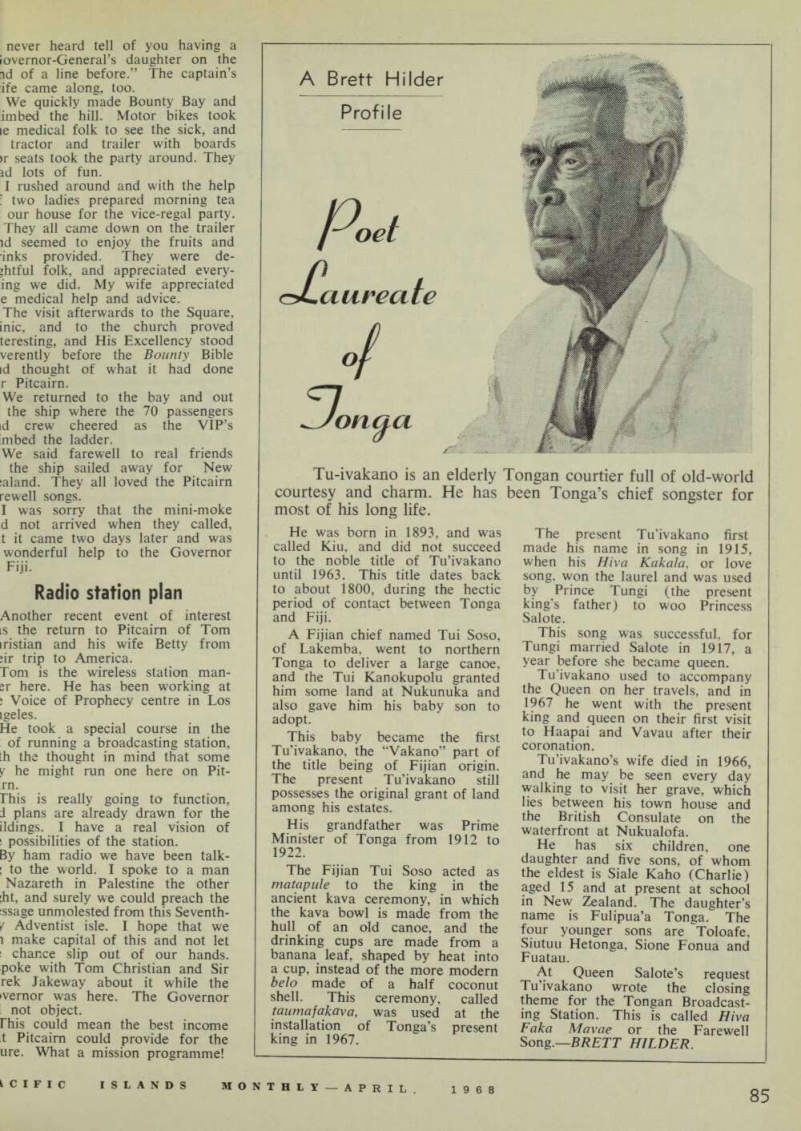 89
89 90
90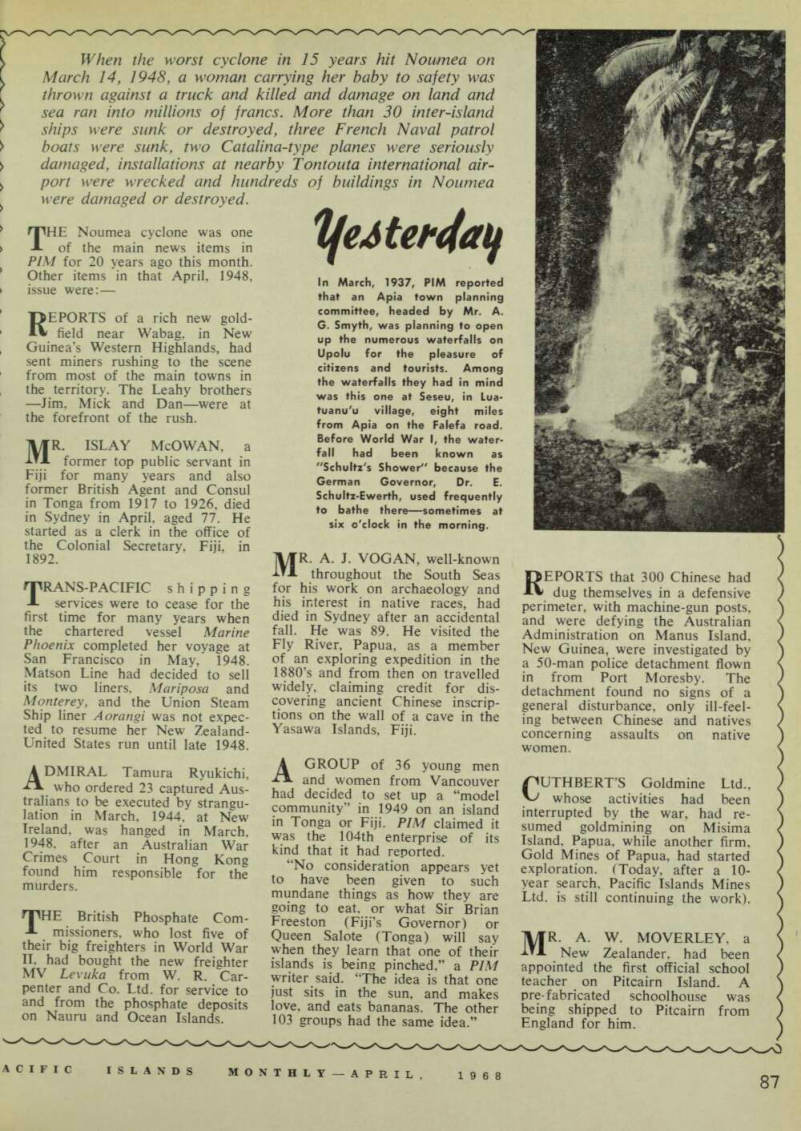 91
91 92
92 93
93 94
94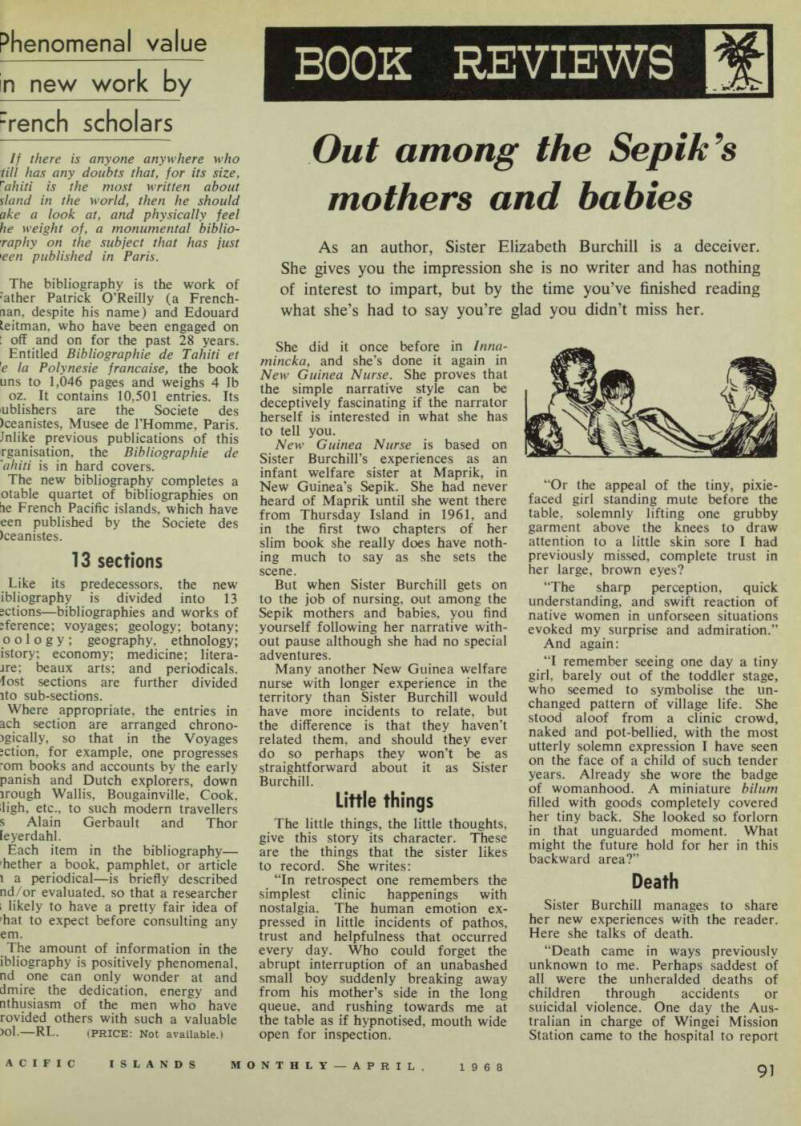 95
95 96
96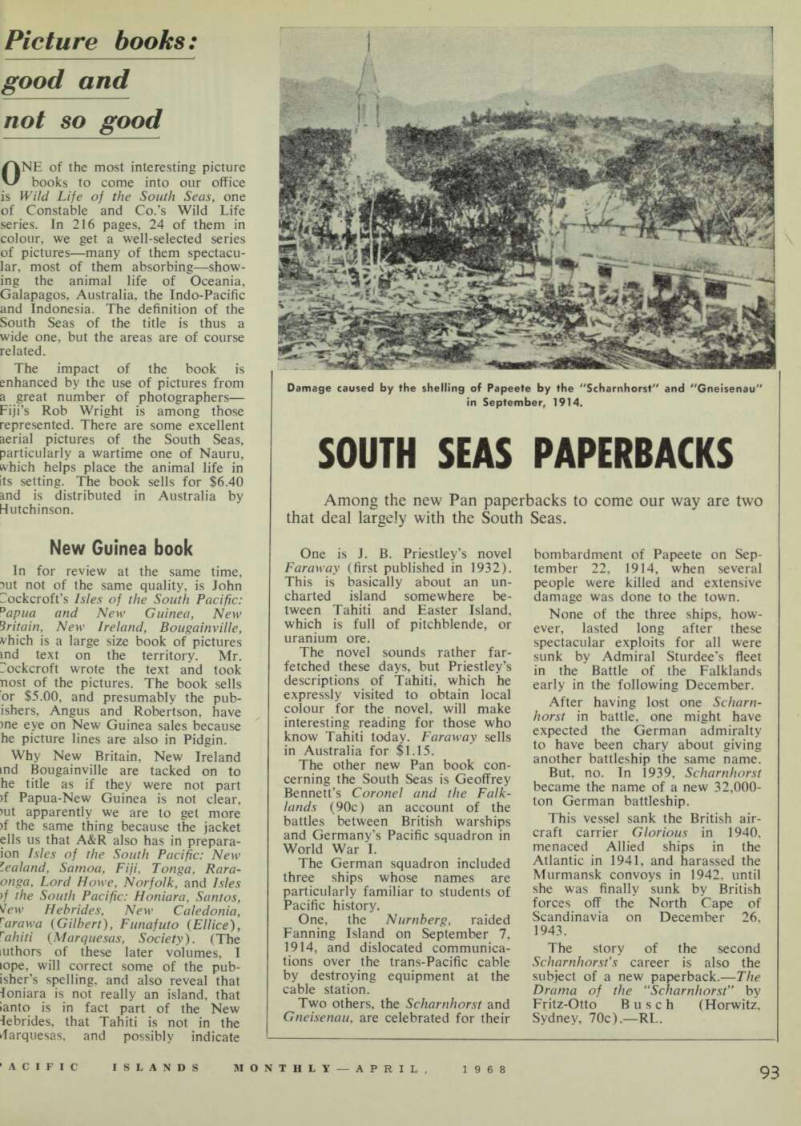 97
97 98
98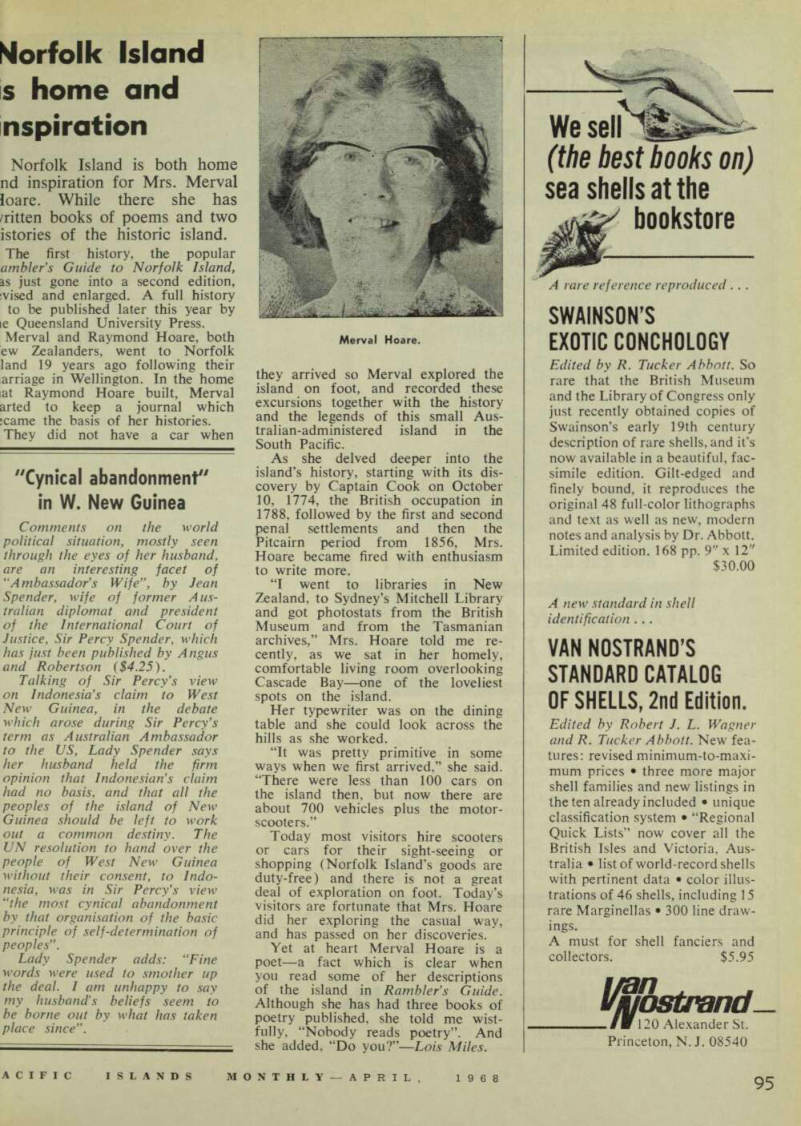 99
99 100
100 101
101 102
102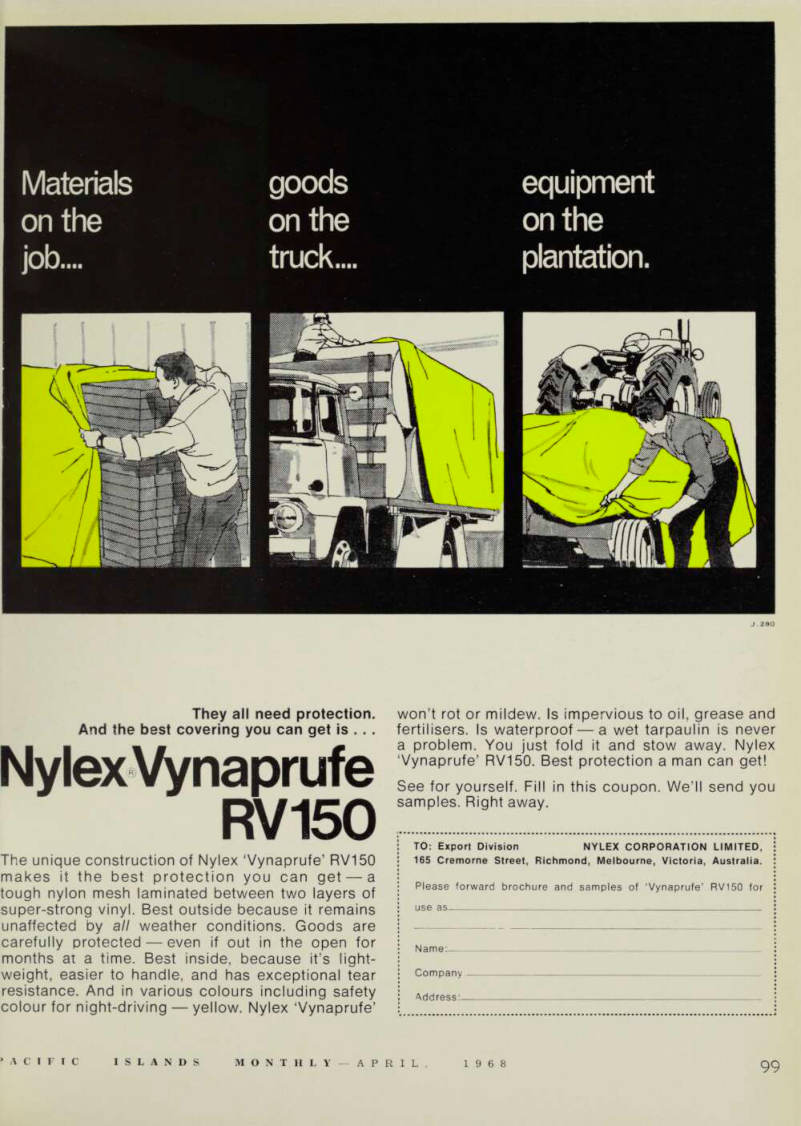 103
103 104
104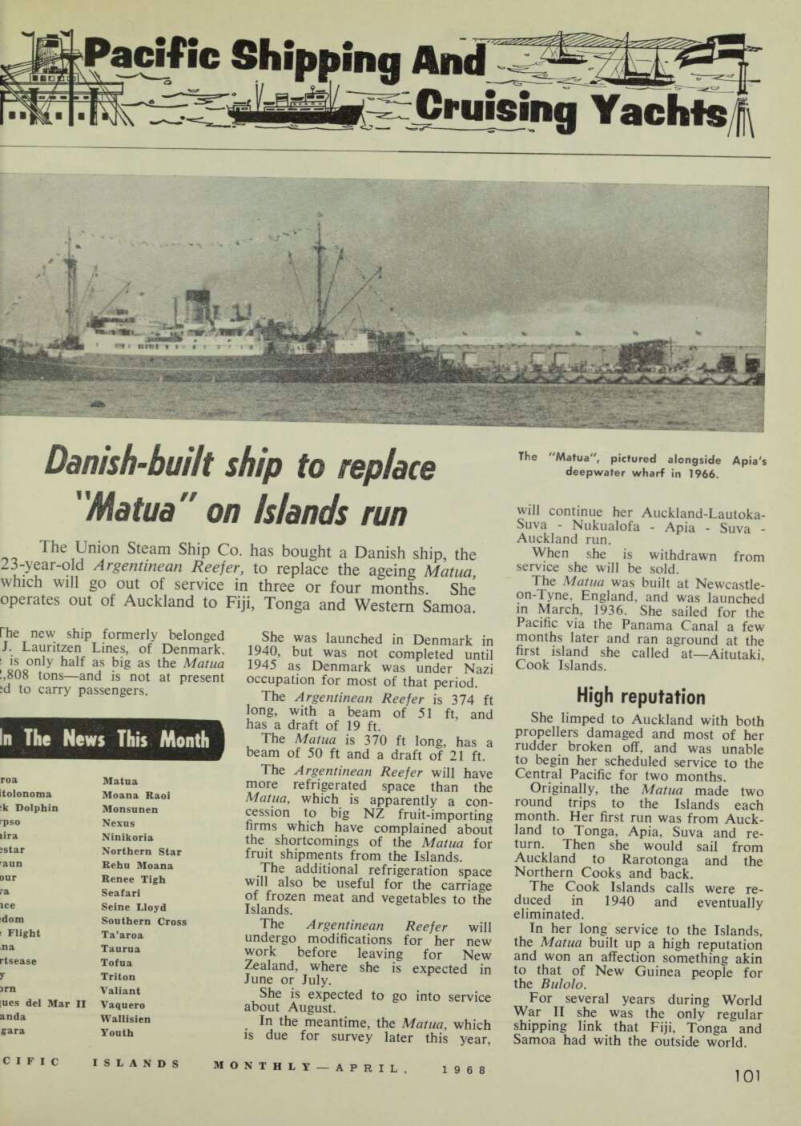 105
105 106
106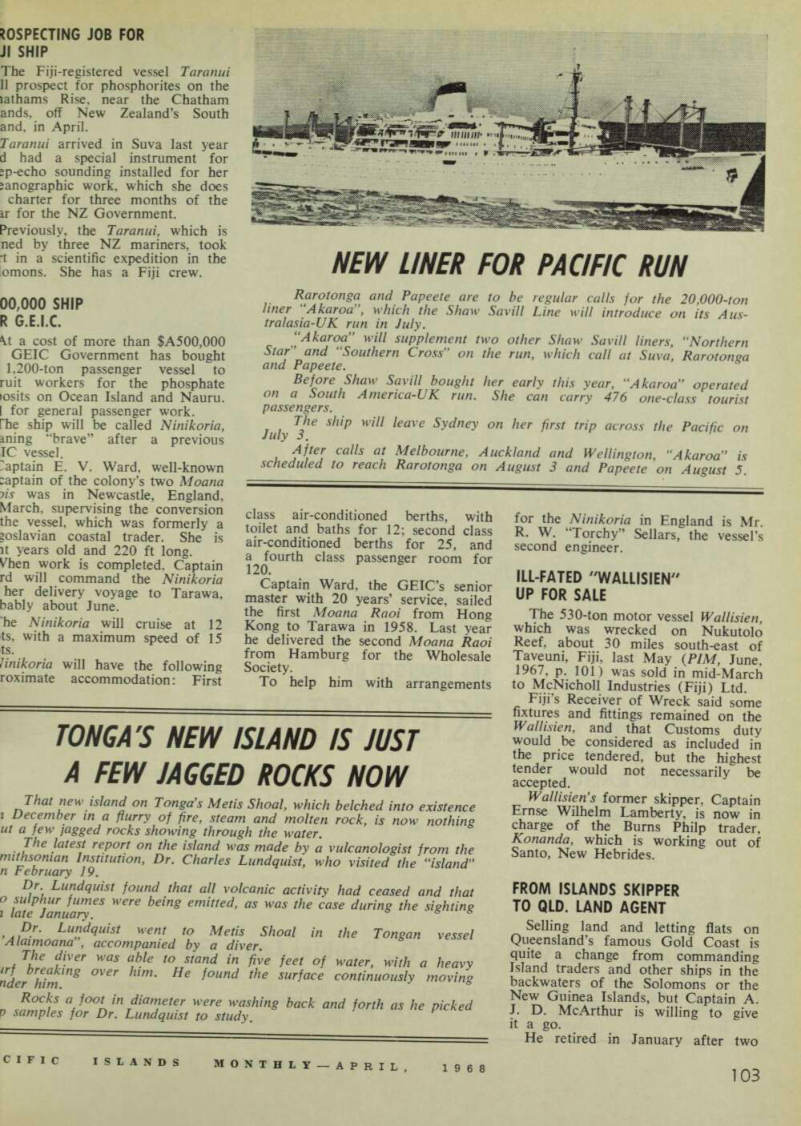 107
107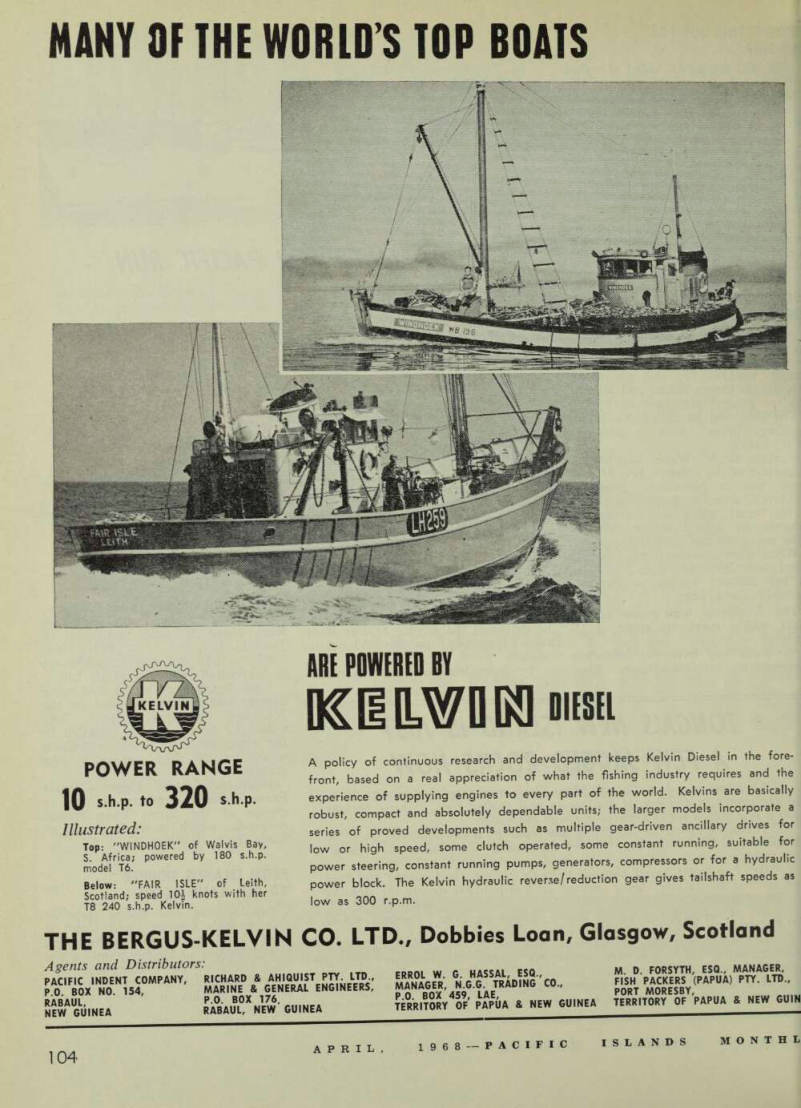 108
108 109
109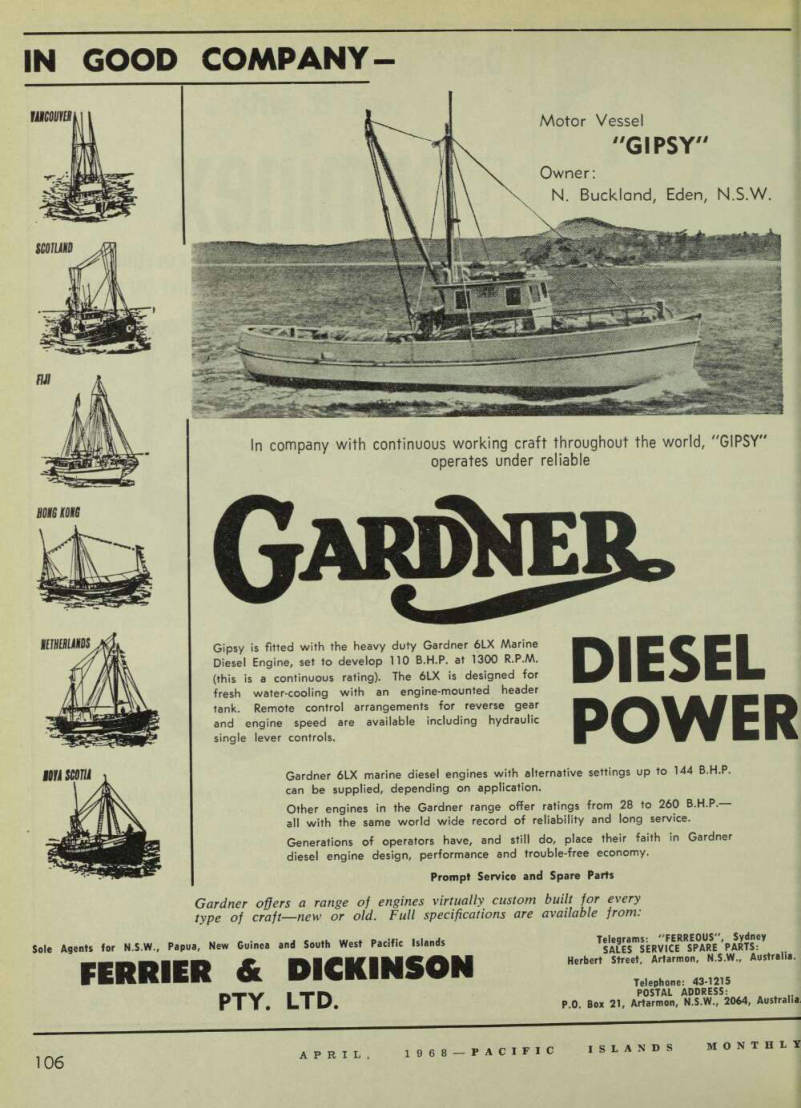 110
110 111
111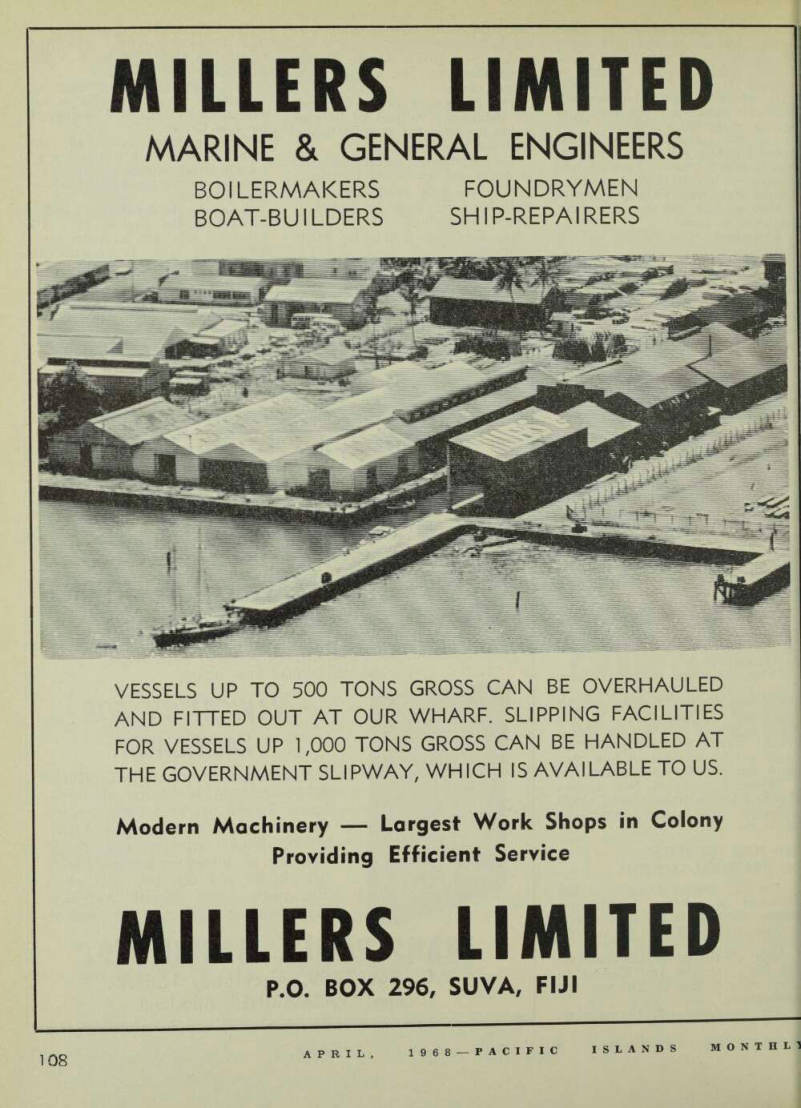 112
112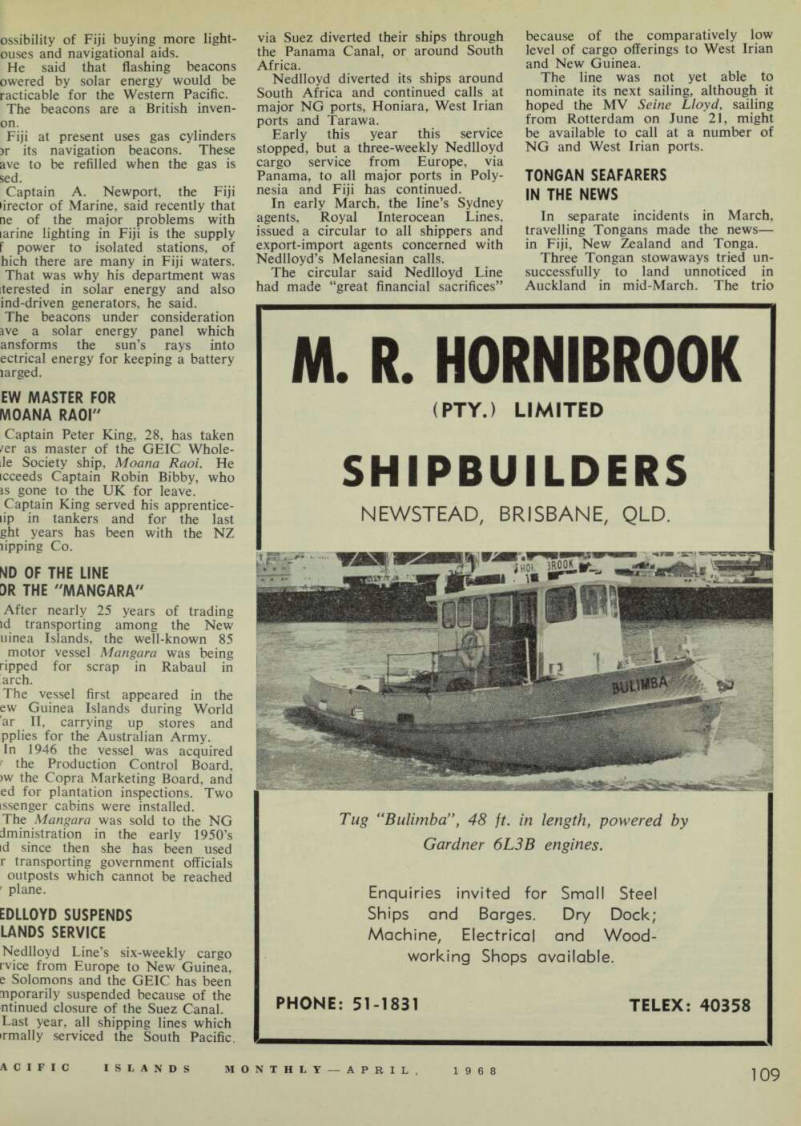 113
113 114
114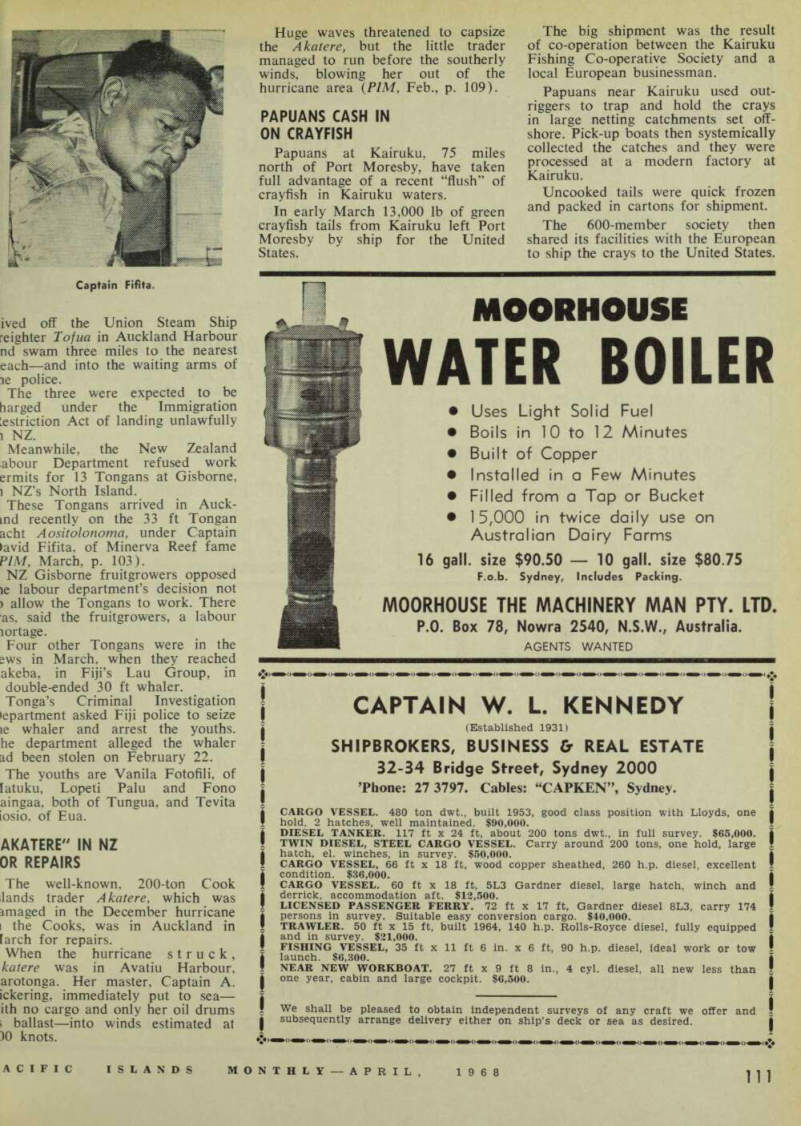 115
115 116
116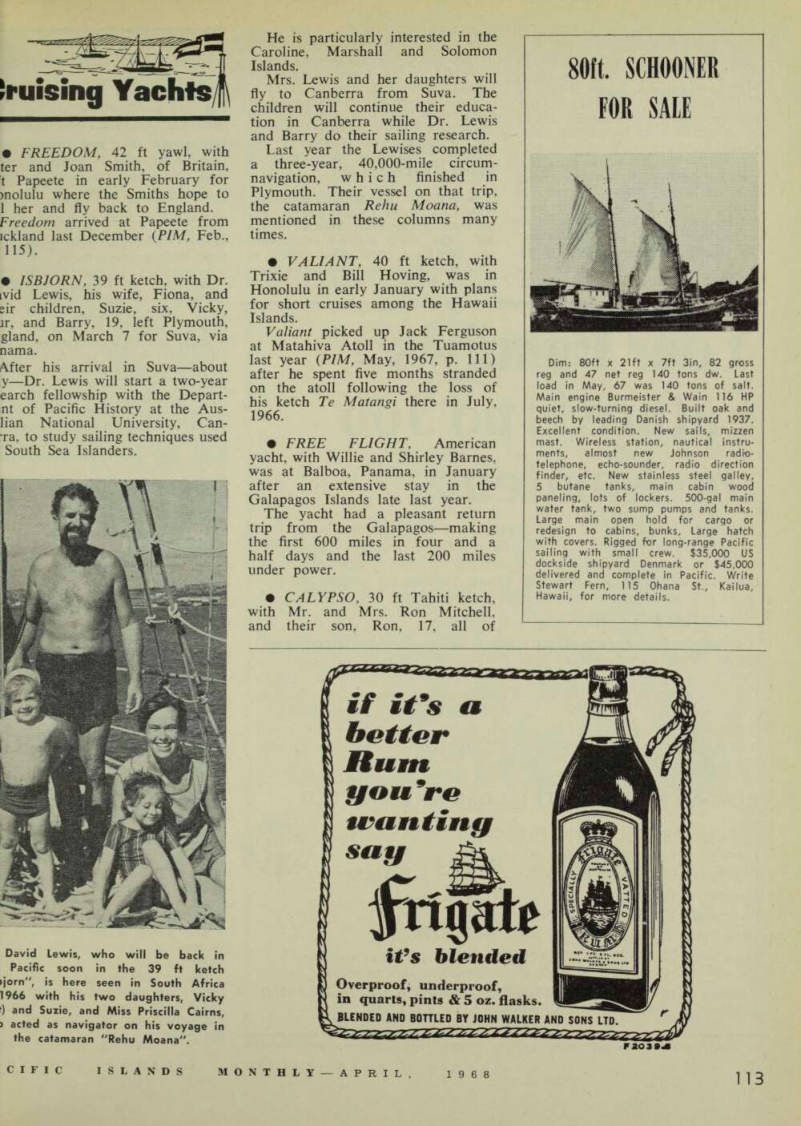 117
117 118
118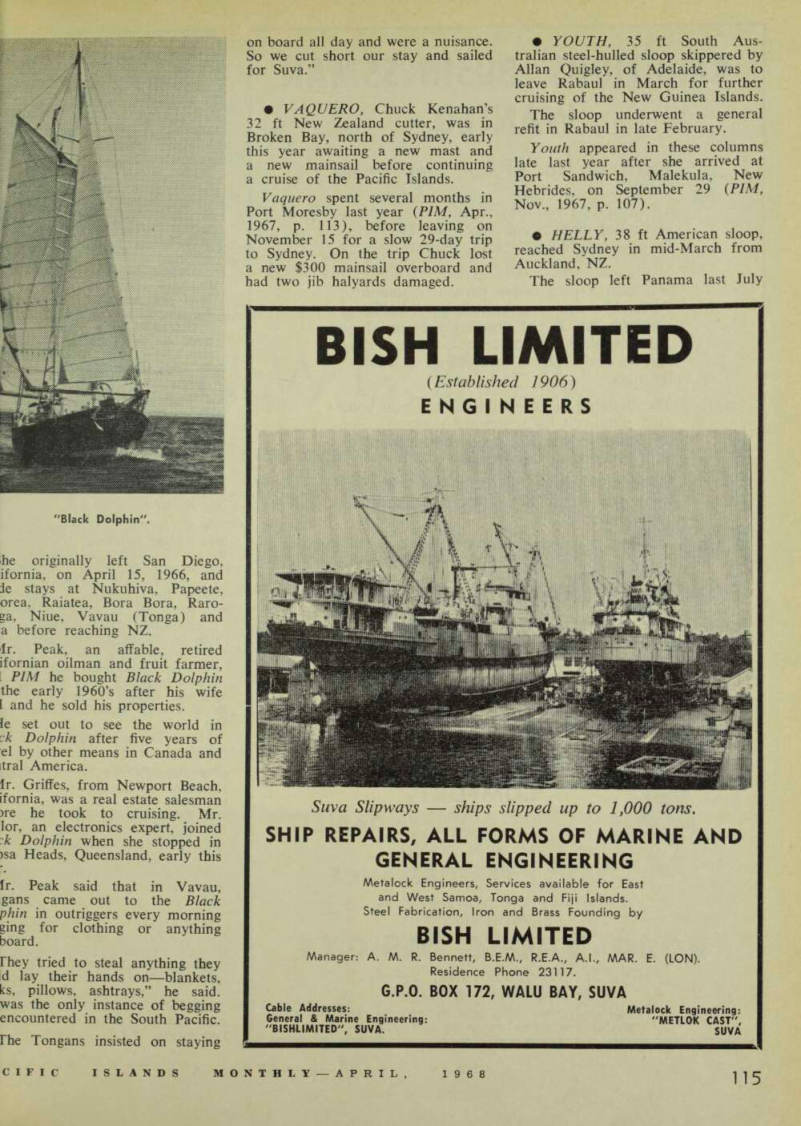 119
119 120
120 121
121 122
122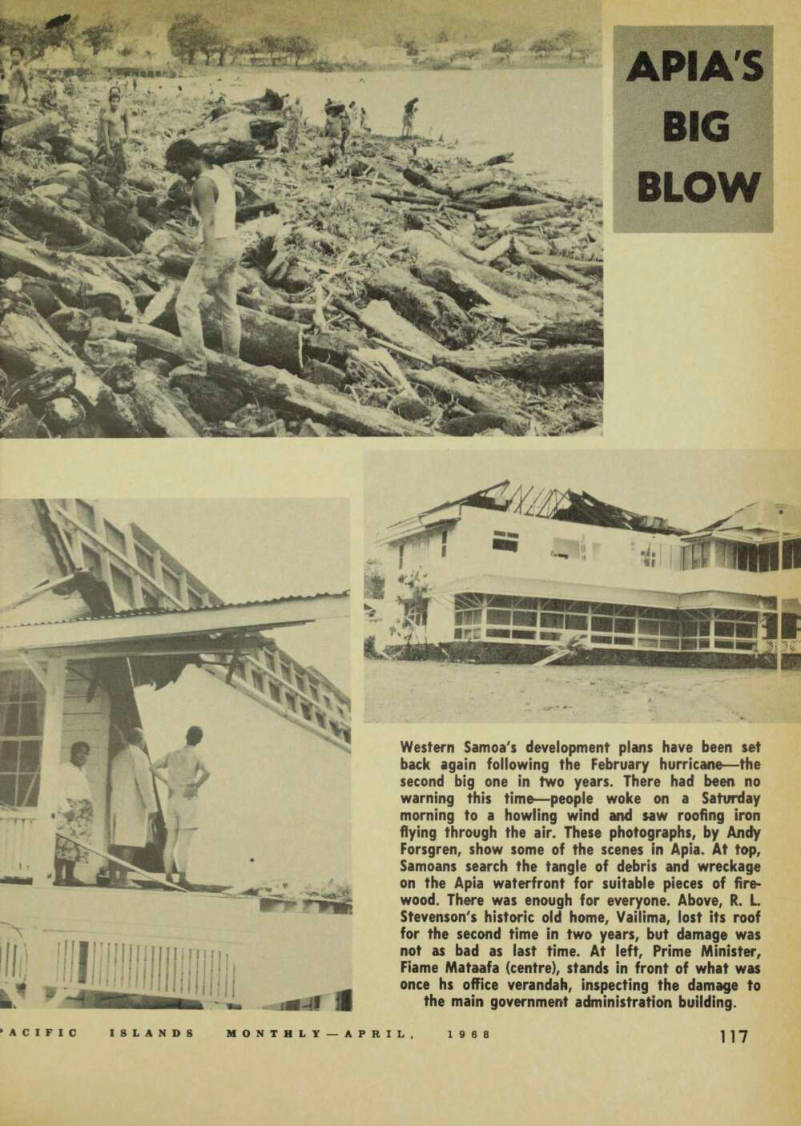 123
123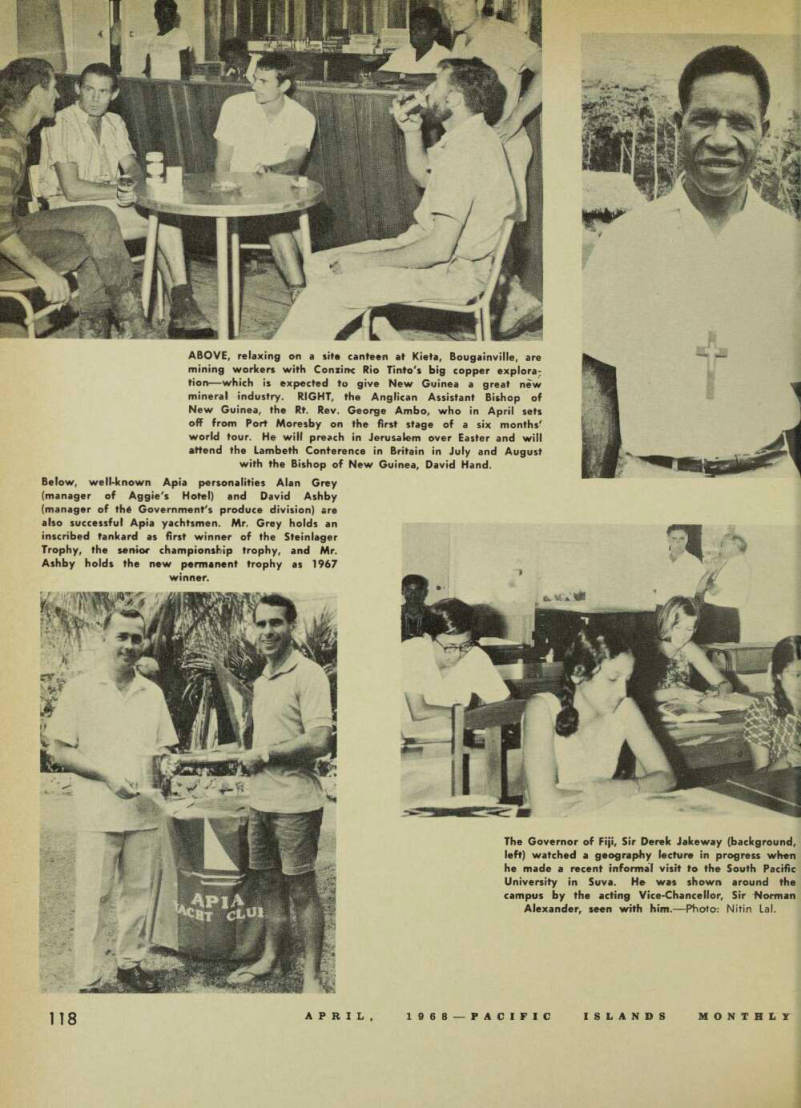 124
124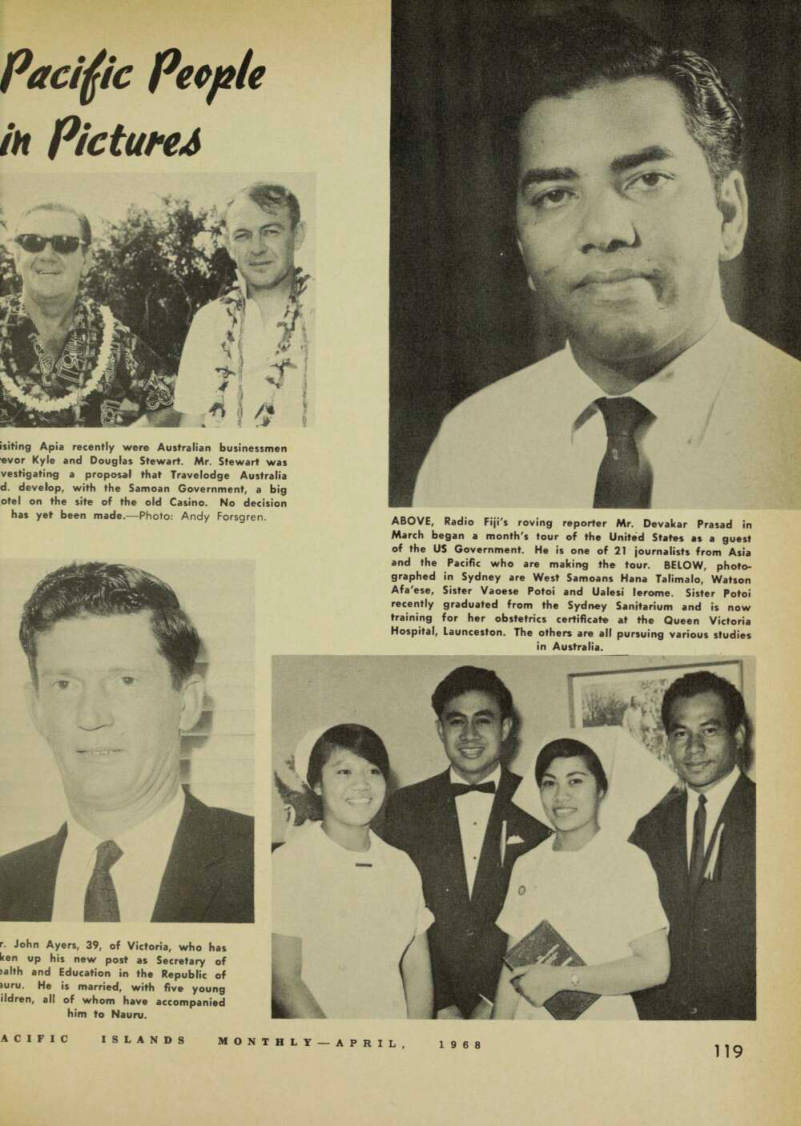 125
125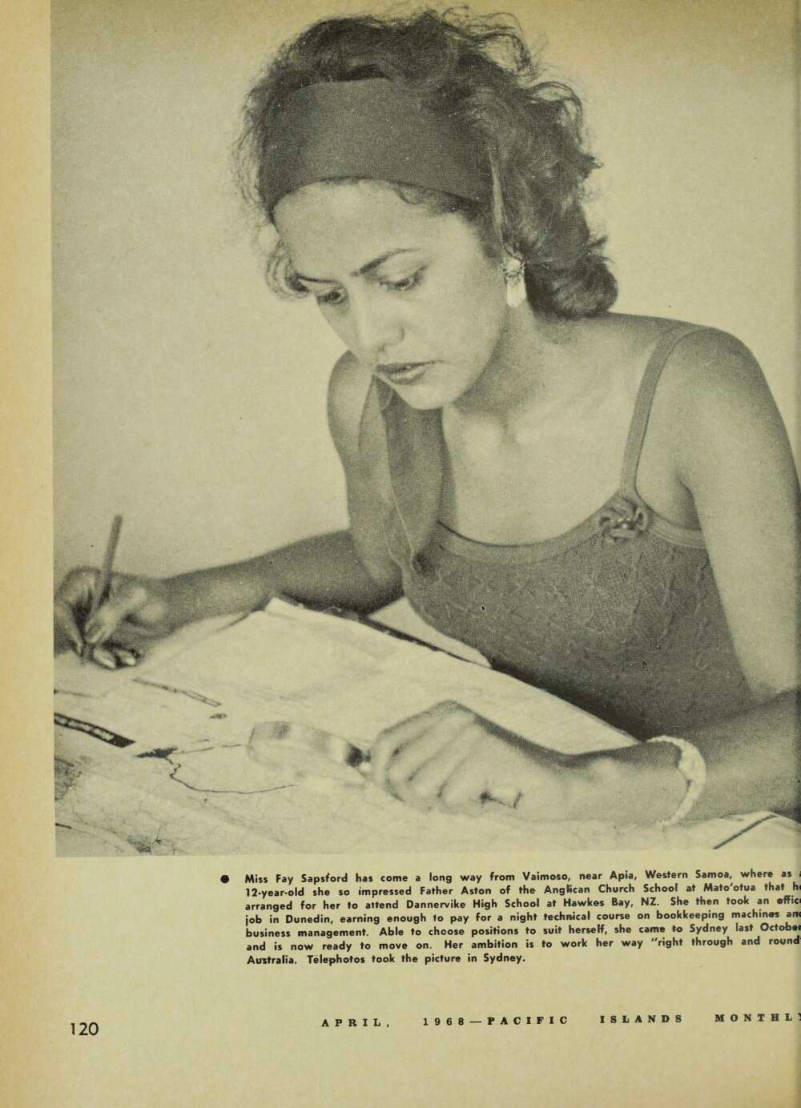 126
126 127
127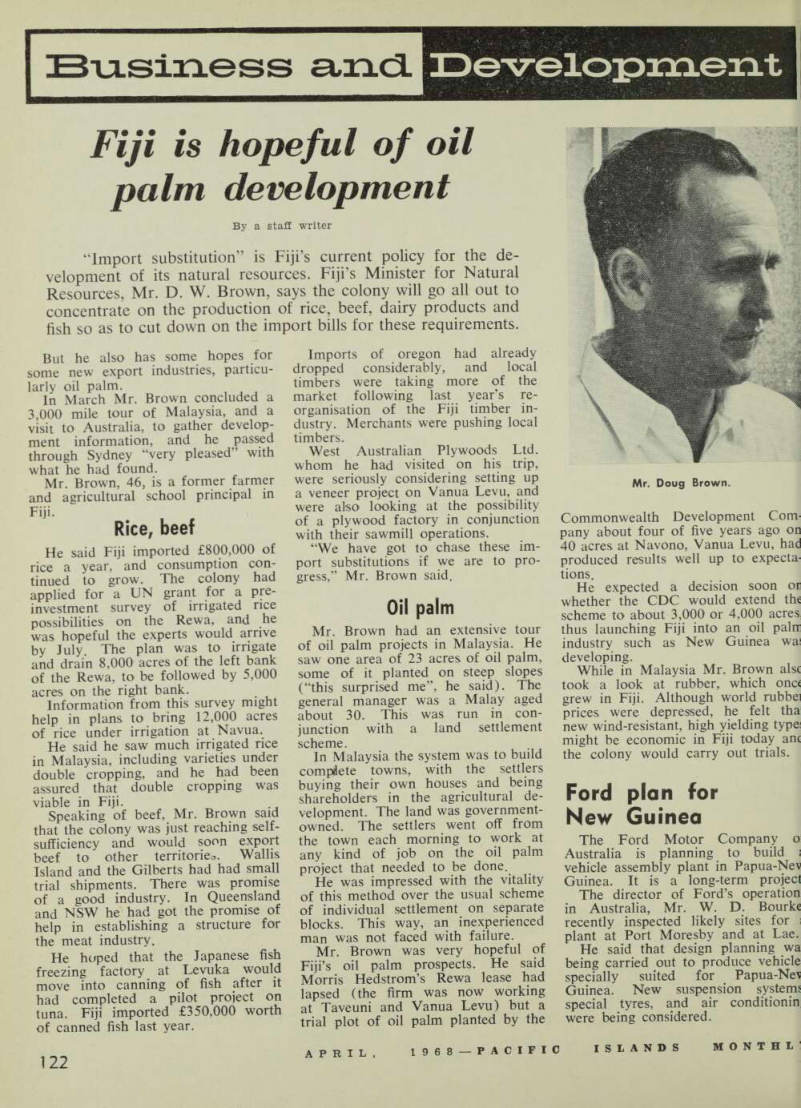 128
128 129
129 130
130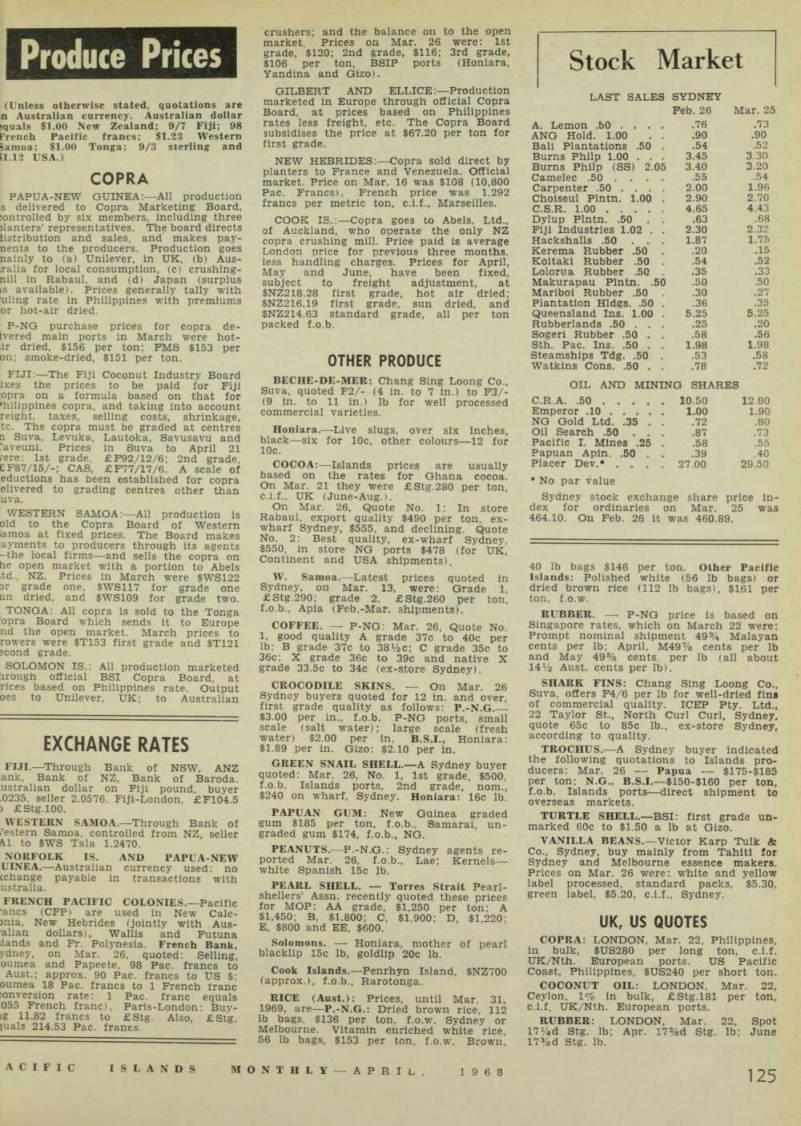 131
131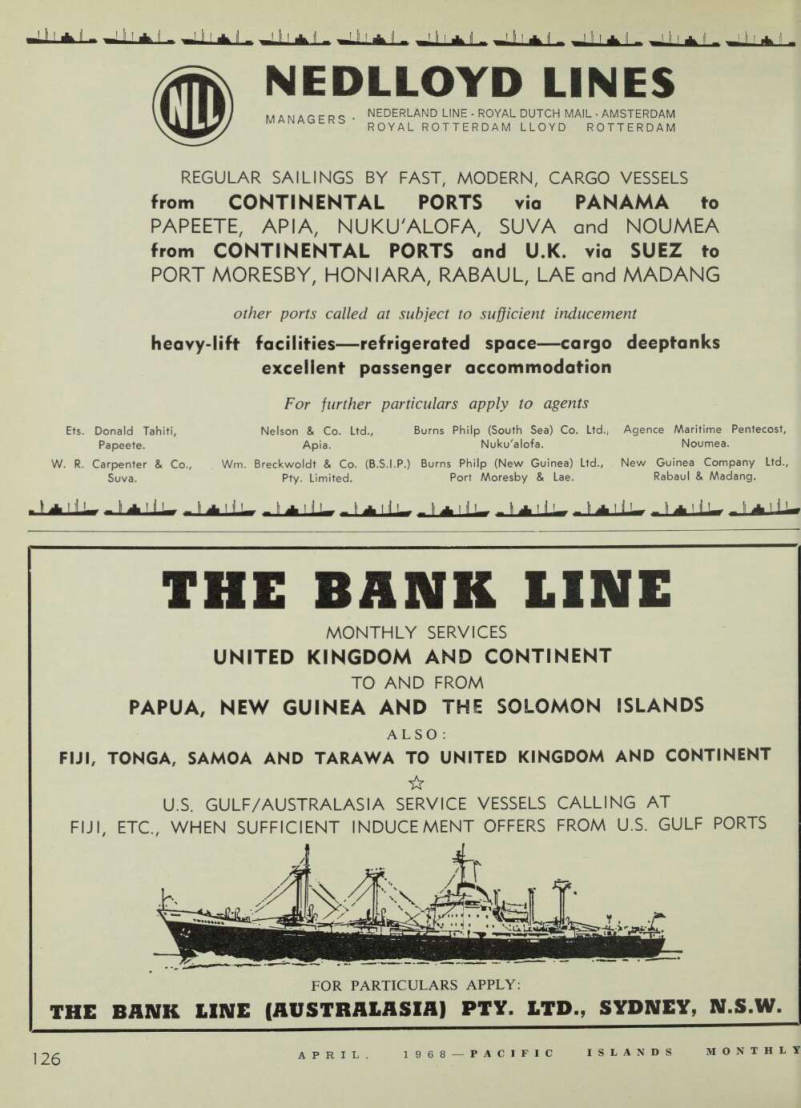 132
132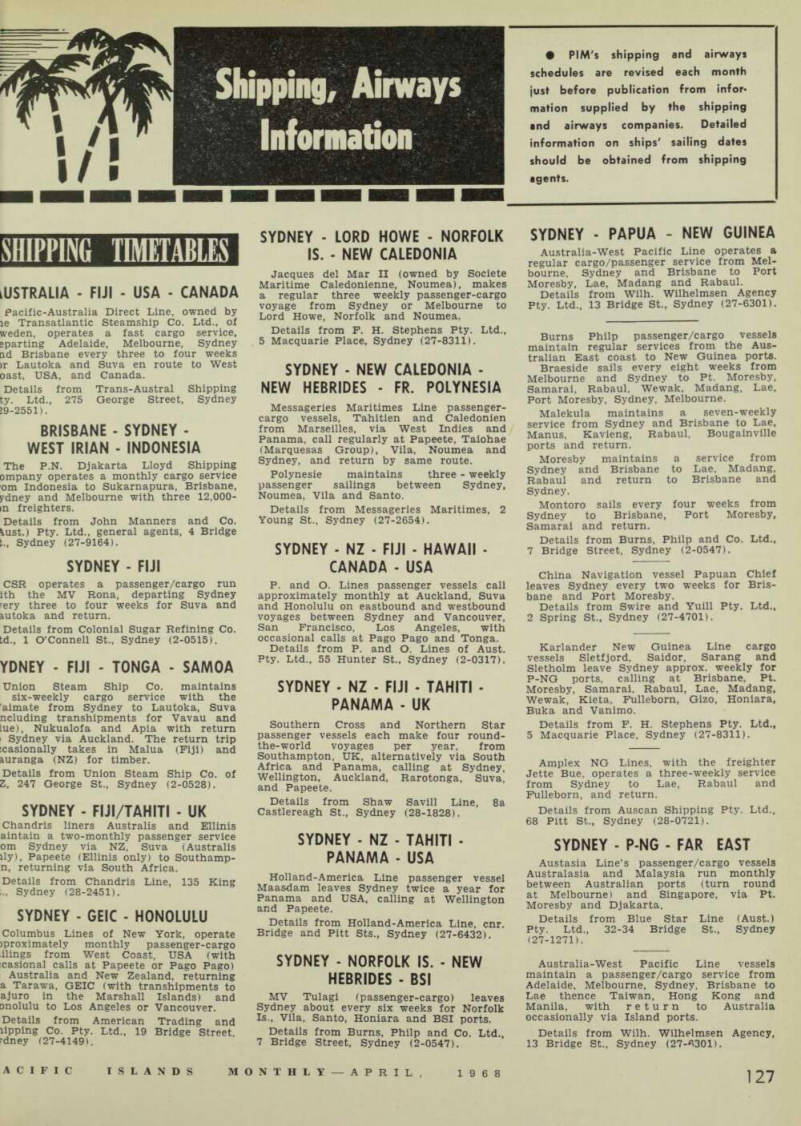 133
133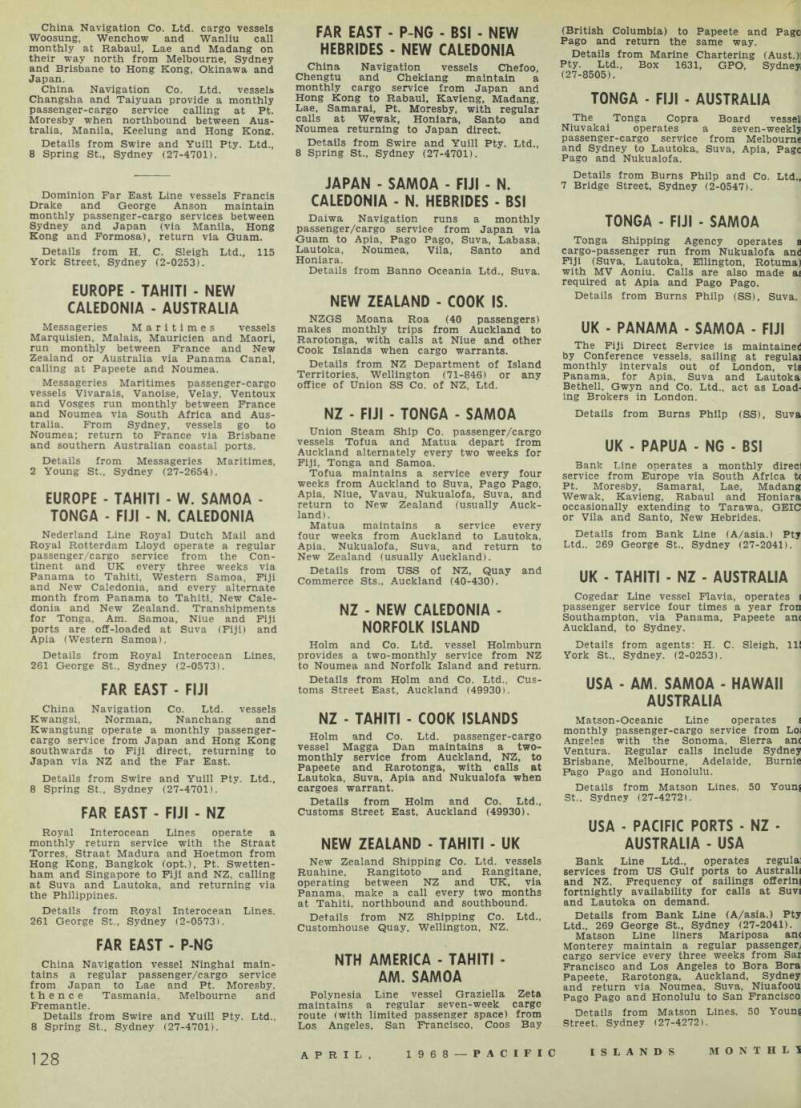 134
134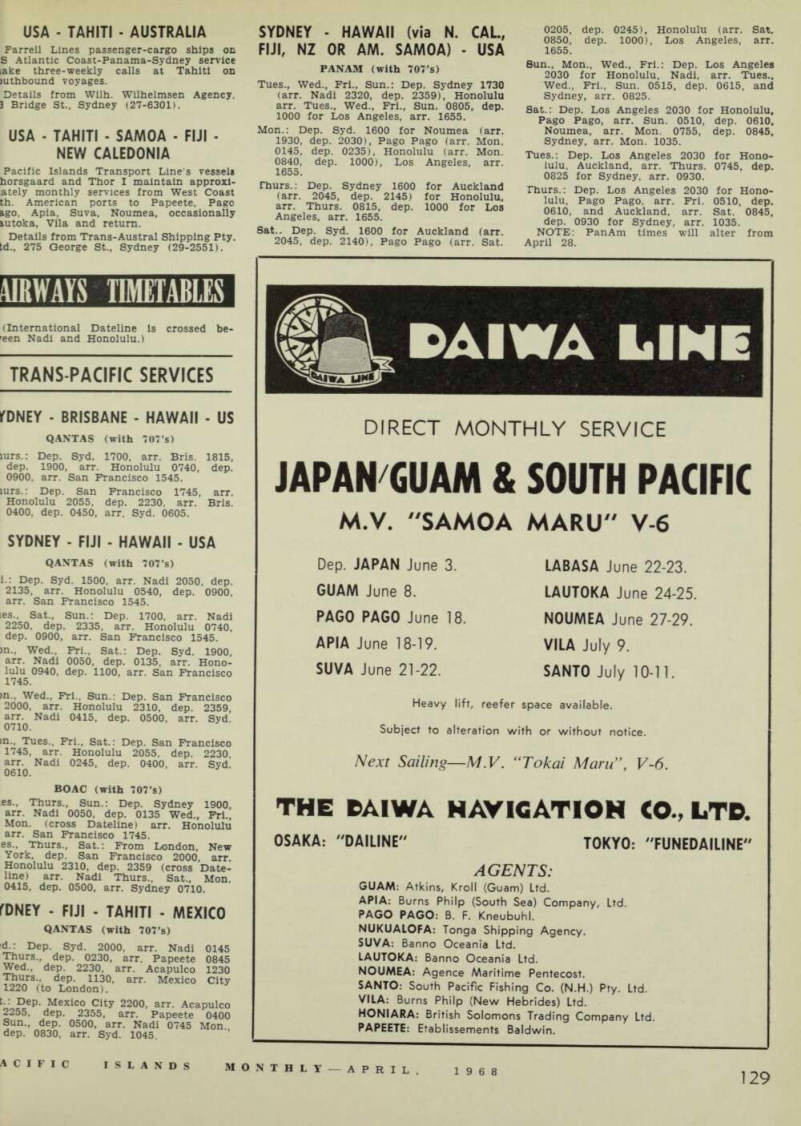 135
135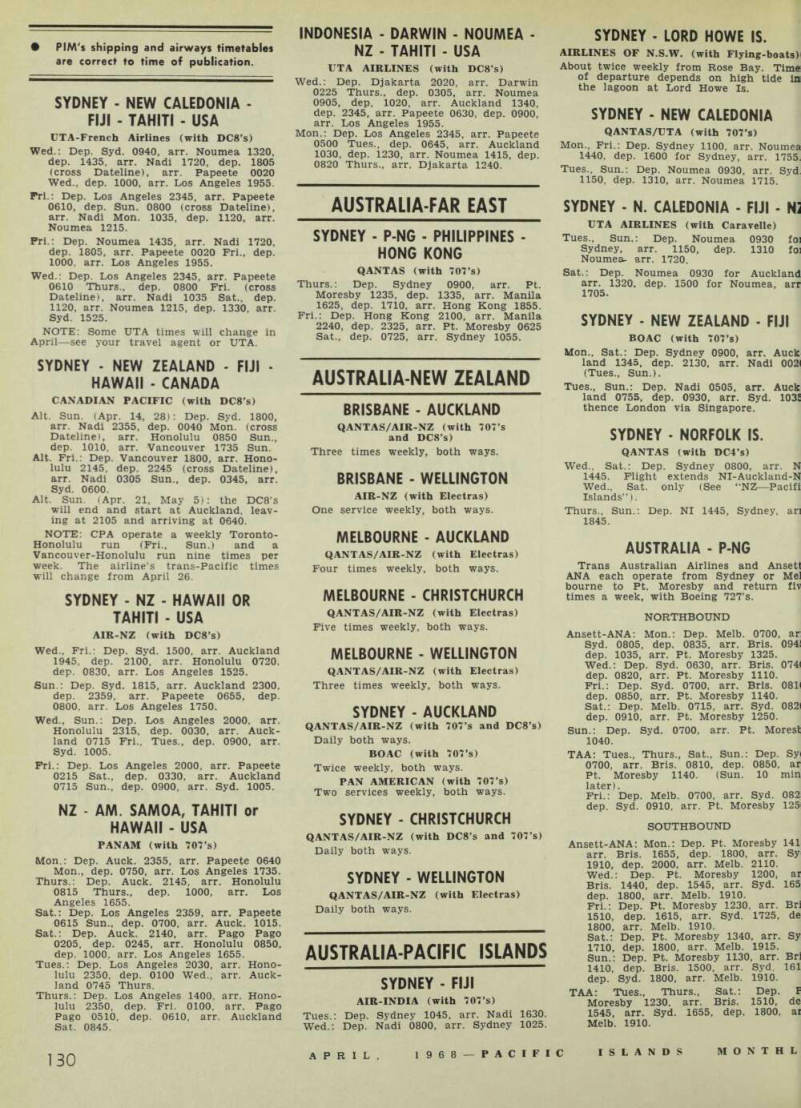 136
136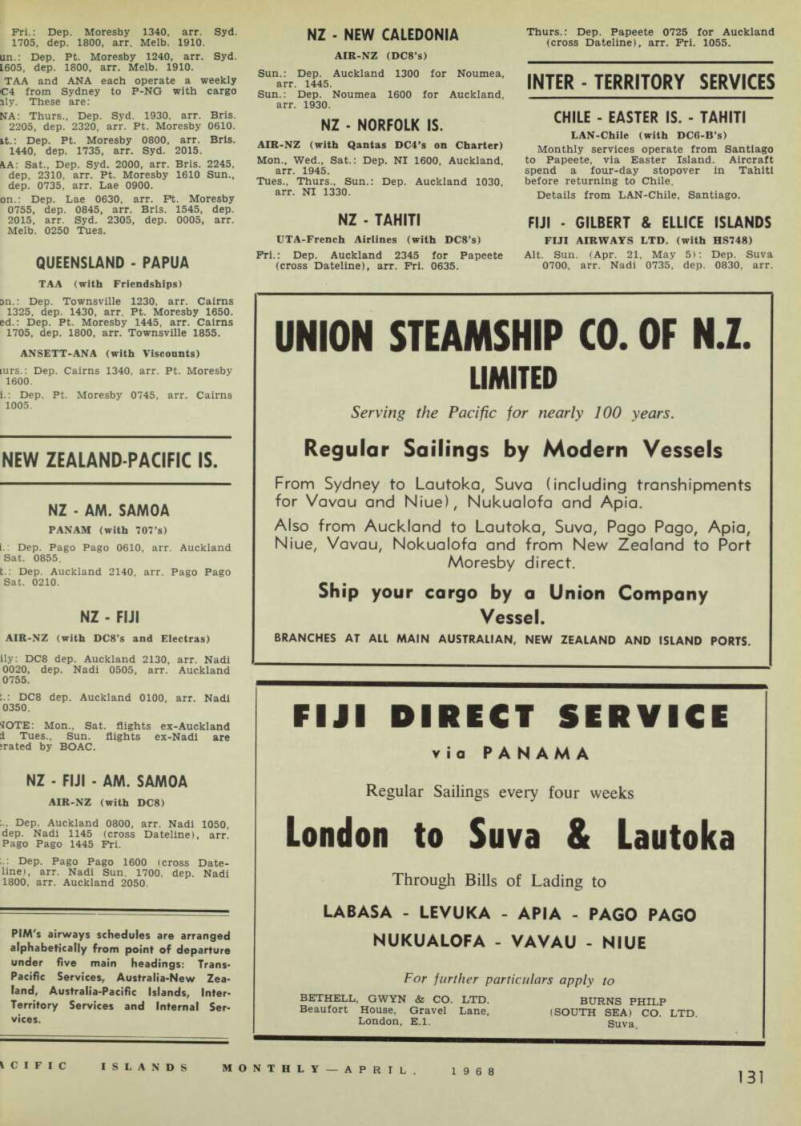 137
137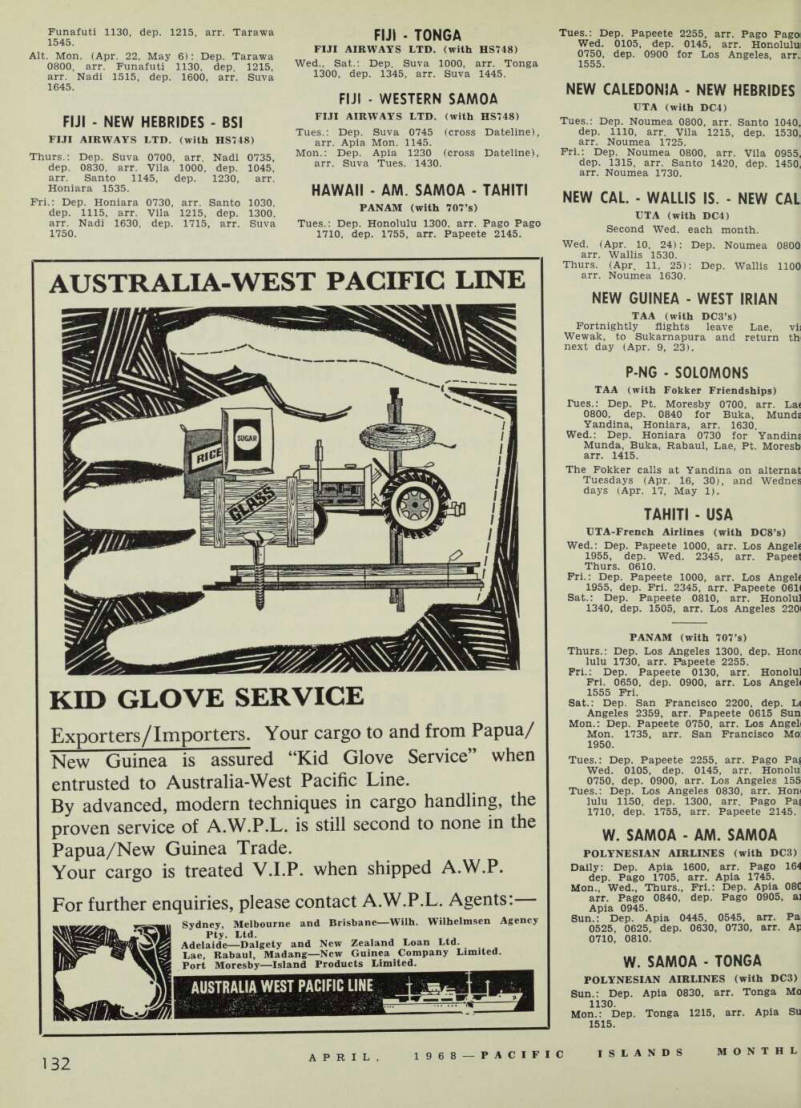 138
138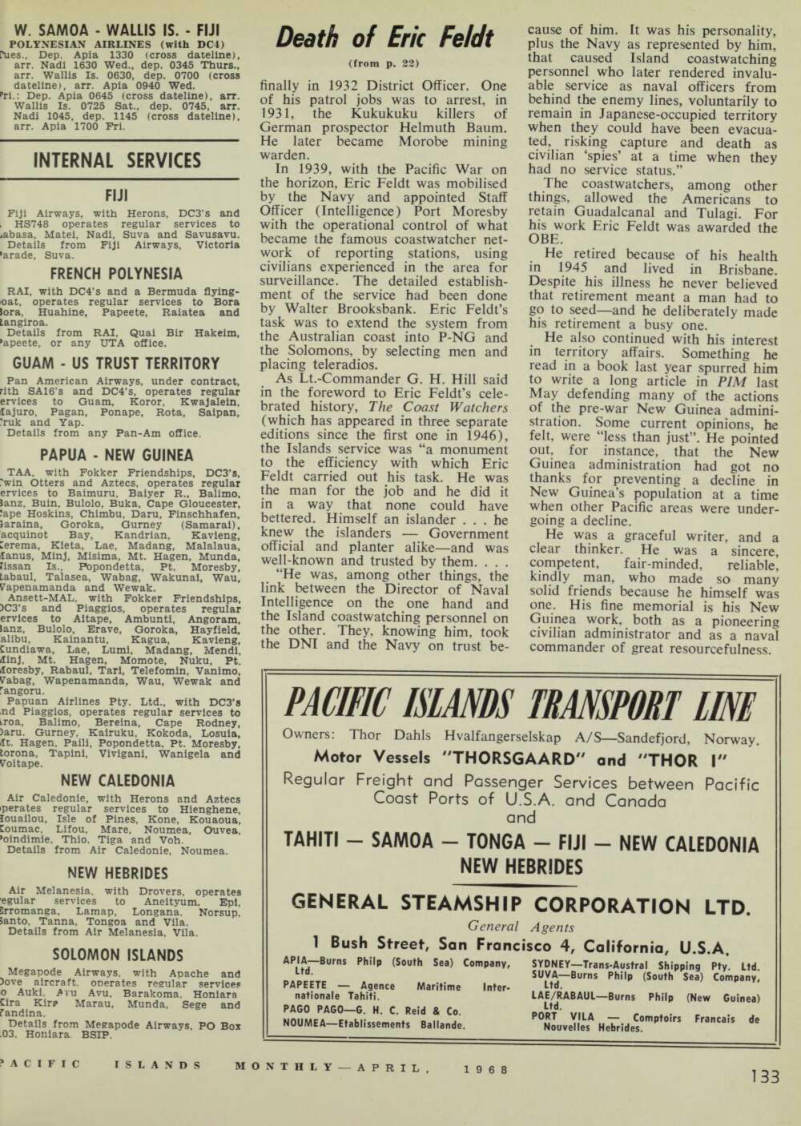 139
139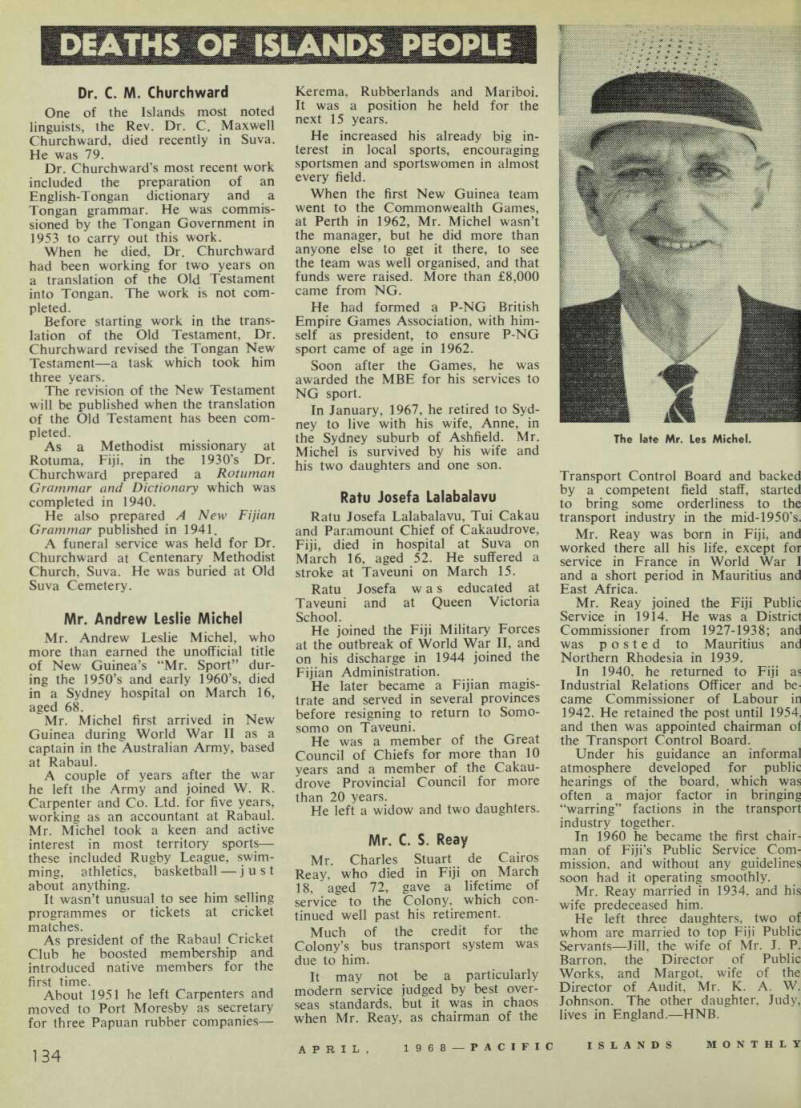 140
140 141
141 142
142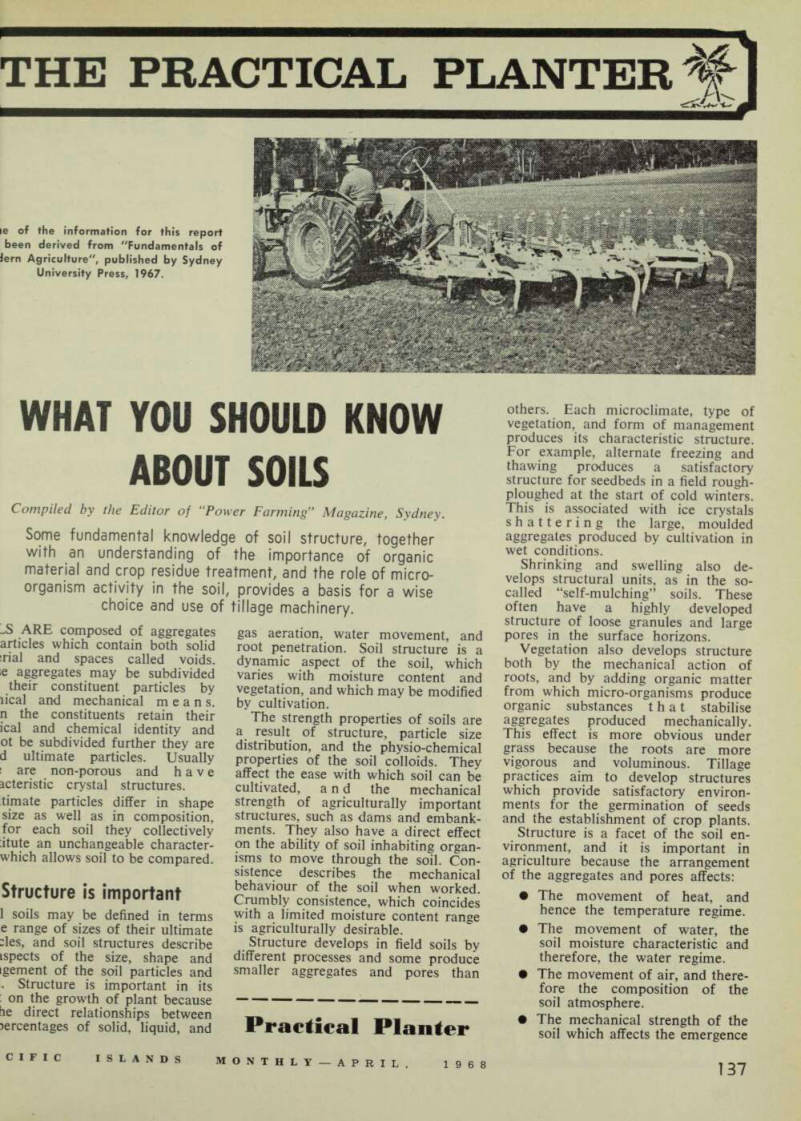 143
143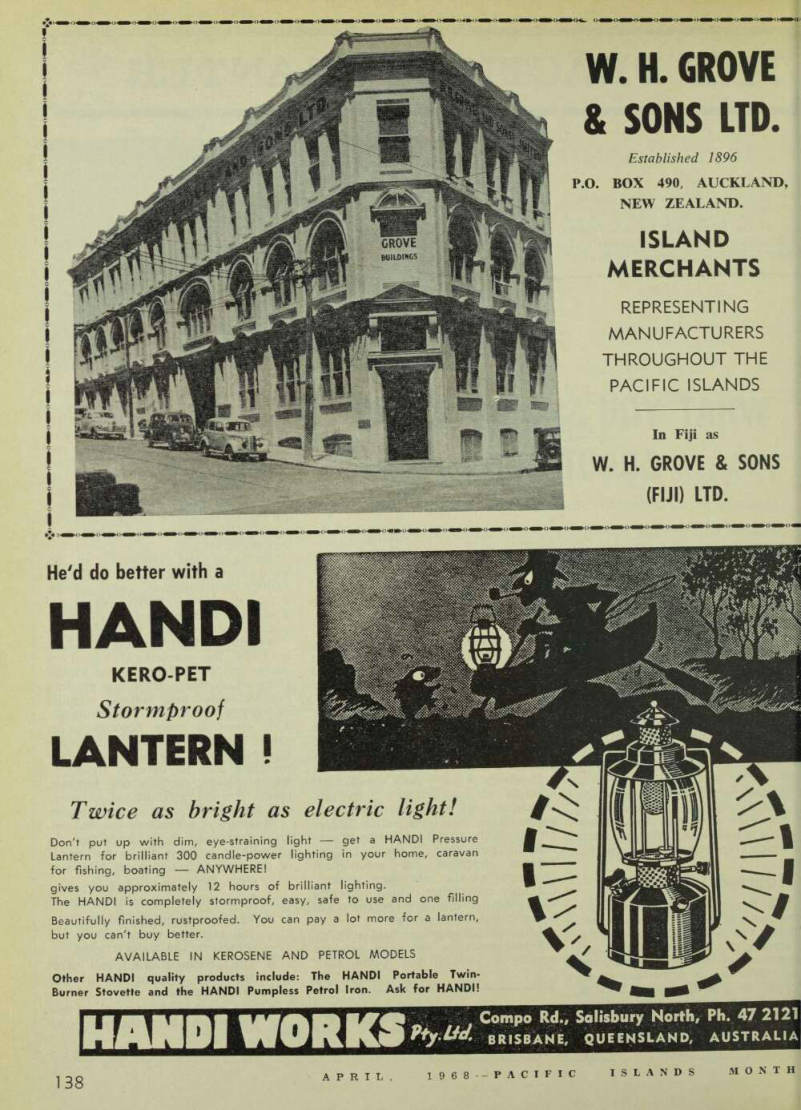 144
144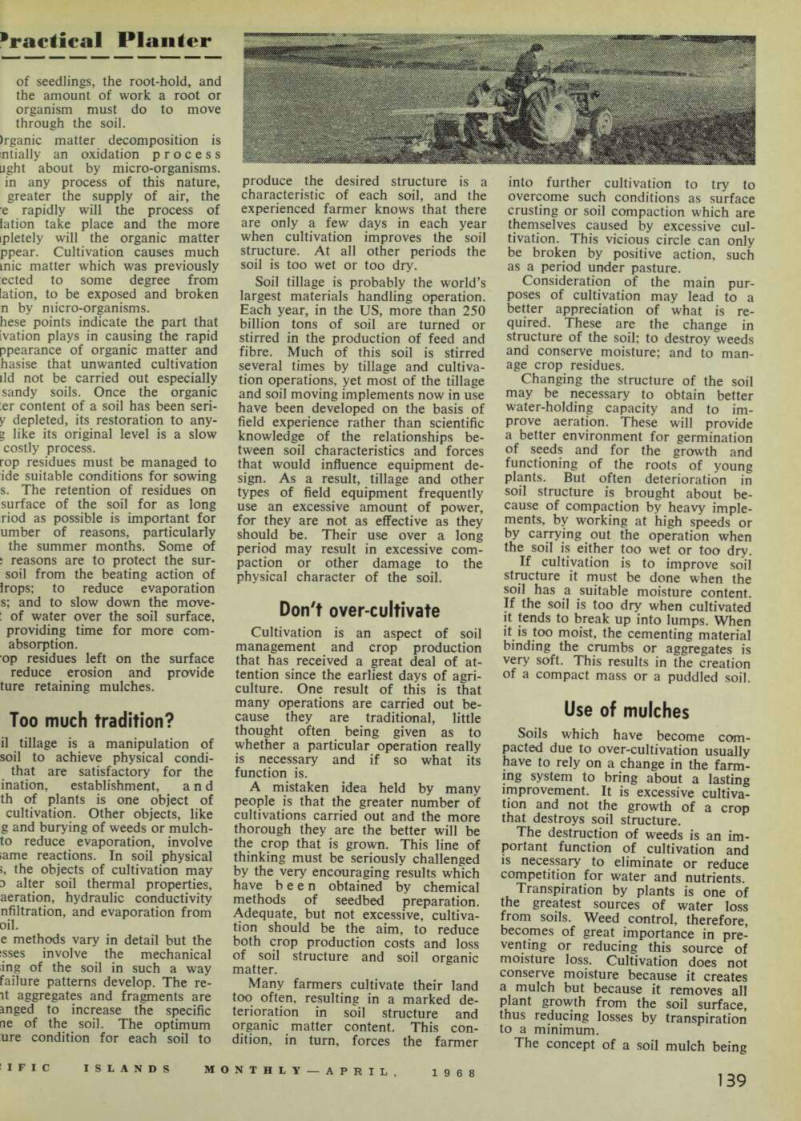 145
145 146
146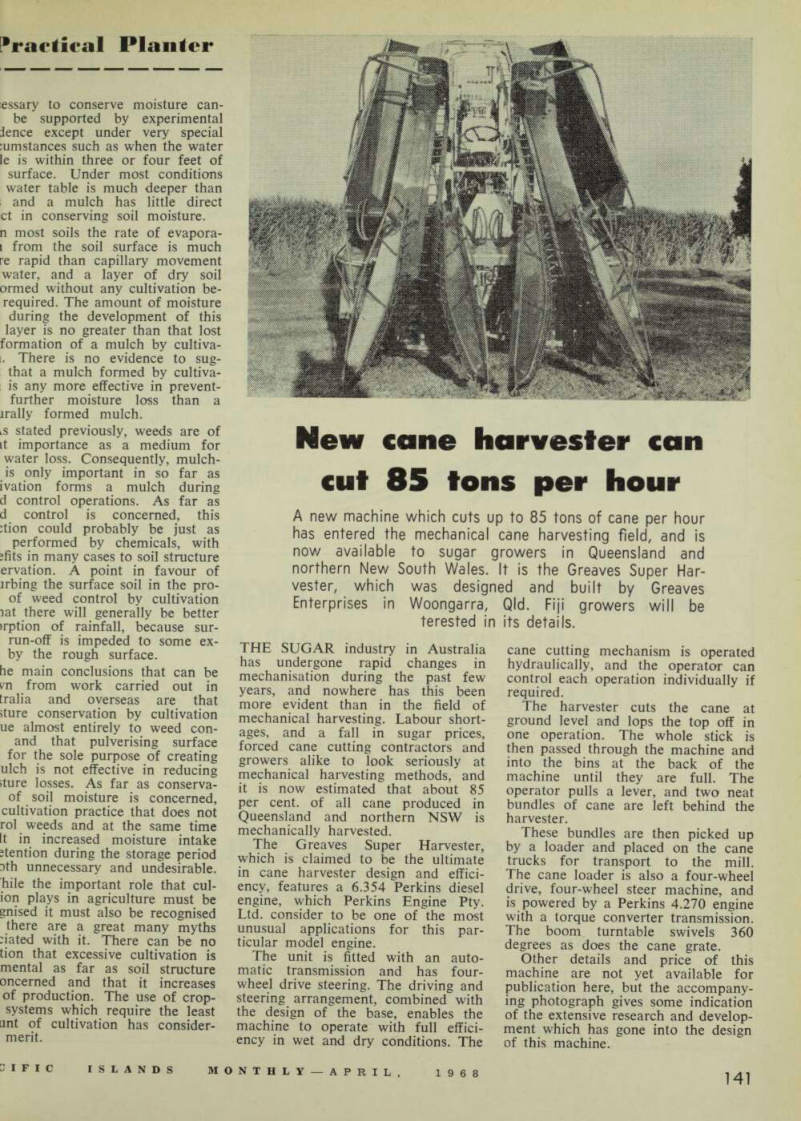 147
147 148
148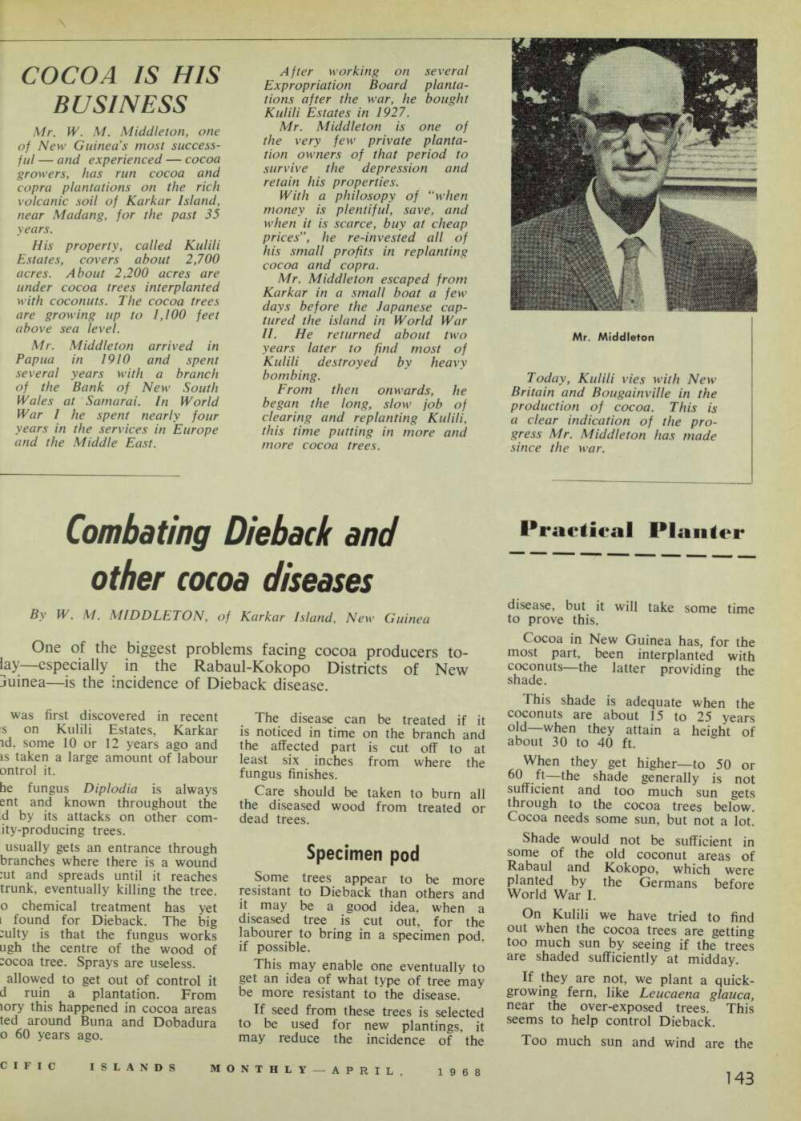 149
149 150
150 151
151 152
152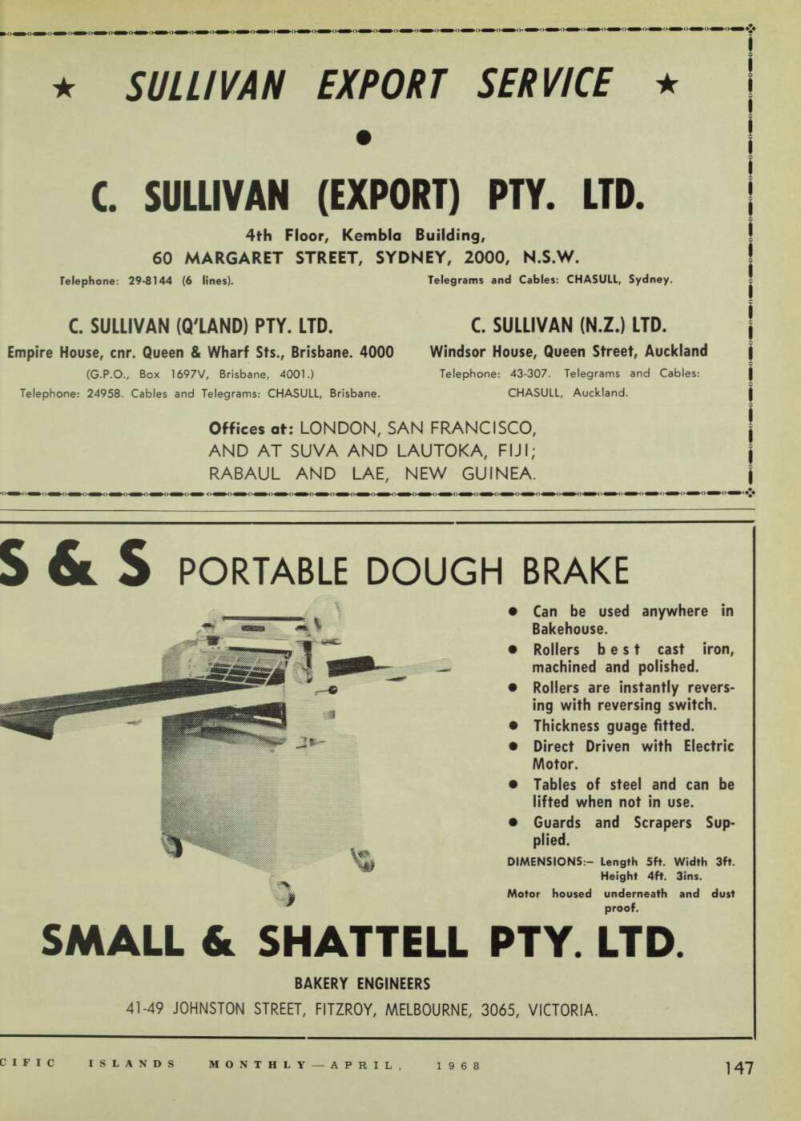 153
153 154
154 155
155 156
156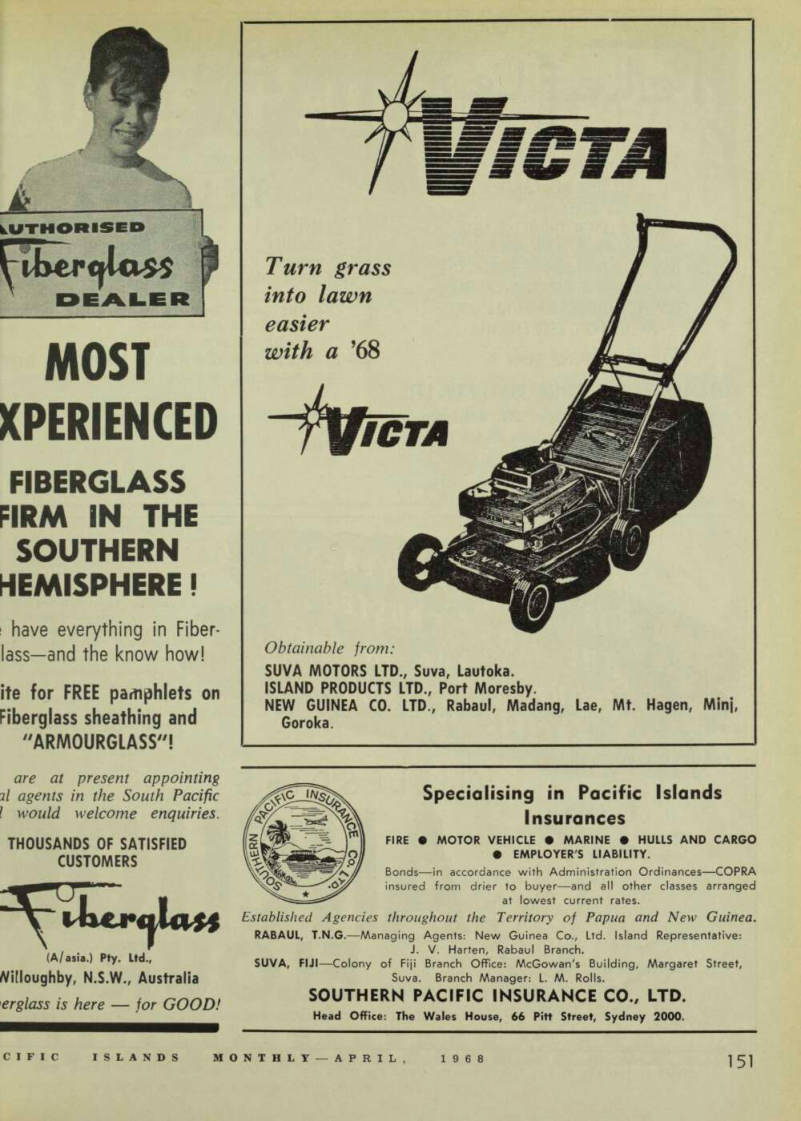 157
157 158
158 159
159 160
160