Book Reviews
pp. 93-95 · Read in the full issue
How Islands sandalwood trade grew from a passion for tea
If Englishmen and Englishwomen had not taken to sipping tea in large quantities instead of quaffing ale round about the time that Captain Cook was discovering the Pacific Islands, the chances are that the British Government might not now be involved in the New Hebrides.
The English predilection for tea, which, 200 years ago, was obtainable virtually only from China, made it necessary for English merchants to find some commodity that the Chinese were prepared to accept in exchange for their tea.
Eventually the merchants solved their problem by selling the Chinese raw cotton and opium which they obtained from India.
However, in the newly-established penal settlement of Sydney, where the thirst for tea was even stronger than it was in England, the merchants were not in a position to obtain cotton and opium; and it was not until sandalwood was discovered in the neighbouring Pacific Islands that they found a commodity that the Chinese wanted.
New Hebrides find
Sandalwood, which the Chinese of those days burnt in their temples, was first discovered in Fiji in the early years of the 19th century. There was later a sandalwood boom in Hawaii; and a few cargoes of the wood were obtained from the Marquesas Islands.
But the islands which proved to be the most valuable source of sandal wood were the islands of the South- West Pacific—the New Hebrides, Isle of Pines, the New Caledonian main land, and the Loyalties.
The discovery of sandalwood in this area came at a time when it had virtually been cut out in all the other islands.
The man who discovered it was one of the best-known Islands trading skippers of the early 19th century, Captain Peter Dillon, who is re nowned for his discovery of the fate of the French explorer La Perouse.
Dillon, who was a veteran of the sandalwood trade in Fiji, was actively
seeking sandalwood at the New Hebrides island of Tanna when he learned that the wood was to be found on the neighbouring island of Erromanga.
Sailing immediately for Erromanga, he anchored in the bay on the island’s western side which is now called after him. However, he could make no headway in trading with the natives, and soon abandoned his hopes of obtaining a cargo of sandalwood there.
Dillon made no subsequent attempt to exploit his find. But before long the details of it became known to others, and a headlong rush began to cash in on it.
Dr. Dorothy Shineberg, of the Aus tralian National University, who has just published a valuable study of the sandalwood trade in the South-West Pacific, believes that Captain Thomas Ebrill, of Tahiti, was probably the first of the New Hebrides sandal wooders in 1826 and 1827.
Rush to Erromanga
However, the first sandalwood voyage to the New Hebrides of which details are known was that organised by Captain Samuel Henry, of Tahiti, who chartered the ship Sophia in 1829.
Henry’s expedition began with the landing of a small gang of Tongans near the shores of Dillon’s Bay. The Sophia was then sent to Tonga to get more labour, and returned in late July, 1829, with 95 more men.
Although the Tongans could not make friends with, nor obtain the co-operation of, the Erromangans, they managed to cut to four tons of sandalwood a day.
They had apparently obtained quite a stock of the wood when the Sophia, for some reason, sailed for Honolulu.
There, news of the Erromanga
sandalwood stands soon leaked out; and within a few weeks two Hawaiian ships and one British were racing the Sophia back to New Hebrides to join in the new “gold rush”.
The three new ships brought about 600 extra labourers—Hawaiians and Rotumans —to the island.
The notion of the Hawaians, it seems, was to colonise Erromanga and exterminate the Erromangans.
Not surprisingly, hostilities broke out between the Erromangans and the Hawaiians, and this, combined with a sickness, which killed off many of the labourers, resulted in no one getting any sandalwood to speak of.
Secret voyage
For about 11 years after this fiasco, there was apparently no new attempt to exploit the sandalwood in the area. Then an event occurred which resulted in a second rush.
On April 28, 1841, the brig Camden, of the London Missionary Society, arrived in Sydney, where one of the crew, Edward Foxall, told a group of merchants about some sandalwood he had seen at the Isle of Pines.
Three and a half months later, the merchants dispatched two ships to that island with Foxall as pilot, to gather a cargo of the precious wood.
Although they tried to keep the Isle of Pines discovery a secret, the news soon leaked out, and during the next 12 months at least 25 voyages in quest of sandalwood are known to have been made from Australia to New Caledonia. There was also renewed interest in Tahiti in the southern islands of the New Hebrides. And for the next 25 years, the sandalwood stands of the two groups were continuously exploited.
In the early days, the sandal
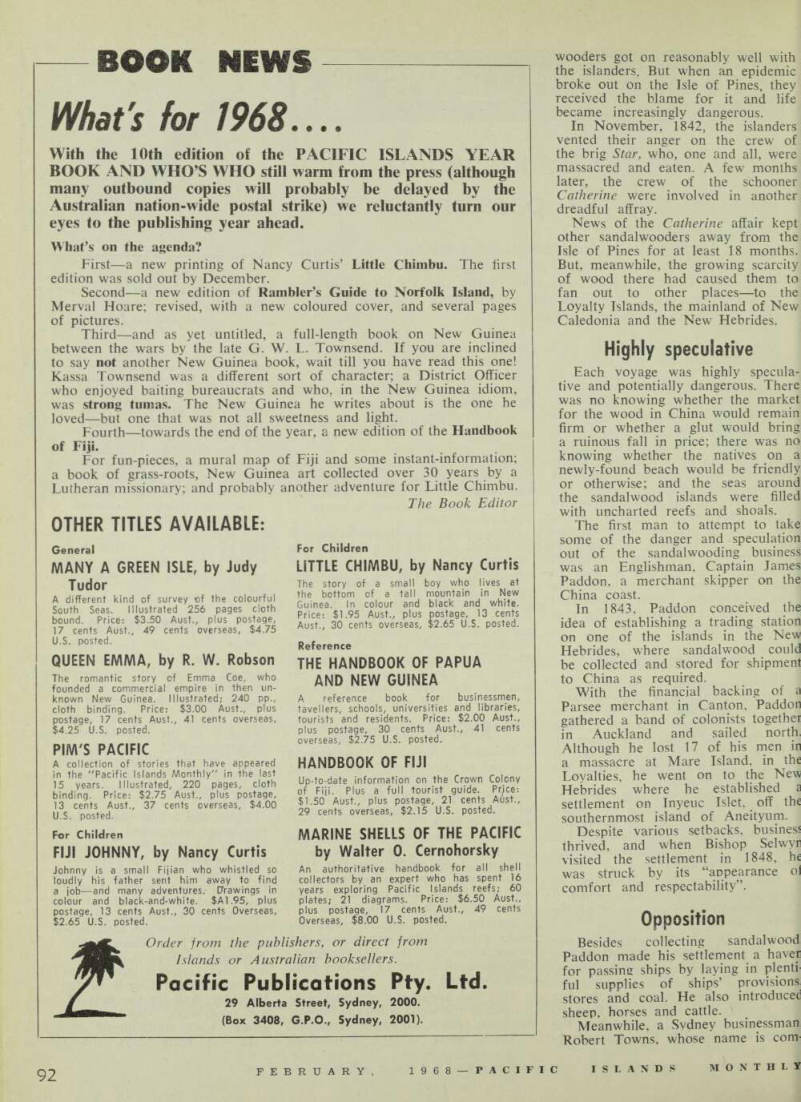
Among the rich sources of sandalwood in the middle of last century were the New Caledonian mainland, the Isle of Pines and the Loyalties.
wooders got on reasonably well with the islanders. But when an epidemic broke out on the Isle of Pines, they received the blame for it and life became increasingly dangerous.
In November, 1842, the islanders vented their anger on the crew of the brig Star, who, one and all, were massacred and eaten. A few months later, the crew of the schooner Catherine were involved in another dreadful affray.
News of the Catherine affair kept other sandalwooders away from the Isle of Pines for at least 18 months.
But, meanwhile, the growing scarcity of wood there had caused them to fan out to other places—to the Loyalty Islands, the mainland of New Caledonia and the New Hebrides.
Highly speculative
Each voyage was highly specula tive and potentially dangerous. There was no knowing whether the market for the wood in China would remain firm or whether a glut would bring a ruinous fall in price; there was no knowing whether the natives on a newly-found beach would be friendly or otherwise; and the seas around the sandalwood islands were filled with uncharted reefs and shoals.
The first man to attempt to take some of the danger and speculation out of the sandalwooding business was an Englishman, Captain James Paddon, a merchant skipper on the China coast.
In 1843, Paddon conceived the idea of establishing a trading station on one of the islands in the New Hebrides, where sandalwood could be collected and stored for shipment to China as required.
With the financial backing of a Parsee merchant in Canton. Paddon gathered a band of colonists together in Auckland and sailed north.
Although he lost 17 of his men in a massacre at Mare Island, in the Loyalties, he went on to the New Hebrides where he established a settlement on Inyeuc Islet, off the southernmost island of Aneityum.
Despite various setbacks, business thrived, and when Bishop Selwyr visited the settlement in 1848, he was struck by its “appearance ol comfort and respectability”.
Opposition
Besides collecting sandalwood, Paddon made his settlement a haver for passing ships by laying in plenti ful supplies of ships’ provisions, stores and coal. He also introduced sheep, horses and cattle.
Meanwhile, a Sydney businessman, Robert Towns, whose name is com-
memorated in the North Queensland city of Townsville, had moved into the sandalwood business in opposi tion to Paddon.
Paddon never forgave Towns for this, and worked in bitter rivalry with him until 1856, when he was forced to come to an agreement with him.
Over the years, Paddon established trading stations on Tanna, Erro mange, the Isle of Pines and He Non (in Noumea harbour). He extended his business to take in coconut oil, beche-de-mer and tortoiseshell; he pioneered the introduction of cattle to New Caledonia; and was respon sible for bringing the first large batch 3f European migrants to that ter ritory.
Towns, for his part, also set up jading stations at various islands; md extended his business in the same way as Paddon. But he had in advantage over Paddon in having lumerous profitable projects in Aus ralia, and was by far the more successful businessman.
By the early 1850’s, the two men vere finding sandalwood increasingly
difficult to get—some islands having been so denuded that hardly a stick was to be found for a botanical col lection.
The sandalwood trade was almost on its last legs when Paddon found some good stands on the island of Espiritu Santo in 1853. This kept the trade going until after his death in 1861; and after Towns withdrew from it in 1864 because of his pre occupation with other matters.
However, the golden days of sandalwooding were well and truly past by then—and no new dis
coveries have since been made to revive it again.
As Dorothy Shineberg observes in her book, the sandalwood trade with the islands of the South-West Pacific “was simply an episode, now forgot ten” in Australia’s extensive colonial trade with China. But it was an important episode in its way.
It enabled such people as Robert Towns to accumulate sufficient capital to begin building commercial empires in Australia, It brought the Islanders in many places into contact with Europeans for the first time and gave them access to such items of European material culture as iron, which had far-reaching effects on traditional ways.
In addition, the trade became a lever by which the missionaries sought to involve the British Government in the New Hebrides because of stories of various malpractices as sociated with it.
Today, a century after the golden days of sandalwooding came to an end in the New Hebrides, Australians are still drinking tea in a big way, although most of it now comes from Ceylon, India, and Indonesia, rather than China.
Next time you have a cup of tea, perhaps you will spare a thought for the old sandalwooders who helped our ancestors to establish the tea drinking habit.
You might spare a thought also for the British Government, which, partly because of sandalwood, is still stuck in the New Hebrides long after it has been able to give most of its other former colonies and pro
tectorates away.
RL.
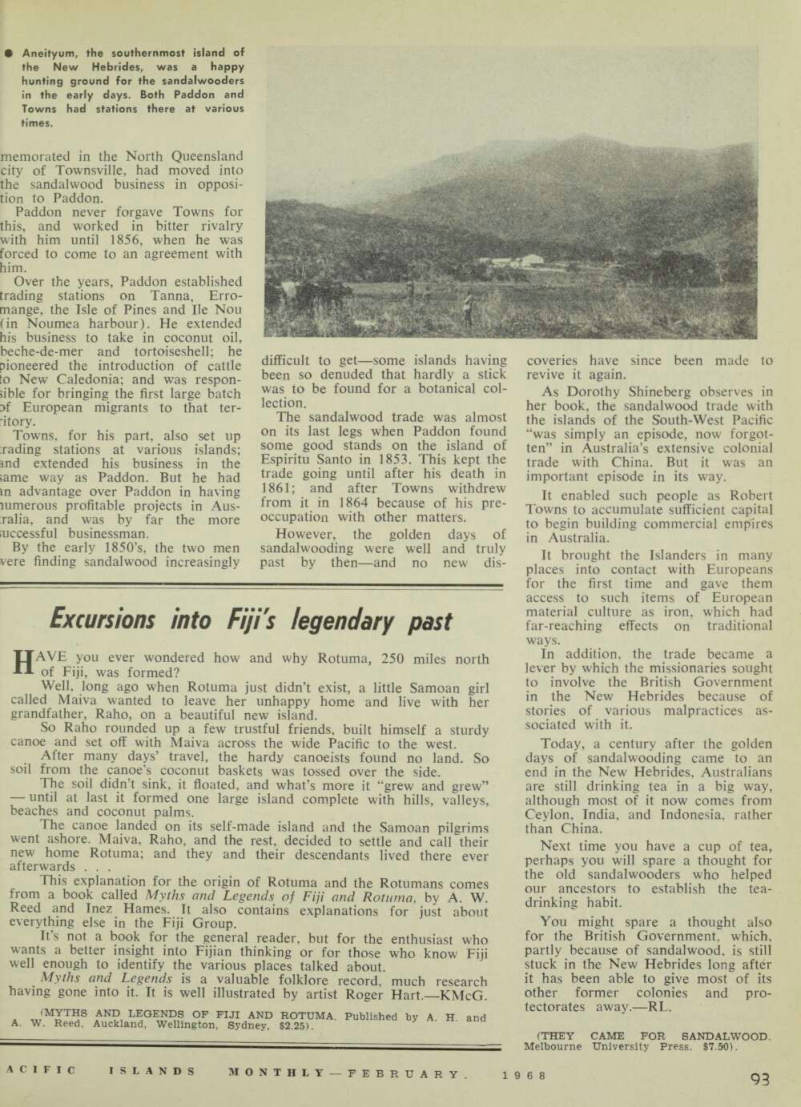
• Aneityum, the southernmost island of the New Hebrides, was a happy hunting ground for the sandalwooders in the early days. Both Paddon and Towns had stations there at various times.