yesterday
p. 91 · Read in the full issue
Which would be Fiji’s international airport—Nadi or Nausori?—was one of the burning questions in the Pacific when PIM was published 20 years ago. Nadi, built by the Americans during World War 11, was the favoured strip be cause it was already used by trans-Pacific aircraft flying be tween Sydney and the US. However, Nausori, in Viti Levu’s wet zone, was far nearer Fiji’s capital, Suva. Nadi, of course, got the nod in the end.
OTHER items in PIM for February, 1948, included: THE new Governor of Fiji and High Commissioner for the Western Pacific, Sir Leslie Brian Freeston, his wife and young daughter, arrived in Suva on January 20. Shortly afterwards Sir Leslie went on a brief visit to Honiara, BSIP.
THE recently-started Noumea- Papeete air service with a Catalina aircraft was expected to become monthly rather than fornightly when the firm running the service, Societe Francaise de Transports Aeriens du Pacifique, bought additional aircraft. The service was via Nadi and Aitutaki.
V’EW GUINEA’S Bulolo Gold Dredging Ltd. recovered 7,057 ounces of gold, worth over $70,000, in January, 1948.
DUE to big rises in cocoa and copra prices, Western Samoa was booming. Trade figures for 1947 doubled those for the pre vious year and Samoans and Europeans competed to buy new cars, American refrigerators, radios and bicycles, PlM’s Apia correspondent reported.
EXHAUSTION of New Cale donian overseas funds had caused a run on Noumea stores.
People had besieged the counters offering to buy almost anything available, at almost any price, PlM’s correspondent said. Popular buys included dress materials, shoes and petrol. ‘TpHE hours of work are nine A hours daily, six days a week, for everyone. Boys marry at 18, girls at 16. The State presents young couples with a house and furniture on marriage . . . Every one may cease work, if this is wished, at 65, and draw half-pay for the rest of their lives.”
Such was a description of life in the Cocos Islands of the Indian Ocean.
THERE were heart-rending sights for thirsty territorians in Port Moresby’s Customs sheds.
Cases of beer lay smashed on the floor with broken glass and dark stains on the concrete—all pointing to the wastage of “gallons of the precious fluid”.
THE motor vessel Bulolo, taken over by the British Admiralty from Burns Philp and Co. Ltd.
at the outbreak of World War 11, was expected to be back in BP’s service from Australia to New Guinea by the end of 1948.
Meanwhile, the BP ship Montoro was doing most of the work on this run.
Abnormally heavy rain lasting about a fortnight in early January, 1948, flooded many rivers on Guadalcanal, BSIP. The Lunga River overflowed and washed away a big three-year-old American-built bridge and buried Henderson airfield under a foot of water a mile wide.
NEARLY 6,000 American war dead, all in bronze-handled, stainless-steel caskets, lined with linen and satin, were at Kukum, near Honiara, BSIP, awaiting shipment to American cemeteries at Hawaii and in the US.
THE battle-scarred town of Lae had a new cinema—the result of seven months of work by ter ritorians using mainly salvaged war material.
MR. H. F. AYSON, formerly Resident Commissioner and Chief Judge in the Cook Islands, had died in New Zealand, aged 63.
He had been associated with the Cooks for 27 years.
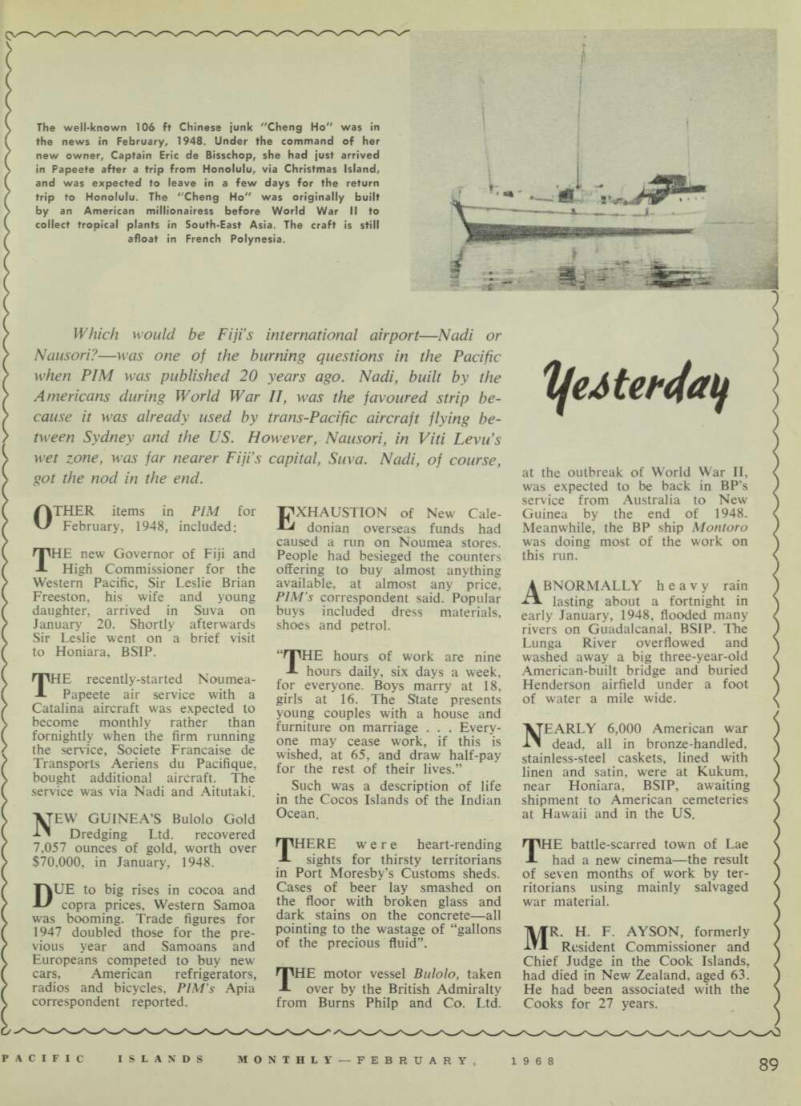
The well-known 106 ft Chinese junk "Cheng Ho" was in the news in February, 1948. Under the command of her new owner, Captain Eric de Bisschop, she had just arrived in Papeete after a trip from Honolulu, via Christmas Island, and was expected to leave in a few days for the return trip to Honolulu. The "Cheng Ho" was originally built by an American millionairess before World War II to collect tropical plants in South-East Asia. The craft is still afloat in French Polynesia.