"Workhorse"
p. 96 · Read in the full issue
Tribute To The
Of Aviation
Of the thousands of types of aircraft that have been built since man first learned to fly, one type has earned a special place in history and in the hearts of the many pilots familiar with it.
This plane is the DC3, which has earned a reputation for safety and dependability and doing almost the impossible.
It was the DC3 and other Douglas Commercial aircraft that lifted the publics faith in air travel after a series of disastrous and highly publicised crashes in the early 19305.
The first DC3 was put into service in 1936 and soon became the most popular aircraft in the US.
Since then over 10,000 have been built and of these about 5,000 are still in service around the world, including the Pacific Islands. Not surprisingly, the DC3 is often referred to as “the plane that will not wear out”.
Even in the jet age, manufacturers and airline operators are still look ing for a replacement for this “old workhorse 5 ’ and there is every pos sibility that they will still be looking when the Concorde is being pensioned off.
Among the many admirers of the DC3 are two American authors, Carroll V. Glines and Wendell F.
Moseley, who have now written a tribute to the aircraft in The DC3, the Story of the Dakota (Hutchinson, $6.15). '
Contained in their book are numerous stories and pictures of DC3s that have continued flying after losing large chunks of wingtip; survived mid-air collisions or have landed safely after bomb explosions in their baggage compartments, etc.
The authors deal extensively with the wartime version of the DC3, the C 47, and with its service all over the world.
Its reliability on long ocean hops was one of the Allies’ great assets in the Pacific War.
After a couple of hours with the Glines-Moseley opus, it is certainly hard to imagine how we could ever have managed without the old faithful DC3.—WT.
Undoubtedly, the pilot is the glamour-boy of aviation. He always has been and always will be.
But there are men who share equal responsibility and who rarely, if ever, get any of the glory.
How many air travellers give a thought to the highly-skilled men who sit in the airport control towers and are responsible not for one but every aircraft coming in, going out or passing through their area of con trol?
Australia has an air safety record unrivalled anywhere in the world today, and Angus and Robertson has recently-published a small and well illustrated book, Take-off to Touch down, the Story of Air Traffic Control, by D. E. Chari wood, ($2,50), which gives an insight into the “back room” of everyday air travel.
In his book Mr. Charlwood, a senior officer in the Air Traffic Control Organisation in Australia, traces the history of the country’s air control from the days when Kingsford-Smith. Ulm. Taylor and the other pioneers flew “by the seat
of their pants” at just on 100 mp to the present near-sonic jet trav( that allows very little margin fc error on anybody’s part, pilot c controller.
This most revealing and interestin little book is well worth the attentio of every aviation-minded reader; may even prove of interest t younger people considering what 1 do when they leave school.—WT.
AN unusual paperback from Ho witz Inc., Sydney, is Flyin Saucers Where Do They Com From? by Richard Tambling—ur usual in that it emphasises Australia “sightings” (with brief mention c New Guinea).
For those interested in “Ufo’s” th is a good 60 cents worth, container as it does a list of societies, bri. bibliography, hints on spotting Ufc and what to do if you see one.
Although I found this book vei interesting I regret to say that M Tambling has failed to convince n
that flying saucers are real.
—WT.
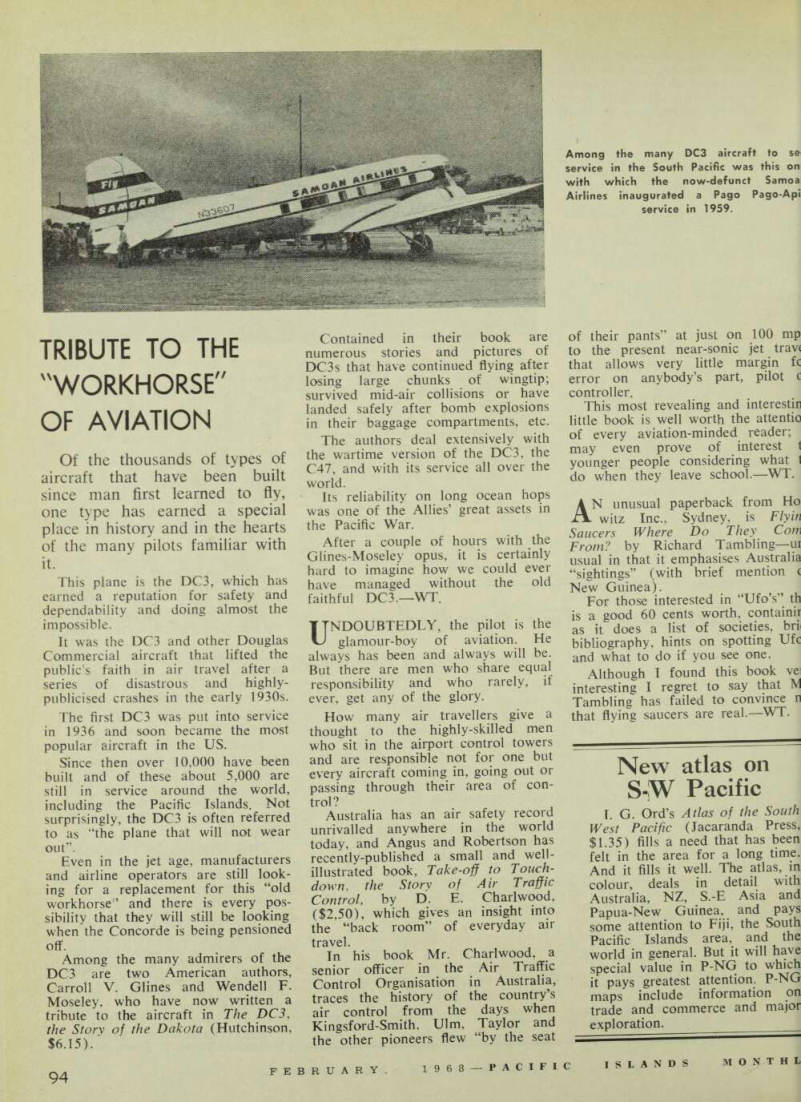
Among the many DC3 aircraft to se[?] service in the South Pacific was this on with which the now-defunct Samoa[?] Airlines inaugurated a Pago Pago-Api[?] service in 1959.