with history, try Moorea!
pp. 43-157 · Read in the full issue

If you like your scenery spiced with history, try Moorea!
By Robert Rangoon
Moorea, Tahiti’s craggily spectacular sister island, exercised a strange spell over many of the early Pacific explorers. Even though it is only 10 miles or so from Tahiti, the explorers were seldom curious enough to go and see what it was like.
Captain Cook, for example, who called at Tahiti four times in the course of his three famous Pacific voyages, and who liked to go every where, see everything, did not manage to get over to Moorea until his last visit in 1777.
Captain Bligh, who spent five months in Tahiti in the Bounty gathering breadfruit for the West Indies, never spent a single day in Moorea on that voyage. Nor did he pay it a visit when he returned to Tahiti in 1792 in the Providence.
Until quite recent years, most of Tahiti’s tourists were also content to observe Moorea at a distance—to admire it as part of Tahiti’s sunset —and leave it at that.
Nowadays, however, Moorea is on the tourist beat, and there are probably few days in the year when the streamlined inter-island ferry
Keke does not take over at least a couple of dozen visitors.
Yet Moorea is still virtually an unknown island. Most visitors, having booked into the Hotel Bali Hai at Maha repa or the Hotel Aimeo on fantastically beautiful Paopao Bay, are generally content to swim, stroll, sunbake or loaf in their immediate vicinity without giving a thought to what might lie behind the magnificent scenery that surrounds them on every side.
Historical associations
Certainly tourists are not encouraged to venture very far afield, for there are no organised tours which go much beyond the two deep fiord like bays on the northern side of the island; the hotel people are apt to say that there is nothing much more to see, anyway; and there are few vehicles available for hire to go anywhere on your own.
But it is possible, if you are persistent enough, to find some one who will hire you a jeep;
and you can then make what must surely be one of the most delightful island tours in the South Seas.
The tour is doubly interesting if you do a little delving into South Seas history and literature before hand, because Moorea is an island with many historical and literary as sociations which cannot be ap preciated unless you know something about them.
I made a tour round the island by jeep in mid-November with three friends who had come to Tahiti as I did on the inaugural flight of Air New Zealand, which now operates a weekly service to Papeete from Auck land and Los Angeles.
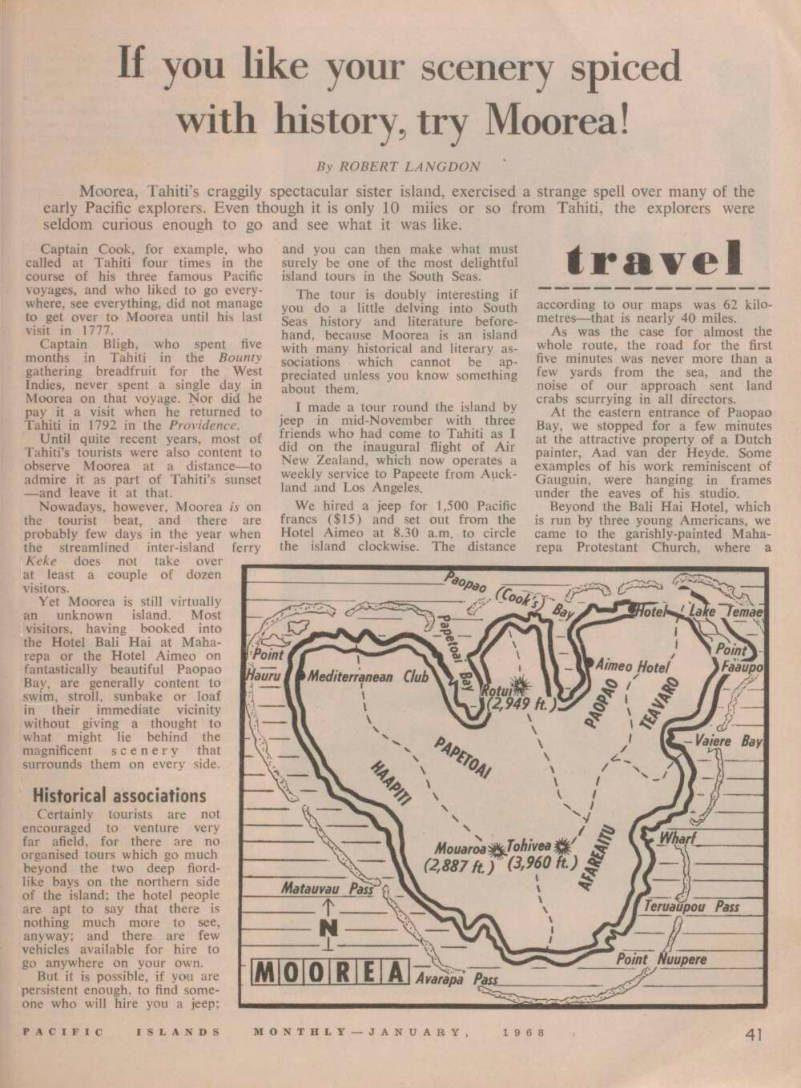
We hired a jeep for 1,500 Pacific francs ($l5) and set out from the Hotel Aimeo at 8.30 a.m. to circle the island clockwise. The distance
travel
according to our maps was 62 kilo metres —that is nearly 40 miles.
As was the case for almost the whole route, the road for the first five minutes was never more than a few yards from the sea, and the noise of our approach sent land crabs scurrying in all directors.
At the eastern entrance of Paopao Bay, we stopped for a few minutes at the attractive property of a Dutch painter, Aad van der Heyde. Some examples of his work reminiscent of Gauguin, were hanging in frames under the eaves of his studio.
Beyond the Bali Hai Hotel, which is run by three young Americans, we came to the garishly-painted Maha repa Protestant Church, where a
goat was sitting nonchalantly on the fence.
Like most other churches on Moorea, an island notable for its churches, this one had a strongly scriptural name, Jehova Nisi. A little further along was another, Kana Galilea.
The Kana Galilea is near the top end of Lake Temae, a sheet of water which gives the north-east corner of Moorea an atoll-like aspect.
The road skirts the lake on its landward side, and after several hundred yards brings you to Temae Village.
Temae has the distinction of being one of the few villages in Polynesia which is not built on the sea. It is also notable for its dancers, whose graceful charm had enlivened our evening at the Hotel Aimeo the night before.
Contemplating the bare-bottomed children who wandered about, and the neatly-tended graves at the end of each garden, I remembered that the American novelist Herman Melville had written about Temae (or, as he called it, Tamai) in his semi-factual novel, Omoo.
Heathenish games
He said that although the people of Temae were nominally Christians, their religion “sat lightly upon them” because they were “so remote from ecclesiastical jurisdiction”. For that reason, many heathenish games and dances still secretly lingered in their valley.
The Temae people may still be, for all I know, as remote from eccle siastical jurisdiction as they were in Melville’s day. However, they are now much nearer to the hurry of civilisation than anyone else on Moorea, for it is on the other side of Lake Temae that Moorea’s 800metre airstrip has been built.
The airstrip was opened in October.
At present, it is only capable of accommodating planes of the aero club variety. But plans are in hand to enlarge and improve it by 1970 so that bigger planes will be able to use it.
The airstrip arrangements are still engagingly primitive—no phones, no
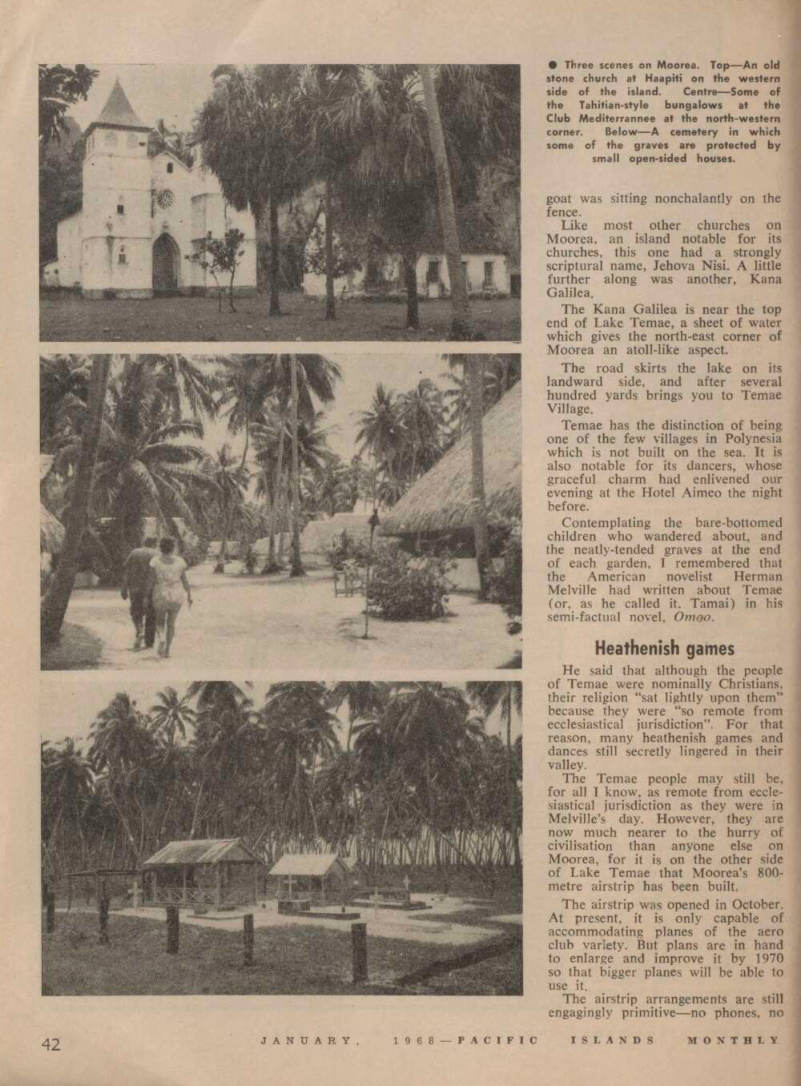
• Three scenes on Moorea. Top—An old stone church at Haapiti on the western side of the island. Centre—Some of the Tahitian-style bungalows at the Club Mediterrannee at the north-western corner. Below—A cemetery in which some of the graves are protected by small open-sided houses.
shelter sheds, no refreshment kiosks, no waiting taxi cabs. So whenever a plane makes the eight-minute trip over from Tahiti, it must fly low over the relevant hotel or hotels before landing to warn it/them that there are customers aboard who will need transport from the airstrip.
A few minutes drive south of the airstrip, we came to the low-lying, rather forlorn looking village of Teavaro; then a few minutes more brought us to one of the most attractive spots in Moorea—Vaiere Bay, a placid expanse of silver water, surrounded by rather more flat land than usual and brilliantly green vegetation.
First Englishman
We reached Vaiere village, at the head of the bay, in pouring rain, and were glad to take refuge in a Chinese store, stocked with the usual as sortment of shirts, towels, bicycle tyres and tinned goods.
At the door, a trio of Polynesian women were gossiping with a blue eyed, sandy-haired man of sixty or so, dressed in sandals, dungarees and a battered straw hat.
The man, hearing us speak English and gathering that we were Anglaises, introduced himself to us in French as the grandson of George Bryan, the first Englishman to settle in the Vaiere district. His own name, he said, was John Suhas, but despite the John part, he could not speak a word of English.
Mr. Suhas told us that the British flag was still represented in the Vaiere district, as a New Zealander, Ross Curtis, had a copra plantation further round the bay.
Mr. Curtis, I thought, was a man of fine taste as far as his surround ings were concerned; and I imagined he would have got along famously with James Morrison, the Bounty’s boatswain’s mate, who was the first European to visit Vaiere and describe it.
After the Bounty mutiny, in which Morrison did not take part, he and several shipmates who had stayed in the Bounty, built a 33 ft schooner in Tahiti in which to sail to the East Indies. On November 12, 1790, they sailed it over to Vaiere on a shake down cruise.
Morrison observed that Vaiere was “a snugg little harbour where a ship could lie in seven fathoms of water
within half a cable’s length of the shore.
“Though the harbour’s mouth lies open to the sea breeze,” he went on, “the swell never reaches the shore ... and as the land breeze which blows every night affords an opportunity to get out every 24 hours, I should prefer the harbour to any that Taheite affords for a single ship, as all kind of provisions are found there common to both islands, and equally plentyful..
Sandalwood island
What Morrison said in 1790 still appears to hold good today. But yachtsmen and others seem never to have heard of Vaiere’s attractive qualities, and so the bay still has the same pristine air about it that it must have had in Morrison’s day.
From Vaiere to the next village, Afareaitu, we drove in drizzling rain past bushes of huge yellow and pink hibiscus, ferns and palm trees.
Within a few minutes, we came in sight of attractive Motu Ahi (Sandalwood Islet), which stands near the entrance to Afareaitu’s lagoon.
The boys at the two-storey Ecole de Afareaitu were playing soccer in the roadway as we drove up to a delightful old-world hostelry that stands next door to it in the centre of the village.
Known as Chez Pauline (Pauline’s Place), the hotel is run by the sister of John Teariki, chief of Afareaitu and one of French Polynesia’s most outstanding politicians.
Chez Pauline consists of two iron roofed buildings which seem to owe their architectural style to the English missionaries who worked in the district for several years in the first quarter of the 19th century.
"Art gallery"
Standing near the door of what we concluded was the parlour of the hotel—such an old-fashioned hotel could never have a bar!—we found a couple of dozen small stone tikis which had apparently been gathered in the district.
Inside, the room was decorated with a variety of shell knick-knacks, a huge tortoise shell, and a number of water colour apd pencil sketches.
Over glasses of deliciously cold Manuia, the hiere de Tahiti, we examined Pauline’s art exhibits, and found them to include samples of the work of at least two former resident artists of Moorea.
One was the celebrated American artist Edgar Leeteg. who was killed
in a road accident on Tahiti some 10 years ago and whose work now fetches fabulous prices. The other was W. Alister Macdonald, a Scottish artist, who died on Moorea in 1956 at the age of 95.
Macdonald’s pictures included a portrait, done in 1925, of le roi de Rurutu (the last king of Rurutu), whose grandson, now married to an American girl, I had chanced to meet in Tahiti a couple of days before.
Afareaitu, which means “house of the gods,” is a village of flowers com manding a full view of Tahiti. It is hemmed in on its landward side by a semi-circle of lofty, almost per pendicular mountains. Two of them —Mt. Mouapata (2,592 ft) and Mt.
Tohivea (3,975 ft) —are the highest on the island. Mt. Mouapata is remarkable in having a hole through its summit, just below the top.
Legend has it that a giant Tahitian once hurled a spear from the Punaauia district of Tahiti, which passed through the mountain top and sailed on to Huahine, cleaving that island in two.
I was sorry we could not afford to spend more time in Afareaitu than the half hour we did, as the village, historically, is one of the most interesting in the South Seas.
First book printed
It was there that the LMS mis sionaries opened their celebrated school, the South Seas Academy, in the early 1820’s. And it was there also that the first books ever printed in the South Seas were produced.
The first sheet of the first book— a 32-page spelling book—was pulled by King Pomare II of Tahiti on June 30, 1817. No copies of that book are now known to exist, but the exact spot where the book was printed can probably still be found because stones from a neighbouring marae were used to provide flagstones for its floor.
South from Afareaitu is the dis trict of Maatea, whose only claim to fame as far as I know is that it was there that Herman Melville and his friend Dr. Long Ghost first landed when they arrived in Moorea in 1842. Melville, who called the place Martair, thought it would be a pleasant place to spend the month of August, if “the mosquitoes could be induced to emigrate”.
In Melville’s day, there was an American called Zeke and a Cockney called Shorty living in Maatea and growing potatoes for the Papeete market; and Melville and Long Ghost spent some time with them
hunting and rambling in the mountains.
I doubt whether there are any market-gardening Zekes and Shortys in Maatea today. At least, we noticed none, and found nothing to tempt us to linger in the district until we reached the south-western corner of the island, where the road begins to trend northwards again.
"Back entrance" view
There, overlooking the bay of Athia is a fine “back entrance” view of Mt. Mouaroa and the other extravagantly-shaped basalt mountains that dominate Paopao and Papetoai Bays on the island’s other side.
A small village of thatched, bamboo huts stands on the bay shore, with brightly painted paopaos drawn up on the beach and fishing nets hanging from the trees.
The scene could easily be straight out of an 18th century engraving.
Yet Tahiti’s international airport, with its thundering jets, is less than a dozen miles away.
Beyond Athia Bay, there is another bay, Vaianahe, where a few more, but much less prepossessing thatched huts stand. Then there is little sign of human life until the village of Haapiti is reached a mile or two further on.
For part of the way between Vaianahe and Haapiti, there is little room for the road between the mountains and the sea; and the road frequently degenerates into a red, muddy ooze.
The village of Haapiti, midway up the western side of Moorea, is a prosperous looking place in a broad open valley, with lofty basalt peaks behind it.
Holiday resort
Although it is one of the largest villages on the island, it never figured in the early history of Moorea as did the others of its size, and never had a resident LMS missionary.
Haapiti has a fine school, many attractive children, and at least four churches. The oldest, a Catholic one, is pictured on p. 42. The other three are called Nazareta, Jerusalema and Galilea.
Beyond Haapiti, the land seems much drier, there are larger expanses of flat land, and more coconut trees.
At the north-west corner of the island is a holiday resort in the form
of a Polynesian village run by the Club Mediterranee of France.
The club was formed in 1950 to provide holidays for its members at moderate cost in various parts of the world. So successful has the idea been that the club now has more than 250,000 members all over the world.
On Moorea, the club has 75 twin bungalows furnished South Seas style, which should, by the look of them, provide “the delightful and easy informality of island living” that their promoters claim they do.
The village stands right on the margin of a truly turquoise blue sea and a fine sandy beach.
Just beyond the Club Mediterranee to the east is a small reef islet called Irioa, which has a small claim to fame in the early history of the Pacific, for it was there that the first Europeans to visit Moorea landed.
Cook's men
These Europeans were members of a boat party sent over from Tahiti by Captain Cook in 1769. Their purpose was to set up an astrono mical observation post to double check Cook’s sightings from Tahiti of the transit of the planet Venus.
The boat party included Joseph Banks, the rich young botanist and future president of the Royal Society, who went over to the mainland from Irioa to see if he could find any plants that did not grow on Tahiti.
He spent a good part of a day wandering about. But he did not go far enough east to discover the deep indentation of Papetoai Bay.
If he had, he may well have altered the course of Pacific history, for when Cook finally discovered the bay in 1777 on his fourth visit to Tahiti, he wrote: “For security and the goodness of its bottom it is not inferior to any harbour I have met with in any of the islands . . . The harbour has a romantic cast which renders it a prospect superior to anything in Tahiti.”
Even so, Papetoai did play a pro minent part in history, for it was there that the Tahitians first accepted Christianity, and it was from there that Christianity spread like wild fire to other parts of the Pacific.
Papetoai became the headquarters of the LMS missionaries in the
Pacific in 1811; and at one time, in 1817, there were no less than 25 missionaries quartered in the village that stands at the western entrance to the bay.
Those old missionaries have left their mark on the architecture of Papetoai to this day, for there is hardly a house that is not built in the tropical style of the Georgian period (see picture p. 40).
Octagonal church
Another relic of the early mis sionaries in Papetoai village is the octagonal church (also pictured on p. 40) that stands on the site of an ancient marae, a few yards from the water’s edge.
The church has the distinction of being the oldest European building still in use in the South Seas. The work of building it began in the year 1822 and it was opened for public worship in 1829.
The church is still in excellent repair—in fact, when I visited it, I found a man with a long ladder fixing one of its 20 tall windows.
The church has several inscriptions of ancient date above its doors, and is lighted within by several quaint, old-fashioned kerosene lamps sus
(Continued on p. 155)
pended on chains from the high, sky blue ceiling.
Leaving the village of Papetoai, we drove along the western side of Papetoai Bay (also called Opunohu Bay), which is dominated on its eastern side by Mt. Rotui, a majestic mountain of cyclopean dimensions, whose black, brooding summit is almost invariably lost in clouds.
At the head of the bay is the extensive valley of Opunohu, which is ringed in by a series of magnificent craggy peaks, which give it the ap pearance of a colossal amphitheatre of the gods.
The Opunohu Valley is the most extensive agricultural property in French Polynesia, and is now owned by the French Government.
It, too, has a place in the annals of the South Seas, for it was there
that the first large scale attempts at agriculture by Europeans were made.
The first of these was as far back as 1818, when John Gyles, of the London Missionary Society, tried un successfully to start a sugar plantation.
The scheme collapsed because the Mooreans feared they would become slaves.
In recent years, the property has belonged to an American, Mr.
Medford Kellum, who sold all but a small part of it to the French Government in 1962.
Mr. Kellum and his wife still live where they have always lived—in a neat, olive-green house on concrete pillars at the head of the bay. It was shipped out from the United States in prefabricated sections in 1925.
They have a number of interesting relics of former days on Moorea.
These include a collection of tikis gathered in the interior, an old whaler’s trypot, and a cannon ball,
which Mr. Kellum believes probably came from one of Cook’s ships.
From the Kellums’ house, there are two ways of returning to the Hotel Aimeo. One is through the ample Opunohu Valley behind mas sive Mt. Rotui. The other is along the coast.
We took the overland road, which, in some places, was as sloshy and oozy as anything we had encountered on the Maatea-Haapiti horror stretch.
However, the poor condition of the road was well compensated for by the magnificent close-ups of the craggy mountains of Moorea’s specta cular interior, which most tourists only see from a distance; and for the occasional whiff of sweet-smelling vanilla that wafted our way from a Chinese plantation.
It was exactly 2.30 p.m. when we regained the Hotel Aimeo, so that our 40-mile trip, which had been punctuated by numerous stops and detours, had taken exactly six hours.